
Our readers keep the lights on and my morning glass full of iced black tea. As an Amazon Associate, I earn from qualifying purchases.
Specs are compiled from manufacturer listings and verified buyer reviews and can change over time — please confirm the key details on the product page before buying.
Acoustic panels absorb echo and cut noise, but the right pick must also protect your walls and match your decor. Shoppers want echo control, a finish that doesn’t look like studio foam, and damage-free installation for rental walls. This guide compares sticky tiles, wood slats, and large panels to find options that absorb sound and look intentional.
I’m Min — the founder and writer behind Gadgets Feed. This guide is built by comparing the manufacturers’ published specifications and the patterns across verified customer reviews, so you get each pick’s real strengths and trade-offs instead of marketing spin.
You want a quieter room for calls or a wall that looks great, and the right acoustic panels for walls deliver both: they absorb echo, mount easily, and come in finishes you’ll enjoy seeing daily.
Our Picks at a Glance

How To Choose The Best Acoustic Panels For Walls
Acoustic panels absorb sound energy so it stops bouncing off your walls, cutting echo and making calls clearer. Before you choose, pick your style: a functional tile grid, a decorative wood slat wall, or a hybrid that does both.
NRC Rating: The Number That Actually Matters
NRC (Noise Reduction Coefficient) tells you what fraction of sound a panel absorbs. A rating of 0.95 means it absorbs 95% of the sound that hits it — about as good as consumer panels get. Cheaper foam might look thick but can score far lower, so always check the NRC before you trust a “heavy duty” label.
Adhesive vs. Drilling: Know Your Wall
Self-adhesive tiles are the landlord’s dream: peel, stick, and remove when you move. But adhesive strength varies wildly between brands. If you have textured walls or brick, you’ll likely need screws, command strips, or extra tape regardless of what the package promises. Smooth drywall is the safest bet for peel-and-stick options.
Aesthetic vs. Coverage: The Real Trade-Off
Big wood slat panels look stunning but cover far less area per pack than 12-tile felt sets. If your priority is killing echo in a large room, you need maximum square footage of absorbent material. If your priority is a feature wall that impresses guests, fewer, prettier panels win. Decide which matters more before you buy.
Quick Comparison
| Model | Best For | NRC Rating | Panel Size | Count | Amazon |
|---|---|---|---|---|---|
| VIVELDA Felt Tiles★ Best Overall | Echo control + pinboard | 0.95 | 11.8″ x 11.8″ | 12 | Amazon |
| Bumusty Felt TilesBest Value | Budget-friendly felt grid | 0.95 | 11.8″ x 11.8″ | 12 | Amazon |
| Amantech Hex FoamStyle Pick | Modern geometric look | — | 12″ x 0.4″ x 12″ | 12 | Amazon |
| Dailycooper Y-Line Foam | Dense studio-style foam | — | 12″ x 10″ x 0.4″ | 12 | Amazon |
| 2nd Gen Hex Panels | High-density hex coverage | — | 14″ x 12″ x 0.4″ | 12 | Amazon |
| TONOR Dual-Layer | Thick, large-area absorption | — | 47.2″ x 23.6″ x 0.72″ | 4 | Amazon |
| Soon Global Vortex | Decorative wood-look art | — | 23.62″ x 23.62″ | 6 | Amazon |
| Art3d Wood Slats | Premium wood feature wall | — | 94.5″ x 7.9″ | 6 | Amazon |
| NeatiEase Wood Slats | Elegant long-slat coverage | — | 96″ x 12.6″ | 4 | Amazon |
In-Depth Reviews
1. VIVELDA Felt Bulletin Board Tiles
Our pick — over 4.5★ from 800+ verified ratings; the strongest balance of quality and price.
The slatted felt tiles that look like architecture, not foam, and quiet a room to match.
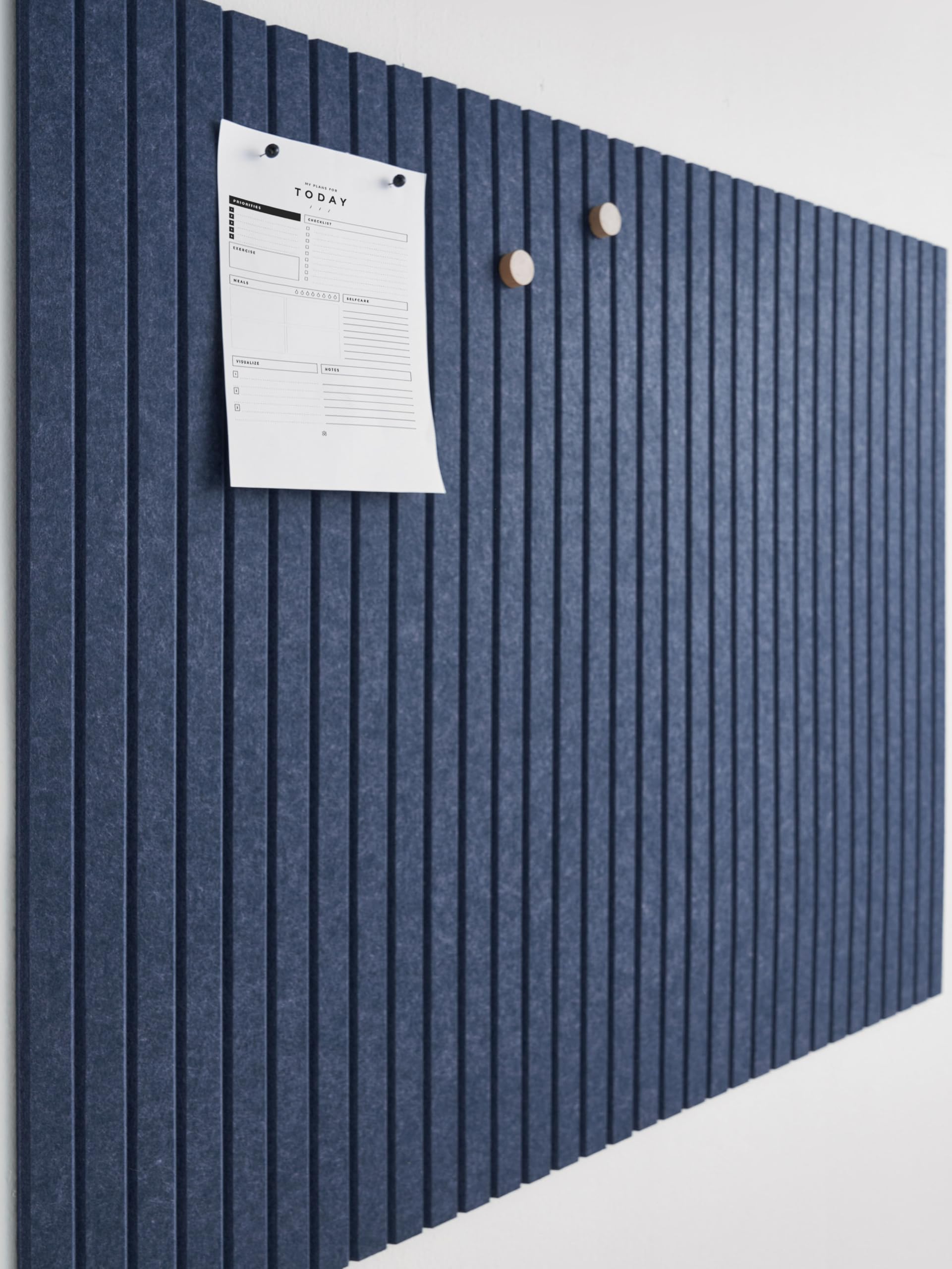
These aren’t flat felt squares. Each VIVELDA tile has precision-cut slat grooves and beveled edges that line up smoothly, so a full 48″x36″ wall of 12 tiles reads as one modern sculpted feature — the kind of thing that photographs like a designer renovation. Owners describe it as a statement piece, and it’s the rare acoustic panel that gets compliments before anyone notices the echo is gone.
The acoustic engineering holds up its end too: an NRC of 0.95 (a noise reduction coefficient, where 1.0 means perfect absorption) at 9mm thick means it absorbs nearly all sound hitting it, so calls get clearer and background chatter drops in home offices and classrooms. The 12 tiles each weigh 150g, and the set works as a pin board, memo board, or vision board — pushpins hold fine, but they leave tiny holes since the felt doesn’t self-heal.
Installation is where it shines for renters. The set includes 60 double-sided adhesive tabs that hold strong on smooth walls, and buyers report the removal trick works — “Removed/repositioned 3 easily, no residue.” The tiles are OEKO-TEX Standard 100 certified (tested free of formaldehyde, phthalates, and lead), so they’re comfortable in nurseries and classrooms. At 2.36 kg for the full set, it’s noticeably heavier than the Bumusty alternative at 1.37 kg, which tracks with the denser feel reviewers praise.
Why owners love it
- Slatted beveled design looks high-end, not like foam
- NRC 0.95 genuinely cuts echo in offices
- 60 adhesive tabs hold firm and remove clean
What to expect
- Pushpins leave visible holes in the felt
- Adhesion gets mixed reviews on textured walls
Reach for these if: you want echo control plus a pin-ready wall that looks intentional, in a nursery, classroom, or home office.
Look elsewhere if: your walls are heavily textured and you can’t use screws — the adhesive is the setup’s weak link.
2. Bumusty Large Felt Bulletin Board Tiles
The featherlight felt set that goes up solo and still delivers rated echo absorption.
At just 1.37 kg for all 12 tiles — a full 72% lighter than the VIVELDA set above — the Bumusty panels are the ones you can hang on your own without breaking a sweat. Each tile is 105g and 0.35″ thick, with an NRC up to 0.95, so the acoustic performance matches the pricier felt competition even though the material feels lighter in hand.
The value story is strong: 12 tiles at 11.8″ x 11.8″ each, plus 30 pushpins included, arranged into a 47.2″ x 35.4″ display board. Owners call it a stylish upgrade over standard cork, using it for kids’ artwork, scarf displays, and jewelry organization. The 60 nano adhesive tabs are the same peel-and-stick approach, and owners mention the hold is genuinely strong — “It sticks to the wall perfectly!” — though some note tiles can fall on certain surfaces, so smooth drywall is the safe bet.
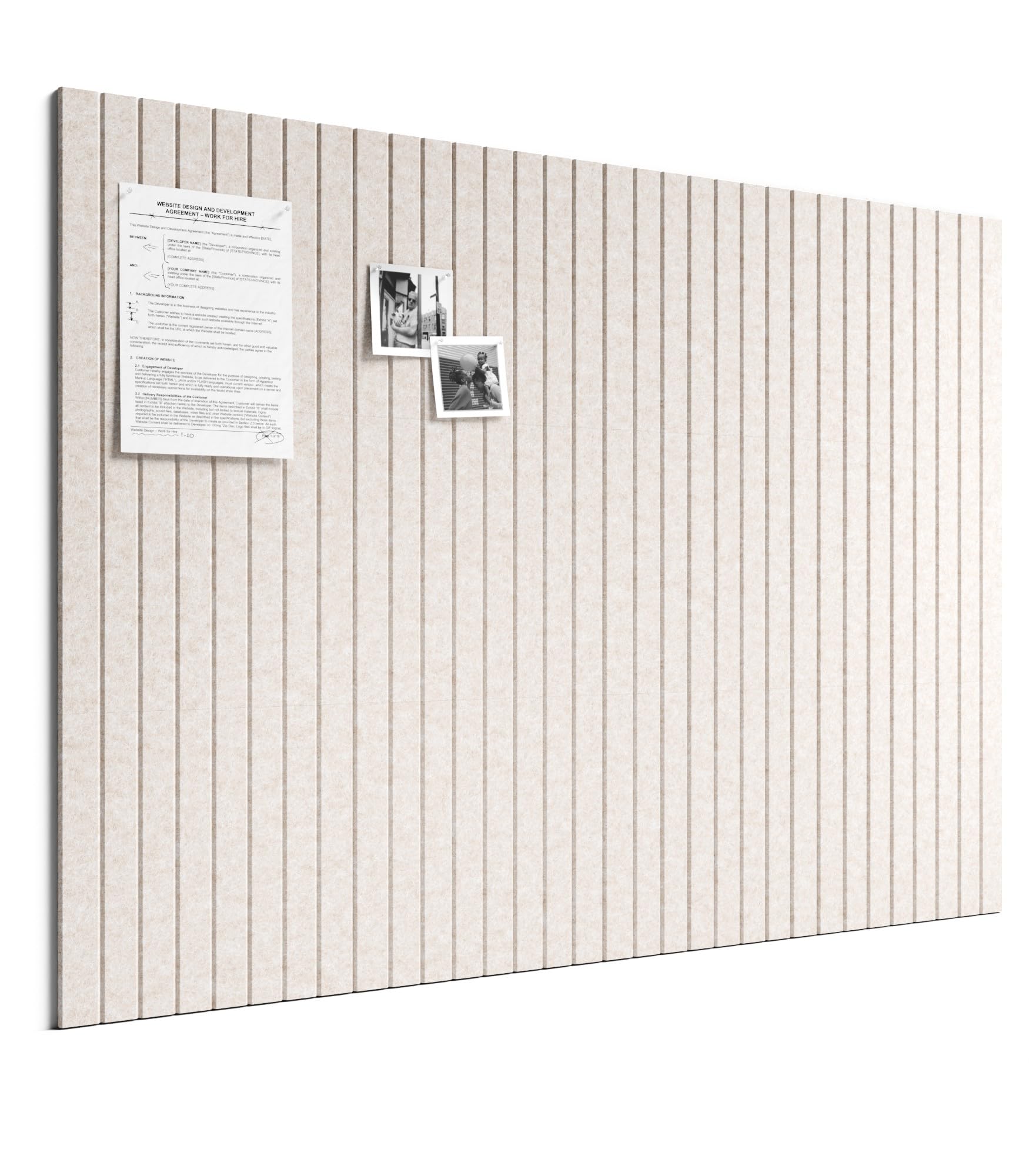
This is the pick for the budget-conscious who still want the rated 0.95 NRC. It’s a hair smaller in overall footprint than the VIVELDA (47.2″ x 35.4″ vs 48″ x 36″, about a 2% gap), and it lacks the slatted statement look — flat felt is simpler. What it saves in weight and cost, it spends on practicality: it’s genuinely easy to arrange into many shapes and looks polished in an oatmeal tone that blends into most rooms.
What wins people over
- Lightweight one-person install at 1.37 kg for 12 tiles
- NRC up to 0.95 matches premium felt
- Pushpins included for instant pinboard use
Watch for
- Flat design lacks the slatted texture of the top pick
- Wall attachment is the most-discussed mixed point
Best suited for: the renter or DIY-er who wants rated echo absorption without the weight or the splurge.
Not for: anyone wanting a sculpted architectural wall — this one is clean and flat, not dimensional.
3. Amantech Hexagonal Acoustic Panels
12 honeycomb-shaped tiles that kill echo and double as a geometric design feature.
The hexagonal honeycomb shape is the hook here — it’s a genuinely fashionable wall treatment, not just a sound fix. Each tile is 12″ x 0.4″ x 12″, made of 100% polyester fiber that’s odorless, non-toxic, and formaldehyde-free. Owners repeatedly mention the shape’s appeal and how well it absorbs echo for remote work with cameras and microphones.
Installation is tear-and-stick: the glue is pre-applied on the back, so you peel the protective layer and press. Panels cut easily with a knife for custom fits around outlets or corners. The honest limitation, echoed across reviews, is that one 12-pack is thin at 0.4″ and won’t deliver studio-grade soundproofing — it’s genuinely good at taming echo and reverb, not at blocking neighbors. Buyers advise grabbing multiple sets for a noticeable difference in larger rooms.
Where this stands out from the felt tiles above is the shape and the vibe. Honeycomb panels create a modern, almost art-installation look that feels intentional, especially in a Telecom Blue tone. It’s the pick for a podcast corner or gaming room where you want the acoustic function to double as decor.
Smart buy if: you want echo control with a geometric aesthetic and are willing to combine multiple packs for real coverage.
Reach for these if: design matters as much as decibels and you like the honeycomb look.
Think twice if: you expect one pack to soundproof a room — this is echo absorption, not sound blocking.
4. Dailycooper Y-Lined Acoustic Panels

Dense 9.4 lb/ft³ foam with a Y-lined face for studio-grade echo control.
Density is the story here, and the numbers back it up. At 9.4 lb/ft³, this is serious foam — dense enough to absorb unwanted sound, reduce echoes, and kill reverb and flutter echoes that thinner panels let through. That’s why it shows up in recording studios and podcast setups where sound quality genuinely matters. The self-adhesive backing means no tape and no extra adhesives.
Each of the 12 panels measures 12″ x 10″ x 0.4″, covering about 7.5 square feet per pack. The Y-lined design with beveled edges gives it a distinct, almost futuristic look — one reviewer noted the panels glow under a black light for a real gaming-room vibe. The material is 100% polyester fiber, flame retardant, odorless, and safe to touch and breathe.
The trade-off is real but specific: the most-discussed point in reviews is the adhesion, which is mixed. Some panels stick well; others may need extra help on textured walls. One studio owner used Velcro strips instead of the sticky backing for a more adjustable setup. If you’re on smooth drywall, you’re likely fine; if not, plan for backup mounting.
Why it earns a spot
- 9.4 lb/ft³ density targets reverb and flutter echo
- Flame retardant and odorless polyester fiber
- Y-lined beveled design looks sharp in studios
The honest catch
- Adhesive quality varies by wall surface
- 0.4″ thickness means limited sound isolation
Best for: home studio owners and podcasters who need real reverb control and don’t mind reinforcing the adhesive.
Skip if: you want maximum coverage per dollar — 7.5 sq ft per pack is on the smaller side.
5. 2nd Generation Hexagon Panels

Ultra-dense 390 lbs/yd³ hex panels sized large enough to actually cover a wall.
The headline spec is the density: 390 lbs/yd³, which the maker says is 30% higher than similar products thanks to a patented vacuum needle punching technique. What that means in practice is a smoother, denser tile that absorbs sound better than standard foam and holds up to handling. Each panel is 14″ x 12″ x 0.4″, a noticeably larger hex than the 12″ competition, so you need fewer to cover the same space.
Setup is a true 10-minute job: peel the strong self-adhesive backing and press onto any clean, flat surface. A free installation gap tool comes in every pack for consistent spacing and creative layouts.
The panels carry SGS certification and use 6D polyester raw material — no recycled waste, no odor, toxins, or formaldehyde — so they’re safe around kids and pets. Owners use them for pin display walls and instrument practice rooms, noting real improvements in articulation and tuning clarity in live spaces with hardwood or concrete. The Orange & Moon Grey combo is genuinely pretty.
Density for the win: 390 lbs/yd³ and a 14″ span make this the most material-per-tile hex option, ideal for larger coverage with fewer pieces.
Reach for these if: you want dense, large-format hex panels that go up fast and stay put.
Look elsewhere if: you’re on textured walls — the strong adhesive is permanent and can leave residue on uneven surfaces.
6. TONOR Dual-Layer Thickened Panels

Four oversized 47.2″ panels at 0.72″ thick for serious echo taming on big walls.
This is the heavyweight approach. Each TONOR panel is 47.2″ x 23.6″ x 0.72″ — nearly double the thickness of standard foam tiles — built with a dual-layer reinforced structure that disperses echo and noise more effectively than single-layer panels. Four panels cover roughly 4400 square inches, which is the fastest way to fill a large wall without a 12-piece grid.
The install is still peel-and-stick: a strong adhesive on the back, no tape needed. Customers note real-world wins against highway noise and thin apartment walls, with one buyer noting it significantly muffled loud voices and bass. Another used it on an interior door to keep TV volume comfortable without bothering neighbors. At 7500g for four panels, this is dense, substantial material — not flimsy foam.
The classic stripe pattern looks like felt and reads as decor rather than a recording booth. Panels cut easily with a knife for fitting around obstacles. The honest note: while it dramatically reduces echo and noise, buyers describe it as sound dampening rather than true isolation — you’ll cut noise noticeably, not eliminate it completely. For the price of one pack, you’re covering a lot of wall.
The big-panel advantage
- 0.72″ dual-layer thickness out-muscles thin tiles
- 4 panels cover roughly 4400 sq inches fast
- Stripe finish looks like premium felt
Consider first
- Large size means less layout flexibility
- Seams between panels are a minor recurring gripe
Grab these if: you have one big wall or thin apartment walls and want maximum coverage with minimal pieces.
Pass if: you want a creative mosaic layout — four large rectangles don’t leave much room for pattern play.
7. Soon Global Arcadian Vortex Panels
Grooved panels with a realistic wood print that feel more like wall art than acoustics.
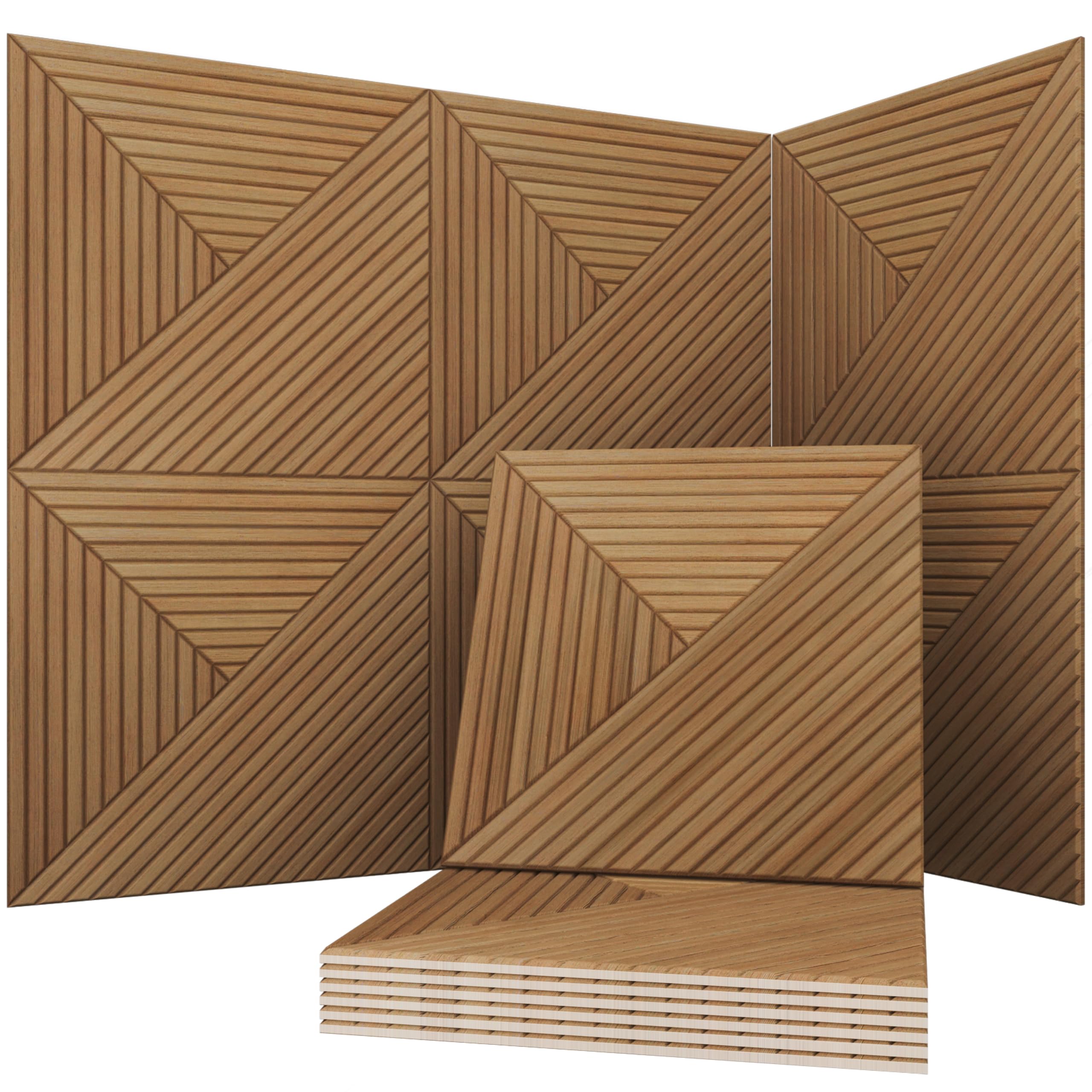
The “Arcadian Vortex” design is the differentiator: continuous grooves with a realistic wood-texture print that flows across adjoining panels, creating a single unified feature wall. Buyers consistently say these look even better in person and get compliments — the geometric wood pattern adds character in a way typical acoustic panels simply don’t. Each panel is 23.62″ x 23.62″, with six covering 3348 square inches.
Acoustically, the linear channels trap and diffuse sound effectively, reducing echo across larger surfaces. The material is high-density polyester fiber — lightweight, resilient, and safe. Assembly is tool-free: a 30-piece set of transparent double-sided adhesive squares is included, and the install ranks as the most-praised aspect of the whole product. Panels cut easily to fit around outlets, and they work beautifully over brick when paired with stronger tape.
This is the best pick for acoustic benefit without the studio-foam look. One detail to note: some buyers found the colors slightly less vivid than the product photos, though lighting helps. The adhesive is strong — so strong it’s hard to remove — so position carefully. For a living room or modern workspace, this balances function and aesthetics better than almost anything else on this list.
Decor-first acoustic: the wood-look grooves make this the pick for spaces where the wall must look intentional, not functional.
Choose this for: living rooms and offices where you want the wall to be a conversation piece with sound benefits.
Not your first pick if: raw echo reduction per dollar is your only metric — you pay a premium for the wood aesthetic.
8. Art3d Wood Slat Wall Panels
Six 94.5″ fluted panels in warm walnut that transform a wall into a designer centerpiece.
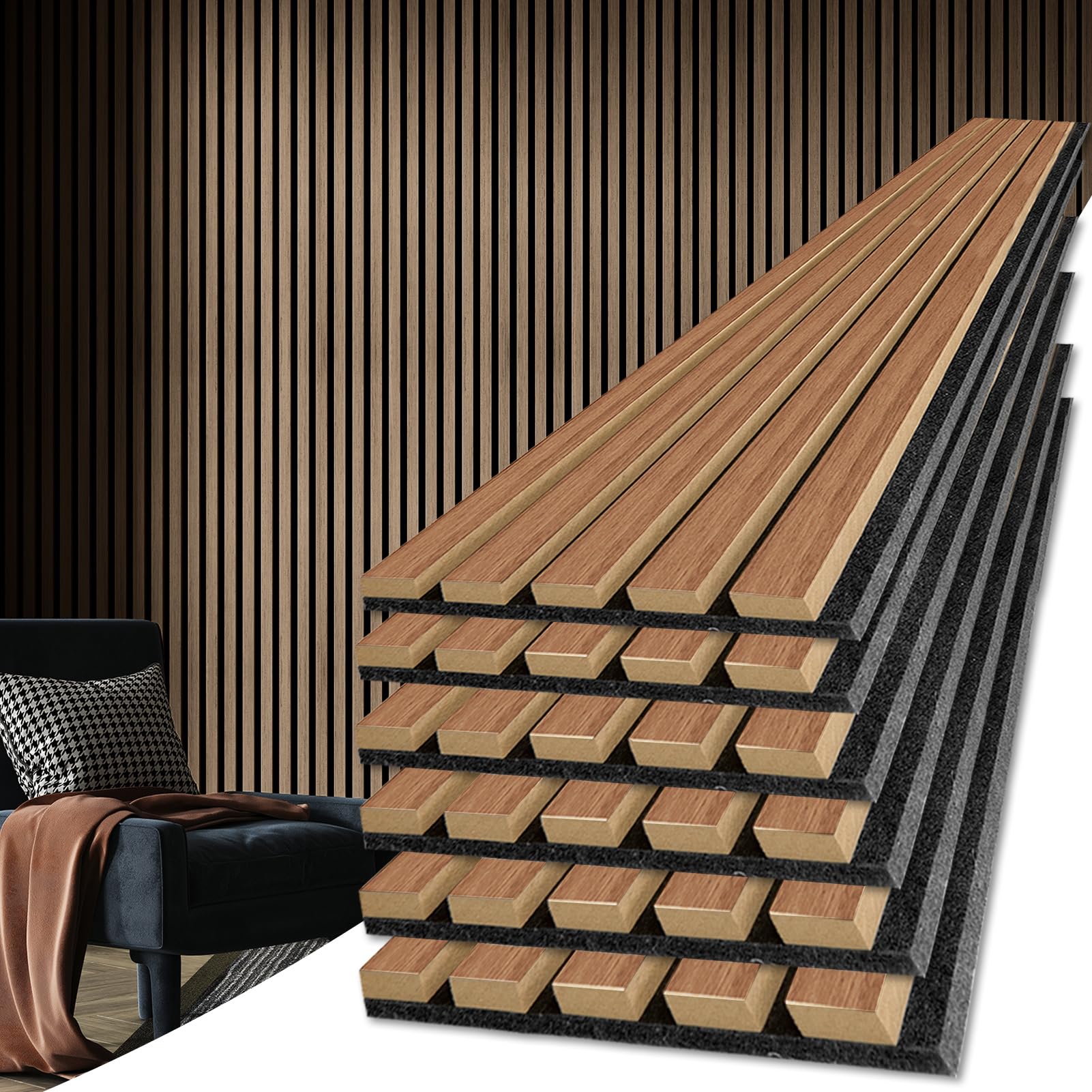
These are the statement panels. Six fluted slats at 94.5″ x 7.9″ each cover about 31.5 sq. ft. of wall in a warm walnut finish that owners describe as transforming rooms — from bathrooms to living rooms to hidden closet doors. The quality is the most-praised aspect by a wide margin, with the medium walnut tone matching oak finishes and elevating a space instantly.
Acoustically, the high-density polyester fiber backing with MDF slats provides genuine noise cancellation, with buyers reporting significant echo reduction after a floor-to-ceiling install. The panels mount with basic tools and screws — a different approach than the peel-and-stick felt above, and one that rewards a DIY mindset. They’re easy to cut with scissors or a saw, and the fluted design hides wires beautifully.
These panels make a room look remodeled, not just accessorized. Edges can be sharp after cutting, and one pack covers only 31.5 sq ft at a premium price. Order a sample pack first to confirm the finish before committing. For a warm, elegant wood look, this is the top choice on this list.
The wood-wall payoff
- Warm walnut fluted design reads as a remodel
- Genuine noise and echo reduction in practice
- Easy to cut and dress around outlets
Plan around this
- 32 sq ft per pack goes fast on big walls
- Cut edges need care to avoid splinters
Splurge on this if: you want a premium wood feature wall that earns its place in the room’s design.
Budget differently if: you’re covering a huge area — the cost per square foot adds up quickly.
9. NeatiEase Wood Panels for Wall

Four 96″ teak slats with a realistic veneer that bend and cut for full-wall creativity.
The length is the feature: four panels at 96″ x 12.6″ each cover about 33 sq. ft., and they can be installed horizontally or vertically and cut to any shape. The teak color is a realistic veneer over sturdy MDF with a felt backing, and owners consistently call it a modern, luxury look that transforms basements and apartments. At 19.96 kg for four panels, these are built to last.
Acoustic performance is solid — reviewers point out significant sound absorption and echo reduction, with the panels earning praise for making a noticeable difference in room acoustics. The mount is straightforward: drywall screws and basic tools, no special hardware. The felt backing also gives a clean finish against the wall. It’s a genuinely functional upgrade that happens to look high-end.
The trade-offs are honest ones. The teak veneer photographs well but the material is MDF, which cuts with effort and produces dust — owners recommend an oscillating tool. Packaging issues occasionally damage the panel ends, and as with all wood slats, “soundproofing” is more accurately described as echo absorption, not full sound blocking. If you want a warm, contemporary wall in a natural tone, this delivers a premium result for the effort.
What stands out
- 96″ panels install horizontally or vertically for flexibility
- Realistic teak veneer looks high-end
- Felt backing enhances sound absorption
Keep in mind
- MDF is dusty and tough to cut cleanly
- Occasional shipping damage to panel ends
Reach for this if: you want a long, smooth wood wall and don’t mind a little DIY effort for a luxurious result.
Look elsewhere if: you need peel-and-stick simplicity — these require screws and a steady hand.
Understanding the Specs
NRC Rating
NRC (Noise Reduction Coefficient) is the single most important number on an acoustic panel. It measures what fraction of sound the panel absorbs, from 0 (nothing) to 1 (everything). A rating of 0.95 means 95% of sound hitting the panel is absorbed instead of bouncing back. The higher the NRC, the less echo you’ll hear — and the clearer your calls and recordings will be.
Adhesive Strength & Wall Type
Self-adhesive panels use peel-and-stick backing that works best on smooth, clean drywall. Textured walls, brick, or painted surfaces with texture can defeat even strong adhesive, which is why some shoppers say tiles falling off while others praise the hold. If your walls aren’t smooth, plan for screws, command strips, or extra tape to reinforce the mount.
Panel Thickness vs. Density
Thicker panels (like 0.72″) absorb more sound than thin ones (0.4″), but density matters too. A dense polyester fiber panel can outperform a thick, flimsy foam. Check the density rating in lb/ft³ or lbs/yd³ — higher numbers mean better absorption and a sturdier feel that won’t sag or crumble.
Coverage Area
Coverage dictates how many packs you’ll need. A 12-pack of 12″ tiles covers roughly 12 square feet; four large 47.2″ panels cover far more. Measure your target wall and calculate square footage before buying. For echo reduction, more coverage is always better — partial coverage tames echo but won’t transform a lively room.
FAQ
Do acoustic panels block sound or just reduce echo?
Will peel-and-stick panels damage my painted walls when removed?
How many panels do I need to notice a difference?
Can I cut acoustic panels to fit around outlets or corners?
What is the difference between felt tiles and foam acoustic panels?
Are acoustic panels safe for kids’ rooms and nurseries?
Do wood slat panels actually reduce noise or are they just decorative?
Can acoustic panels be mounted on ceilings?
Final Thoughts: The Verdict
For most people, the acoustic panels for walls winner is the VIVELDA Felt Tiles because it pairs the highest NRC rating of 0.95 with a slatted design that looks like a designer feature wall, plus the safety of OEKO-TEX certification. If you want the best value in a lighter, budget-friendly felt pack, the Bumusty Tiles deliver the same rated absorption at a featherweight 1.37 kg. And for a warm, premium wood statement wall that genuinely cuts echo, the Art3d Wood Slats are the ones to reach for.
How We Picked
We do not accept paid placement. Every pick is matched to a real buyer and a real use-case; we do not hands-on test units.
Sources & Methodology
Specifications: manufacturer listings and product documentation. Review insights: verified customer reviews, as of August 2026. Pricing: not shown on this page (it changes often); check the current price via the retailer link.
As an Amazon Associate, Gadgets Feed earns from qualifying purchases. This does not affect which products we feature.