
Our readers keep the lights on and my morning glass full of iced black tea. As an Amazon Associate, I earn from qualifying purchases.
Specs are compiled from manufacturer listings and verified buyer reviews and can change over time — please confirm the key details on the product page before buying.
A good first paddle should feel weightless, not leave your forearms aching within the first mile. For beginners, the real challenge is fatigue from a heavy shaft and fluttering blades, not speed. This guide cuts through jargon to find paddles that put your energy into the water, not into vibration and dead weight.
I’m Min — the founder and writer behind Gadgets Feed. This guide is built by comparing the manufacturers’ published specifications and the patterns across verified customer reviews, so you get each pick’s real strengths and trade-offs instead of marketing spin.
If you’re searching for the perfect beginner kayak paddle, focus on feathering angles, shaft material, and total weight to match your paddling style and your kayak’s width.
Our Picks at a Glance

How To Choose The Best Beginner Kayak Paddle
Picking your first paddle is less about brand names and more about matching three things: your height, your kayak’s beam width, and the type of water you’ll paddle. A paddle that’s too long or too heavy will turn a relaxing float into a chore, so it’s worth understanding the basics before you click buy.
Feathering: The Angle That Saves Your Wrist
Feathering means the two blades are offset at an angle — often 60 degrees — so when one blade enters the water, the other slices through the air edge-on. This reduces wind resistance on the recovery stroke and takes strain off your wrist and forearm. Beginner paddles often offer 0° (straight) or 60° settings, letting you start unfeathered and switch as you build technique.
Shaft Material: Weight vs. Durability
Aluminum shafts are the budget workhorses — durable and affordable, but heavier over a long day. Fiberglass steps up with a lighter feel and better vibration damping. Carbon fiber is the featherweight champion, cutting fatigue dramatically, but it costs more. For a first paddle, many beginners find a light fiberglass or carbon shaft worth the extra dollars to protect their shoulders.
Blade Shape and Length
Asymmetrical blades (taller than they are wide) grab water cleanly and reduce flutter, making each stroke more efficient. Length matters too: a general rule many paddlers use is that the paddle should be roughly your height plus the width of your kayak. Shorter paddles suit narrow boats and smaller paddlers; longer ones fit wide, stable kayaks and taller folks.
Quick Comparison
| Model | Best For | Shaft Material | Length | Weight | Amazon |
|---|---|---|---|---|---|
| Bending Branches Whisper★ Best Overall | Fatigue-free all-day paddling | Aluminum | 230 cm | 16 oz | Amazon |
| Pelican SymbiosaPremium Pick | Adjustable fit & angle control | Fiberglass | 90.5–94.5 in | 2.1 lbs | Amazon |
| OCEANBROAD CarbonBest Value | Ultra-light budget performance | Carbon Fiber | 90.5 in / 230 cm | 33 oz | Amazon |
| Abahub Carbon | Snappy acceleration on a budget | Carbon Fiber | 90.5 in / 230 cm | 33 oz | Amazon |
| Carlisle Day Tripper | Tough maneuvering & fishing | Tempered Aluminum | 230 cm (90.5 in) | 37 oz | Amazon |
| WONITAGO Adjustable | Adjustable carbon for varied paddlers | Carbon Fiber | 86–94 in / 220–240 cm | 2 lbs | Amazon |
| Camco Crooked Creek | Budget-friendly family paddling | Anodized Aluminum | 7 ft | 2 lbs | Amazon |
| The Catch (Pelican) | Kayak fishing with built-in tools | Fiberglass | 98.5 in / 250 cm | 2.1 lbs | Amazon |
| WONITAGO Fiberglass | Entry-level value for tight budgets | Fiberglass | 90–98 in | 2.3 lbs | Amazon |
In‑Depth Reviews
1. Bending Branches Whisper Kayak Paddle
Our pick — over 4.5★ from 650+ verified ratings; the strongest balance of quality and price.
A featherweight aluminum paddle that keeps arms fresh through all-day sessions.
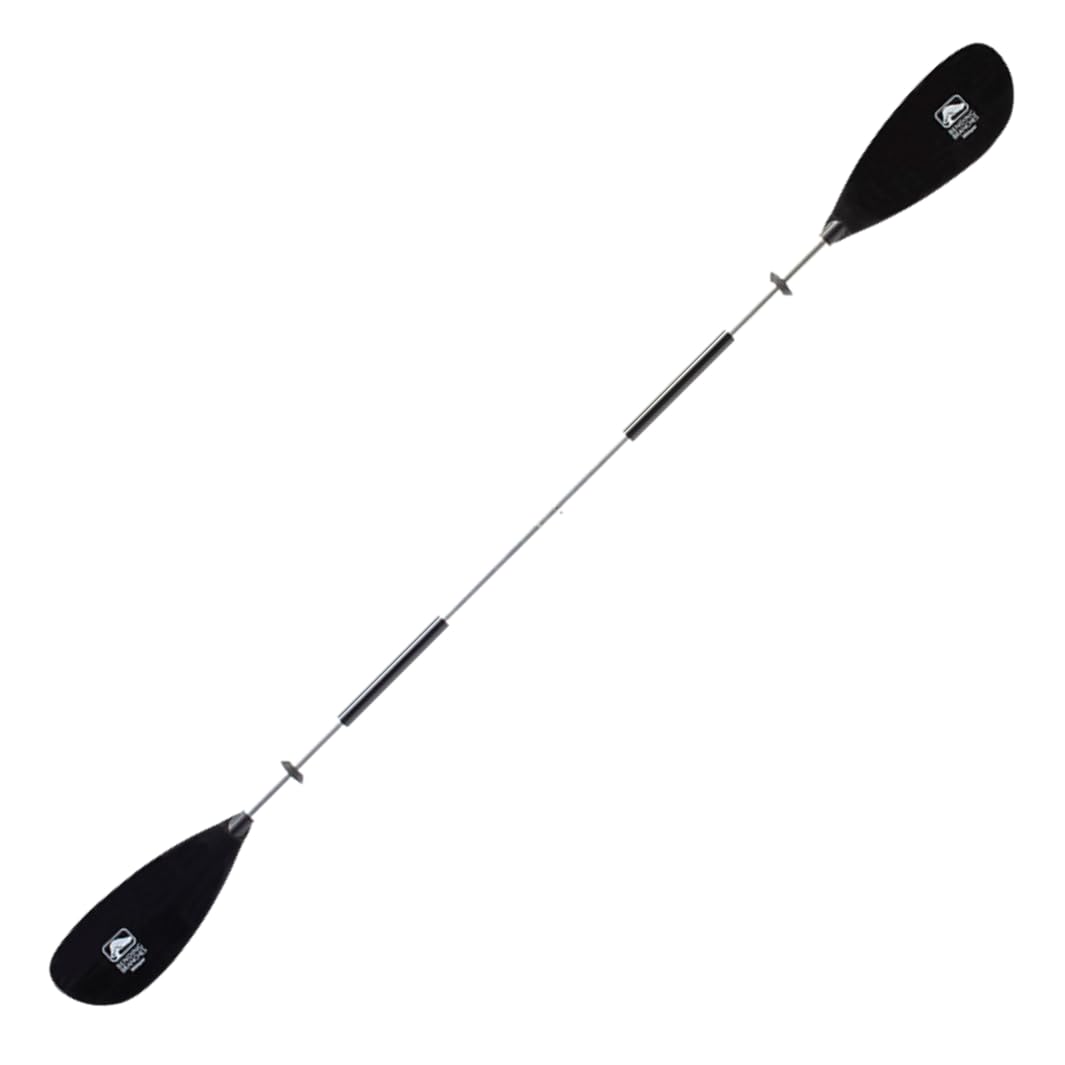
At just 16 ounces, this paddle is almost comically light for an aluminum model — several owners claim they can’t tell the weight difference from fiberglass options costing nearly twice as much. The two-piece aluminum shaft with a snug 3-hole snap button ferrule gives you that stable, dependable feel recreational paddlers want, and it breaks down to fit easily in a vehicle for transport.
The polypropylene blades use a dihedral design (a raised ridge down the center of each blade) that cuts through the water smoothly with minimal flutter. Buyers report that the 230/240 cm sizes fit 32-inch kayaks perfectly, and an 8-hour day on the water produces no fatigue. The adjustable feathering at 0° or 60° (left or right) lets you dial in your wrist angle as you build experience.
The only recurring complaint is minor — the black comfort grips can leave a dark residue on your hands, but it washes off easily. Its light weight and smooth blade action let beginners paddle for hours without noticing the paddle.
featherlight touring choice: The best balance of light weight, durability, and adjustable feathering for a first-time buyer, handcrafted in the USA.
lightest pick: You want a dependable, feather-light paddle that fits your kayak and your budget without compromise.
budget buyers: You demand carbon fiber performance for racing — the aluminum shaft trades a little stiffness for affordability.
2. Pelican Symbiosa Kayak Paddle
The adjustable fiberglass paddle that bends to your exact height and stroke angle.
If you stand between 5 and 6 feet tall, you can tailor this paddle to your exact body and boat: the telescoping ferrule system (the joint that connects the two shaft halves) slides from 90.5 inches up to 94.5 inches, so you match the length to your torso and your kayak’s width. You also get a 360° blade angle adjustment, meaning you can rotate the blade to any position—not just preset clicks—to find the feathering angle (the tilt that reduces wrist strain) that feels most natural to you.
Owners mention it feels noticeably lighter and more efficient than stock aluminum paddles, cutting stroke effort. The shaft’s ovalized section (where it transitions from round to slightly oval) acts as a visual and tactile guide for where your right hand should sit. Adjustable drip rings keep water from running down the shaft onto your hands, and the impact-resistant fiberglass-reinforced nylon blades handle weekly rough paddling without issue.
The consensus is that this is a solid, sturdy, good-looking paddle that offers serious value. Add the weight — just 2.1 pounds — and you have a paddle that feels like a premium upgrade without the premium price tag.
custom fit champion
- Telescoping length adjusts 4 inches for a personalized fit
- Infinite blade angle adjustment beats fixed presets
- Lightweight fiberglass reduces arm fatigue on long trips
heavier build
- Not built for whitewater — it’s a low-angle touring paddle
- Occasional loose screw in the box needs a quick tighten
comfort seekers: Recreational paddlers who want a tailored fit and infinite angle adjustability.
weight watchers: You’re over 6 feet tall and need a longer reach — the Symbiosa tops out at 94.5 inches.
3. OCEANBROAD Carbon Fiber Kayak Paddle
A budget carbon fiber paddle that keeps shoulders fresh on three-mile paddles against the current.
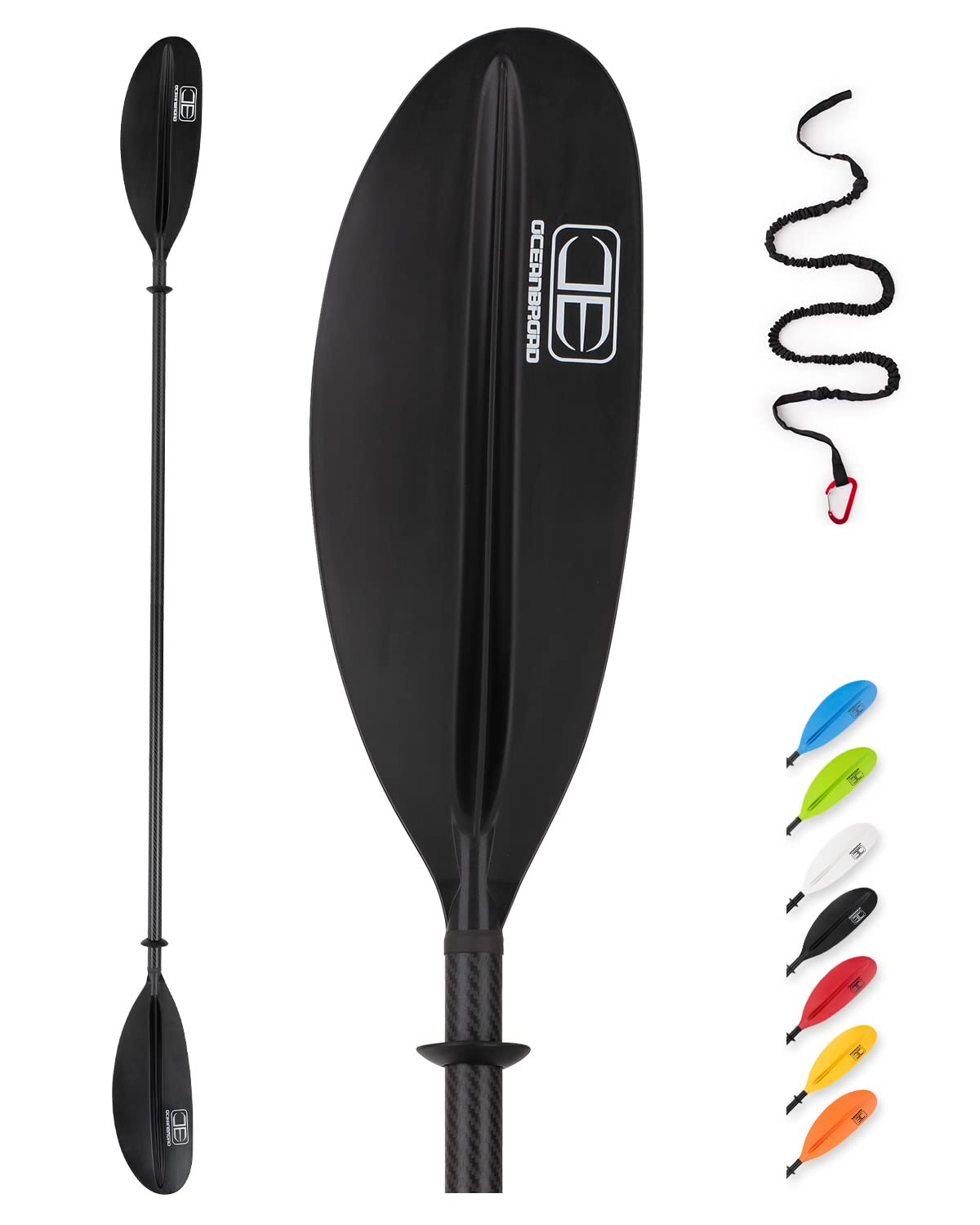
At 33 ounces with a carbon fiber composite shaft, this paddle delivers featherweight performance at a budget-friendly price point. Owners who took it out for a three-to-four-mile trip against a low current reported zero fatigue — proof of how efficiently the wide blade design converts your energy into forward motion with minimal effort.
The UV-stable fiberglass-reinforced PP blades are built to shrug off saltwater corrosion and rough handling. One owner described pushing away from obstacles with the paddle, noting the reinforcement means you don’t have to worry about snapping it on rocks or timber. The bungee paddle leash is a thoughtful touch for photo breaks, keeping your paddle secured to the kayak, while the non-slip ergonomic grips and drip rings keep your hands dry.
What wins people over here is the value — dozens of owners call out the quality for the price, praising how it gets beginners in the water quickly. The two-piece split design fits easily in compact car trunks. A few note the length runs slightly short for taller paddlers, so measure your reach before committing.
budget carbon: You want carbon fiber lightness without spending a fortune — this is the smart money pick.
premium feel: You’re over 6 feet tall and need extra length, since this runs at 230 cm only.
4. Abahub Carbon Fiber Kayak Paddle

A stiff carbon shaft that delivers snappy, responsive acceleration on every stroke.
The 1.25mm thick, 29mm diameter carbon fiber composite shaft delivers minimal flex — owners describe it as stiff and well-made, a big upgrade over aluminum. The 18-inch asymmetrical blades are designed with a hollow spine for reinforcement and less weight, which translates to better cuts and pulls through the water. It weighs just 33 ounces, making it perfect for beginner and intermediate kayakers alike.
This 90.5-inch paddle suits most paddlers over 5’5″ and fits kayaks with common widths of 24 to 28 inches, so it works for a broad range of boats. The 2-section detachable design offers 3 locking positions to offset the blade and cut wind resistance, and a 0.5mm rubber cover on the shaft keeps your grip secure during cold winter paddling. Two upgraded drip rings at the blade joints stop water from running down the shaft, so your hands stay dry.
One owner who paddles heavy canoes and kayaks at 4.4-4.5+ mph with no flutter called it a better value than pricier options. The honest trade-off: the carbon shaft lacks a grippy rubber surface, so some owners add their own grip tape or silicone — minor fix for an otherwise excellent performer.
balanced performance
- Stiff carbon shaft with minimal flex for efficient power transfer
- Hollow-spine blades reduce weight and flutter
- 3 locking positions for wind-resistance adjustment
minor flex
- No grip surface on the shaft — plan to add your own
- Plastic blades lack reinforcement, showing slight flex
all-rounder: Paddlers who want real carbon fiber stiffness and snappy acceleration on a budget.
hard paddlers: Anyone who wants a tacky, grippy shaft right from the start.
5. Carlisle Day Tripper Aluminum Kayak Paddle

The rock-shrugging aluminum paddle built for fishing tight spots and pushing off timber.
This is the paddle for anglers and maneuverability-focused paddlers. The broad, asymmetrical polypropylene blades are shaped for smooth, efficient strokes, and owners consistently praise how well it handles in tight spots — perfect for a fishing kayak where you’re constantly adjusting position. It weighs 37 ounces, noticeably heavier than carbon options, but the tempered aluminum shaft delivers toughness that shrugs off pushes against rocks and timber.
The oval construction of the shaft is intentional — it gives you quick hand placement and a firmer grip, with the oval side indicating blade angle. The pushbutton takedown lets you feather the blades at 60 degrees or keep them inline for right- or left-handed control. Customers note the two-piece connection is solid with no wobble, and the 230 cm length works well, with 220 and 240 cm sizes also available.
The value is what wins people over — dozens of owners call it excellent value for money, with some reporting it lasted six years of heavy use. One paddler even survived whitewater rafting, hitting rocks and using it to push off, and it held up strong. The honest trade-off is weight: it’s heavier than carbon, so it’s best for tough maneuvering rather than long open-water distance paddling.
entry level: Anglers and paddlers who need a tough, reliable blade for maneuvering and pushing off obstacles.
long trips: Marathon open-water paddlers who want featherweight performance over durability.
6. WONITAGO Adjustable Carbon Fiber Kayak Paddle
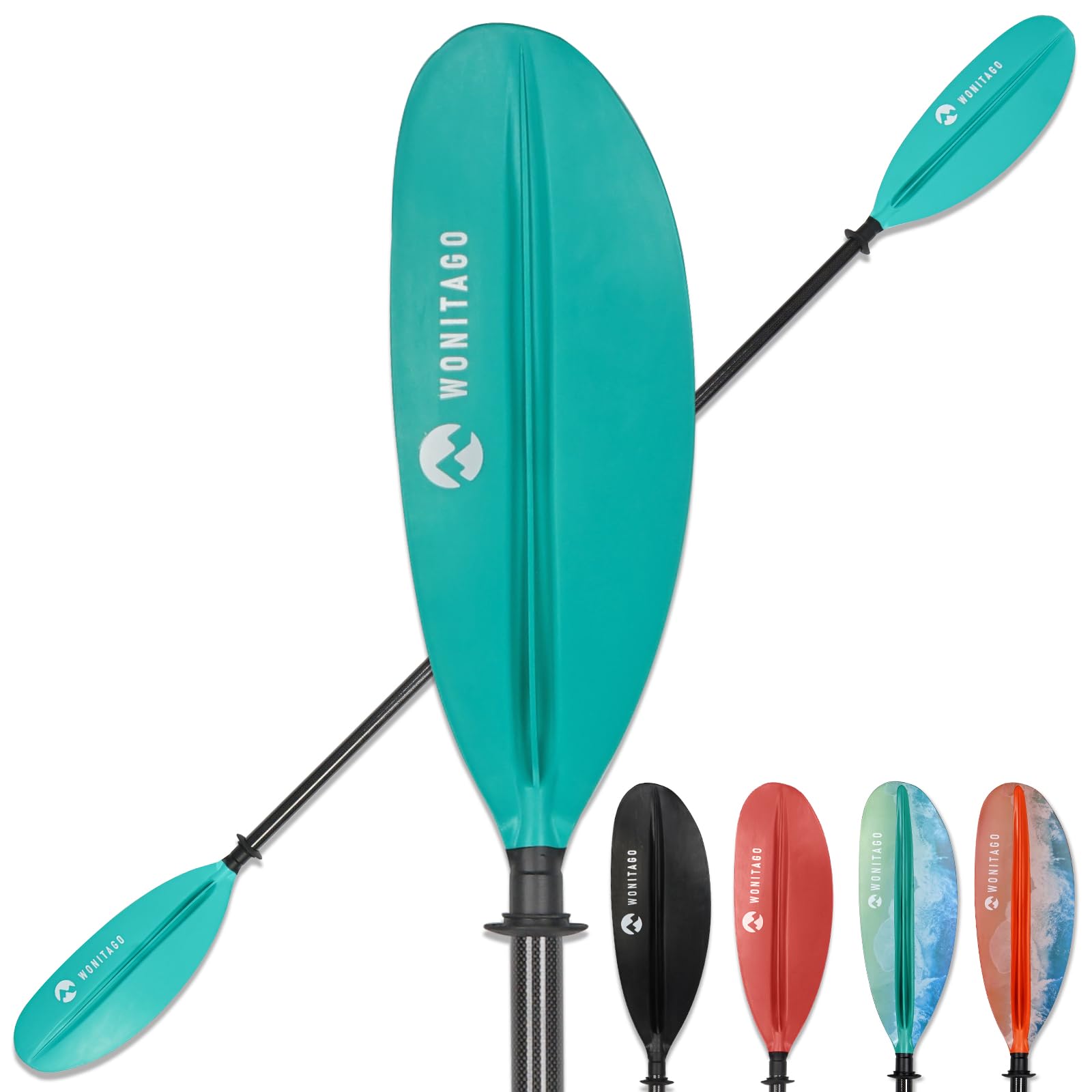
The 20cm-adjustable carbon paddle that fits every paddler in the family.
Because its total length adjusts from 86 to 94 inches (220 to 240 cm), this paddle adapts to different paddlers—ideal for households where several people share one kayak. Weighing just 2 pounds, the carbon fiber shaft reduces fatigue on long trips, and it’s stiff enough for speed and control yet flexible enough to resist snapping under pressure.
The 3-piece combined design makes it highly portable, breaking down to fit in tight storage spaces. The ±60° quick pin button lock lets you assemble and adjust the angle fast, adapting to your kayak’s specific width. The fiberglass + PP enhanced blades float in both saltwater and freshwater, with a streamlined design that adds power and stability while reducing flutter.
Owners praise it as a great everyday paddle — light, good value, and highly adjustable. The teal color gets specific love for matching paddle boards. The honest caveat: it’s best suited for calm rivers and lakes rather than rough ocean expeditions, with medium durability for starter recreational use.
shared use: Multiple people will use one paddle, or you want to fine-tune length and angle as you progress.
fixed length: You plan to tackle rough ocean conditions — this is a calm-water recreational paddle.
7. Camco Crooked Creek Kayak Paddle

The dependable budget blade that’s perfect for kids, petite paddlers, and quick replacements.
This is the paddle to grab when you need a reliable, no-fuss option that won’t break the bank. The lightweight anodized aluminum shaft paired with fiberglass-reinforced polypropylene blades delivers solid performance for lake cruising and river fun. At just 2 pounds, it’s light enough for kids and petite adults to handle comfortably all day.
The 3-position push-button feather settings give you versatility to match your stroke style, and the two-piece design breaks down for convenient storage in boats or RVs. Owners describe it as a great paddle for the money — smooth, light, and versatile for various water conditions. One owner who lost their stock paddle called it so much better than what came with the kayak that they immediately ordered a second.
Buyers consistently praise the build quality, and rubber grips plus drip guards come included. The honest caveat: the 7-foot (84-inch) length runs short for taller paddlers, and some reviewers point out the blade can snap at the handle joint under extreme stress—though shoppers say the warranty replacement process is fast and painless.
packability: Families, kids, petite paddlers, or anyone needing a solid budget replacement paddle.
open water: You’re over 6 feet tall and need a longer reach — this runs short.
8. The Catch Kayak Paddle (Pelican)
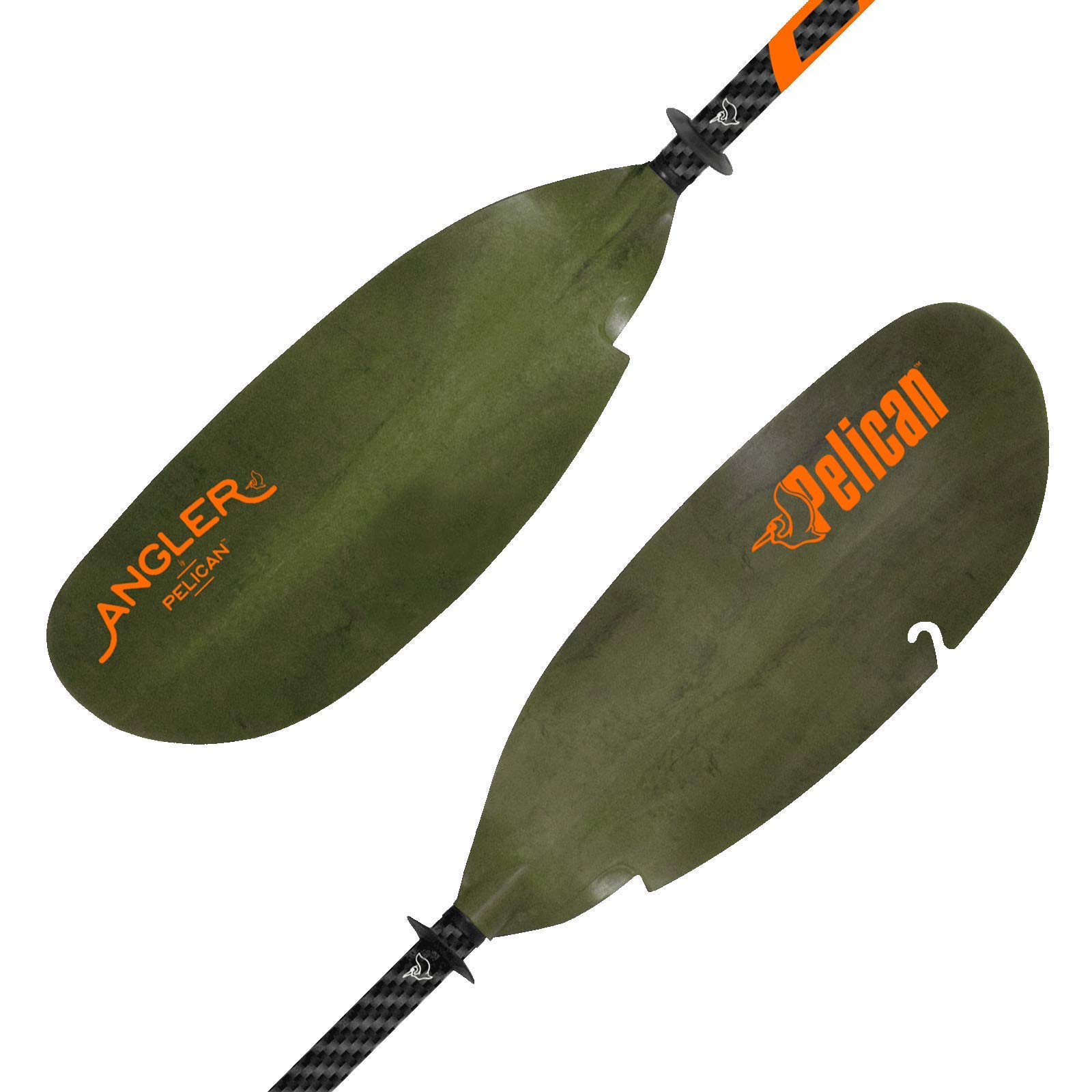
The fishing-first paddle with a built-in hook retrieval system and measuring tape.
This paddle is purpose-built for anglers — it comes with an integrated hook retrieval system and a tape measure along the shaft, so you can measure your catch without reaching for a separate tool. At 98.5 inches, it’s designed for anglers over 6 feet tall in kayaks over 34 inches wide, making it ideal for wide, stable fishing platforms and inflatable kayaks.
The fiberglass shaft with fiberglass-reinforced nylon blades delivers impact resistance for durability, while the 0 to 65° blade angle adjustment lets you fine-tune your stroke. The ovalized shaft section guides your right hand placement, and adjustable drip rings keep water off your hands for a better grip. Owners describe it as solid, strong, and lengthy — one with a 35-inch wide kayak called the length ideal.
What wins people over is the built-in fishing features — the notches and measuring ruler get specific praise as a great addition. It’s lighter than aluminum options and cuts water well. The honest trade-off: some owners note the blade has noticeable flexibility, describing it as “very bendy,” so it’s not the stiffest paddle for aggressive power strokes.
first timer: Tall anglers on wide kayaks who want fishing tools integrated into their paddle.
speed seekers: Paddlers who demand maximum blade stiffness for powerful, aggressive strokes.
9. WONITAGO Adjustable Fiberglass Kayak Paddle
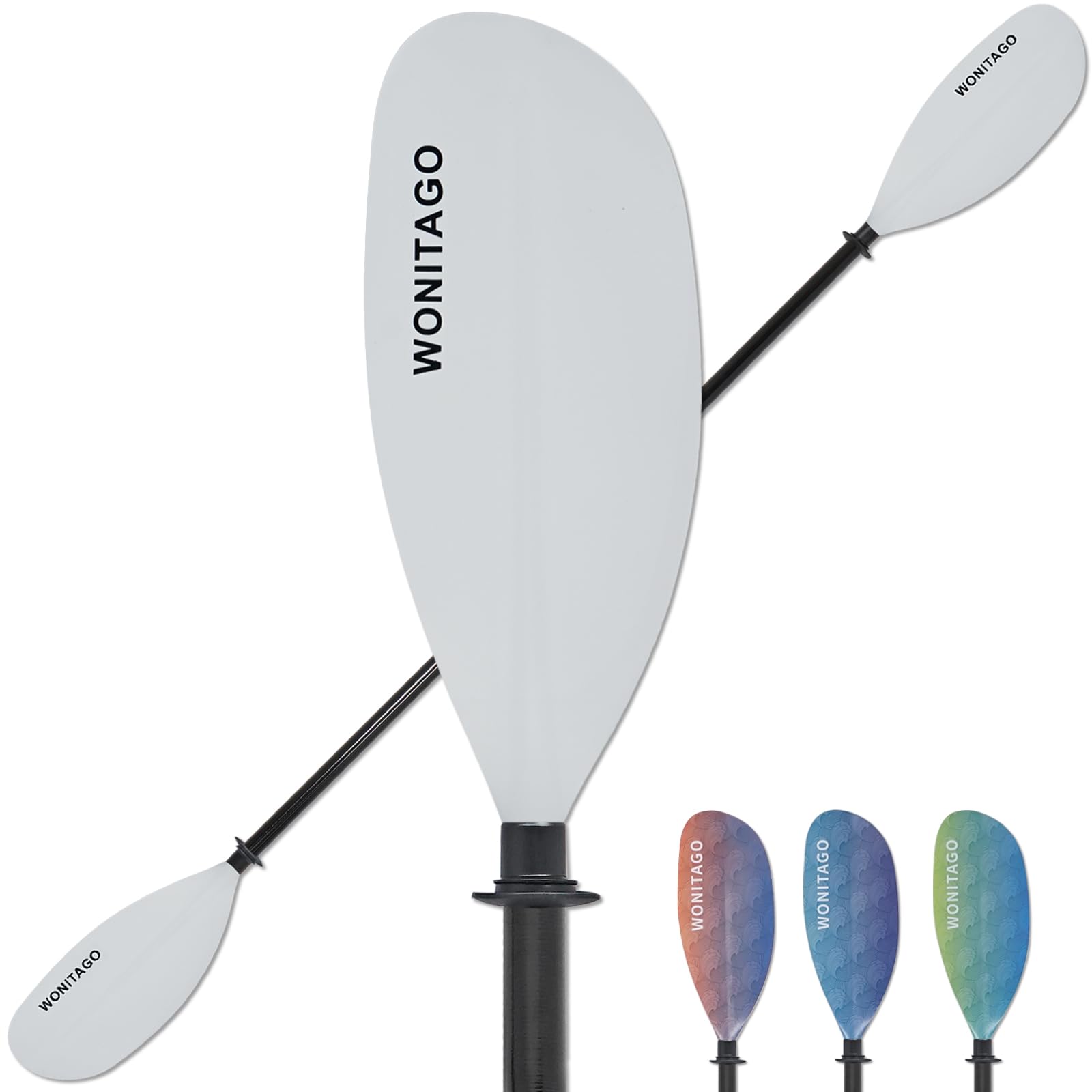
The budget fiberglass paddle that survived wind, waves, rocks, and aggressive paddling.
This is the entry-level pick that proves you don’t need to spend a fortune for a quality paddle. The premium fiberglass shaft offers better toughness and strength than ordinary aluminum, with a ribbed surface that increases traction and prevents slipping. The 16.5″ x 7″ nylon blades provide good durability and corrosion resistance whether you’re in saltwater or freshwater.
The 8-inch adjustable length (90 to 98 inches total) means you can fine-tune the fit, and at just 2.3 pounds, it’s light enough for all-day paddling. The 3-piece detachable design makes it travel-friendly, while the quick pin button lock ensures easy assembly. The 60° (L/R) rotatable design gives you control over the angle and direction of force.
Owners who’ve put it through hell — dropping it, banging it on rocks, paddling aggressively in the wrong direction — report it’s still intact. It’s a favorite for Advanced Elements Inflatable Kayaks, with buyers praising the paddle quality and value. The honest caveat: the printed design on the blades can start to come off around the edges with rough handling, though the paddle itself performs great.
recreational: You want a tough, adjustable fiberglass paddle at a rock-bottom price point.
aggressive tours: Aesthetics matter long-term — the blade design may wear around the edges with heavy abuse.
Understanding the Specs
Feathering Angle
Feathering is the offset angle between your two blades, usually 0° (straight) or 60° (angled). A feathered paddle reduces wind resistance on the recovery stroke because the blade slices through the air edge-on, which takes strain off your wrist. Beginners often start at 0° and gradually experiment with 60° feathering as their technique improves — look for a paddle that lets you switch.
Shaft Material and Weight
Shaft material is the single biggest factor in paddle weight. Aluminum is durable and budget-friendly but heavier; fiberglass is lighter with better shock absorption; carbon fiber is the featherweight champion that minimizes fatigue on long trips. Weight directly affects how tired your arms get — a difference of even 10 ounces becomes noticeable after an hour of paddling.
FAQ
How long should my beginner kayak paddle be?
What is paddle feathering and do I need it?
Is fiberglass better than aluminum for a first paddle?
What are drip rings and why do they matter?
How do I know if a paddle fits my kayak width?
What is an asymmetrical blade and why does it matter?
Can I use a paddle with a paddle board or canoe?
How do I store and transport a two-piece paddle?
What’s the difference between 0°, 60°, and 65° feathering angles?
Why does blade size affect my paddling?
Final Thoughts: The Verdict
If you want one dependable pick, the beginner kayak paddle winner is the Bending Branches Whisper because it delivers feather-light aluminum performance, adjustable feathering, and quality construction that owners consistently praise. If you want a highly adjustable fit with infinite angle control, grab the Pelican Symbiosa. And for budget-conscious paddlers who want carbon fiber lightness, the OCEANBROAD Carbon is the one to reach for.
How We Picked
We do not accept paid placement. Every pick is matched to a real buyer and a real use-case; we do not hands-on test units.
Sources & Methodology
Specifications: manufacturer listings and product documentation. Review insights: verified customer reviews, as of August 2026. Pricing: not shown on this page (it changes often); check the current price via the retailer link.
As an Amazon Associate, Gadgets Feed earns from qualifying purchases. This does not affect which products we feature.