
Our readers keep the lights on and my morning glass full of iced black tea. As an Amazon Associate, I earn from qualifying purchases.
Specs are compiled from manufacturer listings and verified buyer reviews and can change over time — please confirm the key details on the product page before buying.
That sharp, burning ache under the ball of your foot can turn every step into a decision. Whether it is metatarsalgia, a Morton’s neuroma, or just a long day on your feet in unforgiving shoes, the right insert does one job: it redistributes pressure so the sore spot stops taking the brunt. This guide breaks down nine distinctly different approaches to that problem — from thin pads that vanish inside dress shoes to full orthotic insoles that rebuild your stride.
I’m Min — the founder and writer behind Gadgets Feed. This guide is built by comparing the manufacturers’ published specifications and the patterns across verified customer reviews, so you get each pick’s real strengths and trade-offs instead of marketing spin.
If your forefoot pain is making you dread your own shoes, ball of foot inserts are the targeted fix that cushions, lifts, and rebalances where you hurt most.
Our Picks at a Glance


How To Choose The Best Ball Of Foot Inserts
Ball of foot pain is rarely one problem. It can be a dropped metatarsal head, a pinched nerve, or simple overuse — and each responds to a slightly different shape of support. Before you pick, match the insert’s design to where and how it hurts.
Match the Form to the Footwear
The most important question is what shoes you wear. A 3/4 length insole stops before the toes, so it fits loafers, oxfords, flats, and other low-profile shoes where a full-length insert is too snug. A full-length orthotic, by contrast, needs a shoe with a removable factory insole and a roomy interior — think wide sneakers, work boots, or athletic shoes. Buying a full-length insert for a tight dress shoe is the most common mismatch.
Understand the Pad’s Job
A metatarsal pad sits just behind the ball of your foot and lifts that area, shifting weight back toward the arch and off the painful spot. Some come as thin self-adhesive pads you stick to the insole or your foot; others are built into a rigid orthotic shell. Adhesive pads are cheap and portable across shoes, but they wear out and need replacing. Orthotic insoles cost more and take a break-in period, but they correct your whole foot position.
Check the Materials and Longevity
Materials decide how long the relief lasts. Wool felt pads are soft and moldable but flatten over days of use. Leather-covered dense foam lasts far longer and resists odor. Rigid orthotics made of materials like Q-E.V.A. (a lightweight supportive foam) hold their shape for years. If you swap shoes daily, look for something you can move between pairs; if you have one problem pair, a stick-on pad is enough.
Quick Comparison
| Model | Best For | Length | Material | Metatarsal Pad | Amazon |
|---|---|---|---|---|---|
| Pedag Holiday★ Best Overall | Dress shoes & arch support | 3/4 Length | Sheepskin Leather | Built-in | Amazon |
| Chiroplax High Heel PadsThe Heel Companion | High heels & sandals | Forefoot Pad | Gel + Leather | Cushion Pad | Amazon |
| Wellsfoot Felt PadsValue Multi-Pack | Value multi-pack | Forefoot Pad | Wool Felt | Self-Adhesive | Amazon |
| Temiart Felt Pads | Morton’s neuroma relief | Forefoot Pad | Wool Felt | Self-Adhesive | Amazon |
| Pedag Drop | Targeted metatarsal lift | Forefoot Pad | Vegetable Tan Leather | Tear-Drop Pad | Amazon |
| Mars Wellness Dancer Pads | Sesamoiditis & calluses | Forefoot Pad | Premium Felt | Cut-out Pad | Amazon |
| Footlogics Metatarsalgia | Flat shoes & loafers | 3/4 Length | Q-E.V.A. | Built-in Raise | Amazon |
| Orthostride Insoles | Standing all day | Full Length | PU Foam | Built-in | Amazon |
| PowerStep Pinnacle Plus Met | Walking & running | Full Length | Polyester + Foam | Built-in | Amazon |
In‑Depth Reviews
1. Pedag Holiday 3/4 Length Sheepskin Orthotic Inserts
Our pick — 4.5★ from 800+ verified ratings; the strongest balance of quality and price.
The dress-shoe savior that slips into loafers and flats, handcrafted in Germany from lambskin leather
The defining strength here is the low profile. At just 0.15 inches thick and weighing 1.12 ounces, this 3/4 length insole is built for tight shoes — loafers, oxfords, and flat ballet styles where a full-length insert simply will not fit. The thin build means you get arch support and a metatarsal pad without your foot feeling crammed in, and the lambskin leather surface stays comfortable against bare skin in summer footwear.
What wins people over is the arch support — the most-discussed strength — closely followed by genuine foot pain relief. Buyers report it outperforming custom orthotics for overpronation, bunions, and plantar fasciitis, and sustaining 4 to 7 mile daily walks on a stiff but thin base. Multiple long-term owners mention a decade-plus of daily use, with the sheepskin resisting odor. It also carries the APMA Seal of Acceptance from the American Podiatric Medical Association, a recognition for promoting foot health.
One honest fit note: measuring 96 mentions, sizing is the most-discussed aspect and it is genuinely mixed. The universal fit claims Women’s 5 through 12 and Men’s 6 through 18, but owners consistently advise ordering up a full size — several who wore an 8 ordered a 9 for the perfect fit. Half sizes should size up too. The adhesive heel pad holds firmly but locks the insert to one pair of shoes, so owners who rotate footwear simply buy a few pairs.
Built to outlast trends: A decade-plus of daily wear is the headline here, with 3/4 length toe room and odor-resistant lambskin making it the set-and-forget choice for low-profile shoes.
Expect to size up: The recurring tip across owners is ordering one size up for the right fit, and the sticky heel pad means dedicating a pair to each shoe.
Reach for this if: you live in loafers, oxfords, or flats and want arch support plus metatarsal relief without bulk.
Look elsewhere if: you mostly wear high heels — the pad is not designed for them and the adhesive heel shortens its lifespan there.
2. Chiroplax High Heel Pads Cushions Inserts
The cloud-spa fix that turns punishing heels into walkable shoes, with a slip-resistant leather top
These forefoot cushions are engineered for the specific hell of high heels: a gel pad wrapped in a proprietary slip-resistant leather surface that keeps your foot planted instead of sliding forward into the toe box. The sticky backing is strong enough that pads do not shift once attached, and they are reusable — rinse the backing, let it dry, and the stickiness returns for another round. One set gives you 4 pairs (8 pieces), enough to outfit multiple problem shoes.
You get a secure fit and cushioning in one pad, according to owners. One reviewer says they “turned three pairs of cute but terribly uncomfortable shoes into cloud-spas for my feet.” They also fill extra room in shoes that are a half size too big, stopping your foot from slipping forward. The pads stick well to the insole, yet the fabric surface does not grab your foot, so they stay put without bunching.
Thickness is the honest trade-off. Owners agree the regular version is ideal for most shoes, but a noticeable group prefers the thinner option specifically for high heels where space is tight — some worry normal thickness takes up too much room. One owner found the flat cushioning loses its plushness after about an hour in closed-toe shoes, and praises the company’s thicker alternative for open-toe heels instead.
Why shoes stop hurting
- Slip-resistant leather top stops the forward slide in heels
- Washable and reusable — rinse the backing to restore stickiness
- 4 pairs outfit multiple shoes at once
The fit caveat
- Normal thickness can crowd tight high heels — thin version is safer there
- Flat cushioning fades after roughly an hour in closed-toe styles
Best for: anyone whose heels or slightly-too-big shoes need a grip-and-cushion combo that is reusable.
Think twice if: your heels are already tight — order the thinner version to avoid taking up too much room.
3. Wellsfoot Metatarsal Felt Foot Pads
An 18-pack of wool felt pads thin enough for high heels yet supportive enough for all-day walking
For the price of a single premium pad, this value pack gives you 18 felt metatarsal pads at 1/4 inch thick, designed to sit comfortably under the ball of your foot. The wool felt provides a soft, supportive cushion that tackles forefoot pain, metatarsalgia, and Morton’s neuromas, and the strong adhesive is meant to hold all day without leaving sticky residue on your foot or shoe. With 18 in hand, you can change shoes at will and keep a fresh pad in each pair.
The recurring gripe is adhesion — the most-mentioned aspect and honestly mixed. Some pads stick well and stay put under socks; others are nearly impossible to reposition once applied and leave residue on anything but the smoothest insoles. Owners learn to place them carefully the first time or remove them nightly to avoid sticking to skin. The brand backs it with a money-refund promise if the pads do not help.
Relief in bulk: 18 pads mean you are never without a cushion, and they work across most shoes — especially high heels.
Place once, place right: Adhesion is the variable here; repositioning is hard and residue appears on rougher insoles, so commit to the first placement.
Grab this if: you want a budget-friendly, disposable pad you can spread across every pair of shoes.
skip it if: you need something reusable you can move between shoes daily — the adhesive makes that impractical.
4. Temiart 18-Pack Ball of Foot Cushions
Soft-yet-firm felt pads that target Morton’s neuroma by lifting pressure off the second and third metatarsal heads
This 18-pack of wool felt pads targets pain under the ball of your foot. The placement guide tells you to set the pad behind the second and third metatarsal heads — the spot that takes the most pressure when you walk. At 1/4 inch thick, they are firm enough to spread your weight but soft enough for all-day wear. You can stick them directly to your foot or inside your shoe.
Quality is the aspect owners mention most, with functionality right behind. The pads are frequently described as among the best available for Morton’s neuroma, relieving pain by taking pressure off the surrounding toes. Owners confirm the right thickness and good ongoing adhesion, with several reporting a single pad lasting about two days before it needs swapping. The 18-piece count means you always have a fresh one ready.
Adhesion is the most-mentioned aspect and it is genuinely mixed — some pads stay in place for days while others fall off quickly. One owner found the pad shifts and flattens over time, leaving sticky spots that baby powder helps manage, and notes it detaches when wet, making replacement a recurring cost after showers. A separate owner found it too thick for metatarsalgia, feeling like a rock, and got better results in wide toe-box shoes like Hoka Bondi or Asics Cumulus.
Neuroma-focused relief: The pad’s placement behind the second and third metatarsal heads is exactly where neuroma pain lives, and the firm felt holds its ground.
Manage the stick: Wet conditions loosen the grip and some pads flatten fast — have spares ready and dry shoes in mind.
Choose this when: Morton’s neuroma is your primary complaint and you want a firm, targeted lift rather than soft mush.
Pass if: you need something reusable — these are single-use pads that degrade with moisture and time.
5. Pedag Drop Metatarsal Pads

A tear-drop shaped lift in vegetable-tanned leather that saved a runner’s 40-miles-a-week routine
This is not a cushion — it is a repositioning tool. The tear-drop shaped Pad from Pedag is anatomically designed to lift and shape the metatarsal arch, targeting splayfoot, bunions, and Morton’s neuroma by relieving the burning and stinging that comes from a flat metatarsal arch. Each of the 3 pairs is made from vegetable-tanned leather, handcrafted in Germany, with a self-adhesive backing that turns any insole into a metatarsal insole.
Effectiveness is the standout aspect by a wide margin, with comfort second. The most compelling evidence is a runner who taped the pad directly to his foot for metatarsal pain and found immediate relief — then kept running 40 miles a week with the pad still effective. Owners describe the leather-covered dense foam as far superior to felt pads, durable through daily use, and capable of eliminating hammer-toe pain for the life of the shoe when applied under the insole.
Fit is the most-mentioned aspect, and owners are split. Some say the adhesive sticks well to insoles; others report pads that will not stick at all, so they advise tucking the pad under the insole instead of on top. One detailed installation guide recommends positioning the pad slightly above the big-toe metatarsal plane, securing it with tape, and notes it brings immediate metatarsalgia relief — while honestly adding it is not a cure, so reducing activity and using arch support still matter.
Why it earns its keep
- High-quality leather exterior over dense foam outlasts felt pads
- The tear-drop shape lifts the metatarsal arch anatomically
- Portable across shoes when taped to the foot — proven at 40 miles a week
Where it stumbles
- Adhesive quality varies batch to batch — some pads will not stick at all
- Applying under the insole with tape often works better than direct placement
Best for: active people — runners, hikers — who need a durable, repositionable lift that travels between shoes.
Not for: anyone wanting a soft cushion; this is a firm corrective lift, not a plush pad.
6. Mars Wellness Felt Dancer Pads

The cut-out pad that shields the exact sore metatarsal head, born from dancers fighting calluses
Where most pads push up under the whole forefoot, this dancer pad works differently: its cut-out surrounds the area under a designated metatarsal head, re-distributing weight onto the pad and away from the painful spot. That makes it the precise tool for sesamoiditis, turf toe, dropped metatarsal head pain, calluses, and hallux limitus. The premium felt is made in the USA, is latex-free, and fits all styles of footwear for both men and women.
Effectiveness leads the most-mentioned aspects, with pain relief second. The most striking owner story is a runner with 5-plus years of sesamoiditis who got significant relief and got back to running — the key tip being placement slightly below the toe to lift it, not directly under. Owners also use it for cycling-induced sesamoid joint damage, finding it distributes weight away from the joint and stays put during tennis. One pad lasts about 3 days before losing stickiness.
Adhesion is the most-discussed aspect and it is genuinely mixed — the adhesive is strong, sometimes too strong. Owners find it works best glued to the underside of a removable insole rather than directly on the foot, which prevents sock sticking and lasts far longer. A full-time wearer notes the pads flatten with long-term running use, and pain returns when going barefoot. For the right condition, though, the relief is described as allowing an active lifestyle again.
Pinpoint protection: The cut-out design shields one specific sore metatarsal head while leaving the rest of your foot free.
Glue it under the insole: Direct foot application fights the strong adhesive; under the insole is where these pads perform best and last longest.
Best for: sesamoiditis, turf toe, and dropped metatarsal heads — conditions where a precise cut-out matters more than overall cushioning.
Look elsewhere if: your pain spreads across the whole forefoot rather than one spot — a full pad or orthotic suits that better.
7. Footlogics 3/4 Length Orthotic Insoles

A 3/4 length orthotic with a prominent built-in metatarsal raise, developed by Australian podiatrists
This is a structural fix disguised as an insole. At 3/4 length to give your toes breathing space, it carries a prominent built-in metatarsal raise to lift pressure off the ball of the foot, plus a deep heel cup and strong arch support. It is made from lightweight yet supportive Q-E.V.A. (a resilient foam) with shock-absorbing Podflex heel and forefoot padding, and it is designed to fit flat or low-heeled shoes — loafers, moccasins, or flat sandals, with or without laces.
Comfort is the most-praised aspect by far, with pain relief second. One owner’s foot injury pain resolved within 2 hours of use and stayed gone for 3 days. Another who had failed a custom orthotic and a store-bought one found these alleviated ball-of-foot pressure while fitting regular shoes — calling them the best option found. Developed by Australian podiatrists, they target metatarsalgia, Morton’s neuroma, fallen arches, and tired aching feet.
Fit is the most-mentioned aspect and it is genuinely mixed. The 3/4 length keeps them out of tight toe boxes, but some owners find the half-size insoles slide within the shoe — one solution is spray-gluing them after removing the original insole. Sizing by foot measurement rather than shoe size is recommended. Cushioning also splits opinion: some find it nicely cushioned, others too firm, and one owner notes the heel and ball padding runs thin under the strong support.
What it fixes well
- Prominent metatarsal raise targets ball of foot pain directly
- 3/4 length fits loafers and flats a full insole cannot
- Outperformed a custom orthotic for one owner
What to watch
- Half-size insoles can slide inside the shoe without glue
- The firm support is not for everyone — some find it too stiff
Choose this if: you want podiatrist-developed structural support that fits flat shoes, not just sneakers.
pass on it if: you need deep plush cushioning — this leans firm and corrective, not soft.
8. Orthostride Orthotic Insoles with Metatarsal Pads
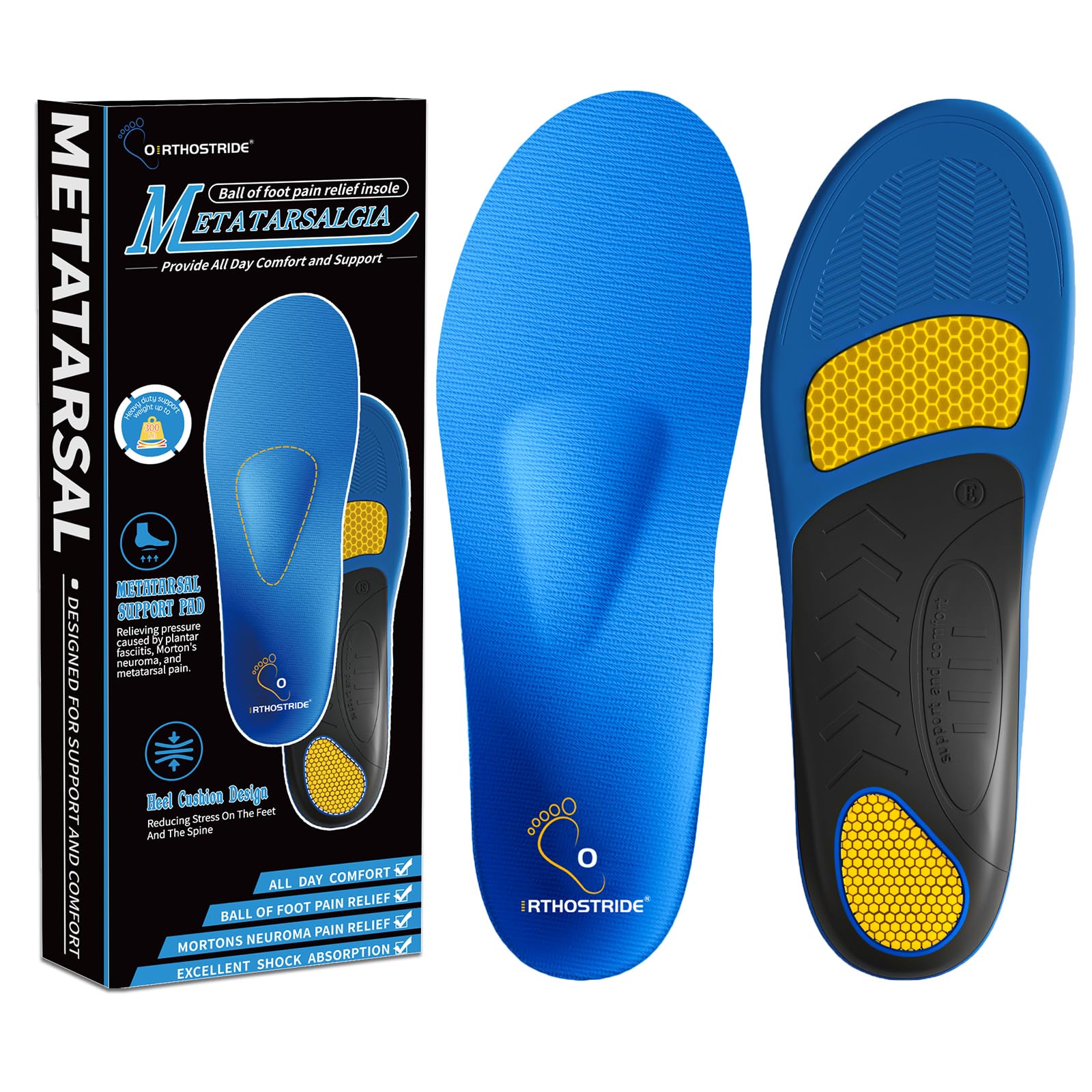
A full-length orthotic built for people paid to stand, with a deep U-shaped heel cup for stability
This insole is built for one lifestyle above all: standing all day. Its built-in metatarsal pads alleviate forefoot pressure while a deep U-shaped heel cup enhances heel and ankle stability, preventing excessive movement that leads to sprains. The shock-absorbing PU foam (a resilient cushioning foam) with breathable fabric is designed to keep feet cool and dry through long shifts, targeting metatarsalgia, Morton’s neuroma, and general ball of foot pain.
Pain relief leads the most-praised aspects, with quality second. Customers note the targeted cushioning and arch support relieving ball-of-foot pain from standing, with the insoles fitting easily, staying put, and proving great for heavy-walking jobs. The metatarsal pads are described as making a noticeable difference during long periods on the feet, providing great cushioning without feeling bulky. One owner’s podiatrist recommended them specifically for metatarsalgia.
The honest caveat is fit and thickness. These are full-coverage insoles best suited to roomy footwear — wide-fit sneakers, work boots, or athletic shoes — and the data calls out the optimal fit requires a more spacious interior. Some owners find the metatarsal pad could be thicker and may flatten over time. Value for money also splits opinion, with a minority finding the cost hard to justify despite strong performance.
Built for the long shift: The combination of metatarsal pads and a stabilizing heel cup is exactly what standing workers need to finish a shift without aching.
Needs roomy shoes: Full coverage means wide sneakers or work boots — these will crowd a snug dress shoe.
Reach for this if: you stand or walk for hours in sneakers, work boots, or athletic shoes and want full-foot support.
Look elsewhere if: your problem shoes are tight loafers or heels — the full length will not fit.
9. PowerStep Pinnacle Plus Met

The best-selling full-length orthotic with built-in metatarsal pads, trusted by over 11,000 owners
This is the heavy hitter of the category — nearly 11,000 owners have filed in behind it, and the reason shows in the numbers: pain relief is the top-praised aspect, with comfort right behind. Its built-in metatarsal pads add targeted cushioning under the forefoot, paired with neutral arch support and a deep heel cradle that improves stability and motion control for standard arches. A dual-layer construction puts premium foam on top for shock absorption from heel to toe.
Relief stories are rapid and dramatic. A hiker with high arches, tight Achilles, and wide feet went from “hiking hell to hiking heaven” — completing 7-mile hikes pain-free in trail runners. A delivery driver credits it with curing ball-of-foot pain., A runner fixed metatarsalgia from a big-toe injury within an hour., and reviewers sum it up: “they make a huge difference in my walking stamina and eliminated my foot pain.” The firm-but-flexible arch also helps address mild to moderate pronation (inward rolling of the foot).
Fit is the most-mentioned aspect and it is genuinely mixed. Sized by your normal shoe size, most owners find it works as expected, but some find it too big for their shoes — these are full-length inserts that require removing the factory insole. Durability also varies: one owner wore through the toe after 2 months of delivery driving, while others report sturdy transfer between shoes. PowerStep recommends a two-week break-in, starting at 1 hour a day and adding an hour daily.
Why it leads the pack
- Built-in metatarsal pads plus deep heel cradle correct the whole foot
- Dual-layer cushioning absorbs shock from heel to toe
- Proven at 7-mile hikes and 40-hour delivery weeks
What to expect
- Full length requires a removable factory insole — not for tight shoes
- Two-week break-in needed, starting at 1 hour a day
Best for: walkers, runners, and hikers who want a proven full-length orthotic and will follow the break-in period.
Pass if: your shoes cannot remove the factory insole or you need instant comfort with zero adjustment period.
Understanding the Specs
3/4 Length vs. Full Length
3/4 length insoles stop before the toes, which is why they fit loafers, oxfords, flats, and other low-profile shoes. Full-length insoles run the entire shoe and need a removable factory insole plus a roomy interior — they belong in wide sneakers, work boots, or athletic shoes. Matching the length to your footwear is the single biggest factor in whether an insert actually works.
Metatarsal Pad Placement
A metatarsal pad sits just behind the ball of the foot, lifting that area to shift weight back toward the arch. Some are built into an orthotic shell, some are self-adhesive pads you place yourself. The classic placement for neuroma pain is behind the second and third metatarsal heads — the spot that takes the most impact when you walk.
Materials and Durability
Wool felt is soft, moldable, and cheap, but it flattens within days. Leather-covered dense foam lasts far longer and resists odor. Rigid orthotics made from materials like Q-E.V.A. (a lightweight supportive foam) hold their shape for years. Consider how often you will replace the pad and whether you will move it between shoes.
Break-In Period
Rigid orthotic insoles often require a break-in period — PowerStep recommends two weeks, starting at 1 hour a day and increasing by an hour daily. Soft adhesive pads give instant relief but need replacing. If you want immediate comfort, choose a pad; if you want long-term correction, be ready to invest in the break-in.
FAQ
Will ball of foot inserts fit my dress shoes or loafers?
What is the difference between a metatarsal pad and a full orthotic insole?
How long do adhesive felt pads last before needing replacement?
Are ball of foot inserts reusable or disposable?
Will these help with Morton’s neuroma specifically?
What size should I order for ball of foot inserts?
Can I move the same insert between different pairs of shoes?
Do I need a break-in period for these inserts?
Final Thoughts: The Verdict
Across the board, the ball of foot inserts winner is the Pedag Holiday because it combines decade-plus durability with a 0.15-inch profile that disappears into dress shoes while still delivering real arch and metatarsal support. If you live in high heels, grab the Chiroplax pads — the slip-resistant leather top and reusable adhesive turn punishing shoes into walkable ones. And for all-day standing in sneakers or work boots, the PowerStep Pinnacle Plus Met is the one to reach for, trusted by over 11,000 owners and proven at 7-mile hikes.
How We Picked
We do not accept paid placement. Every pick is matched to a real buyer and a real use-case; we do not hands-on test units.
Sources & Methodology
Specifications: manufacturer listings and product documentation. Review insights: verified customer reviews, as of August 2026. Pricing: not shown on this page (it changes often); check the current price via the retailer link.
As an Amazon Associate, Gadgets Feed earns from qualifying purchases. This does not affect which products we feature.