
Our readers keep the lights on and my morning glass full of iced black tea. As an Amazon Associate, I earn from qualifying purchases.
Specs are compiled from manufacturer listings and verified buyer reviews and can change over time — please confirm the key details on the product page before buying.
You don’t buy a backpack solar panel for the wattage sticker — you buy it so your phone, power bank, or CPAP battery isn’t dead when you’re miles from an outlet. The real question is which panel delivers its rated wattage in real sunlight, survives rough handling, and folds compactly for your pack. This guide cuts through the specs to focus on real output, portability, and the trade-offs between them.
I’m Min — the founder and writer behind Gadgets Feed. This guide is built by comparing the manufacturers’ published specifications and the patterns across verified customer reviews, so you get each pick’s real strengths and trade-offs instead of marketing spin.
Whether you’re topping off a Jackery at a campsite or keeping a fridge alive during an outage, the right backpack solar panel balances wattage, weight, and weatherproofing for your exact trips.
Our Picks at a Glance


How To Choose The Best Backpack Solar Panel
A panel’s real output depends on sun angle, cloud cover, and heat, so match its size and features to your actual use.
Match the wattage to your power station
A 100W panel charges a small station far faster than a 30W one, but only if the station accepts that much input. A power station with a 60W input limit will only draw 60W from a 100W panel, so buying the biggest panel isn’t always the smartest move.
Read the waterproof rating carefully
The IP rating indicates how much weather a panel can withstand. IP65 handles dust and light rain, while IP67 survives full submersion in water — but even then, the zippered pocket protecting the controller is the part you really need to keep dry.
Don’t ignore the connectors
Your power station determines which cable you need: XT60 for EcoFlow, Anderson for Jackery, MC4 for Renogy’s direct battery output, or USB-C for charging phones and tablets straight from the panel. A 5-in-1 cable saves you carrying a bag of adapters.
Quick Comparison
| Model | Best For | Max Power | Efficiency | Weight | Amazon |
|---|---|---|---|---|---|
| ZOUPW 100W★ Best Overall | Top Overall Output | 100 watts | 23.5% | 9.5 lbs | Amazon |
| FlexSolar 60WBest Value | Best Lightweight Value | 60 watts | 24% | 2.6 lbs | Amazon |
| Anker SOLIX PS30Compact Pick | Compact Backpacking | 30 watts | — | 2.2 lbs | Amazon |
| Luvknit 100W | Value with Adapters | 100 watts | 24% | 8.2 lbs | Amazon |
| FlexSolar 100W | Ultra-Portable Power | 100 watts | 23%+ | 4.1 lbs | Amazon |
| Renogy 100W | High-Efficiency Build | 100 watts | 25% | 7.3 lbs | Amazon |
| EBL Solar 100W | Universal Compatibility | 100 watts | 23% | — | Amazon |
| ELECOM NESTOUT 28W | Backpack Strapping | 28 watts | High | 1.7 lbs | Amazon |
| Renogy 200W | Max Off-Grid Input | 200 watts | 25% | 13.9 lbs | Amazon |
In‑Depth Reviews
1. ZOUPW 100W Portable Solar Panel
Our pick — over 4.5★ from 700+ verified ratings; the strongest balance of quality and price.
The powerhouse that quietly out-charges everything else in this roundup on real campsite sun.
This is the pick for anyone who runs a power station and wants to actually refill it in hours, not days. Its 23.5% efficient A+ monocrystalline cells push a true 100-watt maximum, and the twin kickstands angle it at 45° to capture up to 25% more sunlight than laying flat — the difference between a dying Jackery and a topped-off one by dinner. Buyers report charging from 62% to 100% in 1.5 hours, a 38% gain that makes 100W panels feel almost luxurious.
The 5-in-1 connector cable is the real travel hack: DC8020 for Jackery Explorer series, XT60 for EcoFlow DELTA/RIVER, Anderson, DC7909, and DC5521 all in one 10ft cable, so you rarely need a bag of adapters. It’s IP67 waterproof with an ETFE coating that resists heat and rain, though the wise move is keeping the zippered pocket dry since that’s where the controller lives. At 9.5 lbs folded to 24.13 x 21.06 x 1.77 inches, it’s not a day-hike panel — this is car camping, RVing, and overlanding territory. The built-in USB-C PD (15V/3A) and two USB-A ports (QC3.0 12V/1.5A) also let you charge phones and tablets directly without a generator in the loop.
Compared to the FlexSolar 60W below, this delivers 67% more power at 100 watts versus 60, and its amperage capacity of 4.96 A beats that panel’s 3.03 A — a 64% gap that matters when you’re feeding a hungry station. Reviewers consistently call out the well-built feel and sturdy nylon canvas, though the kickstands lack fine adjustability and the magnetic clasp, while satisfying, doesn’t replace a proper stand. One owner noted it’s a bit large and awkward for a wheelchair user, and the price has crept up since launch. The recurring reality check: some units deliver near 100W while others see only 20-25W, so expect real-world output to depend heavily on sun angle and cloud cover.
What Wins People Over
- Quality is the most-praised trait, backed by steady 100W-class output in good sun
- Charging performance earns strong marks, with a 5-in-1 cable covering nearly every power station
- IP67 waterproofing plus ETFE coating handles rain and heat on RV and marine trips
What to Watch
- Power output is honestly mixed — some owners see 20-25W instead of 100W depending on conditions
- At 9.5 lbs it’s heavy for long carries; the built-in USB-C caps at 45W, not the 60W some expect
Reach for this if: you have a Jackery, EcoFlow, Bluetti, or Anker station and want one cable plus real 100W-class charging at a campsite or in an outage.
Look elsewhere if: you’re backpacking — 9.5 lbs is a lot to haul, and the FlexSolar 100W at 4.1 lbs is the lighter path to similar wattage.
2. FlexSolar 60W Foldable Portable Solar Panel Charger
The featherweight folder that turns a laptop-sized slab into 60W of genuine roadside power.
This is the balance for hikers and car campers who want real charging without lugging a 10-pound brick. At just 2.6 lbs with a folded size of 9.8 x 12 x 1 inches — basically a thick magazine or small laptop — it slips into a backpack side pocket and barely registers. Its A+ monocrystalline cells hit up to 24% energy conversion, and owners mention ~40W through the PD40 USB-C port flat on the ground in late afternoon sun, climbing to 50W via the DC output.
Where this panel really wins is its triple-port flexibility. The QC3.0 USB-A tops out at 18W, the PD3.0 USB-C at 40W, and the DC output at 60W (20V-28V), so you can charge an iPad, phone, and a small power station under 300Wh all at once, guided by an LED indicator that tells you when the light is strong enough to bother. It’s IP67 waterproof and dustproof (up to 24% efficiency), though the junction box itself isn’t waterproof, so treat that spot with care. The 6-section fold means no kickstand — you lay it flat or prop it — and while it’s light, it’s still described as a little burden for serious hiking, more suited to camping and driving trips.
Compared to the ZOUPW 100W above, this trades top-end power for portability: 60 watts versus 100, and 3.03 A versus 4.96 A, but at a fraction of the weight and a friendlier folded footprint. Buyers praise the build quality as its most-mentioned strength, noting it charges a CPAP battery pack in 2-3 hours of direct sun. The honest caveats: in shade the output sags noticeably, owners note it takes a while to fully charge a large power station, and the port caps are vulnerable if left open — an occasional unit has died after months in storage, so it rewards regular use.
Why it earns its spot: For the price, you get 60W of actual output, three charging ports, and IP67 weather resistance in a 2.6-lb package that folds to magazine size — the best pure value in this list.
Best for: car campers, road-trippers, and emergency kits where every pound counts and you don’t need to feed a large station.
Think twice if: you run a 500Wh+ power station — a 60W panel will take all day to refill it, and a 100W panel is the better match.
3. Anker SOLIX PS30 Portable Solar Panel
The ultralight 30W charger that disappears into a pack and tops off phones all afternoon.
This is the pure backpacking play — a 2.2-lb, 30W panel built from aluminum, monocrystalline silicon, and tempered glass that folds down to 10.7 x 8.8 x 1.7 inches and rides on a pack with the included carabiners. It’s IP65 weather-resistant, so light rain and dust won’t stop it, and it’s designed to charge smartphones, tablets, and cameras straight through USB-A and USB-C ports. Customers note portability as its standout trait, with several noting it fits perfectly in backpacks and is ideal for multi-day trails.
The reality check on wattage is the same one that hits every small panel: real output rarely matches the sticker. Reviewers point out it charges an iPhone from 50% to full in about 2 hours, but several note it delivers barely 10W of charge input rather than the rated 30W — the power output is the most-discussed aspect, and it’s a mixed bag. It won’t refill a power station meaningfully; this is a device-charging panel, not a station-refilling one. There’s also a durability note worth sizing honestly: some units have struggled after a couple of months, and Anker has refunded owners in those cases rather than leaving them stranded.
Where it beats the ELECOM NESTOUT below is raw name-brand reliability and the 18-month warranty, though it lacks that panel’s built-in current checker and mesh storage pouches. If your trip is about keeping a phone, GPS, and camera alive — not running a fridge — this is a genuinely great fit. The catch is that 30W is simply not enough for anyone planning to charge a laptop or power station, and the carabiners, while handy for angling, don’t replace a proper kickstand.
What Owners Rave About
- Portability is the most-praised feature — it fits perfectly in a backpack
- Sturdy tempered glass and aluminum build feel premium for the weight
- USB-A and USB-C ports charge multiple small devices at once
Honest Fit Notes
- Power output is the most-discussed aspect and it’s mixed — some see barely 10W instead of 30W
- Not built for power stations or laptops; it’s a phone-and-tablet panel
Grab this for: weekend hikes and international travel where keeping a phone alive for 2-3 days is the whole job.
Step up if: you expect to charge a power bank or station — the FlexSolar 60W at barely more weight delivers double the wattage.
4. Luvknit 100W Portable Solar Panel (with Controller)

The 100W value champ that ships with a controller and enough adapters to match almost any station.
If you want 100W-class power without the premium badge, this Luvknit delivers — its monocrystalline cells claim up to 24% conversion efficiency, and it comes with a dedicated power controller plus a cable that adapts DC5521 to Anderson, DC, and XT60, along with four barrel adapters (8020/7909/5525/5315). That’s a serious accessory kit for the price, and shoppers say it charges a Jackery in about 2.5 hours with plug-and-play simplicity. The foldable design with a carry handle and built-in kickstand sets up in seconds, and at 8.2 lbs it’s manageable for car camping.
The honest truth on output: it’s mixed. Some owners see a real 95-96W in strong sun, while others get around 55W versus the 100W lab rating — and the charging speed is the single most-discussed aspect in reviews, flagged as mixed rather than glowing. That’s a classic portable-panel reality: angle, heat, and cloud cover move the needle a lot. The package includes a power controller, which is a genuinely useful addition, though a few buyers report the advertised XT60 cable doesn’t always arrive in the box.
Compared to the ZOUPW at the top, this is the value play: similar 100W class and efficiency (24% vs 23.5%), but at a lower price point with a controller thrown in. The trade-offs are real — the kickstands are flimsy and fall in wind, and the USB 3.0 port has failed for at least one owner (with the seller replacing it). It’s lighter than the ZOUPW’s 9.5 lbs at 8.2 lbs, and the strong zippers and reinforced fabric give it a rugged campsite feel. Buyers put value for money as the most-praised trait, followed closely by how easy it is to set up.
Value proposition: The included power controller and five adapter types make this the cheapest way to get a full 100W charging rig that talks to almost any station — just don’t expect the full 100W in anything but ideal midday sun.
Who it’s for: budget-conscious campers and RVers who want 100W capability with a controller and adapter flexibility from the start.
Pass if: you need rock-solid kickstands in wind or guaranteed 100W — both are the weak points here.
5. FlexSolar 100W Foldable Portable Solar Panel
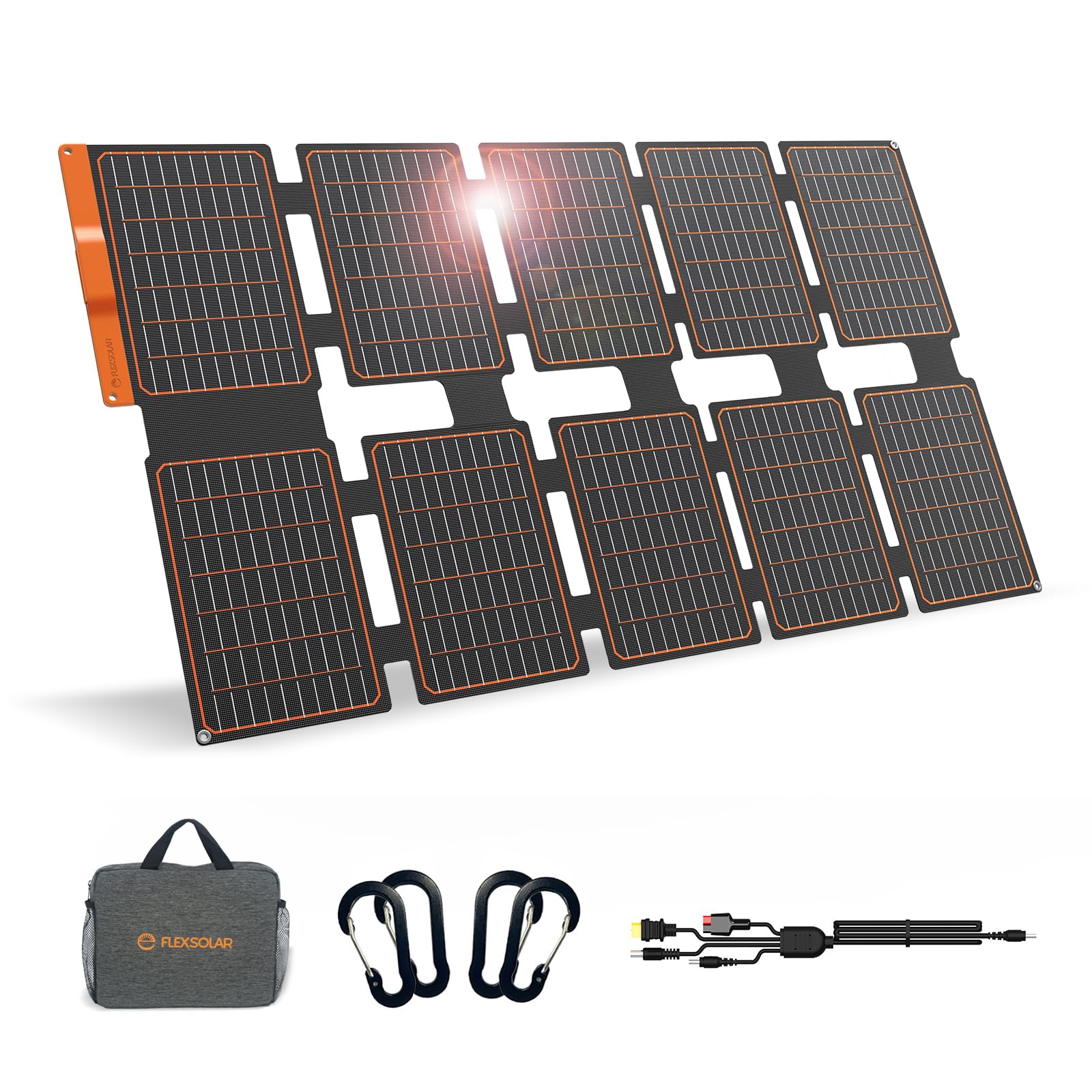
The 4.1-lb 100W panel that rewrites what “portable” means at this wattage.
This is the panel that makes you double-check the specs: a full 100W maximum in a package that weighs just 4.1 lbs and folds to 12.99 x 10.43 x 2.17 inches — smaller than a 15-inch laptop. Its monocrystalline cells with ETFE lamination deliver 23%+ energy conversion, and it’s IP67 waterproof and dustproof, so rain, sand, and downpours don’t shut it down. Owners mention real-world output around 80W in good sun, with one noting it charged an iPad from 9% to 95% in 7 hours — respectable for a panel this light.
The 3-in-1 output setup is genuinely useful: a PD 3.0 45W USB-C, an 18W USB-A, and a 100W DC output all run at once, and the included 4-in-1 cable (DC5521, DC7909, Anderson, XT60) means it’ll feed most stations and directly charge a laptop. Owners highlight the quality build and padded carry case as top traits, and note it works in partial shade better than you’d expect. The trade-offs: angling it is genuinely awkward with no kickstand, there’s no MC4 connector for direct battery hookup, and the DC/USB circuitry gets hot under 60W+ loads — so treat the plastic near the ports with care.
Against the Renogy 100W below, this is the weight winner at 4.1 lbs versus 7.3 lbs, but it gives up the adjustable kickstands and the UL certification. Reviewers describe it as remarkably packable and note the multi-connector cable is the star of the kit, though long-term durability is the open question — the plastic around the ports feels cheaper than the rest of the build. If your priority is carrying 100W on your back without the 9-lb anchor, this is the one.
What Stands Out
- Quality is the most-praised aspect, with a genuinely solid, premium feel
- Power output earns strong marks — ~80W real-world in good sun
- Compact size is a top trait, packing smaller than a 15-inch laptop
The Trade-offs
- No kickstand makes finding the right sun angle a chore
- Durability is the most-mixed aspect — plastic near ports feels less reassuring
Reach for this if: you want true 100W capability in a pack that’s lighter than most 60W panels — the best weight-to-power ratio on this list.
Choose the Renogy instead if: you need adjustable stands and certified safety over the absolute lightest build.
6. Renogy 100W Portable Solar Panel

The certified 25%-efficient workhorse for RVs, trucks, and anyone who wants dependable 100W without surprises.
Renogy’s E.Flex 100W brings the brand’s utility-grade reputation to a portable format: 25% efficiency from 16BB N-Type cells (outperforming standard 9BB panels at 22.5%), IP65 weather protection, and a UL 61730 certification that signals serious safety testing. It folds to backpack size at 22.99 x 22.54 x 1.57 inches and weighs 7.3 lbs, with a magnetic closure and four adjustable kickstands offering 40°/50°/60° angles — the setup genuinely helps you chase the sun. Customers note real-world output from 87W to 96W in full sun, which is about as close to the sticker as portable panels get.
The connectivity is built for RV life: a USB-C PD port (45W max) and two USB-A ports (18W and 15W) charge three devices at once, while the MC4 output feeds a power station or 12V battery system including AGM, LiFePO4, and deep-cycle batteries. The built-in accessory pouch and reinforced grommets for staking (or mounting on an RV) make it feel like a permanent rig rather than a disposable gadget. Buyers consistently note it recharges Bluetti and Anker stations in about 2 hours of good sun.
The honest caveats: the included MC4 cable is only 3 feet with no adapters, so you may need a heavy-gauge extension, and the kickstands are the most-mixed aspect — flimsy in wind, with owners propping the panel against a tire or chair instead. It’s also note the USB-C tops out at 40W rather than the labeled 45W. Compared to the ZOUPW at the top, this wins on verified efficiency (25% vs 23.5%) and certification, but it lacks that panel’s 5-in-1 universal cable, so check your station’s connector before buying.
The standout: 25% efficiency plus UL certification makes this the most trustworthy 100W panel here — what you see is close to what you get, with owners reporting up to 96W in full sun.
Best for: RV owners, truck campers, and off-grid folks who want a certified, efficient panel that mounts or stakes down and feeds a 12V battery system.
Note the catch: the short 3-ft cable and no adapter options mean you must verify your power station’s input before committing.
7. EBL Solar 100W Portable Solar Panel
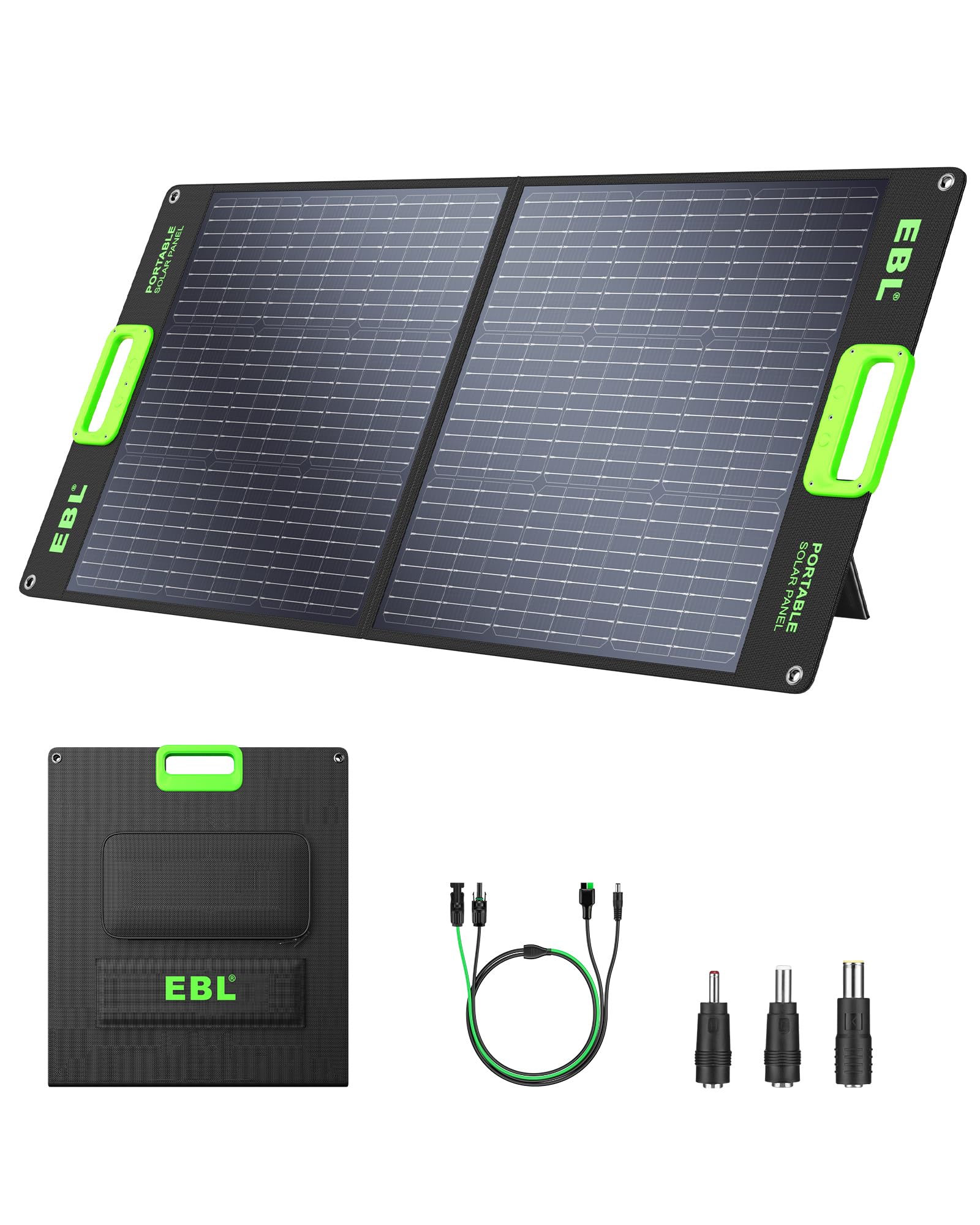
The 100W adapter bundle that talks to nearly any generator, fridge, or computer on the market.
EBL’s Apollo 100W is built around compatibility — its upgraded monocrystal cells hit 23% efficiency, and the box includes MC4-to-Anderson and MC4-to-DC5521 cables plus three barrel adapters (5.5×2.1 to 5.5×2.5, 7.9×0.9, and 3.5×1.5), so it matches most generators and even some computers. Reviewers point out performance as its top trait, with one noting it powered a 75-quart fridge, and another hitting 148W during an Ohio summer afternoon. The dual kickstands angle it at 45° for up to 20% more sunlight than flat laying, and the magnetic handle makes folding and storage genuinely easy.
The Smart IC adds overcharging, overheating, and short-circuit protection, which is a meaningful safety net for direct device charging. It’s IP65 water-resistant with ETFE lamination — fine for splashes, but the maker explicitly warns against leaving it in rain or soaking it, so this is a dry-day panel. The honest reality: some shoppers say a true 100W while others see around 65W, and output sags to just 1-2W in clouds or shadow. That’s the single most-mixed aspect, and it’s worth sizing your expectations accordingly.
Against the ZOUPW at the top, this offers similar 100W class and efficiency (23% vs 23.5%) but with a different connector strategy: MC4-based rather than a single 5-in-1 cable. Owners praise the durable build and how cables and connectors store neatly in the back pocket. The weak points are the 6-ft cable (shorter than ideal for positioning) and the fact it’s not fully waterproof despite the IP65 label — treat it as splash-resistant, not rain-proof.
What Impresses
- Performance is the most-praised trait — one owner ran a 75-qt fridge off it
- Quality follows close behind, with a rugged build and magnetic folding handle
- Smart IC protection guards against overcharging and short circuits
Where It Falters
- Power output is honestly mixed — some see 65W instead of 100W, and clouds drop it to 1-2W
- IP65 means splash-resistant only; the maker warns against real rain exposure
Grab this if: you have multiple brands of gear and want one panel with enough adapters to match them all without buying extras.
skip it if: you camp in wet climates — the IP65 rating and rain warning make this a fair-weather panel.
8. ELECOM NESTOUT Portable Solar Panel (28W)

The award-winning 28W panel built like field gear, with a current checker that shows you real charging at a glance.
The NESTOUT Outdoor Series won an IF Design Gold Award, and the design DNA shows everywhere: a durable water-resistant ripstop nylon case, two mesh storage pouches for cables and battery packs, three exterior loops for hanging from trees or tents, and two built-in adjustable stands. It uses SunPower MAXEON cells for up to a 24% efficiency increase over traditional cells, delivering 28W of maximum power in a 1.7-lb package that folds to 30cm x 20cm x 5cm and straps cleanly onto a backpack. Buyers report charging a device from 40% to 80% in 1 hour and 35 minutes in good sun.
The built-in current checker LED display is the differentiator here — it shows the actual solar power flowing into the USB ports, so you’re never guessing whether the angle is working. Dual USB-A ports charge phones, tablets, and earbuds, making this a pure device-charging panel rather than a power-station feeder. Owners praise the charging performance and portability most, with one noting it’s ideal for remote travel and another describing the handy pouch for a battery pack and cords as the standout feature — it’s compact enough to strap on a pack or slip inside.
The limitations are clear: at 28W, this won’t meaningfully charge a power station, and the included instructions are only in Japanese, which frustrates some buyers. But for its intended job — keeping a phone, GPS, and earbuds alive on a river trip or long hike — owners mention it charges fast and keeps everything topped off. Compared to the Anker PS30 above, this offers the current checker and storage pouches, though Anker carries a stronger brand warranty at 18 months versus this panel’s 1-year coverage.
The defining strength: Charging performance is the most-praised trait, and the built-in current checker means you always know if you’re actually catching rays — no more guessing.
Reach for this if: you spend multi-day trips in remote places and want a weather-resistant panel that hangs from a tree, charges your devices, and tells you its real output.
Look elsewhere if: you need to charge a power station or laptop — 28W is strictly for small devices, and Japanese-only instructions are a real annoyance.
9. Renogy 200W Portable Solar Panel
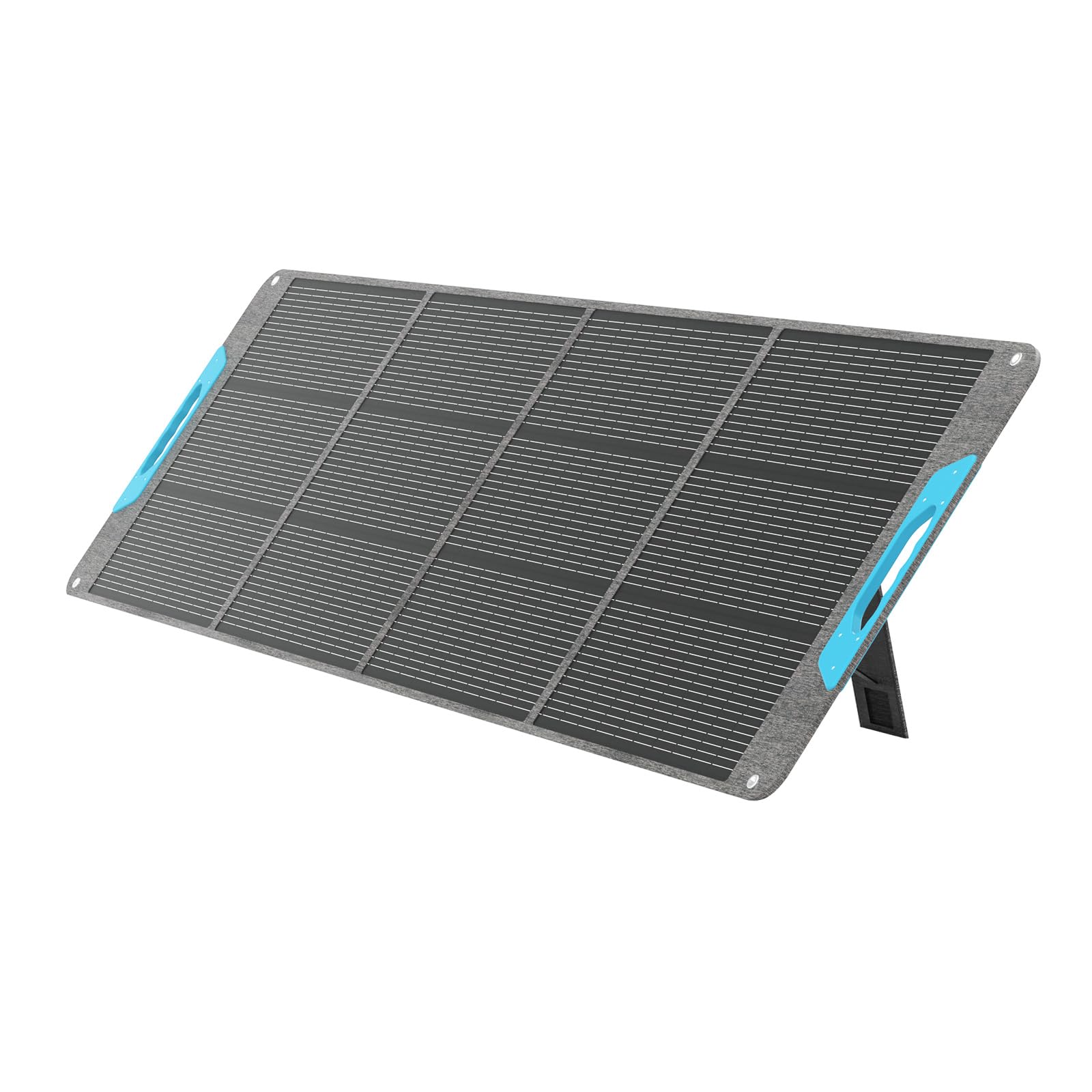
The 200W powerhouse for boondockers and van-lifers who need real power, not a phone trickle.
This is the panel for serious off-grid setups, not backpack trips — a 200W maximum with 25% efficiency from 16BB N-Type cells, meaning it packs more punch per square inch of sunlight than standard 9BB panels at 22.5%. It folds to 23.72 x 22.99 x 1.97 inches and weighs 13.89 lbs with a magnetic closure and four adjustable kickstands offering 40°/50°/60° angles. Customers note 154W through a 10ft cable under load, and one owner ran a 60W laptop load while keeping a battery at 99-100% — it handles real work.
The connectivity is built for a mobile rig: a USB-C PD (45W max) and two USB-A ports (18W and 15W) charge three devices simultaneously, while the MC4 output feeds a power station or 12V battery system including AGM, LiFePO4, and deep-cycle batteries. It’s IP65-rated, UL 61730 certified, and backed by a 2-year material and workmanship warranty. Owners praise the quality and functionality most, noting it works particularly well with Bluetti AC70 systems and excels at boondocking — the dust-resistant exterior stays clean in the backcountry.
The honest trade-offs: the kickstands are described as janky in wind, no cable is included in the box, and output averages around 133W in full summer sun rather than the full 200W (output drops with heat — keeping it cool off the ground helps). One owner noted running two in series avoided clipping on an Anker C-1000, which shows the voltage math matters if you’re building a serious rig. Compared to the ZOUPW at the top, this is a different class entirely — you’re buying it to run a fridge, CPAP, or laptop continuously, not to top off a phone, and the weight makes clear it’s for vehicle-adjacent camping, not hauling on your back.
What Makes It Great
- Quality is the most-praised trait, with functionality a close second — it handles real appliance loads
- 25% efficiency and UL 61730 certification add genuine trustworthiness
- Triple charging ports plus MC4 output cover devices and stations at once
Honest Limitations
- Power output is the most-mixed aspect — expect ~133W average in summer, not the full 200W
- No cable in the box, and the kickstands are flimsy in wind despite the rugged build
This is for: boondockers, van-lifers, and emergency preppers running fridges, CPAP machines, or laptops who need a panel that earns its keep daily.
Skip it for: backpacking or trips where you’ll carry it far — 13.9 lbs demands a vehicle, and the missing cable is an extra purchase.
Understanding the Specs
Watts and Amps
The wattage rating (100W, 60W, 30W) is a lab ceiling; real output depends on angle, clouds, and heat. Amperage (4.96 A, 3.03 A) tells you how fast current flows, which matters when your power station’s input limit caps how much it will draw. A 100W panel only helps if your station accepts that much.
Efficiency and Cell Type
Efficiency (23.5%, 24%, 25%) measures how much sunlight becomes electricity — higher means more power from the same panel size. Monocrystalline cells are the standard for portable panels because they convert more light than older poly types. ETFE coating adds durability and heat resistance over basic PET wraps.
IP Weather Ratings
The IP code tells you what weather a panel survives. IP65 handles dust and light rain; IP67 survives submersion in water. But even an IP67 panel’s junction box or zippered controller pocket may not be waterproof, so check the fine print before leaving it out in a downpour.
Connector Types
Your power station dictates the cable: XT60 for EcoFlow, Anderson for Jackery, MC4 for direct 12V battery hookup, and USB-C or USB-A for charging phones and tablets straight from the panel. A 5-in-1 or 4-in-1 cable bundles several standards, saving you from carrying a bag of adapters.
FAQ
Will a 100W solar panel work with my Jackery or EcoFlow power station?
How much actual power will I get in real sunlight?
What’s the difference between IP65 and IP67 waterproof ratings?
Can I charge my phone or tablet directly without a power station?
How heavy is too heavy for a backpack solar panel?
Is a 30W panel enough for camping?
How long does a portable solar panel last?
What’s the difference between a 100W and a 200W solar panel?
Do I need a solar charge controller between the panel and my battery?
Can I charge a laptop directly from a backpack solar panel?
Final Thoughts: The Verdict
If you want one dependable pick, the backpack solar panel winner is the ZOUPW 100W because it delivers genuine 100W-class charging with a 5-in-1 cable and IP67 weatherproofing — a real workhorse for the price. If you want featherweight portability, grab the FlexSolar 60W, which folds to magazine size at just 2.6 lbs. And for pure off-grid power running a fridge or CPAP, the Renogy 200W is the one to reach for — provided you have a vehicle to carry its 13.9 lbs. Match the wattage to your biggest device and verify your station’s connector to avoid a dead battery.
How We Picked
We do not accept paid placement. Every pick is matched to a real buyer and a real use-case; we do not hands-on test units.
Sources & Methodology
Specifications: manufacturer listings and product documentation. Review insights: verified customer reviews, as of August 2026. Pricing: not shown on this page (it changes often); check the current price via the retailer link.
As an Amazon Associate, Gadgets Feed earns from qualifying purchases. This does not affect which products we feature.