
Our readers keep the lights on and my morning glass full of iced black tea. As an Amazon Associate, I earn from qualifying purchases.
Specs are compiled from manufacturer listings and verified buyer reviews and can change over time — please confirm the key details on the product page before buying.
If your azaleas look thin, pale, or just refuse to put on a show, the problem is almost always the soil pH and the food you’re giving them. Azaleas are acid-loving plants, and they simply cannot pull nutrients from neutral or alkaline soil. The right fertilizer lowers soil pH and feeds roots, turning a sad shrub into a wall of color—this guide sorts out which one.
I’m Min — the founder and writer behind Gadgets Feed. This guide is built by comparing the manufacturers’ published specifications and the patterns across verified customer reviews, so you get each pick’s real strengths and trade-offs instead of marketing spin.
Granular or water-soluble, organic or synthetic, each option here earns its place for a specific garden situation. This is your practical roadmap to picking the right azalea fertilizer for your shrubs, your soil, and your schedule.
Our Picks at a Glance


How To Choose The Best Azalea Fertilizer
Azaleas demand acidic soil and a specific nutrient balance. They need a fertilizer that does two jobs at once: it must supply nutrients and it must help keep the soil acidic. The wrong fertilizer causes yellow leaves and no blooms, regardless of feeding frequency.
Decode the N-P-K Ratio
The three numbers on any bag tell you the percentage of nitrogen, phosphorus, and potassium. Acid-loving fertilizers are usually higher in nitrogen, and they often include sulfur to help lower soil pH. A 4-3-4 granular option feeds steadily, while a higher-nitrogen formula like 17-6-6 pushes lush green growth hard.
Granules vs. Water-Soluble
Slow-release granules sit in the soil and feed over weeks, which suits busy gardeners who want a “low-maintenance” routine. Water-soluble powders mix into a watering can and feed instantly, which is better for potted plants or a quick rescue of a struggling shrub.
Check the Micronutrients
Beyond the big three, azaleas need trace elements like iron and magnesium. These prevent chlorosis, which is the yellowing between leaf veins that shows up when the soil is too alkaline. Micronutrients like iron and magnesium prevent chlorosis and are the hidden detail that separates good from great.
Quick Comparison
| Model | Best For | Form | N-P-K Ratio | Weight | Amazon |
|---|---|---|---|---|---|
| Espoma Holly-Tone 36 lb★ Best Overall | Big gardens & organic feeding | Granules | 4-3-4 | 36 lb | Amazon |
| Schultz 14-7-7Fast Bloomer | Fast results & camellias | Granules | 14-7-7 | 3.5 lb | Amazon |
| Dr. Earth Acid LoversPet-Safe Pick | Organic & pet-safe feeding | Granules | 0.3-0.4-3 | 4 lb | Amazon |
| Miracle-Gro Water Soluble | Quick feeding & potted plants | Powder | 30-10-10 | 5 lb | Amazon |
| GARDENWISE 8-4-8 | Iron-rich feeding & soil acidifying | Granules | 8-4-8 | 32 oz | Amazon |
| FoxFarm Happy Frog | Gentle feeding & soil microbes | Powder | — | 4 lb | Amazon |
| Jack’s Classic 17-6-6 | Heavy growth & foliar feeding | Powder | 17-6-6 | 1.5 lb | Amazon |
| Fertilome 9-15-13 | Big root blooms & phosphate | Granules | 9-15-13 | 10 lb | Amazon |
| Espoma Holly-Tone 18 lb | Mid-size gardens & organic | Granules | 4-3-4 | 18 lb | Amazon |
In‑Depth Reviews
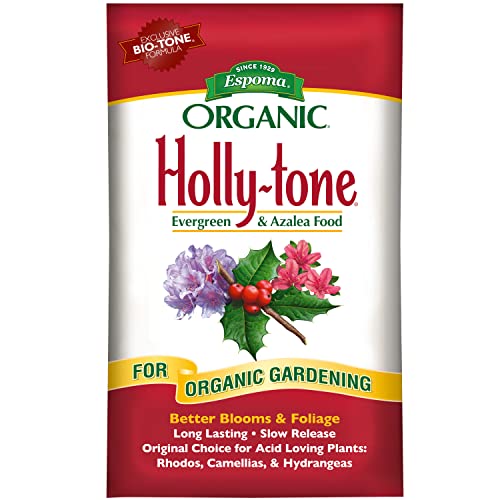
1. Espoma Organic Holly-Tone 4-3-4 (36 lb. Bag)
Our pick — over 4.5★ from 950+ verified ratings; the strongest balance of quality and price.
The original acid-feeding giant that turns a whole yard of shrubs into a bloom factory.
If you want one bag that handles everything from azaleas to hydrangeas to blueberries, this is the crowd favorite — 4.8 stars across over 900 owners. It is a 4-3-4 organic granule with 5% sulfur, which means it feeds steadily while nudging your soil toward the acidity azaleas need. The 36-pound bag is the single biggest supply in this lineup, giving you enough for spring and fall feedings all season long.
You get lush blooms and healthy berries without any mixing. Buyers report their azaleas blooming all summer, holly berries turning red and lush, and one owner describing the results as “on the miracle level.” You just scatter the granules around the drip line and water them in — no prep needed.
The catch is the size: a 36-pound bag is overkill for a single potted azalea, and you will be storing it for years. But if you have a real bed of acid-loving plants, this is the most economical and dependable choice in this guide.
Why It Earns The Top Spot
- Approved for organic gardening as a registered Organic Input Material.
- 36-pound bag covers a large landscape without rebuying.
- Slow-release organics create a long-lasting nutrient reservoir.
- Made in the USA by Espoma, in the natural organics business since 1929.
Who Should Think Twice
- Overkill for a single container plant or tiny patio planter.
- The 36 lb size needs dry indoor storage space.
Reach for the big bag if: you have a full bed of azaleas, rhododendrons, or hydrangeas and want one organic, set-and-forget feeding routine.
Look elsewhere if: you only have a couple of pots — the 18 lb version suits you better.
2. Schultz Azalea, Camellia, Rhododendron 14-7-7
The quick-responding granule that puts visible color back on your bushes within a week.
This 14-7-7 slow-release granule is for the impatient gardener. Owners mention spreading it easily and noticing results in about a week, with blooms described as “almost iridescent” in sunlight. For a fertilizer at an entry-level price point, that speed is remarkable — the higher nitrogen ratio gives leaves a fast green-up while the slow-release coating keeps feeding for weeks.
Owners of camellias and rhododendrons are the most loyal fans here, with many using it every single year. It includes micronutrients, needs no mixing, and comes in a manageable 3.5-pound size that stores easily. One gardener even credits it with saving a rhododendron from dying.
It is a synthetic formula, so it is not the choice for certified-organic gardens. But if your priority is fast, visible results on a tight budget, this punches well above its weight.
Between this and the Espoma above, the trade-off is speed versus scale: Schultz shows results in days, while the Espoma 36 lb bag feeds a far larger area.
Grab this for: camellia and rhododendron owners who want an affordable, fast-acting granule with proven yearly results.
Skip if: you need a certified-organic label or a bag big enough for a whole landscape.
3. Dr. Earth Acid Lovers Azalea, Camellia & Maple Fertilizer
The cleanest organic formula around, handcrafted for gardens where pets and kids roam.
For the gardener who reads every label, Dr. Earth is the standout. It is the only Non-GMO Project Verified fertilizer made in the USA, and it is OMRI, CCOF, and NOP listed — certifications that mean it meets strict organic standards. The granules are described as people and pet safe, with no synthetic chemicals or toxic ingredients, making it the obvious pick for yards where children and animals play.
Customers note it reviving sad camellias with no digging or compost tea needed — just toss it on and water. The reviews are full of rescued shrubs, from a saved azalea bush to gardenias blooming better than ever. It even works in notoriously alkaline Texas soil, which is the toughest test an acid-lover can face.
Keep in mind this is a 4-liter bag, which is small next to the Espoma’s 36 liters — that is a 9.0x gap in volume. The value-for-money feedback is mixed, since the premium organic certification carries a higher price per pound. For a few special shrubs, that purity is worth it.
Who it fits: organic purists and pet-owning households who prioritize clean ingredients over bulk quantity. The certification list here is class-leading in this guide.
4. Miracle-Gro Water Soluble Azalea, Camellia, Rhododendron Plant Food

The instant-feed solution that rescues potted plants and garden beds alike in a single watering.
This is the one to reach for when a plant looks sad right now. It is a water-soluble powder, so it feeds instantly the moment it hits the roots, and it is the most versatile product here — it covers azaleas, camellias, rhododendrons, gardenias, hibiscus, hollies, hydrangeas, and even orchids. That makes it a single product for an entire indoor and outdoor collection.
The formula is designed to be gentle, and the maker states it won’t burn foliage when used as directed. Mixing ratios are clearly marked at 1:144 for indoor feeding and 1:18 for outdoor, so you can tailor the strength. Reviewers point out rhododendrons recovering and greening up within a week. A 30-year user swears it is more effective than a popular holly fertilizer.
One honest gripe: the resealable Velcro bag closure collects powder and stops sealing properly over time. Buyers suggest wiping it clean before closing. That is a minor annoyance against a fertilizer that is otherwise universally praised.
Best for: gardeners juggling many types of acid-loving plants, or anyone who wants results they can see within days instead of weeks. The bag-closure quibble is the only real downside.
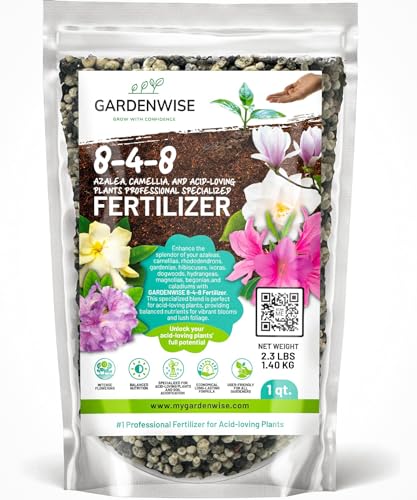
5. GARDENWISE 8-4-8 Acidic Fertilizer
The iron-loaded formula that cures yellow leaves and pushes out a torrent of blooms.
If your azalea leaves are yellowing between the veins, that is chlorosis — an iron deficiency caused by alkaline soil. This 8-4-8 blend tackles it head-on with magnesium, iron, and manganese, and it doubles as a soil acidifier. Shoppers say incredible results in just two weeks, with one rhododendron looking 75% healthier within 24 hours of application.
The slow-release granules are designed for just three feedings per year, which makes the routine remarkably simple. It also contains live bacterial microbes from a refined bio-solid process, which helps enrich the soil itself rather than just dumping nutrients on top.
There are two honest cautions. The 32-ounce bag is smaller than it looks, and the packaging size draws frequent criticism. And while most plants thrive, there are reports of sensitive gardenias declining quickly, so start with a light application on young plants. It is a potent formula that rewards careful use.
Choose this if: your soil runs alkaline and your azaleas show yellow leaves that other fertilizers have not fixed.
Be careful if: you have delicate gardenias — apply sparingly and watch the response.
6. FoxFarm Happy Frog Acid Loving Plants Fertilizer

The gentle soil-feeding powder that revives frost-damaged bushes with beneficial fungi.
FoxFarm’s Happy Frog is built around biology, not just chemistry. It contains mycorrhizal fungi and beneficial soil microbes that help roots take up nutrients and absorb water more efficiently, and it is OMRI listed for organic use. The philosophy here is gentle, consistent feeding that won’t overwhelm a stressed plant.
That gentle approach shines in recovery stories. Owners describe frosted Katsura bushes bouncing back with healthy leaves after a trim and a feeding, and container raspberries and roses loving the mix. One avid gardener reported heavy flowering and fruiting on strawberries within 10 days. The mixing ratio is simple at 1/16 cup per gallon of water.
This 4-pound powder is not the cheapest per pound, and it lacks a bold N-P-K number on the label. But for gardeners who value soil health and have watched a plant bounce back from the brink, the living biology makes it worth the premium.
For the soil-first gardener: the fungi and microbes make this a long-term investment in soil health, not just a quick bloom fix. Best for recovering stressed plants.
7. Jack’s Classic 17-6-6 Acid Special

The grower-grade powder that pushes explosive green growth and bigger blooms through iron and sulfur.
This is the serious gardener’s tool. With a 17-6-6 analysis, it packs far more nitrogen than any other pick here, making it ideal for promoting lush vegetative growth and stronger blooms in acid-loving plants. The secret is improve iron and sulfur, which are exactly what azaleas need to stay deep green in acidic soil.
You can apply it three ways: as a foliar spray on leaves, as a root drench, or in a continuous feed system — something no granular option in this guide can do. The included measuring spoon makes mixing simple to use at 1 teaspoon per gallon of water, and the water-soluble powder goes further than liquids because you mix it yourself.
Blueberry growers are the biggest fans here, with bushes struggling to produce new growth responding quickly. Gardenias and Colorado spruce trees also get regular mention. The 1.5-pound size is compact, but because a little powder makes many gallons, it lasts far longer than the bag suggests.
Pick this for: gardeners who want aggressive, targeted growth and the flexibility of foliar feeding. The high nitrogen is a real boost for struggling shrubs.
Note: this is a synthetic powder, so certified-organic gardeners should look to the Espoma or Dr. Earth options instead.
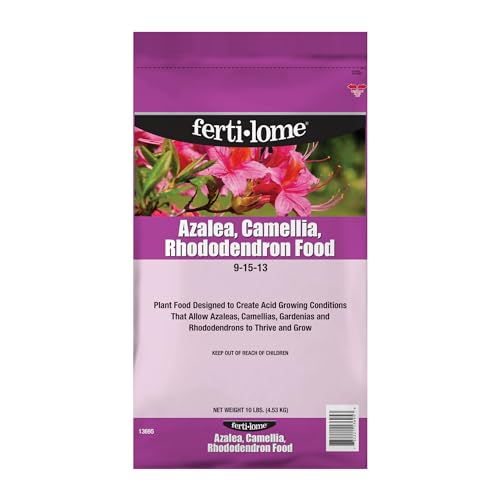
8. Fertilome Azalea, Camellia & Rhododendron Food 9-15-13
The phosphate-heavy granule that gets stubborn rhododendrons flowering for the first time in years.
This 9-15-13 fertilizer flips the usual ratio on its head — it is highest in phosphate, the nutrient that drives root development and flower production. For a rhododendron that has not bloomed in three years or a gardenia that just will not set buds, this is the targeted fix. The reviews are full of exactly those success stories.
The feeding schedule is clearly laid out: early spring, again after blooming, and once more in the fall. Application rates are spelled out by plant size — use 1/4 to 1/2 cup for plants 1 to 5 feet tall, and 3/4 to 1 1/4 cups for plants 6 to 12 feet. That level of guidance takes the guesswork out entirely.
At 10 pounds, it is a solid mid-size bag, and owners praise it as a better value than the small bags at big-box stores. It also creates the acid growing condition that lets azaleas, camellias, and gardenias thrive. The only wish from buyers is for an even larger size — over 40 mature plants can empty this bag fast.
The Bloom-Boosting Edge
- 15% phosphate is the highest in this guide, targeting root and flower development.
- Clear cup-based dosing by plant height.
- 10 lb bag is generous for a multi-shrub bed.
Know Before You Buy
- High-phosphate formulas are slower to green up leaves than high-nitrogen ones.
- Synthetic formula, so not for organic-certified gardens.
Reach for this if: your goal is flowers, not foliage — especially for rhododendrons that have stopped blooming entirely.
skip it if: you want organic certification or a quick green-up of yellow leaves.
9. Espoma Organic Holly-Tone 4-3-4 (18 lb. Bag)

The same legendary organic formula, sized down for the everyday garden without the bulk-bin commitment.
This is the 18-pound version of the same Espoma Holly-Tone that tops our list, and it exists for one very good reason: not everyone needs 36 pounds of fertilizer. The 4-3-4 analysis, the 5% sulfur, the Bio-tone formula, and the organic certification are all identical — you are just getting a more manageable quantity.
The effectiveness carries over completely. Owners describe rhododendrons that had not flowered in four years finally blooming profusely after fall and spring applications. Hydrangea fans report more beautiful blooms every single year, and blueberry bushes thrive on it because the organics feed steadily over time.
The one recurring note is a simple one: this is strong, concentrated organic material, and owners advise using it sparingly. A rare bag arrives with a small factory seal leak, which costs a little product but is not a functional issue. Given the identical formula to the Best Overall pick, the choice between the two bags is purely about garden size and storage space.
The right size for: small to mid-size gardens that want the proven Espoma formula without committing to the 36 lb bag. Same great organic feeding, half the storage footprint.
Understanding the Specs
N-P-K Ratio (Nitrogen-Phosphorus-Potassium)
These three numbers tell you the percentage of the big three nutrients in the bag. Nitrogen drives green leaf growth, phosphorus fuels roots and flowers, and potassium supports overall plant health. For azaleas, a higher nitrogen number helps push lush foliage, while a higher middle number (like the Fertilome’s 15) targets blooming. Your choice depends on whether your plant needs leaves or flowers most.
Slow-Release vs. Water-Soluble
Granules sit in the soil and break down slowly, feeding over weeks or months with a single application — ideal for busy schedules. Water-soluble powders mix with water and feed instantly, which is perfect for potted plants or fast rescue missions. The trade-off is convenience versus control: granules are set-and-forget, while powders let you adjust strength every watering.
Soil Acidifiers & Sulfur
Azaleas need acidic soil to absorb nutrients, and many fertilizers include sulfur to help lower pH. The Espoma formulas carry 5% sulfur for this purpose, and the GARDENWISE blend is described as an effective soil acidifier. If your soil runs alkaline, a fertilizer with sulfur does double duty: it feeds while it adjusts the soil chemistry your azalea depends on.
Micronutrients & Organic Certification
Beyond the big three, azaleas need trace elements like iron, magnesium, and manganese to prevent yellowing leaves. Look for labels that call out iron or a full micronutrient package. For organic gardens, check for OMRI or CCOF certification — the Dr. Earth and Espoma options carry these, while the FoxFarm Happy Frog is also OMRI listed.
FAQ
When is the best time to fertilize azaleas?
What is the difference between slow-release granules and water-soluble fertilizer?
Can I use the same fertilizer on hydrangeas and blueberries?
Why are my azalea leaves turning yellow between the veins?
How much fertilizer do I need to apply per plant?
Is organic fertilizer better for azaleas than synthetic?
What does the N-P-K ratio actually mean for my azaleas?
Can I use a fertilizer meant for acid-loving plants on my potted azaleas?
Will these fertilizers burn my plants if I use too much?
How long does a bag of azalea fertilizer typically last?
Final Thoughts: The Verdict
For most gardeners, the best azalea fertilizer overall is the Espoma Organic Holly-Tone 36 lb because it pairs proven organic feeding with the biggest bag and the highest owner satisfaction in this guide. If you want fast, visible results in days, grab the Schultz 14-7-7. And for pet-safe organic feeding of a few special shrubs, the Dr. Earth Acid Lovers is the cleanest choice on the shelf.
How We Picked
We do not accept paid placement. Every pick is matched to a real buyer and a real use-case; we do not hands-on test units.
Sources & Methodology
Specifications: manufacturer listings and product documentation. Review insights: verified customer reviews, as of August 2026. Pricing: not shown on this page (it changes often); check the current price via the retailer link.
As an Amazon Associate, Gadgets Feed earns from qualifying purchases. This does not affect which products we feature.