
Our readers keep the lights on and my morning glass full of iced black tea. As an Amazon Associate, I earn from qualifying purchases.
Specs are compiled from manufacturer listings and verified buyer reviews and can change over time — please confirm the key details on the product page before buying.
An 8-inch powered subwoofer is the answer when you want chest-thumping lows but your room, desk, or car simply doesn’t have the square footage for a massive 12-inch box. Every pick here has a built-in amplifier, so you skip the separate amp and wiring headaches. You just connect your speakers or receiver, tune the crossover, and feel the difference.
I’m Min — the founder and writer behind Gadgets Feed. This guide is built by comparing the manufacturers’ published specifications and the patterns across verified customer reviews, so you get each pick’s real strengths and trade-offs instead of marketing spin.
Whether you are filling a small living room, a studio desk, or a truck cab, the right 8-inch powered subwoofer adds deep, clean bass without dominating your space.
Our Picks at a Glance


How To Choose The Best 8-Inch Powered Subwoofer
Before you click buy, understand the three specs that decide if a subwoofer will actually satisfy you: power, frequency response, and connectivity. An 8-inch driver cannot move as much air as a larger one, so the amplifier quality and the cabinet design matter even more at this size.
Match the Power to Your Room
RMS wattage is the continuous power the amp can deliver, while peak wattage is a brief burst. For a small or medium room, look for something in the 100W to 250W RMS range. Higher RMS means you can play louder without distortion, but it also means the sub will be larger and heavier, so balance power against your available space.
Check the Frequency Response for Depth
The lower the hertz number, the deeper the bass can go. A sub that reaches down to 30Hz or 35Hz delivers the floor-shaking rumble in movie explosions, while one that stops at 40Hz still handles music well but misses the deepest effects. Always pair this with the crossover setting to avoid muddy overlap with your main speakers.
Think About Your Inputs Before You Buy
Most home subs accept standard RCA connections, while studio models often use balanced TRS or XLR inputs for cleaner signal. If you plan to connect a factory car stereo without a dedicated sub output, you need speaker-level inputs. Check your receiver or speakers first to know which connection type your chosen sub must have.
Quick Comparison
| Model | Best For | Power (RMS) | Frequency Response | Key Inputs | Amazon |
|---|---|---|---|---|---|
| Audioengine S8★ Best Overall | Desktop & small-room music | 250W | — | RCA | Amazon |
| Rockville Rock Shaker 8Best Value | Budget home theater | 200W | — | RCA + Speaker | Amazon |
| Dayton Audio CS800Top Performer | Clean, tight music bass | 150W | 35Hz | RCA + Speaker | Amazon |
| MTX Audio RT8PT | Under-seat car installs | 120W | 35–250Hz | RCA + High Level | Amazon |
| Edifier T5s | Bookshelf speakers | 70W | 35Hz | RCA | Amazon |
| Klipsch R-8SW | Small living rooms | 150W Peak | — | RCA + LFE | Amazon |
| PreSonus Eris Sub 8BT | Studio monitoring | 100W | 30Hz | TRS + RCA + BT | Amazon |
| KRK S8.4 | Serious music mixing | 109W | 30Hz | XLR | Amazon |
| Rockford Fosgate P300-8P | Under-seat car bass | 300W | — | Speaker Level | Amazon |
| Alpine PWE-S8 | Compact car cabins | 120W | 32–150Hz | RCA | Amazon |
| Kanto SUB8 | Accurate music listening | 300W Peak | 35–175Hz | RCA | Amazon |
In‑Depth Reviews
1. Audioengine S8 Powered Subwoofer
Our pick — over 4.5★ from 750+ verified ratings; the strongest balance of quality and price.
The desktop champion that disappears under a desk while shaking the whole room.
This is the subwoofer that owners describe as “perfect at 25% volume,” and the reason is its 250W power rating paired with a down-firing design. The down-firing driver pushes bass toward the floor, which spreads the low end evenly through a small or medium room without needing precise placement. It is built for desks and compact spaces, yet it delivers the kind of punch that makes movies feel theatrical.
Setup is genuinely plug-and-play with RCA connectivity, and the sleep mode auto-powers down when idle to save energy. What wins people over is the sound quality — the most praised aspect by a wide margin — with owners noting it is “incredibly loud” and pairs beautifully with Audioengine A2+ or A5+ speakers. There is a catch for desktop users: if your speakers lack a sub output, you will need an audio splitter to share the signal, a tip that shows up repeatedly in owner feedback.
The flexibility extends beyond a single setup. It works as a “versatile bass shaker” that doubles as an active speaker for home studio use, and it is compatible with the Audioengine W3 wireless adapter kit if you want to cut the cable. The main limitation is power-hungry rooms — this is not the sub for a large open-plan living area, where owners suggest stepping up to a bigger driver for the deepest impact.
Tuning balance: Set the crossover to 50Hz and the S8 disappears into your music, blending with your speakers instead of drawing attention to itself, according to owners.
Room fit note: The sharp metal feet can scratch hardwood; a flat-footed placement or small pads solve it instantly.
Reach for this if: you want studio-grade accuracy for a desktop PC setup, small studio, or a Sonos-based system where space is tight.
Look elsewhere if: you need to fill a large living room or home theater, where a single 8-inch driver will run out of headroom.
2. Rockville Rock Shaker 8
A deep-bass specialist that brings 400W of peak punch to small speakers at a budget price.
The Rock Shaker 8 packs a 400W peak / 200W RMS Class-D amplifier into a compact MDF cabinet, giving it the muscle to transform small bookshelf speakers into a full-range system. Owners praise its “clean open bass” and note it makes a “big difference in stereo sound,” which is exactly what you want when your main speakers top out in the mid-bass. The 8-inch driver uses a Y30 magnet and a 1.5-inch 4-layer voice coil for responsive, punchy performance.
Connectivity is a rare strength here: it offers both RCA and speaker-level inputs, so it works with older receivers that lack a dedicated sub output. The slim footprint — 11.8″ W x 13.8″ H x 15″ D — tucks neatly behind a cabinet or beside a TV stand, and it runs on 110-240V power for flexibility. Despite the budget positioning, the build quality and volume control earn consistent praise.
The honest trade-off is reliability, which draws mixed feedback. Some buyers report units failing within weeks — one described a sub that “stopped playing when hot” after three weeks — while others run it daily with zero issues. The cabinet also feels light and thin to the touch, and bass can turn boomy if you push the volume past a few notches. For desktop or bookshelf setups at moderate levels, it is remarkable value; for high-end systems, the limitations show.
balance: Keep the volume at 3-4 notches and pair it with a quality AC cord, and owners mention tight, controlled bass that sounds far more expensive than it is.
Known caveat: The unmarked crossover knob has no detents, so tuning by feel takes patience.
Best for: budget-minded buyers adding bass to small speakers, a workshop, or a gaming setup where deep rumble matters more than finesse.
Not for: anyone needing a dependable sub for a high-end system or who plans to push it hard daily.
3. Dayton Audio CS800
The 150W overachiever whose tight, musical bass rivals subs twice its price and size.
The CS800 delivers “clean tight bass” that owners describe as powerful enough to cause rattles in a room, all from a modest 150W Class-D amplifier. It uses a rigid, braced cabinet to eliminate boominess and distortion, which is why one owner called it “the best bang for buck” after it beat a previous 12-inch sub in their setup. The 35Hz frequency response means it reaches deep enough for most music and film content.
Flexibility is the theme here: stereo RCA, LFE, and speaker-level inputs let it integrate with virtually any system, and the auto-on feature wakes it when a signal arrives. The swappable grille is a thoughtful touch, letting you match your décor — black grille included, gray sold separately. Owners describe the look as “vintage” and appreciate the solid, heavy build that resists resonance.
Designed in the USA and backed by a 5-year warranty, the CS800 is the safe long-term choice in this list. The recurring minor complaint is the auto-on trigger, which some owners find engages too late, causing standby at low listening volumes. Placement is also critical — it wants a solid surface and some distance from walls to sound its best, but that is true of most quality subs.
Best feature: The transparent, non-boomy character makes it ideal for music lovers who hate exaggerated bass.
Minor trade-off: The grille cloth is flimsy, so handle it gently during placement.
Choose this if: you want accurate, musical bass for a stereo or modest home theater and value a 5-year warranty.
skip it if: you listen at very low volumes, where the auto-on trigger may annoy you.
4. MTX Audio RT8PT
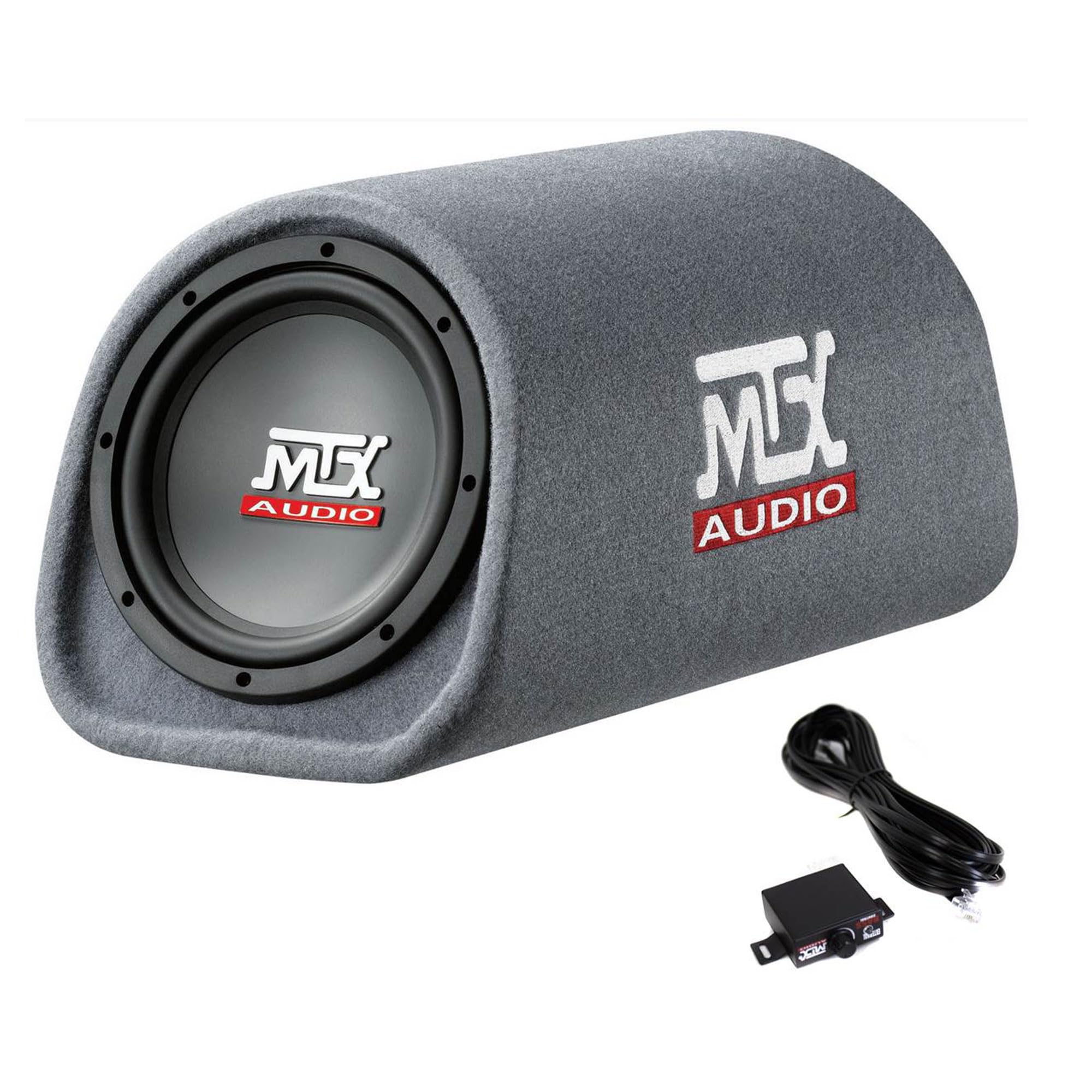
The cylindrical space-saver that slides under a truck seat and still delivers 240W of punch.
The RT8PT is built for vehicles where space is the enemy, fitting neatly under the rear seat of trucks and SUVs. Its single 8-inch driver is amplified to 240W MAX / 120W RMS, and owners say it sounds like 10-inch subs running three times the wattage. The vented tube design boosts output, while the aviation-grade carpet covering resists wear and blends with any interior color.
Installation is straightforward thanks to RCA, high-level, and low-level inputs, plus an external bass control knob for on-the-fly tuning. The included mounting straps secure it firmly, and the variable crossover (50Hz-200Hz, 12dB/Oct) gives you control over how it blends with your door speakers. Owners in small cars like the Tacoma and PT Cruiser report it “improves stock sound 100%.”
The trade-off is depth: this sub plays down to 35Hz but lacks the sub-35Hz rumble that bass-heads crave. It shines with electronic, rock, and country, but rap tracks with ultra-low bass are “hit-or-miss.” It also saves space at the cost of some output — it is a “steady bass” sub, not a window-rattler. If deep hip-hop bass is your priority, this is not the one.
Who it suits: Drivers of small trucks and cars who want to add bass without sacrificing legroom or trunk space.
Reality check: The tube shape saves space but makes placement in some trunks awkward, and deep-bass fans will want more.
Reach for it if: you drive a small vehicle and want an easy, space-conscious upgrade to the factory stereo.
Think twice if: you listen mostly to bass-heavy rap and need sub-35Hz extension.
5. Edifier T5s Powered Subwoofer

A 70W musical sub with a wood-grain face that feels more like furniture than gear.
The T5s is designed to disappear into your living space, with a slim 18mm MDF cabinet wrapped in wood grain and a low-profile grille. Its 8-inch long-throw woofer produces a 35Hz deep bass that owners say “fills a small or medium room,” powered by a clean 70W RMS Class-D amplifier. The right-firing acoustic port minimizes resonance for tight, clean bass.
Setup is refreshingly simple with auto-standby after 15 minutes of inactivity, and it includes both 3.5mm-to-RCA and RCA cables in the box. The low-pass filter (30Hz-160Hz) and phase selector (0°/180°) give you real control over integration. It works in series without a sub output — audio source to sub, then out to main speakers — which is a lifesaver for powered speakers lacking a dedicated sub port.
The value story is strong, with owners noting the auto-on function triggers at very low signal levels, more sensitively than pricier subs. However, compatibility is the catch: it officially pairs with a specific list of Edifier speakers, and some customers note issues with non-listed systems. Its 70W output is also modest, so it suits small rooms and desks better than a large open living area.
Best for: Edifier speaker owners who want a matching, clean-looking bass foundation for a desk or small room.
Watch out: Verify your speaker model is on the compatibility list before buying, as some setups may not integrate cleanly.
Choose this if: you already own Edifier bookshelf speakers and want a matching look with a low-maintenance setup—the cable is included, so you can plug in and play.
Look elsewhere if: you need loud, room-filling output for a large living room.
6. Klipsch Reference R-8SW

The compact home-theater favorite that sounds bigger than its 8-inch driver should.
Owners call the R-8SW “the sub that performs like a 12-inch,” and they say its clean, strong bass is “powerful enough for a 15×20 room.” The spun copper IMG woofer (a lightweight, rigid cone material) and all-digital amplifier work together in a down-firing design, so bass spreads evenly across your small living room. It pairs exceptionally well with Klipsch R-15PM speakers, but it works with any system that has RCA or LFE (low-frequency effects) connectivity.
The compact footprint is a major selling point, fitting neatly into an entertainment center or beside a sofa without dominating. Owners consistently praise the build quality and the clean sound at moderate volumes, noting it “won’t disturb the neighbors” at half gain — a rare trait for a subwoofer. It replaced a 25-year-old 10-inch Cerwin Vega in one setup and outperformed it, which speaks volumes about its efficiency.
The honest limitation is depth: this is not a theater-level rumble machine, and owners advise against cranking the gain. A recurring quirk is a “pop” sound when you power it off, a byproduct of the lack of a soft power-down. For music and movies in small or medium rooms, it is a stellar value; for large spaces, you will want a bigger driver.
balance: Set the crossover to 80Hz and it blends smoothly with bookshelf speakers, giving you a cohesive, natural sound without any boominess.
Biggest quirk: The power-off pop is real, so route power through a switch or live with a soft click.
Best for: apartment dwellers and small-room listeners who want a compact sub that respects the neighbors.
Not for: home-theater enthusiasts chasing deep, floor-shaking effects.
7. PreSonus Eris Sub 8BT

The 100W studio workhorse that drops to 30Hz and brings Bluetooth to the mixing desk.
The Eris Sub 8BT is built for accuracy, which is why it is a favorite in home studios. Its 100W amplifier drives an 8-inch woven-composite woofer down to a “molar-rattling” 30Hz, giving you the full sonic spectrum for better mixes. The front-firing design and flexible crossover controls ensure it starts working exactly where your main monitors stop, avoiding the “flabby, smudged low-end” that plagues poorly integrated systems.
Connectivity is the standout feature: ¼-inch TRS balanced inputs for professional gear, unbalanced RCA for consumer devices, and a front-panel ⅛-inch aux input for your phone. Bluetooth 5.0 wireless streaming adds casual listening flexibility, and the front-panel headphone output with a built-in amp lets you switch to private monitoring instantly. The power-saver mode engages after 40 minutes of idle time.
Owners say it transforms a small room into a “rich auditory environment,” handling analog synthesizers and Eurorack levels with ease. It pairs exceptionally well with JBL 305P MkII monitors and PreSonus Eris speakers. The occasional complaint is connectivity quirkiness with non-PreSonus systems, and some note a slight bass delay with certain USB setups. For a small studio, it is nearly perfect; for a living room, its studio-tuning shows its best face.
Studio strength: The highpass/lowpass crossover controls give you precise control over where the sub and monitors meet.
Home catch: Bluetooth convenience is great, but wired TRS connections deliver the most accurate response.
Reach for this if: you make music, game, or watch movies at a desk and want accurate bass plus wireless flexibility.
Think twice if: you demand the cleanest possible signal path and never use Bluetooth, where wired-only subs may suffice.
8. KRK S8.4 Studio Subwoofer

The 109W reference sub whose glass-aramid woofer delivers flat, honest bass for critical listening.
The S8.4 is the serious mixing tool, using an 8-inch glass aramid composite woofer to deliver accurate bass extension to 30Hz with a max SPL of 112 dB. This is not a sub for casual listening; it is designed to reveal exactly what is in your mix. Owners praise it for playing the 35-70Hz range with tight, solid output and no hum or rattles, making it “perfect back-panel controls” a favorite feature for fine-tuning.
Its Class-D amplifier is powerful and lightweight, and the curved design with a front-firing bass port offers placement flexibility. The footswitch control (footswitch not included) lets you toggle the sub and crossover filter on and off quickly, which is invaluable when A/B testing mixes. XLR connectivity ensures a clean, balanced signal path for professional studio gear.
Owners say it “adds that low end I was lacking” when paired with KRK V8 monitors, and it enhances music clarity rather than overpowering it. The honest trade-off is size and weight — it is described as “awkward large” and heavy, so measure your space. Some also note it lacks Bluetooth, which is fine for studio use but limits casual streaming. For a dedicated mixing room, it is worth every bit of its premium price.
Why it wins in the studio: Clean, uncolored bass that translates well to other playback systems — the hallmark of a reference monitor.
Space warning: Budget for its physical footprint, and note the footswitch is an extra purchase.
Best for: producers and audiophiles with a dedicated mixing space who need honest, accurate bass.
pass on it if: you want a space-saving lifestyle sub for casual TV and music in a living room.
9. Rockford Fosgate Punch P300-8P

The 300W all-in-one that slips under a rear seat and punches way above its slim size.
The Punch P300-8P is the definition of “big bass in a small package,” a self-contained enclosure with a built-in 300W Class-D amplifier. Its slim 11.4″ x 17.6″ x 5.6″ footprint fits perfectly behind the rear seat of a Ford F150 or in a Miata trunk, making it a top choice for truck and SUV owners. The 8-inch driver is impedance-tune for the built-in amp, so you get maximum output without an external amplifier.
Installation is famously simple with speaker-level inputs for factory systems or line-level inputs for aftermarket setups. The adjustable 12dB/octave low-pass crossover, onboard bass boost EQ, and phase switch give you real control over the sound. The remote Punch level control lets you dial bass up or down from the driver’s seat, and the auto turn-on wakes it via sound detection.
Owners call the bass “balanced deep and punchy,” beating the factory sub in an F150 and adding felt impact to a Silverado Bose system. It is ideal for daily bass fill, not extreme pounding — pushing it hard reveals port air noise and a struggle at high volume. The build quality is famously solid, backed by a 1-year warranty, and it saves precious space versus a traditional box. For a clean, space-saving upgrade, it is excellent value.
balance: One owner described it as “near 12-inch depth at moderate volume,” which captures how efficiently it uses its power.
Limit: Keep gains moderate; at very high volume it loses composure, and the port is built cheaply.
Reach for this if: you drive a truck or smaller car and want an easy, high-quality bass upgrade that hides out of sight.
Look elsewhere if: you want to win bass competitions — this is a daily-driver sub, not a show system.
10. Alpine PWE-S8

The 120W under-seat gem with a high-excursion cone that adds felt lows without hogging cabin space.
The PWE-S8 is the go-to for drivers who refuse to sacrifice trunk space. Its 8-inch high-excursion woofer and built-in Class-D amplifier deliver 240W peak / 120W RMS, filling out the spectrum below 50Hz with tight, controlled bass. At just a few inches tall, it slips invisibly under the front or rear seat of a Civic, Jeep Wrangler, or GMC Canyon, making it a perfect addition to trucks and small cabins.
Its compact design hides away completely, yet reviewers point out it “nicely fills out the spectrum below 50Hz” and adds an “impressive boom for its size.” The remote level control lets you adjust bass intensity across genres, and the frequency response spans 32-150Hz, so you get solid musical range. Installation is a manageable DIY job—owners complete it in about 30 minutes using basic tools.
The value equation is genuinely mixed here — it is a premium-priced compact sub, and some owners question the cost per watt. It is not a boomer; it delivers “tight, controlled bass” rather than window-rattling output, and a few shoppers say reliability concerns over time. For a clean, space-conscious upgrade in a small vehicle, it is superb; for maximum volume per dollar, a larger boxed sub wins.
Who it suits: Truck, Jeep, and small-car owners who want real bass without losing cargo space.
Honest note: The install can be fiddly — one owner fixed a power issue by sanding a ground point to bare metal.
Choose this if: stealth, space savings, and Alpine build quality matter more than maximum SPL.
Think twice if: you want heavy, room-shaking bass for a larger vehicle where a bigger driver fits.
11. Kanto SUB8

The 300W sealed-box perfectionist that prioritizes musical accuracy over raw boom.
The SUB8 uses a sealed enclosure, which means it reacts to audio changes more quickly than vented designs, producing every bass note accurately with little distortion. At roughly 11 inches in each direction, it fits under a desk or in the smallest apartments where traditional subs dominate the space. The 300W peak power is plenty — owners run it at 10% volume with excellent results.
This sub is for listeners who value tonal purity over house-shaking output. Owners describe the bass as “tight, controlled, and musical,” blending perfectly with Kanto YU6MB or ORA4 speakers. The matte black, vinyl-wrapped finish looks premium and resists wear, and the adjustable high-pass filter and phase switch ensure clean integration with any system. The 35-175Hz frequency response covers music beautifully, though it does not dig below 40Hz.
The honest trade-off is price and depth: it costs more than many 8-inch subs, and it will not reach the deepest sub-35Hz effects that ported designs manage. It is designed for two-channel music systems and near-field listening, not cavernous home theaters. For an audiophile desktop or small-room setup, the accuracy and build quality justify the premium.
Best feature: Superior accuracy over loudness, making it ideal for music lovers who hate exaggerated bass.
Watch out: The crossover can bleed higher frequencies with non-Kanto speakers, so pair it with matching gear for best results.
Reach for this if: you want a refined, accurate sub for a hi-fi music system or gaming desk in a small space.
Look elsewhere if: you expect deep movie-theater rumble — this sealed sub plays it musical, not monstrous.
Understanding the Specs
Amplifier Power (RMS vs. Peak)
RMS wattage is the steady power the amp can deliver continuously, which is the honest number for loudness. Peak wattage is a brief burst that marketing loves to quote — the Rockville lists 400W peak but 200W RMS, and the Alpine lists 240W peak but 120W RMS. Compare RMS values between subs to judge real output, not the eye-catching peak figure.
Frequency Response & Crossover
Frequency response tells you how low the bass can go, with 30-35Hz being excellent for an 8-inch driver. The crossover frequency (often 50-80Hz) decides where the sub takes over from your main speakers. Set it where your speakers start to lose output, and use the phase switch to ensure the sub and speakers push in sync rather than canceling each other.
FAQ
Will an 8-inch subwoofer be enough for my room?
Do I need a subwoofer output on my receiver to use one?
What is the difference between a sealed and ported subwoofer?
Can I connect an 8-inch powered sub to my computer speakers?
What does the crossover setting actually do?
How can I hide an 8-inch subwoofer in a small room?
Is a powered subwoofer better than a passive one?
What is a class-D amplifier and why does it matter?
Can I use a car subwoofer in my home?
How do I stop my subwoofer from sounding boomy or muddy?
Final Thoughts: The Verdict
Across the board, the 8-inch powered subwoofer winner is the Audioengine S8 because its 250W output and down-firing design deliver studio-grade accuracy that fills a desktop or small room with clean, punchy bass. If you want a feature-packed studio sub with Bluetooth flexibility, grab the PreSonus Eris Sub 8BT. And for car owners who refuse to give up trunk space, the Alpine PWE-S8 is the one to reach for. Every pick here proves that an 8-inch driver can deliver serious low end when the amplifier and cabinet are engineered right.
How We Picked
We do not accept paid placement. Every pick is matched to a real buyer and a real use-case; we do not hands-on test units.
Sources & Methodology
Specifications: manufacturer listings and product documentation. Review insights: verified customer reviews, as of August 2026. Pricing: not shown on this page (it changes often); check the current price via the retailer link.
As an Amazon Associate, Gadgets Feed earns from qualifying purchases. This does not affect which products we feature.