
Our readers keep the lights on and my morning glass full of iced black tea. As an Amazon Associate, I earn from qualifying purchases.
Specs are compiled from manufacturer listings and verified buyer reviews and can change over time — please confirm the key details on the product page before buying.
Buying a backflow preventer means you are protecting your drinking water from the dirty water that could siphon back into your pipes. The real question is which type you need — a simple hose bib vacuum breaker, a dual check valve, or a full reduced pressure zone assembly. This guide breaks down the six most reliable options on the market and matches each one to the job it does best.
I’m Min — the founder and writer behind Gadgets Feed. This guide is built by comparing the manufacturers’ published specifications and the patterns across verified customer reviews, so you get each pick’s real strengths and trade-offs instead of marketing spin.
Whether you are a homeowner guarding a garden hose or a facility manager meeting code, this breakdown of the best backflow preventer choices will help you buy the right valve on the first try.
Our Picks at a Glance

How To Choose The Best Backflow Preventer
Selecting the right valve starts with one question: what level of contamination are you guarding against? A garden hose attached to a faucet needs light protection, while a boiler feed or a chemical line needs the strictest assembly money can buy. Understanding the three protection tiers makes the rest of the decision easy.
Match the Protection Type to the Hazard
A hose bib vacuum breaker (like the WHK) is the entry-level guard for outdoor spigots, stopping water from being sucked back into the house when a hose sits in a puddle. A dual check valve (like the Watts 9D) adds a second seal and suits small supply lines with moderate risk. For continuous pressure on health-hazard lines — hospitals, industrial plants, boiler feeds — you need a pressure vacuum breaker or a reduced pressure zone assembly that vents water to prove it is working.
Check the Pressure Rating and Temperature Range
Every valve has a maximum working pressure it can withstand before failing. A hose bib unit rated at 125 psi handles normal household pressure, while a commercial dual check rated at 175 psi gives you more headroom. Temperature matters too — a brass valve rated up to 250 degrees Fahrenheit suits hot water lines, whereas a plastic-bonnet vacuum breaker tops out around 140 degrees and needs freeze protection.
Size the Inlet Correctly
Backflow preventers come in standard pipe sizes, most commonly 3/4-inch and 1-inch. You must match the inlet thread to your existing pipe — a 3/4-inch female hose thread connects to a standard garden faucet, while a 1-inch National Pipe Tapered thread is meant for larger service lines. If you have a 3/4-inch line, do not buy a 1-inch valve expecting an adapter to fix the mismatch.
Quick Comparison
| Model | Best For | Protection Type | Max Pressure | Inlet Size | Amazon |
|---|---|---|---|---|---|
| Febco 765★ Best Overall | Continuous pressure irrigation | Pressure Vacuum Breaker | 150 psi | 1 inch | Amazon |
| Zurn 34-975XLPro Grade | In-ground sprinkler systems | Reduced Pressure Principle | — | 3/4 inch | Amazon |
| Zurn 1-350XL | Residential sprinkler mains | Double Check | — | 1 inch | Amazon |
| Watts 009-QT | Code-required high hazard lines | Reduced Pressure Zone | — | 3/4 inch | Amazon |
| Watts 9D | Small supply lines, labs | Dual Check Valve | 175 psi | 3/4 inch | Amazon |
| WHK 6-Pack | Garden hoses and spigots | Hose Bib Vacuum Breaker | 125 psi | 3/4 inch | Amazon |
In-Depth Reviews
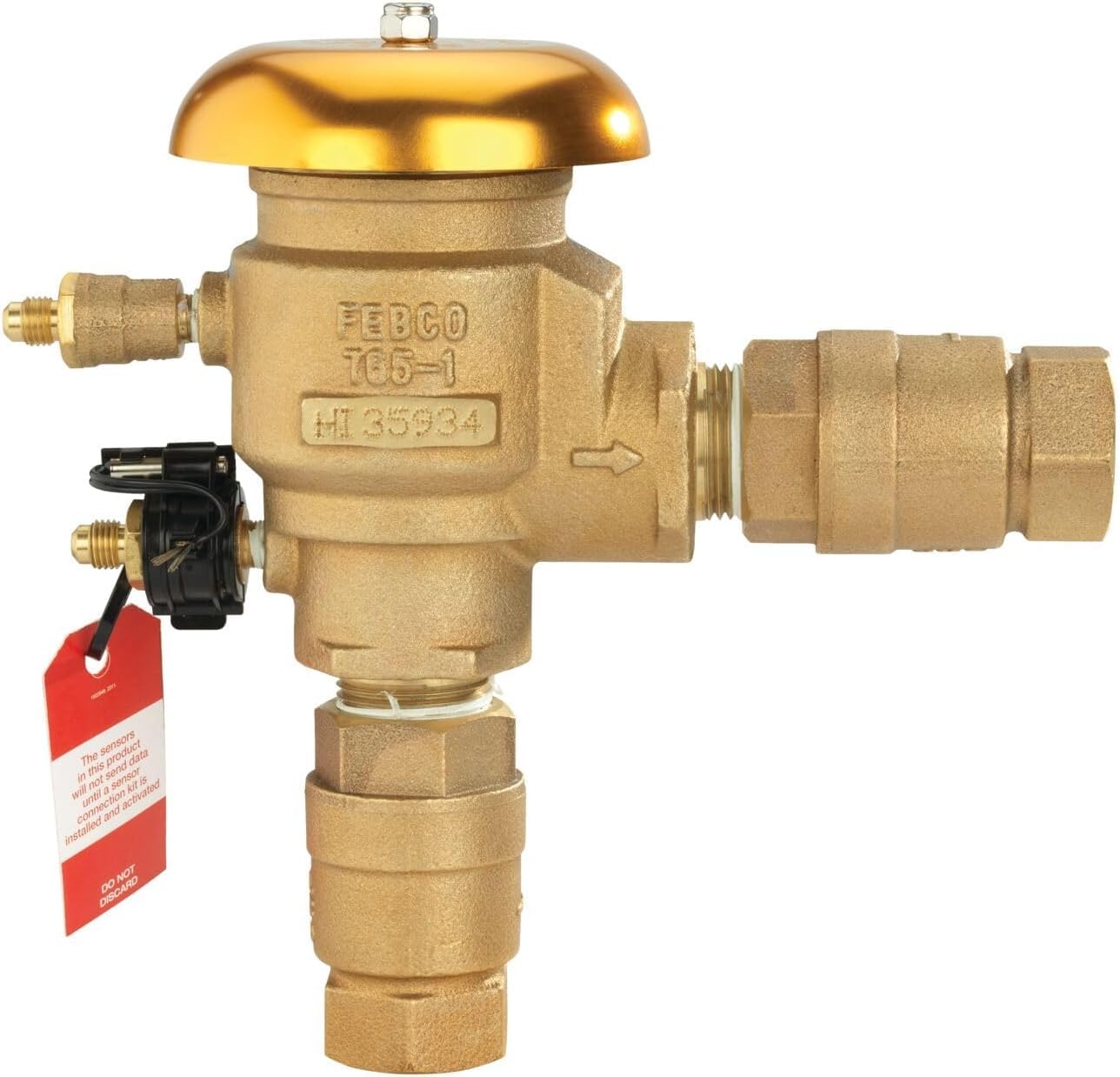
1. Febco 765 Bronze Pressure Vacuum Breaker Backflow Preventer 1″ Inlet
Our pick — over 4.5★ from 200+ verified ratings; the strongest balance of quality and price.
The bronze workhorse that holds steady pressure and thinks ahead about freezing.
For continuous-pressure lines feeding irrigation, boiler feeds, or industrial water service, this pressure vacuum breaker is the one that earns its place as the top pick. It handles a maximum working pressure of 150 psi (10.3 bar) and operates across a temperature range of 32 degrees F to 140 degrees F (0 degrees C to 60 degrees C), which covers the everyday duty cycle of a demanding water line. The plastic bonnet is there specifically to protect the assembly from freeze damage, and the spring-loaded check valve plus air relief valve keep the mechanism responsive.
The standout feature here is the included freeze sensor, which pairs with SentryPlus Alert technology to ping facility personnel the moment temperatures creep toward freezing. That is a real layer of protection that the cheaper plastic-hose units simply do not offer. As owners put it, this unit is an “exact replacement for a very old unit” that goes in smoothly, and one buyer who kept the old inlet valve noted the new one was actually easier to turn, needed a union on the PVC, and showed no leaks over three months of service. The recurring gripe in the review pages is leakage — a handful of units reportedly arrive leaking from the start, and a brief spray on startup seems to be a quirk of the design. Quality is what wins people over here, though, with dozens of owners calling out the solid bronze construction and smooth operation.
This Febco measures 10 x 7 x 7 inches, so it is a full-size assembly meant for a permanent installation, not a quick thread-on fitting. It arrives as a single valve unit with National Pipe Tapered threads on the 1-inch inlet, and the manufacturer is Watts, so you are getting a name brand under the Febco badge. It is heavier and more involved to fit than the garden-hose units further down this list, which is exactly the point — this is protection for the whole property, not one spigot.
What earns the top spot
- Built-in freeze sensor connects to SentryPlus Alert monitoring
- 150 psi maximum pressure suits continuous service lines
- Quality brass construction wins the most owner praise
Know before you buy
- Occasional units arrive leaking from day one
- Full-size assembly needs space for installation
Best if you: run a permanent irrigation or boiler line up to 150 psi and want freeze monitoring built in.
A different fit: skip this if you just need to guard a single outdoor faucet — the WHK multi-pack covers that for far less effort.
2. Zurn Wilkins 34-975XL 3/4″ 975XL Reduced Pressure Principle Backflow Preventer
The sprinkler-system savior that passes city inspection and saves a plumber’s bill.
The crowd favorite here — 4.4 stars across 500-plus owners — tells the real story: this unit gets approved by inspectors and goes in fast. One owner in Riverside, California reported passing the city inspection after an install that took under an hour, skipping the –2,000 quotes local plumbers had handed out. That combination of code compliance and do-it-yourself friendliness is the whole appeal.
The wye pattern design is the engineering trick that makes this possible. Instead of a straight-through body, the wye layout shortens the overall footprint and gives you easy access to the first check for debris removal, which cuts both installation time and maintenance costs. The entire unit is serviceable in line, meaning you can rebuild it without pulling the whole assembly off the pipe, and it ships pre-assembled with backflow, pressure regulation, and strainer components already in place. The bronze body weighs a solid 11 pounds, so this is a substantial piece of equipment, and the 3/4-inch configuration fits the standard residential sprinkler feed.
The honest caveat from the review pages is split between durability and leakage — some owners have had units run for years without a drip, while others report failures after about six months or leaks developing over time. The advice that recurs across the data is to remove this assembly for the winter if you live in a freezing climate, which protects the seals and extends its life. It also carries a 1-year limited warranty from the manufacturer, giving you a defined safety net on a genuine investment.
Inspector approved: passes city testing reliably and replaces cracked Zurn Wilkins units exactly, per multiple owners.
Plan for the season: winter removal is recommended for longevity, and durability is the most mixed aspect in the owner feedback.
Reach for this if: your irrigation system needs to clear a municipal inspection and you want a valve you can service without uninstalling it.
Think twice if: you want a set-and-forget fitting — this one rewards seasonal care to keep the seals happy.
3. Zurn Wilkins 1-350XL 1″ 350XL Double Check Backflow Preventer

The low-lead double check that guards a whole sprinkler main without winter worry.
This 1-inch double check assembly is the pick for residential sprinkler mains where you need dependable protection without the complexity of a reduced pressure zone unit. It is purpose-built for the job — one owner replaced the failing unit on a sprinkler system, installed this one, and “haven’t had a problem” since. The double check design uses two independently acting check valves, which is enough for non-health-hazard applications like landscape irrigation, and the 1-inch inlet matches the larger service lines that feed a full lawn system.
The construction choices here are what set it apart. The exterior is stainless steel, which delivers the corrosion-resistance you want for an outdoor, below-grade installation, and the EZSwap pressure vessel is designed to cut repair time — instead of rebuilding the whole assembly, you swap the vessel and move on. The integrated Flush Tool saves up to 15 minutes per installation by letting you flush the line easily before you button everything up. It is also winterization-friendly, which matters if your climate dips below freezing, and it is compliant with low-lead laws, making it suitable for potable water service per the owner feedback.
The certifications stack up impressively: ASSE Listed 1015, IAPMO Listed, CSA Certified B64.5, AWWA Compliant C510, and approved by the Foundation for Cross Connection Control and Hydraulic Research at the University of Southern California. That is the full alphabet of code compliance, which is why it also gets used for potable water lines, not just irrigation. One owner notes that while it works fine, it still needs to be inspected and certified after installation in many jurisdictions — so check your local rules. An isolated report of repeated pipe blows exists in the data, but far more buyers report straightforward, problem-free service on their sprinkler systems.
Code ready: full ASSE, IAPMO, CSA, and AWWA compliance plus USC Foundation approval covers inspection requirements.
Maintenance friendly: the EZSwap vessel and Flush Tool keep repair and install times down.
Pick this for: a 1-inch sprinkler main needing durable, low-lead protection with easy future servicing.
Not the one if: you have a high health hazard like boiler feed — that scenario needs a reduced pressure zone unit instead.
4. Watts 3/4″ 009M3 Backflow Preventer Reduced Pressure Zone Assembly RPZ 3/4 009-QT

The American-made RPZ that replaced a plastic unit and outlasted it by 18 years.
When the strictest protection is required — think health-hazard lines where any backflow is unacceptable — a reduced pressure zone assembly is the gold standard, and this Watts 009-QT is a trusted way to get there. The defining proof of its durability comes straight from the owner community: one buyer replaced the exact same model after 18 years of continuous use, which is a rare longevity claim in this category. It is made in the United States, carries a bronze body, and uses the 3/4-inch National Pipe Tapered threading that fits standard residential and light commercial feed lines.
The reduced pressure zone design is the key difference from the double check units. An RPZ constantly maintains a zone of lowered pressure between two check valves, and if that pressure drops, the assembly vents water to the atmosphere — visible proof that the unit is functioning and that contamination cannot cross. That is why municipalities often mandate an RPZ for any line that could endanger the potable supply. This specific model is lead-free and passes testing, per the owner who confirmed both, and it replaced a builder-installed plastic unit that one buyer described as inferior quality by far.
The honest trade-off shows up in the review data as a leakage complaint — several owners mention the unit starting to leak after a few months of service, including one who bought a second unit and saw the same result. That makes this a valve to monitor after installation rather than one to forget about entirely. It comes as a single unit with 2 ports, and the full port QT ball valves are included in the box, so you are ready to plumb it in right away.
Why it leads on protection
- RPZ design vents to prove it is working and blocks contamination
- Owner-documented 18-year service life on the same model
- Lead-free construction passes testing per buyers
The watch item
- Leakage after a few months is the most-reported issue
Choose this when: your jurisdiction demands maximum RPZ-level protection on a 3/4-inch line.
Look elsewhere if: you want a maintenance-free fit — expect to keep an eye on this one after the first few months.
5. Watts 9D 3/4″ Brass Dual Check Valve Backflow Preventer Union Female NPT

A compact forged-brass dual check built for hot water and tight commercial spaces.
This dual check valve is the specialist for smaller supply lines where space is tight and hot water is in play. Its defining strength is the temperature range — it handles from 33 degrees F (0.5 degrees C) all the way up to 250 degrees F (121 degrees C), which makes it one of the few units here that is genuinely suited for hot water service on sterilizers, dairy equipment, processing tanks, and laboratory lines. The forged brass body weighs just 6.4 ounces and measures a compact 0.29 x 0.29 x 0.29 inches, so it slips into tight plumbing runs where a full RPZ assembly could never fit.
The internal design is where the engineering shows. It uses two tight-seating rubber check valves — a primary that seats a rubber disc against a mating rubber part, and a secondary that uses a rubber disc-to-metal seat — for a redundant seal against back-siphonage. The internal parts are stainless steel for durability, and an integral strainer protects the mechanism from debris in the line. It takes on a maximum pressure of 175 psi (12.1 bar), which is 40% more headroom than the garden-hose WHK unit’s 125 psi rating, and requires a minimum of 25 psi (1.7 bar) to operate correctly. That higher pressure ceiling is why owners trust it in community well systems — the data includes a buyer who installed one over seven years ago for a community well and only replaced it when water flow started causing a whining sound, noting it “still back-checked” even then.
The review consensus is that it functions well and delivers solid value, though installation gets mixed feedback — most find it straightforward while one owner struggled with tightening. The recurring note in the review pages is that a previous unit of similar design lasted about five years before leaking, which frames this as a dependable but not immortal component. Its compact size and hot-water capability make it the right answer for specialized commercial fittings rather than whole-property protection.
Hot line hero: the 250-degree Fahrenheit ceiling and 175 psi rating outclass every other valve in this lineup.
Right-sized: the 6.4-ounce body and 0.29-inch dimensions fit where bulkier assemblies will not.
Grab this for: compact hot or cold supply lines needing dual-check redundancy up to 175 psi.
Pass on it if: you need whole-property continuous-pressure protection — that is the Febco or a Zurn assembly’s job.
6. WHK 3/4 GHT Hose Bib Backflow Preventer Vacuum Breaker (6-Pack)

Six solid brass guards for every spigot on the property, priced like an afterthought.
For the simple job of keeping garden-hose water from siphoning back into your home’s drinking supply, this six-pack of hose bib vacuum breakers is the practical, budget-friendly answer. You get 6 PCS of solid heavy-duty brass fittings plus 1 PC of Teflon tape and 6 additional washers, so you can outfit every outdoor faucet — hose bibs, sillcocks, wall faucets, even RV water lines — in one purchase. Each unit weighs just 2.4 ounces and measures 1.56 x 1.2 x 1.1 inches, making them nearly weightless compared to the 6.4-ounce Watts 9D dual check, and they thread straight onto a 3/4-inch female hose inlet with a 3/4-inch male hose outlet.
The protection here is the anti-siphon vacuum breaker, which is exactly the right level for a garden hose. It meets the ASSE 1011/CSA B64.2 and ANSI/NSF 61-9 standards, so it is code-compliant for the low-hazard job of guarding a spigot. The max operating pressure is 125 psi (at a 40% lower ceiling than the Watts 9D’s 175 psi), and the max operating temperature is 180 degrees F/82 degrees C, which covers normal outdoor water use comfortably. The break-off screw lets you permanently attach it to the faucet, and the self-draining design blocks water from freezing in the valve.
The critical caveat comes straight from the owner data: in a low-pressure drip irrigation system, these units create “an intolerably loud whine that resonates on every water pipe in the house,” per one buyer who ultimately switched to a plastic alternative that stayed quiet. These are designed to alert on backflow and flood prevention, which is the same mechanism that produces that whine under low flow. For standard hose use at normal household pressure, the feedback is overwhelmingly positive — owners describe them as heavy, sturdy, and well-built, with the permanent screw holding up. One buyer purchased 12 and planned to buy more, which says plenty about the value proposition.
What makes it a steal
- Six fittings in one box with Teflon tape and spare washers included
- Meets ASSE 1011 and ANSI/NSF 61-9 standards
- Break-off screw allows permanent anti-tamper attachment
Who should steer clear
- Not for low-pressure drip systems — the whine can resonate through the house
Buy this if: you want to protect every outdoor faucet and spigot at once, at normal household pressure.
skip it if: your setup is a drip irrigation system with low flow — the noise will drive you to a plastic alternative.
Understanding the Specs
Pressure Rating (psi)
The maximum working pressure tells you the highest water pressure the valve can handle before the seals or body risk failure. A hose bib vacuum breaker rated at 125 psi covers standard household pressure, while a commercial dual check rated at 175 psi gives you more headroom for stronger municipal supplies. Always check that the valve’s rating meets or exceeds your home’s water pressure.
Protection Type
A vacuum breaker is the lightest guard for outdoor spigots, a dual check valve adds a second seal for moderate risk, and a reduced pressure zone (RPZ) assembly is the strictest tier that vents water to prove it is working. Match the tier to the hazard — a garden hose needs light protection, while a boiler feed or health-hazard line demands the full RPZ setup.
FAQ
What is the difference between a vacuum breaker and a dual check valve?
When do I need a reduced pressure zone assembly instead of a double check valve?
Will a 3/4-inch backflow preventer fit my existing pipe?
How long does a backflow preventer last before it needs replacing?
Why does my new backflow preventer make a whining noise?
Can I install a backflow preventer myself or do I need a plumber?
What does it mean if my backflow preventer is leaking from the start?
Is a backflow preventer required by law for garden hoses?
What is the difference between bronze and brass construction?
Can I use a backflow preventer on a hot water line?
Final Thoughts: The Verdict
For the majority of shoppers, the backflow preventer winner is the Febco 765 because it pairs 150 psi continuous-pressure protection with an included freeze sensor that the cheaper units lack. If your in-ground sprinkler needs to pass a city inspection, grab the Zurn 34-975XL. And for protecting every outdoor faucet on a budget, the WHK 6-pack is the one to reach for — just keep it away from low-pressure drip systems.
How We Picked
We do not accept paid placement. Every pick is matched to a real buyer and a real use-case; we do not hands-on test units.
Sources & Methodology
Specifications: manufacturer listings and product documentation. Review insights: verified customer reviews, as of August 2026. Pricing: not shown on this page (it changes often); check the current price via the retailer link.
As an Amazon Associate, Gadgets Feed earns from qualifying purchases. This does not affect which products we feature.