
Our readers keep the lights on and my morning glass full of iced black tea. As an Amazon Associate, I earn from qualifying purchases.
Specs are compiled from manufacturer listings and verified buyer reviews and can change over time — please confirm the key details on the product page before buying.
An 11-channel receiver is the difference between watching a movie and being inside it. You get true overhead effects, rear surround detail, and enough amplifier headroom to make your speakers sound far more expensive than they are. The catch is that picking one means navigating room-correction software, HDMI 2.1 specs, and power ratings that can sound like a different language.
I’m Min — the founder and writer behind Gadgets Feed. This guide is built by comparing the manufacturers’ published specifications and the patterns across verified customer reviews, so you get each pick’s real strengths and trade-offs instead of marketing spin.
Here is the honest breakdown of the best 11 channel receiver options, ranked by real-world performance, amplifier muscle, and the features that actually matter for a dedicated home theater.
Our Picks at a Glance
How To Choose The Best 11 Channel Receiver
Before you buy an 11-channel receiver, you need to settle three things: how many speakers you plan to run, how much power you actually need, and which room-correction system you can live with. Get these right and you will enjoy great sound for years; get them wrong and you will likely be printing a return shipping label.
Count Your Speakers Before You Count Channels
An 11-channel receiver powers 11 separate speaker channels. That is enough for a 7.2.4 layout — seven ear-level speakers, two subwoofers, and four overhead Atmos channels. If you only have a 5.1.2 setup today, an 11-channel unit gives you room to grow without buying a second amp later.
Power Ratings Are Not Created Equal
Look for the wattage measured at 8 ohms with two channels driven — that is the honest number. A receiver rated at 140 watts per channel will drive most tower speakers with ease, but if you have low-impedance speakers or a huge room, you want the highest continuous rating you can afford.
Room Correction Is the Real Hero
The best amplifier in the world sounds bad in a bad room. Room-correction software listens to your speakers from your seating position and fixes reflections and bass peaks automatically. Dirac Live is widely considered the most advanced, but Audyssey MultEQ XT32 and YPAO are also excellent — just know which one you are getting before you buy.
Quick Comparison
| Model | Best For | Watts Per Channel | HDMI Spec | Room Correction | Amazon |
|---|---|---|---|---|---|
| Onkyo TX-RZ70★ Best Overall | Best Overall / Value | 140W | 40Gbps HDMI 2.1 (8K) | Dirac Live Full Bandwidth | Amazon |
| Onkyo TXRZ70 (Refurb)Budget Flagship | Budget-Minded Flagship | 140W | HDMI 2.1 (8K) | Dirac Live Full Bandwidth | Amazon |
| Yamaha RX-A8A | Gaming & Simplicity | 140W | 40Gbps HDMI 2.1 (8K/4K120) | YPAO R.S.C. 3D | Amazon |
| Sony STR-AZ5000ES | Premium Build & Brand | 130W | HDMI 2.1 (8K & 4K/120) | DCAC IX | Amazon |
| Denon AVR-X6800H | Max Channels & Headroom | 140W | 8K HDMI (7-in/2-out) | Audyssey MultEQ XT32 | Amazon |
In‑Depth Reviews
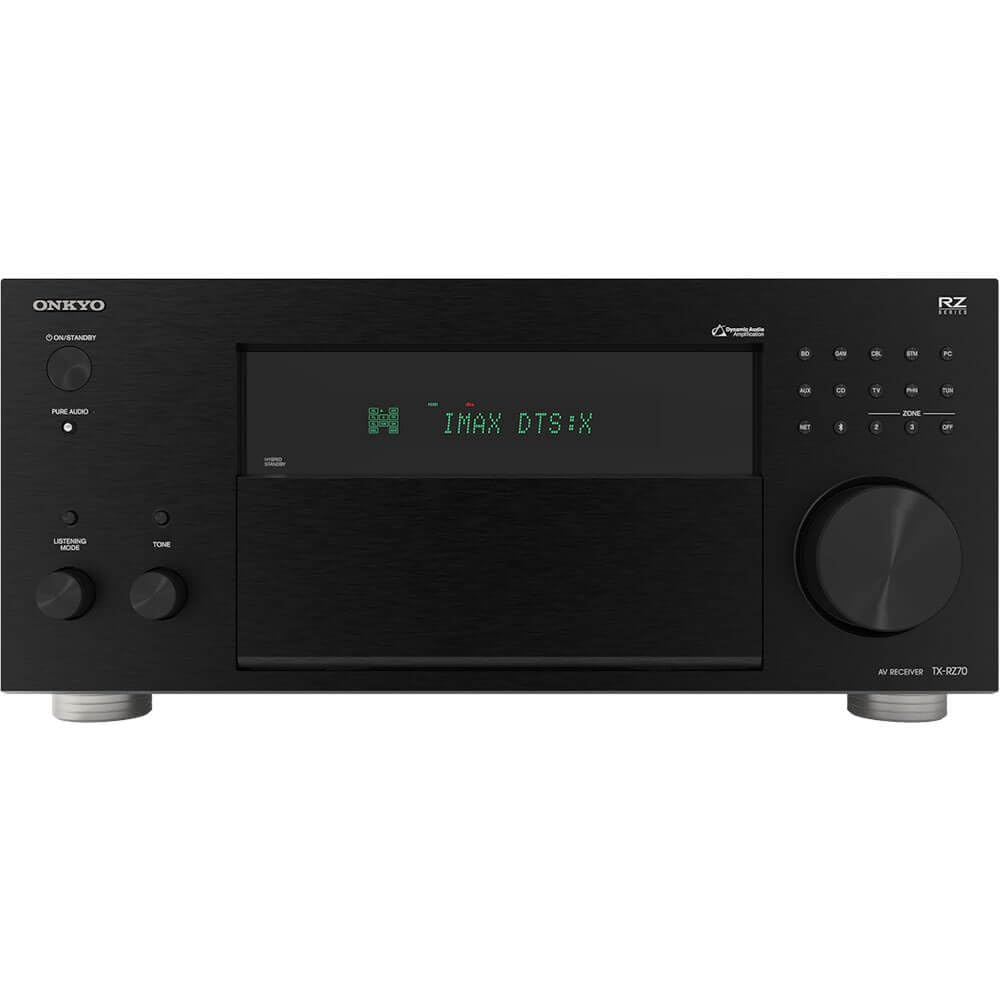
1. Onkyo TX-RZ70 11.2-Channel AV Receiver
Our pick — over 4★ from 100+ verified ratings; the strongest balance of quality and price.
The complete package that pairs room-perfecting Dirac Live with genuine 140-watt amplifier muscle.
This is the receiver that keeps coming up when people stop comparing spec sheets and start listening. It delivers 140 watts per channel across 11 channels, giving you the headroom to drive a full 7.2.4 Atmos setup with authority. It runs cool and silent, ideal for open-rack placement.
The headline here is Dirac Live Room Calibration Full Bandwidth, which uses machine learning to measure your room and correct the audio for your exact speaker layout. Owners say Dirac Live “transforms bass and imaging,” elevating modest speakers. Add the THX Certified badge, ESS Sabre DACs, and IMAX Enhanced Mode that stretches the picture up to 26% more on screen, and this feels like a processor that cost twice as much.
Independent tests measured 170W per channel, exceeding its 140W rating. It handles full 40Gbps HDMI 2.1 with zero handshake issues, supports 8K, Dolby Vision, HDR10+, and Auro-3D, and it is Roon Ready for high-end music streaming. The feature set genuinely rivals receivers priced well above it.
Why owners love it
- The thing everyone raves about is the performance — the combination of raw power and Dirac’s calibration makes a 7.2.4 setup sound enormous.
- Full-bandwidth Dirac Live is included from the start, which normally costs extra on other brands.
- Zero HDMI handshake issues with 4K/120Hz, VRR, and Dolby Atmos content.
What to know before buying
- It is physically huge and heavy — plan your AV rack shelf accordingly.
- The included remote feels cheap even though the receiver itself is premium.
- A small number of owners hit reliability problems; the manual is also not the clearest.
The smart money pick: If you want flagship performance, elite room correction, and pre-out jacks for future external amps, this is the receiver to build your theater around.
Think twice if: You want the absolute simplest setup and never plan to use external amplification — the Dirac setup does take some time to run properly.
2. Onkyo TXRZ70 11.2 Channel THX Certified Premium AV Receiver
The same heavyweight amplifier core as our top pick, offered as a refurbished unit for a lower entry point.
This is effectively the same TX-RZ70 hardware — 140 watts across 11.2 channels, THX Certified, Dirac Live Full Bandwidth, and ESS Sabre DACs — sold as a refurbished unit. For buyers who want the flagship experience at a friendlier price, that is an appealing math problem. Owners replacing Denon units report the Dirac tuning is “superior to Audyssey,” with clean, detailed sound and no video issues.
The trade-off is the refurbished reality. Several owners describe it as a “BEAST of a receiver” that is seriously overbuilt for its price point, and reliability is the most-praised aspect here. But a few units have arrived with problems — including one that clicked and refused to power on, which reads like a shipping or refurbishment casualty rather than a design flaw.
It drives demanding speakers well, works with external amps via pre-outs, and the mobile app is solid. The recurring honest caveat is that you are buying a refurbished unit, so the experience depends heavily on the condition of the specific unit you receive.
The refurb gamble: When it works, this is one of the best-value 11-channel receivers money can buy — the same Dirac-powered muscle as the top pick at a lower price.
The honest caveat: Refurbished electronics carry a higher risk of arriving with a fault, so buy from a source with a solid return policy.
3. Yamaha RX-A8A AVENTAGE 11.2-Channel AV Receiver

A top-tier Yamaha with Surround:AI that tune sound in real time and the cleanest HDMI 2.1 suite for gamers.
The Yamaha RX-A8A is the brand’s flagship AVENTAGE model, designed for buyers who want premium sound in a very reliable, well-rounded package. It supports Dolby Atmos, DTS:X, and Auro-3D (three object-based surround formats that place sounds around you in 3D space), and its unique Surround:AI technology analyzes each scene and automatically tune the sound effects in real time. Buyers report this makes dialogue clearer and action scenes more rich without you having to fiddle with settings.
Gamers will appreciate that all HDMI inputs support 8K60 and 4K120 at 40 Gbps, with ALLM and VRR for next-gen consoles. The 7-in/3-out HDMI section with HDCP 2.3 and eARC means you can connect every device you own. Its YPAO R.S.C. with 3D room correction includes multipoint measurement, and the independent subwoofer adjustment is a feature owners specifically praise for improving bass balance.
It is a heavyweight at 47.2 pounds, so you need a sturdy shelf. Its sound is “most dynamic and engaging,” with punchy bass that some say beats the Onkyo RZ70 and Denon X4800. The downsides are its older-feeling on-screen display and a MusicCast app that is not the prettiest.
Why it stands out
- Surround:AI is a genuinely different feature — it adjusts audio in real time per scene, which no other brand does.
- All HDMI inputs support 8K60 and 4K120 with full 40 Gbps bandwidth for next-gen gaming.
- Quality and performance are the most-praised aspects, with reliable sound and strong bass.
The trade-offs
- The on-screen display and MusicCast app feel dated compared to rivals.
- Some owners have hit HDCP errors that need a restart to clear.
- At 47.2 pounds, it demands a solid, dedicated AV shelf.
Reach for this if: You want a reliable, powerful, and musically engaging receiver that handles gaming features flawlessly and lets you adjust each subwoofer independently.
Look elsewhere if: You prefer the deeper room-correction reach of Dirac Live — Yamaha’s YPAO is good but not as advanced.
4. Sony STR-AZ5000ES Premium ES 11.2 CH 8K A/V Receiver

Sony’s ES-series build quality pairs with 360 Spatial Sound Mapping, a feature that creates rich audio from fewer physical speakers, so you can skip some surround channels and still get a full soundstage.
Sony’s ES line has a reputation for exceptional build quality, and this receiver lives up to it. The STR-AZ5000ES is a 130W-per-channel receiver (at 8 ohms, 1kHz, 2ch driven) with 8K and 4K/120 HDMI 2.1 connectivity across 7 inputs and 2 outputs. Owners praise its “made extremely well” build, easy setup, backlit remote, and Bravia integration.
Its defining feature is 360 Spatial Sound Mapping, which uses the Digital Cinema Auto Calibration IX system to create phantom speakers — virtual surround channels that fill the room without needing as many physical speakers. In practice, owners say the spatial audio “sounds great,” though the room-mapping software can struggle if you use front ceiling speakers, requiring a manual add during setup.
It decodes Dolby Atmos and DTS:X, supports Dolby Vision, HDR10, and IMAX Enhanced, and works with Sonos systems. The downside reported by a few is the on-screen popup that appears when you turn on your TV, which some find annoying. The most serious complaint — a faulty HDMI port damaging a connected TV — appears to be an isolated incident rather than a pattern.
Built like a tank: If you value premium construction and smooth Bravia integration, this is the most solid-feeling receiver on the list, with a chassis that owners mention feels reassuringly heavy and rigid.
Know this first: Its room correction is less automated than Dirac or Audyssey, so expect to spend time in the calibration menus.
5. Denon AVR-X6800H 11.4 Channel AV Receiver

The 11.4-channel powerhouse that processes up to 13.4 channels, with Audyssey MultEQ XT32 room correction built in.
The Denon AVR-X6800H is the receiver for people who refuse to be limited by their amplifier. It delivers 140 watts across 11 channels but can process up to 13.4 channels — meaning you can run an external amplifier later for a truly massive system without swapping receivers. It supports Dolby Atmos, DTS:X, IMAX Enhanced, and Auro-3D, plus Dolby Atmos Height Virtualization for creating height effects even without ceiling speakers.
Upgraders call it a “top-tier build” with superior airflow and easy setup. It pairs beautifully with high-end speakers — one owner uses Arendal speakers and reports excellent room correction results. Audyssey MultEQ XT32 is the industry’s most battle-tested room-correction system.
The catch is real-world complexity. A few customers note HDMI 2.1 issues when using Nvidia graphics cards, including HDR10 and Dolby TrueHD problems, and occasional EDID issues requiring a power cycle. The quality feedback overall is mixed — while many love it, the reliability is not universally bulletproof, so it is a pick for those who enjoy tweaking.
The big wins
- 13.4-channel processing gives you a clear upgrade path to external amps — no need to buy a new receiver later.
- 8K HDMI support with Dolby Vision, HDR10+, and 8K upscaling on all 7 inputs.
- Owners upgrading from older Denons call it the best one yet, with excellent sound separation.
The honest caveats
- HDMI 2.1 can be finicky with Nvidia GPUs, including HDR and EDID quirks.
- At this price, some owners expect perfect reliability — and a few report needing power cycles.
- The on-screen setup guide is good, but the advanced menus are deep.
Best for the builder: Choose this if you plan to grow your system over time with external amplifiers and want the most future-proof processing of any pick here.
Not for the impatient: If you want plug-and-play perfection with zero HDMI troubleshooting, the Yamaha or Onkyo are smoother daily drivers.
Understanding the Specs
What “11.2 Channels” Really Means
The first number is amplifier channels — 11 power amp sections for speakers. The second is subwoofer outputs, which do not need their own amps. An 11.2 receiver can drive a 7.2.4 setup: seven ear-level speakers, two subwoofers, and four Atmos height channels. That is the standard for a serious home theater.
Watts Per Channel and Speaker Matching
Wattage tells you how loud and clean the receiver can drive speakers. A 140-watt-per-channel receiver will comfortably drive most tower speakers. If you have low-impedance speakers or a very large room, look for the highest continuous rating. The wattage number is measured at 8 ohms with two channels driven — that is the honest baseline.
FAQ
Do I actually need 11 channels for a home theater?
What is the difference between 11.2 and 13.4 channel processing?
Will an 11-channel receiver work with my existing TV and speakers?
What is the best room correction system?
Is HDMI 2.1 important for an 11-channel receiver?
Can I use an 11-channel receiver with external amplifiers?
How heavy are these receivers and do they need special ventilation?
What is the difference between Dolby Atmos, DTS:X, and Auro-3D?
Is a refurbished 11-channel receiver a good idea?
How long do AV receivers last?
Final Thoughts: The Verdict
For most buyers, the 11 channel receiver winner is the Onkyo TX-RZ70 because it combines genuine 140-watt power, full-bandwidth Dirac Live room correction (a system that adjusts sound to your room’s acoustics), and THX certification into one package that outperforms its price class. If you want the most simple to use daily driver with the best gaming features, grab the Yamaha RX-A8A. And for the ultimate future-proofed system you can grow with external amps, the Denon AVR-X6800H is the one to reach for.
How We Picked
We do not accept paid placement. Every pick is matched to a real buyer and a real use-case; we do not hands-on test units.
Sources & Methodology
Specifications: manufacturer listings and product documentation. Review insights: verified customer reviews, as of August 2026. Pricing: not shown on this page (it changes often); check the current price via the retailer link.
As an Amazon Associate, Gadgets Feed earns from qualifying purchases. This does not affect which products we feature.