
Our readers keep the lights on and my morning glass full of iced black tea. As an Amazon Associate, I earn from qualifying purchases.
Specs are compiled from manufacturer listings and verified buyer reviews and can change over time — please confirm the key details on the product page before buying.
The best hiking tripod disappears into your pack until you need it for that golden-hour shot. It must be light enough to carry for miles, but stable enough to hold sharp in a breeze. The trade-offs here are real, so this guide focuses on what actually matters: folded length, trail weight, and how much gear each set of legs will hold.
I’m Min — the founder and writer behind Gadgets Feed. This guide is built by comparing the manufacturers’ published specifications and the patterns across verified customer reviews, so you get each pick’s real strengths and trade-offs instead of marketing spin.
You will find the perfect lightweight, packable camera tripod for hiking that balances stability, height, and weight for your next trail adventure.
Our Picks at a Glance


How To Choose The Best Camera Tripod For Hiking
Trail weight dictates how far you’ll carry it, so every ounce matters on steep climbs. Before you look at camera compatibility or head smoothness, you need to decide how much weight you are willing to carry and how short the folded tripod must be to fit your pack.
Folded Size vs. Extended Height
A tripod that collapses to under 18 inches can slide into a backpack side pocket or a carry-on. The trade-off is that shorter folded lengths often mean more leg sections or a lower maximum height, so you might be crouching instead of standing for that shot.
Load Capacity Is Not Static
Manufacturers list a maximum load, but that number drops when the legs are fully extended. A tripod rated for 22 lbs at low height may only be stable with a lighter mirrorless setup when the center column is raised to eye level.
Ball Head Quality
A smooth, drift-free ball head is critical for sharp long exposures. A smooth head that locks tight without drifting is worth more than a few saved grams, because a head that creeps ruins long exposures.
Quick Comparison
| Model | Best For | Max Height | Weight | Material | Amazon |
|---|---|---|---|---|---|
| SIRUI AM-223★ Best Overall | Ultra-compact, low-angle shooting | 16 inches | 0.52 kg | Carbon Fiber | Amazon |
| NEEWER LITETRIP LT07Best Value | Full-height shots with phone/camera combo | 61.6 inches | 3.5 pounds | Aluminum | Amazon |
| Cayer CH35Lightest Pick | Minimal weight, max portability | 53.6 inches | 0.4 kg | Carbon Fiber | Amazon |
| K&F Concept 60 | Airline travel and monopod use | 60 inches | 1 kg | Carbon Fiber | Amazon |
| Fotopro 60″ | Quick tripod-to-monopod conversion | 62 inches | 0.98 kg | Carbon Fiber | Amazon |
| SIRUI Traveler 5CX | Backpack-side-pocket carrying | 52 inches | 0.92 kg | Carbon Fiber | Amazon |
| Manfrotto Befree Advanced | Reliable, premium aluminum build | 59.45 inches | 3.5 pounds | Aluminum | Amazon |
| NEEWER LITETRIP LT32 | Heavy telephoto lenses on trail | 62 inches | 1.71 kg | Carbon Fiber | Amazon |
| Peak Design Travel Tripod | Pro-level stability in a water-bottle profile | 60 inches | 1.29 kg | Carbon Fiber | Amazon |
In‑Depth Reviews
1. SIRUI AM-223 Carbon Fiber Mini Tripod
Our pick — over 4.5★ from 600+ verified ratings; the strongest balance of quality and price.
The pocket-sized carbon legs that somehow handle a full-frame DSLR with a heavy zoom lens.
This is the pick for hikers who prioritize pack space above all else. It tops out at 16 inches, which is a fraction of the NEEWER LT07’s 61.6-inch reach — but that is the whole point. You are not getting eye-level shots; you are getting rock-solid ground-level and macro angles that full-size tripods cannot reach.
The build quality is what wins people over, and it shows in the details. The 10-layer carbon fiber legs measure 16mm in diameter, which feels sturdy in hand despite the 0.52 kg weight. Buyers report it holds a Nikon D750 with a 70-200 f/2.8 without any head creep, and the smooth ball head works with all Arca plates. The flat leg positioning lets you get the camera low to the ground for those close-up shots.
It’s a specialist for low-angle and macro work, not a general-purpose tripod. If you are a landscape photographer who shoots mostly from ground level or a backpacker who wants a tripod for occasional family shots, this is a joy to use. The twist locks are positive, the spikes are removable, and it folds to just 12.1 inches. Owners mention it is “rock-solid stability, larger leg diameter” — a surprising amount of confidence for such a small footprint.
What earns its place in your pack
- Folded height of 12.1 inches slides into any backpack pocket
- 10-layer carbon fiber legs stay rigid for the weight
- Handles heavy full-frame gear like the Nikon D750 with 70-200mm
Know the limits before you buy
- 16-inch max height means no standing-height shots
- Can feel tippy in portrait orientation with long lenses
- The B-00K head’s safety release can gouge the head if forced
Reach for it if: you shoot low angles, macro work, or want the lightest possible full-frame-capable support.
Look elsewhere if: you need a tripod that brings the camera up to your eye level on the trail.
2. NEEWER LITETRIP LT07 61″ Aluminum Travel Tripod
A full-height aluminum workhorse that doubles as a vlogging rig and teleprompter.
The LT07 is the answer for hikers who refuse to choose between a proper tripod and a phone setup. It extends from 19 inches all the way to 61.6 inches, so you get genuine eye-level shooting — something the SIRUI AM-223 above simply cannot offer. The 4-section aluminum legs fold down to a 20.5-inch length with a 2.2-inch diameter for an easy single-hand grip.
What makes it special is the versatility. The detachable panoramic ball head has a 40mm scaled pan base for smooth 90° vertical shots, and it can be removed and mounted on a monopod or slider via a 3/8″ thread. The included 2-in-1 phone holder doubles as a handle grip, with a 180° tilt and adjustable opening that fits iPhone 17 Pro Max down to Samsung Galaxy S24 Ultra. You can even mount it as a mobile teleprompter with the cold shoe for an LED light.
The trade-off for that height is aluminum weight — 3.5 pounds, notably heavier than the carbon fiber options here. Customers note it feels sturdy and “loves the clips and the versatility of it in terms of height,” with one noting it fits easily in a 24″ luggage. The recurring gripe is the round center column that can rotate during panoramas unless you tighten it hard.
The smart-buyer read: this is the value king — solid quality and sturdiness are the most-praised aspects, and the build easily competes with higher-priced name brands.
Who it suits: day hikers who want one tripod for every scenario, from long-exposure landscapes to phone video.
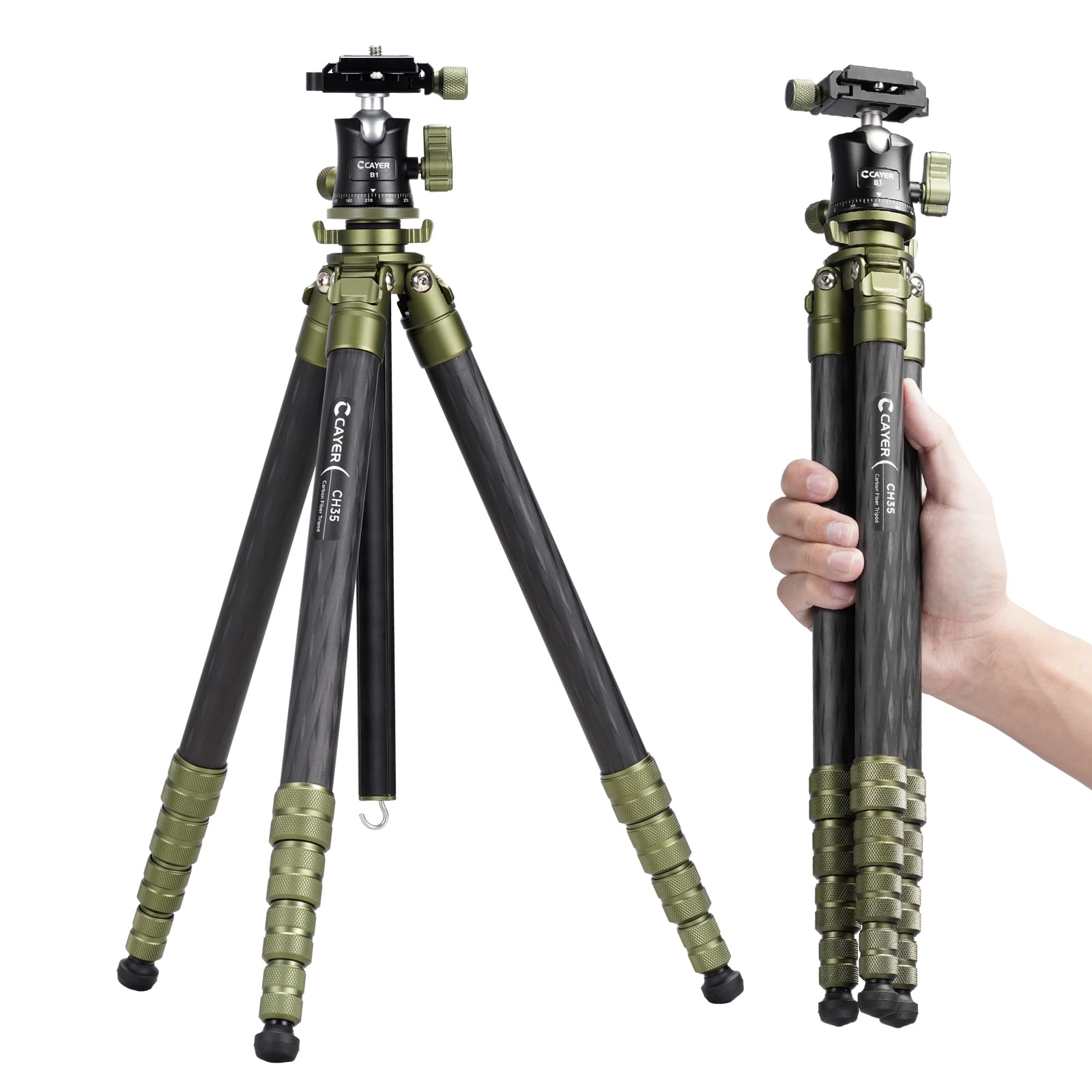
3. Cayer CH35 Travel Tripod
The featherweight that climbers and astrophotographers carry without a second thought.
At 0.4 kg, this is the lightest tripod on this list — a full 30% lighter than the SIRUI AM-223’s 0.52 kg. That difference is what you feel on the fifth mile of a climb. Despite the tiny weight, the carbon fiber legs extend to 53.6 inches for eye-level shots, and the unique Y-shaped center column folds the whole thing down to just 17.7 inches.
This is the pick for serious hikers who shoot astrophotography or timelapse in remote areas, as reviewers point out doing. They need two tripods — one for stills, one for timelapse — and want something light enough to carry to remote spots. The 42mm ball head offers 45° tilt, 360° pan, and 90° side tilt, plus an Arca-type quick release plate and 1/4″ mounting screw for broad camera compatibility.
The honest caveat is wind: it’s not for gusty conditions. One reviewer noted it fell over from the wind in New York, so treat it as a fair-weather companion for lighter setups. It also drops to just 6.1 inches with the included short column, making it a superb tabletop and macro tripod. The included phone clamp and carrying case make it a complete kit.
Best for the ultralight purist: the value for money and sturdiness are the most-discussed strengths, and it doubles as a desktop tripod.
The catch: that featherweight build trades away stability in gusty conditions, so keep the center hook weighted.
4. K&F Concept 60″ Carbon Fiber Tripod
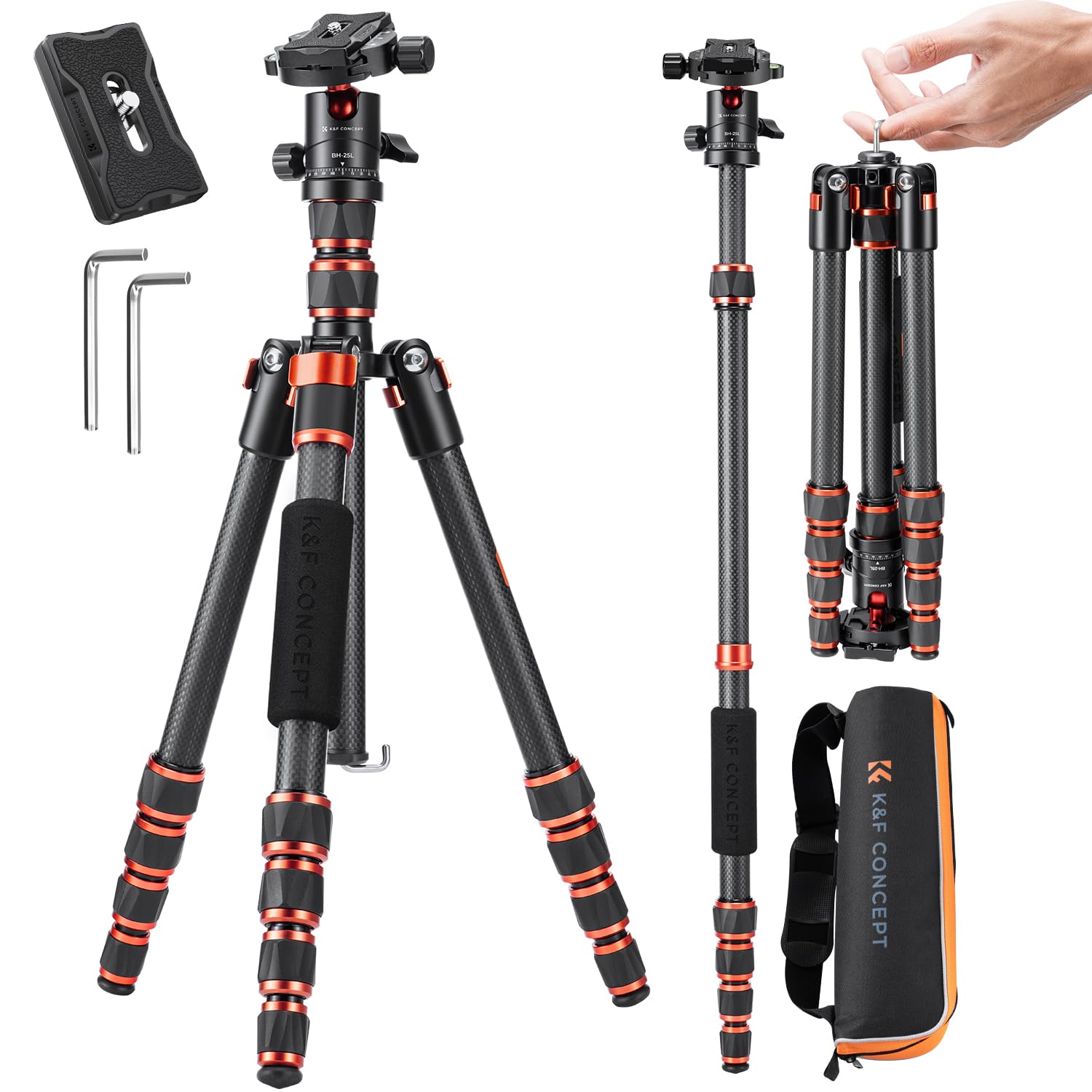
The trail-to-airline traveler that converts into a monopod when the trail gets crowded.
If you hike and fly, this tripod fits both worlds. Its 5-section legs adjust from 18 to 60 inches in seconds using a metal knob lock, and the 180-degree reflex design folds it to just 13.8 inches — short enough for most airline carry-on limits (40-55cm). At 1 kg, you can carry it into mountains, deserts, or wilderness without feeling the weight.
The standout feature is the detachable leg that converts into a monopod. One leg removes and attaches to the ball head, giving you a working height between 14.6 inches and 62 inches. This is gold for wildlife shooters or anyone who needs to reach over crowds at events. The 25mm ball head provides 8kg of safe load-bearing capacity with a 360-degree horizontal scale for precise panoramic positioning.
The balanced trade-off here is durability versus weight. Buyers praise the lightweight and compact fold, but some report broken leg latches on initial units — though the company replaced them quickly. The recurring smell note is the foam or rubber grips, which can leave an odor on your hands after use, so plan accordingly for long trail days.
Why it earns a spot: weight and quality are the most-praised aspects, and the reversible center column drops you to low-angle macro shots in seconds.
Who should skip it: anyone who wants a fuss-free grab-and-go — the knob locks demand more fiddling than flip locks.
5. Fotopro 60″ Carbon Fiber Travel Tripod
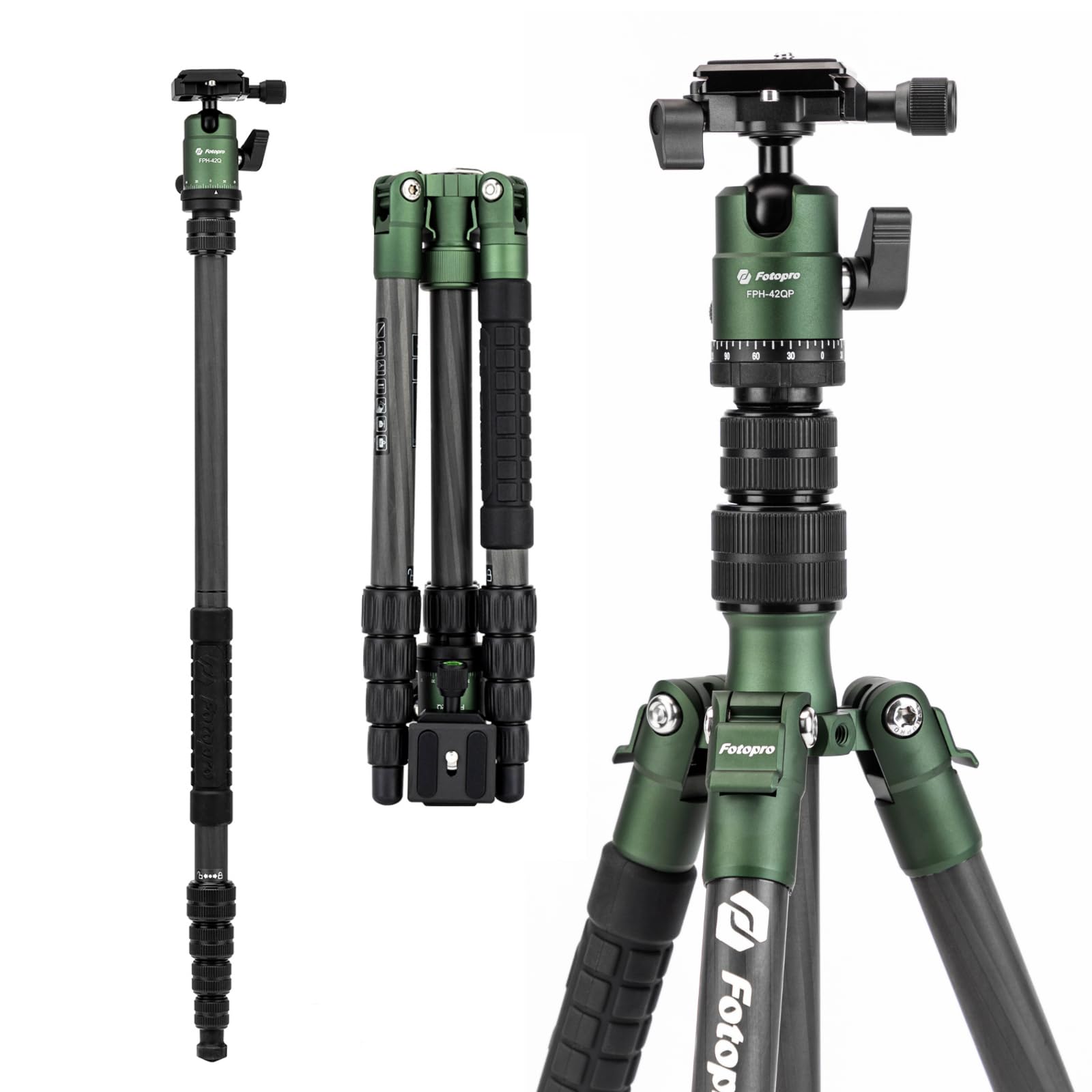
A 2-pound carbon setup that reaches 62 inches and converts to a monopod in under 10 seconds.
At 2 lbs (0.98 kg), this carbon fiber tripod holds 17.6 lbs of gear while saving over 1.3 lbs versus aluminum models. The 3 leg angles — 25°, 50°, and 80° — let you adapt to slopes and uneven ground, and the carbon fiber dampens vibration for sharper long exposures. When folded, it shrinks to 14.17 inches, fitting carry-on bags and overhead bins.
The 2-in-1 conversion is genuinely tool-free. Detach one leg, and the tripod becomes a monopod reaching 42.7 inches — perfect for wildlife or crossing a crowded viewpoint. The tripod itself reaches 62 inches, and the reversible center column drops down for ground-level macro shots. It ships with a true Arca-Swiss compatible plate, so it works with your existing camera gear.
Stability is the trade-off. Shoppers say it is “not stiff enough for ultra-long exposures in even a light wind, but it’ll work for pretty much anything else.” The included carry bag has a shoulder strap, and the center hook lets you hang your pack to add wind resistance.
The functional angle: the most-praised aspects are its functionality and value for money, with owners using it for spotting scopes as well as cameras.
Reach for it if: you need a genuine monopod option without buying a second piece of gear.
6. SIRUI Traveler 5CX Carbon Fiber Tripod

The 12.4-inch folded wonder that doubles as a selfie stick and hiking cane.
This is the tripod that disappears into your setup. When folded, it measures just 12.4 inches, making it perfect for a backpack side pocket, suitcase, or car door pocket. The carbon fiber legs and aluminum ball head weigh only 2.03 lbs (0.93 kg), yet support up to 13.23 lbs (6 kg) of gear — though SIRUI recommends a 50% payload at full extension.
The defining trick is the telescopic, removable center column. Extend it for high-angle shots, or remove it entirely for lower angles. Buyers have even used the detachable pole as a selfie stick, and one 220-lb owner used it as a cane after an ankle injury — proof of the build quality. The 360° detachable ball head tilts 90° vertically and features a horizontal scale for precise positioning.
The recurring concern is the plastic threads. While the tripod holds a mirrorless camera with a 200-400mm lens well in horizontal mode, some buyers report the threads don’t tighten securely, and it’s not ideal for astrophotography where absolute rigidity matters. The 180° fold and included bag make it a complete travel package.
The weight is the headline: it’s the most-praised aspect, and the 3.54-inch minimum height is perfect for ground-level work.
Pass on it if: you shoot heavy telephoto lenses fully extended in windy conditions — that’s beyond its comfort zone.
7. Manfrotto Befree Advanced Aluminum Tripod

The Italian-built aluminum tripod with a premium feel that survives being thrown in a vehicle.
Manfrotto brings a legacy of quality to the hiking category, and it shows in the 494 aluminum ball head with three independent controls for sphere lock, friction, and pan lock. The QPL Travel locking system on the spider guarantees maximum stability, and the independent leg angles give you creative freedom on uneven terrain. It extends to 59.45 inches and folds to 15.8 inches.
Buyers rave about the build. One said: “Very sturdy very high quality and exactly what I would expect from manfrotto.” It holds a Nikon D750 or an iPhone holder without strain, sets up in about a minute, and the ball head swivels smoothly yet locks firmly.
The trade-off for that premium feel is aluminum weight. At 3.5 pounds, it ties with the NEEWER LT07 as the heaviest option here, and some buyers find it heavy for a “travel” tripod. There are also occasional reports of the ball head getting stuck after months of use, so treat the friction control gently.
High-quality materials, honest limits: the camera plate can block SD card access, so plan for that when swapping cards mid-hike.
Choose it if: you trust the Manfrotto name and want a tripod that feels like it will outlast your camera body.
8. NEEWER LITETRIP LT32 Carbon Fiber Tripod

The carbon fiber beast that holds a Sigma 150-600mm lens rock-solid on rocky terrain.
This is the tripod for hikers who carry serious glass. The 1-inch (26mm) carbon fiber tubes support a 22lb (10kg) load capacity — or 10lb with the ball head — and buyers confirm it holds a 3kg Sigma 150-600mm lens rock-solid. The 360° panoramic ball head base offers ±15° quick leveling, dual U slots for 90° tilt, and a bubble level to keep your horizon straight.
On the trail, its feature set stands out. Spring-loaded metal flip buckles let you change height from 16″ to 62″ quickly, with three fixed leg angles (22°, 55°, 70°). Remove the foot pads to expose spikes that grip sand, rock, or mud. Two 1/4″ threads on the spider let you attach magic arms or other gear.
The honest caveat is the stock ball head. Buyers consistently praise the legs but note the head is the weak point — “exceptional legs, but plan for a head swap.” The round head stem allows panning, but it’s not as refined as the legs. At 1.71 kg, it’s heavier than the SIRUI AM-223, but that weight buys you the stability to keep a 150-600mm lens steady.
Buy it for the legs: build quality is the most-praised aspect, and the flip buckles are fast and reliable in cold conditions.
Plan around it: budget for a better ball head if you shoot critical long exposures — the legs outshine the stock head.
9. Peak Design Travel Tripod Carbon Fiber

The water-bottle-sized carbon tripod that packs pro-level stability and a hidden phone mount.
Peak Design reimagined the travel tripod from scratch, and the result is a setup that packs down to the diameter of a water bottle. The unique leg design deploys and locks in seconds with a quick-release lever system — no flipping or fumbling. It extends to 60 inches, and the reversible center column lets you shoot low or hang weight from the integrated hook.
The intelligence is in the details. The omnidirectional ball head uses a single adjustment ring for fast control, and a built-in mobile mount pops out of the center column so you can switch from camera to phone instantly. It supports up to 20 lbs, handling a full-frame DSLR with a telephoto lens, and the anodized aluminum ball head is secure enough for medium format gear.
This is the most expensive tripod here, and the value is contested. Buyers call it “well worth the money” for the premium feel and portability, while others find it overpriced. The honest cons are the leg clips that can pinch skin, the limited vertical ballhead mobility (you’ll want an L-bracket for portrait shots), and the hex wrench holder that ejects tools easily. The compact 15.4-inch folded length makes it a favorite for motorcycle travel and backpack side pockets.
The pro-level verdict: quality and stability are the most-praised aspects, and it’s the best portable tripod found by owners who replaced stolen units.
Worth it if: you want a lifetime-quality tripod and don’t mind learning its quirks — like keeping the tool kit turned correctly to its detent.
Understanding the Specs
Carbon Fiber vs. Aluminum
Carbon fiber legs dampen vibration better than aluminum, which means sharper long exposures on windy ridgelines. Aluminum is cheaper and often heavier, but it can feel more rigid at the same weight. For hiking, carbon’s weight savings usually win — you feel the difference on the climb, not just in the specs.
Ball Head Load and Stability
A ball head rated for 8kg won’t hold that weight steady at full leg extension. Real-world stability drops as height increases, which is why many manufacturers recommend a 50% payload at max height. Match the head’s capacity to your heaviest lens plus a safety margin for wind.
FAQ
How short should a hiking tripod fold to fit in my backpack?
What is the ideal weight for a hiking tripod?
Can I use a heavy telephoto lens on a lightweight hiking tripod?
What is the difference between a ball head and a pan-tilt head for hiking?
Why do some hiking tripods convert into monopods?
How do I keep a lightweight tripod stable in windy conditions?
What does Arca-Swiss compatible mean for my camera?
Can these tripods hold my smartphone too?
What is the best tripod for low-angle macro shots on the trail?
Final Thoughts: The Verdict
For most people, the camera tripod for hiking winner is the SIRUI AM-223 because it offers the best balance of ultra-compact size, rock-solid build quality, and surprising load capacity for its weight. If you want full-height reach with phone and camera versatility, grab the NEEWER LITETRIP LT07. And for serious telephoto shooters who need to steady a 150-600mm lens on the trail, the NEEWER LITETRIP LT32 is the one to reach for.
How We Picked
We do not accept paid placement. Every pick is matched to a real buyer and a real use-case; we do not hands-on test units.
Sources & Methodology
Specifications: manufacturer listings and product documentation. Review insights: verified customer reviews, as of August 2026. Pricing: not shown on this page (it changes often); check the current price via the retailer link.
As an Amazon Associate, Gadgets Feed earns from qualifying purchases. This does not affect which products we feature.