
Our readers keep the lights on and my morning glass full of iced black tea. As an Amazon Associate, I earn from qualifying purchases.
Specs are compiled from manufacturer listings and verified buyer reviews and can change over time — please confirm the key details on the product page before buying.
You can see Jupiter’s moons and Saturn’s rings with your own eyes through a budget telescope—no photos needed. The difference between a great scope and a frustrating one depends on a few specs you can learn in minutes. Here are the most popular models for planet viewing, so you can choose confidently without drowning in jargon.
I’m Min — the founder and writer behind Gadgets Feed. This guide is built by comparing the manufacturers’ published specifications and the patterns across verified customer reviews, so you get each pick’s real strengths and trade-offs instead of marketing spin.
Here is how to choose an affordable telescope to see planets that will actually deliver those breathtaking views on your first clear night.
Our Picks at a Glance


How To Choose The Best Affordable Telescope To See Planets
Planet viewing is a demanding task for any telescope, and the price of entry doesn’t have to be high. The secret is knowing that the lens opening (aperture) and the stability of the stand matter far more than the marketing hype about massive magnification numbers. A wobbly mount that shakes at high power will ruin the view of Jupiter more than a slightly smaller lens will.
The Golden Rule: Aperture (The Lens Width)
Look for a telescope with an aperture of at least 70mm (or 2.8 inches). This is the width of the main lens that gathers light. A larger aperture, like the 90mm found on many of the picks here, captures more light, which is essential for seeing the subtle banding on Jupiter’s surface or the faint division in Saturn’s rings. More light gathered means brighter, more detailed images.
Magnification vs. Useful Magnification
You will see bold claims of “600x” magnification, but that is marketing fluff. A good rule of thumb for planetary viewing is about 50x magnification for every inch of aperture. For a 90mm (about 3.5 inches) scope, that means around 175x is the practical upper limit. Most beginners will find the best views of planets at around 60x to 120x, which is easily reached with the included eyepieces. Push beyond that, and the image gets too dim and blurry.
The Stability of the Mount
Planets are small in the eyepiece, so any tiny shake in the tripod becomes a big blur or a moving target. A sturdy stainless steel tripod is far better than a flimsy aluminum one. An Altazimuth (AZ) mount moves up, down, left, and right, which is intuitive for beginners. An Equatorial (EQ) mount is heavier and has a learning curve, but it tracks the stars as the Earth rotates, which is a significant advantage when you are trying to share a view of Saturn with the family.
Quick Comparison
| Model | Best For | Aperture | Focal Length | Mount Type | Amazon |
|---|---|---|---|---|---|
| Celticbird 80mm★ Best Overall | Travel-ready beginners | 80mm | 900mm | Altazimuth | Amazon |
| MEEZAA 90mmBest Value | Standout value & clarity | 90mm | 800mm | Altazimuth | Amazon |
| Dianfan 90mmMost Versatile | Multi-use observation | 90mm | 800mm | Altazimuth | Amazon |
| Hawkko 90/900 | High power on a budget | 90mm | 900mm | Altazimuth | Amazon |
| Koolpte 90/900 | Phone photography | 90mm | 900mm | Altazimuth | Amazon |
| Gskyer 90mm | Classic all-rounder | 90mm | 600mm | Altazimuth | Amazon |
| Celestron LT 80AZ | App-guided location | 80mm | 400mm | Altazimuth | Amazon |
| MEEZAA 150EQ | Deep-space & planets | 150mm | 650mm | Equatorial | Amazon |
| Sky-Watcher Heritage | Instant, stable observing | 130mm | 650mm | Tabletop Dobsonian | Amazon |
In‑Depth Reviews
1. Celticbird 80mm Refractor
Our pick — over 4.5★ from 150+ verified ratings; the strongest balance of quality and price.
This 80mm refractor pairs a 900mm focal length with a travel bag for dark-sky trips.
The Celticbird wins our top spot because it balances everything a first-time planet hunter needs without a single major compromise. Its 80mm aperture pairs with a 900mm focal length, which gives you the “reach” to see fine detail on the moon and the cloud bands on Jupiter. Because it packs down into a carry bag with all its accessories, you can take it to darker skies—the one thing that matters more than any lens upgrade.
Owners consistently describe the pure joy of their first views, with one parent noting how it allowed a 5-year-old planet-obsessed child to see Jupiter’s 4 moons and even meteors. The tool-free assembly is a standout (around 5 minutes to set up and 3 minutes to tear down), and the adjustable aluminum tripod, which extends from 20″ to 45″, accommodates both kids and adults comfortably. The quality is the most-praised aspect here, with over 70 owners highlighting its build and performance.
Just be aware that while the tripod is stable, it’s not precision instrument—some owners note the mount is a bit imprecise for fine tracking at high power. You’ll want to use the lower magnification eyepiece (the 20mm) for finding targets and let the telescope’s superior optics do the heavy lifting. For a gift, a first scope, or a travel companion, this is the complete package.
Why it wins
- High 900mm focal length for planetary detail
- Truly portable with a bag for dark-sky trips
- So easy a child can set it up in minutes
What to manage
- Tripod is functional, but not precision-grade
- Some units may have dust on the lens
Choose this for: The family or traveler who wants a dependable, easy-to-use scope that reveals Jupiter’s moons on the first night out.
Reach for the MEEZAA if: You want the bigger 90mm aperture for slightly brighter images and don’t mind a lower 800mm focal length.
2. MEEZAA 90mm Refractor
This 90mm refractor offers a stainless steel tripod and a 12% wider aperture than the Celticbird.
If there is a consensus pick for the best all-around starter scope, it’s the MEEZAA. Its 90mm aperture is a full 12% wider than the Celticbird’s 80mm lens, capturing noticeably more light for those faint fuzzy objects beyond our solar system. The “Excellent 90mm refractor; crisp lunar craters, Jupiter’s bands visible” captures the experience owners rave about. With 217 owners praising its quality, this is a scope that delivers on its promises.
You can assemble this scope in about 10 minutes using the paper manual, according to most buyers. The stainless steel tripod adjusts from 28 to 46 inches, and the accessory tray keeps your eyepieces within reach. Its focal length is 800mm—shorter than the Celticbird’s 900mm—but the larger aperture pulls in more light, so you get sharper views of dim objects like the Orion Nebula than the Celticbird can deliver.
The main trade-off is that the finderscope (the small sighting tube on top) is a straight-through model, which can be awkward to look through. Expect a slight learning curve in aligning it with the main tube. But given its sturdy build and high customer satisfaction among over 800 owners, this represents the best balance of budget and performance in the lineup.
The verdict: A fantastic, stable platform that rewards patience with incredible views of the moon and planets, backed by an accessory kit that leaves nothing missing.
Pick this up if: You want the maximum light-gathering aperture for the money and appreciate the sturdiness of a stainless steel tripod.
skip it if: You need the longer 900mm focal length for high-power planetary magnification—the Celticbird is your better match.
3. Dianfan 90mm Refractor
This 90mm refractor’s 45° zenith mirror delivers upright views for daytime and nighttime use.
The Dianfan uses its 90mm aperture and 800mm focal length to deliver sharp images of the moon’s craters and the bands on Jupiter, but what makes it unique is its 45° zenith mirror. This mirror makes the image upright and correctly oriented, which means you can use it during the day for birdwatching or scanning cityscapes just as easily as you can at night for planets. This versatility makes it a brilliant first telescope for a family or an outdoor enthusiast, not just an astronomy buff.
Buyers report a 10-minute setup time and praise its portability, noting it works wonderfully with Samsung and Pixel phones. The fully coated 90mm objective lens gathers light well, and the high-transmission coatings enhance contrast and color. It’s a quality build that earns the most praise for its overall quality (266 owner mentions), beating even our top pick on that specific metric.
Push this scope to its maximum 240x magnification and the image blurs, so stick to the balance of 32x to 100x for crisp views. It won’t show faint deep-sky galaxies, but for planets, the moon, and daytime use, it excels.
Versatility wins
- Upright, correctly-oriented images for daytime use
- Easy 15-minute setup with clear instructions
- Lots of praise for overall build quality
Know the limit
- High magnification (240x) leads to blurry images
- Not ideal for viewing faint nebulas or galaxies
Best for: The buyer who wants one scope for both daytime nature watching and nighttime planet gazing, without the hassle of needing a separate spotting scope.
4. Hawkko 90/900 Refractor

This 90mm refractor’s 900mm focal length enables high-power views of Saturn’s rings and Jupiter’s bands.
With a 900mm focal length paired with a 90mm aperture, the Hawkko is built for planetary detail. This combination allows for higher useful magnification for seeing the Cassini division in Saturn’s rings or the Great Red Spot on Jupiter. For those just starting out, the high-powered magnification (36x to 270x) is a huge draw, letting you push the limits of what you can see. It’s a scope that grows with you as you learn.
The mount is a standout feature for a scope in this range. It’s a stable stainless steel AZ mount that supports smooth 360° rotation, and the tripod height adjusts from 28″ to 46″. This stability is crucial at higher magnifications, and owners note that they can clearly see Saturn’s rings and Jupiter’s cloud bands with ease. The kit includes everything you need: a finder scope, a 45° zenith mirror, 25mm and 10mm eyepieces, and a 3x Barlow lens.
The feedback is overwhelmingly positive, with the most common sentiment being a strong recommendation to buy. The main caveat is that the scope can shake on bumpy or uneven ground at maximum magnification, so a solid, level surface is key. The phone adapter, while functional, can be a bit finicky to align perfectly.
The take: An outstanding performer that prioritizes high-power planetary views and comes with a more rock-solid tripod than its closest competitors.
Aim for this if: You are serious about seeing the finer details of planets like Saturn and Jupiter and want a scope that won’t feel limiting after a few months.
Consider Dianfan instead if: You also want perfectly upright daytime views for terrestrial observation—a feature this scope lacks.
5. Koolpte 90/900 Refractor

This 90mm refractor includes a wireless remote and phone adapter for shake-free moon photos.
The Koolpte is for you if you want to photograph what you see, not just observe. Its 90mm aperture and 900mm focal length deliver sharp views, but the standout is the included phone adapter and wireless remote. You trigger your phone’s shutter without touching the telescope, so you avoid the shake that blurs most eyepiece photos—a steady way to capture and share.
While owners are keen on the clear views of the moon and planets, the quality of the components is the most-praised aspect, with over 100 owners highlighting it. The Plossl eyepieces are a step up in image quality from the Kellner eyepieces found on many budget scopes, giving you a slightly wider field of view and better edge sharpness. The mount is a smooth “Vertisteel” Altazimuth mount that holds its position well.
The feedback on sturdiness, however, is mixed. The mount itself is strong, but the phone holder attachment has come in for some criticism for not being as secure as it could be. Some owners also found the included Barlow lens difficult to get a clear image with. For pure visual observation, it’s on par with the Hawkko, but the wireless remote gives it a distinct edge for casual astrophotography.
Capture the view
- Wireless remote prevents camera shake for crisp phone photos
- Higher-quality Plossl eyepieces included
- Smooth, precise AZ mount
Watch the details
- Phone holder security earns mixed feedback
- Barlow lens can be tricky to use effectively
Perfect for: The dad or mom who wants to capture the “wow” moment of seeing the moon’s craters to share on social media, without the frustration of hand-held phone adapters.
6. Gskyer 600x90mm

This 90mm refractor with a 600mm focal length offers wide-field views and a versatile kit for beginners.
The Gskyer is a proven entry-level scope. Its 90mm aperture and 600mm focal length (f/6.7) make it a wide-field instrument—ideal for sweeping the sky and spotting star clusters—but it offers less magnification for planets than a 900mm scope. It shows the moon’s craters and Jupiter’s moons clearly, and it pulls in enough light for brighter galaxies and nebulas, a bonus for a generalist.
The kit is fantastic, including three eyepieces (24x, 60x, 120x), a 3x Barlow lens to triple those Magnifications, a 6×30 finderscope, and a 48-degree erecting BAK7 prism for upright terrestrial views. It even comes with astronomy software to help you navigate the night sky. Owners frequently mention that kids love it, and its ease of assembly and use is a huge plus for total beginners.
The main feedback is that the optical quality is great, but for serious planet chasing, it’s outclassed by the 900mm focal length scopes. A common owner finding is that the image shakes at the highest magnification (120x), which the flimsy tripod doesn’t help. For a broad introduction to astronomy that includes the moon, planets, and deep-sky, it’s a solid budget pick, but dedicated planet viewers should look to the Hawkko for more reach.
The honest take: A quality first telescope, but its shorter 600mm focal length means planets will appear smaller in the eyepiece than through the 900mm models in this list.
Choose this for: A child’s or beginner’s first scope that offers a versatile mix of moon views and wide-field star clusters, where ease of use beats raw magnification.
Level up to Hawkko if: Your primary goal is to see the fine detail in Saturn’s rings or Jupiter’s bands, which requires that longer 900mm reach.
7. Celestron StarSense Explorer LT 80AZ

This 80mm refractor uses a smartphone dock and app to guide beginners to planets.
This is the pick for anyone who has ever bought a telescope and never found a single planet because they couldn’t figure out where to point it. The Celestron StarSense Explorer uses a patented technology to analyze the star patterns overhead. You simply dock your smartphone to the mount, launch the free app, and follow the on-screen arrows until the bullseye turns green. You don’t need to know a single constellation to find Jupiter or Saturn.
This scope uses an 80mm refractor with a 400mm focal length—shorter than the other picks, so you get a wider field of view but less zoom on planets. You won’t see as much detail as on a 900mm scope, but Saturn’s rings and Jupiter’s moons are clear, and the navigation system’s ease makes it ideal for a complete novice.
Feedback is split between those who find it makes observing easy and those who struggle with the app, either due to phone compatibility or the app not recognizing the sky. The red dot finderscope and the build quality are praised, as is the brand’s customer support. For a beginner who wants a specific, guided experience to find their way around the night sky, this is a standout, but those who prefer the traditional eyepiece-only experience may find the app a distraction.
easy positioning
- App-guided navigation eliminates the hardest part of stargazing
- Reputable Celestron brand with a 2-Year US Warranty
- Simple manual altazimuth mount
Consider the trade-offs
- Short 400mm focal length limits high-power planetary detail
- App functionality can be finicky depending on your phone
- Stability and app alignment draw some negative feedback
Who it’s for: The tech-savvy beginner who owns a smartphone and wants to point at a planet named on the screen, falling in love with astronomy through instant gratification.
8. MEEZAA 150EQ Reflector
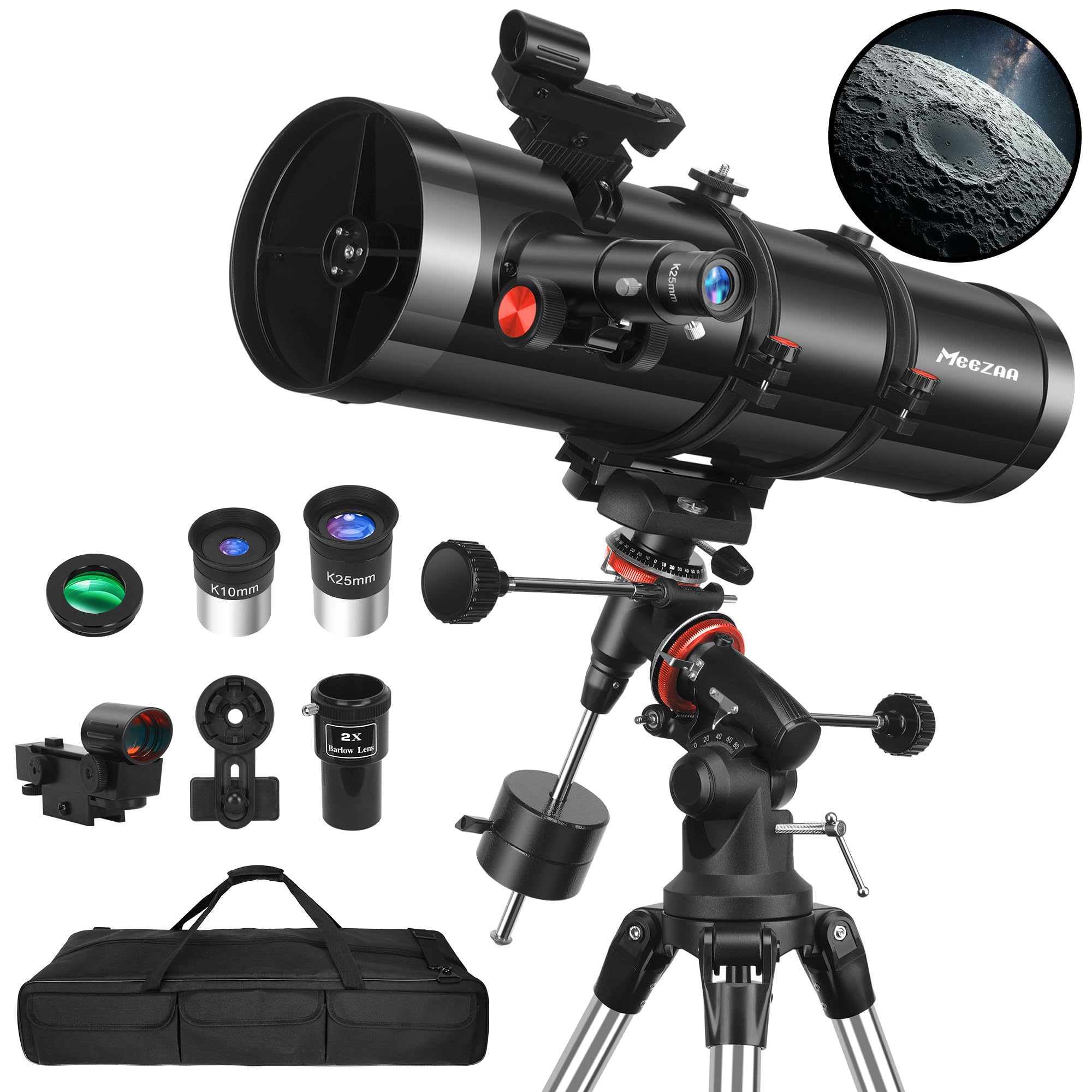
This 150mm reflector on an EQ mount reveals deep-sky objects and tracks planets smoothly.
This scope stands apart with a 150mm aperture—50% bigger than the 90mm models—and a 650mm focal length on a Newtonian reflector design (mirrors instead of lenses). The large mirror gathers far more light, so it’s the only scope here that shows faint objects like the Andromeda Galaxy or Orion Nebula satisfyingly, plus crisper planet views.
It comes with a proper German Equatorial (EQ) mount, which is the kind serious astronomers use. It features slow-motion control knobs and precision dials so you can smoothly track objects across the sky as the Earth rotates. This means you can keep Jupiter in the eyepiece for minutes at a time to really study its bands, instead of constantly nudging the scope back into position. Owners praise the sturdy build, noting it’s solid and the mount is heavy-duty.
The catch is complexity and weight. This is a heavy, multi-part instrument that takes time to assemble and learn to use correctly; it is not a 5-minute setup. Also, the instructions have drawn some mixed feedback for clarity. It’s a serious purchase for someone ready to commit to astronomy as a hobby, not just a casual weekend curiosity. For that buyer, this is an unbeatable value in aperture and quality.
Serious power
- 150mm aperture reveals deep-sky galaxies and nebulas
- EQ mount with slow-motion controls tracks objects smoothly
- Heavy-duty stainless steel tripod for stability
Commitment required
- Heavy and complex to assemble, not for casual use
- Learning curve for the Equatorial mount
- Swapping eyepieces can require focus recalibration
Choose this if: You are ready to invest time in learning a serious instrument and want to see not just Saturn’s rings, but the faint smudge of the Andromeda Galaxy with your own eyes.
Stick with a 90mm refractor if: You want a quick, grab-and-go scope that you can set up in minutes on a weeknight.
9. Sky-Watcher Heritage 130P

A tabletop giant that delivers big-aperture views with zero setup hassle.
The Sky-Watcher Heritage 130P breaks the mold by putting a whopping 130mm of aperture into a compact, tabletop design. This classic Dobsonian style is the secret weapon of amateur astronomers because the simple, sturdy rocker-box base provides the most stable platform for the money. It comes fully assembled right from the start—just set it on a sturdy table, and you’re ready to explore. No tripod setup, no wobbly legs, just instant views.
That big 130mm aperture absolutely obliterates the 90mm refractors in light-gathering power for deep-sky objects. Owners mention fantastic views of the moon, Jupiter and its four moons, Saturn’s rings, star clusters, and even faint Uranus and Neptune. The collapsible design keeps it compact for transport, though you’ll need that stable table surface. The included 10mm and 25mm eyepieces and StarPointer finderscope are a great start.
The trade-off for that aperture and stability is that it’s a bit heavy and not as portable as the refractor-and-tripod combos. Also, for a tabletop scope, the views are best when you’re seated, which makes it less ideal for sharing with a group. There is some mixed feedback on sturdiness with a mention that the optical tube can fall off the base too easily if bumped, so it requires a gentle touch. But for the sheer amount of aperture per dollar, it’s untouchable.
Aperture king
- Massive 130mm aperture for bright, detailed views
- Rock-solid tabletop Dobsonian mount
- No assembly required, ready to use instantly
Set it up right
- Requires a stable table, not ideal for the field
- Can be heavy and awkward to carry long distances
- Optical tube can be bumped off its base if handled carelessly
This is for: Anyone with a backyard table and a desire to see the faintest objects possible for the money, including a ten-year-old’s first glimpse of a galaxy. The most “wow” per dollar you’ll find.
Look to the MEEZAA 150EQ if: You need a proper tripod for uneven terrain and don’t mind a longer setup and learning curve for an even bigger mirror.
Understanding the Specs
Aperture: The Light Bucket
This is the most important number. It’s the diameter of the main lens (in a refractor) or mirror (in a reflector) that gathers light. Measured in millimeters (mm), a bigger number means a brighter, sharper image and the ability to see fainter objects. For seeing planets, 80mm is the minimum to look for, while 90mm and above will give you noticeably better views of Jupiter’s cloud details and Saturn’s ring divisions. On a reflector, the bigger aperture also helps a lot with deep-sky objects.
Focal Length & Magnification
Focal length, in millimeters, determines the potential magnification of the telescope. A longer focal length (like 900mm) gives you more “reach” for high-power views of planets. You change magnification by swapping eyepieces. To figure out the magnification, divide the telescope’s focal length by the eyepiece’s focal length (e.g., 900mm telescope / 10mm eyepiece = 90x magnification). The useful maximum is about 50x per inch of aperture, so don’t chase huge numbers.
FAQ
What is the best affordable telescope to see planets for a beginner?
Is a 90mm aperture telescope good enough to see Saturn’s rings?
What does aperture mean in a telescope?
How much magnification do I need to see Jupiter’s moons?
Is a longer focal length better for seeing planets?
What is the difference between an Altazimuth and an Equatorial mount?
Can I take photos of planets with a smartphone through these telescopes?
What should I look for in a telescope tripod?
Which telescope is better, a refractor or a reflector?
Why can’t I find any planets with my cheap telescope?
Final Thoughts: The Verdict
For most buyers, the affordable telescope to see planets winner is the Celticbird 80mm—it balances portability with a high focal length for planetary detail, and the kit is simple enough for a total beginner. If you want more light-gathering power and brighter images, choose the MEEZAA 90mm, the crowd favorite for value. For a serious stargazer ready to commit, the MEEZAA 150EQ is the pick—its 150mm aperture reveals faint galaxies and nebulas that smaller scopes can’t reach.
How We Picked
We do not accept paid placement. Every pick is matched to a real buyer and a real use-case; we do not hands-on test units.
Sources & Methodology
Specifications: manufacturer listings and product documentation. Review insights: verified customer reviews, as of August 2026. Pricing: not shown on this page (it changes often); check the current price via the retailer link.
As an Amazon Associate, Gadgets Feed earns from qualifying purchases. This does not affect which products we feature.