
Our readers keep the lights on and my morning glass full of iced black tea. As an Amazon Associate, I earn from qualifying purchases.
Specs are compiled from manufacturer listings and verified buyer reviews and can change over time — please confirm the key details on the product page before buying.
Choosing your first underwater camera is a battle between two fears: the dread of a ruined phone in a rented housing, and the disappointment of murky, blue-tinted photos that don’t match the vacation memory. This guide cuts through the spec-sheet noise to focus on what actually matters for a beginner—real waterproof depth, ease of use, and getting footage you’ll actually want to share.
I’m Min — the founder and writer behind Gadgets Feed. This guide is built by comparing the manufacturers’ published specifications and the patterns across verified customer reviews, so you get each pick’s real strengths and trade-offs instead of marketing spin.
We break down the top-rated models by depth rating, video resolution, and battery life to find the beginner underwater camera that turns your first dip into a highlight reel.
Our Picks at a Glance

How To Choose The Best Beginner Underwater Camera
For a first-time buyer, the single most important spec is the waterproof depth rating. It determines where you can safely take the camera, from pool splashes at a few feet to serious scuba dives at 40 feet or more. Always match the rating to the deepest water you plan to explore, not just the beach.
Define Your Underwater Adventure
Are you a snorkeler who stays near the surface, or a certified diver who plans to go deep? A camera rated for 10-15 meters (33-50 feet) is perfect for snorkeling and freediving, while a model rated for 20 meters or more opens up scuba territory. Buying a camera rated far deeper than you’ll ever dive is wasted budget.
Prioritize Ease of Use Over Raw Specs
Beginners should look for straightforward controls, a responsive touchscreen, and dedicated underwater modes that adjust color balance automatically. A camera with the most megapixels is worthless if you can’t navigate the menu while holding your breath. Simplest is often best when you’re focused on staying safe and having fun.
Look at the Whole Package
The battle isn’t just about the body. Check what’s in the box: a memory card, a floating strap to prevent sinking, and a spare battery are essential. Waterproofing seals degrade, so a model with easy access to those seals for maintenance is a smart long-term choice for a durable gadget.
Quick Comparison
| Model | Best For | Waterproof Depth | Video Resolution | Battery Life | Amazon |
|---|---|---|---|---|---|
| DJI Osmo Action 5 Pro★ Best Overall | Best Overall / Versatile Action | 20m (IP68) | 4K / 7680p sensor | 240 min | Amazon |
| 8K Underwater Camera WiFiBest Value | Budget-Friendly Diving | 50FT | 8K | 90 min | Amazon |
| GoPro LIT HeroCompact Pick | Entry-Level GoPro / Built-in Light | 16ft (5m) | 4K60 | ~3 hrs display | Amazon |
| Kodak PIXPRO WPZ2 (Bundle) | Value Compact / All-in-One Kit | 15m | 1080p Full HD | — | Amazon |
| Kodak PIXPRO WPZ2 | Rugged Travel Companion | 49.2FT | 1080p Full HD | — | Amazon |
| PENTAX WG-90 | Macro Photography / Tough Build | 14m | Full HD (H.264) | — | Amazon |
| PENTAX WG-90 (Blue) | Reliable Tough Camera | 14m | Full HD | 2.5 hours | Amazon |
| Insta360 Ace Pro 2 | Premium Low-Light & 8K | 12m | 8K30 / 4K60 HDR | — | Amazon |
| OM System OLYMPUS TG-7 | Serious Snorkeling / Macro | 15m | 4K Movie | — | Amazon |
In‑Depth Reviews
1. DJI Osmo Action 5 Pro Essential Combo
Our pick — over 4.5★ from 1,500+ verified ratings; the strongest balance of quality and price.
This action camera delivers 4K video, HyperSmooth-style stabilization, and a 240-minute battery in a pocketable, IP68-rated body.
For the beginner who wants one camera for underwater adventures and everyday life, this is the benchmark. Its defining strength is the 240-minute battery and IP68 rating for 20m underwater use, so you can record a full morning of snorkeling without hunting for a charger. Owners consistently praise the build quality and the reliability, and the “first action camera; films volleyball games” story sums up how approachable it is right from the start.
The dual OLED touchscreens make framing and switching modes easy, which is a huge win when you’re new to action cams. The 1/1.3″ sensor with 2.4 µm large pixels and 13.5-stop dynamic range translates to clear, colorful footage even in tricky light. While it’s not a dedicated stills camera, the 40MP effective still resolution and 2x digital zoom handle photos well enough for sharing.
Compared to the Insta360 Ace Pro 2, this DJI holds a battery advantage—240 minutes versus the Ace Pro’s dual-battery setup—and it’s rated for deeper dives at 20m vs 12m. Buyers report the footage is “stellar” and the stabilization is “top-tier,” making it forgiving for shaky first-person clips. The only notable ask from owners is to add an SD card since it relies on internal storage, though 47GB is built in.
What Wins People Over
- Long 240-minute battery means all-day recording without a swap.
- Rock-solid HyperSmooth-style stabilization keeps horizon level.
- Dual OLED screens for easy selfie framing and control.
The Honest Trade-offs
- Internal storage is your backup; a microSD card is still worth adding.
- Audio is average without an external mic, so a shotgun mic helps for vlogging.
Reach for this if: you want a single, versatile camera that travels from pool to mountain and back without fuss.
Look elsewhere if: your priority is extreme macro photography or you need a dedicated stills camera for diving.
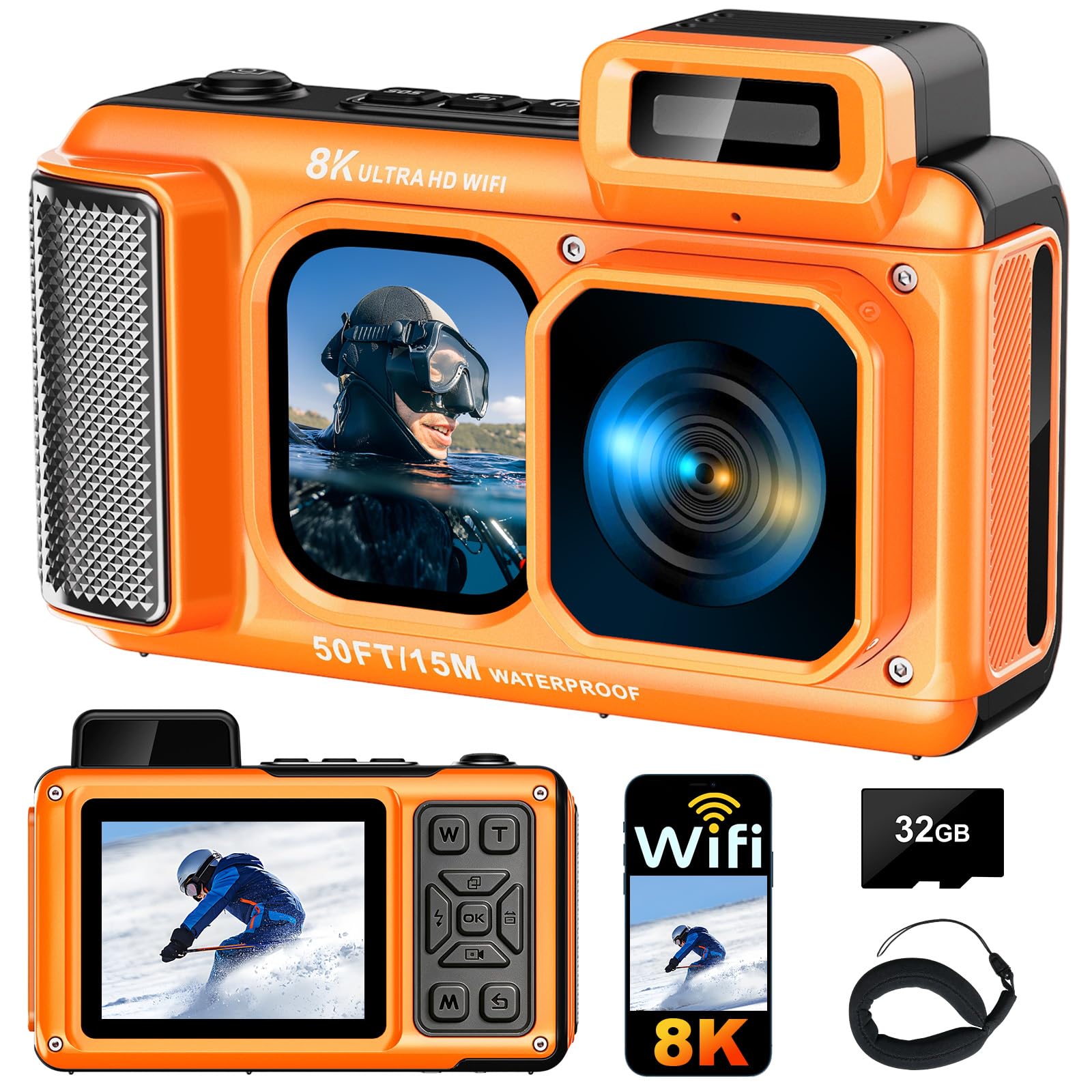
2. 8K Underwater Camera WiFi 90MP
This budget pick floats, shoots 8K video, and is waterproof to 50FT with dual screens for easy selfies.
This is the budget pick that punches far above its weight class. With an 18x digital zoom and a 50FT waterproof rating, it’s built for snorkelers and divers who want to capture detail without spending a fortune. The standout feature is the dual-screen setup—a 2.0″ front screen for selfies and a 3.0″ rear touchscreen—making it exceptionally easy for beginners to frame group shots.
The 90-minute battery from its 1800mAh cell is respectable, and the included 32GB card means you’re ready to shoot immediately. Owners rave about the value, with one buyer noting it “exceeded my expectations” for an upcoming dive trip. The image quality is “sharp and colorful underwater,” thanks to the 75MP effective still resolution and low-light sensor that handles dim reef shots.
While its 90 minutes of recording is a fraction of the DJI’s 240 minutes, the price difference reflects that trade-off. The Wi-Fi sharing is a huge plus for instant phone transfers, and the buoyancy strap is a lifesaver if you drop it. This is a brilliant first camera for casual vacations and pool days, where the priority is convenience and getting a working shot, not pro-level grading.
Our take: If you are new to underwater photography and want a dedicated camera without overspending, this is the one to pick. The dual screens (one in front, one in back) make selfies easy, and the included memory card means you can start shooting right from the start.
Choose this for: a family vacation camera that floats, shoots 8K, and won’t cause panic if it bumps a rock.
Note: Its battery life is short, so plan to pack a spare for full-day island tours.
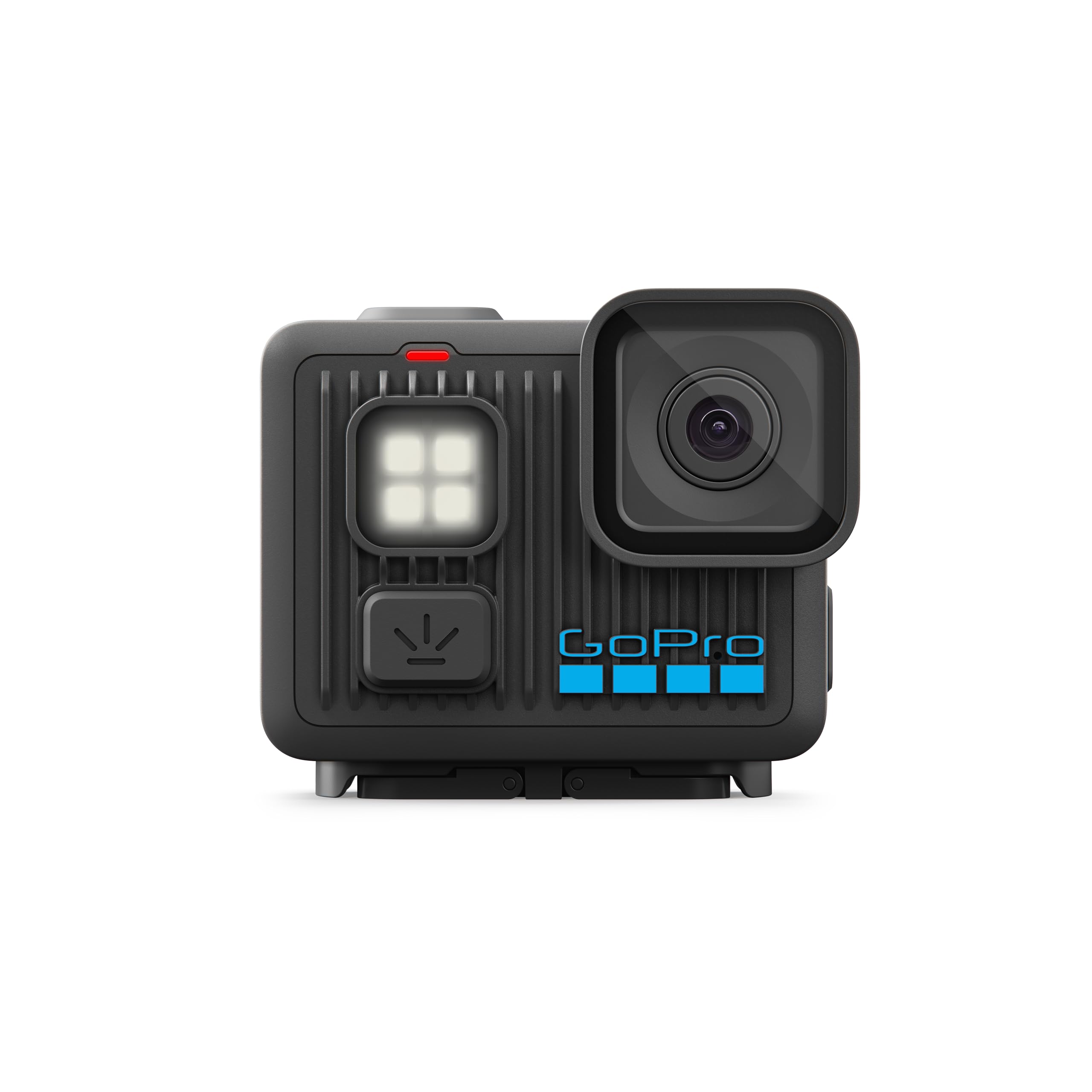
3. GoPro LIT Hero
This compact GoPro includes a built-in light with three brightness settings for dark underwater and night shots.
If you’re already familiar with the GoPro brand but want something smaller and simpler, the LIT Hero is a clever entry point. It’s the only camera in this lineup with a built-in light featuring 3 brightness settings, which helps illuminate scenes in total darkness or murky water. The design is classic GoPro: rugged, waterproof to 16ft (5m), and incredibly pocketable.
It captures 4K60 video and 12MP photos, with HyperSmooth stabilization to keep your clips steady. The simplified controls let you tap between video, photo, and slo-mo modes, so no manual digging needed. Owners love the compact size, noting it “fits in the front pocket” and the light “makes for some cool videos.”
The trade-off is battery life—buyers consistently flag it as “terrible,” which is a real concern for a full day of swimming. Also, its 16ft depth is shallower than rivals, so it’s strictly for surface snorkeling and pool use, not scuba. Buy it for the GoPro ecosystem feel and the unique light, but keep a power bank handy.
Verdict: A fun, compact second camera or a starter for kids. The built-in light is a unique a neat extra, but the short battery and shallow depth rating make it a niche pick.
Best for: quick grab-and-go pool sessions and vloggers who want the GoPro name without the bulk.
Skip if: you need a camera for deep dives or long recording days.
4. Kodak PIXPRO WPZ2 (Bundle)
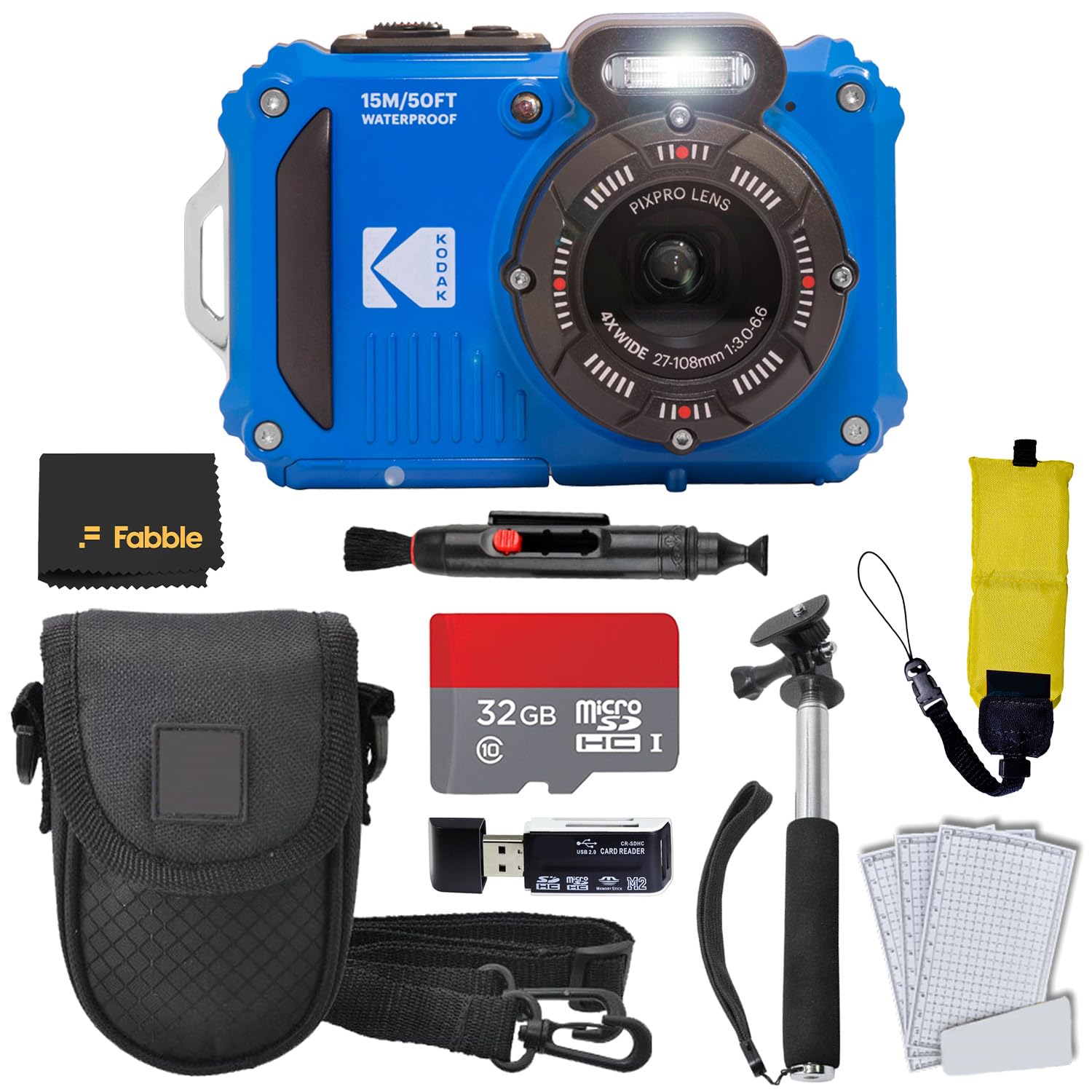
This rugged point-and-shoot ships with a 32GB card, case, and floating strap, ready for immediate use.
This Kodak is the definition of an all-in-one travel buddy. The bundle includes a SanDisk Ultra 32GB microSDHC card, a floating wrist strap, a monopod, a lens pen, and a case—everything you need for a beach trip without extra shopping. At its heart is a 16.35MP 1/2.3″ BSI CMOS sensor with a 4x optical zoom lens (27-108mm equivalent), capturing sharp 1080p Full HD video at 30fps.
It’s built to take a beating, rated waterproof to 15m and shockproof to 2 meters (6.56 feet). Owners have used it for “deep water snorkeling” and love the picture quality and ease of use. The 2.7″ LCD is simple to navigate, and built-in Wi-Fi makes phone transfer a breeze—one buyer called the transfer “brilliant.”
Compared to the DJI’s video power, the Kodak is a stills-first camera, and its 1080p video is a step down from 4K. Some owners mention reliability issues over time, so it’s not a lifetime investment, but for the price and included kit, it’s a phenomenal introduction to underwater photography.
Kit Highlights
- Everything included: 32GB card, case, and floating strap.
- Waterproof to 15m and shockproof for rugged use.
- Optical zoom (4x) for framing without losing quality.
Watch Out For
- Video is capped at 1080p, not 4K.
- Reliability is a mixed bag for long-term owners.
Reach for this if: you want a grab-and-go kit with zero extra purchases for a family snorkeling trip.
Think twice if: you plan to shoot 4K video or need a camera for professional-level dives.
5. Kodak PIXPRO WPZ2 (Blue)
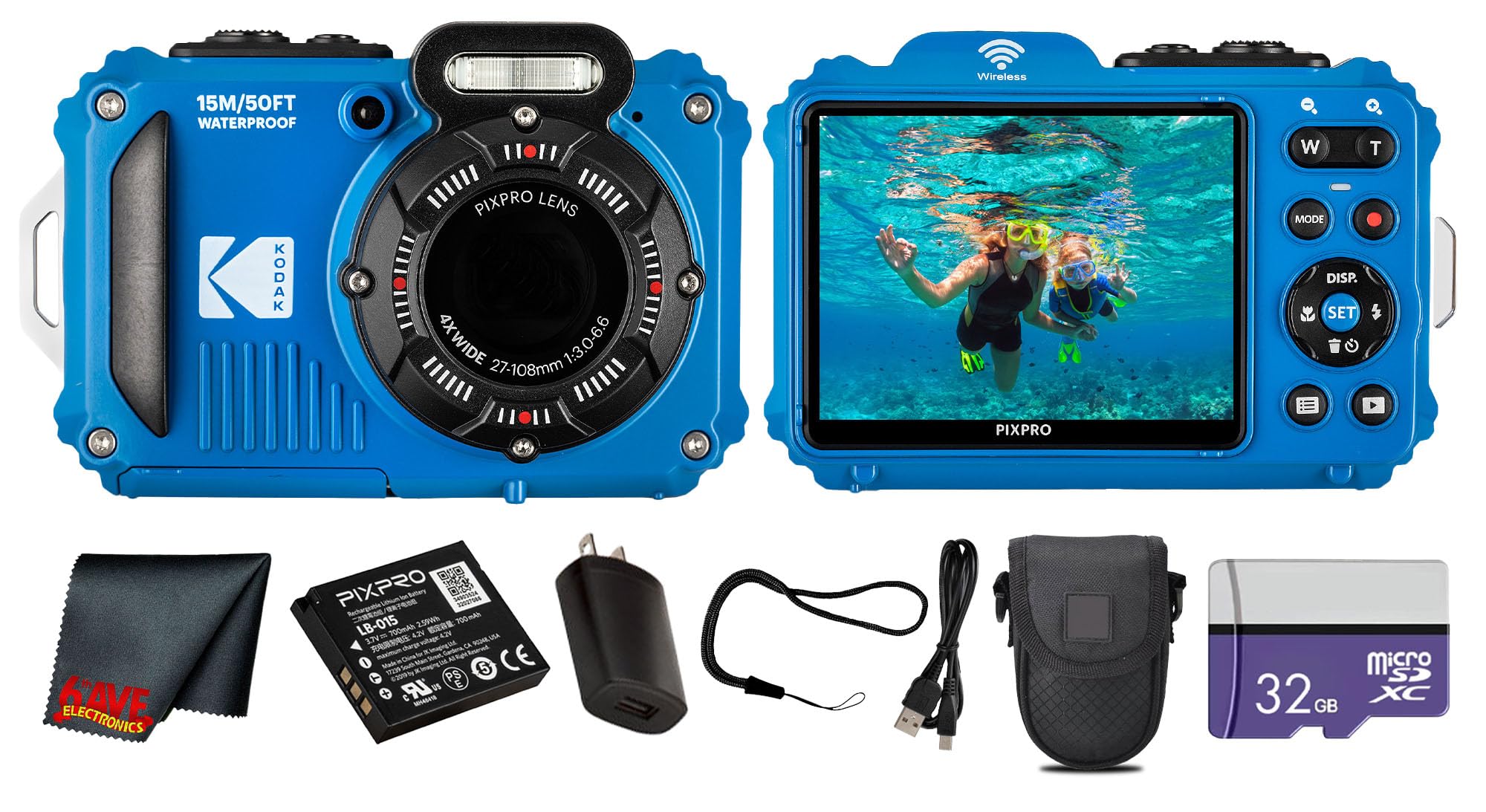
This no-frills compact is waterproof to 49.2FT and delivers sharp 16MP stills at a budget price.
This version of the WPZ2 strips the bundle down to the essentials—camera, case, 32GB card, and cleaning cloth—at a slightly lower entry point. The core specs are identical to the bundle: a 16.35MP BSI CMOS sensor, 4x optical zoom (27-108mm), and Full HD 1080p video. It’s waterproof to 49.2 feet, shockproof to 6.6 feet, and rated IP6X dust resistant, making it a true all-weather companion for hiking and beach days.
The 2.7-inch LCD (the screen on the back) and built-in Wi-Fi (wireless transfer to your phone) keep things simple. Customers note it is “super easy to navigate and use,” and one reviewer praised the “flawless pictures” and “HD quality.” With an ISO range of 100 to 3200 (light sensitivity) and burst shooting up to 6 frames per second, you can snap fast-moving fish without blur.
Where it falls short is video—1080p is fine for social clips but won’t match the 4K of action cams. The battery life isn’t specified, so you’ll want a spare for long trips. For a beginner focused on photos and rugged portability, this is a fantastic, wallet-friendly choice that gets the job done.
Our read: If stills are your priority and you want a camera that survives drops and splashes, this is the best budget value in the lineup. The 49.2FT rating is genuinely impressive at this price.
Best suited for: hikers and casual snorkelers who want reliable photos without learning complex settings.
Consider instead: a 4K action cam if you’re planning to vlog or need high-frame-rate video.
6. PENTAX WG-90 Blue

This rugged camera features six LED macro lights to illuminate tiny subjects at close range.
Pentax has a legendary reputation for tough cameras, and the WG-90 lives up to it. It’s waterproof to 14 meters for up to two hours, shockproof against a 1.6-meter fall, and freezeproof to -10°C. The headline feature is the six LED Macro Lights arranged around the lens barrel, which provide bright, uniform illumination for close-up shots that reveal details invisible to the naked eye.
The 16-megapixel back-illuminated CMOS sensor with a top ISO of 6400 handles low light well, and the dedicated Underwater shooting mode tune color and contrast for sub-surface scenes. The 5x optical zoom lens (28mm wide-angle coverage) is versatile for sweeping landscapes too. Owners praise its durability and battery life, noting it’s “perfect for a reckless family” and handles macro shots exceptionally well.
The catch is the auto settings, which one buyer says make “terrible decisions about aperture vs shutter speed,” so you’ll get better results learning manual mode. Also, its Full HD (H.264) video resolution is a step behind the 4K action cams. This is a niche tool for macro enthusiasts and families who value toughness above video specs.
Why It Stands Out
- Built-in 6-LED ring light for macro and dark shots.
- Heavy-duty 14m waterproof and freezeproof body.
- Digital Microscope Mode for extreme close-ups.
The Learning Curve
- Auto mode is weak; manual settings produce the best quality.
- Video is capped at Full HD, not 4K.
Get this for: macro photography, free-diving, or any harsh environment where a tough body is non-negotiable.
Skip if: you want simple point-and-shoot auto modes or 4K video.
7. PENTAX WG-90 Blue (Genuine)

This dependable tough camera offers a clear 2.5-hour battery rating and is waterproof to 14m.
This listing emphasizes the “Genuine” Pentax build and adds a clear 2.5-hour battery life spec, making it a practical choice for all-day outings. It shares the WG-90 DNA: waterproof to 14 meters (39.8 ft), shockproof to 1.6 meters, and cold-resistant to -10°C. The back-illuminated 16-megapixel CMOS sensor with ISO 6400 delivers solid detail, and the six Macro Lights are ready for close-ups.
Owners appreciate its lightweight, “rugged and easy to use” nature, with one noting it’s ideal for family use. The 5x optical zoom lens with a maximum focal length of 25mm provides a useful telephoto reach. It’s a camera that starts up quickly, so you can grab it the moment you see something interesting.
The main difference from its sibling listing is the clearer battery spec and bundled battery, which is a big plus for travelers. Like the other WG-90, the auto settings are its weak point, so expect to tweak manual controls for the best shots. If you want a tough, reliable camera that won’t quit, this is a solid contender.
Verdict: A dependable, no-nonsense tough camera. The 2.5-hour battery spec makes planning your dives easier than with models that leave it vague.
Pick this if: you want a lightweight, durable camera for family trips and don’t mind learning basic manual controls.
Look elsewhere if: you need 4K video or fully automatic, stress-free shooting.
8. Insta360 Ace Pro 2 Dual Battery Bundle
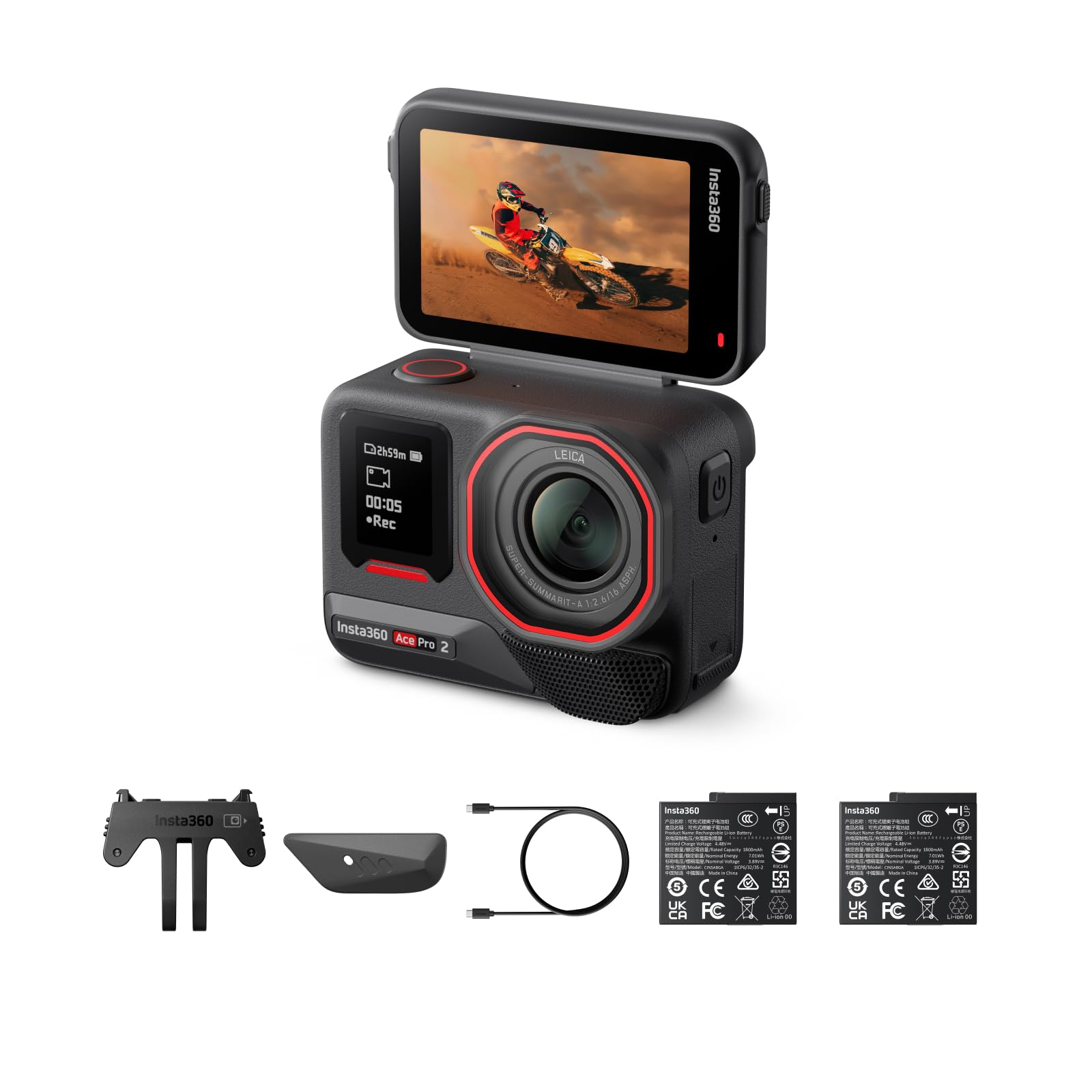
This Leica-co-engineered camera leads with 8K video and PureVideo Mode for low-light underwater shots.
For the beginner who’s serious about image quality from day one, the Ace Pro 2 is the premium benchmark. Co-engineered with Leica, it features a 1/1.3″ 8K sensor with 13.5 stops of dynamic range and a 2.4μm equivalent pixel size, delivering 8K30fps and 4K60fps Active HDR video. The PureVideo Mode redefines low-light performance, supported up to 4K60fps, making it a standout for sunset dives.
The dual-battery bundle is a lifesaver for full-day shooting, as the 8K recording drains power quickly—owners say the extra battery is “an absolute lifesaver.” It’s waterproof to 39ft (12m) and handles -4ºF (-20ºC) cold. The 2.5″ flip touchscreen has a 70% increase in pixel density, making it easy to preview even in bright sunlight. Divers rave about its “excellent low-light and underwater performance.”
Compared to the DJI Osmo Action 5 Pro, the Ace Pro 2 wins on raw resolution (8K vs 4K) and low-light capability, but the DJI has a longer single-battery life (240 min vs. the Ace Pro’s need for a swap). However, this bundle solves that with two batteries included. The compulsory app activation is a hurdle some owners find annoying, and the lack of a 1/4″ thread means you’ll need an adapter for tripods.
Standout Strengths
- 8K resolution with Leica color science for stunning detail.
- PureVideo Mode makes low-light and night diving look great.
- FlowState Stabilization keeps footage silky smooth.
Things to Know
- Requires app activation, which can be an annoying setup step.
- Battery life is short at 8K; the dual bundle is essential.
- No standard tripod thread without an adapter.
Reach for this if: you want the absolute best image quality and low-light performance in a beginner-friendly action camera.
Think twice if: you want a simple plug-and-play setup or are on a strict budget.
9. OM System OLYMPUS Tough TG-7 Red

The scuba-ready point-and-shoot with 4K video and a macro system that captures a centimeter away.
This is the camera for the budding underwater naturalist. The TG-7 is the successor to the famous TG-6, and it’s waterproof to 15 meters (50 feet), freezeproof to -10°C, shockproof to 2.1 meters, and even crushproof to 100 kgf. The high-resolution F2.0 lens with a maximum 4x zoom and back-illuminated CMOS sensor produces sharp, bright images.
Its defining feature is the variable macro system, comprised of 4 macro modes that can magnify up to 1 centimeter from the end of the lens. This is ideal for spotting tiny nudibranchs and coral polyps. It also has 5 underwater modes, including underwater microscope and underwater HDR, plus 4K Movie and 120 fps High-speed recordings.
Owners love its durability and macro capability, calling it “excellent value for macro beginners.” However, the image quality in low light is weak, and the small LCD is tricky to frame with underwater. The battery dies without much warning, so a spare is essential. It won’t match pro gear, but for a rugged, dedicated dive camera, it’s a top-tier choice.
What Makes It Great
- 4K video and 120 fps slow-motion recording.
- Macro system captures subjects just 1cm from the lens.
- Crushproof and freezeproof for extreme conditions.
Honest Limitations
- Low-light quality is weak compared to action cams.
- Battery life drains quickly; carry a spare.
- Small LCD makes underwater framing difficult.
Best for: scuba divers and tide-pool explorers who want macro shots and 4K in a tough body.
Look elsewhere if: you prioritize low-light video or want a large, bright screen for framing.
Understanding the Specs
Waterproof Depth Rating
This is the most crucial spec. It tells you how deep you can sink the camera without a housing. A rating of 5m (16ft) is fine for pool splashes, but you need 10-15m (33-50ft) for real snorkeling and scuba. The DJI’s 20m rating and the TG-7’s 15m rating are the deep-dive champions here.
Image Stabilization
Underwater, your hands are moving with the waves, so stabilization is key to avoiding blurry footage. Look for systems like DJI’s HorizonSteady or Insta360’s FlowState Stabilization. They keep the horizon level and smooth out shakes, so your clips look professional even if your swimming isn’t.
Video Resolution and Frame Rate
4K video captures four times the detail of 1080p Full HD, giving you room to crop and zoom in post-editing. A higher frame rate like 60fps or 120fps allows for smooth slow-motion playback. Beginners should aim for 4K60, which the GoPro LIT Hero and Ace Pro 2 offer, for versatile, fluid footage.
Battery Life and Accessories
Underwater cameras drain batteries fast, especially in 4K. Always check the battery life spec and consider buying a spare. The DJI’s 240 minutes is exceptional, while the 8K camera’s 90 minutes is a trade-off for its price. Float straps and extra batteries are the accessories that prevent a ruined day.
FAQ
What is the difference between an underwater camera and a waterproof case for my phone?
Will a 50-foot waterproof rating work for scuba diving?
Is a higher megapixel count always better for underwater photos?
How long does an underwater camera battery last?
Can I use a beginner underwater camera for activities other than diving?
What does IP68 mean for an underwater camera?
Is it better to buy a bundle with accessories?
How do I maintain the waterproof seals on my camera?
Final Thoughts: The Verdict
For most beginners, the beginner underwater camera winner is the DJI Osmo Action 5 Pro because it pairs the deepest dive rating with the longest battery and smooth stabilization, so you can focus on shooting, not settings. If you want a budget-friendly dive companion that floats and records 8K video, choose the 8K Underwater Camera. For macro shots (extreme close-ups of tiny sea life) in a rugged body with a ring light, the PENTAX WG-90 is your best bet.
How We Picked
We do not accept paid placement. Every pick is matched to a real buyer and a real use-case; we do not hands-on test units.
Sources & Methodology
Specifications: manufacturer listings and product documentation. Review insights: verified customer reviews, as of August 2026. Pricing: not shown on this page (it changes often); check the current price via the retailer link.
As an Amazon Associate, Gadgets Feed earns from qualifying purchases. This does not affect which products we feature.