
Our readers keep the lights on and my morning glass full of iced black tea. As an Amazon Associate, I earn from qualifying purchases.
Specs are compiled from manufacturer listings and verified buyer reviews and can change over time — please confirm the key details on the product page before buying.
Pulling a deep vacuum on a car’s AC system is the difference between a cabin that blows icy air for years and one that slowly loses its charge to trapped moisture. The pump’s flow rate and ultimate vacuum rating determine how fast that moisture boils off, so those two specs matter most. This guide compares nine of the most popular evacuation pumps on the market, from a professional 8 CFM workhorse to budget-friendly single-stage kits, so you can match the tool to the jobs you actually do.
I’m Min — the founder and writer behind Gadgets Feed. This guide is built by comparing the manufacturers’ published specifications and the patterns across verified customer reviews, so you get each pick’s real strengths and trade-offs instead of marketing spin.
A pump that pulls moisture and air out quickly gets you back on the road sooner. This guide explains CFM (cubic feet per minute, the measure of how quickly the pump moves air) and why a two-stage pump reaches a deeper vacuum than a single-stage, plus which kits come with the gauges and hoses you need to start right away with an auto ac evacuation pump.
Our Picks at a Glance


How To Choose The Best Auto AC Evacuation Pump
Before you spend money, you need to know what the spec sheet is actually telling you. The two key specs are flow rate (CFM) and ultimate vacuum (microns). CFM measures air-moving speed; microns measure how deep the vacuum can go.
Match the CFM to the system size
A 3.5 CFM pump handles a typical car AC, pulling a deep vacuum in 15–20 minutes. For mini splits, commercial refrigeration, or multiple vehicles, a 5 or 8 CFM pump cuts that time significantly. Higher CFM pumps are heavier, louder, and pricier, so don’t overspend for one car a year.
Single-stage vs. dual-stage design
A single-stage pump uses one set of rotary vanes—simpler, cheaper, and standard for occasional DIY. A dual-stage pump runs the air through two sets of vanes, which lets it reach a much deeper vacuum (a lower micron number) and handles moisture-laden systems far better. If you live in a humid climate or work on systems that have been open to the air for a long time, the extra cost of a dual-stage pump is worth it.
Kits vs. bare pumps
Some pumps ship alone, which is fine if you already own a manifold gauge set and hoses. The kit options bundle in a three-way or four-way manifold gauge, color-coded hoses, refrigerant can taps, and sometimes a carrying bag. For a first-time buyer, a complete kit removes the guesswork of matching fittings, but you often sacrifice quality in the cheap gauges and hoses to hit the price point.
Quick Comparison
| Model | Best For | Flow Rate | Stages | Micron Rating | Amazon |
|---|---|---|---|---|---|
| Fieldpiece VP67★ Best Overall | Professional speed | 8 CFM | Single | 15 microns | Amazon |
| Robinair 15800Commercial Capacity | Commercial capacity | 8 CFM | Dual | 40 microns | Amazon |
| Robinair 15310Trusted Classic | Trusted light duty | 3 CFM | Single | 75 microns | Amazon |
| VIVOHOME VH321 | Dual-stage DIY | 5 CFM | Dual | 0.3 Pa | Amazon |
| BACOENG R32 Kit | New refrigerants | 4 CFM | Single | 15 microns | Amazon |
| OMT 4.5 CFM Kit | Complete 4-way kit | 4.5 CFM | Single | — | Amazon |
| OMT 3.5 CFM Kit | Value auto kit | 3.5 CFM | Single | — | Amazon |
| VTG VOGTEN Kit | All-in-one bundle | 4.5 CFM | Single | — | Amazon |
| ZENY Combo | Budget DIY | 3.5 CFM | Single | — | Amazon |
In‑Depth Reviews
1. Fieldpiece VP67 Vacuum Pump
Our pick — over 4.5★ from 350+ verified ratings; the strongest balance of quality and price.
The pro-grade speed demon that pulls a residential system down in minutes, not an afternoon.
If you make a living pulling vacuum, the Fieldpiece VP67 is the pump that sets the pace. Its 8 CFM flow rate moves roughly 2.3 times more air per minute than a 3.5 CFM pump like the ZENY, and the 15-micron ultimate vacuum rating means you’re pulling moisture out to professional standards. Buyers report it “Pulled 63 microns first use,” which is deep enough to satisfy any manufacturer’s evacuation spec.
You can carry this pump easily because the 1/2 HP DC motor keeps the weight down to 29 lbs., and it keeps working even when the power supply on a job site dips low. The RunQuick oil change system is the standout convenience feature — you can swap the oil in seconds while the pump is running, and the backlit oil reservoir makes it easy to see when the oil is getting cloudy. Multiple port sizes (1/4 inch, 3/8 inch, and 1/2 inch) mean you can connect to almost any hose setup without hunting for an adapter.
The quarter-turn gas ballast with an LED indicator vents wet systems to prevent moisture from contaminating the oil, and the A2L compatibility means it’s safe to use with modern, mildly flammable refrigerants. The one real complaint in the data is quality control on delivery — a few units arrived damaged or pre-used, and Fieldpiece advised those buyers to return them. For a professional, the speed and the oil-change system alone justify the price.
What the pros rave about
- Compact footprint for the power — 1,478 cubic inches
- Faster evacuation than any 3.5 CFM pump on this list
- Backlit oil sight glass makes monitoring easy
What to watch for
- Needs adapters for R134a Acme fittings
- Occasional delivery damage reports
Grab it if: you’re a pro or serious hobbyist who values minutes saved and mess-free oil changes over the price tag.
Think twice if: you only service one car a year — the premium price won’t pay itself off at that pace.
2. Robinair 15800 VacuMaster Economy Vacuum Pump
The dual-stage commercial brute that pulls deep vacuum fast and keeps running for hours.
When you need serious capacity, the Robinair 15800 delivers 8 CFM of free air displacement from a 2-stage rotary vane design, which is why it’s a favorite for commercial refrigeration work. The dual-stage design lets it reach a factory-rated 40 microns, so it’s pulling deeper than any single-stage pump on this list. One owner in the data runs it for two years of daily milking sessions — two hours at a time — and another reports it pulls sub-500 microns quickly on commercial HVAC systems.
You can run long evacuation jobs without overheating because the 1 HP thermally protected motor runs on 115V, and the 18.6 ounce oil capacity keeps it cool during extended pulls. The 72-inch power cord gives you welcome flexibility on a crowded rooftop, and the angled oil drain valve at the bottom of the reservoir makes oil changes quick and complete. It’s not a subtle machine though — owners mention heavy oil fog from the exhaust that needs to be piped away, and at this size it’s heavy enough that you’ll want a rope to get it up a ladder.
The durability story is mostly positive, with many owners reporting years of service, but the data shows a clear split: some units have failed within months. One buyer received a clearly used pump labeled as new, and another traced a failure to neglected oil changes. For HVAC use with regular oil maintenance, this pump is a proven performer.
Built for endurance
- 8 CFM dual-stage pulls deeper than any single-stage
- Finned aluminum surfaces shed heat for longer runs
- Powers heavy use like dairy milking systems
Heavy duty trade-offs
- Exhaust vents heavy oil fog
- Interior steel body adds considerable weight
Best suited to: technicians who pull vacuum all day on big systems and need the depth of a dual-stage pump.
Not ideal for: the casual DIYer storing it in a garage for months between uses.
3. Robinair 15310 VacuMaster Vacuum Pump
The entry-level Robinair that pays for itself on the first AC repair you do yourself.
You get a reliable 3 CFM single-stage pump with the Robinair 15310, the one many DIYers graduate to after cheap imports fail. The 1/3 HP thermally protected motor runs on 110V, and the factory rating of 75 microns is honest — customers note reaching 28-29 inHg on a car AC and seeing vent temperatures drop from 50°F to 40°F after a proper evacuation. The 8.5 ounce oil capacity and angled drain valve make maintenance straightforward.
It’s a favorite beyond automotive work too, with the review data showing heavy use in wood stabilizing and degassing. The finned aluminum surfaces keep the pump cooler during longer runs, and the non-skid feet keep it planted on a workbench. One buyer notes it ran for 24 straight hours without issues, which speaks to the solid build quality.
The honest caveat is that a 3 CFM single-stage pump is not fast and won’t pull the deep vacuum of a dual-stage on large volumes. One owner measured only about 750 microns on a stubborn system and noted that half an ounce of water took hours to boil off. If you’re working on big refrigeration equipment, step up to the dual-stage 15800 or the VIVOHOME below.
Solid and proven
- Quiet operation with sturdy build
- Reached 28-29 µm in real owner use
- Oil mist is minimal for a single-stage
Know its limits
- Not fast on large or wet systems
- Oil seep from the drain plug reported
Reach for this if: you want a trusted, reliable brand for occasional car AC work and don’t mind waiting 20 minutes for a deep pull.
Look elsewhere if: you’re pulling vacuum on big mini splits or commercial units weekly.
4. VIVOHOME 110V 1/2 HP 5 CFM Dual Stage Vacuum Pump

The dual-stage value king that pulls deeper than any single-stage at a similar price.
The VIVOHOME VH321 is the answer for the DIYer who wants dual-stage depth without paying double. The 1/2 HP motor spins at 2880 r/min and moves 5 CFM, reaching an ultimate vacuum of 0.3 Pa in about 3 minutes. Reviewers point out pumping a boat freezer down to 200 microns and measuring the pump pulling as low as 10 microns with a quality hose setup — numbers that match or beat pumps costing far more.
The dual-stage design is the headline feature, and owners who upgraded from single-stage pumps describe the difference as dramatic. One review notes the pump weighs at least twice as much as a typical single-stage and performs much faster, which is exactly what you want when pulling moisture from a system. The 304 stainless steel coarse filter keeps contaminants out of the pump chamber, while a cotton layer filter catches oil mist at the exhaust.
The build quality is generally praised, with buyers calling it solid and quiet at around 65 dB, but there are durability concerns in the data. Some shoppers say the pump seizing up within three months or failing on first use, and one buyer notes it stutters like a car failing to crank after an overnight idle. The 1/4-inch SAE and 1/2-inch Acme intake fittings cover most connections, and the bottom oil drain valve makes changes simple.
Dual-stage depth, DIY price
- 0.3 Pa ultimate vacuum rivals pro pumps
- Easy to hit -30 inHg quickly
- Low noise at approximately 65 dB
Consistency concern
- Some units struggle to restart after storage
- Durability is the most common mixed complaint
Pick this if: you want dual-stage performance for mini splits and freezer work without the professional price jump.
Be wary if: you need a pump you can trust every single day — the QC record is spotty.
5. BACOENG R32 AC Vacuum Pump and Gauge Set
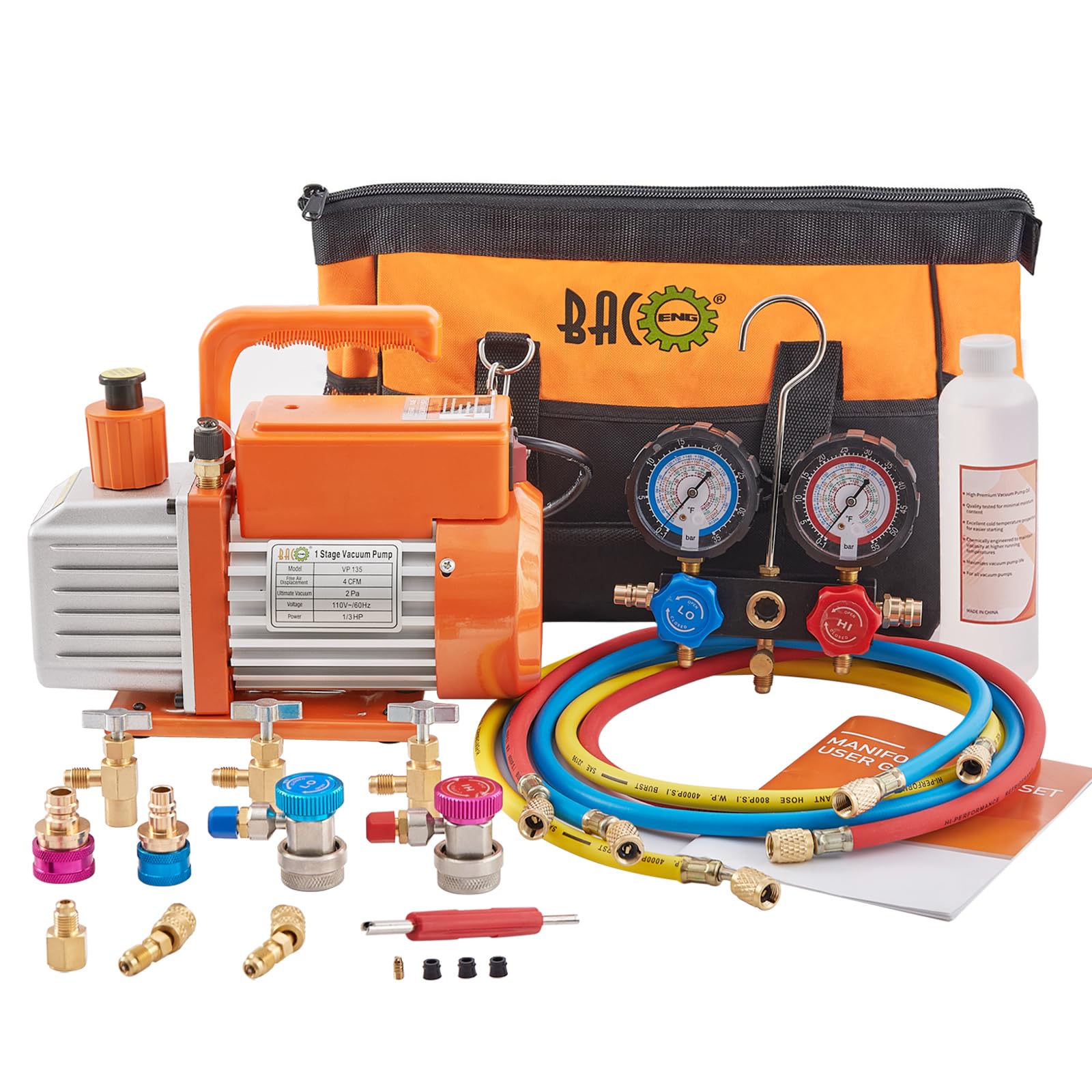
The sparkless kit that’s ready for R32 and R1234yf straight from the start.
You can service newer cars and mini splits because the BACOENG kit handles R1234yf and R32 refrigerants, making it among the most future-proof options here. The 4 CFM pump is driven by a 1/3 HP high-torque copper motor, and it pulls systems down to 15 microns (2 Pa) quickly. One buyer reports pulling a deep vacuum on a 3.5-ton system with confidence, and another calls it a “mini split hero” that only took a minute or two to pull down fresh line sets.
The sparkless motor is the defining safety feature — the ignition-proof ON/OFF switch ensures no sparks when you’re handling flammable modern refrigerants. The kit includes a 3-way manifold gauge with color-coded hoses, R134a and R1234yf can taps, R134a quick couplers, R134a to R1234yf adapters, five-foot hoses, and two R410a adapters. That’s everything you need to start working on any vehicle or split system, and the included carrying bag keeps it all organized.
The honest feedback is that the gauge set itself looks a little cheap, and the vacuum performance gets mixed reviews — while many report great pulls, one owner only got 12 PSI. It’s not a pump you’d want for daily commercial abuse, as the buyers report it’s built for a few jobs rather than years of heavy use.
Ready for the future
- Works with R32, R1234yf, R134a, and R410a
- Sparkless motor adds safety with flammable refrigerants
- Complete kit with bag and adapters
Keep expectations in check
- Gauge build quality is basic
- Not intended for long-term daily pro use
Best for: the modern DIYer working on newer cars and split systems who wants one kit that handles every current refrigerant.
Skip if: you’re a pro who needs industrial-grade durability.
6. OMT 4.5 CFM AC Vacuum Pump and Gauge Set, Blue
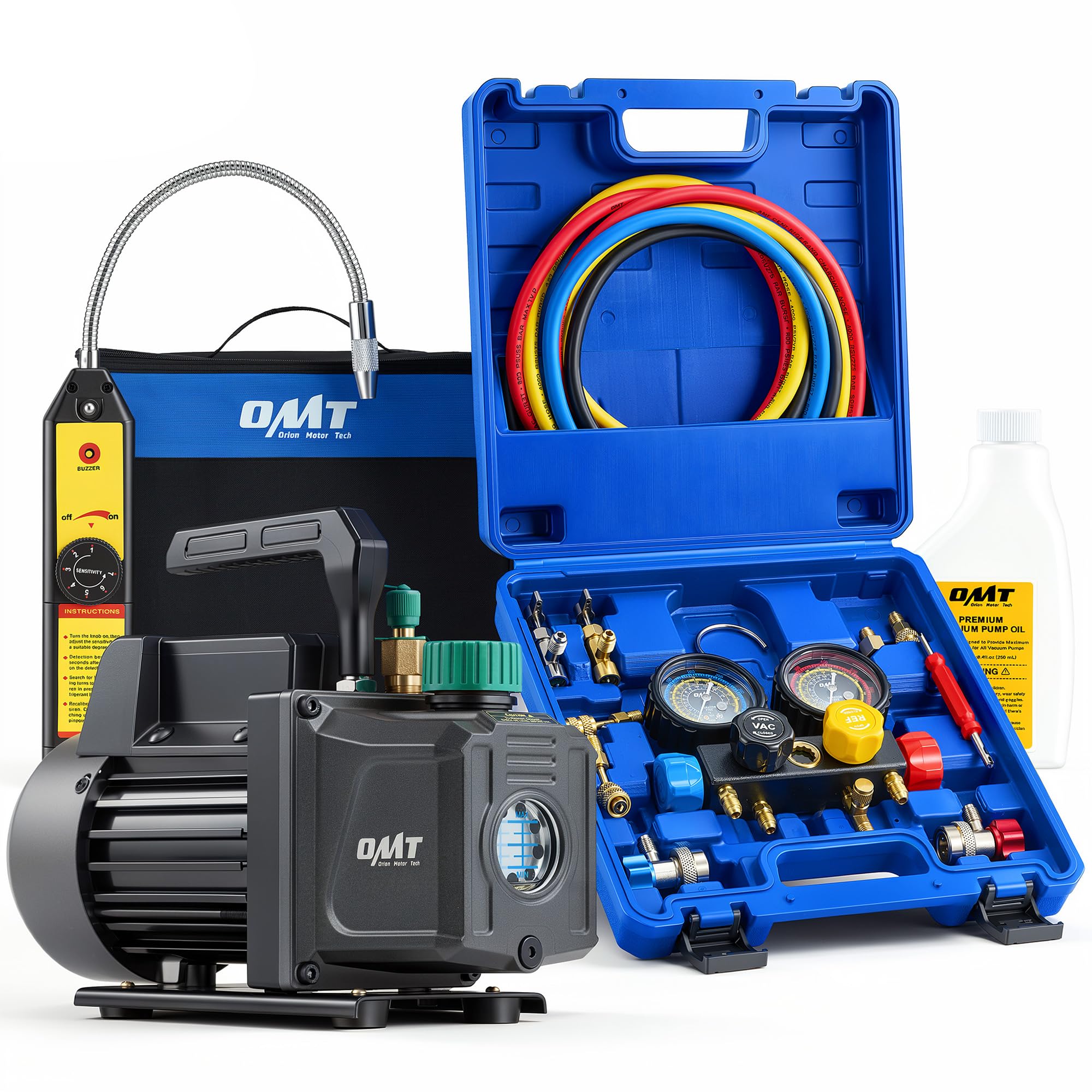
The all-in-one kit with a 4-way manifold, leak detector, and hoses rated to 800 psi.
You get everything you need to start evacuating right away with the Orion Motor Tech 4.5 CFM kit, the most complete package on this list, bundling a 1/3 HP vacuum pump with a 4-way manifold gauge, an electronic leak detector, R134a can taps with quick couplers, R410a adapters, vacuum oil, and a durable carrying case. The all-copper motor evacuates fast, and the 4-layer color-coded hoses handle up to 800 psi working pressure with a 4,000 psi burst rating — the strongest hoses in this lineup by a clear margin.
Buyers who upgraded from cheaper pumps describe the difference as night and day, noting the OMT pulls vacuum faster than a professional unit they already owned. The built-in cooling fan prevents overheating during long evacuations, and the bottom drain valve makes oil changes quick. The 0.26 qt. of included vacuum oil means you can start immediately.
The recurring complaint in the data is the yellow plastic knob on the manifold, which some owners mention breaking easily. A few also mention the low-pressure connector can bend the Schrader pin on the service port if you over-tighten. The 21.9 lb. weight makes it feel substantial, and the carrying case keeps everything organized for transport.
Everything in one box
- Includes an electronic leak detector — unusual at this price
- 800 psi working pressure hoses
- Faster evacuation than cheaper single-stage pumps
Handle with care
- Yellow plastic manifold knob is fragile
- Low-pressure connector can bind if overtightened
Choose this if: you want a single purchase that covers pump, gauges, hoses, and leak detection for both car and home HVAC work.
Pass on it if: you already own a quality manifold gauge set and just need a bare pump.
7. OMT 3.5 CFM AC Vacuum Pump and Gauge Set

The budget-friendly Orion kit that recharges two family cars without a trip to the shop.
The Orion Motor Tech 3.5 CFM kit is the value pick that proves you don’t need professional gear to keep your cars blowing cold. The 1/4 hp all-copper motor evacuates at a 3.5 CFM flow rate, and the aluminum alloy casing dissipates heat while brass-fitted tethered safety caps prevent oil leaks. One owner reports pulling a vacuum in 10 minutes and running the pump for a full hour without overheating.
What makes this kit special is the completeness: a 3-way manifold gauge, R134a self-sealing and puncture-style taps, R134a quick couplers, vacuum oil, and three color-coded hoses rated to 600 psi with a 3,000 psi burst pressure. Owners describe recharging both their own car and their spouse’s car easily after watching a few videos, with one noting the pump is light enough to move around with one hand.
The honest trade-off is in the accessories. The self-sealing can tap is widely reported as poor, with some buyers replacing it immediately. The instructions are also weak, so you’ll want YouTube as your guide. The pump itself, however, holds up well — the all-copper motor runs cool, and the built-in cooling fan helps during longer jobs.
DIY-friendly value
- Light and easy to move around
- Pulled a vacuum in 10 minutes in owner testing
- Complete kit saves you buying gauges separately
Budget accessory quality
- Self-sealing can tap is a weak point
- Instructions are minimal
Ideal for: the first-time DIYer recharging a car or two each year who wants a complete kit at a friendly price.
Not for: anyone planning repeated commercial use — the tap will need replacing.
8. VTG VOGTEN 4.5 CFM AC Vacuum Pump and Gauge Set
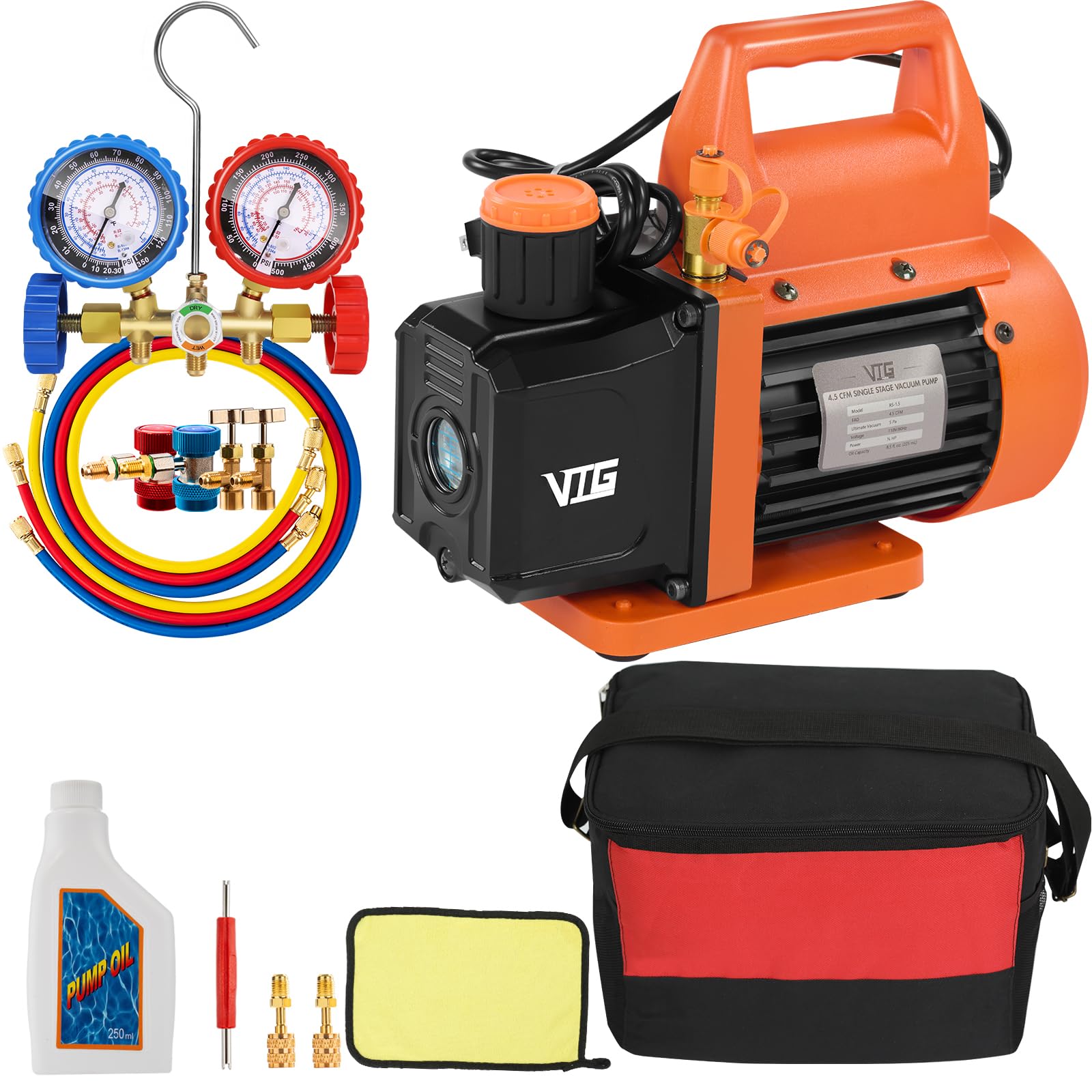
A complete mini split and auto AC kit with every adapter you can think of included.
You get more accessories than most kits with the VTG VOGTEN, bundling a 110V 1/3 HP 4.5 CFM single-stage pump with a three-way manifold gauge, three hoses, low and high-pressure quick couplers, two R410a adapters, two R134a can taps, a valve core wrench, and a cleaning cloth — all packed into a storage bag. The 15.79 x 13.39 x 7.05 inch package is about 21% larger than the ZENY combo kit, but that space is filled with genuinely useful accessories.
Customers note the pump holding -30 inHg of pressure for four hours on a mini split installation, and one first-time user successfully changed a compressor and pulled vacuum following YouTube directions. The 4.5 CFM flow rate is enough for most home HVAC work, and the aluminum alloy casing dissipates heat while resisting chemical corrosion from refrigerants.
The honest criticism is durability. The review data shows leaks, especially around the mini split adapter, and several reviewers point out the yellow hose can’t fully close, risking refrigerant loss. The gauges are also reported as inaccurate by some. It worked well for the job, but skip it if you need a tool that survives years of regular commercial use.
Most complete bundle
- Includes both R134a can tap styles
- Held -30 inHg for 4 hours in owner testing
- Storage bag keeps everything together
Build honesty
- Mini split adapter prone to leaks
- Not built for repeated heavy use
Grab this if: you’re installing a mini split or servicing an older car and want one box with every adapter pre-matched.
Look elsewhere if: durability across dozens of jobs is your top priority.
9. ZENY 3.5CFM Single-Stage Rotary Vane Vacuum Pump Combo

The entry-level combo that gets your mini split or car AC pulling vacuum on a strict budget.
You can pull vacuum on a mini split or a single car while staying affordable with the ZENY combo, the honest budget answer. Shoppers say it worked great for vacuuming out mini split units, and its 13 x 12 x 7 inch footprint makes it among the most compact options here. The heavy-duty aluminum alloy casing and direct-drive motor (a motor that connects straight to the pump without belts or gears) make starting easy and maintenance-free.
The value story is strong — owners consistently call it a great deal for occasional use, with one DIYer urging others not to spend a ton on expensive devices when this one does the job well. The oil sight glass lets you monitor oil levels, and the non-slip cushion handle makes it comfortable to carry. It ships with a bottle of vacuum oil, the internal high-volume cooling fan helps on longer pulls, and the 3.5 CFM flow rate is plenty for car AC work.
The data shows a few honest caveats. Gauge accuracy gets mixed feedback, some owners wish it had a shutoff valve to prevent oil from being pulled into the AC tooling, and durability is the weak spot — one owner reported fittings failing after 5-7 uses. For the price, it’s a capable starter pump; just don’t expect it to outlast pumps costing multiple times more.
Best value starter
- Compact footprint fits in small storage spots
- Comes with a bottle of vacuum oil
- Direct-drive motor starts easily
Budget realities
- Fittings may fail after repeated use
- No shutoff valve to stop oil migration
Perfect for: the weekend warrior doing one or two AC jobs a year who wants a functional kit at the lowest entry cost.
Steer clear if: you need a pump that holds up to monthly commercial work.
Understanding the Specs
CFM and What It Means for You
CFM stands for cubic feet per minute, and it measures how much air the pump moves. Higher CFM means faster evacuation, but it also means a heavier, louder, and pricier pump. A 3.5 CFM unit handles a single car AC fine, while an 8 CFM unit like the Fieldpiece VP67 tears through commercial jobs. Match the CFM to the size of the systems you actually service.
Micron Rating and Vacuum Depth
The micron rating tells you how deeply the pump can pull the pressure down — lower is better. A pump rated to 15 microns (like the Fieldpiece) can boil off more moisture than one rated to 75 microns (like the Robinair 15310). For automotive AC work, the goal is to get below 500 microns; for best results with moisture-laden systems, aim for a pump rated to 40 microns or lower.
FAQ
How long should I run an AC evacuation pump on my car?
What is the difference between a single-stage and dual-stage vacuum pump?
Can I use a 3.5 CFM vacuum pump on a mini split system?
Do I need a manifold gauge set with my vacuum pump?
Why is the oil in my vacuum pump turning milky or cloudy?
Will an AC evacuation pump work with R410a refrigerant?
How often should I change the oil in my vacuum pump?
Is a higher CFM pump always better?
Can I use a vacuum pump for purposes other than AC evacuation?
What does the micron number on a vacuum pump spec actually mean?
Final Thoughts: The Verdict
Your auto ac evacuation pump choice depends on how often you work and what systems you service. For the professional or serious hobbyist, the Fieldpiece VP67 is the winner — its 8 CFM flow rate and RunQuick oil change system justify the premium price through sheer time saved. If you want dual-stage depth for mini splits and freezer work at a DIY price, the VIVOHOME VH321 is the smart middle ground. And for the occasional car AC job on a budget, the ZENY combo gets the job done without the sticker shock.
How We Picked
We do not accept paid placement. Every pick is matched to a real buyer and a real use-case; we do not hands-on test units.
Sources & Methodology
Specifications: manufacturer listings and product documentation. Review insights: verified customer reviews, as of August 2026. Pricing: not shown on this page (it changes often); check the current price via the retailer link.
As an Amazon Associate, Gadgets Feed earns from qualifying purchases. This does not affect which products we feature.