
Our readers keep the lights on and my morning glass full of iced black tea. As an Amazon Associate, I earn from qualifying purchases.
Specs are compiled from manufacturer listings and verified buyer reviews and can change over time — please confirm the key details on the product page before buying.
ABS is the go-to plastic for functional parts that need to handle heat, impact, and everyday wear — but it has a nasty habit of warping off the build plate and smelling like a chemical factory. The right spool makes the difference between parts that look injection-molded and a curled-up mess in the corner of your enclosure.
I’m Min — the founder and writer behind Gadgets Feed. This guide is built by comparing the manufacturers’ published specifications and the patterns across verified customer reviews, so you get each pick’s real strengths and trade-offs instead of marketing spin.
We ranked the top nine spools by their toughness, heat resistance, and how well they actually stick — so you can find the best abs filament for your printer and your projects.
Our Picks at a Glance

How To Choose The Right ABS Filament
Before you pick a spool, you need a printer that can actually handle the material. ABS shrinks as it cools, so it lifts off the bed unless you keep the whole print area warm. That means a heated bed and a fully enclosed chamber are not optional extras — they are the difference between success and a failed print.
Match the speed rating to your machine
Standard ABS likes a slower pace, but several brands now sell high-speed formulas rated for 300mm/s or more. These only help if your printer can move that fast and keep the hot end hot enough to melt the plastic at that rate. A speed rating is a ceiling, not a promise — start slower and work up.
Check the heat resistance you actually need
ABS already beats PLA for heat tolerance, but the range matters. Some spools hold their shape up to 85°C, others are rated for 91°C, and a few list a “hot deformation” point under 90°C. If your part sits near a hot engine bay or a summer car dashboard, aim for the higher number.
Read the diameter numbers
A tight tolerance on the 1.75mm diameter means the filament feeds smoothly and your extrusion stays even. Look for a stated tolerance of ±0.02mm to ±0.03mm — that tells you the maker measured the line carefully instead of just spooling it up and hoping.
Quick Comparison
| Model | Best For | Max Print Speed | Heat Resistance | Diameter Tolerance | Amazon |
|---|---|---|---|---|---|
| Creality CR-ABS★ Best Overall | Reliable all-round prints | — | — | — | Amazon |
| ELEGOO ABSTop Performer | Strong, tough functional parts | — | up to 85 °C | 1.75 mm | Amazon |
| OVERTURE ABSBest Finish | Glossy, professional finishes | — | — | ±0.02 mm | Amazon |
| SUNLU High Speed ABS | Fast printing with low warp | 350mm/s | up to 91°C | — | Amazon |
| ANYCUBIC ABS | High-temp, anti-warp prints | — | up to 85°C | ± 0.02mm | Amazon |
| FLASHFORGE ABS Pro | Low-odor, low-warp prints | — | Below 90℃ | +/-0.02 mm | Amazon |
| Creality ABS | Budget-friendly, no-tangle spool | — | — | + / -.03 mm | Amazon |
| QIDI ABS Rapido | Ultra-high-speed printing | 400mm/s | — | +/- 0.03mm | Amazon |
| Bambu Lab ABS | smooth AMS multi-color | — | — | ±0.03mm | Amazon |
In-Depth Reviews
1. Creality ABS Filament 1.75mm
Our pick — over 4.5★ from 500+ verified ratings; the strongest balance of quality and price.
The crowd-favorite that survives vibration and strain without splitting at the seams.
Creality’s own CR-ABS is engineered for parts that take a beating. The maker claims excellent impact resistance and heat resistance, and owners back that up — prints come out tough, hard, and rigid, with no layer separation or warped edges. This is the stuff for brackets, mounts, and housings that see real movement and stress.
What wins people over here is the reliability, with the most owners praising consistent extrusion and solid layer adhesion. Run it inside an enclosure and warping stays minimal. The spool also behaves — it arrives well-wound with a consistent diameter, so you are not fighting tangles mid-print.
The honest trade-off is the smell. It is billed as odorless, but buyers report a strong odor when the nozzle runs hot, and one buyer explicitly warns: “double check your nozzle temp settings before printing! my P2S went up to 270 c after an update and it fogged the glass lid and door with an oily like film.” Keep the nozzle below 250°C and this spool treats you right. One owner also notes it performs poorly in open air — a heated, enclosed printer is a must.
What Owners Love
- Strong, impact-resistant prints that handle vibration and strain
- Reliable extrusion — smooth, no clogging or stringing
- Good value next to pricier brands
What to Watch
- Smell is real if you overheat it — keep the nozzle below 250°C
- Needs a fully enclosed printer; poor results in open air
- Bed adhesion can fail mid-print for some owners
Reach for this if: you want a dependable, impact-resistant ABS that has proven itself across hundreds of owners.
Look elsewhere if: your printer is not enclosed — this spool will warp and smell without a warm chamber.
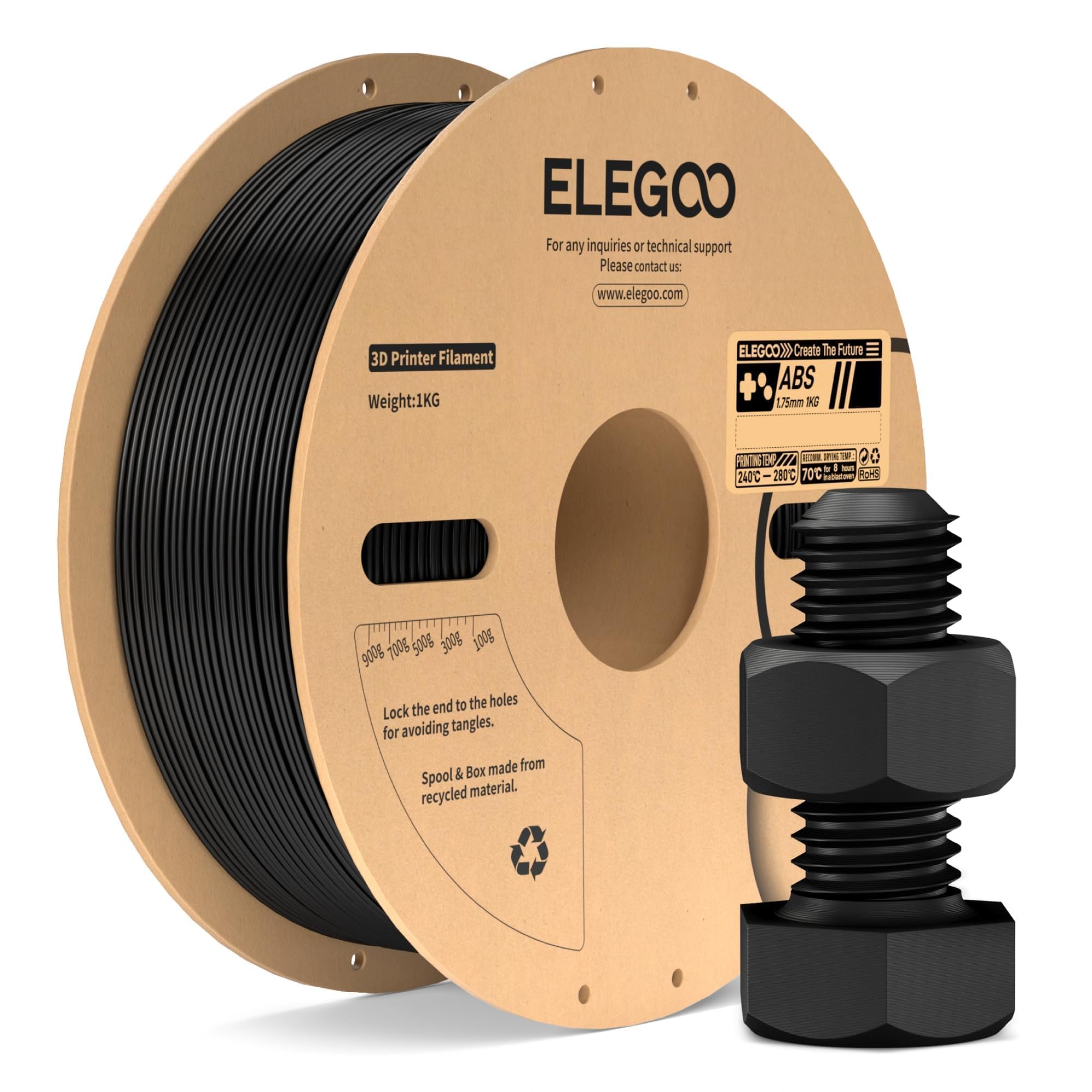
2. ELEGOO ABS 3D Printer Filament 1.75mm
The tough spool for drone mounts and rugged gear that takes hits and keeps its shape.
ELEGOO built this ABS for demanding parts — drone mounts, protective cases, and industrial tools that need to shrug off impacts and wear. It is rated to withstand heat up to 85 °C, so it holds its form near hot surfaces where PLA would sag. The maker also claims good water resistance, which matters for outdoor gear.
The quality is the thing owners single out most. Prints come out smooth and consistent, with strong bed adhesion and layer bonding. It runs beautifully on Prusa printers — one owner printed at 0.1mm layers on a Prusa MK4S smooth bed with no clogs or spooling issues. The black color stays stable throughout the roll, and the material even resists sanitizer sprays.
There is a genuine ABS smell while printing, so an enclosed printer is required for best results — ELEGOO says so right on the box. The one recurring gripe is winding: a few owners mention haphazard spooling that caused binding, so check the first few layers. A quick dry before use is also recommended by the maker if the spool has been sitting.
Built for function: impact resistance plus 85 °C heat tolerance makes this the pick for parts that live in the real world.
One caveat: winding quality varies, so watch for tangles on the first unspooling.
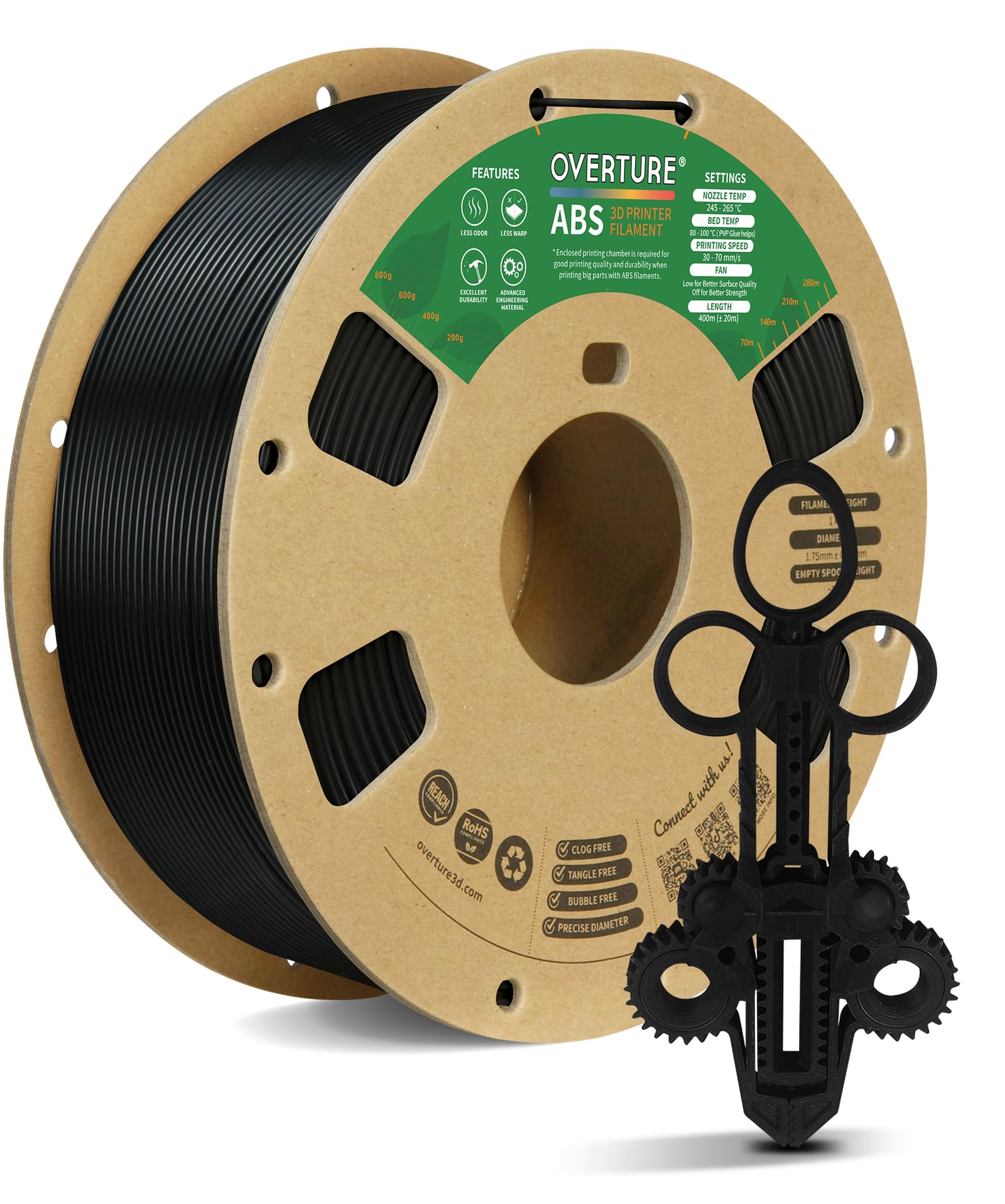
3. OVERTURE ABS High Strength 1.75mm
The spool that delivers a glossy, professional surface straight off the build plate.
OVERTURE engineered this ABS to yield a characteristically glossy finish without heavy post-processing. That means prints look polished the moment they come off the bed — ideal for enclosures and cosmetic parts where appearance matters as much as strength. The filament also withstands higher temperatures than standard 3D printing filaments, suiting functional prototypes and automotive parts.
Precision is the headline spec: an advanced CCD measuring system holds a strict tolerance of ±0.02 mm on the 1.75mm diameter. Customers note flawless printing on BambuLab machines and a track record of 30+ spools over 8 months with zero tangling issues. Layer adhesion and initial bed adhesion earn strong praise, with minimal warping when an enclosure is used.
Durability gets mixed words though — some find it very durable while others describe it as brittle. First-layer adhesion can be picky; PVA glue helps and a brim is recommended for small footprints. The spool itself is thoughtfully designed with a grid layout for tangle management and a viewing hole, which is a nice touch for a consumable.
Why It Shines
- Glossy, professional finish with minimal post-processing
- Tight ±0.02 mm diameter tolerance for smooth, even extrusion
- User-friendly spool with grid layout and viewing hole
Where It’s Picky
- Durability is mixed — some owners find parts brittle
- Small footprints need a brim for reliable first-layer adhesion
Best for: builders who want a shiny, dimensional part without sanding or smoothing.
Not for: prints that take heavy flexing — the brittleness reports suggest it prefers rigid parts.
4. SUNLU High Speed ABS 1KG
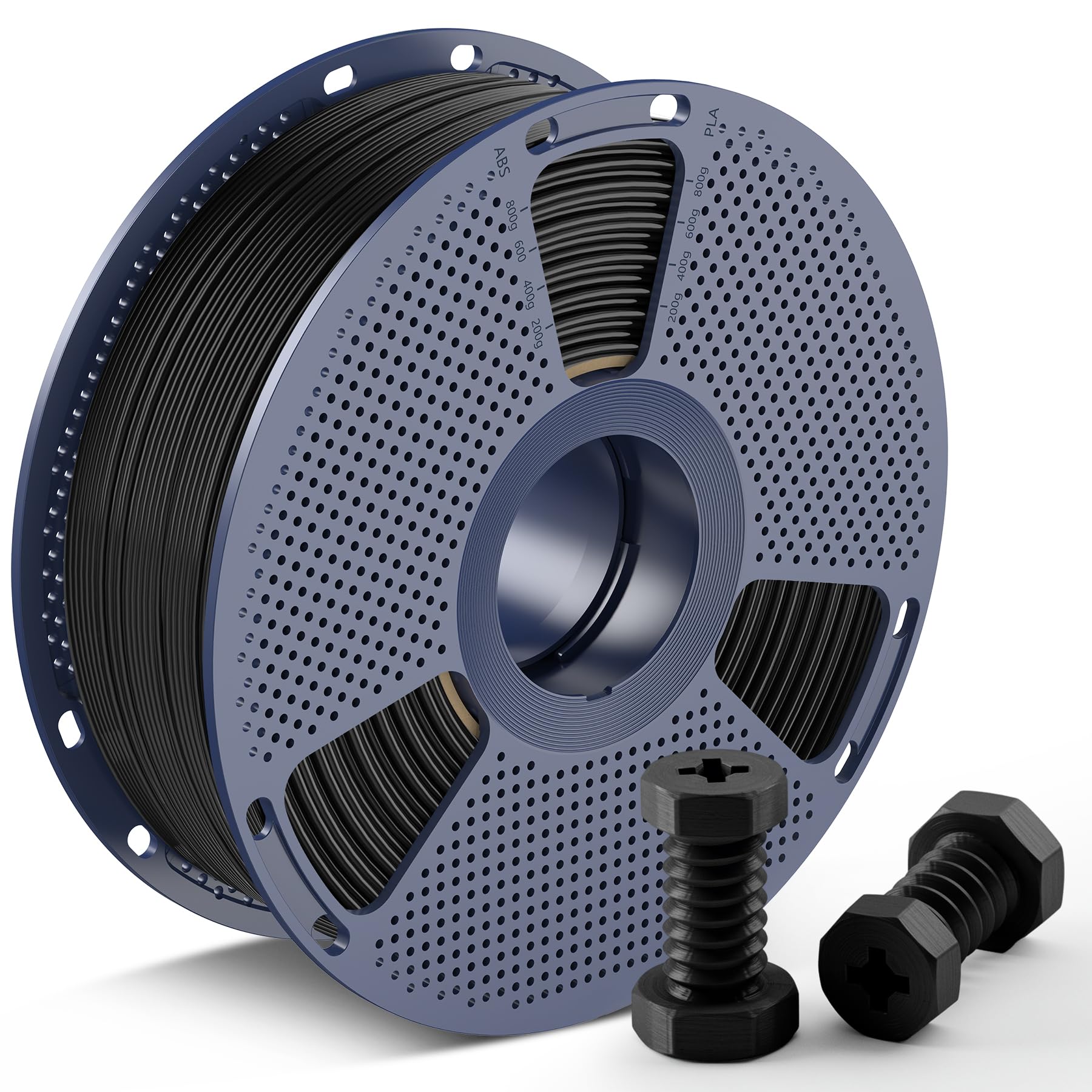
ABS that moves — rated for 350mm/s without sacrificing strength or layer bonds.
SUNLU’s Rapid ABS is built for printers that like to fly. It supports speeds up to 350mm/s while holding print quality, and buyers confirm it actually hits advertised speeds with minimal warping. For a material that usually demands patience, that is a serious time-saver on big functional parts.
Heat resistance is the other standout: a heat deformation temperature up to 91°C. That beats the 85°C rating on the ELEGOO above, making it the better pick for parts near hot surfaces. The manufacturer recommends a nozzle of 280-290℃ and a bed of 90-100℃ to get the best results, so make sure your hot end can reach those temps.
The finish is clean and smooth with solid layer adhesion, though owners note it comes out slightly shinier than expected — a preference thing, not a flaw. Quality and printability are the most-praised aspects, and 4 rolls in, reviewers point out zero tangles or clogs. It does not stick to every OEM plate, so a cryogrip or similar plate may be needed.
Speed + heat: the only spool here with both a 350mm/s rating and 91°C heat tolerance, so it covers fast work and hot environments.
Watch the plate: some owners found it needs a cryogrip plate for reliable first-layer stick.
5. ANYCUBIC ABS Filament 1.75mm

The anti-warp formula that tackles a full 220mm × 220mm print area at 100°C.
Warping is ABS’s biggest enemy, and ANYCUBIC attacked it head-on. This filament is formulated to minimize the thermal-stress warping that ruins big prints, supporting a 220mm × 220mm anti-warping print area with a heated bed at 100°C. That is a bold claim for ABS, and it boosts your printing success rate on large flat parts.
The material holds its strength and form even in environments up to 85°C, and the maker says it is tougher and more durable than PLA and PETG. Shoppers say excellent print quality and easy printing, with one using it on a Bambu X1C and finding it in line with more name-brand ABS filaments. It even works with the ACE Pro’s intelligent recognition system for auto-setting print parameters.
The spool is a tight fit in the AMS — one owner notes it “just barely fits” — so measure your dry box before loading. It is thinner on review history than the established picks, so consider that if you value long-term track records over fresh formulations.
Anti-warp focus: if large, flat prints are your bread and butter, the 220mm × 220mm claim makes this the one to test first.
Check the fit: the spool barely fits in some AMS units, so confirm your setup before committing.
6. FLASHFORGE ABS Pro 1.75mm Black
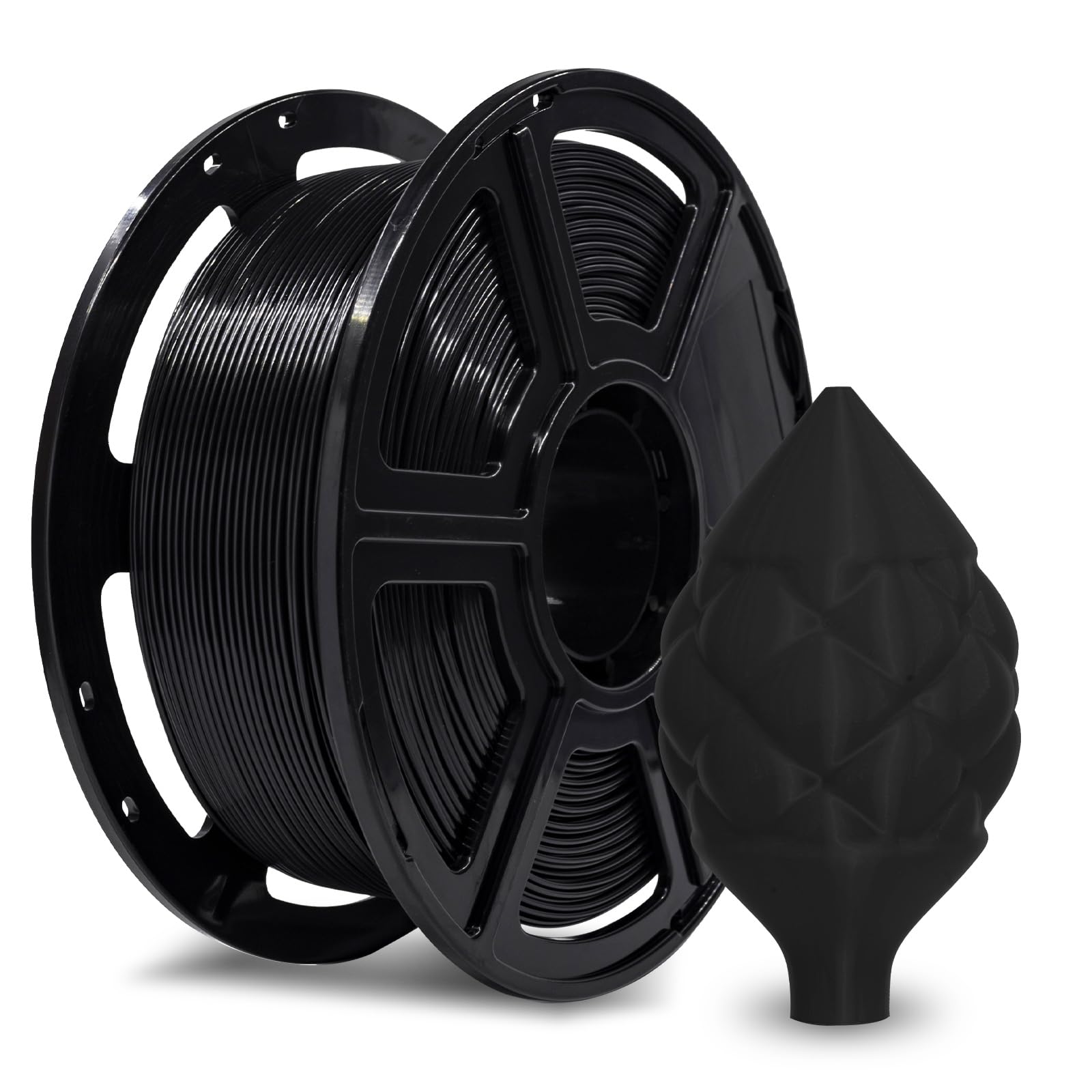
Hardly smells, barely warps, and still handles action camera mounts and tool housings.
FLASHFORGE ABS Pro is a modified ABS that ditches the worst parts of the material’s personality. It has reduced shrinkage and eliminated strong odors, making it far more pleasant to print with than standard ABS. The maker rates its hot deformation below 90℃, so heat-resistant functional parts — action camera mounts, tools, electrical housings — are squarely in its wheelhouse.
Owners consistently praise the quality and printability, noting it prints flawlessly on a Bambulab P1s and delivers strong parts. Best layer adhesion comes at 230°C with a 90°C bed, and it handles 120mm/s without issue. The color range earns its own praise, with one vivid purple drawing compliments, and dimensional accuracy holds at ±0.02 mm.
The trade-off: modified ABS tends to be slightly weaker and more brittle than classic ABS, so skip it if you need maximum impact strength. It is also hygroscopic — one owner found it became rough and stringy after a week exposed to air, then restored after a few hours of drying. Keep it sealed when not in use.
The Perks
- Low odor and low warp — comfortable printing environment
- ±0.02 mm precision for consistent, smooth extrusion
- Vibrant color options that owners rave about
The Trade-Offs
- Slightly weaker and more brittle than classic ABS
- Soaks up moisture — needs sealed storage or a dry box
Grab this for: long print sessions where smell and warping would drive you nuts.
pass on it if: your parts must take serious impact — the modified formula gives up some toughness.
7. Creality 3D Printer Filament ABS Black 1KG

The wallet-friendly spool that prints smooth and clean without sticker shock.
Creality’s budget ABS delivers the essentials without the premium price. It is fully mechanically wound and manually inspected to keep the line tidy and tangle-free, with a larger spool inner diameter for smoother feeding. Dimensional accuracy holds at ±0.03 mm, which is fine for most functional prints even if it is a touch looser than the ±0.02 mm spools above.
Buyers report it prints really smooth and clean, with some calling it their go-to black ABS. One found it behaves like Hatchbox ABS, printing without stringing at 232°C on an Ender 3. The recommended nozzle range is 220℃-260℃ with a bed of 90℃-110℃, and as with all ABS, a fully enclosed printer dramatically improves your success rate.
The main caveat is warping — one owner says it warps more easily than other brands they use, but they still buy it for the price. Some packs arrive with failed vacuum seals and need drying first, so check the bag on arrival. Adhesion is generally solid on PEI plates with glue.
Value play: the no-tangle spool and smooth prints punch well above the price point.
Fair warning: expect more warping than pricier rivals, and verify the vacuum seal on arrival.
8. QIDI TECHNOLOGY ABS Rapido 1kg
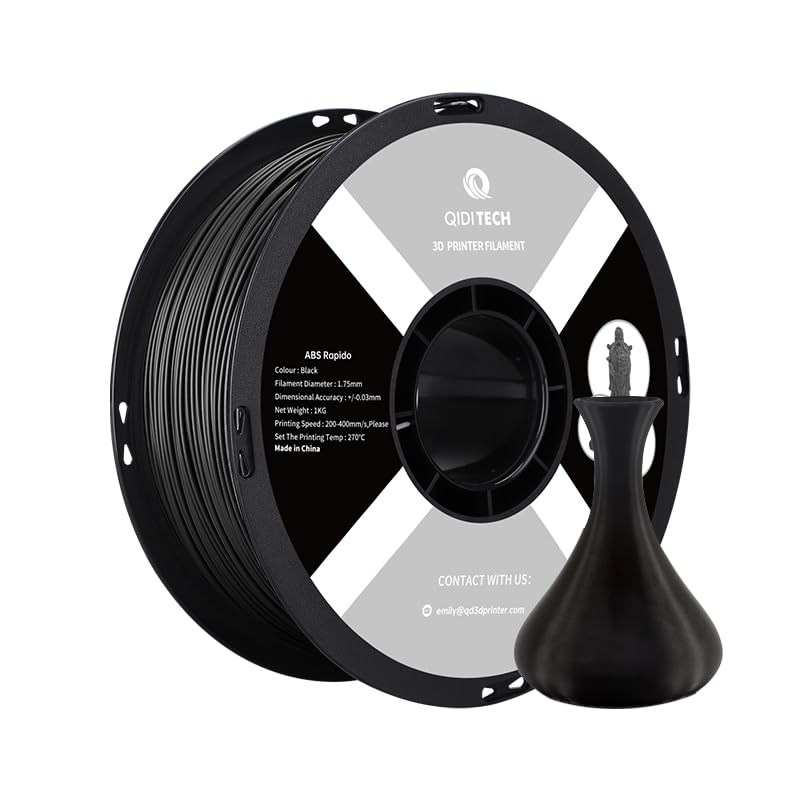
The fastest ABS here — rated for 400mm/s with low odor and minimal warping.
QIDI’s ABS Rapido is the speed demon of the group, supporting print speeds up to 400mm/s — the highest rating on this list. Owners confirm it prints as fast as the printer can run, with crisp, clean parts. The maker recommends pairing it with the QIDI X-Plus3, but it works across high-speed FDM machines.
It is built for functional parts that need durability or high-temperature resistance, with more impact resistance than PLA. The low VOC treatment removes volatile organics, so the smell is noticeably reduced versus traditional ABS, with no bubbles and low warpage during printing. Dimensional accuracy holds at ±0.03 mm.
Layer adhesion and print quality get the strongest praise, with owners reporting zero warping on long thin models and excellent overhangs when using a brim and glue stick. The recommended nozzle temp is 270°C with a bed of 80-100°C. Value gets mixed words — it runs higher in price, and one owner wished for a spool-less version to cut waste.
Built for speed: at 400mm/s, this is the ceiling for fast ABS printing on this list.
Pay for pace: you are spending more for the speed rating, so it only makes sense if your printer can use it.
9. Bambu Lab ABS Filament Black 1kg Refill
If you own a Bambu printer, this spool saves you setup time — its RFID tag (a small chip the printer reads automatically) loads the correct print settings for you, so you do not have to enter temperature or speed manually.
Bambu Lab’s ABS is engineered for the AMS system, and the RFID tags are the killer feature. Drop the spool in and your printer auto-sets the print parameters — no hunting for the right profile. Owners call the convenience priceless, and it flows well with spot-on diameter and consistent results from start to finish.
The material itself is engineering-grade ABS with a precise 1.75mm diameter and ±0.03mm tolerance for smooth extrusion. It is formulated for low warp and improved layer adhesion when printed in an enclosed chamber, and the clean finish sands, drills, paints, or acetone-smoothes well for professional results. Each spool arrives vacuum-sealed with desiccant.
Print quality earns consistent praise, with owners reporting no adhesion issues and predictable results. The catch is the refill format — it is a 1kg refill without a spool, so you need a Bambu spool or AMS to use it. It also costs more per kilo than the budget picks, so it is the right choice mainly for Bambu ecosystem loyalists.
Ecosystem win: RFID auto-setup removes the guesswork for Bambu AMS owners.
The cost: you pay a premium for the convenience, and the refill needs a compatible spool.
Understanding the Specs
Print Speed Rating
High-speed ABS spools list a maximum speed in mm/s — the SUNLU is rated for 350mm/s and the QIDI Rapido for 400mm/s. That number is the ceiling your printer can push, not a guarantee. Your machine needs a hot end that can melt fast enough and a motion system that keeps up. Start at half the rated speed and ramp up until you see layer issues.
Heat Deformation Temperature
This is the point where a printed part starts to soften and lose shape under load. ELEGOO and ANYCUBIC rate theirs up to 85°C, while SUNLU pushes to 91°C and FLASHFORGE lists deformation below 90℃. If your part sits near a hot engine or a sunny car dash, the higher number keeps the part rigid longer.
Diameter Tolerance
The 1.75mm line varies slightly along its length. A tolerance of ±0.02 mm (OVERTURE, ANYCUBIC, FLASHFORGE) means very even extrusion, while ±0.03 mm (Creality, QIDI, Bambu Lab) is still fine for most prints. Tighter tolerance reduces clogs and keeps layer lines even across a long print.
Enclosure Requirement
ABS shrinks as it cools, which pulls corners off the bed. A fully enclosed printer keeps the whole chamber warm, slowing that cool-down and preventing warping and layer separation. Nearly every maker here recommends an enclosed printer or an open printer plus an enclosure to improve success rates.
FAQ
Do I really need an enclosed printer for ABS?
What is a safe nozzle temperature for ABS?
What bed temperature should I use for ABS?
Why does my ABS smell so bad and is it safe?
What is the difference between high-speed ABS and regular ABS?
How do I stop ABS from warping on the build plate?
Is ABS stronger than PLA and PETG?
Do I need to dry ABS filament before printing?
What does the diameter tolerance number mean?
Final Thoughts: The Verdict
If you want one dependable pick, the abs filament winner is the Creality CR-ABS because it pairs proven impact resistance with reliable extrusion and solid value across a huge pool of happy owners. If you want maximum speed without warping, grab the SUNLU High Speed ABS at 350mm/s with 91°C heat tolerance. And for a nearly smell-free printing experience on functional parts, the FLASHFORGE ABS Pro is the one to reach for.
How We Picked
We do not accept paid placement. Every pick is matched to a real buyer and a real use-case; we do not hands-on test units.
Sources & Methodology
Specifications: manufacturer listings and product documentation. Review insights: verified customer reviews, as of August 2026. Pricing: not shown on this page (it changes often); check the current price via the retailer link.
As an Amazon Associate, Gadgets Feed earns from qualifying purchases. This does not affect which products we feature.