
The jump from phone clips to true 4K video is the moment your content stops looking like home movies and starts feeling like cinema. But here’s the thing the sticker won’t tell you: two cameras can both claim “4K 60fps” and deliver completely different results — one can be stunning and the other frustratingly soft. The difference lives in the sensor size, the processing power, and the lens system you choose. You need a 4K digital camera that fits not just your budget, but your actual shooting style, whether that’s vlogging on the move, capturing fast-moving wildlife, or producing professional-grade footage in a studio.
I‘m Min — the co-founder and writer behind Gadgets Feed. I’ve spent years analyzing sensor specs, codec options, and autofocus systems across dozens of mirrorless and cinema cameras to help you separate genuine value from marketing hype.
This guide breaks down the critical specs and real-world performance of the best 4K digital cameras available today, from pocketable gimbal cameras to full-frame powerhouses, so you can make a confident choice.
How To Choose The Best 4K Digital Camera
Choosing a 4K camera is about more than just resolution. You need to weigh sensor size, autofocus reliability, stabilization, and lens ecosystem to find a camera that matches your skill level and shooting environment. Here’s what to focus on.
Sensor Size & Image Quality
Sensor size directly affects low-light performance and depth of field. Full-frame sensors (35mm) deliver the best noise control and dynamic range, making them ideal for professional work in challenging light. APS-C and Micro Four Thirds sensors are smaller but allow for more compact, lightweight cameras and lenses, often at a significantly lower price. A 1-inch sensor, like the one in the DJI Osmo Pocket 3, is a step up from a phone sensor and excellent for vlogging, but it cannot match the light-gathering ability of larger sensors.
Autofocus Performance
For video, reliable autofocus is critical. Phase-detection systems (like Canon’s Dual Pixel or Sony’s 693-point array) lock onto subjects faster and track them more smoothly than contrast-detection systems. The best systems now use AI to detect human eyes, animal eyes, and even vehicles. Hybrid systems (found in the Panasonic S5II) combine both methods to offer the best of both worlds. A camera with poor autofocus will ruin more shots than a slightly lower resolution sensor ever could.
In-Body Image Stabilization (IBIS)
IBIS compensates for camera shake, letting you shoot handheld footage that looks like it was on a gimbal. The Panasonic LUMIX G85 and Olympus E-M10 Mark IV have class-leading 5-axis stabilization, while the DJI Osmo Pocket 3 uses a mechanical gimbal for ultra-smooth movement. Full-frame cameras like the Sony A7 IV also offer effective IBIS, but mirrorless cameras typically require lenses with Optical Image Stabilization (OIS) for the best combined result.
Quick Comparison
On smaller screens, swipe sideways to see the full table.
| Model | Category | Best For | Key Spec | Amazon |
|---|---|---|---|---|
| Sony Alpha 7 IV | Full-Frame | Hybrid photo/video pro | 33MP, 4K 60p 10-bit 4:2:2 | Amazon |
| Panasonic LUMIX S5II | Full-Frame | Hybrid with best Stabilization | 24.2MP, Active I.S., Unlimited 4:2:2 10-bit | Amazon |
| Nikon D7500 | DSLR | Fast action & wildlife | 20.9MP, 51-Point AF, 8 fps | Amazon |
| OM SYSTEM E-M10 Mark IV | Mirrorless MFT | Portable travel & selfie | 20MP, 5-Axis IBIS, 4.5 Stops | Amazon |
| Canon EOS R8 | Full-Frame | Lightweight full-frame entry | 24.2MP, 4K 60p oversampled from 6K | Amazon |
| Blackmagic Pocket Cinema 4K | Cinema | Professional video production | 4/3” sensor, 13 Stops DR, RAW | Amazon |
| Sony a7 III | Full-Frame | Low light & all-around | 24.2MP BSI, 693 AF Points, 10fps | Amazon |
| Panasonic LUMIX G85 | Mirrorless MFT | Budget hybrid with IBIS | 16MP, 5-Axis Dual I.S., 4K | Amazon |
| DJI Osmo Pocket 3 | Gimbal Camera | Vlogging & action vids | 1” CMOS, 3-Axis Mechanical Gimbal | Amazon |
| Canon EOS R100 | Mirrorless APS-C | Beginner mirrorless | 24.1MP, Digic 8, Dual Pixel AF | Amazon |
| OBSBOT Tail Air | PTZ Camera | Live streaming & tracking | 4K, AI Tracking, NDI/WiFi | Amazon |
In‑Depth Reviews
1. Sony Alpha 7 IV

The Sony Alpha 7 IV is the definitive hybrid camera for professionals who demand equal excellence in stills and video. Its 33MP Exmor R back-illuminated sensor, combined with the BIONZ XR processor, delivers stunning 4K 60p video in 10-bit 4:2:2 color depth with full pixel readout from a 7K oversample at 30p. The real-time Eye AF for humans and animals locks onto subjects with surgical precision, even in tricky backlit scenarios.
Build quality is exceptional, featuring a weather-sealed magnesium alloy body, a high-resolution 3.2-inch articulating touchscreen, and dual card slots (CFexpress Type A and SD UHS-II). The in-body image stabilization (IBIS) provides a solid 5.5 stops of compensation, making handheld video footage remarkably smooth. Battery life comfortably exceeds 2,000 shots per charge, which is outstanding for a mirrorless camera.
The S-Cinetone color profile adds a cinematic look straight out of camera, reducing grading time in post. It’s a significant investment, but the A7 IV delivers professional-grade versatility that can handle everything from portrait sessions to run-and-gun documentary work. If you’re a working hybrid shooter, this is the benchmark.
Why it’s great
- Pro-level 33MP sensor with outstanding dynamic range and 4K 60p 10-bit video.
- Fast, reliable autofocus with real-time Eye AF for people, animals, and birds.
- Excellent battery life and dual card slots for redundancy.
Good to know
- No built-in flash; relies on external hotshoe flash.
- Slight rolling shutter at 4K 60p compared to global shutter sensors.
2. Panasonic LUMIX S5II
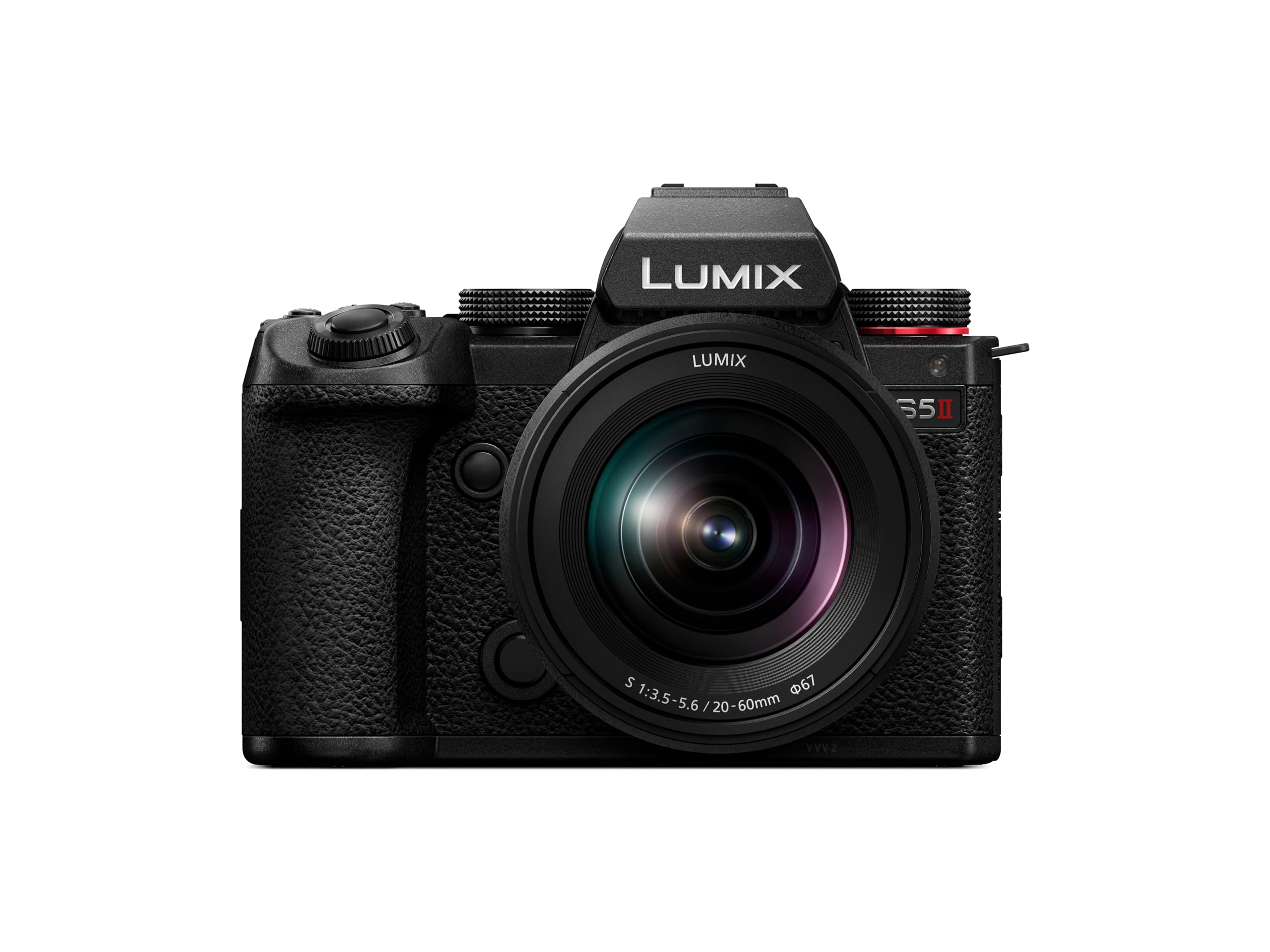
The Panasonic LUMIX S5II marks a turning point for the brand with the introduction of Phase Hybrid Autofocus, solving the autofocus struggles of previous models. Paired with a 24.2MP full-frame CMOS sensor and the L2 image processor, it delivers unlimited 4:2:2 10-bit 4K recording with no time limit — a massive advantage for long-form content creators, interviews, and live events. A built-in fan and heat sink allow this unlimited recording without overheating.
The Active I.S. (image stabilization) technology is among the best in class, allowing you to walk and shoot without a gimbal. The combination of 5-axis IBIS and lens-based stabilization provides incredibly smooth handheld footage. The 14+ stop V-Log/V-Gamut capture offers massive flexibility for color grading, while the REAL TIME LUT feature lets you apply looks in-camera for a near-final image on set.
The kit 20-60mm F3.5-5.6 L Mount lens provides a useful wide-angle to standard range. The robust magnesium alloy body is weather-sealed, and the high-resolution EVF and vari-angle LCD make framing easy. For hybrid shooters who need reliable autofocus and the industry‘s best stabilization, the S5II is a powerhouse at a mid-range price.
Why it’s great
- Phase Hybrid AF finally brings competitive autofocus to Panasonic full-frame.
- Unlimited 4:2:2 10-bit recording with active cooling for long shoots.
- Best-in-class Active I.S. for smooth handheld video without a gimbal.
Good to know
- Battery life is average; a battery grip is recommended for long shoots.
- The kit lens is good, but upgrading to a faster aperture prime unlocks its full potential for low light.
3. Canon EOS R8

The Canon EOS R8 is the lightest full-frame RF mount camera, weighing just 461g, yet it shares the same 24.2MP sensor and DIGIC X processor as the flagship R6 Mark II. This means you get professional-grade image quality, uncropped 4K 60p video oversampled from 6K, and Canon’s excellent Dual Pixel CMOS AF II covering 100% of the frame with deep-learning subject detection.
Its autofocus is remarkably fast and intelligent, detecting people, animals, and even vehicles and trains. The 40fps electronic shutter (with AF tracking) is a game-changer for action and sports photography at this price point. Canon Log 3 allows for excellent dynamic range retention in video, and the Full HD 180fps slow-motion mode adds creative flexibility.
The R8 lacks in-body image stabilization (IBIS) and uses a smaller battery, but these compromises allow it to be incredibly light and portable. The vari-angle touchscreen is perfect for vlogging. If you want full-frame quality and blazing-fast autofocus without the R6 Mark II price tag, the R8 is a fantastic entry point into the RF ecosystem.
Why it’s great
- Pro-level image quality and autofocus in a lightweight, affordable full-frame body.
- Uncropped 4K 60p oversampled from 6K with Canon Log 3.
- Excellent battery life and dual card slots for redundancy in its class.
Good to know
- No in-body image stabilization; relies on lens IS.
- Single UHS-II SD card slot.
- Battery life is modest (approximately 300 shots using mechanical shutter).
4. Blackmagic Pocket Cinema Camera 4K

The Blackmagic Pocket Cinema Camera 4K (BMPCC4K) is a dedicated cinema camera that prioritizes video quality above all else. Its 4/3” HDR sensor delivers a native resolution of 4096 x 2160 with 13 stops of dynamic range, capturing subtle shadow and highlight details that consumer cameras miss. The dual native ISO up to 25,600 keeps noise impressively low in low-light scenarios.
Recording options are professional-grade: you can shoot to SD UHS-II, CFast 2.0, or external SSDs via USB-C in Blackmagic RAW or Apple ProRes formats. The 5-inch touchscreen LCD is bright and sharp, eliminating the need for an external monitor. Audio inputs include two mini XLRs with phantom power and a 3.5mm jack, making it a complete production tool.
This camera lacks in-body stabilization, continuous autofocus, and a flip-out screen — it is built for controlled shooting on tripods or gimbals, not run-and-gun vlogging. Battery life is very short, so external power or a battery grip is essential. The included DaVinci Resolve Studio license is a massive bonus for post-production. The BMPCC4K rewards planning with stunning filmic results.
Why it’s great
- True cinema-quality 4K video with 13 stops of dynamic range and RAW recording.
- Professional audio inputs (dual mini XLR with phantom power).
- Includes DaVinci Resolve Studio license for color grading.
Good to know
- Very short battery life; requires external power or battery grip for extended shoots.
- No IBIS, continuous AF, or flip-out screen — not for casual vlogging or photography.
5. Sony a7 III

The Sony a7 III remains a benchmark for full-frame value years after its release. Its 24.2MP back-illuminated sensor offers superb dynamic range (15 stops) and remarkable low-light performance well beyond its age. The combination of 693 phase-detection and 425 contrast-detection AF points covers 93% of the frame, providing fast and reliable subject tracking for both stills and video.
It shoots 4K 30p video with full pixel readout (no pixel binning), which delivers sharp, detailed footage. The 10fps silent or mechanical shutter with AE/AF tracking makes it excellent for sports and wildlife. Battery life is exceptional, with a CIPA rating of 710 shots on a single NP-FZ100 charge, easily lasting through a full day of shooting.
The body is smaller and lighter than many competitors, but the menu system is dated and complex. The 28-70mm kit lens is decent but does not do justice to the sensor’s capabilities; a prime upgrade is recommended. For a hybrid shooter prioritizing low-light performance, battery life, and a mature lens ecosystem, the a7 III is still a compelling choice.
Why it’s great
- Excellent low-light performance with 15 stops of dynamic range.
- Fast, reliable 693-point phase-detection AF system and fast 10fps burst shooting.
- Exceptional battery life for a mirrorless camera.
Good to know
- 4K video is limited to 30fps; no 10-bit internal recording or C-Log.
- Menu system is older and less intuitive than newer models.
- Kit lens is functional but doesn’t maximize the sensor’s potential.
6. Nikon D7500

The Nikon D7500 is a rugged DSLR that stands out for its class-leading image quality, inherited from the pro-grade D500. Its 20.9MP APS-C CMOS sensor and EXPEED 5 processor deliver excellent high-ISO performance and accurate colors. The 51-point AF system with 15 cross-type sensors, combined with group-area AF, offers snappy and precise subject tracking for fast-moving subjects like sports or wildlife.
The optical viewfinder is bright and lag-free, a key advantage for action shooting. The camera shoots 4K Ultra HD video with stereo sound, power aperture control, and auto ISO, making it more than capable for high-quality video. The 3.2-inch tilting touchscreen is clear and responsive, and the camera is weather-sealed, giving it a robust feel.
It has a large, comfortable grip and long battery life, a hallmark of DSLRs. The 18-140mm VR kit lens provides a versatile zoom range, though wider apertures would help in lower light. For photographers who prefer the optical viewfinder and want a durable, fast-shooting camera with great video, the D7500 remains a top-tier DSLR choice.
Why it’s great
- Excellent image quality with great high-ISO performance from a D500-derived sensor.
- Fast, reliable 51-point AF system ideal for wildlife and sports photography.
- Weather-sealed, durable build with a comfortable grip and long battery life.
Good to know
- Older DSLR design with no mirrorless advantages like IBIS or silent electronic shutter.
- 4K video is cropped 1.5x compared to full-frame sensors, and lacks advanced video features like 10-bit output.
7. OM SYSTEM Olympus E-M10 Mark IV

The OM SYSTEM E-M10 Mark IV is a charming and capable Micro Four Thirds camera that packs 20MP image quality, 5-axis in-body image stabilization, and 4K video into a compact, retro-styled body. The 5-axis IBIS is effective for up to 4.5 stops, allowing steady handheld shots and smooth video in lower light. The kit 14-42mm F3.5-5.6 EZ pancake lens collapses to make the camera nearly pocketable.
It features a unique flip-down selfie mode that automatically activates when the monitor is tilted down, making it one of the best cameras for selfie shooters and vloggers. The 121-point contrast-detect AF is fast enough for most everyday shooting. The camera is packed with useful features like 16 art filters, in-camera panorama stitching, and in-camera focus stacking.
Battery life is decent, but the lack of a USB-C charger and reliance on Micro-USB is an outdated annoyance. The WiFi app connection is functional but a bit slow. For a compact, affordable camera with great stabilization and a playful photography experience, the E-M10 Mark IV is a fantastic travel companion and a great entry point into the MFT ecosystem.
Why it’s great
- Compact and lightweight design with a great retro look and feel.
- Excellent 5-axis IBIS for handheld shots and stable video.
- Dedicated selfie mode and built-in flash, ideal for casual photography.
Good to know
- Uses Micro-USB for charging, not modern USB-C.
- WiFi app for photo transfer can be slow and finicky.
8. Panasonic LUMIX G85

The Panasonic LUMIX G85 is a versatile Micro Four Thirds camera that punches well above its weight. Its 16MP sensor (with no low-pass filter) captures sharp, detailed images, and the class-leading 5-axis Dual Image Stabilization (IBIS combined with lens OIS) achieves incredibly smooth handheld video — rivaling cameras costing more than twice as much. It shoots 4K 30fps video and offers Lumix exclusive features like 4K Photo (frame grabs) and Post Focus.
The camera body is well-built with a magnesium alloy front plate and is splash and dust resistant. The kit 12-60mm F3.5-5.6 Power O.I.S. lens provides a useful 24-120mm equivalent zoom range with excellent sharpness. The high-resolution OLED viewfinder and tilting touchscreen are clear and precise. Autofocus is reliable in good light, though it struggles slightly in very low light for 4K video.
It lacks a headphone jack, and its WiFi setup can be finicky with some modern phones. For a camera that offers professional-grade stabilization and solid 4K video at a very accessible price, the G85 is a stellar budget hybrid for both beginners and experienced shooters looking for an affordable second body.
Why it’s great
- Outstanding 5-axis Dual I.S. for smooth handheld video and sharp low-light photos.
- Excellent build quality with weather sealing and a comfortable grip.
- Versatile 12-60mm kit lens with strong image quality and Optical I.S.
Good to know
- Autofocus can be a bit slower in very low light for video.
- No headphone jack for audio monitoring while recording video.
- Battery life is below average for a mirrorless camera.
9. DJI Osmo Pocket 3

The DJI Osmo Pocket 3 is a purpose-built vlogging and travel camera that combines a large 1-inch CMOS sensor with a built-in 3-axis mechanical gimbal. The result is stunning 4K 120fps footage that is silky smooth, even when walking fast. The active track 6.0 automatically keeps you centered in the frame, making solo vlogging effortless.
The 2-inch rotating touchscreen allows quick switching between horizontal and vertical shooting — perfect for both YouTube and TikTok/Reels content. The Creator Combo includes the DJI Mic 2 transmitter, a wide-angle lens, a battery handle, a mini tripod, and a carrying bag, creating a complete vlogging kit. The 1-inch sensor captures much better low-light footage and dynamic range than any phone or action camera.
It supports direct connection to two DJI Mic transmitters for pro-level audio. The LUT support and D-Log M color profile allow for easy color grading. The Osmo Pocket 3 is not a full-fledged ILC, but its combination of stabilization, image quality, and portability makes it the undisputed king of handheld vlogging.
Why it’s great
- Incredibly smooth 4K 120fps footage thanks to a built-in 3-axis mechanical gimbal.
- Excellent image quality from a 1-inch CMOS sensor, far superior to phones.
- Compact and portable, with a versatile Creator Combo for all-day vlogging.
Good to know
- Not an interchangeable lens system; you’re limited to the built-in lens.
- Small sensor compared to APS-C or full-frame cameras, limiting extreme low-light performance.
- The internal gimbal is delicate; it needs to be handled with care and stored properly.
10. Canon EOS R100

The Canon EOS R100 is the smallest and lightest camera in the EOS R series, designed as a straightforward entry point into mirrorless photography and 4K video. Its 24.1MP APS-C CMOS sensor, paired with the DIGIC 8 processor, delivers great image clarity with natural bokeh. The Dual Pixel CMOS AF covers 143 zones with human face and eye detection, making autofocus simple and reliable for beginners.
It shoots 4K video at 24fps and Full HD at up to 60fps, making it suitable for casual vlogs and family memories. The kit RF-S 18-45mm F4.5-6.3 IS STM lens is a compact standard zoom with Optical Image Stabilization. The camera is lightweight and portable, and the menu system is clean and easy to navigate.
The compromise for its size and price is a simpler feature set: no touchscreen, a lower-resolution EVF, and 4K video is limited to 24fps with a noticeable crop. It is not a camera for serious videographers, but as an affordable, high-quality 4K camera for absolute beginners wanting to step up from a phone, the R100 is a solid and simple choice.
Why it’s great
- Compact, lightweight body that is the smallest in the EOS R series.
- Beginner-friendly with a clean GUI and reliable Dual Pixel AF.
- Good 24.1MP image quality for a very accessible price point.
Good to know
- 4K video is limited to 24fps and has a significant crop factor.
- No touchscreen or articulating LCD like higher-end models.
- Battery charger not included in the box.
11. OBSBOT Tail Air

The OBSBOT Tail Air is a specialized PTZ (Pan-Tilt-Zoom) camera designed for live streaming and content creation on platforms like YouTube, Twitch, and Facebook. It offers 4K resolution and a 320° horizontal / 180° vertical rotation range, allowing it to follow subjects with AI tracking for humans, animals, and objects. Gesture control lets you start or stop tracking by simply waving a hand.
It features four connection methods: Micro HDMI, USB-C, Ethernet, and Wi-Fi, supporting protocols like RTMP, RTSP, and VISCA. This makes it extremely flexible for multi-camera setups or streaming directly to platforms. The companion OBSBOT Start app offers full manual control over exposure, focus, and tracking parameters.
It uses a 23mm f/1.8 lens, which is reasonably wide and bright for a PTZ. The NDI feature requires an additional license purchase. A significant reported issue is that the camera’s battery cannot be bypassed or user-replaced; if the battery fails, the camera becomes unusable. The Tail Air is excellent for its target use case — automated streaming with minimal human operator — but reliability concerns mean a backup plan is wise.
Why it’s great
- Advanced AI tracking for people, animals, and objects with gesture control.
- Versatile connectivity (USB-C, HDMI, Ethernet, Wi-Fi, NDI).
- Compact, portable PTZ form factor for easy placement anywhere.
Good to know
- Internal battery cannot be bypassed or user-replaced, posing a long-term durability risk.
- NDI license is an additional purchase; it’s not included out of the box.
FAQ
Is 4K 30fps good enough for professional video?
Why is sensor size more important than megapixels for 4K?
Do I need a cinema camera to shoot professional 4K video?
Final Thoughts: The Verdict
For most users, the best 4k digital camera winner is the Sony Alpha 7 IV because it delivers a perfect balance of professional-grade stills and video performance with versatile features. If you want the best stabilization and unlimited recording for serious video work, grab the Panasonic LUMIX S5II. And for the ultimate vlogging companion that puts smooth cinematic footage in your pocket, nothing beats the DJI Osmo Pocket 3.