
Our readers keep the lights on and my morning glass full of iced black tea. As an Amazon Associate, I earn from qualifying purchases.
Specs are compiled from manufacturer listings and verified buyer reviews and can change over time — please confirm the key details on the product page before buying.
If you are tired of the smoky, finicky ritual of mixing oil into gasoline for a 2-stroke engine, a 4-stroke leaf blower is your answer — it runs on straight gas, which makes it easier to start, cleaner to run, and simpler to maintain for years. The real decision here is between a lightweight handheld for quick cleanups and a larger backpack or walk-behind unit for clearing an entire acre.
I’m Min — the founder and writer behind Gadgets Feed. This guide is built by comparing the manufacturers’ published specifications and the patterns across verified customer reviews, so you get each pick’s real strengths and trade-offs instead of marketing spin.
You will find the best 4 stroke leaf blower for your yard size here, from budget handhelds to premium walk-behind machines. 4 stroke leaf blower options run on pure gasoline, which means no oil mixing and easier everyday use.
Quick Picks
- VEVOR 25.4CC Handheld 4-Stroke Gas Leaf Blower — Best Value
- SENIX 4QL 49cc 4-Cycle Backpack Gas Leaf Blower — Top Performer
- SENIX 49CC 4-Cycle Gas Powered Backpack Leaf — Best Overall
- Landworks Walk Behind Jet Sweep 7HP 4-Stroke — Premium Pick
- SuperHandy Walk Behind Leaf Blower — Most Versatile
How To Choose The Best 4 Stroke Leaf Blower
Picking a 4-stroke blower starts with matching the machine to the size of the job. A handheld unit at around 11 pounds is perfect for walkways and small lawns, while a backpack model spreads the weight across your shoulders for longer sessions, and a wheeled walk-behind blower practically does the heavy lifting for you on large, open properties.
Match Air Volume and Speed to Your Yard
The two numbers that matter are CFM (cubic feet per minute, or how much air the machine pushes) and MPH (miles per hour, or how fast that air travels). High CFM is what moves big piles of wet leaves, while high MPH is what dislodges debris stuck in tight corners and along fences. For a typical half-acre lot, you want at least 400 CFM; for purely light duty, a 300 CFM handheld can still get the job done.
Quick Comparison
| Model | Best For | Air Volume | Air Speed | Engine Size | Amazon |
|---|---|---|---|---|---|
| VEVOR 25.4CC Handheld | Small yards & tight corners | 340 CFM | 130 MPH | 25.4 cc | Amazon |
| SENIX 4QL 49cc Backpack | Big debris with low vibration | 600 CFM | 200 MPH | 49 cc | Amazon |
| SENIX 49CC Backpack | Quiet neighborhood cleanups | 425 CFM | 195 MPH | 49 cc | Amazon |
| Landworks 7HP Walk-Behind | Large open properties | 2000 CFM | 200 MPH | 212 cc | Amazon |
| SuperHandy 7HP Walk-Behind | Heavy debris on rough land | 1270 CFM | 150 MPH | 209 cc | Amazon |
In‑Depth Reviews
1. VEVOR 25.4CC Handheld 4-Stroke Gas Leaf Blower
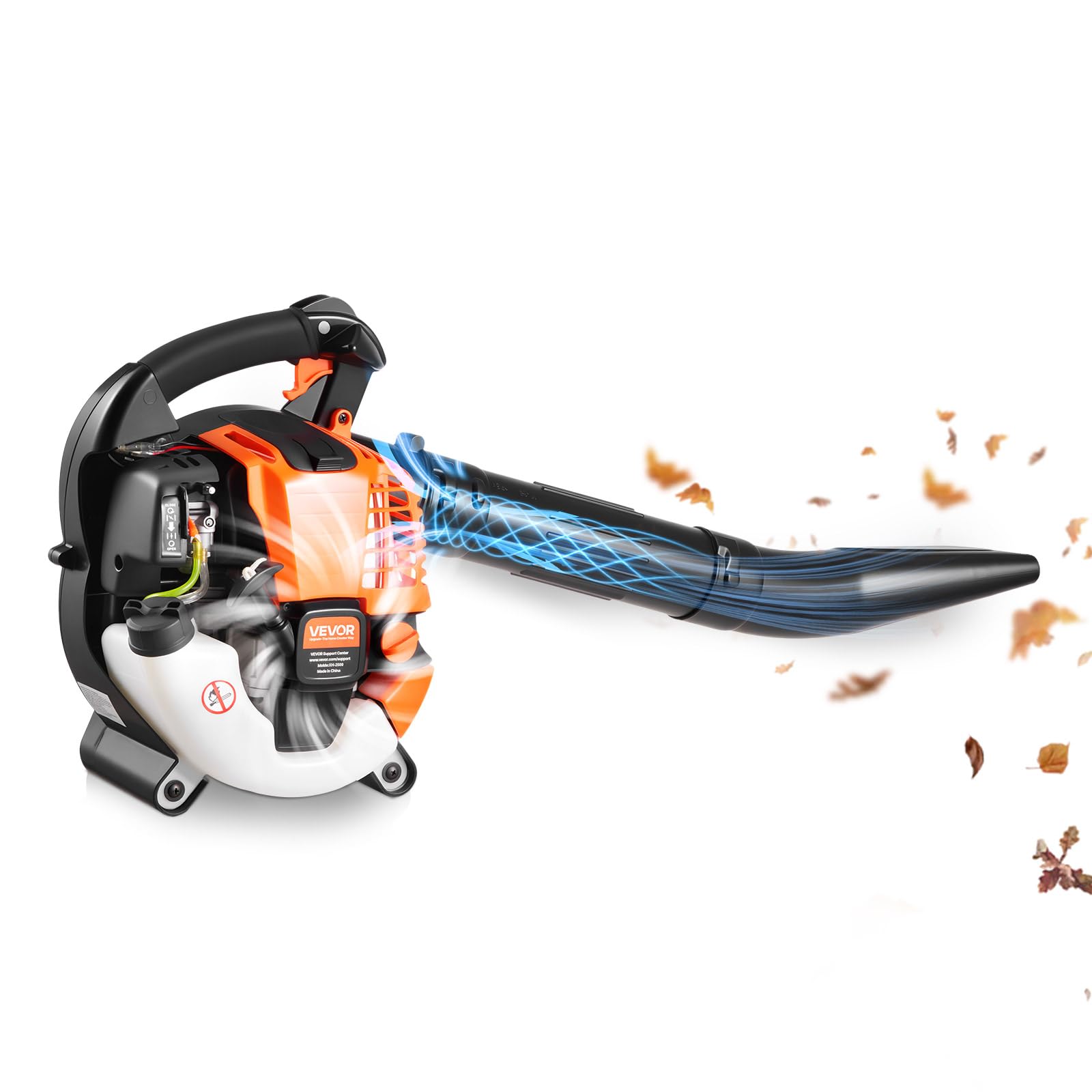
The lightweight grab-and-go blower that makes daily driveway cleanup genuinely easy.
The defining feature here is the 25.4 cc 4-stroke engine — it gives you steady power for routine yard, lawn, and driveway cleanup without ever requiring you to mix oil into the fuel. Just pour in gas and pull the starter, which makes this a uniquely beginner-friendly entry into gas-powered blowing.
At 11.3 pounds, it is noticeably lighter than the backpack models further down this list, and buyers report it feels light enough to use comfortably for extended sessions on small yards, walkways, and tight corners. That lightweight body is the reason it handles so well in confined spaces where a big machine feels clumsy.
What wins people over is the raw power you get for the money — owners mention it stays reliable even after 10 hours of use, handling wet leaves and branches that would choke lesser blowers. Customers note it starts on the second pull and comfortably cleared a 200-foot snow driveway in about 20 minutes.
What Owners Rave About
- Powerful 340 CFM flow despite its compact size
- No fuel mixing — straight gas means simpler starts
- Lightweight 11.3 lb body reduces arm fatigue
Where It Falls Short
- Assembly is a little fiddly, with the primer bulb in an odd spot
- Some owners find it loud at full throttle
- A few units arrive needing idle adjustment to stay running
Best suited for: The first-time gas blower buyer who wants cheap, fuss-free power for a small yard, without any oil-mixing hassle.
Heads-up: Starting is a mixed bag — most fire up on the second pull, but an occasional unit can be stubborn until it warms up.
2. SENIX 4QL 49cc 4-Cycle Backpack Gas Leaf Blower

The high-volume backpack blower with cruise control for marathon cleanups across big properties.
This is the powerhouse of the list, pushing up to 600 CFM of air volume and 200 MPH of air speed — a full 76% more air flow than the VEVOR handheld above, which makes it the right tool for moving heavy wet leaves and yard debris across large lawns. The 49 cc 4QL full-crank engine is designed to run with low vibration, so it stays comfortable on your back for long periods.
The clever part is the patented 4QL technology: it requires no mixing of gas and oil, and it works in all directions without stalling or leaking oil, so you can tilt and reach without worrying about the motor starving. A variable-speed throttle paired with cruise control lets you lock in your desired blowing speed for extended use, rather than holding the trigger the whole time.
Owners describe it as very powerful and fairly quiet for the amount of force it puts out — one buyer reports it runs flawlessly for 3-4 hours on the first day. There is a caveat though: it takes a few minutes to warm up before it hits its stride, and some owners received units with gas leakage from the cap that would not start at all.
The Strengths
- 600 CFM and 200 MPH clears heavy wet debris fast
- Cruise control saves your hand on long jobs
- Anti-vibration engine stays comfortable all day
The Risks
- Reliability is the biggest concern — a few units stop after 2-3 minutes
- Gas leakage from the cap reported on some units
- Fuel line can kink and stall until you trim it
Who it’s for: The demanding homeowner who wants maximum air volume and low vibration for an afternoon of serious leaf-moving.
Think twice if: You need guaranteed reliability from the start — this one rewards patience with a break-in period.
3. SENIX 49CC 4-Cycle Gas Powered Backpack Leaf Blower, 425 CFM & 195 MPH
The quiet, comfortable backpack blower that tames wet leaves without rattling your ears or spine.
Where this SENIX wins is the daily comfort package: the 49cc 4-cycle engine delivers 425 CFM (12m³/min) and 195 MPH (87m/s), which is enough to easily clear wet, heavy leaves and grass, but owners consistently praise how quiet and low-vibration it runs compared to typical 2-stroke machines. That makes it the polite choice for early-morning cleanups in a dense neighborhood.
It is built for year-round use on 1/2- to 1-acre yards, with a variable-speed throttle and cruise control to hold your pace during extended work. The ergonomic harness spreads the 18.2-pound weight across your back, so it carries better than any handheld could over a long session.
Assembly is trivial — reviewers point out it started on the second pull right from the start, and several owners say it matches the performance of their old professional Stihl handheld while being far more comfortable. The honest trade-off: some owners find the left-side air intake gets blocked when held right-handed, and a few report the engine takes a while to warm up before it runs smoothly.
What Makes It Great
- Quiet operation with easy 2nd-pull starts
- Comfortable 18.2 lb backpack design with harness
- No oil mixing — cleaner and more eco-friendly than 2-cycle
The Fine Print
- Left-side air intake can block if held right-handed
- Starts can be finicky until the engine warms up
- Less raw air power than a comparable 2-stroke
Best for: The homeowner who prioritizes a quiet, comfortable, low-vibration experience over sheer maximum CFM.
skip it if: You need the absolute highest pressure for moving soaking-wet piles — a 600 CFM model is the step up.
4. Landworks Walk Behind Jet Sweep 7HP 4-Stroke Leaf Blower

The wheeled hurricane that turns a full acre of leaves into tidy piles without straining your back.
This is the machine you step up to when a handheld no longer cuts it. The Landworks runs a 7HP 212cc 4-stroke single-cylinder OHV gas engine pushing a massive 2000 CFM of air volume and 200 MPH of wind force, driven by a heavy-duty 13.5 inch (340mm) metal impeller — numbers that dwarf the backpack models above and make short work of even wet, matted leaves.
Being wheeled rather than carried changes everything about fatigue. It rolls on two rugged 10-inch rear wheels and an 8-inch 360-degree swivel front wheel, so you walk forward with the unit behind you instead of hauling its weight on your shoulders — and owners specifically praise that maneuverability, noting you can clear a 300-foot driveway in under 10 minutes at idle speed.
The engine runs on unleaded 87+ octane gasoline with a 0.7-gallon tank, and the rust-resistant powder-coated steel frame is built to last many seasons. Shoppers say it handles twigs and branches as easily as leaves, and one buyer even cleared inches of dry snow from a 100-foot uphill driveway with it. The recurring gripe is the impeller blades — some buyers report them failing toward the end of a season, though the responsive customer service has shipped replacement parts.
Reliability is the headline: owners single it out as the most dependable aspect of this machine — it starts easily and powers through bumpy yards where a handheld would bog down.
The real cost: weight and vibration are high, and durability of the impeller is the trade-off to plan around.
5. SuperHandy Walk Behind Leaf Blower, Wheeled 7HP 209cc

The wheeled workhorse that cuts a one-hour leaf cleanup down to fifteen minutes.
The SuperHandy runs a 7HP 209cc 4-stroke engine that delivers 150 MPH air speed and 1270 CFM airflow — less peak volume than the Landworks but still more than double the SENIX backpack above, enough to blow leaves and branches across 15-20 feet with ease. Its 14.2-inch plastic impeller is engineered to move serious air while keeping the overall machine lighter and easier to push.
It rolls on 12-inch rugged rear wheels and an 8-inch 360-degree swivel front wheel, and the adjustable airflow angle gives you precise control over where the debris lands. The rust-resistant powder-coated steel frame is built to shrug off seasonal use year after year, making it a genuine multi-season tool for gardens, lawns, and large open areas.
Owners mention it starts on the first pull and runs with solid, vibration-free construction, cutting what was a one-hour raking job down to about 15 minutes. The honest catch is in the numbers: 7HP 209cc is plenty for flat, smooth ground, but owners note the maneuverability suffers on rocky or uneven terrain where the wheels struggle to grip.
What owners love: the sheer power-to-effort ratio — it starts instantly, blows leaves and branches far, and the adjustable chute directs airflow exactly where you need it.
What to expect: durability is the mixed bag here; some report impeller and front-wheel failures within the first hour, so this rewards a careful first inspection.
Understanding the Specs
Air Volume (CFM) vs Air Speed (MPH)
CFM, or cubic feet per minute, tells you how much air the blower moves — this is what piles up a big mound of leaves quickly. MPH, or miles per hour, tells you how fast that air travels — this is what dislodges debris stuck in tight corners. A high-CFM, lower-MPH machine suits open lawns; a high-MPH blower is better for cleaning along fences and flower beds.
Engine Displacement (cc)
The cc figure (cubic centimeters) measures the engine’s cylinder volume — basically how big and powerful the motor is. A 25.4 cc handheld is fine for small driveways, a 49 cc backpack moves heavier debris across an acre, and a 200+ cc walk-behind can practically bulldoze a large property. Bigger cc means more air power but also more weight and noise.
FAQ
Does a 4 stroke leaf blower need oil mixed with the gas?
What is the difference between a handheld, backpack, and walk-behind leaf blower?
Is a 4-stroke leaf blower louder than a 2-stroke?
Will a 4-stroke blower handle wet leaves and snow?
What size yard needs a walk-behind blower instead of a backpack?
How do I start a stubborn 4-stroke leaf blower?
Is a 4-stroke leaf blower better for the environment than a 2-stroke?
What kind of fuel should I use in a 4-stroke leaf blower?
Final Thoughts: The Verdict
If you want the best blend of comfort, quiet operation, and everyday usefulness, the SENIX 49CC Backpack is the one to reach for — it is the crowd favorite at 4 stars across over five hundred owners, and the backpack design makes long cleanups genuinely comfortable. If your priority is maximum raw air volume to move heavy wet debris across a big property, the Landworks Walk-Behind delivers 2000 CFM of hurricane-force wind on wheels. And if you are on a budget with a small yard, the VEVOR Handheld gives you lightweight, no-mixing power at the best value — just be ready to give it a warm-up minute before full throttle.
How We Picked
We do not accept paid placement. Every pick is matched to a real buyer and a real use-case; we do not hands-on test units.
Sources & Methodology
Specifications: manufacturer listings and product documentation. Review insights: verified customer reviews, as of August 2026. Pricing: not shown on this page (it changes often); check the current price via the retailer link.
As an Amazon Associate, Gadgets Feed earns from qualifying purchases. This does not affect which products we feature.