
Our readers keep the lights on and my morning glass full of iced black tea. As an Amazon Associate, I earn from qualifying purchases.
Specs are compiled from manufacturer listings and verified buyer reviews and can change over time — please confirm the key details on the product page before buying.
You want the thrill of FPV racing without wasting money on gear that breaks or demands hours of setup. The market splits into fragile toys that barely hover and expensive machines that need assembly before your first flight. This guide shows you which models let you actually learn to fly—from a ready-to-go bundle to a true pilot’s machine—and why your choice depends on how much you want to build versus just fly.
I’m Min — the founder and writer behind Gadgets Feed. This guide is built by comparing the manufacturers’ published specifications and the patterns across verified customer reviews, so you get each pick’s real strengths and trade-offs instead of marketing spin.
Finding the right beginner racing drone means balancing flight time, durability, and how much setup you are willing to do—if you want a camera drone for aerial videos or a true FPV racer for the thrill.
Our Picks at a Glance


How To Choose The Best Beginner Racing Drone
Before you click buy, know that a racing drone is not a camera drone. It is a nimble, often exposed machine built for speed and acrobatics. Your choice depends on how you want to learn: with a camera drone that flies itself, or a true FPV racer that puts you in the pilot’s seat.
The Ready-to-Fly (RTF) vs. Bind-and-Fly (BNF) choice
The fastest way to take off is an RTF kit. These bundles include the drone, a controller, and FPV goggles, so you have everything in one box. Some brands, like the Cetus Pro kit, even include spare propellers and a storage bag. If you already own a compatible radio transmitter, a BNF (Bind-and-Fly) model like the EMAX Nanohawk is cheaper and lets you use your existing gear.
Flight time is your practice time
Longer flight times mean more practice per battery, so prioritize kits with multiple batteries. A drone with a single battery that lasts only 4 minutes will frustrate you. Look for kits that include multiple batteries, or plan to buy spares. Some models offer 8 minutes of flight on a single charge, while others need you to swap batteries frequently to keep practicing.
Durability is everything
Crashes are inevitable, so prioritize a frame with flexible plastic or propeller guards. A drone built with flexible plastic or a sturdy frame will survive those first few bumps. Look for models with propeller guards or protected ducts, and check what spare parts are easily available. Choose a model with easily replaceable spare parts to survive early impacts.
Quick Comparison
| Model | Best For | Flight Time | Camera & View | Radio System | Amazon |
|---|---|---|---|---|---|
| DJI Avata 2★ Best Overall | rich 4K FPV flying | ~15-20 min | 4K/60fps, 155° FOV | DJI RC Motion 3 | Amazon |
| Holy Stone HS280DBest Value | Camera-first beginners | 28 min (2 batteries) | 1080P HD | Wi-Fi Remote | Amazon |
| EMAX Nanohawk BNFCompact Pick | Micro whoop racing | ~3.5 min / battery | FPV 5.8g | External (BNF) | Amazon |
| Mgfdget Mini Drone | Budget 4K camera flights | 2 batteries included | 4K HD | Wi-Fi Remote | Amazon |
| BETAFPV Meteor75 Pro | Fast 1S backyard fun | 4-6 min / battery | C03 FPV Micro | ELRS | Amazon |
| EZ Pilot RTF Kit | Kids learning with goggles | Up to 4 min | FPV 5.8Ghz | Included Controller | Amazon |
| APEX FPV Kit | Indoor freestyle basics | 15-18 min (3 batteries) | FPV Goggles 120° | RF Remote | Amazon |
| EMAX Tinyhawk RTF | Classic beginner RTF kit | ~4 min / battery | FPV (not Wi-Fi) | Included Controller | Amazon |
| BETAFPV Cetus Pro | Safe, beginner-friendly kit | ~5 min / battery | FPV Goggles | LiteRadio 2 SE | Amazon |
| BETAFPV Aquila16 | Long flight times | Up to 8 min | VR03 Goggles | LiteRadio 2 SE (ELRS V3) | Amazon |
| Tinyhawk 3 RTF Kit | Tough, configurable flying | Not specified | Real 5.8G FPV | FrSky Controller | Amazon |
In‑Depth Reviews
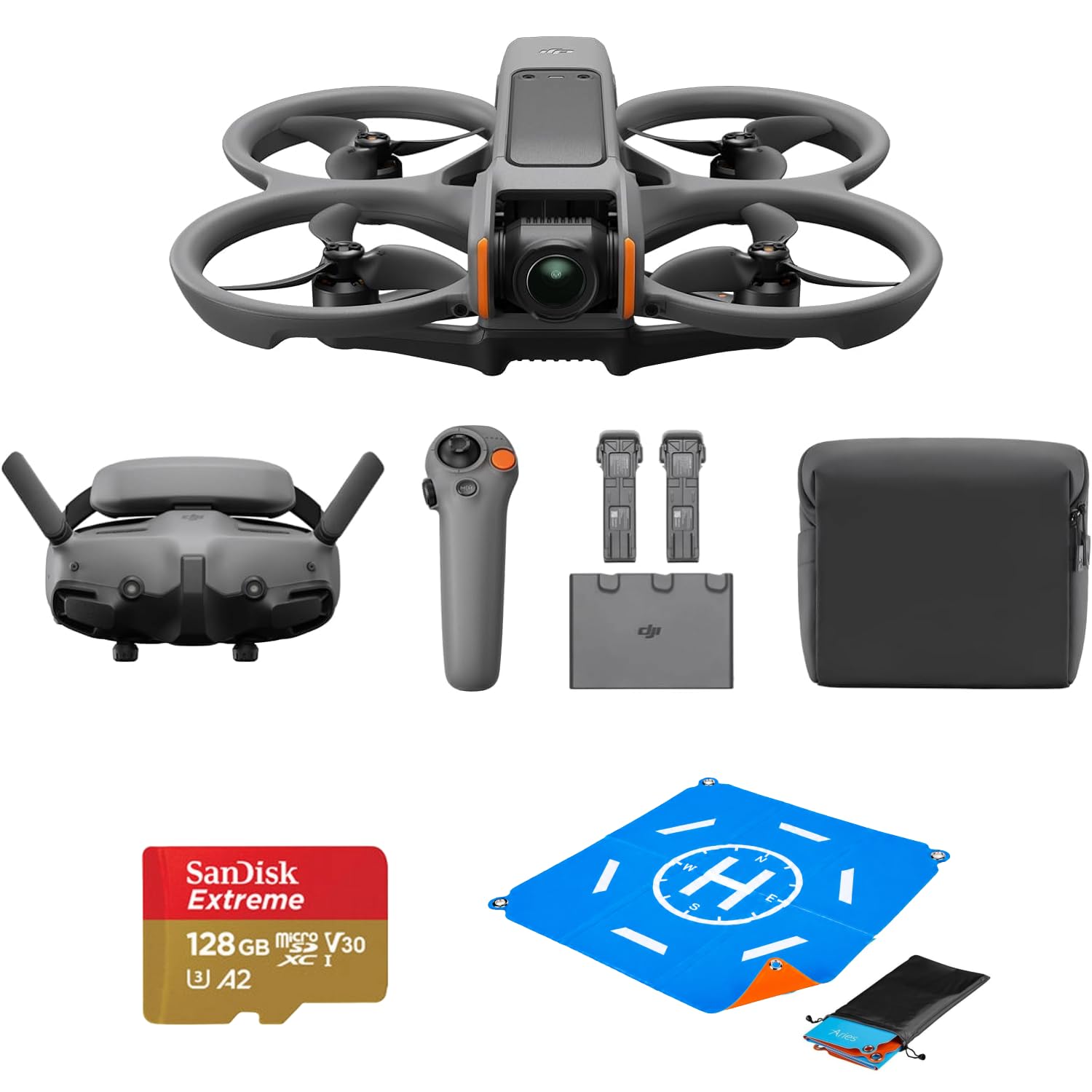
1. DJI Avata 2 Fly More Combo
Our pick — over 4.5★ from 100+ verified ratings; the strongest balance of quality and price.
The premium route into FPV that makes you feel like a pro from the first battery.
Its integrated propeller guard and motion controller reduce crash anxiety for new pilots. The built-in propeller guard means you can fly closer to objects without the panic, and the intuitive motion controller responds to your hand movements instead of complicated sticks. Beginners report that a few flights in Beginner mode are enough to gain confidence to switch to sport mode, which is exactly the gentle learning curve you want.
Your footage will look stunning too, thanks to a 1/1.3-inch image sensor (a large sensor for a drone) capturing 4K/60fps video with a super-wide 155° field of view. The Fly More Combo includes three Intelligent Batteries and DJI Goggles 3, so you get the full rich cockpit experience. Buyers report 4.8 stars across thousands of owners, praising the build quality—the most-discussed aspect of this drone.
The rich advantage
- Integrated propeller guard adds real durability for learning
- One-push acrobatics let you flip and roll without expert stick skills
- Delivers 4K/60fps footage with a 155° field of view
- Includes 3 batteries, goggles, and motion controller in the combo
Consider this first
- Owners mention battery life lands around 15 minutes per charge
- The premium price puts it out of reach for a casual first try
- Some owners note low-light flying is not its strong suit
Reach for this if: you want the safest, most polished FPV experience with cinematic 4K quality and don’t mind paying for it.
Look elsewhere if: your goal is cheap, disposable fun or you want to build and repair your own racing quad.
2. Holy Stone HS280D FPV Drone
A lightweight camera drone that lets you practice without the fear of breaking the bank.
The HS280D is a foldable quadcopter that tips the scales at just 164g, which means no registration is required in many regions. It’s built around powerful brushless motors that offer better wind resistance and quieter operation than the brushed motors found in cheaper toys. Owners appreciate that it feels more premium than its price suggests, especially the quality of the controller.
What really separates it for beginners is the 28-minute total flight time across two modular batteries. With a 300ft range and 15 minutes of flight per battery, you get enough practice time to actually improve. The gesture selfie and Tap Fly modes add fun, though the 1080P camera is decent for casual shots rather than cinematic footage.
Why it wins new pilots over
- Brushless motors last longer and handle wind better than brushed
- Comes with 2 modular batteries for 28 minutes of total air time
- Foldable and light at 164g for easy carrying
Keep in mind
- The plastic body is thin, so it’s better suited for careful learners
- The video feed is laggy over Wi-Fi, so keep it close
- Not the choice for serious FPV racing or cinematic work
Best if: you’re a kid or cautious adult who wants to learn the basics of flying with a camera before investing in a true FPV racer.
Think twice if: you expect a tough, crash-proof shell or pro-level footage.
3. EMAX Nanohawk BNF 65mm Whoop
A micro whoop so light it feels like a feather, built for indoor racing precision.
Weighing just 20 grams, this 65mm whoop is a true racing drone for those who already own a controller. It’s a Bind-and-Fly model, meaning you need a compatible radio transmitter like a Jumper T-lite. Once bound, pilots find it fast, nimble, and genuinely fun to throw around indoor spaces.
You’ll need to be prepared for the battery reality though: this little racer gives you about 3.5 minutes of flight per battery, and you’ll want 6 or more batteries to have a decent session. The flight controller runs Betaflight, which is intuitive for tuning, but the biggest caveat is quality control. The most-discussed aspect is mixed — some units arrive with issues, and the stock propellers are fragile. It’s a great pick if you’re handy and already in the ecosystem.
Fast, but fragile: Owners love the speed and nimbleness, but recommend simulator practice first and budget for spare parts.
The honest catch: Quality control is the most common topic in reviews, so inspect your unit carefully and be ready to return a defective one.
For the hobbyist: This is a gateway into real FPV racing for someone who loves tinkering and already has a radio.
Not for: anyone who wants a self-contained, ready-to-fly package from the start.
4. Mgfdget Mini Drone with 4K Camera

An entry-level 4K camera drone that prioritizes easy controls over raw speed.
This foldable quadcopter weighs just 249 grams and offers a 4K camera with a 90° remote angle adjustment, making it a solid choice for outdoor exploration and travel. It’s powered by high-efficiency brushless motors, which means strong power, quiet operation, and good wind resistance for a drone in this class. The two included batteries extend your flying time.
Beginners will appreciate the multiple one-click functions: altitude hold, gesture selfie, one-key return, and 360° flips. The low-power alert on the tail lights tells you when to land before the battery dies. This isn’t an FPV racing drone in the traditional sense, but it is a fantastic way to get comfortable with aerial controls and capture decent 4K shots while you learn.
Easy camera flying: The 4K camera and foldable design make it a great travel companion for learning the ropes.
Know the limits: It lacks the high-speed agility of a true racing whoop, so manage your expectations on speed.
Pick this if: you want a cheap, portable camera drone to learn basic flight controls and capture 4K memories.
skip it if: your priority is FPV goggles and high-speed acrobatic racing.
5. BETAFPV Meteor75 Pro Whoop

The whoop that bridges the gap between backyard bashing and serious FPV speed.
This is a serious step up from toy drones, offering a fast, responsive flight experience ideal for FPV racing or acrobatic flying both indoors and outdoors. It’s a 1S brushless whoop with a durable 1mm-thick flight controller and a G473 processor that boosts computing speed by 55%. The default ELRS protocol and V3 firmware make binding modern and reliable.
What beginners love most is the beginner-friendly design: solder-free motor plugs mean you can swap out a broken motor without touching a soldering iron. It’s super fun and rated for 4-5 minutes of flight. The catch is durability—it’s the most-discussed aspect, but it’s a mixed bag. It can take a beating, but hard crashes can break it, and some units arrive damaged. It’s best for outdoor flying in low wind, and it will be unstable in strong winds.
The performance edge
- Solder-free motor plugs make repairs easy for beginners
- Fast and agile with the largest available 1S whoop frame
- Adjustable VTX power from 25-400mW for range or battery life
The trade-offs
- Durability is a mixed bag; hard crashes can break the frame
- Camera angle is aggressive indoors, though adjustable
- Needs an ELRS controller to fly (it’s a BNF model)
Best for: a beginner who wants real FPV speed and is willing to learn Betaflight tuning and handle basic repairs.
Not ideal for: those who want a rugged, indestructible drone or a complete out-of-the-box kit.
6. EZ Pilot RTF Racing FPV Drone Kit

A true FPV kit with real goggles, designed so kids can learn with one stick.
This Ready-to-Fly kit is unique because it gives you a real first-person view without needing a smartphone or Wi-Fi. The included 5.8Ghz FPV goggles show you what the drone sees, offering the full pilot experience. The EZPilot is programmed with 3 difficulty levels, letting learners start with a single stick and progress to flips and full manual control.
Its three difficulty levels let kids progress from single-stick control to full manual flight. However, you will want extra batteries, as the flight time tops out around 4 minutes. The catch is that while the concept is great, some units aren’t truly ready to fly from the start and may require Betaflight setup to fix drifting. It’s also note the camera can be fragile if bumped into a wall.
Learn by seeing: The bundled 5.8G goggles are the big draw here, providing a real FPV experience for the price.
Expect some setup: Some customers note the drone drifts and needs Betaflight tuning before it flies straight, so be prepared to tinker.
Great for: a child or absolute beginner who wants to try FPV goggles without a huge investment.
Be cautious if: you want zero setup and guaranteed reliability straight from the box.
7. APEX FPV Drone Kit with 120° Goggles

A pre-tuned kit with a wide 120° view, ready to fly right after unboxing.
This kit is fully calibrated from the start, with no complex parameter settings or soldering required, making it perfect for first-time FPV pilots. The 120° FPV goggles offer a super-wide, rich view, and the drone itself supports analog transmission with near-zero latency for responsive control. You get three flight modes—Beginner, Horizon, and ATTI—which fit all skill levels.
In Beginner Mode, altitude hold keeps the drone stable, which is a huge help for newbies. The kit includes 3 batteries for a total flight time of 15-18 minutes, which is generous for this class. Owners praise its stable performance in open areas, though reliability varies. The downside is that reliability and battery life are mixed, so while it works well from day one for some, others report it stops working after a short time.
Ready to fly fast
- Pre-tuned and ready to fly, with no soldering needed
- Super-wide 120° FPV goggles for an rich view
- 3 battery packs deliver 15-18 minutes of flight time
Watch out for
- Some units arrive used or broken, pointing to quality control issues
- Battery life and long-term reliability get mixed feedback
Choose this if: you want a forgiving, pre-tuned FPV kit with a wide-angle goggle view for learning indoors.
Think twice if: you’re worried about receiving a defective unit and want a brand with a stronger quality reputation.
8. EMAX Tinyhawk RTF Micro Racing Drone

The legendary starter kit that has launched thousands of pilots into FPV racing.
The Tinyhawk RTF kit is the complete package: FPV goggles, a controller, and the drone, all ready to fly with no extra gear needed. It’s a true FPV drone using real 5.8G transmission rather than Wi-Fi, giving you a responsive connection up to 200 feet. With a top speed of up to 35mph, it’s fast enough to feel thrilling but light enough to be maneuverable indoors.
It’s a great cross between a beginner’s toy and a racer’s tool, and it’s highly praised for being a suitable entry point into the hobby. Many pilots have survived serious crashes, including a reported 40-foot fall onto concrete, which speaks to its build quality. The caveats are that flight performance and durability get mixed feedback, and some units break easily. It bridges toy drones and real FPV, but plan to purchase spare batteries for longer sessions.
The proven path: It’s the classic “beginner-to-pilot” bridge, providing a huge community and an upgradeable platform.
The honest reality: While some units survive 40-foot falls, others break after a few gentle bumps, so durability is a lottery.
Best for: a first-time drone buyer who wants the genuine FPV experience without buying separate parts.
Not for: those who demand maximum durability or zero learning curve on the controls.
9. BETAFPV Cetus Pro FPV Kit

A brushless whoop designed from the ground up to take you from zero to pilot.
The Cetus Pro is a complete FPV kit that includes the brushless quadcopter, LiteRadio 2 SE transmitter, and VR02 FPV goggles. It’s sturdy and powerful, allowing you to fly faster, race, and even do freestyle flying. The kit is built with beginners in mind, offering an auxiliary flight function that reduces the operating threshold significantly.
It has N/S/M (Normal, Sport, Manual) flight modes, each with three speed settings. The altitude hold function makes indoor hovering very stable, and the self-protection function triggers an emergency landing if you lose control or hit a low battery. The standout feature is Turtle Mode, which lets you flip the drone over from the transmitter if you land upside down—no walking across the field needed. Owners highlight its build quality and durability, with one unit surviving water submersion.
Built for safety
- Turtle Mode saves you from walking to flip the drone over
- 3 flight modes and 3 speeds adapt as your skills grow
- Altitude Hold keeps the quad steady for indoor practice
Remember this
- Video quality is functional but not stunning, with some static
- Battery life is short, around 5 minutes, so buy spares
Ideal for: a beginner who wants a safe, durable, and complete kit that won’t get destroyed on the first crash.
Consider alternatives if: you want crisp video quality or a drone with a longer flight time per battery.
10. BETAFPV Aquila16 FPV Kit

Prioritizes longer flight times and a clear goggle display to keep you learning.
This kit stands out for its 8-minute flight time on a single default 1100mAh battery, which is double what many other whoops offer. It’s ideal for beginners seeking a smooth flying experience in N/S mode, with a maximum flight distance of 200 meters indoors or outdoors. The included VR03 FPV goggles feature a video recording function and a 4.3-inch 800x480px HD display, showing you a bright, clear world.
The high-power 350mW video transmission system guarantees real-time video with stable signals. It comes with the LiteRadio 2 SE transmitter running ELRS V3 firmware and supports simulator practice before you even fly. While quality and beginner suitability are top positives, a few reviewers point out issues with crashes and controller failures, and the video quality is criticized by some for being extremely low.
The long-runner: An 8-minute flight time is a massive advantage for practice, letting you stay in the air longer.
Know the drawbacks: Durability and reliability get mixed reviews, and the video feed isn’t high-definition.
Pick this for: maximizing your practice time with fewer battery swaps and a comfortable goggle experience.
Look elsewhere if: you need exceptional camera clarity or are worried about crash resilience.
11. Tinyhawk 3 RTF Kit

A tough, fully configurable racing drone that rewards pilots who love to tinker.
The Tinyhawk 3 is a ready-to-fly kit—power on and start flying—built with flexible plastic for added durability. It’s a real 5.8G FPV drone with a controller and goggles included, so you get the full experience without needing a smartphone. For a beginner who wants to grow, this is a great choice because it’s fully configurable through Betaflight software.
Shoppers say it’s incredibly fun and durable, with one unit still flying years later. It can handle falls from a second story and is described as tough. The FrSky protocol and full-house range give you a solid connection. However, the most-discussed aspects are mixed: reliability and ease of use get mixed feedback, with some reporting motors stopping and finding it difficult to operate. The camera quality and range can also be poor, and a software update has been known to cause issues, so it’s best for someone comfortable with tuning.
The tinkerer’s choice
- Flexible plastic frame survives serious indoor and outdoor falls
- Full Betaflight configurability for advanced tuning
- Includes controller and goggles in a ready-to-fly kit
Proceed with care
- Motor reliability and ease of use get mixed feedback
- Video quality and range are weak points for some owners
- Steep learning curve if you’re not familiar with FPV controls
Best for: a tech-savvy beginner who wants a tough, upgradeable platform and enjoys using Betaflight to fine-tune their flight.
Not for: someone who wants a plug-and-play drone with zero software setup or perfect video.
Understanding the Specs
Flight Time & Batteries
The single most important number for a beginner is how long you stay in the air. Most micro whoops offer 3-5 minutes per battery, meaning you’ll need to buy several spares. Some kits, like the Aquila16, offer up to 8 minutes to extend your practice sessions. Always factor in the cost and availability of extra batteries when budgeting.
FPV Systems: Analog vs. Digital
FPV (First-Person View) goggles receive the live video feed from your drone. Analog systems, like the 5.8G ones used by the Tinyhawk and Cetus Pro, are cheaper and have low latency but can show static and scan lines. Digital DJI systems offer crisp video but at a premium price. For a starter, analog goggles are perfectly fine for learning the basics.
FAQ
What is the difference between a camera drone and an FPV racing drone?
How many batteries should I buy for a beginner FPV drone?
Should I start with a tiny whoop or a larger 3-inch/5-inch racing drone?
What does BNF and RTF mean for racing drones?
What is the ELRS radio protocol and why does it matter?
How long does a battery take to charge?
Do I need to learn to use Betaflight to fly a racing drone?
Is the battery and charging setup safe for beginners?
Final Thoughts: The Verdict
For most people, the beginner racing drone winner is the DJI Avata 2 because it takes the intimidation out of FPV with its propeller guard and motion controls while delivering incredible 4K image quality. If you want a safe, complete kit that encourages slow, steady learning while staying affordable, grab the BETAFPV Cetus Pro. And for a budget-friendly camera drone to learn the basics of flight control before you graduate to racing, the Holy Stone HS280D is the one to reach for.
How We Picked
We do not accept paid placement. Every pick is matched to a real buyer and a real use-case; we do not hands-on test units.
Sources & Methodology
Specifications: manufacturer listings and product documentation. Review insights: verified customer reviews, as of August 2026. Pricing: not shown on this page (it changes often); check the current price via the retailer link.
As an Amazon Associate, Gadgets Feed earns from qualifying purchases. This does not affect which products we feature.