
An exterior door may look solid, but the thin gap along the bottom and sides is a direct pathway for sound, drafts, dust, and light. A proper acoustic door seal eliminates that pathway by applying dense, resilient material that compresses against the frame or threshold to create an airtight—and near-soundproof—barrier.
I’m Min — the co-founder and writer behind Gadgets Feed. I’ve spent years analyzing consumer hardware and acoustic treatment components, measuring the real decibel drops between a hollow gap and a properly sealed door frame.
Whether you are blocking noisy hallway chatter in an apartment or preventing heat loss through a garage door, choosing the right seal depends on gap size, door type, and installation method. This guide compares the top seven contenders to help you find the best acoustic door seal for your specific situation.
How To Choose The Best Acoustic Door Seal
The right acoustic door seal depends on three factors: the width and depth of the gap around your door, the material of the door frame, and whether you need a permanent or easily removable solution. A seal that excels at blocking air may not deliver the same sound-dampening performance, so matching the seal type to your specific problem is critical.
Measure Your Gap First
The most common mistake is buying a seal designed for a gap smaller than what your door actually has. Brush strips work well on gaps under 1/4 inch, while Q-shaped foam and double-bulb sweeps handle gaps up to 1/2 inch. For gaps larger than that, an adjustable automatic door bottom is typically the only effective solution.
Choose the Right Material
Foam, felt, silicone, and neoprene each behave differently under compression. Polyurethane foam offers excellent sound absorption but can degrade over time in direct sunlight. Silicone rubber stays flexible across extreme temperatures and resists cracking. Neoprene is the gold standard for acoustic performance because it is dense, self-extinguishing, and rated for fire and smoke protection—making it ideal for serious soundproofing.
Consider Installation Method
Self-adhesive strips require a clean, dry surface and can lose grip in cold weather. Kerf-slot inserts slide into a pre-cut groove in the door frame and never peel away. Surface-mounted sweeps with screws provide the most secure hold for heavy doors. If you cannot damage paint or wood, pressure-fit Q-shaped foam is the safest bet.
Quick Comparison
On smaller screens, swipe sideways to see the full table.
| Model | Category | Best For | Key Spec | Amazon |
|---|---|---|---|---|
| Audimute Soundproofing Kit | Premium Kit | Multi-door soundproofing | Includes 100 ft of seal + 25 ft sweep | Amazon |
| TMS Automatic Door Bottom | Pro Grade | Heavy sound & smoke seal | Double neoprene bulb, spring-loaded | Amazon |
| KS Hardware Double Bubble | Premium Sweep | Adjustable under-door seal | Fits gaps 3/8″ to 7/8″ | Amazon |
| ZOMPAGO Brush Weather Stripping | Mid Value | Sliding doors & windows | 33 ft roll, dense felt pile | Amazon |
| M-D Silicone Gasket Seal | Mid Value | Extreme temperature flexibility | Silicone rubber, 20 ft length | Amazon |
| Ravinte Q-Shaped Foam | Budget Champion | Large gaps, no adhesive needed | Fits slots 0.35″ to 0.59″ | Amazon |
| Randall Kerf Slide-in Seal | Budget Champion | Precise kerf door replacement | Double bulb, no screws needed | Amazon |
In‑Depth Reviews
1. Audimute Soundproofing Acoustic Door Seal Kit

Audimute’s kit treats up to four standard doors at once, making it the most cost-effective option for tackling an entire home or apartment. The package includes two 50-foot rolls of 3/16-inch by 1/2-inch door seal and one 25-foot door sweep, providing enough material for the top, sides, and bottom of multiple doors.
The PU foam core compresses easily against irregular door frames while maintaining memory over time. Real-world user tests show measurable reductions of 10 dB on music and hallway noise when the seal is installed correctly using the “light test” to identify every visible gap. The adhesive is strong enough to leave residue on removal, so this is best treated as a permanent installation.
Performance depends heavily on meticulous installation—layering the seal on both the door and the frame is recommended for critical listening spaces like recording studios or home offices. The included door sweep works well on flat floors but may require partial floor-mounting on uneven surfaces.
Why it’s great
- Generous material covers up to 4 doors
- PU foam compresses evenly for light-tight seal
- Proven 10 dB noise reduction in studio settings
Good to know
- Adhesive can damage paint upon removal
- Uneven floors may require extra DIY modifications
2. TMS Automatic Door Bottom

This surface-mounted automatic door bottom is the most sophisticated entry in this guide. It uses a spring-loaded mechanism that raises the double neoprene seal when the door opens and lowers it when the door closes, eliminating drag and wear on the seal. The clear anodized aluminum housing provides a clean, professional finish that blends with most metal door frames.
The solid neoprene bulbs are self-extinguishing, oil-resistant, and fire-rated—meaning they block sound, smoke, light, and drafts simultaneously. Trademark Soundproofing tests the mechanism through 5 million open-close cycles, so it is built for high-traffic commercial or heavy residential use. The maximum gap fill of 1 inch makes it the only option here for doors with severe floor clearance issues.
Installation requires drilling into the door surface, and cutting the aluminum housing to size demands a power saw. A small number of users report significant off-gassing odor from the neoprene that can linger for weeks, so ventilation during the break-in period is advisable.
Why it’s great
- Automatic lift mechanism prevents seal wear
- Dual neoprene bulbs certified for smoke & fire blocking
- Handles gaps up to 1 inch
Good to know
- Requires power saw for length adjustment
- Potential neoprene off-gassing initially
3. KS Hardware Adjustable Double Bubble Door Sweep

The KS Hardware Double Bubble sweep uses a patent-pending design that creates two parallel sealing surfaces between the sweep and the threshold, maximizing contact area for both acoustic and weather sealing. The adjustable under-door bracket accommodates gaps from 3/8 inch to 7/8 inch, making it compatible with most residential thresholds regardless of wear.
Users report dramatic improvements in garage door insulation, with one reviewer noting the garage temperature stabilized to within 1°F of the house after installation—a measurable difference from the previous 6–8°F drop. The exterior drip cap channels water away from the entrance, protecting against moisture damage. Installation is straightforward with the included screws and screw covers, and the door does not need to be removed from its frame.
The 42-inch version fits standard exterior doors, and the white or black color options match most door finishes. A friction-fit component for the screw shields is the only reported minor design flaw.
Why it’s great
- Dual bubble design maximizes threshold contact
- Adjustable from 3/8″ to 7/8″ gap
- Exterior drip cap protects against rain
Good to know
- Screw shield installation requires careful handling
- May need trimming for non-standard door widths
4. ZOMPAGO Strong Adhesive Brush Weather Stripping
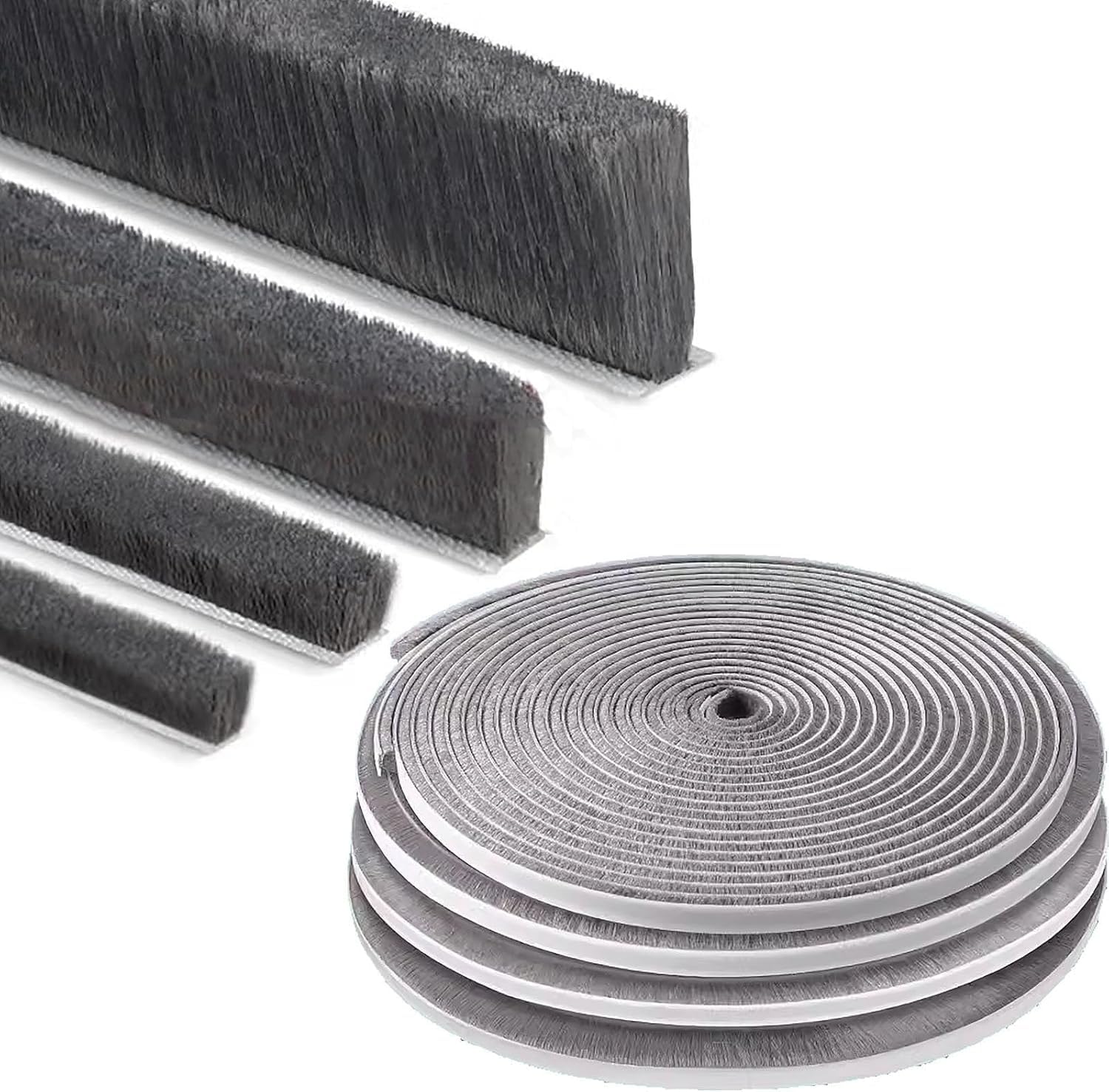
ZOMPAGO’s brush stripping uses high-density woven gray felt pile that creates a soft but effective barrier against sound, dust, and drafts. Unlike foam or rubber, the pile structure does not deform permanently under compression—it springs back when the door opens, maintaining consistent sealing over hundreds of cycles. The 33-foot roll is generous enough for several windows or a sliding glass door plus a standard door frame.
The oil-based adhesive backing is rated to perform from -10°C to 60°C, so it stays stuck through winter cold and summer heat without degumming. Users confirm the adhesion is extremely strong—comparable to heavy-duty duct tape—and the felt is lint-free and wear-resistant. Installation is as simple as cleaning the surface, peeling the backing, and pressing firmly.
This seal works best on sliding doors, double-hung windows, and cabinet gaps where a low-friction brush is preferable to a sticky foam surface. It is not designed for bottom-door use where foot traffic would crush the bristles, but it excels as a perimeter seal where the door face meets the frame.
Why it’s great
- High-density felt pile does not deform permanently
- Strong adhesive works in extreme temperatures
- Easy peel-and-stick installation
Good to know
- Not suitable for bottom-of-door sweeps
- Adhesive can be ruined by skin oil or dirt
5. M-D Building Products Silicone Gasket Seal

M-D’s silicone rubber gasket is the thinnest option here at only 1/2 inch wide, but what it lacks in bulk it makes up for in material science. Silicone remains flexible from sub-zero cold to extreme heat without cracking, and it does not degrade under UV exposure like polyurethane or foam. This makes it the best choice for exterior doors that face direct sun or wide seasonal temperature swings.
The teardrop profile creates a gentle compression curve that seals effectively even on slightly warped frames—though multiple users caution that the 1/2-inch width is insufficient for gaps larger than 1/4 inch. It works best as a supplementary side or top seal on a door that already has a primary bottom sweep. Installation is adhesive-free; you simply press the gasket into the gap and trim to length.
The 20-foot length is practical for one standard door perimeter with a small surplus. Experienced users note that the adhesive backing could be stronger, but the silicone itself withstands years of abuse without losing its shape.
Why it’s great
- Silicone rubber resists cracking in any weather
- Flexible teardrop shape conforms to uneven frames
- Simple press-fit installation with no hardware
Good to know
- Too thin for gaps exceeding 1/4 inch
- Adhesive grip is moderate, not heavy-duty
6. Ravinte Q-Shaped Foam Weather Stripping

Ravinte’s Q-shaped foam stripping is unique among the non-adhesive options because it relies on a firm, high-density foam core with a PU and PE composite skin that slides directly into door grooves or recesses. The shape maintains constant outward pressure against the frame, creating an effective light and air block without any glue or screws. The 40-foot length gives you plenty of material for multiple doors or generous trial cuts.
The foam is rated for slot widths between 0.35 and 0.59 inches, covering the most common residential gap range. Users consistently report that installation takes under five minutes per door—just measure, cut, and press the strip into the channel. The material is resilient enough to snap back after compression, but it does require the door to have a pre-existing groove or recess. Doors with flat, smooth frames cannot use this product without modification.
Some users note that the foam’s fit is not as snug as adhesive-backed options, and bright sunlight may still leak around the edges if the groove is slightly oversized. For renters or anyone who cannot leave marks, this is the safest choice.
Why it’s great
- Zero adhesive means no residue or paint damage
- High-density core blocks light completely
- Quick install with no tools required
Good to know
- Requires a pre-existing groove or channel
- May not seal as tightly as adhesive strips
7. Randall Manufacturing Kerf Slide-in Double Bulb Seal

Randall Manufacturing’s door bottom is engineered specifically for doors with a kerf slot—the thin channel cut into the bottom edge of certain steel and fiberglass doors. The double-bulb rubber design provides superior insulation compared to flat fin-only strips, and the built-in rain caps prevent water from seeping under the door during heavy rain. At 36 inches long and 1.75 inches wide, it matches the standard kerf slot dimensions used by most major door brands.
Installation is purely mechanical: slide the sweep into the kerf channel, trim any excess length with heavy-duty scissors, and you are done. No screws, no adhesive, and no removing the door from its hinges. Users praise the build quality, noting that it outperforms the sweeps available at local big-box hardware stores. The double bulbs compress to fill gaps up to 1/2 inch while maintaining a weathertight barrier.
The main trade-off is compatibility—this seal only works on doors that already have a kerf slot. Standard wooden doors or doors without the groove cannot use it. A small percentage of units arrived slightly bent from shipping, but the rubber material generally straightened out after installation.
Why it’s great
- Tool-free slide-in installation for kerf doors
- Double bulbs fill gaps up to 1/2 inch
- Built-in rain caps prevent moisture ingress
Good to know
- Only fits doors with an existing kerf slot
- May require minor trimming of length and legs
FAQ
Will an acoustic door seal completely soundproof a room?
Can I use adhesive weather stripping on a metal door?
How often should I replace a door seal?
Final Thoughts: The Verdict
For most users, the best acoustic door seal winner is the Audimute Soundproofing Kit because it includes enough material for four doors and delivers proven 10 dB reductions with polyurethane foam. If you want a heavy-duty automatic seal that handles a 1-inch gap, grab the TMS Automatic Door Bottom. And for an affordable, tool-free solution on a kerf door, nothing beats the Randall Manufacturing Kerf Slide-in Seal.