
Our readers keep the lights on and my morning glass full of iced black tea. As an Amazon Associate, I earn from qualifying purchases.
Specs are compiled from manufacturer listings and verified buyer reviews and can change over time — please confirm the key details on the product page before buying.
Choosing a great pair of binoculars under $500 is really about balancing three things that pull against each other: magnification power, light-gathering lens size, and how much weight you want to carry. Crank the magnification too high with small lenses and the image gets dim and shaky; go too big and you are hauling a boat anchor. The picks here are the ones that solve that trade-off cleanly for real-world use, from a stadium seat or a forest trail.
I’m Min — the founder and writer behind Gadgets Feed. This guide is built by comparing the manufacturers’ published specifications and the patterns across verified customer reviews, so you get each pick’s real strengths and trade-offs instead of marketing spin.
You will find the full breakdown of the best binoculars under $500 below, with clear verdicts on which pair fits birding, hunting, travel, and low-light viewing.
Our Picks at a Glance

How To Choose The Best Binoculars Under $500
The first number on the barrel (like 10×42) tells you two things that set your whole experience. The “10x” means objects appear ten times closer than they do to your naked eye, while the “42” is the diameter of the front lens in millimeters — and that front lens is what gathers light. Bigger front glass plus higher magnification usually means a sharper, brighter view, but it also adds size and weight, so the best pick is the one that fits how you actually use them.
Match magnification to your hands, not your ego
A 10x magnification gets you closer to a distant bird or a stage performer, but it also magnifies every little tremble in your arms. For birding from a trail or watching wildlife that stays still, 8x or 10x is the balance most owners stick with. Zoom models like a 10-30x push detail further but demand a tripod the higher you go — the stability of your arms simply can’t keep a 30x image steady.
Look for the glass quality in the coating and prisms
The words “fully multi-coated” on the lens mean multiple layers reduce glare and boost brightness, which matters most at dawn and dusk. BAK-4 prisms (a type of high-quality glass inside) and ED glass (a special low-dispersion glass that stops color fringing) are the marks of a serious optic. Coating quality is often the real difference between a pair and a pair that looks nearly identical on paper.
Check the exit pupil and eye relief for your eyes
Divide the lens size by the magnification to get the exit pupil — the small circle of light that hits your eye. A bigger number (above 5mm) gives a brighter image in dim conditions. Eye relief is the space between your eye and the lens; 15mm or more is the comfort zone for eyeglass wearers, so you don’t have to press the cups into your glasses to see the full view.
Quick Comparison
| Model | Best For | Magnification & Lens | Field of View | Eye Relief | Amazon |
|---|---|---|---|---|---|
| Vortex Diamondback HD 10×42★ Best Overall | All-round performance | 10×42 | 330 feet | 15 mm | Amazon |
| SVBONY SV202 10×42 EDBudget Champion | Budget ED glass | 10×42 | 6.5 degrees | 15.2 mm | Amazon |
| Sogries 10-30×50 ZoomZoom Specialist | Long-distance zoom | 10-30×50 | — | 22 mm | Amazon |
| Nikon PROSTAFF P3 10×42 | Trusted brand value | 10×42 | 367 feet | 15.7 mm | Amazon |
| Athlon Midas G2 10×25 | Pocket portability | 10×25 | 5.4 degrees | 15.5 mm | Amazon |
| Vortex Diamondback HD 8×42 | Wide steady views | 8×42 | 393 feet | 17 mm | Amazon |
| Steiner Marine 7×50 | Low-light & autofocus | 7×50 | 7.2 degrees | 20 mm | Amazon |
| Nikon Monarch M5 8×42 | Premium ED clarity | 8×42 | 335 feet | 19.5 mm | Amazon |
| ZEISS Terra ED 10×42 | Top-tier brand optics | 10×42 | 330 feet | 18 mm | Amazon |
In‑Depth Reviews
1. Vortex Diamondback HD 10×42 Binoculars
Our pick — over 4.5★ from 3,500+ verified ratings; the strongest balance of quality and price.
The versatile 10×42 with dielectric coating delivers crisp, bright views in most conditions.
This is the pair that keeps winning people over, and the reason is simple: it gets the optical fundamentals right. The 10x magnification with 42mm objective lenses is paired with dielectric coating, a special mirror-like layer that reflects light onto your eye for a bright, color-accurate image, and a fully multi-coated lens system that boosts light transmission. Owners use it for everything from birding to hunts, and the consensus is that the sharpness and brightness punch well above what the price suggests.
The comfort details are where this one shines. Twist-up adjustable eyecups let you dial in the right distance whether you wear glasses or not, and the center focus wheel moves both barrels together so you’re not fiddling with two controls. A diopter on the right eyepiece (a small ring that corrects the difference between your two eyes) fine-tunes the view. The rubber armor gives a secure, non-slip grip, and the whole thing is built to shrug off recoil and impact.
Where it really earns its keep is in wet or foggy weather. Argon purging and O-ring seals keep water and internal fog from ever forming, so the view stays clear through rain or in and out of a warm truck on a cold morning. It ships with a GlassPak harness (a chest-mounted carry system), and buyers report “I love these new10x42 binoculars for Bird watching” — the focus is sharp and the case and lens caps keep the glass protected. The lifetime, fully transferable VIP warranty means this is likely the last pair you buy at this level.
What owners rave about
- Exceptional clarity and light gathering — a stand-out for the price
- Sturdy yet lightweight build that feels secure in hand
- Fog-proof argon purging makes it reliable in any weather
What to weigh up
- 15mm eye relief is fine, but tight for those with thick glasses
- Field of view is a touch narrower than some rivals
Reach for these if: you want one versatile pair for birding, hunting, and travel that you’ll trust for years.
Consider a different pair if: you need the widest possible view for tracking fast-moving birds in dense canopy.
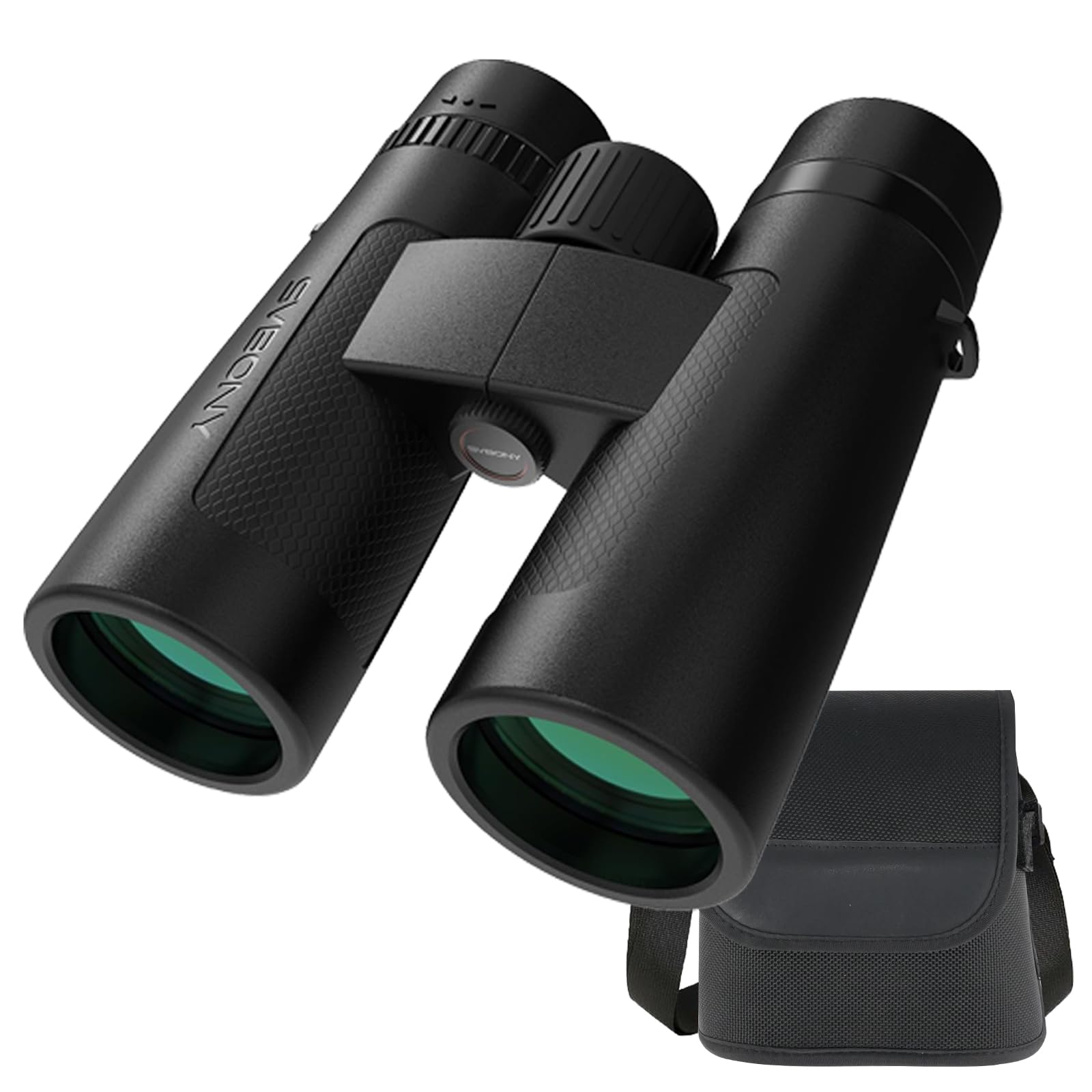
2. SVBONY Upgraded SV202 10×42 ED Binoculars
Startlingly good ED-glass optics that make the premium brands sweat a little.
The headline here is that you get ED glass — extra-low dispersion glass that virtually eliminates the purple fringing around objects — at a price where most brands are still using standard glass. The 10×42 configuration delivers a wide 8-degree apparent angle of view, which beats the 6.3 degrees on the Vortex Diamondback HD above, so you see a noticeably bigger picture through the eyepiece. Owners describe the view as “crisp, bright, no distortion, not too heavy.”
It is also built for real outdoor abuse. The IPX7 waterproof rating means it can survive being submerged in water up to a meter deep, and the non-slip rubber armor is impact-resistant for harsh environments. A rotating, adjustable eyecup makes it comfortable with or without glasses, and the multi-layer coating plus phase correction technology keeps images bright at dawn and dusk when birds are most active. The internal light-masking design even suppresses stray light so you can pick out subtle details like individual bird feathers.
For cruise trips and coastal viewing, this is a favorite pairing. The wide field of view makes tracking fast-moving dolphins or seabirds easy, and the integrated tripod mount lets you hold a steady view over long sessions. The 15.2mm eye relief is comfortable for eyeglass wearers, and unlike the Vortex, the slightly wider exit pupil (4.27mm vs 4.2mm) keeps the image bright in shading forests without a big price jump.
Why it wins: You simply don’t expect this level of ED-glass sharpness and IPX7 waterproofing at this tier — it redefines what budget binoculars should look like.
Buy it for: beginners wanting a serious step-up in clarity, or anyone who wants a waterproof pair that won’t hurt if it gets scratched.
skip it if: you need a brand name on the barrel for resale or gifting confidence.
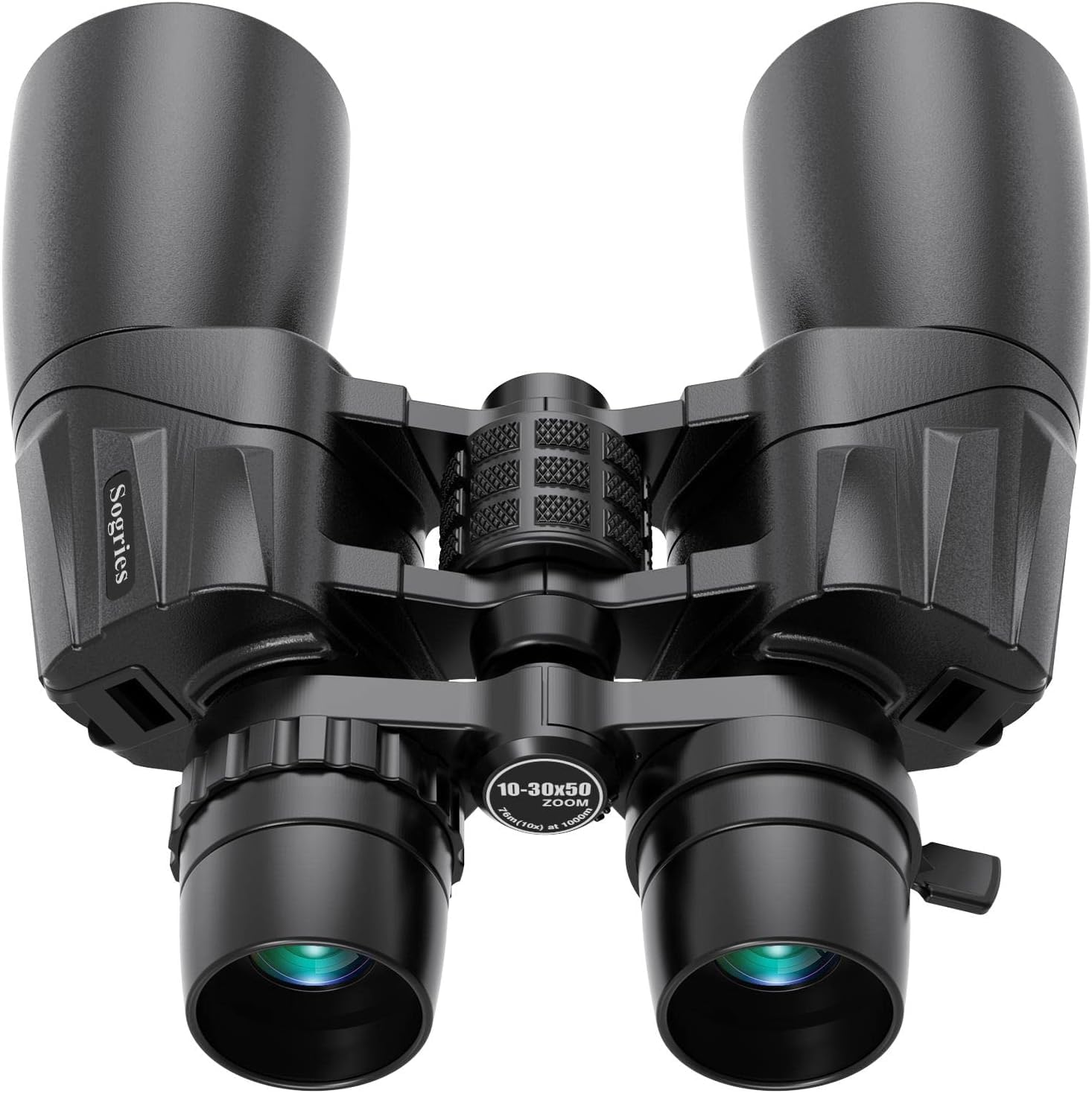
3. Sogries 10-30×50 Zoom Binoculars
The 10-30×50 zoom pulls distant detail close, but demands a tripod at high power.
When you need to read a ship’s name across a harbor or see a player’s jersey number from the top of a stadium, this is the pair. The 10-30x zoom with a 50mm objective lens delivers up to 30x magnification — the most powerful in this lineup — with a light transmittance of up to 99.5% thanks to BAK-4 prisms and fully multi-coated broadband green film. The field of view narrows as you zoom, but the clarity and detail at high power is what owners keep praising.
Comfort is genuinely thought through here. The twist-extendable eyecups let you adjust the position, and the ridge-designed body adjusts to fit most adult faces. A smooth zoom joystick on top lets you sweep from 10x to 30x without taking your eye away.
Here is the honest trade-off: the metal barrel needed for stability at high power makes this a heavy, tripod-friendly tool rather than a grab-and-go walker. The manufacturer explicitly recommends a tripod (sold separately), so plan for it if you want sharp views at 30x. The O-ring sealed lenses with anti-fog coating keep moisture out, and it carries a 10-year warranty with 24-hour customer service. Owners in port work report reading distant ship lettering clearly — a job this tool was clearly built for.
Where it dominates
- 30x top magnification is the most powerful in this guide
- 22mm eye relief is top-tier for glasses wearers
- Smooth, accurate zoom and a sturdy feel in hand
Where it fights you
- Needs a tripod at high zoom — it’s not a walk-around pair
- Field of view shrinks noticeably as you zoom in
Grab these for: the long-distance jobs — ports, concerts, stadiums, and wildlife where close is never close enough.
Give them a miss if: you want a light, carry-everywhere pair for casual birding.
4. Nikon PROSTAFF P3 10×42 Binoculars

Nikon’s proven clarity in a nitrogen-purged, fog-proof shell built for all weather.
Nikon’s name carries weight for a reason, and the PROSTAFF P3 is the pair that delivers that reputation at a sensible price. The 10×42 configuration uses large objective lenses that gather abundant light for sharp images at dawn or dusk, backed by multilayer coatings that minimize reflections and boost brightness. The silver-alloy prism coating ensures vivid, lifelike color — which is exactly what birders want when they’re trying to identify a species by its plumage.
The weather-readiness here is top-tier for the price. O-ring seals and nitrogen gas purging prevent fogging and water intrusion, so the view stays clear through rain, snow, humidity, or rapid temperature swings. The body is fiberglass-reinforced polycarbonate with rubber armor — lightweight enough for all-day carry but rugged enough for rough handling. The 367-foot field of view at 1000 yards is the widest among the 10×42 options here, making it easier to pick up moving birds.
Comfort is a big part of the appeal. Turn-and-slide eyecups with 15.7mm eye relief make it easy to view with or without glasses, and the smooth central focus wheel allows quick, precise adjustments. Owners highlight how easy it is to see individual feathers from 50 feet away, and one described them as “clear, bright and sharp. Happy every time I pick them up.” The lead- and arsenic-free eco-glass is a nice touch for the environmentally conscious. The only consistent gripe is that the lens covers feel a bit flimsy — a minor quibble for an otherwise excellent optic.
The read: It hits the balance between price and performance, delivering Nikon’s signature clarity with weatherproofing that rivals costing more.
Ideal for: birders and hikers who want a dependable brand with a wide view and reliable fog-proofing.
Not the pick if: you prioritize the absolute brightest low-light image over brand reputation.
5. Athlon Midas G2 10×25 UHD Binoculars

The 16-ounce 10×25 with UHD glass folds flat to slip into a pants pocket.
Most compact binoculars are a compromise — small but dim, or sharp but heavy. The Midas G2 sidesteps that by packing UHD glass (extra-low dispersion glass that kills the chromatic fringe) and an ESP dielectric coating that reflects over 99% of the light to your eye into a body that weighs just 16 ounces. The result is an image so clear that owners say it outperforms Steiners and other bigger brands at three times the price.
The 10×25 configuration means a smaller 2.5mm exit pupil, so it’s not the pair for deep twilight work. But for daytime hiking, travel, and bowhunting from a pack, the compact size is the entire point. The magnesium chassis gives you the strength of a metal body while cutting weight by as much as 35%, and the three-piece design lets the tubes fold inward until they touch — making it genuinely pocketable. The XPL coating protects the exterior lenses from dirt, oil, and scratches.
Owners consistently praise the “crisp edges” and “twist-up eyecups,” with one noting the clarity looked “to my eye, to be better in the Athalon though…impressively so.” The 5.4-degree field of view is narrower than the full-size options above, so tracking very fast-moving birds takes a little more practice. But if you want something you can slip in a pocket and forget until a bald eagle shows up, this is the best tiny pair in the guide — and several owners note it beats the pricier Pentax 8×25.
What makes it special
- Pocket-sized at 16 oz with a 35% lighter magnesium chassis
- UHD glass and dielectric coating for exceptional clarity
- Folds flat to disappear into a pants pocket
What to know before buying
- Small 2.5mm exit pupil struggles in low light
- Shallow eyecups and narrow field take practice to master
Choose this over the big pairs if: you want to carry optics every day without the bulk — travel and day hikes are its home turf.
Look elsewhere if: most of your viewing happens at dawn or dusk.
6. Vortex Diamondback HD 8×42 Binoculars
The 8×42 with a 393-foot field of view makes tracking birds through dense cover easy.
If you’ve ever struggled to find a bird after lifting binoculars to your eyes, the 8×42 is the quiet fix. The 8x magnification on the same 42mm lens as the 10x version produces a bigger exit pupil (5.25mm vs 4.2mm) which means a brighter image and a noticeably steadier hold — you simply don’t have to fight as much hand shake. The 393-foot field of view at 1000 yards is the widest in the entire Vortex lineup here, which makes scanning a treeline or following a fast-moving raptor much easier.
It shares all the same DNA as the 10x Diamondback HD: dielectric coating for bright, color-accurate images, fully multi-coated lenses, and the Armortek coating that shields the exterior glass from scratches and oil. The twist-up eyecups and center focus wheel are identical, as is the fog-proof argon purging and O-ring sealing. Owners on an Alaskan cruise report spotting bears on shorelines and whales in the fjord — proof of how well the 8×42 handles both distance and low light.
For birding specifically, the closer focus distance (5.5 feet) lets you bring backyard visitors into crisp view, and owners who switched from pricier brands like Nikon Monarch call it “crisp, bright optics; natural colors; solid, lightweight build.” The 17mm eye relief is a touch more generous than the 10x model, making it the better choice if you wear glasses. If you’re choosing between the two Diamondbacks, this is the one that makes finding your target easier, while the 10x sees farther once you’re locked on.
Why it wins over its 10x sibling: The wider 393-foot field and brighter 5.25mm exit pupil make it the better birding tool for most people, especially in dense cover.
Best suited to: birders and nature walkers who value the widest view and easiest target acquisition.
Pick the 10x instead if: you spend more time looking at distant wildlife in open terrain.
7. Steiner Marine 7×50 Binoculars

The 7×50 with a 7.14mm exit pupil and Sports Auto Focus excels in low light.
When the sun drops and everything else goes dark, the Steiner Marine is the pair you want in your hands. The 7×50 configuration with a massive 7.14mm exit pupil — the largest in this entire guide — pulls in an enormous amount of light, making it superb for stargazing, night surveillance, and dusk wildlife viewing. Owners describe “excellent optical clarity at low light and night” and praise the “superb” night vision that other pairs simply can’t match.
The defining feature is Sports Auto Focus, which delivers a sharp image from 20 yards to infinity without any focusing. There’s no wheel to spin — you just raise them and look. This is a revelation for eyeglass wearers (20mm eye relief is generous) and for anyone who’s ever missed a moment while fiddling with a focus knob. The floating prism system uses flexible silicone mounts to absorb severe shock and impact without damage, making these genuinely tough optics for marine or hunting use.
The honest trade-offs are weight and field of view. At 7.2 degrees, the view is narrower than the 8×42 options above, and the 50mm lenses make this a heavier pair that isn’t ideal for long hikes. Owners note they’re “heavy but steady” and “sturdy.” The waterproof rubber armor with ergonomic ridges gives a secure grip even in wet conditions. For astronomy, surveillance, and marine use where stability and low light matter more than portability, this is a standout — backed by a heritage lifetime warranty.
Where it’s class-leading
- Massive 7.14mm exit pupil for superb low-light and night views
- Autofocus means zero knob-twisting from 20 yards to infinity
- Silicone-mounted prisms shrug off severe shock
Where it’s not for you
- Heavy for all-day hiking — this is a stabile, tripod-friendly tool
- Narrower field of view than the 8×42 pairs
Reach for the Steiner if: your watching happens at dusk, at night, on the water, or in a stadium — anywhere light is scarce and you don’t want to focus.
Give it a pass if: you’re a trail hiker who wants the lightest possible carry.
8. Nikon Monarch M5 8×42 Binoculars
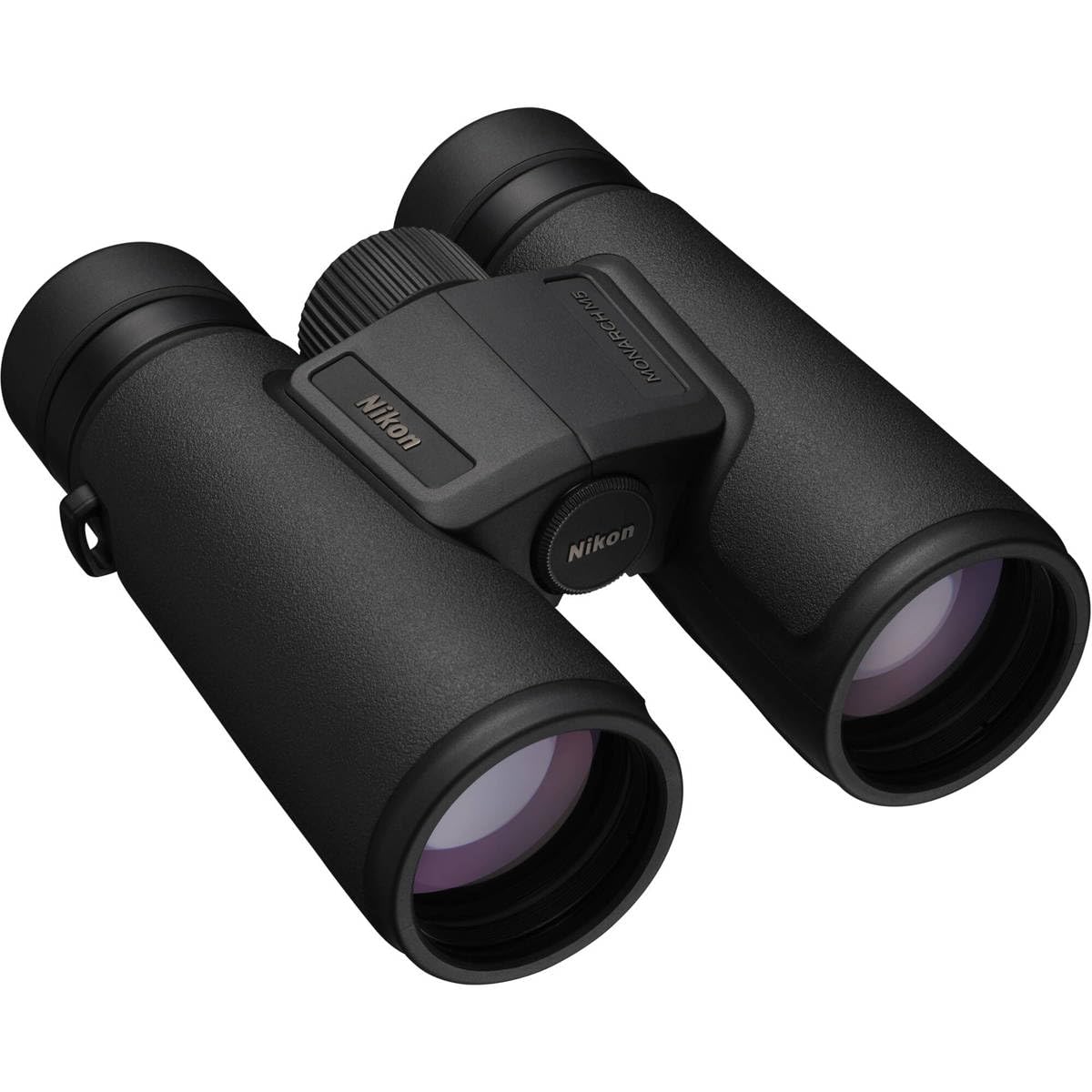
Nikon’s ED-glass 8×42 keeps 80% of the frame sharp, even at the edges.
If you’re serious about birding, image quality at the edges of the frame is where cheap binoculars fall apart. The Monarch M5 is the pair that doesn’t. Owners who tested five binoculars side-by-side found the M5 8×42 kept 80% of the field in focus with minimal chromatic aberration — while cheaper models dropped to 40% or even 30% at the edges. That means when a bird is slightly off-center, you still see it crisply instead of a blur.
The secret is the ED glass (extra-low dispersion glass) combined with dielectric high-reflective multilayer prism coatings. Together they minimize color fringing and enhance light transmission for a bright, natural view whether you’re in shaded forest or open field. The 19.5mm eye relief is the most generous in this guide, making it exceptionally comfortable for eyeglass wearers. The large, smooth central focus knob allows precise adjustments, and the close-focus capability goes as near as 8.2 feet for intricate detail.
The 8×42 configuration delivers a wider, steadier image than the 10x pair — a deliberate choice for tracking birds in motion. It’s waterproof and fogproof with a nitrogen-purged housing and O-ring seals, so weather never stops the viewing. Owners note it’s “lightweight, clear optics, easy to use” and praise the excellent image quality for the price. One owner even described seeing “the shadows of the moon’s craters” through the M5 — a level of detail that shows this glass punches well above its tier.
what separates it: Edge-to-edge sharpness with 80% of the field in focus — a spec that makes birds identifiable even when they’re not centered.
Perfect for: serious birders who want premium ED-glass clarity without jumping to flagships, and eyeglass wearers needing generous relief.
Expect to carry: a slightly larger and heavier body than the PROSTAFF P3 — a fair trade for the extra sharpness.
9. ZEISS Terra ED 10×42 Binoculars

The ZEISS Terra ED delivers 88% light transmission for benchmark German clarity.
ZEISS is a name that needs no introduction in optics, and the Terra ED is how that legendary German engineering becomes accessible. The headline number is 88% light transmission, delivered by Schmidt-Pechan ED glass with a hydrophobic multi-coating. That means the image stays bright, clear, and high-contrast even in the toughest light — owners praise the “magnificent separation in depth of field” and call the clarity “amazing.” This is, quite simply, the finest glass in this guide.
The focus experience is where ZEISS shows its design mastery. The large, easy-to-grip focus wheel is positioned so your index finger lands on it naturally, always ready when something notable happens in front of you. It’s fast and precise — exactly what you want when a rare bird flits into view. The 18mm eye relief is comfortable for glasses wearers, and the compact, fiberglass-reinforced casing is both lightweight and sturdy enough to be “nearly indestructible,” as the manufacturer puts it.
Weather is never an excuse to stay inside with the Terra ED. The hydrophobic multi-layer anti-reflective coating makes water bead up and roll off the lenses, so you keep a clear, unhindered view even in rain. The 10×42 configuration delivers a sharp 330-foot field of view, and it fits easily into any bag. Owners describe it as “perfect for bird watching” with a “wide, crisp optics, light, portable, perfect grip.” This is the pair you buy when you want the best optics this budget can physically allow, and you don’t want to upgrade again.
What justifies the top tier
- 88% light transmission for outstanding clarity and contrast
- Hydrophobic coating keeps water off the lens in rain
- Fast, naturally-positioned focus wheel you’ll love using
The reasonable niggles
- Sits at the top of the budget — expect to pay for the name
- Neck strap doesn’t fit in the included case
Choose the ZEISS if: you want the benchmark for optical quality and a pair that feels like a forever investment.
Save the difference if: you’d rather have Vortex’s lifetime warranty and near-identical real-world clarity for less.
Understanding the Specs
Magnification and Objective Lens
The two numbers on a binocular (like 10×42) are the magnification power and the front lens diameter in millimeters. Higher magnification brings things closer but magnifies hand shake, while a bigger front lens gathers more light for a brighter image. A 10×42 is the most versatile all-rounder, while 8×42 offers a wider, steadier view and 7×50 excels in low light.
Exit Pupil and Eye Relief
The exit pupil is the bright circle of light you see in the eyepiece, calculated by dividing the lens size by the magnification. A value above 5mm gives a bright image in dim conditions. Eye relief is the distance your eye can sit from the lens — 15mm or more is comfortable for eyeglass wearers, and higher numbers like 20mm or 22mm are the most glasses-friendly.
FAQ
What does 10×42 mean on binoculars?
Is 8×42 or 10×42 better for birding?
What is ED glass and why does it matter?
How do I know if binoculars will work with my eyeglasses?
What is the exit pupil and why should I care?
Do I need a tripod for high-power binoculars?
What is the difference between waterproof and fog-proof?
How does autofocus work on binoculars like the Steiner Marine?
Final Thoughts: The Verdict
For the majority of shoppers, the best all-round pick is the Vortex Diamondback HD 10×42 because it combines crisp, bright optics with genuine fog-proofing and a lifetime warranty that’s tough to top at this level. If you want the widest, steadiest view for birding, the Vortex Diamondback HD 8×42 is the smarter choice. And for the absolute best glass your money can buy, the ZEISS Terra ED is the one to reach for — a benchmark pair that justifies every dollar for those who demand the finest optics.
How We Picked
We do not accept paid placement. Every pick is matched to a real buyer and a real use-case; we do not hands-on test units.
Sources & Methodology
Specifications: manufacturer listings and product documentation. Review insights: verified customer reviews, as of August 2026. Pricing: not shown on this page (it changes often); check the current price via the retailer link.
As an Amazon Associate, Gadgets Feed earns from qualifying purchases. This does not affect which products we feature.