
Our readers keep the lights on and my morning glass full of iced black tea. As an Amazon Associate, I earn from qualifying purchases.
Specs are compiled from manufacturer listings and verified buyer reviews and can change over time — please confirm the key details on the product page before buying.
You want great sound in your living room, kitchen, and patio — without running wires or juggling apps. An AirPlay 2 amplifier turns your existing passive speakers into smart, wirelessly-connected audio zones you control from your iPhone. This guide sorts through the real-world trade-offs — power output, app stability, and multi-room capabilities — to help you pick the one that matches how you actually listen.
I’m Min — the founder and writer behind Gadgets Feed. This guide is built by comparing the manufacturers’ published specifications and the patterns across verified customer reviews, so you get each pick’s real strengths and trade-offs instead of marketing spin.
From compact single-room models to whole-home zone systems, we break down the best airplay 2 amplifier options for your budget and speaker setup, so you can start streaming in minutes without guesswork.
Our Picks at a Glance


How To Choose The Best Airplay 2 Amplifier
Your amplifier is the engine that powers your speakers, and AirPlay 2 turns it into the control center for your whole home audio. Before you buy, think about the power your speakers need, if you want music in multiple rooms, and which app you prefer to control it all.
Power Output and Speaker Matching
Wattage per channel is the headline number, but it’s really about your speakers’ sensitivity and how loud you listen. A compact amp pushing 60 watts per channel drives bookshelf speakers perfectly in a living room, while a whole-home system needs 100 watts per channel to fill larger areas. Always check that the amp’s wattage comfortably exceeds your speakers’ recommended power range so you never push it into distortion.
Multi-Room vs. Single-Room Approach
Some amplifiers are built to power one pair of speakers with a subwoofer, giving you a great 2.1 setup for a single room. Others are designed as zone amplifiers — they power several pairs of in-ceiling or in-wall speakers across different rooms simultaneously. If you plan to stream different music to the kitchen and the patio at the same time, a multi-zone amp with individual controls for each area is non-negotiable.
Connectivity and Ecosystem Fit
AirPlay 2 is essential, but the best amps also include HDMI eARC (a port that sends TV audio back to the amp with one cable) for clear TV sound, plus Bluetooth, Spotify Connect, and a companion app. Some apps are smoother than others, and a few makers let you use Alexa or Siri voice commands. Decide if you want to control everything from your phone, your TV remote, or a dedicated app.
Quick Comparison
| Model | Best For | Power Output | Multi-Room Zones | TV Connection | Amazon |
|---|---|---|---|---|---|
| WiiM Amp★ Best Overall | Compact single-room hi-fi and TV | 60W/ch (8Ω) | No (AirPlay 2 receiver only) | HDMI ARC | Amazon |
| SVS Prime Wireless ProFour-Channel Power | Powerful desktop or bookshelf setup | 50W x 4 | No | HDMI ARC | Amazon |
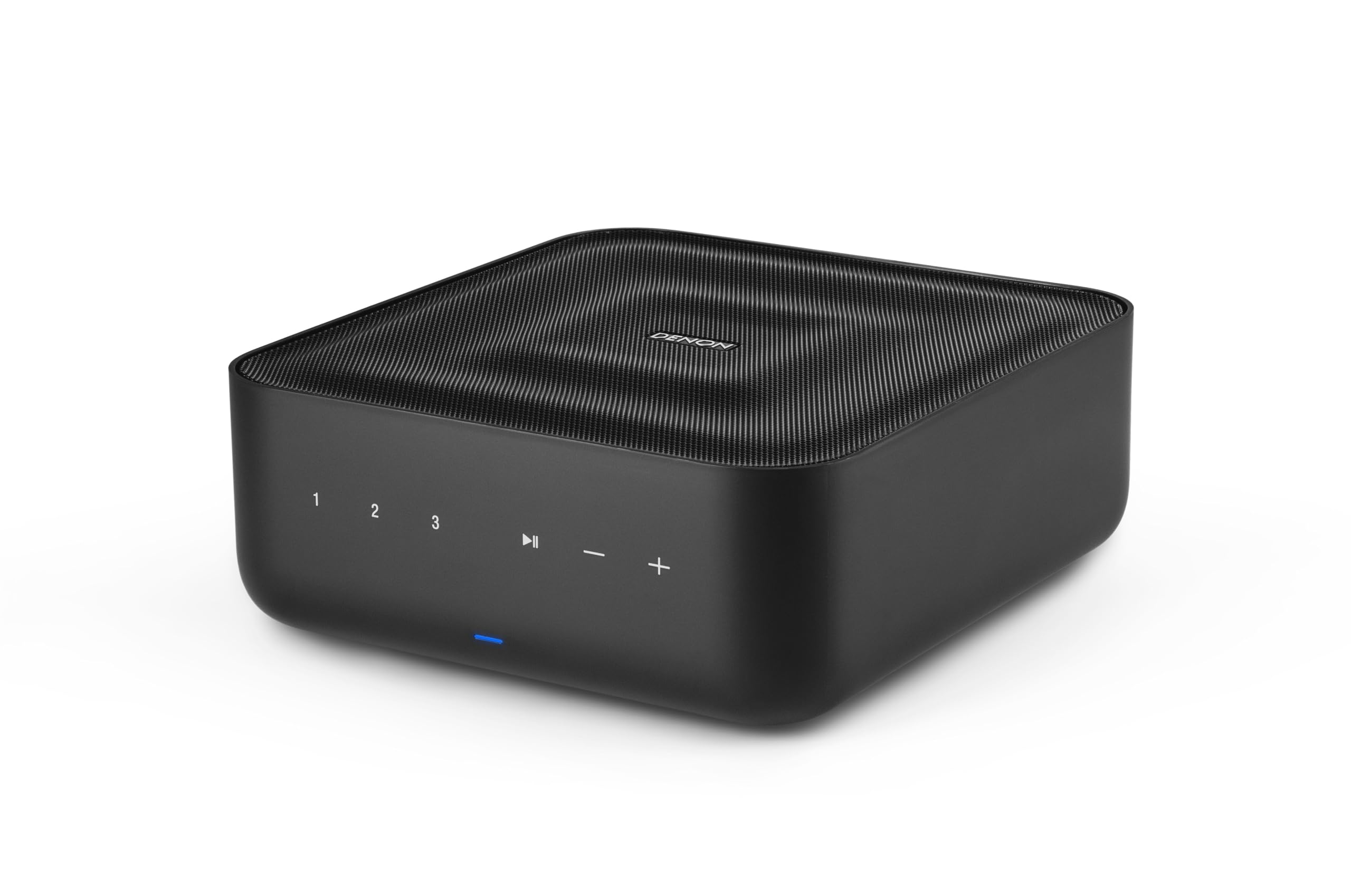
| Denon Home AmplifierMulti-Room Hub | Multi-room via HEOS in one box | 100W/ch | Yes (HEOS) | HDMI eARC | Amazon |
| Marantz Model M1 | Audiophile grade single-room sound | 100W/ch | Yes (HEOS) | HDMI eARC | Amazon |
| Denon PMA-900HNE | Traditional hi-fi with streaming built-in | 85W/ch | Yes (HEOS) | No (Optical/Coax) | Amazon |
| Bluesound Powernode | Premium streaming with great DAC | 80W/ch | Yes (BluOS) | HDMI eARC | Amazon |
| Juke-6 | 6-zone whole-home installation | 40W/ch (8Ω) | 6 Zones (12ch) | Via Apple TV | Amazon |
| Juke-8 | 8-zone whole-home installation | 40W/ch | 8 Zones (16ch) | Via Apple TV | Amazon |
| Juke+ | High-power 6-zone for larger rooms | 100W/ch | 6 Zones | Optical / RCA | Amazon |
In-Depth Reviews
1. WiiM Amp Streaming Amplifier
Our pick — over 4.5★ from 2,000+ verified ratings; the strongest balance of quality and price.
The compact giant that transforms bookshelf speakers into a smart stereo system with cinematic TV audio.
The WiiM Amp tops satisfaction with 4.6 stars across 2,300+ ratings, with build and sound quality earning the most praise. It packs 60 Watts per channel at 8 ohms, which jumps to a hefty 120 Watts per channel at 4 ohms, giving it genuine muscle for floor-standing, architectural, outdoor, or bookshelf speakers. At 4.1 pounds, it trades the bulk of traditional amps for a footprint small enough to sit on top of a PC case, a point owners repeatedly celebrate.
For TV, the HDMI ARC port simplifies hookup to your television, and adding a powered subwoofer turns it into a 2.1 system for movies and games. The WiiM Home App handles volume, syncs speakers room by room, and works with Alexa, Google Assistant, or Siri voice commands. Streaming supports hi-res audio up to 24-bit/192 kHz from Spotify, Amazon Music, TIDAL, and Qobuz.
The reviews paint a clear picture: buyers call it “a very smart and good power amp” for a 2.1 home theatre and note that wireless outdoor speaker pairing works flawlessly. The caveats are few and fair — connectivity gets mixed feedback in the owner surveys, and the analog input is described as poor for turntables, so vinyl fans should use an external phono preamp. It lacks multiple HDMI ports, but a simple switch solves that. One feature to know: this is an AirPlay receiver only, so it cannot transmit AirPlay streams to other AirPlay-enabled devices.
Why It Wins
- Compact size with powerful 120W/ch at 4 ohms peak output
- Easy setup praised in multiple owner reviews
- HDMI ARC and subwoofer out for a full 2.1 setup
- Hi-res 24-bit/192kHz streaming with voice control
Watch Out For
- Weak analog input for turntables without a preamp
- Only a single HDMI connection
- Connectivity is the most-mixed aspect in owner reports
Reach for this if you want: a do-everything streaming amp for a single room — great for TV, subwoofers, and hi-res playlists without taking up a shelf.
Think twice if: vinyl is your main source or you need to transmit audio to other AirPlay speakers, since this is a receiver only.
2. SVS Prime Wireless Pro SoundBase
A four-channel powerhouse that drives multiple pairs of speakers with pristine clarity and deep bass.
The SVS Prime Wireless Pro stands out by carrying a 300-watt amplifier arranged as 50 watts across four channels, paired with a 24-bit/192kHz DAC for high-resolution playback. Buyers report “great sound and clarity” with good speakers and say it “beats competing streaming amp in power and sound” on Tidal, Qobuz, and Amazon Unlimited HD. This is an amplifier for someone who wants to power two sets of speakers in stereo configurations or bi-amp a single pair for better control.
Connectivity is vast: Wi-Fi, Apple AirPlay 2 for iPhones, Chromecast, Bluetooth, and Spotify Connect cover the wireless bases, while HDMI with ARC/eARC handles TV audio. It adds line level, optical, 3.5mm AUX, headphone, and ethernet inputs, plus subwoofer output for heart-pounding bass. Control works through the DTS Play-Fi app, the front panel display, or an IR remote, with Siri, Alexa, and Hey Google voice support.
The catch here is the app ecosystem. Owners mention a critical issue: “SVS confirmed DTS Play-Fi Windows app discontinued; returning product.” This makes the Windows PC control path a dead end, though the AirPlay and Chromecast routes still work for phones. A smaller number of owners received a repackaged unit and noted the bass can run overwhelming and muddy, with missing mid and high detail on some setups. Apple AirPlay 2 also stopped working for one buyer after updates, which is worth monitoring.
The Real Catch: Powerful, flexible hardware — but the DTS Play-Fi Windows app has been discontinued, which is a significant issue for PC users. Buyers prefer AirPlay and Chromecast routes, which work fine.
3. Denon Home Amplifier (100W x 2)
A compact, powerful hub that brings Denon’s multi-room HEOS ecosystem into your existing speaker setup.
The Denon Home Amplifier delivers 100W per channel of class D amplification, and it’s exactly what you’d expect from a brand with over a century of audio engineering. Customers note clean, detailed sound via its 192kHz DAC, calling it a “solid little amplifier.” It pairs well with KEF Q150 speakers, producing clean and dynamic audio. While it weighs 4.6 pounds, that density speaks to its premium build quality — the second most-praised aspect in owner reviews after sound quality.
This is a true multi-room hub thanks to built-in HEOS, letting you stream Spotify, Tidal, Pandora, and Amazon Music via Wi-Fi, AirPlay 2, or Bluetooth. It decodes Dolby Digital Plus and supports high-res ALAC, FLAC, WAV up to 192kHz/24-bit, and DSD. HDMI eARC connects to your TV easily, and IR learning lets you control it with your existing TV remote. It’s compact enough to fit two units on a standard 19-inch rack.
The trade-off is the app-dependent setup, which owners describe as having a slight learning curve. The HEOS app is required to turn the unit on — it won’t automatically wake with TV, line-in, or optical inputs. Some reviewers point out it “shuts off frequently,” which is a real reliability concern that comes up in the reviews, even as others run it flawlessly. Reset involves holding the Bluetooth button while plugging it in. Expect to invest a little setup effort, but as one buyer put it, “it’s worth the little effort.”
Sounds Great
- Clean 100W/ch with detailed highs and tight bass
- Full HEOS multi-room integration for whole-home streaming
- HDMI eARC and high-res file support including DSD
Setup Demands
- App-only control; won’t auto-wake with TV or line inputs
- Reliability draws mixed feedback, with some units randomly shutting off
- No remote included in the box
Best if you are: building a multi-room Denon ecosystem and want a powerful compact amp to anchor one zone with TV audio.
Who should skip it: anyone wanting a plug-and-play on/off experience — this one lives and dies by the HEOS app.
4. Marantz Model M1 Wireless Streaming Amplifier
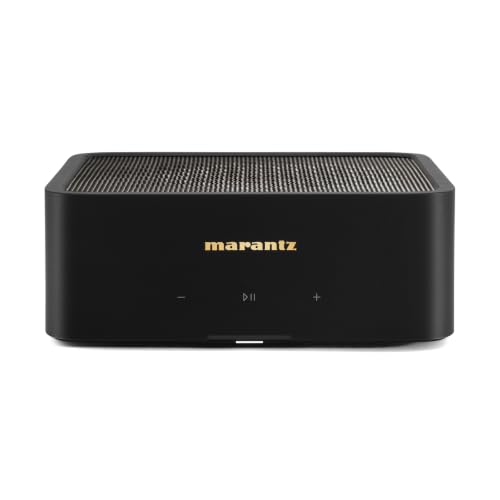
Japanese-built refinement that breathes life into demanding speakers with nuanced, musical delivery.
The Marantz Model M1 is the audiophile’s choice in this lineup, built at Marantz’s Shirakawa Audio Works facility in Japan. It delivers 100 W per channel of low-distortion amplification, and owners confirm it drives demanding speakers like the KEF R3 Meta and Revel F36 beautifully. Reviewers call the sound “incredible” with nuanced mids and lows, crediting Marantz Musical Digital Filtering for preserving warmth and spaciousness.
Under the hood, it streams hi-res music up to 24-bit/192kHz PCM and DSD via HEOS, with AirPlay 2, Spotify Connect, and Bluetooth. HDMI eARC with Dolby Digital+ decoding upgrades your TV sound dramatically, and you can even control volume with your existing TV remote. Its soft-touch finish, metal grille, and dimmable front panel give it a subtle elegance, and its diminutive size makes it perfect for multi-room extension of a larger Marantz system.
The honest downsides: shoppers say the HEOS app is the weak link, describing it as “poor” and slow with long updates. There’s no physical volume knob, which some find frustrating, and the materials feel cheaper than the price suggests to some owners. A few buyers report it beats the WiiM Amp Ultra in sound quality but acknowledge the app experience lags behind. You’re paying for the sound engineering and build heritage, not the software.
The Performance Verdict: If the sound is your priority and you can live with a mediocre app, this is the one that drives demanding speakers beautifully.
5. Denon PMA-900HNE Integrated Stereo Amplifier

A full-sized traditional integrated amp that adds HEOS streaming and vinyl-friendly phono inputs to your hi-fi rack.
The Denon PMA-900HNE is for the purist who wants a proper integrated amplifier first and streaming second. It runs 85W per channel through Denon’s Advanced High-Current circuit, and owners mention warm, tight bass with a sturdy build and an OLED display. Reviewers find it an “excellent” mid-tier model, with compatibility being the second-most praised aspect. It’s noticeably heavier than the compact options at 8.3 pounds, reflecting the traditional transformer-based design and beefy chassis.
This amp stands out for its built-in phono input with an MM/MC equalizer (a circuit that adjusts the signal from a turntable), so you can play vinyl without buying a separate preamp. Owners confirm it works well with cartridges like the Ortofon 2M Blue and DL-103 MC. It has 3 optical and 1 coaxial input for CD players, Blu-Ray, and TV audio, plus a subwoofer pre-out. HEOS built-in streams from Spotify, Pandora, and TIDAL across rooms, and it supports AirPlay 2 and Bluetooth. Customers note AirPlay sounds better than Bluetooth on this unit.
The trade-off is that it runs hot — a common note among owners — and the HEOS app is described as clunky with no Tidal Connect support. One reviewer noted the volume knob is metal while other controls feel plasticky. There’s no HDMI input, so TV audio must go through optical or coaxial. It also has a 2-year warranty, so you have coverage if the heat becomes an issue.
The Hi-Fi Core
- Built-in MM/MC phono stage for serious vinyl setups
- AirPlay reviews as superior to Bluetooth on this unit
- Multiple optical and coaxial digital inputs
Know Before Buying
- Runs hot in normal use — plan ventilation
- HEOS app feels clunky and lacks Tidal Connect
- No HDMI for direct TV connection
Choose this over the compact amps if: you have a vinyl collection and a traditional hi-fi rack, and you want streaming as a bonus rather than the main event.
Look elsewhere if: you want a single box for TV audio plus streaming — this needs separate HDMI handling.
6. Bluesound Powernode (White)
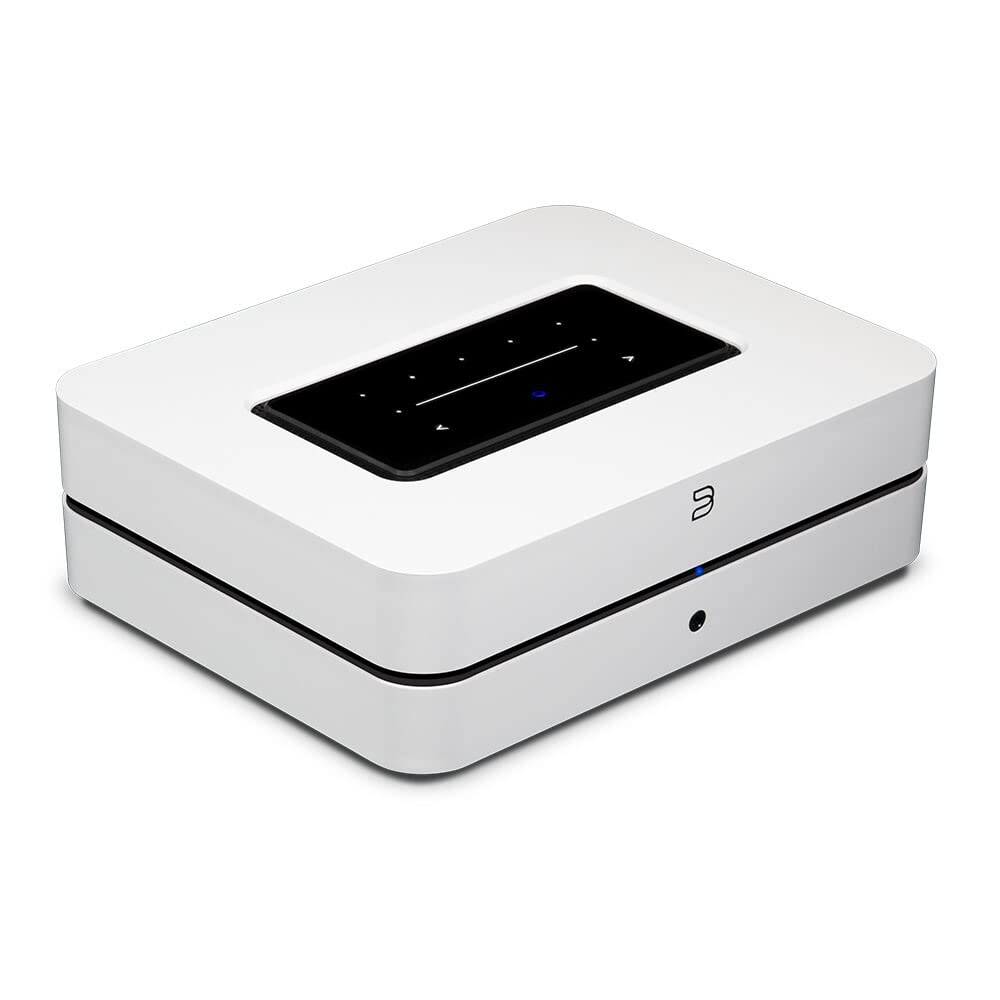
The minimalist white box packing 80 watts of HybridDigital power and a reference-grade DAC for easy streaming.
Bluesound’s Powernode is a HiFi multi-room amplifier that hides serious muscle behind a compact minimalist exterior. It delivers 2 x 80 watts of HybridDigital amplification and sports a premium 32-bit/384kHz DAC powered by a Quad-Core 1.8GHz ARM Cortex A53 processor. Reviewers point out it sounds “fantastic” and “just works,” with several praising MQA streaming. Setup takes about five minutes, and the HDMI connection handles TV audio for movies and YouTube beautifully.
The BluOS Controller app works on smart devices and laptops, giving access to internet radio, cloud music services, and your local library. It features HDMI with ARC and eARC, digital, optical, and analog inputs, wired and wireless headphone outputs, dual subwoofer outputs, and even wireless Dolby surround sound. AirPlay 2 lets you play music and podcasts from wireless stereo components across the whole house in sync. Dual-band Wi-Fi, Gigabit Ethernet, and 2-way Bluetooth aptX HD round out the connectivity.
The reviews show a split: many find the app works amazingly and setup is easy, while a smaller group reports app issues and a time-consuming setup process. One owner found the Powernode slightly inferior to an Arcam SA20 with Elac speakers, though they praised its power and compact design. Check your unit’s factory seal — one buyer received a defective used unit that sparked, so verify you have a genuine new product. Spotify users note the app occasionally forces a manual switch back to Spotify, which is a minor workflow annoyance.
The Balanced Take: Excellent sound, a great DAC, and broad connectivity — just be ready for a possible app learning curve and double-check you receive a sealed, new unit.
7. Juke-6 | 6 Zone Audio Amplifier
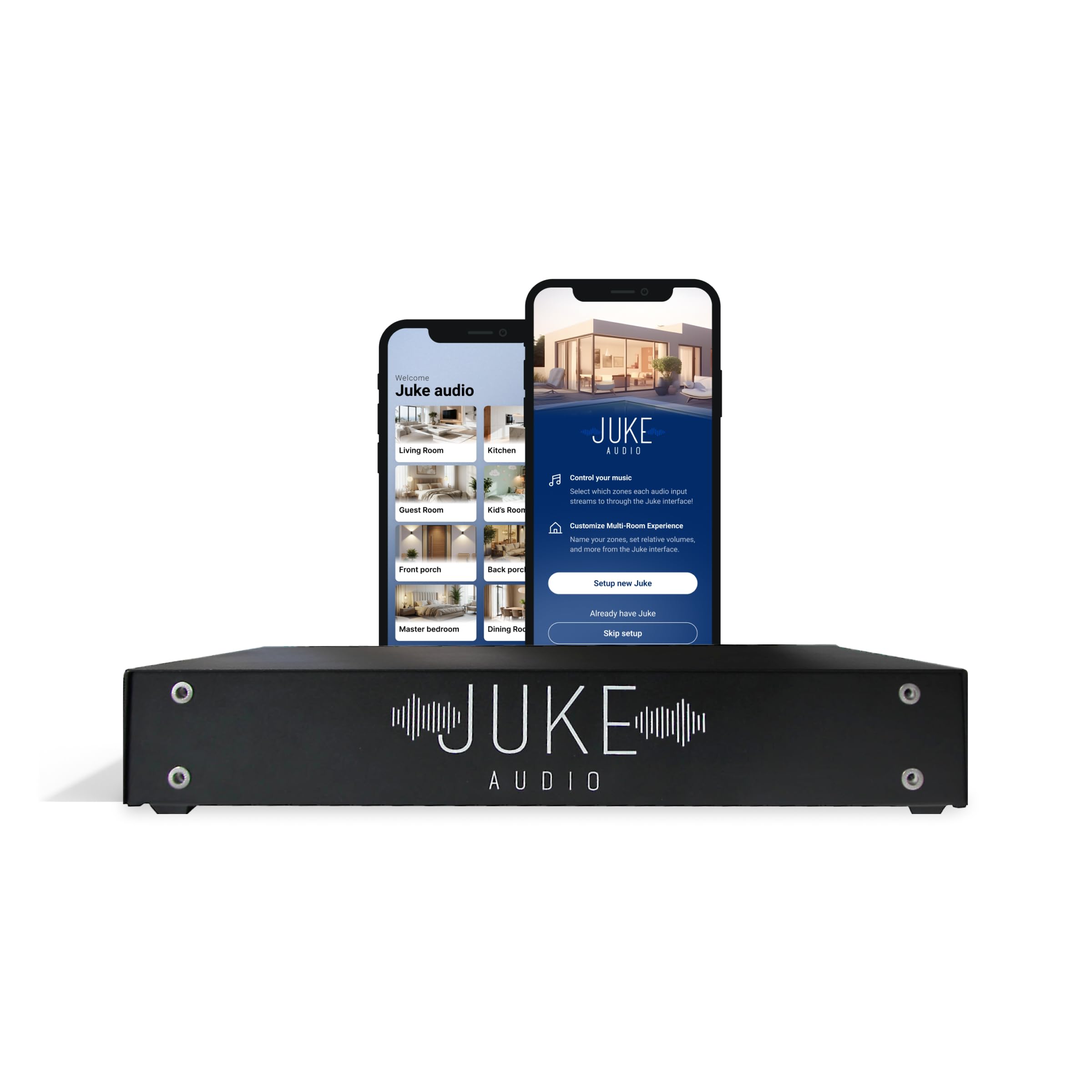
A dedicated whole-home amplifier that powers six zones of in-ceiling and outdoor speakers with one clean box.
The Juke-6 is built for a specific job: powering passive in-ceiling, in-wall, and landscape speakers across six audio zones. It provides amplification for up to 12 speaker channels (40 watts per channel into 8 ohms), with each channel stable down to 2 ohms. Shoppers say it works “great with Spotify Connect and Airplay,” and the quality is the most-praised aspect by far in owner feedback. It’s been described as a reliable drop-in replacement for older whole-home audio amps like Russound systems, with low power usage and simple app control.
It uniquely displays each connected speaker zone individually within AirPlay 2 and Spotify, so Apple users can stream directly from any app to any combination of rooms. Multiple users can play different audio in different zones simultaneously — Dad’s music in one area while the kids listen to theirs in another. It also supports Bluetooth and DLNA streaming. For TV, connect an AppleTV to your television and wirelessly transmit audio to any connected speakers, controlling room selection and volume from your TV remote.
Owners praise it as “far more affordable than 6 Sonos amps” and note it’s easy to set up with excellent sound quality. The power output draws mixed feedback — it’s sufficient for 6.5-inch 2-way in-ceiling speakers but some find it underpowered for outdoor speakers. AirPlay sync can drift when used with Apple TV, and there’s no per-zone volume control when playing the same source. One professional installer was enthusiastic after 2+ years, calling it reliable with great customer service; another integrator returned it immediately, so consistency matters to professionals.
The Whole-Home Win
- Each of the 6 zones appears individually in AirPlay 2
- Supports simultaneous streams from different users
- Replaces complex Russound setups with simple app control
Set Expectations
- 40W/ch is fine for ceilings, weak for large outdoor areas
- AirPlay sync can drift with Apple TV sources
- No per-zone volume control on a shared source
This is the answer for: homeowners with in-ceiling speakers in multiple rooms who want one box to power and control them all from an iPhone.
skip it if: you’re driving large outdoor speakers or need per-zone volume when playing the same track everywhere.
8. Juke-8: 8 Zone Multi-Room Amplifier
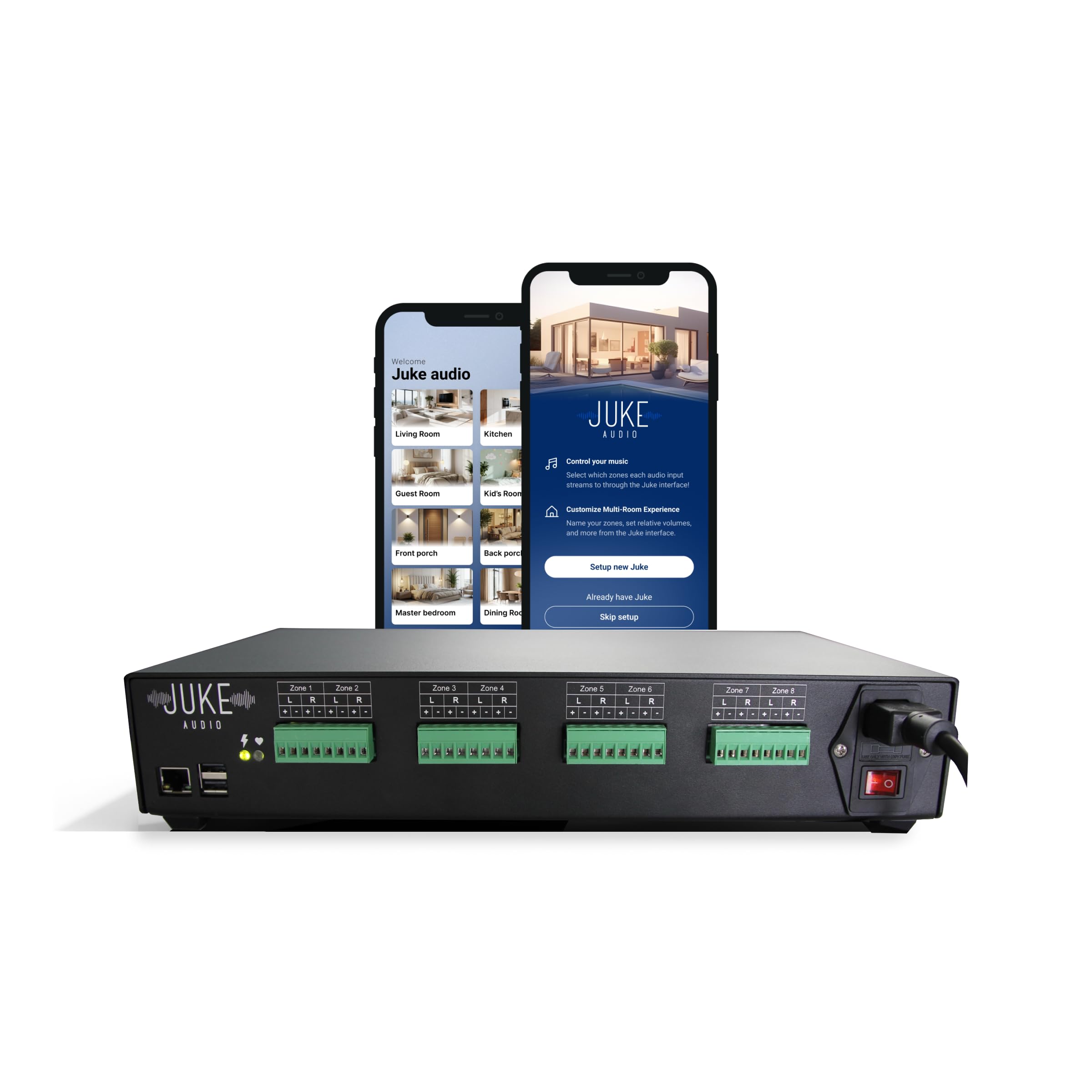
The eight-zone master that replaces a whole rack of streamers, amps, and speaker selectors in a single unit.
If you have more rooms than the Juke-6 can handle, the Juke-8 scales up to eight zones with 16 channels of output power at 40 watts each. Buyers report it “works like a charm” with great sound, praising quality first and functionality second. Owners highlight its versatility — it works well in bedrooms, kitchens, and bathrooms, and reliably plays different music in each room.
Like its sibling, this amp shows each zone separately in AirPlay 2 and Spotify, and the companion app lets Android and Apple users log into music services directly — currently Pandora, Tidal, and TuneIn, with more promised via free firmware updates. The app lets you set volume for any zone, create pre-set multi-room groups, pick audio input types, and check speaker connections.
The main complaint is sound quality for some: one owner described it as “much like a 1980’s AM radio” with muffled audio lacking highs and lows, while most others praise the sound. Power can be an issue for large rooms, with one installer noting 20W/channel is underpowered for bigger spaces, though it’s sufficient for typical indoor zones. Some users report occasional phone disconnects lasting 20-25 minutes. It also favors Apple devices — Android users need additional apps and steps, which knocks a star off the rating for non-iPhone owners.
Why Installers Like It
- Saves thousands versus professional whole-home systems
- 8 independent zones with individual AirPlay 2 targets
- Easy setup — even for non-technical users
Know The Limits
- Sound quality gets rare but strong criticism for mushiness
- Android experience requires extra apps and steps
- Underpowered for very large rooms or outdoor zones
Best for: Apple households with 7-8 rooms of wired speakers who want to skip the expensive installer route.
Not ideal if: your home is Android-centric or you expect reference-grade fidelity from a multi-zone distribution amp.
9. Juke+ | 6 Zone Audio Amplifier
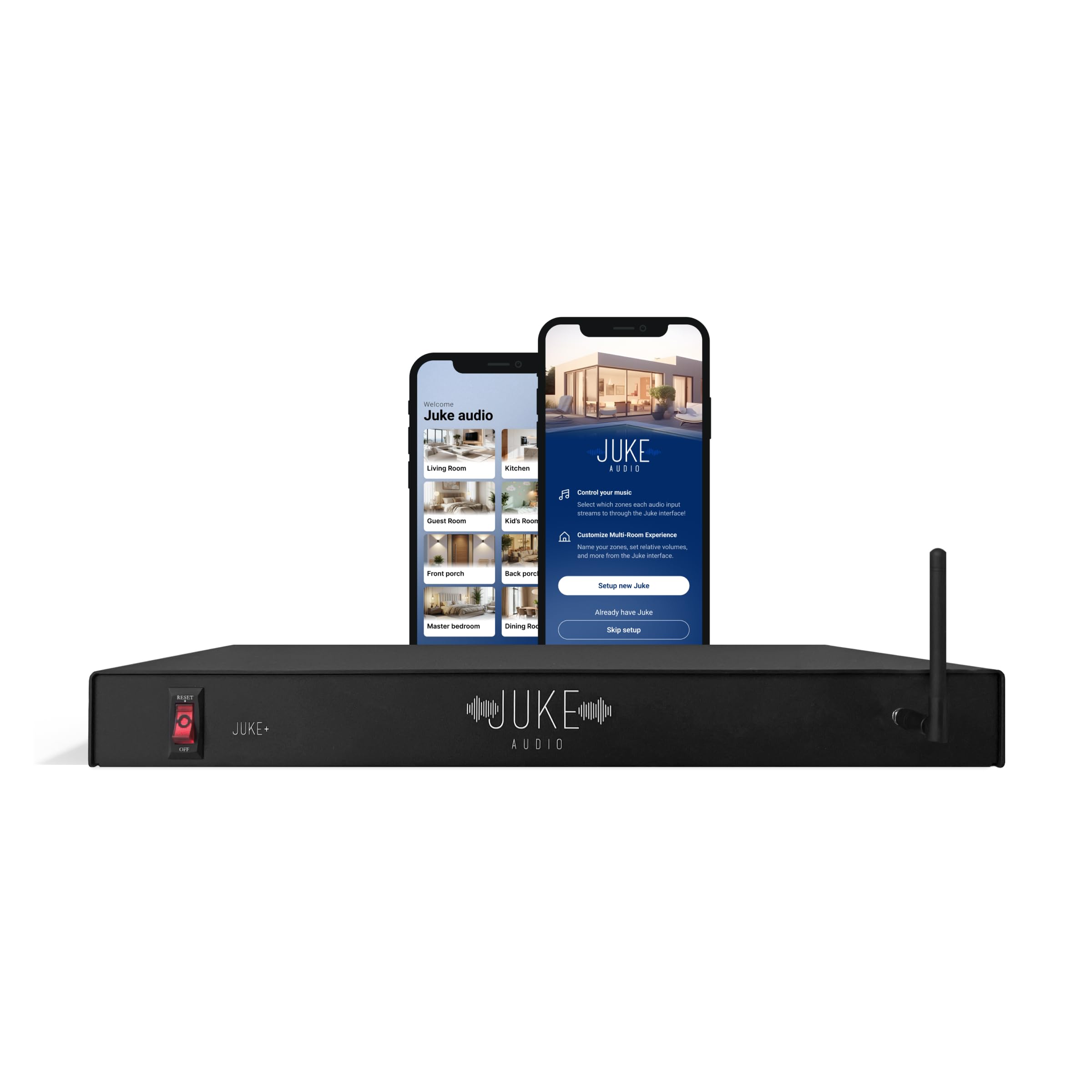
The flagship Juke that doubles the power per channel and adds a built-in equalizer for serious whole-home setups.
The Juke+ is the newest flagship from Juke Audio, and it answers the main complaint about its siblings: power. It delivers 100 watts per channel across six zones — a substantial upgrade from the standard Juke’s 40 watts — making it capable of driving outdoor and basement speakers that the older models struggled with. A 1U rack mountable amplifier, it also offers a built-in audio equalizer to tune any area to your specific sound preference, addressing another common request from owners of the original Juke.
It displays each zone individually within AirPlay 2 and Spotify, and the app supports multiple simultaneous audio streams so different family members can listen to different music in different areas. For analog sources, the RCA input connects a record player, while the optical input handles digital sources like a television. You can also connect a powered subwoofer or surround sound receiver as an additional zone, groupable with any of the 6 speaker output zones.
One owner calls it the “best multi-room amplifier with app,” noting individual control of 6 hardwired zones and easy Sonos Port integration. Another says the extra power is ideal for outdoor and basement use, and it works smoothly whether streaming Spotify on a Samsung phone or Apple Music on iOS. One buyer hit a minor setup hiccup — an app connection failure initially — but a troubleshooting guide and reinstall fixed it, leaving them “very pleased” with the sound quality and app. The one 3-star review notes Spotify Connect didn’t work at first despite a premium subscription, though AirPlay functioned fine.
The Flagship Verdict: The most capable Juke for demanding whole-home installations, with the power and EQ control the standard models lack.
Understanding the Specs
Power Output (Watts per Channel)
This number tells you how loud and clean the amp will drive your speakers. It’s usually stated at a specific impedance — 8 ohms is the standard for most bookshelf and floor-standing speakers, while 4 ohms represents more demanding loads. A higher wattage at lower impedance (like 120W at 4 ohms) means the amp has good current reserves for dynamic peaks. Match the amp’s wattage to your speakers’ recommended power range so you have headroom without risking distortion.
Multi-Room Zones and Channels
Single-room amps power one pair of speakers, typically with a subwoofer output for a 2.1 setup. Multi-zone amps distribute power across several pairs of speakers — a 6-zone model might offer 12 channels to power stereo pairs in six rooms. Some, like the WiiM Amp, are AirPlay 2 receivers only, meaning they receive streams but don’t broadcast to other AirPlay speakers. Others, like the Juke series, display each connected zone as an individual AirPlay 2 target so you can send different music to different rooms.
HDMI ARC vs. eARC
HDMI ARC (Audio Return Channel) lets your TV send audio down the same HDMI cable you use for video, so you control volume with your TV remote. eARC is the enhanced version with higher bandwidth, supporting lossless and high-resolution audio formats like Dolby Digital Plus. If you watch a lot of movies and TV, an amp with HDMI eARC is the cleanest way to integrate TV sound — you don’t need a separate optical cable. Some multi-zone amps skip HDMI entirely and use optical or wireless Apple TV routing instead.
The Control App Matters
An AirPlay 2 amplifier is only as good as its companion app. The app handles setup, volume, EQ, and multi-room grouping. Buyers consistently rate the WiiM Home app highly, while the HEOS app used by Denon and Marantz draws mixed feedback for being clunky. Some apps let you mix services (Spotify, TIDAL, Qobuz) while others require you to switch manually. Before buying, consider which app you’ll live with daily — it affects your experience more than any single spec.
FAQ
What is the difference between AirPlay 1 and AirPlay 2?
Can I use an AirPlay 2 amplifier with speakers I already own?
How many watts per channel do I need for my speakers?
Can I connect my TV to an AirPlay 2 amplifier?
What is the difference between HEOS and AirPlay 2?
How do I connect a turntable to a streaming amplifier?
Can I stream to different speakers in different rooms at the same time?
Can I add a subwoofer to an AirPlay 2 amplifier?
Does every AirPlay 2 amplifier work with Spotify?
How many watts do I need for outdoor speakers?
Final Thoughts: The Verdict
If you want one dependable pick, the airplay 2 amplifier winner is the WiiM Amp because it delivers the best combination of power, sound quality, and app experience with the highest satisfaction ratings. If you want a multi-room ecosystem for in-ceiling speakers, grab the Juke-6. And for audiophile-grade single-room listening, the Marantz Model M1 is the one to reach for.
How We Picked
We do not accept paid placement. Every pick is matched to a real buyer and a real use-case; we do not hands-on test units.
Sources & Methodology
Specifications: manufacturer listings and product documentation. Review insights: verified customer reviews, as of August 2026. Pricing: not shown on this page (it changes often); check the current price via the retailer link.
As an Amazon Associate, Gadgets Feed earns from qualifying purchases. This does not affect which products we feature.