
Our readers keep the lights on and my morning glass full of iced black tea. As an Amazon Associate, I earn from qualifying purchases.
Specs are compiled from manufacturer listings and verified buyer reviews and can change over time — please confirm the key details on the product page before buying.
Buying a pellet stove on a budget usually means worrying about whether it will actually keep you warm in January. The real question is whether a budget model can heat your space reliably without constant babysitting. This guide shows which budget-friendly stoves genuinely deliver on BTU output, hopper capacity, and everyday usability.
I’m Min — the founder and writer behind Gadgets Feed. This guide is built by comparing the manufacturers’ published specifications and the patterns across verified customer reviews, so you get each pick’s real strengths and trade-offs instead of marketing spin.
The crowd favorite here — 4.2 stars from 50+ owners — pairs huge capacity with smart controls, but the honest verdict on the budget pellet stove landscape is that matching the unit to your square footage matters more than any single spec.
Our Picks at a Glance

How To Choose The Best Budget Pellet Stove
Choosing a budget pellet stove means balancing a few key specs against your home’s real needs. A cheap unit that’s too small will run non-stop and still leave you cold, while an oversized one wastes pellets. Focus on four things: heat output, hopper size, ignition style, and how easy it is to clean.
Match BTU output to your square footage
The British thermal unit (BTU) figure tells you how much heat the stove can produce per hour. A higher number means more warming power, but it also means more fuel burned. Check the manufacturer’s stated coverage in square feet and compare it to your open living space — that’s the fastest way to avoid buying the wrong size.
Weigh hopper capacity against your routine
The hopper holds the wood pellets that feed the fire. A bigger hopper means fewer refills, which is huge on cold nights. Look for the capacity in pounds and think about how many hours you want between fills — some units stretch a fill across a full day, while others need attention every night.
Decide between electric and non-electric ignition
Most budget stoves use an electric auto-igniter that lights the pellets at the push of a button. Some gravity-feed models need no electricity at all, which is a lifesaver during power outages. The trade-off is that non-electric units often take more hands-on effort to start and maintain a steady burn.
Quick Comparison
| Model | Best For | Heat Output | Hopper Capacity | Coverage | Amazon |
|---|---|---|---|---|---|
| Cleveland Iron Works PS130W★ Best Overall | Large homes & smart control | 29,501 BTU | 130 lb | 2,000–3,000 sq ft | Amazon |
| ComfortBilt HP40 AlpineCompact Pick | Compact spaces & cabins | 26,224 BTU | 25 lb | 1,500 sq ft | Amazon |
| US Stove GW1949 Wiseway | Off-grid & outages | 40,000 BTU | 60 lb | 2,000 sq ft | Amazon |
| Castle 41278 Serenity | Programmable scheduling | 32,000 BTU | 40 lb | 1,500 sq ft | Amazon |
| PelPro PP70 | Workshops & mobile homes | 42,500 BTU | 70 lb | 2,000 sq ft | Amazon |
| Canyon Lodge C130W | Whole-house heating | 29,501 BTU | 130 lb | 2,000–3,000 sq ft | Amazon |
In‑Depth Reviews
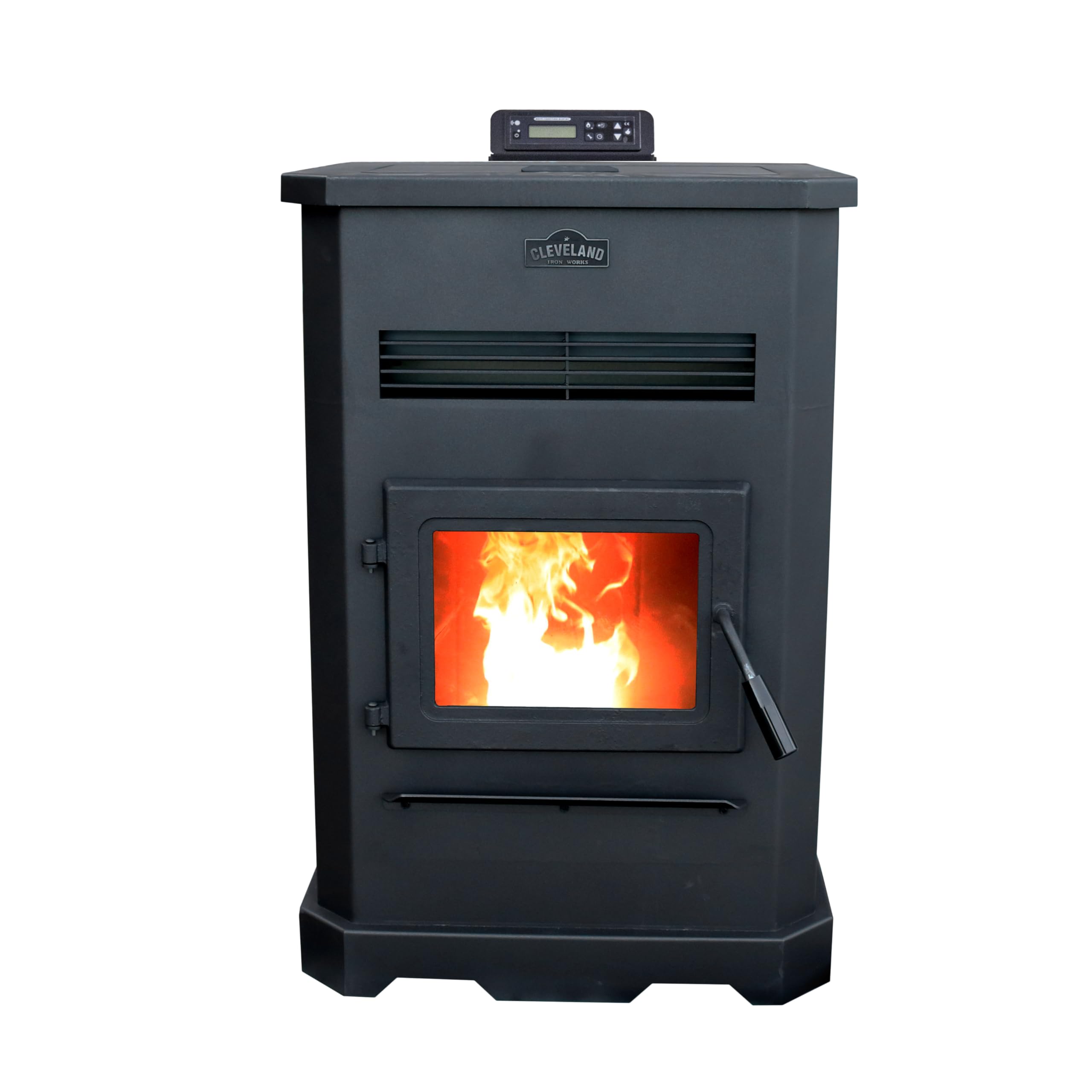
1. Cleveland Iron Works Large Pellet Stove
Our pick — over 4★ from 50+ verified ratings; the strongest balance of quality and price.
The whole-house powerhouse that phones home when your living room gets cold.
If you’re heating a big open floor plan, this is the one that ends the search. The 130-pound hopper is the standout — that’s roughly three full bags of pellets, so you’re not trudging outside in the dark to reload. Buyers report the hopper holds closer to 115 pounds, still the largest here and a 5.2x gap over the ComfortBilt below.
You get 29,501 BTU of heat output, and the built-in WiFi lets you adjust temperature from your phone. That smart-home convenience — checking and changing the heat without getting up — is a feature the rest of this budget list simply doesn’t offer. The cast iron body is a hefty 209.4 pounds, which tells you this is a serious appliance, not a flimsy space heater.
Buyers praise its fast warm-up and consistent, even heat. Owners mention a quick warm-up and consistent, even heat that holds its set temperature well. The trade-off, as owners put it: the manual is genuinely unhelpful, and the control panel takes some patience to learn — a few customers note a failed control board. Set aside time to read online tutorials.
What Earns the Top Spot
- 130 lb hopper means rare refills — a full day of heat from one load
- WiFi app control for adjusting temperature from anywhere
- Fast house warming backed by 29,501 BTU output
Honest Trade-offs
- No ash pan, so cleaning means more manual scooping
- Confusing control panel and a manual that doesn’t help
- Heavy 209.4 lb cast iron frame needs two people to move
Reach for it if: you have a large home that needs serious BTU output and you love adjusting heat from your phone.
Look elsewhere if: you want simple push-button controls without a learning curve.
2. ComfortBilt HP40 Alpine Pellet Stove
The little stove with surprising bite for cabins and garages.
This one is built for smaller spaces, and its compact footprint proves it. At 21″D x 17″W x 30″H, it’s noticeably smaller than the Cleveland above — a 31% smaller volume that slides into tight corners without dominating the room. That makes it a fit for cabins, sunrooms, garages, and workshops where floor space is precious.
Despite the size, it still delivers 26,224 BTU per hour — enough for 1,500 square feet under normal conditions. The 25-pound hopper is the clear trade-off here; it’s a 5.2x smaller capacity than the Cleveland, so plan on more frequent refills. But you do get five power settings, a programmable thermostat, and an included remote control for fine-tuning from the couch.
Owners say the value is solid — it heats 1,000 square feet easily on the efficient low settings, which burn about 1.3 to 2.5 pounds of pellets per hour. The catch is temperamental behavior on low heat settings, with some humming or rattling at cycle points, and the viewing glass carbonates quickly, cutting visibility. The removable ash pan makes daily cleaning straightforward.
Perfect fit for: anyone heating a compact home or workspace who prioritizes a small footprint and easy cleaning over hopper size.
The honest note: low settings can run fussy — reviewers point out it runs better on the efficient manual modes (L1–L3) than on ECO.
3. US Stove GW1949 Wiseway Non-Electric Pellet Stove

The only stove here that keeps burning when the power goes out.
This is the outlier of the group, and that’s exactly its appeal. The Wiseway uses a natural gravity feed system — no electric motors, no ignition, no blower — so it keeps running through a blackout when every other stove on this list goes dark. That alone makes it the go-to for off-grid cabins and outage-prone areas.
The 60-pound hopper extends burn time up to 30 hours, and the steel body weighs a manageable 131 pounds versus the Cleveland’s 209.4. It also uses standard 3-inch pellet venting for simpler installation.
Shoppers say it’s effective and simple to assemble, but there’s a hard honesty required here: it struggles in brutal northern winters. One owner in Northern Maine reports it can’t hold 600 square feet above 68°F. The gravity feed also needs regular attention — pellets can clump and clog the chute, requiring a rod to push them down. This is a capable stove, but it’s best as a supplementary heat source in mild-to-moderate climates or a true emergency backup.
Why It Stands Apart
- Runs with zero electricity — a lifeline during outages
- 40,000 BTU output covers up to 2,000 sq ft
- 60 lb hopper stretches a fill up to 30 hours
Where It Falls Short
- Gravity feed requires manual prodding when pellets clog
- Heavy smoke and fumes on the very first startup — burn it outside first
- Struggles to hold heat in extreme northern climates
Choose it for: the security of heat without any electrical dependency.
Think twice if: you live where winter routinely drops far below freezing and you expect it to be your only heat source.
4. Castle 41278 Serenity Pellet Stove

The program-your-week schedule champion that keeps your routine warm.
If you like to set and forget, this stove’s smart controller is the headline. It offers Manual, Thermostat, Weekly, and Eco operating modes — meaning you can program the heat to follow your schedule, warming the house before you wake and easing off while you’re at work. The Weekly mode is rare at this price tier.
It delivers 32,000 BTU and covers 1,500 square feet, with a 40-pound hopper that buyers report lasts about 16 hours on fan setting two. That’s a full overnight and into the next day on one fill. The clean design is a real selling point: there are no tubes, corrugations, or hidden chambers to scrub, so maintenance is simpler than on many rivals.
What wins people over is the reliability — a house in a cold, snowy winter stayed warm all season, cutting the electric bill noticeably. Quality control is a catch: one buyer reports the auger cycling just 3-4 times before quitting, and tech support struggled without schematics. As owners put it, find a good brand of pellets and stick with it — pellet quality genuinely matters here.
Best for: homeowners who want schedule-based heating and hate cleaning hard-to-reach stove interiors.
Know before you buy: the 186-pound body needs a dolly, and the included remote handles all four modes once you’ve programmed them.
5. PelPro PP70 Pellet Stove

The high-efficiency workhorse for shops and mobile homes, built on home soil.
This is the efficiency king of the list. The PelPro PP70 is EPA-certified at 88.5% efficiency — meaning more of each pellet’s energy becomes heat in your room instead of going up the flue. That’s a genuine cost-savings story over a full winter. It also brandishes the biggest raw heat output here: 42,500 BTU, covering up to 2,000 square feet.
It’s built for practical spaces — the marketing targets older homes, tiny homes, shops, garages, cabins, and even mobile homes, with a fresh air kit included. A 70-pound hopper holds up to two days of fuel, and the easy-dial control offers 10 variable heat settings. The 300W auto-igniter gets the fire going at a button press, and it’s proudly made in the USA.
The shop owners who bought this are impressed — one bought it for a husband’s workshop and he loved it so much a friend ordered one too. But the honest split in feedback is stark: some report flawless multi-winter use, while others describe smoking issues on start and stop that could fill a house. The 199-pound weight and a built-in thermostat round out a capable but polarizing package.
Strongest for: a garage, barn, or shop where a no-frills, high-BTU heater gets daily use.
Worth noting: owners who’ve had trouble cite smoke during ignition cycles — budget for a first burnout outside before installation.
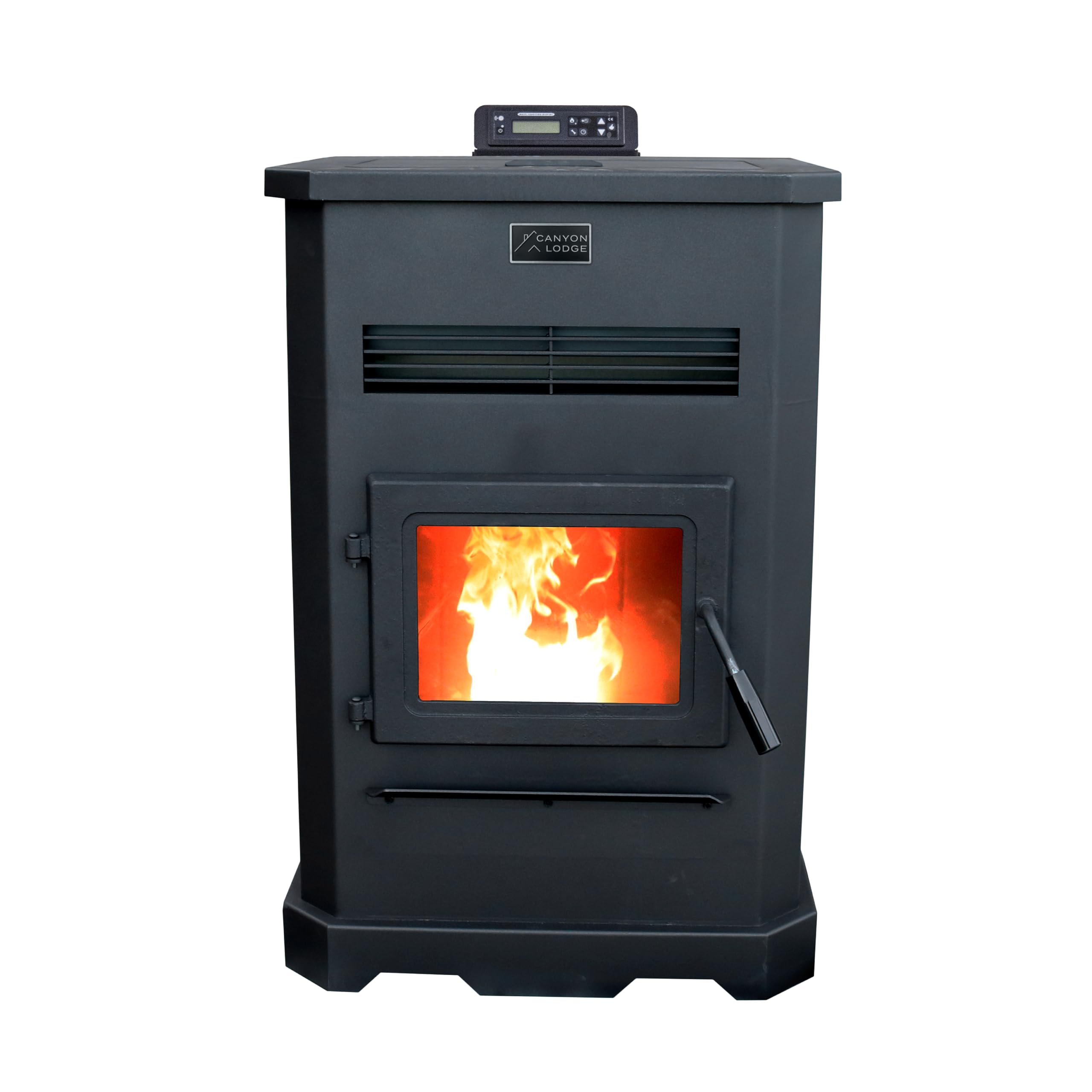
6. Canyon Lodge Large Pellet Stove
The whole-house warmer that runs quietly enough for a bedroom hallway.
This is the sibling of the Cleveland at the top of the list — same 130-pound hopper capacity, same 29,501 BTU output, same 2,000–3,000 square foot coverage, and even the same 209.4-pound build heft. What changes is the package: a Whisper Quiet Blower Technology that keeps fan noise low, plus a large viewing glass with an air wash system to keep the fire visible.
It’s a strong fit for whole-house heating straight from the basement — owners mention it warms the entire home with bedroom doors left open. The automatic ignition and included fresh air kit make it mobile-home approved, and the EPA approval covers emissions standards. A 4-bedroom mobile home owner reports it “heats it great” and slashed the propane bill.
Buyers describe a beautiful, sturdy unit that functions exceptionally well. The honest caveats: the hopper holds around 120 pounds despite the 130-pound claim (still three full 40-pound bags), and the app and remote can be finicky even if they work. One owner reported a serious fire hazard with extremely thin metal, so inspect your unit on delivery.
What Makes It Special
- Whisper-quiet blower for low-noise whole-house heating
- 130 lb hopper with an air-wash viewing glass
- Mobile home approved with fresh air kit included
What to Watch
- App and remote controls are functional but finicky
- Hopper realistically holds 120 lb, not the advertised 130 lb
- Heavy 209.4 lb body is a two-person install
Pick this if: you want Cleveland-style capacity with a quieter blower and a prettier view of the fire.
Be aware: the smart-home app has a learning curve, so budget time to set it up properly.
Understanding the Specs
BTU Output vs. Square Footage
BTU stands for British thermal units — the amount of heat a stove produces in an hour. A higher BTU number heats more space, but it also burns fuel faster. Match the stove’s stated coverage (in square feet) to your open living area, and always size up slightly if your home is drafty or poorly insulated.
Hopper Capacity in Pounds
The hopper is the bin that holds wood pellets before they feed the fire. Measured in pounds, a larger hopper means longer burn times between refills. A 25-pound hopper might last half a day, while a 130-pound hopper can stretch to a full day or more of steady heat — the trade-off is weight and floor space.
Ignition Style: Electric vs. Gravity Feed
Most pellet stoves use an electric auto-igniter that fires the pellets at the touch of a button. Non-electric gravity-feed models need no power at all, feeding pellets by gravity, which keeps them running during outages. The catch: gravity-feed units often need more manual effort to start and maintain the burn.
Efficiency Rating
Efficiency measures how much of the pellet’s energy becomes usable heat instead of escaping up the flue. A rating like 81% or 88.5% means that portion of each pellet’s energy heats your home. Higher efficiency generally means lower fuel costs over a full heating season.
FAQ
Can a budget pellet stove heat a whole house?
How long does a pellet stove hopper last before refilling?
Are non-electric pellet stoves as good as electric ones?
Will a pellet stove work during a power outage?
How often do I need to clean a pellet stove?
Is a pellet stove cheaper than electric heat?
Should I burn the stove outside before installing it?
How much space does a pellet stove need for installation?
Final Thoughts: The Verdict
For most buyers, the best budget pellet stove is the Cleveland Iron Works because it pairs the largest hopper in this lineup with WiFi smart control and enough BTU output to warm a big home. If you want a stove that keeps running when the power goes out, grab the US Stove Wiseway and its gravity feed. And if you have a compact space or cabin where a small footprint matters, the ComfortBilt Alpine delivers surprising heat without dominating the room.
How We Picked
We do not accept paid placement. Every pick is matched to a real buyer and a real use-case; we do not hands-on test units.
Sources & Methodology
Specifications: manufacturer listings and product documentation. Review insights: verified customer reviews, as of August 2026. Pricing: not shown on this page (it changes often); check the current price via the retailer link.
As an Amazon Associate, Gadgets Feed earns from qualifying purchases. This does not affect which products we feature.