
Our readers keep the lights on and my morning glass full of iced black tea. As an Amazon Associate, I earn from qualifying purchases.
Specs are compiled from manufacturer listings and verified buyer reviews and can change over time — please confirm the key details on the product page before buying.
Upgrading the tiny 2.75-inch speakers tucked into your car’s dash is one of the quickest ways to make music, podcasts, and phone calls actually sound clear instead of muffled. The best ones bring crisp vocals and detailed highs to ear level, so you hear the lyrics and instruments instead of just a wall of noise from the door speakers below.
I’m Min — the founder and writer behind Gadgets Feed. This guide is built by comparing the manufacturers’ published specifications and the patterns across verified customer reviews, so you get each pick’s real strengths and trade-offs instead of marketing spin.
If your factory dash sound is flat or harsh, a solid pair of 2-3/4″ speakers can transform the cabin experience without a full install, and this list shows you exactly which ones are worth it.
Our Picks at a Glance


How To Choose The Best 2-3/4″ Speakers
These small speakers do the heavy lifting for your midrange and high frequencies. Before you buy, focus on four things: how much power they can take, how easily they convert that power into volume, whether they’ll physically fit your car’s dash, and the depth you have to work with.
Match the Power to Your Setup
The key number is RMS, not the peak wattage. RMS tells you how much power a speaker can handle continuously, while the peak number is a brief maximum. A speaker rated for 30 Watts RMS is a safe match for most factory stereos, but if you’re running a dedicated amplifier, look for something with a higher RMS rating so you don’t overpower it.
Check the Fit Before You Fall in Love
2.75-inch speakers are common in the dash of GM, Chrysler, Jeep, and Subaru vehicles, but the mounting holes and depth vary. Always measure your existing speaker’s depth and check the mounting pattern.
The closest same-type size serves the same purpose, but not every pick here is the *exact* factory size for every vehicle. Confirm your car’s fit before cutting or splicing any wires.
Quick Comparison
| Model | Best For | Impedance | Sensitivity | Power (RMS/Peak) | Amazon |
|---|---|---|---|---|---|
| KICKER 47KSC2704★ Best Overall | Versatile dash upgrade | 4 Ohm | — | 15-50W Rec. | Amazon |
| PIONEER TS-A709Top Performer | Loud, clean highs | — | 82 dB | 100W / 450W | Amazon |
| Sundown SA-2.75 FR V2Vocal Specialist | Vocal clarity on a budget | 4 Ohm | 84 dB | 30W per side | Amazon |
| Memphis PRX27 | Adjustable tweeters | — | — | — | Amazon |
| AudioControl PNW | Audiophile-grade systems | 3 Ohm | — | 25W (100W max) | Amazon |
| MB Quart XK2-106 | Powerful compact coaxials | 4 Ohms | 92 dB | 70W / 140W | Amazon |
| Powerbass OE275-GM | Plug-and-play GM fit | 4 ohm | — | 25W / 50W | Amazon |
| Alphasonik NS275 | Simple, affordable pair | 3-Ohm | 80dB | 30W / 90W | Amazon |
| Powerbass 2.75″ Dash | Budget Jeep/Chrysler fit | 4 Ohm | 90 dB | 30W / 60W | Amazon |
In-Depth Reviews
1. KICKER 47KSC2704 2.75″ Mid-Range Speakers
Our pick — over 4.5★ from 600+ verified ratings; the strongest balance of quality and price.
The all-rounder that brings concert-style volume to a stock system without turning shrill.
You get better dash sound without rebuilding your whole audio setup. These handle a recommended power range of 15 to 50 watts, which matches most factory stereos, and buyers report “excellent clarity, detail, warmth; no distortion on stock amp.” That warm, non-fatiguing character is why sound quality is the #1 reason buyers choose these.
The real genius is in the brackets. KICKER ships three custom bracketing options, built to fit factory speaker locations in GM, Chrysler, Subaru, Toyota, and Jeep vehicles. That means for a Subaru WRX owner, it’s a direct swap with brackets and hardware included. You get a harness and capacitor in the box too, so the install is genuinely about wiring, not about custom fabrication.
The one honest caveat: these are midrange drivers, so they won’t produce deep bass. They’re best paired with decent door speakers handling the low end. The sound quality depends on the rest of your system—with the right doors, the cabin feels like a theater, but with weak doors, you’ll only be upgrading the top half of the experience.
midrange clarity king
- Three included bracket sets cover GM, Chrysler, Subaru, Toyota, and Jeep fits
- Pairs cleanly with a stock amp—no distortion reported at normal volumes
- Comes with a harness and capacitor for a smoother install
needs amp power
- Needs good door speakers to handle the bass; it’s a mid/tweet driver
- Instructions are minimal—you may need to figure out the correct blockers
tweeter swap: The confident upgrade for most drivers who want clearer, warmer dash sound with a painless fit across many common brands.
full range: You’re buying upper-range clarity, not bass—plan to keep or upgrade your door speakers alongside.
2. PIONEER A-Series Plus TS-A709 2.75″ 2-Way Coaxial
The heavy hitter—massive power headroom for those who love it loud.
For serious volume without distortion, this 2.75-inch speaker beats the rest. It handles 100 watts continuous and 450 watts max, giving you more headroom than almost anything else this size, so you can push it hard with an aftermarket amp and still get crisp highs. Buyers describe “a very large sound” that fills the mid-high gap in a factory setup.
It’s a 2-way coaxial design, meaning it has separate drivers for different frequency ranges, which produces more accurate and balanced sound. The sensitivity rating is 82 dB, so it plays loud even with lower power inputs. For direct-fit upgrades, owners have dropped these into a 2004 4Runner and a 2005-2015 Nissan Xterra with minor bracket work or a little plastic trimming. The broad frequency response ranges from 101 Hz up to 34 kHz, which keeps things clear across most music genres.
This is among the most-reviewed picks here, and buyers agree it beats pricier brands on clean output. It’s a coaxial speaker (one unit combines woofer and tweeter), so you don’t get a separate crossover to fine-tune a component-style sound—but for a straightforward, loud, clear dash upgrade, it’s exceptional value.
coaxial simplicity: 100W RMS and 450W max gives you the confidence to crank it up without worrying about blowing a small speaker.
shallow mounting: Easy install in most dashes, but a few vehicles need bracket hole enlargement or minor trim trimming—measure first.
factory fit: You run an amp or want extreme headroom to play loudly with zero strain.
high spl: You have a basic stock radio and never plan to amplify—you won’t use all its muscle.
3. Sundown Audio SA-2.75 FR V2 Ferrite 2.75″ Dash Speakers
The vocal specialist that makes singing and dialogue the stars of your cabin.
Sundown builds this as a direct factory replacement for 2.75-inch speakers found in the dash of Chrysler and many other new vehicles. It’s a full-range driver with a frequency response of 160Hz to 20KHz, and it’s rated for 30 watts RMS per side, based on a strenuous 8-hour test. The parts are built to last: a vented spider plateau keeps the voice coil cool, and the inverted rubber surround helps with off-axis response—meaning sound stays clear even when the speaker isn’t aimed straight at you.
Owners rave about vocal reproduction, calling it a “huge improvement over the oem speakers” with exceptional clarity on voices. It drops into a 2002 Grand Cherokee dash perfectly, and fits 2005-2020 Nissan Frontier dashes without cutting, though one frame hole may need a bit of dremel slotting for the perfect sit.
There’s a slight learning curve, though. Some owners note installation requires custom work—a small enclosure helps these sound their best, and in a 2015 Sierra, a spray-foamed custom enclosure made a massive difference. The sensitivity is rated at 84 dB, so it’s fine on a factory stereo but shines brighter when amplified. The price is justified by the sound, but it’s not a true plug-and-play for every vehicle.
dash drop-in: The listener who prioritizes vocals and midrange detail and doesn’t mind a little custom work to open up it.
bass heavy: Expect some installation effort—windshield access can be tight, and a proper enclosure open up the best performance.
4. Memphis PRX27 Power Reference Series 2.75″ Full Range

Tweeters that pivot anywhere, so you aim the highs exactly where you want them.
These 2.75-inch full-range speakers stand out with a multi-direction pivot tweeter system. That means the tweeter—the driver that produces the highest frequencies—can be angled on a full 360° axis, so you can aim the bright detail at your ears instead of at the windshield. Owners confirm this adjustability is exactly as flexible as it sounds, and for a Mustang or Camry, it open up a “brighter sound, more top end” than the stock units.
It’s a well-built speaker with a polyurethane surround, a PEI dome tweeter, a black-on-black polypropylene cone, and a stitched butyl rubber surround. The build is meant to last, and the installation is helped by built-in frequency filters that simplify wiring. Each pair even includes crossovers, so you can essentially build your own component setup by running your own midrange woofers.
The honest note: these need power to shine. Owners mention they’re “underpowered without amp” on a factory head unit, and one buyer specifically didn’t recommend them for stock stereos. They handle 100W at 2 ohms without distortion, so they’re happiest when fed by a decent amplifier. The fit gets mixed feedback in some vehicles, so check your mounting depth carefully.
flexible crossover: The pivot tweeters and included crossovers give you component-style tuning in a compact full-range package.
premium price: Best with an amp—on a stock radio alone, they feel underdriven.
active ready: The DIY-minded buyer who wants adjustable highs and crossovers to build a custom front stage.
budget build: Anyone running a modest factory stereo with no plans to amplify.
5. AudioControl PNW Series 2.75″ Component Speakers

The precision option for ears that demand every instrument sit exactly where it should.
If you’re building a serious sound system and want your dash speakers to be more than just “good enough,” this is the premium step. It’s a true component set with an in-line crossover—specifically a second-order Linkwitz-Riley high-pass filter—that tune sound output and reduces distortion. The engineering is deep: a complex FEA-designed motor, a black anodized voice coil former for heat dissipation, and a rigid paper fiber matrix cone with a mica coating for crisp, precise reproduction.
Sound quality is what customers note first, with a “nice warm, present sound” that works even on a factory amp. One owner in a Kia Sorento swapped out the OEM dash speakers and found it “sounds much better” once connected to an aftermarket amp. The design is built to fit many modern factory locations, though it’s physically more substantial—the overall diameter with grille is 3.24 inches, with a mounting depth of 1.37 inches.
Note that the fit is not universal. The cut-out diameter is 2.63 inches, and while it drops into an STI with the HK factory system with no issues, you should measure your dash opening. The price is the highest on this list, but for dedicated audiophiles, the fidelity justifies it. The recommended amplifier power is 25W RMS, with a max of 100W.
soundstage upgrade: You have a tuned amp and want component-grade accuracy and detail from your dash.
quick install: The 2.63-inch cut-out means you should verify your factory opening before committing.
6. MB Quart XK2-106 2.75-Inch Coaxial 2-Way Speaker

The efficiency king—92 dB sensitivity means big volume from very little power.
This compact 2.75-inch coaxial packs a serious punch for its size, offering 140W peak power and 70W RMS. The standout number here is the 92 dB sensitivity, which is the highest on this list by a wide margin. That means it converts power into volume very efficiently, so even a modest factory stereo can drive it to satisfying levels without breaking a sweat.
Owners call these an excellent value, especially as a drop-in for factory Bose dash speakers in a 2025 Silverado. The black aluminum dome tweeter produces “super loud clear tweeters” that fit a Jeep Liberty dash directly, and in a 2008 4Runner, they “bring vocals to ear level.” Frequency response runs from 55Hz to 22kHz, with crisp highs and smooth mids.
The trade-off: some listeners find the highs a touch bright and the mids slightly muddy compared to more expensive reference speakers. For most buyers, that’s a fair bargain given the output level, but if you have a very revealing high-end system, you’ll notice the difference. The steel basket and aluminum build are meant for demanding conditions, including powersports use.
efficient sensitivity: The 92 dB sensitivity makes it the best choice for loud sound on a stock radio.
bright top end: Bright highs are the signature—some will love it, purists may want more warmth in the mids.
loud volumes: Anyone wanting maximum volume from a factory head unit, or a direct Bose dash replacement.
soft listening: You’re chasing a warm, laid-back sound—this one leans bright.
7. PowerBass OE275-GM 2.75″ Direct Fit OEM Replacement
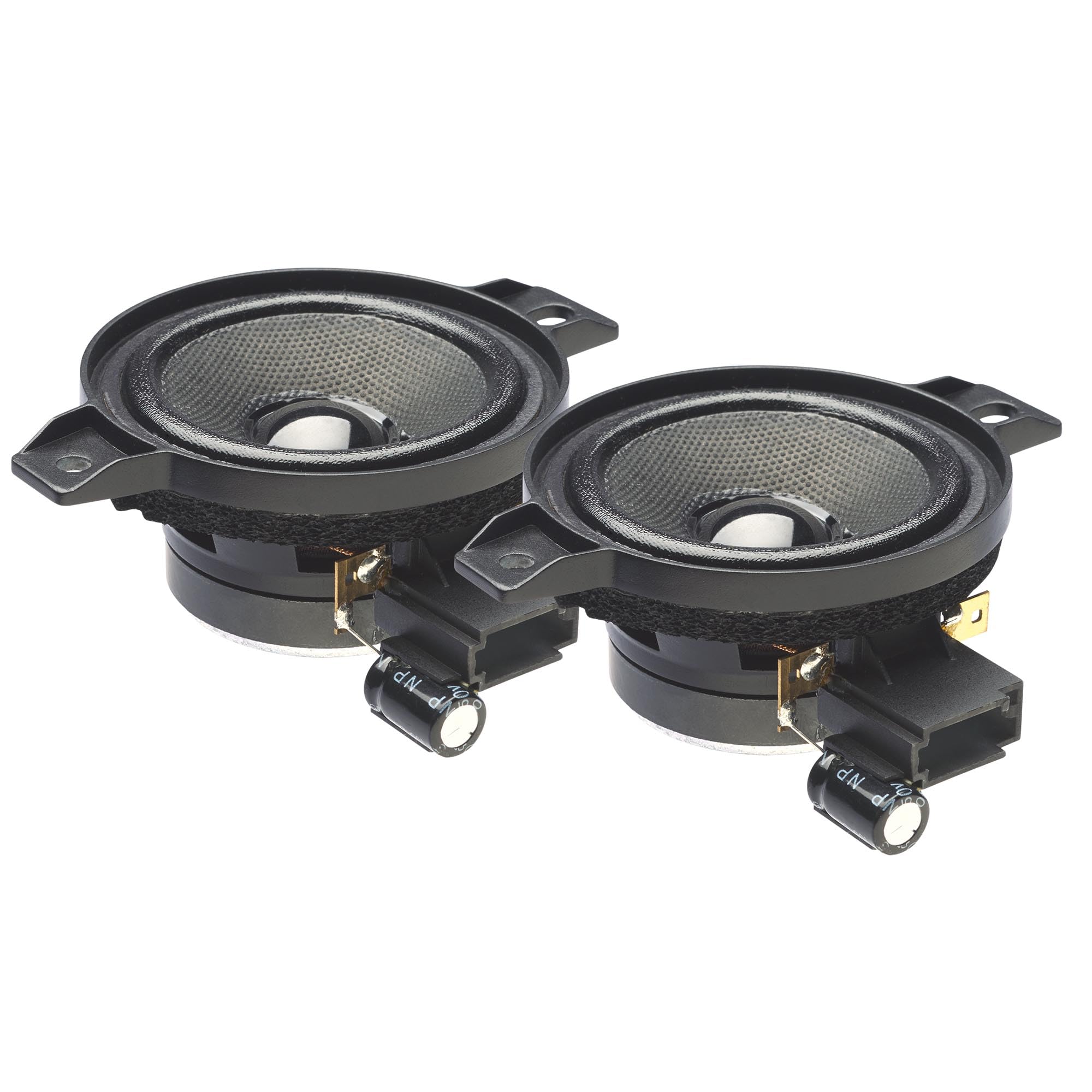
The pure plug-and-play fix for Silverado and Sierra dash speakers.
If you drive a Chevy Silverado or GMC Sierra from the 2014-2021 era, this is the least painful upgrade you can make. It’s designed as a direct-fit OEM replacement, and it comes with a nylon OEM speaker adapter that connects to the factory plug with zero splicing or cutting. Owners in a 2014 Sierra and a 2016 Silverado confirm the swap is simply unplug the old, plug in the new.
This is a high-bandwidth driver with a treated paper cone, rated at 25 watts RMS and 50 watts max. It’s built specifically for Chevy and GMC vehicles, and the sound quality is a clear step up from the factory units. Reviewers point out it “made a HUGE difference” in a 2016 Silverado and sounds “way better than the factory speakers.” The plug-and-play nature is the most-praised feature—it’s the only plug-and-play option some owners could find without cutting wires.
The honest note: fit gets mixed feedback. Most owners find it fits great, but a few report it’s “not exactly fit but close enough.” The tone is a modest upgrade, not a dramatic transformation—one owner called it a “slight upgrade in loudness/clarity” over the 2018 stock dash speakers. And be ready for dash work: removing the dash panel is fairly difficult, so take it slow.
stock replacement: You want a true no-cut, no-splice upgrade for a modern Chevy or GMC dash.
upgrade path: You’re after a dramatic tonal overhaul—this is a clean, moderate step up, not a complete transformation.
8. Alphasonik NS275 Neuron Series 2.75″ Full-Range

An affordable, simple pair that surprises everyone with its output for the size.
If you want a straightforward, low-commitment way to test what 2.75-inch speakers can do, this is the entry point. It’s a pair of full-range tweeters rated at 90 watts max and 30 watts RMS per speaker, with a frequency response from 150Hz to 19000kHz and an 8-ounce magnet. The kit includes both speakers, surface and angled mounts, screws, and speed clips, so you have everything you need to install from the start.
Owners are genuinely impressed by the output. One buyer running 30 watts RMS to each speaker called the sound “extremely good for this size of speaker,” while a Toyota Camry owner noted clear sound that adapts well to the dashboard. For a budget pair, the midrange and upper registers come through with surprising authority.
There are honest limits here. The build quality gets mixed feedback, and one reviewer noted these “don’t have a full range of sound—they are more mid-base than anything.” That’s a fair description: they’re excellent at the mids and highs but won’t dig deep. The sensitivity is rated at 80 dB, which is lower, so they need a bit more power to get loud. For the price, they’re a solid starter—just don’t expect component-level refinement.
small dash: The budget-conscious buyer wanting a quick, complete pair with mounts included.
door install: Lower sensitivity and a mid-focused character—best for mids, not for deep bass or very loud stock setups.
9. Powerbass 2.75″ Dash Speakers for Jeep Grand Cherokee

The budget-friendly straight swap that gives blown factory Infinity speakers new life.
For owners of older Jeep Grand Cherokees, Chrysler, Dodge, and Infinity vehicles, this is the no-nonsense replacement. It’s an OEM-style 2.75-inch speaker with a 1.25-inch mounting depth, a 90 dB sensitivity rating, and a power handling of 60 watts peak and 30 watts RMS. The shallow mounting depth is the key spec—it slides into tight factory dash spots that deeper speakers can’t fit.
The 90 dB sensitivity is notably higher than many competitors, including the Alphasonik’s 80 dB. That’s a real advantage: it gets loud with less power, and owners confirm it “handles 55W output without distortion” while sounding much better than the blown factory Infinity units it replaces. One buyer paired it with 1.2kHz bass blockers and sound deadening for excellent highs alongside door 6x9s.
The honest concern here is reliability. While sound quality and fit are the most-praised aspects, reliability gets mixed feedback—some units work great for years, but a few shoppers say speakers blowing after weeks or failing within months. It’s a value play, not a lifetime component, so treat it as a smart budget upgrade rather than a forever solution.
jeep specific: The 90 dB sensitivity and shallow depth make it the smart budget pick for tight factory dash spots.
harness quirks: Reliability is the most-discussed trade-off—buy it knowing it’s a cost-effective fix, not a permanent one.
grand cherokee: You need an affordable, high-sensitivity swap for a classic Jeep, Chrysler, or Dodge dash.
other models: You need a long-term, high-power component—this is a budget workhorse, not a flagship.
Understanding the Specs
RMS vs. Peak Power
RMS stands for “root mean square” and is the continuous power a speaker can handle. The peak rating is just a brief maximum. Match the speaker’s RMS to your head unit or amp’s output—a 30W RMS speaker is a safe bet for a factory stereo, while a 70-100W RMS speaker needs a real amplifier to shine.
Sensitivity and Impedance
Sensitivity, measured in dB, tells you how efficiently a speaker turns power into volume. A 92 dB speaker gets loud with a stock radio; an 80 dB speaker needs more juice. Impedance is the electrical load—most car speakers are 3 or 4 ohms. The lower the ohms, the more current the amp delivers, so a 3-ohm speaker can draw more power.
FAQ
Will a 2.75-inch speaker fit my car’s dash if the factory one is the same size?
Can I install 2.75-inch dash speakers on a stock factory stereo without an amp?
What is the difference between a midrange speaker and a coaxial speaker?
How do I know if a speaker will fit a Chevy Silverado dash?
Will I need to add bass blockers to my dash speakers?
Is a higher ohm rating better for my car stereo?
How long do 2.75-inch dash speakers typically last?
Can I use 2.75-inch speakers in my motorcycle or powersports vehicle?
Final Thoughts: The Verdict
For most drivers, the 2-3/4″ speakers winner is the KICKER 47KSC2704 because it pairs warm, distortion-free clarity with three bracket sets that fit a wide range of vehicles. If you want maximum volume from a factory radio, grab the MB Quart XK2-106. And for a pure plug-and-play Silverado or Sierra swap, the PowerBass OE275-GM is the one to reach for.
How We Picked
We do not accept paid placement. Every pick is matched to a real buyer and a real use-case; we do not hands-on test units.
Sources & Methodology
Specifications: manufacturer listings and product documentation. Review insights: verified customer reviews, as of August 2026. Pricing: not shown on this page (it changes often); check the current price via the retailer link.
As an Amazon Associate, Gadgets Feed earns from qualifying purchases. This does not affect which products we feature.