
Our readers keep the lights on and my morning glass full of iced black tea. As an Amazon Associate, I earn from qualifying purchases.
Specs are compiled from manufacturer listings and verified buyer reviews and can change over time — please confirm the key details on the product page before buying.
A brush cutter with the right power and blade turns hours of exhausting weed-whacking into a quick, clean job. We rank the top brush cutters by real-world cutting performance, not marketing claims. You will see a clear split between gas-powered workhorses and cordless battery models, with each pick judged on the specs that matter most for serious clearing.
I’m Min — the founder and writer behind Gadgets Feed. This guide is built by comparing the manufacturers’ published specifications and the patterns across verified customer reviews, so you get each pick’s real strengths and trade-offs instead of marketing spin.
Read on to find the best fit for your property, and see our top pick for the best brush cutter, a cordless model that holds its own against gas machines.
Our Picks at a Glance

How To Choose The Best Brush Cutter
First, decide between battery and gas power. Gas engines give you unlimited runtime and raw torque for the thickest brush, but they bring fuel mixing, pull-starting, and maintenance noise. Battery models are quieter, start instantly, and need no fuel prep, but their runtime is tied to battery capacity.
Match Power to Brush Density
Light grass and weekly trimming only need a basic trimmer. Dense weeds, saplings, and overgrown fence lines demand more, either a bigger engine (measured in cubic centimeters or cc) or a metal blade. A 25cc engine handles grass; a 40cc or larger motor tackles serious brush. For cordless units, the motor’s RPM and the battery voltage are the key numbers to compare.
Weigh the Machine and Harness
A brush cutter’s weight and harness quality determine how long you can work without fatigue. Lighter machines in the 7–12 pound range are far less tiring for a full session. Heavy gas models, often 18 pounds or more, are much easier to handle with a well-balanced harness that spreads the load across your shoulders.
Quick Comparison
| Model | Best For | Engine/Motor Power | Cutting Width | Weight | Amazon |
|---|---|---|---|---|---|
| Makita DUR368AZ★ Best Overall | Cordless power | 36V Brushless | 90 cm | 7.5 lbs | Amazon |
| Makita XUX01ZM5Premium Pick | Versatile multi-tool | 7,100 RPM | 15 inches | 9.8 lbs | Amazon |
| Husqvarna 122RJTop Performer | Light brush work | Gas | 17 inches | 12.6 lbs | Amazon |
| PROYAMA 51.7cc | Heavy brush, large lots | 51.7cc 2HP | 18 inches | 19 lbs | Amazon |
| Alpina ABR 32 | High-spec gas cutting | 32.6cc 900W | 43 cm | 8.3 kg | Amazon |
| PROYAMA 40cc | No fuel mixing | 40cc 4-Cycle | 18 inches | 16 lbs | Amazon |
| Wild Badger Power 26cc | 4-in-1 versatility | 26cc 2-Cycle | 17 inches | 23.9 lbs | Amazon |
| BILT HARD Walk Behind | Large fields, no carrying | 170cc 4-Cycle | 22 inches | 54.1 lbs | Amazon |
| PowerSmart 25cc | Budget-friendly gas | 25.4cc 2-Cycle | 16 inches | 18.7 lbs | Amazon |
In‑Depth Reviews
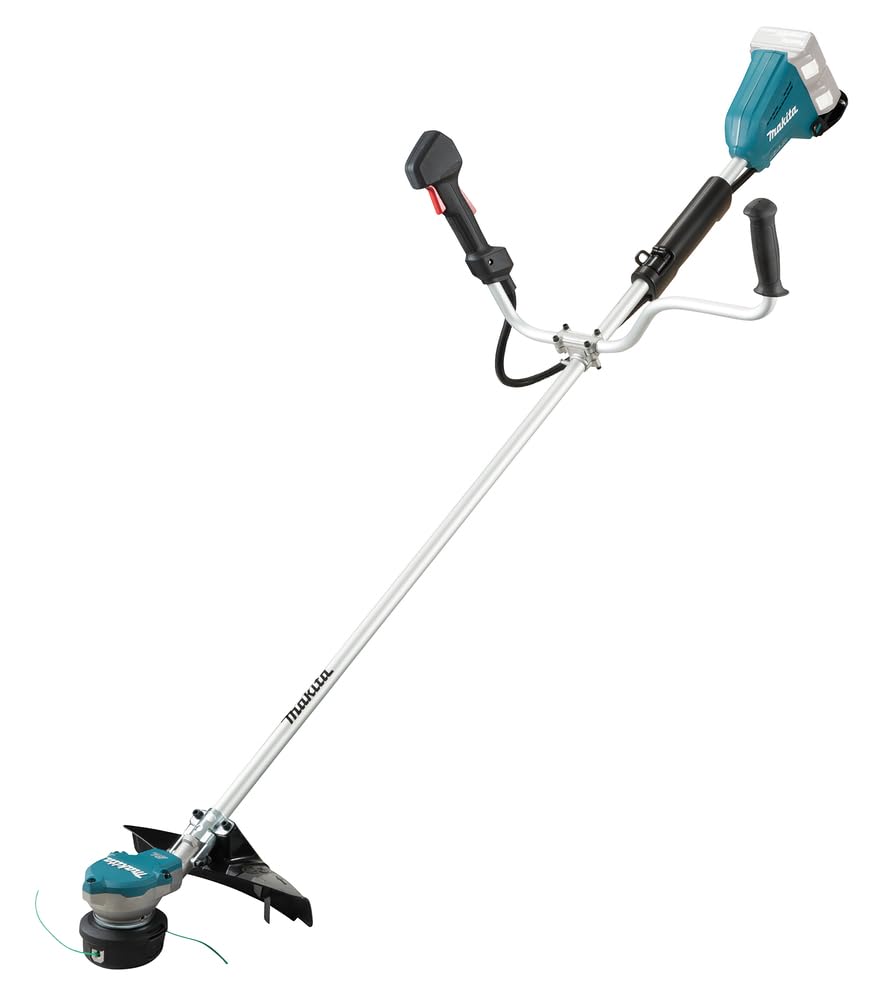
1. Makita DUR368AZ Twin 18V (36V) LXT Brushless Brush Cutter
Our pick — over 4.5★ from 650+ verified ratings; the strongest balance of quality and price.
This cordless model delivers gas-level cutting power without the fuel or pull cord.
That weight saving lets you finish a full day on overgrown ground without quitting sore.
The cutting width is listed at 90 centimeters with the nylon head, and you get three speed settings to match the job.
There is an honest catch here: batteries and charger are not included, so the price buys the tool only, and buyers report heavy brush sessions will drain a pair of batteries in roughly 25 to 30 minutes — the crowd consensus is to keep a spare set on hand.
Why it wins: Lighter than the gas machines while matching them on torque, and the constant speed control keeps the blades spinning at full power even in thick weeds.
The verdict: The best overall choice if you want the cutting muscle of a gas unit without the pull cord, the fuel mixing, or the weight on your shoulders.
Reach for this if… you already own Makita 18V batteries (the twin 18V setup means you slot in two of them for 36V of power) and hate the noise and vibration of gas engines.
Look elsewhere if… you need hours of continuous cutting on a big property and don’t want to invest in extra batteries.
2. Makita XUX01ZM5 36V (18V X2) LXT Brushless Couple Shaft Power Head
A modular powerhouse that turns one motor into a whole yard-care system.
This is the pick for the buyer who wants one power head to run everything. The Makita-built brushless motor spins up to a rated 7,100 RPM, with three speed options (Low: 4,200 RPM, Medium: 6,000, High: 7,100) so you can switch from delicate edging to heavy cutting. The real trick is the lever-style lock system, which lets you swap on other Makita couple-shaft attachments like a pole saw or hedge trimmer in seconds, no tools required.
Sitting at 9.8 pounds, owners note the battery-heavy end needs a harness for comfort, and the trimmer attachment gives a 15-inch cutting width.
Owners consistently report the battery life is the standout feature — with two 5Ah batteries, the runtime stretches long enough to impress, with some sessions hitting a couple of hours on lighter work. The catch is the tool-only format: batteries, charger, and strap are not in the box, and a few mention the harness came missing and had to be requested from Makita.
The verdict: A premium cordless system that replaces a shed full of separate gas tools with one motor and a set of attachments.
The one-liner: Buy this if you are already in the Makita LXT ecosystem and want a trimmer that also becomes a hedge cutter.
Think twice if… you just need a simple stand-alone brush cutter and won’t use the interchangeable attachments.
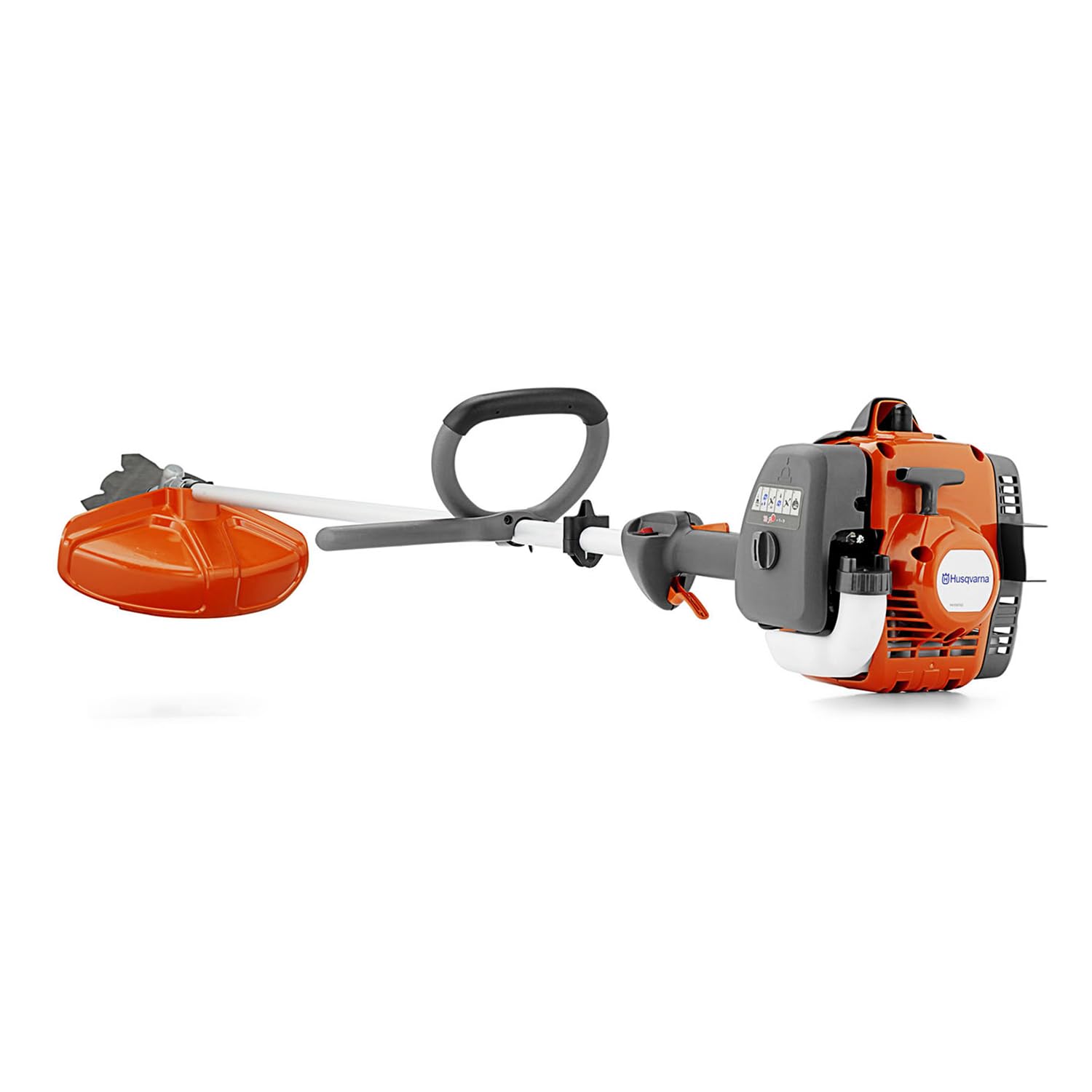
3. Husqvarna 122RJ Multi-Purpose Gas Brush Cutter
A gas machine that feels light enough to carry all day on tough weeds.
Husqvarna brings a trusted name to the list, and at 12.6 pounds this unit is noticeably lighter than the PROYAMA 51.7cc below, making it a better choice for extended sessions. It ships as a multi-purpose tool with both a string trimmer head and a grass blade, so you can clear light brush with the line or switch to the blade for saplings and brambles, with a 17-inch cutting width.
Starting is handled by Smart Start technology — a redesigned engine and starter that cuts the effort needed to fire it up — plus an air purge that pushes air out of the carburetor, so you are not fighting the pull cord.
Owners mention the smaller engine still chews through blackberries and bamboo, starting in a couple of pulls. The gripes here are specific: the instructions for swapping the trimmer head are thin, and the blade nut is reverse-threaded, which confused a few owners when installing the line head. Most find it powerful enough for their needs, but durability on heavy commercial use is less proven than the bigger PROYAMA.
What owners love
- Light enough for hour-long sessions
- Easy, low-effort starts with Smart Start
- Blade and string heads handle varied growth
The trade-offs
- Thin instructions on attachment swapping
- Reverse-threaded blade nut trips up some users
Best for… the homeowner with a mix of tall weeds and light brush who wants a reputable gas brand at a reasonable weight.
Who it’s not for… anyone planning to tackle dense, thick brush daily — a bigger engine will serve better.
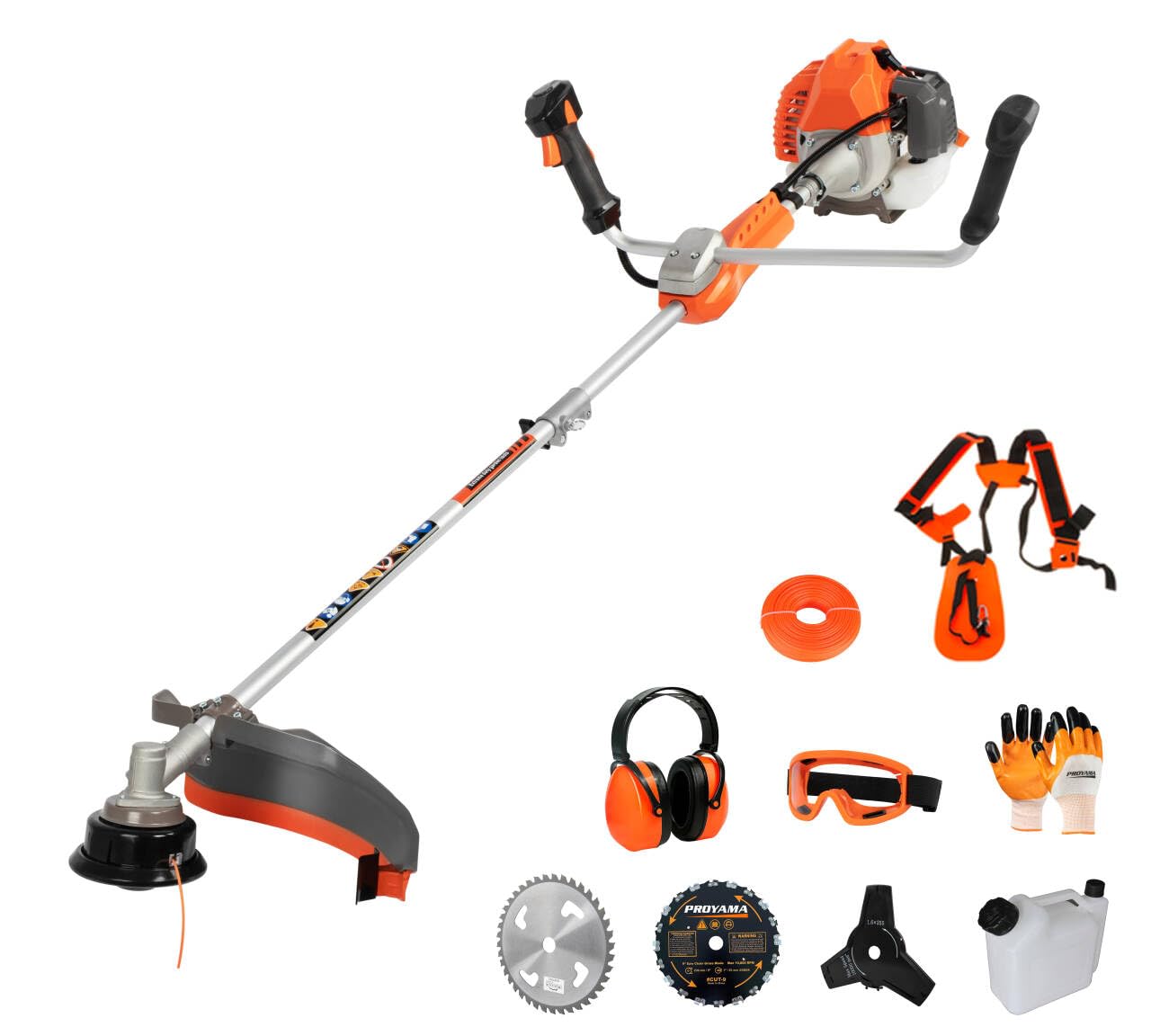
4. PROYAMA 51.7cc Gas Powered Weed Eater Trimmer
The gas brute that treats one-inch saplings like they are wet grass.
This is the machine you reach for when the property has gotten away from you. The 51.7cc engine puts out a claimed 2HP, and the 18-inch cutting width matches the PROYAMA 40cc above, but the extra displacement delivers noticeably more torque — customers note slicing through one-inch stems and even cutting into softwood, which is the kind of performance you expect from a professional brush cutter.
The integrated anti-vibration system helps reduce fatigue, but at 19 pounds this is a heavy tool, and the harness is not a luxury — it is essential.
The honest negatives: assembly instructions are poor, the gear head is sealed, and the throttle lock is weak. The weight is the biggest issue — it is exhausting without the harness, and the guard can obstruct the cut on the right side.
Standout spec: A 51.7cc engine in this class is rare, and it shows in how fast it clears thick growth.
Who should skip it… occasional users with small yards will find the weight and 2-cycle fuel mixing more hassle than it is worth.
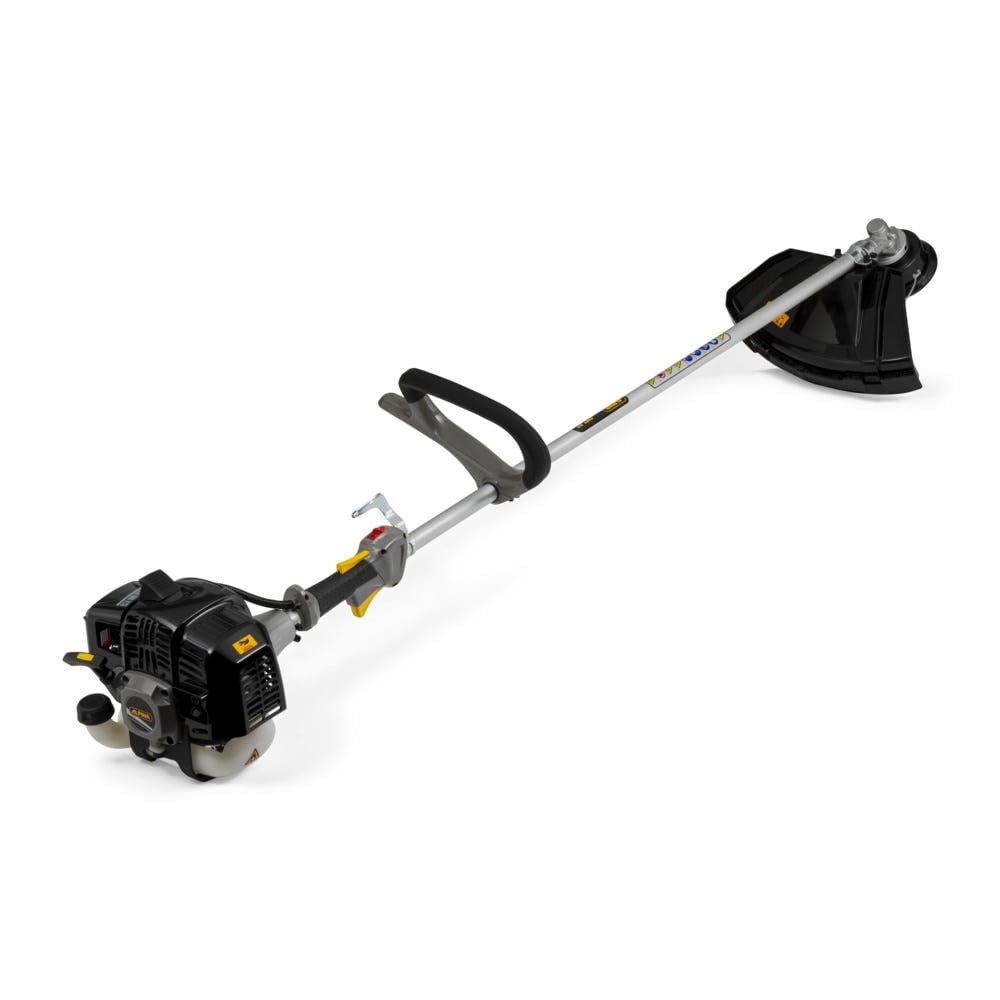
5. Alpina 287220004/A20 Petrol Brushcutter
A European-built cutter with the raw speed to slice through stubborn growth.
This Alpina runs a 2-stroke 32.6cc engine rated at 900W, and the listed top speeds show its personality: the three-point blade spins at 11,000 rpm and the double-wire head at 9,500 rpm. That kind of blade speed is what lets a smaller engine cut like a much bigger one, and the 43-centimeter cutting width gives you a wide, efficient pass.
It arrives with a generous kit — nylon thread head, metal blade, suspender, plastic jerry can, screwdriver, and Allen key — so you can start working from the start. The 0.8L tank keeps the weight down, and owners say it starts on the second pull.
The recurring nitpick is the bump-feed head, which owners find thin and prone to snapping line on stones; the advice is to swap in a fixed multi-line head for rough ground. The hip guard also slips and is uncomfortable, with several owners simply removing it. At 8.3 kg, the harness makes long sessions bearable, and the noise is enough that hearing protection is a must.
Best for… buyers who want a high-RPM gas cutter with a complete accessory kit and don’t mind a little assembly fiddling.
Look elsewhere if… you want a self-contained tool with no quirks — the string head and hip guard need immediate attention.
6. PROYAMA 40cc 4 Cycle Gas Weed Wacker Eater

The 4-cycle engine that removes the biggest chore in gas tools: mixing fuel.
The defining feature here is the engine type. The 40cc 4-cycle unit runs on regular gasoline straight from the pump, with no oil mixed in, which is a major convenience upgrade over 2-cycle machines and a big reason to pick this over the PowerSmart below. The 4-stroke design also runs with less vibration, making it more comfortable on long jobs, and it puts out a claimed 1.5HP for an 18-inch cutting width.
Owners describe it as a “monster” that starts on the first pull and slices through thick weeds and vines, with the included metal blades handling serious brush. It holds up well under heavy use, and the one-year warranty covers the engine.
The trade-offs are real: at 16 pounds it is heavy and awkward to balance, the pull cord is hard on the wrist, and the string head clogs on long grass. The most-discussed issue is starting reliability down the road — a few reviewers point out it becomes hard to start with the choke after a year.
Verdict: The strongest value proposition if you want the convenience of straight gas with enough torque for serious brush, and you are prepared for a heavy machine.
The reason to buy: No fuel mixing and a 40cc engine make this the easiest gas option for regular heavy use.
A fair warning: The weight and pull-start resistance make it a poor fit for smaller or less strong operators.
7. Wild Badger Power 26cc 2-Cycle Gas Weed Wacker
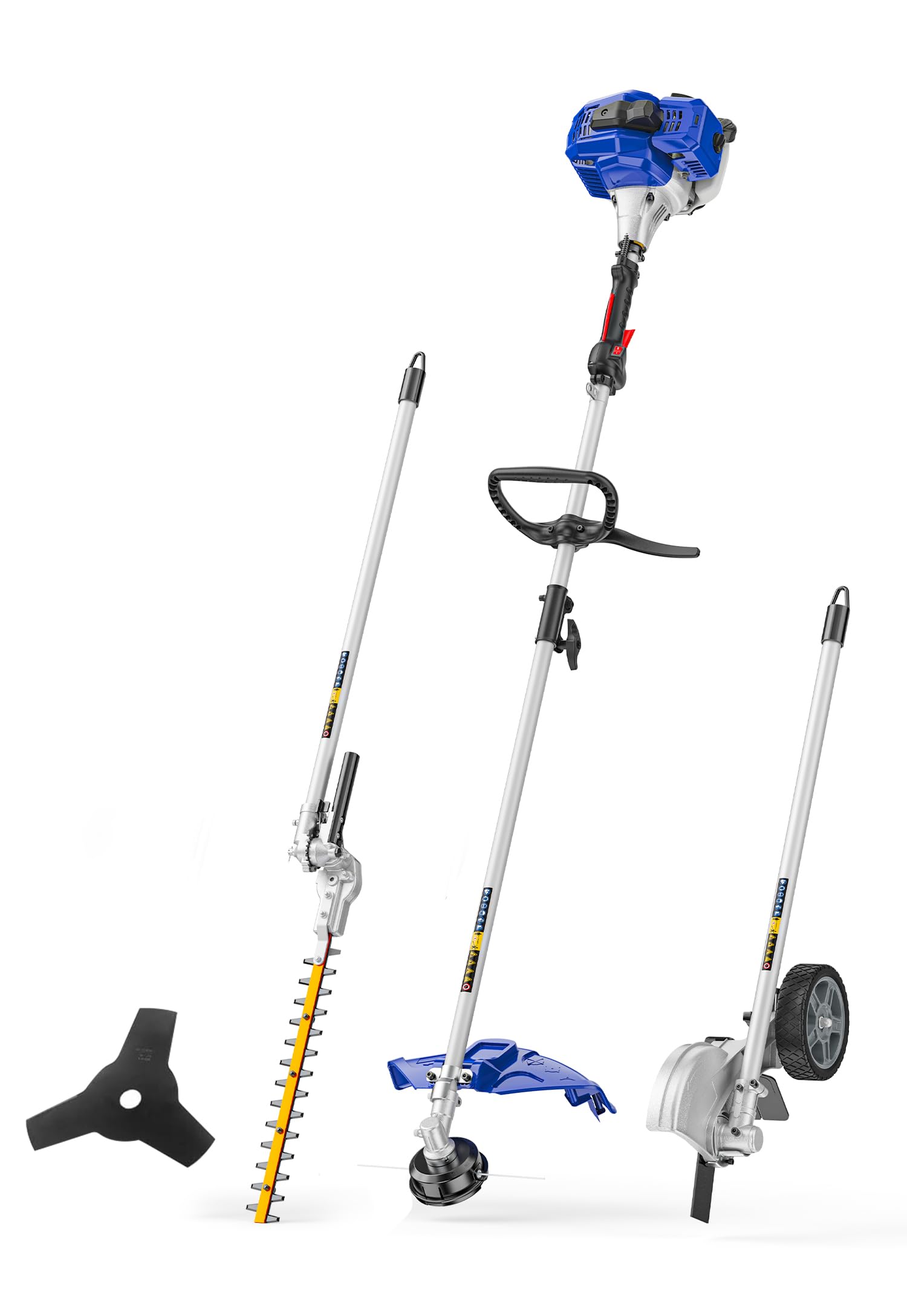
One powerhead, four attachments — a full yard tool lineup in a single box.
The 4-in-1 kit is the entire pitch here, and it delivers on the promise of versatility. You get a 17-inch string trimmer for grass, a 9-inch wheeled-edger blade for clean borders, a 16-inch hedge trimmer, and a 10-inch brush-cutter blade for heavier growth — all swapping on and off the 26cc powerhead in seconds with no tools. The quick-change multi-tool design is genuinely practical for moving between jobs.
Comfort is handled by an aluminum transmission support that cuts vibration, plus a rubber handle and shoulder harness. The engine is a 2-cycle unit, so it needs a gasoline-and-oil mix, and it is designed to start within five pulls. Unusual for this price tier, it is backed by a 3-year limited warranty that covers both homeowners and commercial use.
The catch with this one is reliability. At 23.9 pounds it is the heaviest handheld unit on this list, and durability feedback is split — some shoppers say it stopping after a couple of minutes, while others run it for hours. Owners praise the sturdy build and the easy starts, mentioning the grease fittings as a nice touch, and note it needs a cool-down break after 4-5 hours of work.
The strongest points
- Four attachments cover trimming, edging, hedging, and brush
- Tool-less attachment swaps in seconds
- 3-year commercial-grade warranty
What to weigh
- Heaviest handheld pick at 23.9 lbs
- Reliability reports are mixed
Reach for this if… you want one machine that does everything around the yard and value the warranty.
Think twice if… you need a tool for a single heavy job and want maximum reliability over maximum flexibility.
8. PowerSmart Gas Weed Wacker 2-Cycle 25cc

The budget gas entry that punches far above its price on power.
For a first gas trimmer, this PowerSmart makes a compelling case. The 25.4cc 2-cycle engine delivers a punchy power output, and the 2-in-1 design gives you a 10-inch brush blade plus a 0.095-inch trimmer line, so you can handle both lawn edges and tougher branch cutting with one tool at a 16-inch cutting width. Assembly is straightforward and quick, under 20 minutes by most accounts.
The balanced design and included shoulder strap keep vibration low, and the 5-times pulling starter makes it easy to fire up. At 18.7 pounds, it is a heavy unit, but the harness helps.
This is where the reliability warnings get loudest in the data. The biggest concern is durability — several buyers report units failing within two weeks, starting but dying under load. The shield also tends to fly off due to vibration, a design flaw you will want to check.
The takeaway: Excellent power-to-price ratio, but you are taking a bigger gamble on longevity than with the heavier PROYAMA units.
The best fit: A budget-conscious buyer who wants gas power for light-to-medium brush and accepts a higher failure risk.
Not ideal for… anyone who needs a machine to last through years of rough, regular use.
9. BILT HARD Walk Behind String Trimmer
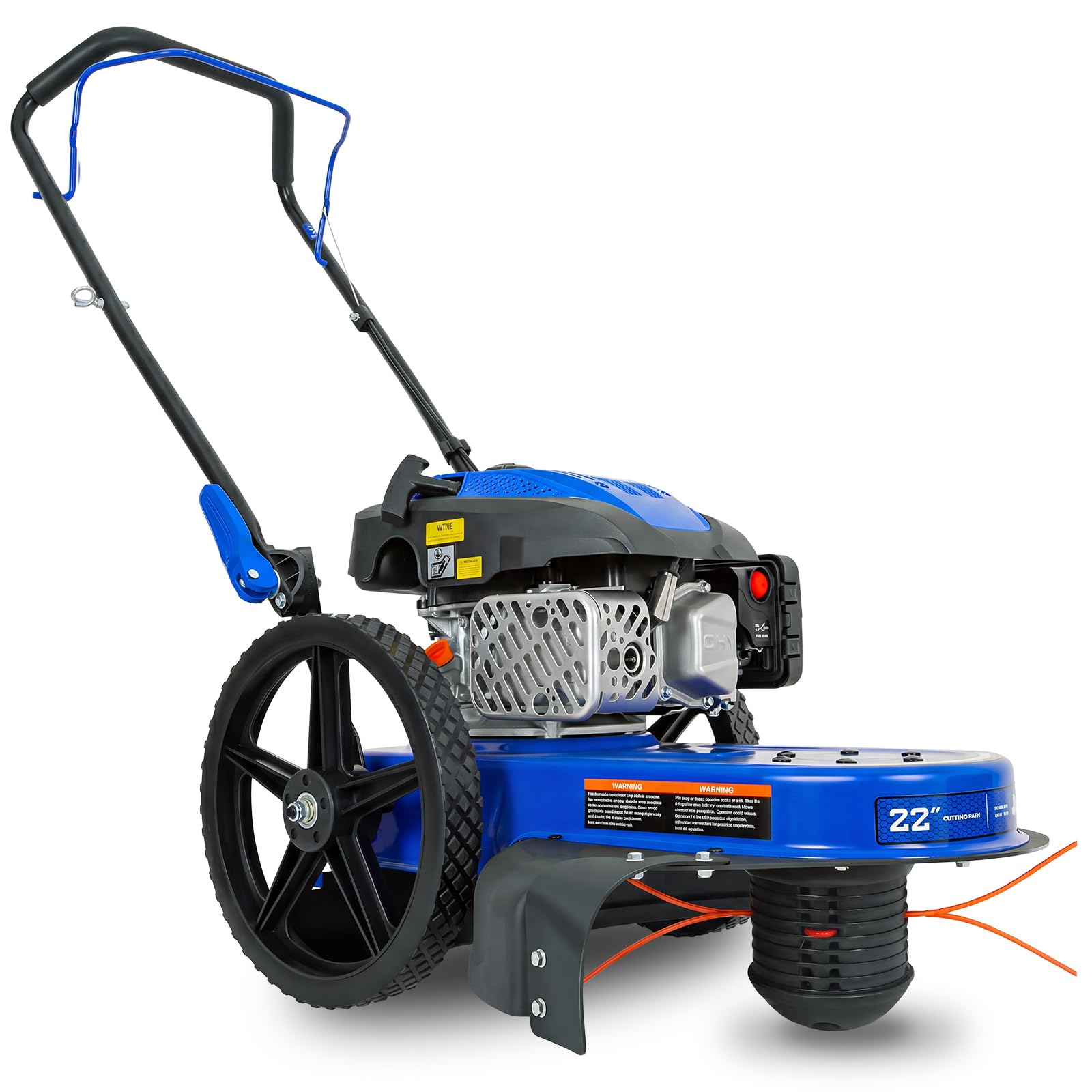
The sit-back solution for clearing acreage without carrying a machine on your back.
This is a completely different approach to brush cutting. Instead of strapping a motor to your shoulders, this walk-behind unit rolls on 14-inch never-flat wheels while a 170cc 4-cycle OHV engine swings a heavy-duty nylon line through a wide 22-inch path. The one-piece steel deck minimizes vibration and adds stability, and the foldable ergonomic handle means it stores compactly when you are done.
For fields, fence lines, and areas where a standard mower can’t reach, this design saves your arms and back entirely. The manual recoil start is straightforward, and owners mention it starts on the second pull.
The performance is exactly what the spec suggests: owners describe it cutting 8 to 12 inch grass “like butter,” and it handles rough, uneven terrain that would stall a push mower. The trade-offs are specific: the string wears out fast on rough ground, the belt is a known weak point with some reporting it breaking after about 15 minutes, and at 54.1 pounds it’s not portable in any meaningful sense.
The niche: If you have a large, overgrown area and hate carrying a trimmer, this walk-behind changes the math entirely.
Best for… owners of large lots and fields who want to clear vegetation standing upright, not bent over a harness.
Who it’s not for… anyone with small yards, fine landscaping, or a need for precision trimming in tight spots.
Understanding the Specs
2-Cycle vs. 4-Cycle Engines
The engine type changes your daily routine. A 2-cycle engine (like the 25cc PowerSmart) requires you to mix oil into the gasoline before every fill — more prep, but these engines are typically lighter and spin up fast. A 4-cycle engine (like the 40cc PROYAMA) runs on straight gas from the pump, simplifying refueling, but the engine block is usually heavier and the power delivery feels different. The choice is about convenience versus weight.
Cutting Width and Blade Type
Cutting width (in inches or centimeters) determines how much ground you cover per pass — a wider head like the 22-inch walk-behind clears more area faster than a 15-inch trimmer. Blade type matters even more: nylon line handles grass and light weeds, while a metal blade (3-tooth or circular) is required for saplings, vines, and dense brush. Match the blade to the job or you’ll spend your day replacing line.
FAQ
Do I need a harness for a heavy gas brush cutter?
What is the difference between a 2-cycle and 4-cycle engine?
Can a brush cutter handle small trees and thick vines?
How long does a cordless brush cutter battery last?
Is a walk-behind brush cutter better than a handheld one?
What does engine CC mean and how much do I need?
Why does my string trimmer keep clogging on long grass?
What safety gear should I use with a brush cutter?
Is a cordless brush cutter as powerful as a gas one?
Final Thoughts: The Verdict
For most people, the clear winner in the brush cutter space is the Makita DUR368AZ because it delivers gas-grade cutting power in a 7.5-pound package with no fuel and no pull cord. If you want maximum clearing muscle for a large property and don’t mind the weight, the PROYAMA 51.7cc is the heavy-duty brute to reach for. And for the buyer who wants one powerhead to run every yard tool, the versatile Makita XUX01ZM5 couple-shaft system is the smart long-term investment.
How We Picked
We do not accept paid placement. Every pick is matched to a real buyer and a real use-case; we do not hands-on test units.
Sources & Methodology
Specifications: manufacturer listings and product documentation. Review insights: verified customer reviews, as of August 2026. Pricing: not shown on this page (it changes often); check the current price via the retailer link.
As an Amazon Associate, Gadgets Feed earns from qualifying purchases. This does not affect which products we feature.