
Our readers keep the lights on and my morning glass full of iced black tea. As an Amazon Associate, I earn from qualifying purchases.
Specs are compiled from manufacturer listings and verified buyer reviews and can change over time — please confirm the key details on the product page before buying.
You want an at home batting cage that won’t collapse in a breeze or shred on the first line drive. Durability hinges on frame material, pole thickness, and fit, not brand.. Use this guide to match a cage to your space, hitters, and climate..
I’m Min — the founder and writer behind Gadgets Feed. This guide is built by comparing the manufacturers’ published specifications and the patterns across verified customer reviews, so you get each pick’s real strengths and trade-offs instead of marketing spin.
No single cage fits every yard, so this breakdown of the best at home batting cage options weighs portability against raw durability—match the frame to your space and your hitters.
Our Picks at a Glance


How To Choose The Best At Home Batting Cage
An at home batting cage is a big commitment of yard space and money, so you want to get the fundamentals right before you commit. Prioritize frame strength, netting quality, and ground anchoring..
Frame Material and Pole Thickness
The frame bears wind and wayward swings, so thicker poles resist bending.. Fiberglass poles are the standard for portable cages because they flex instead of snap, but the thickness matters. A 12.7mm fiberglass pole is noticeably more rigid than a 10mm one, so if you’re planning to use real baseballs with teenage hitters, the thicker pole is worth seeking out.
Cage Length and Your Yard
Cage length dictates practice type: 40 feet for full swings, 22 feet for tee work.. A 40-foot cage gives you room for a full swing and higher-arcing pitches, which is why it’s the choice for serious hitters. Smaller tunnels like 22-foot or 24-foot models fit tighter backyards and still work for tee work, soft toss, and younger players, but they can feel cramped for an adult taking full swings.
Ground Anchoring and Stability
Most cages come with stakes, but not all stakes are created equal. Short U-shaped stakes that come with budget cages often won’t hold in soft dirt, while longer steel pegs or sandbags will. If you live in a windy area, look for a cage with adjustable guy ropes and strong pegs — or plan on upgrading the stakes yourself.
Quick Comparison
| Model | Best For | Length | Height | Weight | Amazon |
|---|---|---|---|---|---|
| Skywalker Sports 40 Foot★ Best Overall | Serious hitters with big yards | 480 in | 120 in | 99 lb | Amazon |
| ANYTHING SPORTS 40 FootPremium Pick | Collapsible full-length practice | 40 ft | — | 138 lb | Amazon |
| Heater Sports Xtender 24′Top Performer | Pitch timing with machines | 24 ft | 120 in | 50 lb | Amazon |
| Arikit 30FT Upgrade | Mid-size yards, machine use | 30 ft | 108 in | 45 lb | Amazon |
| ORIENGEAR 20FT | Fully enclosed compact space | 20 ft | 108 in | 33 lb | Amazon |
| Apex Sports 22ft | Small yards, solid quality | 22 ft | 96 in | 15.31 kg | Amazon |
| VEVOR Portable Batting Cage | Budget-friendly full enclosure | 266.93 in | 94.49 in | 27.1 lb | Amazon |
| ZivPlay 22ft Pop Up | Quick setup for kids | 264 in | 96 in | 29.2 lb | Amazon |
| Heater Sports 12′ Home Run | Light toss with young kids | 12 ft | 120 in | 21 lb | Amazon |
In‑Depth Reviews
1. Skywalker Sports 40 Foot Competitive Batting Cage
Our pick — over 4★ from 150+ verified ratings; the strongest balance of quality and price.
The full-size tunnel that laughs at gusts and supports real batting practice for years
Its 480-inch length and 120-inch clearance provide ample room for full swings.. That translates to a full 40 feet of runway, which means you get space for a complete swing and higher-arcing pitches without the ball clipping the net above you. The 99-pound package weight tells you this is a permanent-feeling structure, not a pop-up you wrestle with every session.
What wins people over is the assembly experience. The frame and net come with all the hardware you need, and owners consistently describe the setup as straightforward with clear instructions. The rusty-steel-and-weather equation is handled by rust-resistant steel tubing paired with UV-treated netting, so it’s built to live outdoors. Buyers report it “Survived 40mph winds on slight grade with legs spread wider; no concrete/guide wires needed,” which is remarkable for a freestanding cage of this size.
The honest trade-off is net quality and some sag. But the collapsible design helps with upkeep—carabiners let you roll the net up to mow underneath, and the whole cage retracts from 40 feet down to between 5-10 feet when you need the yard space back.
What Owners Applaud
- Assembly is the standout feature — clear instructions and a sturdy end result
- 40 ft of length with 10 ft of clearance suits advanced hitters
- Rust-resistant steel frame and UV-treated netting hold up to weather
Where It Demands Patience
- Netting tends to sag and droop more than the photos suggest
- A 99 lb frame needs two people to set up and move around
Your best bet: This is the pick for a family with a serious young hitter and a yard that can host 40 feet of tunnel.
Think twice if: You need to take it down and store it every week — at 99 pounds, portability is not this cage’s strength.
2. ANYTHING SPORTS 40 Foot Collapsible Batting Cage
A full 40-foot tunnel that folds down small enough to fit a modest backyard
If you want the full 40-foot hitting experience but your yard can’t host a permanent structure, this is the cage to consider. The collapsible design is the defining feature, and owners consistently report they can set it up with a 12-year-old’s help — no construction crew needed. The whole package weighs 138 pounds, which is heavy for a portable cage but explains the stability when it’s up.
This cage offers strong value, paying for itself after a dozen sessions.. Owners who’ve priced out commercial cages note that batting cages cost an hour to rent, so a collapsible cage in the backyard pays for itself after a dozen or so sessions. It pairs well with a pitching machine, and buyers specifically recommend it as a replacement for the drive to the park and the chore of chasing balls around. The frame is described as “medium duty” — sturdy enough for regular family use, though not a commercial-grade monster.
The catch is that the poles are not the beefiest you’ll find. A few owners mention bent poles and a frame that feels a bit flimsy until it’s fully staked, and one harsh review claims the net tears easily under powerful hitters. The manufacturer does send replacement poles quickly when you contact them, which softens the blow, but this is a cage for family practice, not a professional training facility.
Collapsible value: The 40-foot length with fold-away convenience makes this the smart buy for a family that wants serious practice space without sacrificing the yard.
Reality check: Treat the poles with respect during setup and you’ll avoid the bent-pole complaints that show up in the reviews.
3. Heater Sports Xtender 24′ Batting Cage
The backyard tunnel that compresses pitch timing so a 50 MPH throw feels like 96
This cage’s 24-foot length does something remarkable for your reaction time. According to the maker, The 24-foot length compresses reaction time, making a 50 MPH pitch feel like 96 MPH., which is exactly the kind of training advantage that helps hitters speed up their hands. The fiberglass arch frame with 1/2-inch fiberglass rods and foam padding makes it portable enough for any sized yard.
The setup story is surprisingly good for a cage this size. The fiberglass rods snap and stack into place, and customers note a solo builder can handle the poles in about an hour, with a second person needed for about 20 minutes of netting work. The built-in harness lets a pitching machine and its operator stay outside the cage for safety, which is a feature families love. One owner has bought three Heater cages over 12 years, calling the durability solid until a lawnmower tore the net.
The durability caveat is real. The 1/4-inch polyester net will develop holes over time if you’re hitting real baseballs, and one harsh review reports the net snapped after a single winter with snow load. This is a cage that rewards careful storage — take it down for big storms and it will last, but leave it up through a snowy season and the net pays the price.
Why It Wins at Training
- 24 ft length creates realistic pitch timing that accelerates hand-eye coordination
- Steel ground stakes and 1″ nylon support ropes add stability
- Fiberglass rods snap together for quick setup and takedown
Where It’s Vulnerable
- Real baseballs will eventually punch holes in the 1/4″ polyester net
- Snow load can snap the net — it needs to come down for winter
Reach for this if: You’re training a hitter who needs to catch up to faster pitching and you have about 24 feet of yard to spare.
Look elsewhere if: Your plan is year-round outdoor use in a snowy climate without storing it between sessions.
4. Arikit Upgrade 30FT Baseball and Softball Batting Cage

A 30-foot mid-size tunnel with an included target that keeps balls out of the neighbor’s yard
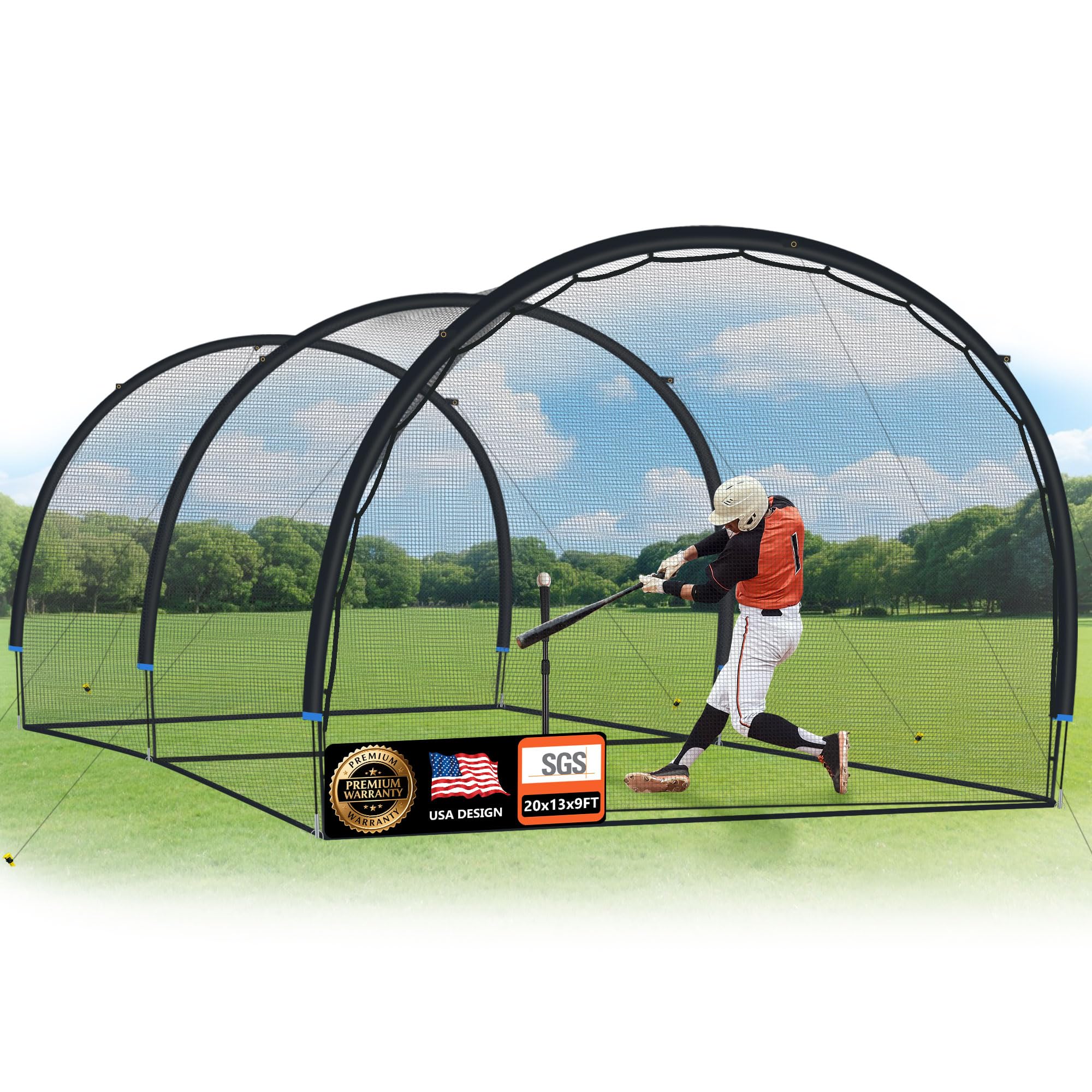
Sitting at 30 feet long, 13 feet wide, and 9 feet tall, this cage splits the difference between compact pop-ups and the massive 40-foot tunnels. That makes it a smart fit for yards that have a little room to spare but can’t host a full-size structure. The enclosure design with a removable gate is a genuine selling point — it stops balls from rolling into the neighbor’s yard and makes practice sessions less about chasing and more about swinging.
The build quality punches above its tier. The frame uses high-strength 1/2-inch fiberglass poles, and the net is a 3-ply polyester square mesh with oxford cloth seams designed to absorb strong impacts. Owners who have had it for a year report it works well with a pitching machine, and one even noted it keeps birds away from the yard. The one-piece design with elasticated poles lets two people set it up in about 15 minutes, which is fast for a cage this size.
There’s a reason the quality feedback is mixed, though. Some owners describe the setup as outstanding while others find it complicated, and the durability reviews flag that the hoops can fall during heavy storms even when the stakes hold. One safety-minded owner found gaps between the main cage and the pitching machine netting that could let a line drive through, so you’ll want to check the seams on arrival.
Balanced mid-size: The 30-foot length with a free target makes this a strong value for a family that wants machine practice without a massive footprint.
Setup variance: One owner claims 15 minutes, another found it complicated — budget a full afternoon the first time.
5. ORIENGEAR 20FT Fully Enclosed Batting Cage
A fully enclosed 20-footer with a 1.25-inch mesh that keeps every ball corralled
The most useful spec here is the 1.25-inch grid on the netting. That tighter mesh, paired with the fully enclosed design, means balls stay put instead of sneaking through gaps — a real frustration with cheaper 2-ply nets. At 20 feet long, 13 feet wide, and 9 feet tall, it’s built to carve out its own training space in a compact yard, and the button-linked door lets you get in and out easily.
Durability is the headline for the right owner. One family reports it survived six months including a hurricane and snow, with thousands of reps, and it lays flat in high winds without full disassembly. The high-strength fiberglass poles and oxford cloth seams are designed to bear strong batting impact, and the package includes enough ground stakes to anchor it firmly on grass.
The flip side is that assembly and durability get genuinely mixed reviews. Some owners call the setup an absolute nightmare that needs three people, the plastic stakes tend to break, and there are multiple reports of poles snapping within a week of use. The manufacturer does offer a free one-year after-sales service and sells replacement poles, which helps, but this is a cage that rewards careful assembly and grass-only use.
The Enclosure Advantage
- 1.25″ mesh keeps balls from escaping the cage
- Button-linked door makes entry and exit easy
- Lays flat in high winds without full disassembly
The Assembly Reality
- Fragile poles and plastic stakes are the weak points
- Expect to need two or three people for the first setup
Grab it for: A compact yard on grass where you want a fully enclosed space and don’t mind a challenging first assembly.
Pass on it if: You plan to set up and tear down frequently — the poles are too fragile for weekly reassembly.
6. Apex Sports 22ft x 12ft x 8ft Batting Cage
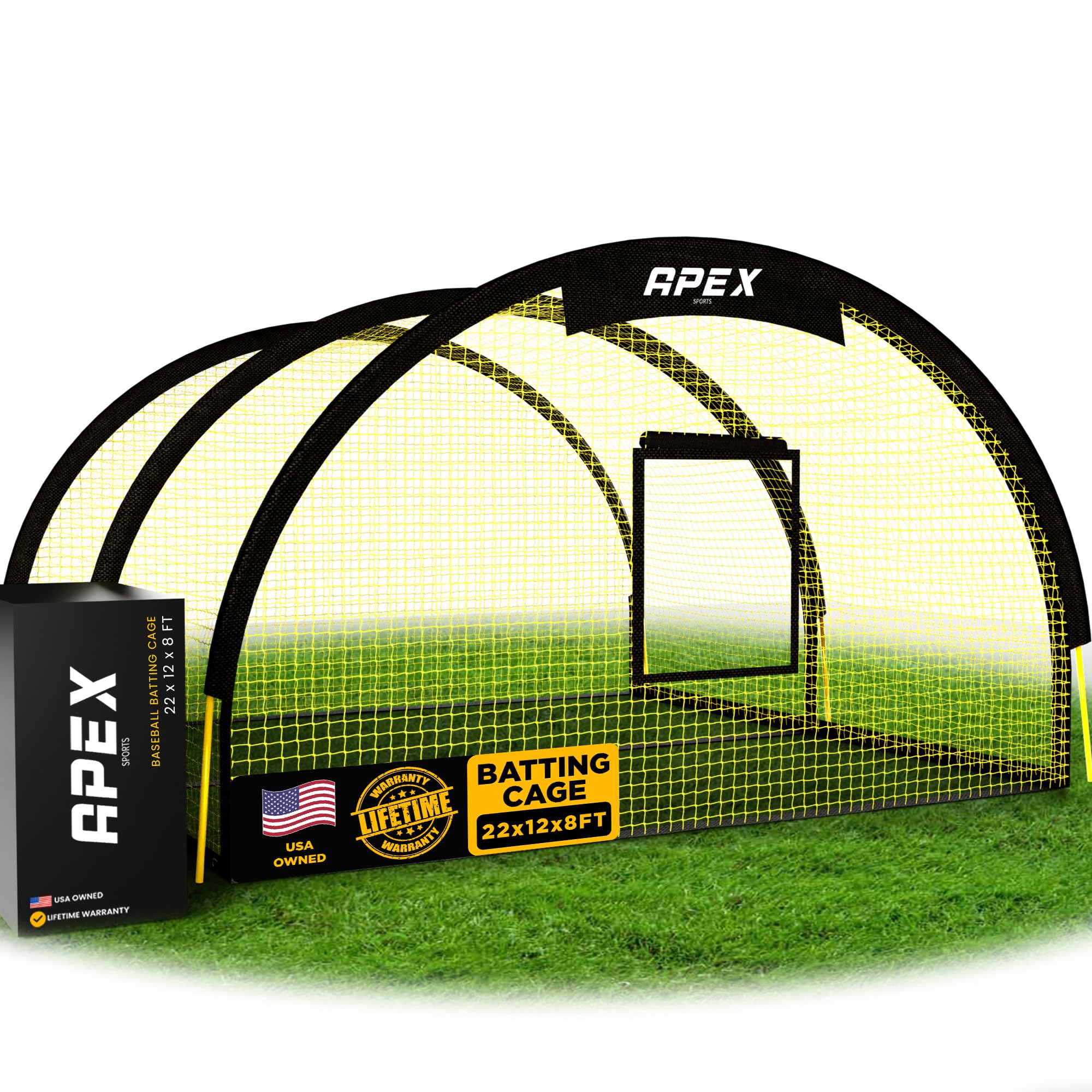
A 22-foot yellow-net tunnel that fits smaller yards and still takes a beating
The defining quality here is the 3-ply stretchable polyester netting with a 1.25-inch grid, which rebounces balls softly while holding up to strong hits. The 3.5-foot by 2-foot pitching machine hole means you can feed real machine pitches, and the 12.7mm fiberglass poles are the thicker kind that resist bending under real swings. For a 22-foot cage, it’s remarkably well-suited to smaller yards.
Quality is the aspect owners praise most, and it shows in the details. The netting contains balls well, the frame stays put on windy days, and a family that ran daily drills all summer with grandchildren called it durable and effective. Setup is manageable if you watch the video first, and one owner even upgraded the stakes with hardware-store versions for about to make it rock-solid.
The weak spots are the included stakes and the end flap. Some reviewers point out the wide end hole has a flap that isn’t fully secure, and one frustrated buyer found it knocked down every morning no matter how well it was staked. Upgrading the stakes seems to solve most stability complaints, which makes this a smart budget play if you’re willing to spend a few extra dollars on better anchors.
Small-yard specialist: The 22-foot footprint with thick poles and quality netting makes this the best value for a compact space.
One upgrade away: Swap the stock stakes for stronger pegs and most stability complaints disappear.
7. VEVOR Portable Batting Cage

A lightweight 27-pound cage that delivers full enclosure on a strict budget
At just 27.1 pounds, this is the lightest full-size cage in the lineup, and it’s genuinely portable. The 22.2 by 12.1 by 7.9 foot footprint gives athletes plenty of room to swing, and the fully enclosed polyester netting with 4-ply reinforced mesh and 600D nylon edge fabric is built to handle repeated impacts. The high-heat cured fiberglass rods and reinforced joints keep it stable in strong winds.
The value proposition is what owners talk about most. For a budget price, you get a removable door, a pitching machine opening, and a complete accessory kit including a 600D waterproof storage bag, a repair module, 12 tie ropes, and both U-shaped and metal ground stakes. One family with kids aged 8 and 13 got major use out of it with tees, overhand pitches, and a machine, calling it an “absolute steal.”
This is where the mixed durability feedback lives. Shoppers say the instructions are genuinely terrible, the stakes that come in the box are too short to hold in soft ground, and one owner’s zipper broke in the first week. The netting durability also gets mixed marks — some find it sturdy, others report rips after a few sessions. It’s a cage that works best if you store it carefully and upgrade the stakes.
The Budget Appeal
- 27.1 lb weight makes it the most portable full-size option
- Complete kit includes storage bag, repair module, and 14 stakes
- 4-ply reinforced mesh and 600D nylon edges resist tears
Where It Falls Short
- Instructions are widely described as confusing
- Stock stakes are too short for soft ground; zipper quality is weak
Best for: A family on a strict budget that wants full enclosure and will store the cage after each session.
Not ideal for: Anyone expecting a leave-it-out-all-season cage — the stakes and net need care to last.
8. ZivPlay 22ft Pop Up Batting Cage

A pop-up cage with 12.7mm poles that sets up in under 30 minutes for kid hitters
The headline here is speed. The manufacturer claims setup in under 30 minutes with no tools required, and the step-by-step visual manual makes it approachable for a first-time buyer. The 12.7mm fiberglass poles are the thicker kind designed not to break, and the 3-ply stretchable polyester net rebounds balls softly instead of tearing on impact. For kids aged 12 and under, this is a genuinely effective practice space.
The 22 by 12 by 8 foot dimensions include a 20-inch by 40-inch pitching hole, so you can practice with a pitching machine or a live pitcher through the detachable door. The 8 supporting ropes with ground pegs are meant to keep it standing under heavy winds. Families report being outside every night after school once it’s up, and it survived 12-plus hits without damage in early testing.
The durability story is the reason to be cautious. Durability is the most-mentioned negative aspect, with several owners reporting poles snapping within a month of use, especially after a winter takedown and reassembly. The netting also has gaps at the edges that let balls escape, and one owner noted the net at the top doesn’t stay tight enough for an adult to take full swings. This is a cage for kid practice, not adult batting.
Kid-friendly speed: The 30-minute setup and soft-rebounding net make this perfect for young players who want to practice daily.
Size it right: Keep expectations realistic — this is a 12-and-under cage, not a full-swing adult tunnel.
9. Heater Sports 12′ Home Run Batting Cage

A 12-foot fiberglass tunnel that’s ideal for soft toss with the youngest hitters
This is the smallest cage in the roundup, and that’s exactly its strength. At 12 feet long with a 10-foot height, it’s built for soft toss, tee work, and very young hitters. The tubular steel legs with rubber tips provide stability, and the 21-pound weight means one person can move it around the yard. It works great for a 6 and 8-year-old doing soft toss, according to owners.
The pitch machine compatibility is the headline spec. It comes with a built-in machine square (machine not included) with dual speed controls that let you pitch curve balls and fastballs, plus an adjustable pitch height. One owner reports extending it to 44 feet for use with real baseballs at 40-65 MPH. For a family with small kids, the lightweight netting stops balls fine and keeps windows safe.
There are real limits here. The netting is light and flimsy compared to full-size cages, the poles need tent pegs and string to stay up in wind, and it’s genuinely not suited for real baseball with adult hitters. One owner’s pitching machine hole was too small — only about 20% of pitches made it through. This is a wiffle-ball-and-soft-toss cage, and judging it against a 40-foot tunnel would be unfair.
The Kid-Safe Appeal
- 21 lb weight is the lightest — easy to move and store
- Built-in machine square with dual speed controls for curveballs and fastballs
- Keeps balls contained and windows protected for young kids
Know Its Limits
- Netting is light and flimsy for real baseball use
- Poles need extra pegs and string to stay up in wind
Choose this for: A young child’s first cage where soft toss and wiffle balls are the main activity.
skip it if: You have teenage hitters throwing real baseballs at 40+ MPH — the net won’t survive that abuse.
Understanding the Specs
Cage Length and Pitch Timing
The length of your cage does more than determine how much space you need. A longer tunnel like 40 feet gives a ball more room to travel, so a pitcher can throw from a realistic distance and still have the ball arrive at the plate with realistic timing. Shorter cages like 24 feet compress that reaction window, which can help a hitter speed up their hands, but they need a machine or a short toss to work.
Net Ply and Mesh Size
Netting is described by its ply and its grid size. A 3-ply net is three layers of polyester woven together, which rebounces balls softly and resists tearing better than a 2-ply net. The mesh size, like 1.25 inches, is the gap between the net fibers — a smaller gap keeps balls from squeezing through and is a sign of a more durable net.
FAQ
How long does a typical backyard batting cage take to set up?
What size batting cage do I need for my backyard?
Can I leave my batting cage up year-round outdoors?
Are thicker fiberglass poles really worth it?
Will a batting cage work with a pitching machine?
How do I keep a portable batting cage from blowing over in the wind?
Is a 3-ply net worth paying extra for?
Can adults take full swings in a compact batting cage?
What’s the difference between a collapsible and a permanent batting cage?
Do batting cages work for softball practice too?
Final Thoughts: The Verdict
For the majority of shoppers, the best at home batting cage is the Skywalker Sports 40 Foot—its rust-resistant steel frame, UV-treated netting, and 40 feet of length give you the closest thing to a commercial setup, and owners actually praise the assembly. If you have a smaller yard but want serious pitch timing training, the Heater Xtender 24′ turns a modest footprint into a reaction-time workout. And for a family on a budget that still wants full enclosure, the Apex Sports 22ft delivers the best balance of thick poles, quality netting, and a price that won’t empty the wallet.
How We Picked
We do not accept paid placement. Every pick is matched to a real buyer and a real use-case; we do not hands-on test units.
Sources & Methodology
Specifications: manufacturer listings and product documentation. Review insights: verified customer reviews, as of August 2026. Pricing: not shown on this page (it changes often); check the current price via the retailer link.
As an Amazon Associate, Gadgets Feed earns from qualifying purchases. This does not affect which products we feature.