
Our readers keep the lights on and my morning glass full of iced black tea. As an Amazon Associate, I earn from qualifying purchases.
Specs are compiled from manufacturer listings and verified buyer reviews and can change over time — please confirm the key details on the product page before buying.
A dead battery is never convenient, and the only way to see it coming is to measure what a battery can actually deliver when you turn the key. This guide covers the best ACT Battery Tester options on Amazon, breaking down the difference between a cheap voltage check and a real load test so you can stop guessing and start knowing.
I’m Min — the founder and writer behind Gadgets Feed. This guide is built by comparing the manufacturers’ published specifications and the patterns across verified customer reviews, so you get each pick’s real strengths and trade-offs instead of marketing spin.
You will learn which features actually matter, how to read the numbers, and why the right act battery tester earns its keep the first time it saves you from a tow.
Our Picks at a Glance


How To Choose The Best ACT Battery Tester
Before you look at any model, you need to know what your vehicles use. A tester’s CCA range tells you if it can even measure your battery, and understanding that number is the difference between a tool that works and one that just sits in the drawer.
Start with the CCA range
CCA stands for cold cranking amps, the measure of how much power a battery can deliver for 30 seconds at 0 degrees Fahrenheit. Every tester has a range it can read, like 100-2000 CCA. If your truck battery is rated at 850 CCA, you need a tester that covers at least that number.
Conductance vs carbon-pile load test
Most modern testers use conductance testing, which sends a small signal through the battery to measure internal resistance without pulling heavy current. This is safe and fast. A carbon-pile tester applies an actual 100-amp load, which is more realistic but generates heat and demands you follow timing rules.
Check the operating voltage range
Some testers only handle 12V systems, while others read 6V motorcycle batteries and 24V heavy truck systems. If you own anything beyond a standard car, a wider voltage range saves you from buying a second tool.
Quick Comparison
| Model | Best For | CCA Range | Voltage | Key Feature | Amazon |
|---|---|---|---|---|---|
| Clore SOLAR BA9★ Best Overall | Precision & portability | 40-1200 CCA | 12V | 0.4 lb travel size | Amazon |
| KONNWEI KW208Best Value | Best value for cars | 100-2000 CCA | 12V | Galvanized clips | Amazon |
| ANCEL BST1004-Wire Precision | Kelvin 4-wire accuracy | 100-2000 CCA | 12V | 4-wire Kelvin test | Amazon |
| TOPDON BT50 | Boats & RVs | 100-2000 CCA | 12V | Spark-free clips | Amazon |
| VDIAGTOOL BT300 | Bluetooth tracking | 5-3000 CCA | 6V/12V | 2.8″ TFT display | Amazon |
| Battery Tender | True load testing | Up to 1000 CCA | 6V/12V | 100-amp load test | Amazon |
| VDIAGTOOL BT500 | 6V/12V/24V flexibility | 5-3000 CCA | 6V/12V/24V | 5-in-1 safety | Amazon |
| TOPDON BT100 | Simple LED verdicts | 100-2000 CCA | 12V | 3-LED status | Amazon |
| ANCEL BST500 | Printed reports | 100-1700 CCA | 12V/24V | Built-in thermal printer | Amazon |
In-Depth Reviews
1. Clore Automotive SOLAR BA9
Our pick — over 4.5★ from 800+ verified ratings; the strongest balance of quality and price.
The featherweight that delivers shop-grade readings without the bulk.
Accuracy is the whole game here, and it is what wins people over. The tester reads CCA and conductance, then flags a battery as bad when its output sits 20% below the rated CCA. That single rule caught a failing battery in a 2020 Subaru before it ever left anyone stranded, and a fresh 750 CCA battery read a healthy 695 CCA on the screen.
You get a 4-line LCD that stays readable in bright sun, plus a 40-1200 CCA range that covers most cars and boats. The unit weighs just 9.6 ounces and even drops into a Pelican 1060 case, so it lives in a toolbox without crowding anything out.
The operating range spans 7-15V, and it handles Flooded, AGM, Spiral, and Gel Cell chemistries. The manual is the weak point — it is small and assumes you know battery types already. It works fine if you know your battery’s CCA rating, and a quick video search fills the gaps.
Accuracy first: The 40-1200 CCA range is tighter than most rivals, but the readings are trusted for real decisions, including marine AGM batteries where it matched rated CA specs closely.
Reach for this if: you want a precise, pocketable tester for cars and boats that you can trust at a glance.
Look elsewhere if: you need a wide CCA range beyond 1200 or you expect the manual to teach you battery basics.
2. KONNWEI KW208
The crowd favorite that flags a dying battery before your car does.
Reliability is the thing everyone raves about with this one, and it has earned its place as the most popular tester in the category. It covers a 100-2000 CCA range, reads voltage, internal resistance, and battery health, then tells you plainly whether to recharge or replace. A 15-year-old Jeep battery was flagged for replacement immediately, while a salvaged Optima Blue Top AGM scored good CCA and MCA readings.
Galvanized alloy clips, updated for durability, grip tighter and improve the 99.7% testing accuracy claim. The built-in AI chip returns results in milliseconds, and it runs cranking, charging, and alternator tests. The alternator diagnosis worked cleanly in practice.
You can test in-vehicle or out, and even dead batteries. The main catch is the skimpy manual — you will need to know your battery’s CCA and type to get accurate results. Keep it to CCA for cars and MCA for boats, and skip hybrid remote jump-start terminals that can trigger false “replace” results.
What owners lean on
- Reliability is the most-praised aspect by a wide margin
- Handles flooded, AGM flat plate, AGM spiral, and gel
- Glove-box friendly at 230 g
Where it trips up
- Manual is thin and assumes prior knowledge
- Accuracy gets mixed feedback on high-draw failures
Best for: the everyday driver who wants a proven, budget-friendly tester that handles most cars and trucks.
Consider another if: you need 6V support or a tester that walks you through setup step by step.
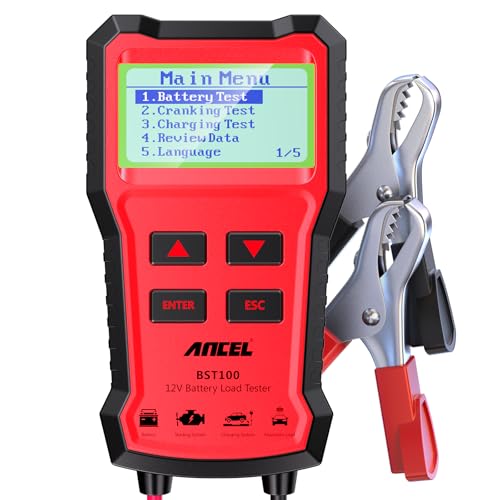
3. ANCEL BST100
Separate current paths deliver readings you can actually repeat.
Functionality is the standout here, and the 4-wire Kelvin method is the reason. By running separate current and voltage paths, the tester cuts out cable and contact resistance, giving you more stable results than a simple two-wire unit. It uses conductance-based testing, so no heavy current is applied to the battery.
You get CCA, battery health, state of charge, voltage, and internal resistance in one clear reading, plus cranking and alternator ripple tests. It proved itself diagnosing a bad 1987 Cutlass battery and then confirming the brand-new replacement was spot on.
The 100-2000 CCA range covers Regular Flooded, AGM Flat Plate, AGM Spiral, GEL, and EFB batteries, with support for standards like CCA, BCI, CA, MCA, JIS, IEC, EN, DIN, SAE, and GB. The manual is the recurring gripe — select the wrong battery type and results go sideways. An occasional “Connection Error” clears by reconnecting the clamps.
Stability matters: The 4-wire Kelvin design is the rare feature that genuinely improves reading consistency, not just a spec-sheet talking point.
Pick this if: you want stable, repeatable readings and a tester that estimates battery age cheaply across cars and even UPS batteries.
The catch: the manual skips crucial details on battery type selection and rating standards, so you will need to know your battery.
4. TOPDON BT50

Spark-free clamps make it the safe pick for tight engine bays.
Quality is what buyers notice first, and the spark-free technology is the defining safety feature. It eliminates explosion risk during testing while reverse-polarity protection guards against accidental misconnections. That matters when you are reaching into a cramped boat or RV compartment.
It delivers professional-grade insight into battery health, cranking capability, and charging system efficiency, with a data-review feature that tracks historical results so you can watch a battery degrade over time. Buyers use it on riding mowers, a fleet of eight vehicles, and typically challenging boat and RV situations.
The 100-2000 CCA range and six-language interface make it globally friendly, and the one-button operation appeals to every skill level. The 215 g weight and decent cable length keep it practical. Build quality gets mixed notes, so this is a home-garage tool rather than a daily shop hammer.
Safety first: The spark-free clips and reverse-polarity protection are the standout reasons to choose this over cheaper two-wire testers.
Reach for this if: you work on boats, RVs, or multiple vehicles and want a tester that prioritizes safe, error-proof connections.
Think twice if: you need a rugged body built for daily professional shop use.
5. VDIAGTOOL BT300
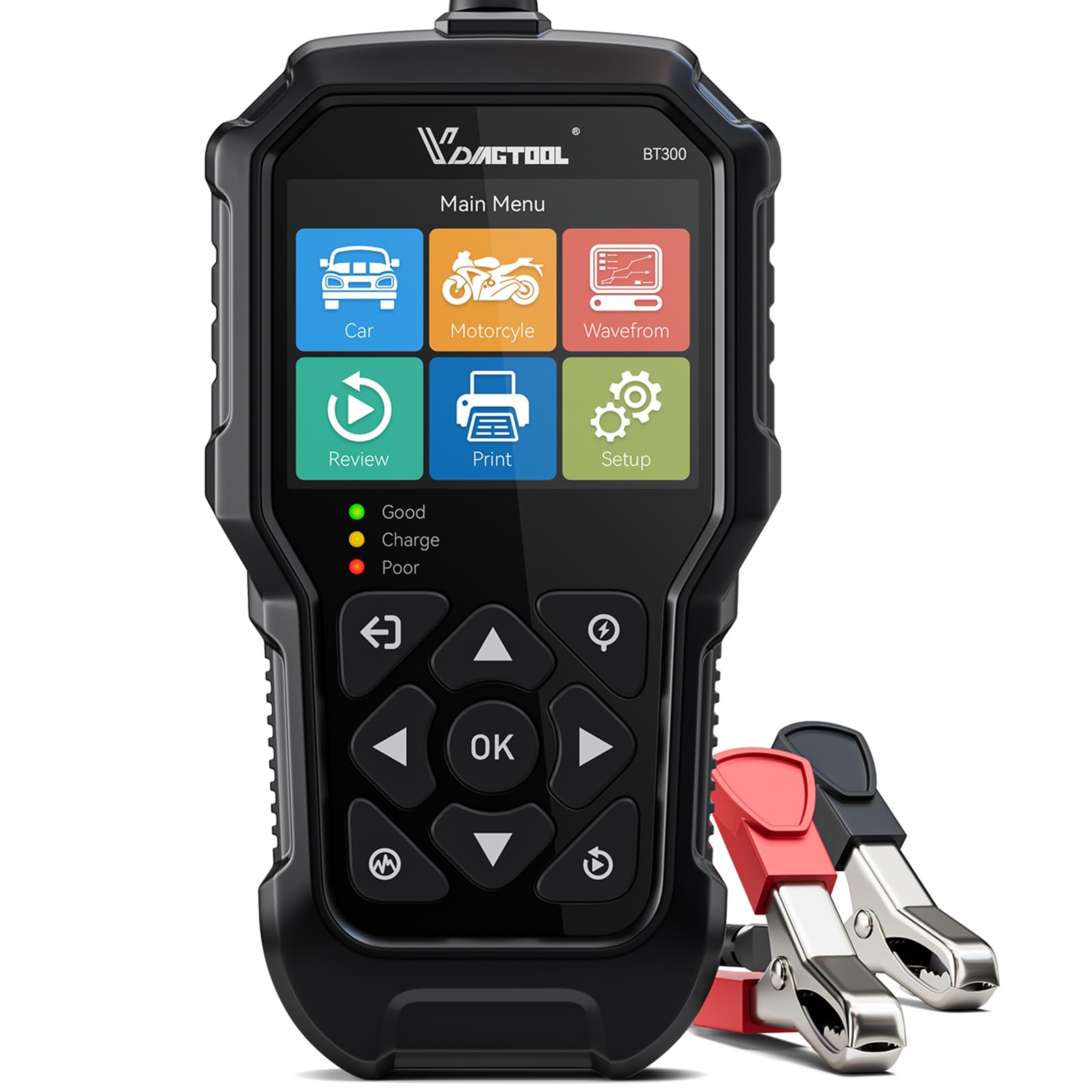
The 5-3000 CCA range plus Bluetooth makes it the most flexible tracker here.
Functionality dominates this pick, and the wide 5-3000 CCA range is the headline. It tests virtually any lead-acid battery — VRLA, SLA, AGM, GEL, LSI — across 6V and 12V systems, covering cars, motorcycles, trucks, SUVs, and boats. The flexible CCA settings let you adjust in ±5 or ±50 steps for ultra-accurate results.
The 2.8″ HD TFT display delivers real-time voltage waveforms, while LED health indicators show green, yellow, or red at a glance. A Bluetooth app records results, which owners used to track multiple batteries over time. One found a kid’s car battery at half its CCA and recommended replacement before it failed.
Turning on headlights dropped the CCA reading by about 100A, confirming the measurement is genuinely sensitive to load. The 99.99% accuracy claim is backed by consistent real-world readings., and it runs cranking and alternator tests. Just note it is not compatible with lithium or golf cart deep cycle batteries.
What wins people over
- Functionality is the most-mentioned strength
- 6V and 12V support in one tool
- Bluetooth app for tracking history
The honest limits
- Load testing option is not clearly visible in the menu
- No 24V support for heavy trucks
Best for: the multi-vehicle owner who wants Bluetooth tracking and a display that shows a live voltage graph.
Consider another if: you need 24V testing or a dedicated load-test mode you can find easily.
6. Battery Tender Load Tester
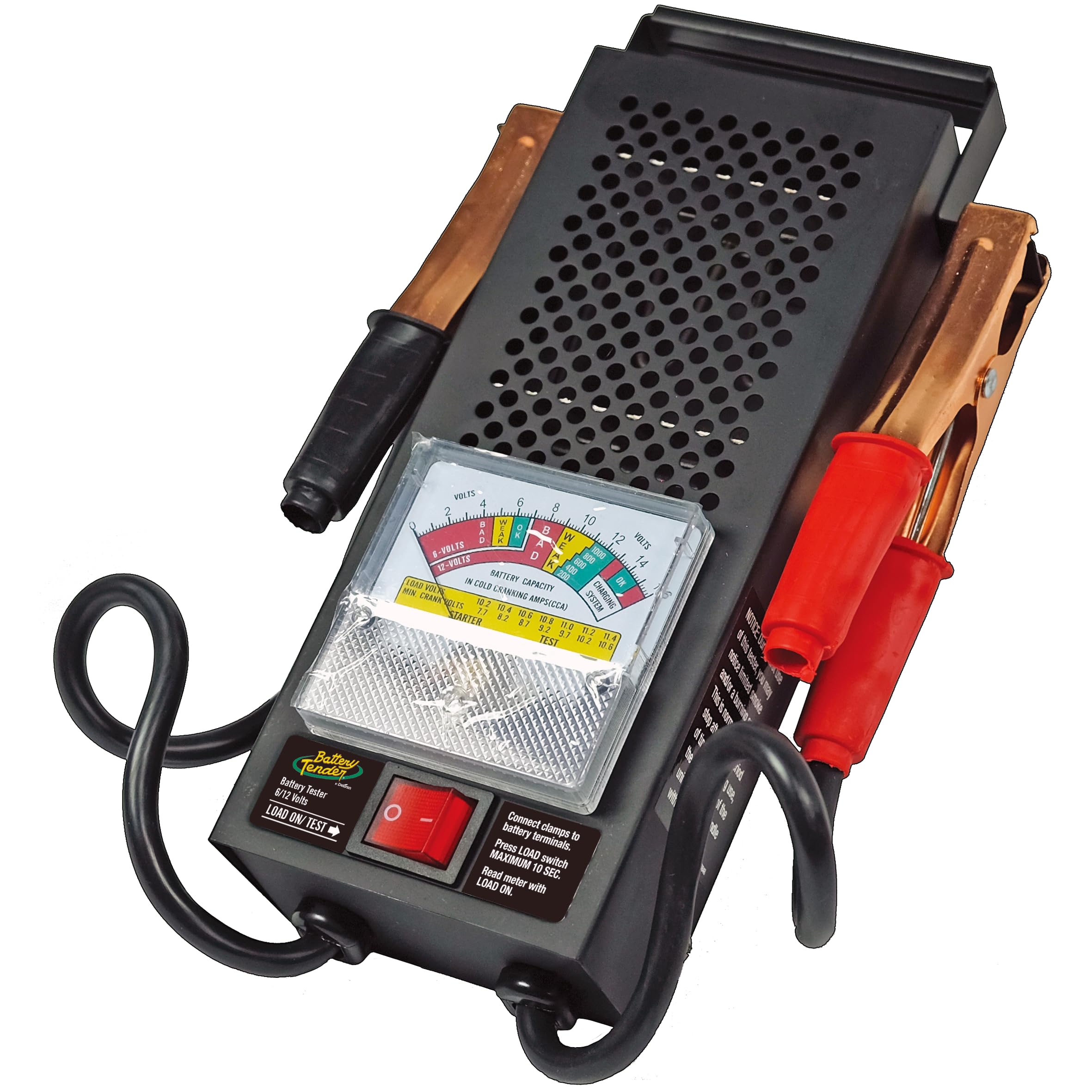
The analog workhorse that pulls a real 100-amp load.
This is the old-school approach, and it works. Instead of measuring conductance, it applies a genuine 100-amp load to a 12V battery or 50 amps to a 6V battery. That real-world stress test is what rental-company crews rely on daily, and it holds up better than previous testers they used.
It tests 12V and 6V starter or deep cycle batteries across cars, trucks, motorcycles, RVs, boats, and ATVs for vehicles up to 1,000 cranking amps. The analog display with color-coded results and a single toggle switch keeps it dead simple. Owners have used it to help neighbors discover they needed a battery upgrade.
The trade-off is real: this unit gets hot fast and produces a smell like burning tires while running. Read the instructions on how long to run it and how long to let it cool. There are no digital failsafes, so you can burn out the coils if you are not paying attention.
Genuine stress test: A real 100-amp load catches weaknesses a conductance tester can miss, but it demands respect for the timing rules.
Reach for this if: you want a true load test and you are willing to follow cooling instructions carefully.
Look elsewhere if: you prefer a digital readout with safety failsafes and no heat management.
7. VDIAGTOOL BT500

One tester that spans 6V, 12V, and 24V fleets without flinching.
Wide compatibility is the defining trait here. The BT500 tests 6V, 12V, and 24V batteries covering regular flooded, AGM flat plate, AGM spiral, GEL, and EFB types, with a 5-3000 CCA range. That means one tool in the box handles everything from a motorcycle to a job-site truck.
Functionality and utility are the two most-praised aspects, and the accuracy holds up against a Napa tester across 8-9 batteries with matching verdicts. The 5-in-1 protection covers reverse polarity and short circuits, wrapped in a shock-resistant ABS body with an anti-slip grip for tight engine bays.
It supports 12 languages, and the crank and charge tests caught a high 14.77V alternator reading. Owners with 35 years of experience vouch for its accuracy on SOH and charging results. The clamps are adequate but not daily-shop heavy duty, and there is no lithium or golf cart support.
Why it stands out
- 6V/12V/24V coverage in one unit
- Matches pro-grade testers on verdicts
- Survived falls with durable build
Where it gives ground
- Clamps not built for daily shop abuse
- Not for lithium or golf cart batteries
Pick this if: you run a mixed fleet of 6V, 12V, and 24V vehicles and want one accurate tester.
The trade-off: the clips are fine for home use but may disappoint a full-time mechanic.
8. TOPDON BT100

Three LEDs turn complicated battery data into a grandma-simple verdict.
Ease of use is the selling point, and the smart 3-LED indicators are the reason. Green, yellow, or red tells you the battery’s condition instantly, removing the guesswork from diagnostics. It reads voltage, internal resistance, and aging status, then runs cranking and charging system tests on 12V lead-acid batteries.
You can test almost any vehicle battery—from cars and motorcycles to trucks, RVs, ATVs, SUVs, boats, and golf carts—thanks to the 100-2000 CCA range (CCA, or cold cranking amps, measures how well a battery starts an engine in cold weather). This range covers flooded, AGM flat plate, AGM spiral, GEL, and EFB battery types. Buyers report it helped diagnose golf cart issues and pinpoint which batteries needed charging versus replacement, saving money. It also confirms a bad battery before you make a low-maintenance return.
The one honest limit: it will not register a battery below roughly 10-11.5V. A deeply discharged lawn mower battery needs a charge first. Owners also found the crank test easier with two people, one watching the display while the other turns the key.
Instant clarity: The 3-LED system is the fastest way to know a battery’s fate, ideal for anyone who does not want to interpret numbers.
Best for: the non-mechanic who wants a simple good/bad answer without learning battery chemistry.
Consider another if: you frequently test deeply discharged batteries below the 10-11.5V threshold.
9. ANCEL BST500
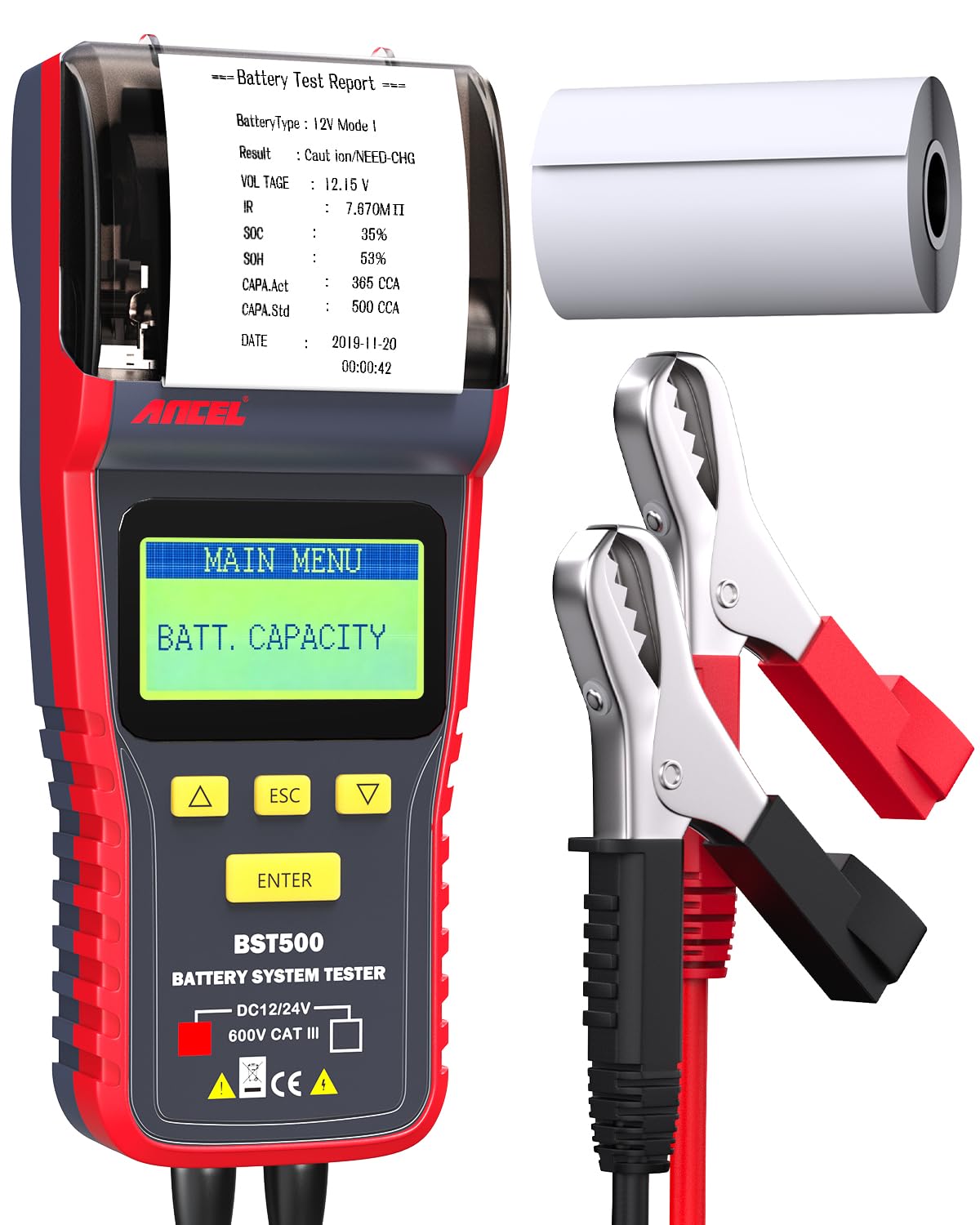
The only tester here that prints a receipt for your battery’s health.
The built-in thermal printer is the defining feature. It prints clear diagnostic reports for 12V and 24V battery tests in seconds with no phone, app, or ink. Shops use the printed tape to hand customers proof of a battery’s condition, attach it to work orders, and keep service records for later comparison.
Quality is the most-praised aspect, and the accuracy holds up against testers that cost far more. It measures voltage, internal resistance, CCA, SOH, cranking, and charging status, then labels the battery GOOD, PAY ATTENTION, or REPLACE. The 100-1700 CCA range covers AGM, EFB, and GEL batteries across cars, trucks, motorcycles, RVs, SUVs, and ATVs.
The printer is the catch. Paper jams are the recurring complaint, and the date and time recording does not always save. The hard plastic case is not rugged either. For a home user, the printer is a novelty. For a service adviser, it is the entire point.
The big win
- Thermal printer gives customers verifiable proof
- Large backlit LCD readable outdoors
- Spark-free clamps with reverse polarity warning
The honest limits
- Printer jams and fades quickly
- Cannot print alternator or starter results
- Hard case not built for rough handling
Reach for this if: you run a shop and need printed proof to hand customers or keep on file.
Look elsewhere if: you just test your own car — the printer adds bulk you do not need, and jams can frustrate.
Understanding the Specs
CCA and the range that matters
CCA, or cold cranking amps, tells you how much power a battery delivers in freezing conditions. Every tester publishes a CCA range it can measure, like 100-2000. Match that range to your vehicle’s battery rating, and you are set. A tester with a narrower range, like the Clore SOLAR’s 40-1200 CCA, still covers most cars but falls short on heavy trucks.
Voltage support: 6V, 12V, or 24V
The voltage tells you which electrical systems the tester can read. Most cars run 12V. Motorcycles and small equipment may use 6V. Heavy trucks run 24V. A tester like the VDIAGTOOL BT500 covers all three, so you never need a second tool. If you only own a standard car, a 12V-only unit is plenty.
FAQ
What does CCA stand for and why does it matter?
Can I test a 24V truck battery with a 12V tester?
What is the difference between a conductance tester and a carbon-pile load tester?
Will a battery tester work on a dead battery?
How do I know which battery type to select on the tester?
Can a battery tester check my alternator?
Is the Battery Tender 100-amp load tester safe for home use?
What is a Kelvin 4-wire test and why is it better?
Can these testers handle lithium or golf cart batteries?
How long does a battery test take?
Final Thoughts: The Verdict
The best pick for most drivers is the Clore SOLAR BA9 because it delivers trusted accuracy in a 9.6-ounce package that lives anywhere. If you want the proven crowd favorite with the widest real-world adoption, grab the KONNWEI KW208. And if you run a mixed fleet of 6V, 12V, and 24V vehicles, the VDIAGTOOL BT500 is the one to reach for. With hundreds of happy owners behind each of these testers, the real risk is not picking one — it is heading into another winter guessing.
How We Picked
We do not accept paid placement. Every pick is matched to a real buyer and a real use-case; we do not hands-on test units.
Sources & Methodology
Specifications: manufacturer listings and product documentation. Review insights: verified customer reviews, as of August 2026. Pricing: not shown on this page (it changes often); check the current price via the retailer link.
As an Amazon Associate, Gadgets Feed earns from qualifying purchases. This does not affect which products we feature.