
Our readers keep the lights on and my morning glass full of iced black tea. As an Amazon Associate, I earn from qualifying purchases.
Specs are compiled from manufacturer listings and verified buyer reviews and can change over time — please confirm the key details on the product page before buying.
You spot a wren darting through thick brush, but your binoculars blur it or cut off the view. The fix depends on two specs: how much light the lens lets in and how wide your view is. This guide sorts through the optics that matter most for birding — magnification, field of view, and close focus — so you pick the pair that actually lets you track a moving target without arm fatigue.
I’m Min — the founder and writer behind Gadgets Feed. This guide is built by comparing the manufacturers’ published specifications and the patterns across verified customer reviews, so you get each pick’s real strengths and trade-offs instead of marketing spin.
Whether you’re a backyard feeder watcher or a trail hiker, the right set of birdwatching binoculars turns a blur into a lifer — and this guide shows you exactly which specs make that happen.
Our Picks at a Glance


How To Choose The Best Birdwatching Binoculars
Birdwatching demands quick focus shifts between distant and nearby subjects. The best pair balances magnification, field of view, and close-focus distance to match your birding style.
Magnification and Objective Lens Size
The first number is magnification (how many times closer things appear), and the second is the objective lens diameter in millimeters (how much light enters). An 8×42 pairs steady handheld magnification with a big light-gathering lens, ideal for dawn and dusk birding. A 10×42 brings birds 10 times closer but sacrifices some stability and a wider view.
Field of View and Close Focus
Field of view (measured in feet at 1,000 yards) tells you how wide an area you see at once — critical for tracking birds in flight. Close focus is how near you can see clearly, which matters for feeder birds or butterflies just a few feet away.
Eye Relief and Waterproofing
Eye relief is the distance from the eyepiece to your eye where you still see the full image; longer relief (15mm or more) helps glasses wearers. For weather, look for nitrogen-purged or argon-purged bodies with O-ring seals so the optics stay fog-free in rain or humidity.
Quick Comparison
| Model | Best For | Magnification & Lens | Field of View | Eye Relief | Amazon |
|---|---|---|---|---|---|
| Vortex Diamondback HD 8×32★ Best Overall | Best Overall — all-round birding | 8×32 | 426 feet | 16mm | Amazon |
| Bushnell PowerView 10×42Best Value | Budget value for glasses wearers | 10×42 | — | — | Amazon |
| Vortex Copperhead HD 10×42Top Performer | High magnification with warranty | 10×42 | 334 feet | 17mm | Amazon |
| Nikon Trailblazer 10×25 | Pocket-sized portability | 10×25 | 285 feet | 6.3mm | Amazon |
| Timorn 8×42 HD + Phone Adapter | Sharing photos of finds | 8×42 | 430 feet | 15mm | Amazon |
| Pentax Papilio II 6.5×21 | Extreme close-up viewing | 6.5×21 | 393 feet | 15mm | Amazon |
| Celestron Nature DX 8×32 | Compact travel companion | 8×32 | 7.4 degrees | 17.5mm | Amazon |
| Sogries 10-30×50 Zoom | Variable power for variety | 10-30×50 | — | 22mm | Amazon |
| Nikon PROSTAFF P3 8×42 | Low-light full-size clarity | 8×42 | 377 feet | 20.2mm | Amazon |
In‑Depth Reviews
1. Vortex Diamondback HD 8×32 Binoculars
Our pick — over 4.5★ from 450+ verified ratings; the strongest balance of quality and price.
The wide-view workhorse that tracks flight paths without leaving your neck sore.
That extra width is exactly what you need to follow a sparrow darting through branches. The 8x magnification keeps the image steady in your hands, so you aren’t fighting shake when a bird finally shows itself.
What wins people over is sheer quality — the most-praised trait across owner experiences. Fully multi-coated lenses and a dielectric coating push brightness and color accuracy, which owners say stays impressive even in low light. The 32mm objective lenses keep the whole unit light enough to fit at the bottom of a hiking pack, and the rubber armor gives a secure, non-slip grip in damp conditions. Argon purging and O-ring seals make it water and fog proof in any weather.
The honest caveat is glasses: at 16mm eye relief, buyers report tunnel vision for glasses wearers despite the twist-up eyecups. The barrel hinge also runs tight, making interpupillary distance adjustment stiff for some. It’s tripod adaptable if you want a car window mount, and a Vortex warranty backs the purchase.
What Owners Rave About
- Outstanding image clarity, even in low light
- Lightweight and portable — fits a hiking pack easily
- Wide field of view ideal for tracking birds
- Sturdy, durable feel with secure grip
Watch Out For
- 16mm eye relief causes tunnel vision for glasses wearers
- Barrel hinge can be stiff to adjust
- Lens caps can feel a bit loose
The pick for: Backyard feeder watchers and hikers who want one reliable, wide-view pair for all-day use.
Think twice if: You wear glasses daily — a longer eye relief number will serve you better.
2. Bushnell PowerView 10×42 Compact Roof Prism Binoculars
A budget-friendly 10x pair that treats glasses wearers right from the first look.
The PowerView stands out for its value — that’s what owners mention most. The extended eyecups let you focus perfectly without removing your glasses, a rarity at this price. Owners mention reaching for these for years of birdwatching: “They have retained the clarity and adjustment as still work as new, after many years.”
The 10x magnification with 42mm objective lenses pulls in bright, crisp views, and the BK-7 prism glass with multi-coated lenses keeps things clear. The diamond-cut rubber armor on the sides gives a secure grip, and it comes ready with a neck strap and carry pouch. It’s versatile enough for desk viewing, field work, or even harsh outdoor conditions.
The trade-offs are real but sized: brightness draws mixed feedback, with some owners reporting fogging issues, and a few units arrived with durability problems. Value for money is the strongest suit here — one owner’s gift to a birdwatcher was praised for better light, focus, and clarity versus an old pair, without pretending to be premium glass.
Best for: First-time birders on a budget who wear glasses and want a dependable 10x view without the premium price.
The catch: Brightness and long-term durability are less consistent than pricier optics, so it’s a value play, not a flagship.
3. Vortex Copperhead HD 10×42 Binoculars
Ten-power reach with an HD optical system that forgives a shaky hand.
The HD optical system delivers edge-to-edge sharpness and strong color fidelity, qualities owners praise relentlessly. Its 17mm eye relief also beats the Diamondback’s 16mm, a small but real comfort gain for glasses wearers.
What wins people over is quality and value for money, the two most-cited traits. The fully multi-coated lenses boost light transmission, and the rubber armor provides a slip-resistant grip. Owners took it to Alaska for wildlife viewing and found the case straps fit snugly against the body for hiking — plus the included GlassPak binocular harness and comfort neck strap cover your carrying needs.
The field of view narrows to 334 feet versus the Diamondback’s 426 feet, a direct trade-off of that higher magnification. Owners call it “a little heavy” but absolutely worth it — one said they get upset when they forget them. Waterproof, fogproof, and shockproof performance keeps it going through rough weather and terrain.
Why It Wins Fans
- crisp images with edge-to-edge sharpness
- Comes with GlassPak harness and neck strap
- Waterproof, fogproof, and shockproof build
- Lifetime VIP warranty, fully transferable
Balance The Trade-Off
- 334-foot field of view is narrower than 8x models
- Slightly heavier than compact alternatives
- 1000-yard view takes practice to hold steady
Reach for this if: You want maximum magnification on a budget and value a transferable lifetime warranty.
Look elsewhere if: You need a wide field of view for tracking fast-moving birds in dense brush.
4. Nikon Trailblazer 10x25mm Binoculars
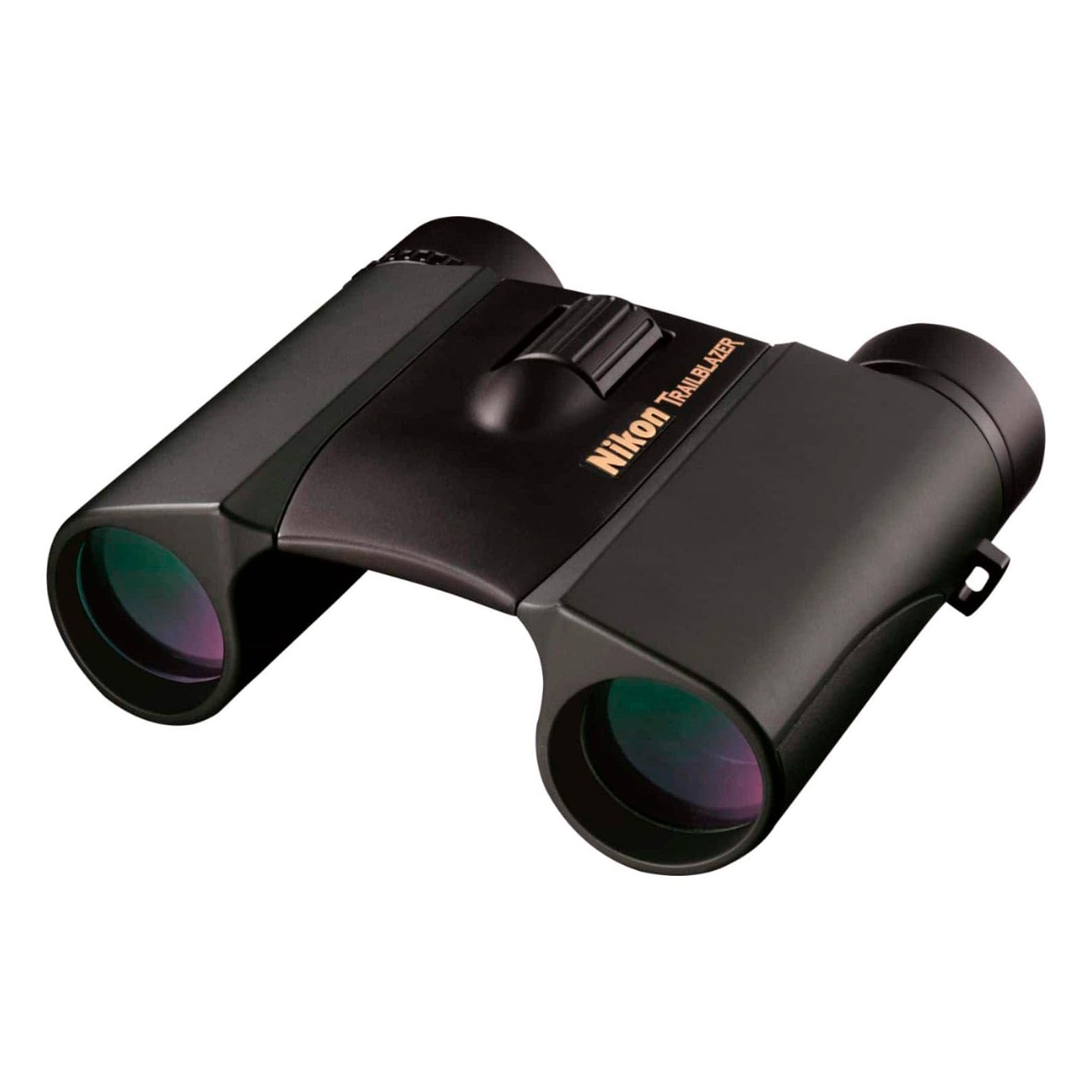
A shirt-pocket pair with full 10x reach for birders who hike light.
The Trailblazer is the portability king — clarity and compact size are its two most-praised traits, and fit in a shirt pocket easily. That 10x magnification gives real reach from a body small enough to forget you’re carrying it. The foldable roof prism design collapses down small, making it ideal for birding, hiking, or travel.
Nitrogen-filled and O-ring sealed, it delivers full waterproof and fogproof protection against rain, mist, or cold. Fully multi-coated lenses enhance brightness and color accuracy, delivering crisp, high-contrast views. The shock-absorbing rubber-armored body provides a firm grip, and the smooth central focus knob allows rapid adjustments from close-up details to distant views.
The catch is physics: with a 25mm objective, it needs light. Owners note that in dim conditions, the view dims noticeably — it simply can’t gather light like a 42mm lens. Eye relief sits at 6.3mm, which is tight for glasses wearers, and a few owners found the eyecups loose or lens caps easy to lose. For daytime birding, though, the value is hard to argue with.
The travel mate: You get a compact build that slips into a daypack, with solid optics for daytime birding, backed by Nikon’s reputation for clear, color-accurate views.
Who should pass: Dawn and dusk birders — the 25mm lens simply won’t gather enough light for low-light sessions.
5. Timorn Binoculars for Adults Bird Watching 8×42 HD with Phone Adapter

The kit that turns a sighting into a shareable photo in seconds.
The Timorn is the only pick here that comes ready to document your finds — it includes a smartphone adapter, a 360° swivel tabletop tripod, and a tripod adapter right in the box. That 430-foot field of view at 1,000 yards is the widest among the main contenders, an advantage owners call decisive for finding moving subjects in the wild.
You get a bright, sharp image even at dusk, thanks to fully multi-coated green film on all lenses (a coating that reduces glare and boosts color), a 16.5mm BAK-4 roof prism (a high-quality glass prism that keeps colors accurate), and a 5.2mm exit pupil (the circle of light reaching your eye) that stays bright in low light. The ergonomic bridge design places both the focus ring and diopter adjustment (a dial that corrects for differences between your eyes) in the center, so you can fine-tune with a single finger. It’s also waterproof up to 1 meter for 30 minutes and nitrogen purged (filled with inert gas) to prevent internal fogging.
The accessories work but feel inexpensive, and the diopter’s central location can get bumped accidentally during use. Owners note the weight — 1.45lb — actually helps stabilize the view, and one safari guide was impressed by the clarity for distant wildlife. If you want proof of your sightings, this is the pair that delivers it.
The Full Kit Advantage
- Smartphone adapter and tripod included for photos
- 430-foot field of view for tracking fast movers
- Wide 8.2-degree apparent angle of view
- Waterproof up to 1m for 30 minutes
Small Gripes
- Accessories feel functional, not premium
- Center diopter can be adjusted accidentally
- Weight is noticeable but helps stability
Best for: Birders who want to photograph and share what they see without buying extra gear.
Not ideal if: You want a featherweight pair — the included kit adds bulk you’ll feel around your neck.
6. Pentax Papilio II 6.5×21 Binoculars
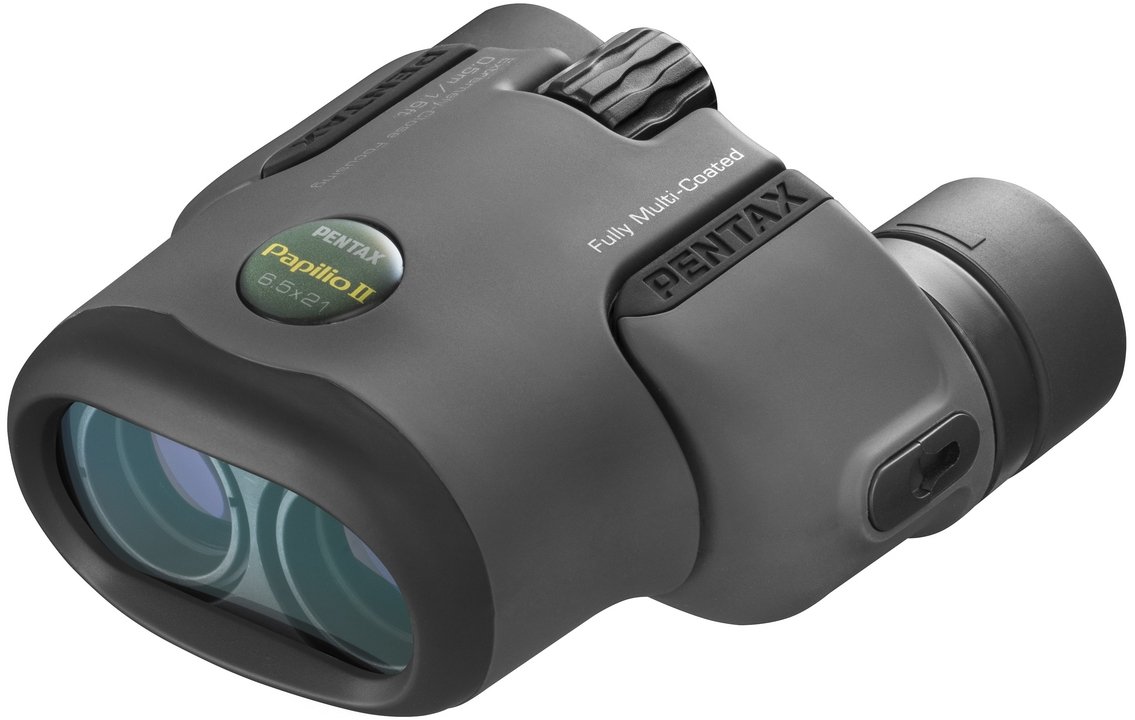
The binocular that doubles as a stereo microscope for butterflies and blooms.
The Papilio II is built for a very specific kind of nature lover: the one who wants to study the detail of flowers, insects, and artwork up close. Its original 50 centimeter macro focus is the standout feature — owners describe the close focus as spectacular, like using a stereo microscope. That’s a completely different job than the long-range picks on this list.
Image quality is by far the most-praised trait, and the aspherical lens elements provide exceptional edge-to-edge sharpness, so items at the edge of your view are as sharp as those in the center. The high-quality BAK-4 prism delivers bright, true-to-life color throughout the field of view. The fully multi-coated optics and helicoid eyecups let you fine-tune eye relief, which works well even with glasses.
Because it’s a compact 6.5×21, it’s not built for long-range reach — one owner notes it’s ideal for close and mid-distance but not high zoom. It’s not waterproof, and a few owners found the rubber grips can wear. For watching hummingbirds at a feeder, dragonflies at 4 feet, or museum displays, this is the tool.
Perfect for: Naturalists who want to inspect insects and flowers at extreme close range with crystal clarity.
Skip if: You mostly scan distant horizons — this one trades long-range power for its unique macro superpower.
7. Celestron Nature DX 8×32 Compact Lightweight Travel Binoculars
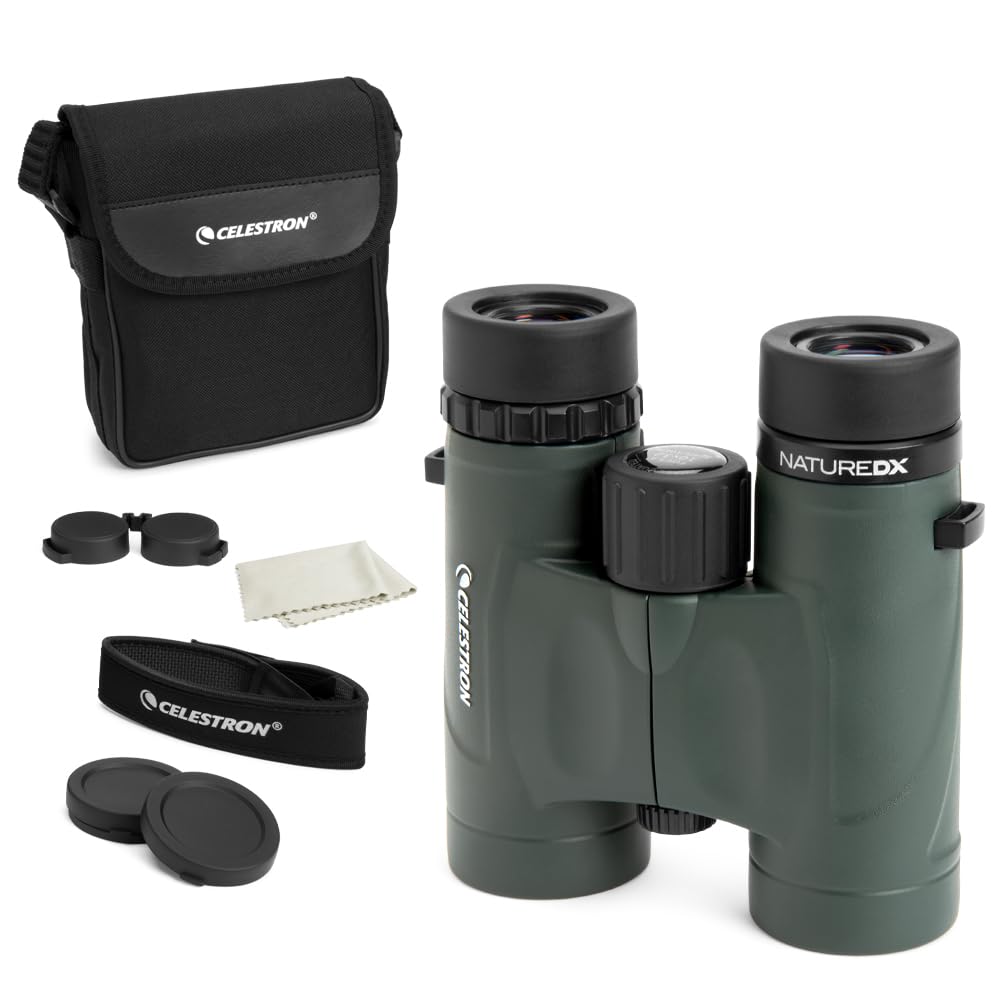
A featherweight 8×32 that punches far above its price in clarity.
The Nature DX earns its spot with image clarity — the most-praised trait — wrapped in a compact, lightweight frame. Owners say it compares favorably to far pricier glass, with one noting it rivals binoculars at many times the cost. The 8×32 configuration strikes a balance: 8x magnification (objects appear 8 times closer) stays stable in your hands, while the 32mm objective lens (the front lens that gathers light) keeps the view bright through dawn and dusk.
Fully multi-coated lenses boost light transmission, and phase-coated BaK-4 prisms enhance contrast and resolution for crisp, color-accurate images. The wide 7.4° angular field of view makes it easy to track movement and scan open landscapes. It’s waterproof, nitrogen-purged to resist fogging, and features a rubber-armored polycarbonate housing that shrugs off bumps.
The durability feedback is mixed — some customers note units breaking in half, so this one deserves a gentle hand. The 17.5mm eye relief is comfortable for glasses wearers, and the tripod adapter socket lets you mount it for extended viewing sessions. Its faster focus actually helps novices lock onto birds quickly.
Where It Shines
- Exceptional clarity for the price point
- Lightweight and comfortable for long sessions
- Works well at dawn and dusk
- Generous 17.5mm eye relief for glasses
Handle With Care
- Durability is mixed — treat it gently
- Not as refined as pricier competitors
- Weight can cause thumb strain for some
The easy pick for: Novice birders who want a quality first pair without overthinking specs.
Be mindful: This is a lighter-duty build — if you’re rough on gear, a sturdier option may last longer.
8. 10-30×50 Zoom Binoculars for Adults High Powered
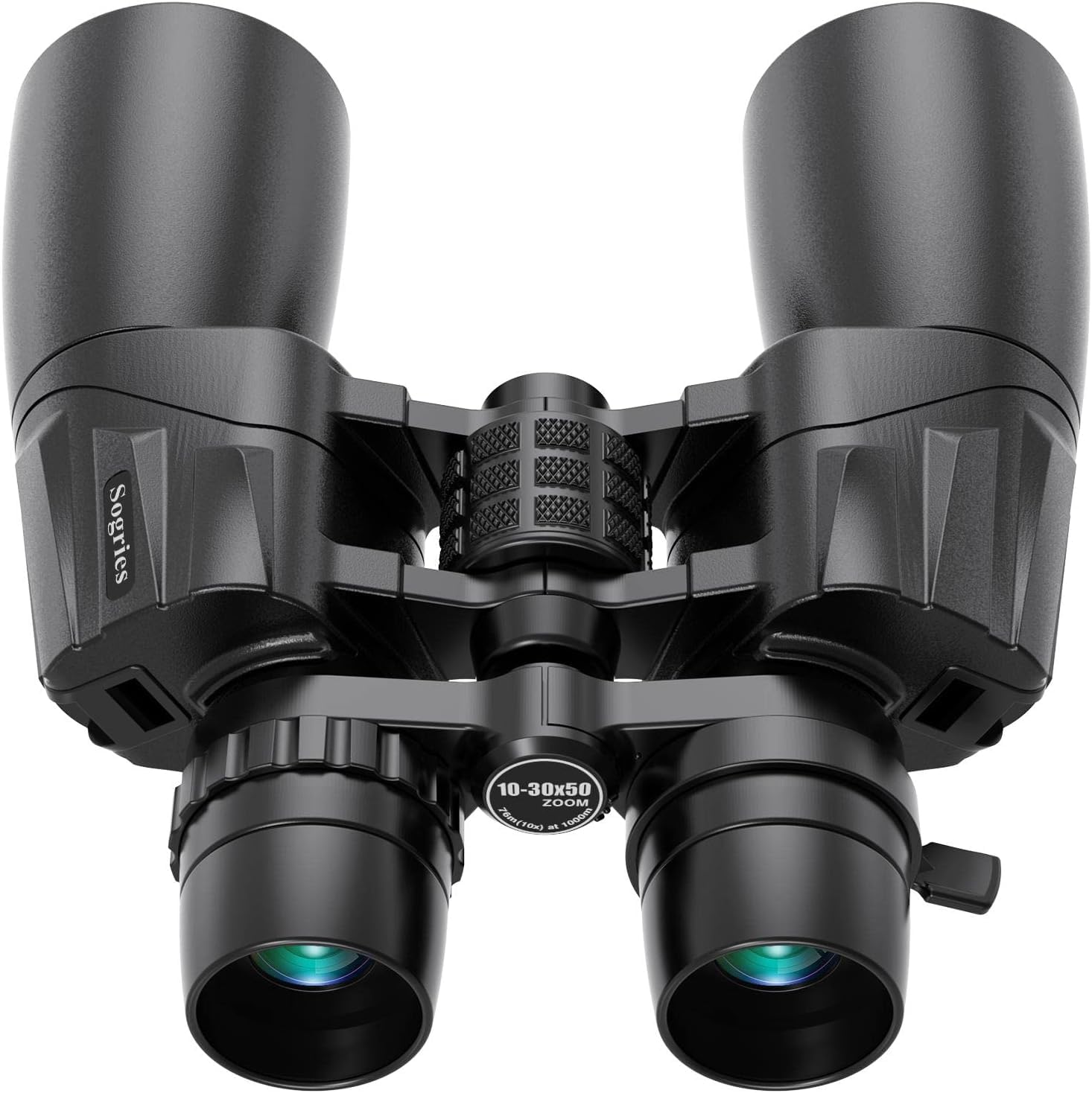
One pair that zooms from 10x to 30x, putting distant birds in your lap.
This zoom model covers a huge range — 10x to 30x magnification — so you can start wide to find a bird, then crank in for a close look. The variable power works well for large-scale theatre productions, concerts, football games, and wildlife viewing. Quality and clarity are the most-praised traits, with owners calling the detail “incredible” even at high power.
The 50mm objective lenses with BAK-4 prisms and FMC multi-coated broadband green film deliver crisp images with light transmittance up to 99.5%. That means brighter views in low-light situations like twilight, though not for completely black nights. The smooth zoom joystick lets your fingers move from 10X to 30X easily, and the 22mm eye relief is generous for glasses wearers.
The trade-off is stability — at 30x, the view magnifies every shake, so the maker recommends a tripod (sold separately, not included). The field of view narrows as you zoom in, which one owner flagged as unexpected but understandable. The O-ring sealed lenses with anti-fog coating keep moisture out, and the rubber armor with non-slip fingerprint construction feels solid.
Ideal for: Birders who also watch sports and concerts and want one versatile zoom pair instead of several fixed-power ones.
Not for: Handheld-only users — the high zoom range demands a tripod for steady viewing.
9. Nikon PROSTAFF P3 8×42 Binocular

A full-size 8×42 that gathers dawn light like a much pricier optic.
The PROSTAFF P3 is the low-light specialist here. Its 42mm objective lenses gather abundant light for sharp images even at dawn or dusk — the 8×42 configuration minimizes shakiness while keeping the view bright and wide. Quality is the most-praised trait, with owners noting stars still look sharp at night, proof of the optics.
The multilayer-coated lenses minimize reflections while enhancing brightness and contrast, and the silver-alloy prism coating ensures vivid, lifelike color across the entire visible spectrum. The 20.2mm eye relief is class-leading here, making it genuinely comfortable for glasses wearers — and the turn-and-slide eyecups adjust for non-glasses users too. Fiberglass-reinforced polycarbonate with rubber armor delivers durability with a secure, non-slip grip.
It’s weather-ready with O-ring seals and nitrogen gas purging to prevent fogging and water intrusion through rain, snow, or rapid temperature changes. Owners call it great value for birding, lighter than comparable models, and built with a solid feel. The 377-foot field of view is slightly narrower than the Diamondback’s 426 feet, but the added light gathering makes it the better dawn patrol companion.
What Makes It Special
- Excellent low-light performance with 42mm lenses
- Long 20.2mm eye relief for glasses wearers
- Nitrogen-filled, waterproof and fogproof
- Lightweight, rugged, solid build
Keep In Mind
- Field of view trails the widest 8x options
- Diopter can feel stiff to adjust
- Full-size body is bulkier than compact picks
Grab this for: Early-morning or late-evening birders who need maximum light gathering from a full-size body.
Pass if: You prioritize the widest possible view over low-light performance.
Understanding the Specs
Field of View vs. Magnification
Field of view is measured in feet at 1,000 yards — the wider the number, the more area you see at once. Wide views make it easier to track a bird in flight or through branches. Higher magnification like 10x brings birds closer but narrows that view and amplifies hand shake. That’s why 8x is often the preferred birding all-rounder.
Eye Relief and Close Focus
Eye relief is the distance from the eyepiece where you still see the full image — 15mm or more generally works comfortably with glasses. Close focus is the minimum distance at which you can focus sharply, critical for feeder birds just a few feet away or butterflies up close. A pair with macro capability like the Pentax can focus at 50cm for extreme close-ups.
FAQ
Is 8x or 10x magnification better for birdwatching?
What does the second number in 8×42 mean?
Does eye relief matter if I wear glasses?
What is a good close focus distance for birding?
Are waterproof binoculars worth the extra cost?
What is the difference between roof prism and porro prism binoculars?
How important is a wide field of view for birding?
Can I use zoom binoculars for birdwatching?
What does fully multi-coated mean in binoculars?
How do I choose between 32mm and 42mm objective lenses?
Final Thoughts: The Verdict
If you want one dependable pick, the winner is the Vortex Diamondback HD 8×32 because it pairs a wide 426-foot field of view with outstanding clarity and a light, packable build. If you want maximum magnification with a lifetime warranty, grab the Vortex Copperhead HD 10×42. And for sharing your finds, the Timorn 8×42 with phone adapter is the one to reach for — it comes ready to photograph everything you spot.
How We Picked
We do not accept paid placement. Every pick is matched to a real buyer and a real use-case; we do not hands-on test units.
Sources & Methodology
Specifications: manufacturer listings and product documentation. Review insights: verified customer reviews, as of August 2026. Pricing: not shown on this page (it changes often); check the current price via the retailer link.
As an Amazon Associate, Gadgets Feed earns from qualifying purchases. This does not affect which products we feature.