
Our readers keep the lights on and my morning glass full of iced black tea. As an Amazon Associate, I earn from qualifying purchases.
Specs are compiled from manufacturer listings and verified buyer reviews and can change over time — please confirm the key details on the product page before buying.
An automatic welding helmet is the difference between welding blind and welding with confidence. The auto-darkening lens reacts to the arc flash in milliseconds, shielding your eyes while keeping the weld pool clearly visible. Top models switch in as little as 1/30,000 of a second, block UV and IR rays continuously, and offer optical clarity rated 1/1/1/1 for a distortion-free view of the puddle.
I’m Min — the founder and writer behind Gadgets Feed. This guide is built by comparing the manufacturers’ published specifications and the patterns across verified customer reviews, so you get each pick’s real strengths and trade-offs instead of marketing spin.
Choosing the right automatic welding helmet starts with shade range, sensor count, and optical clarity, but comfort and battery life decide whether you actually enjoy wearing it daily. This guide breaks down nine proven hoods across every budget tier so you can match the lens to the work you do most.
Our Picks at a Glance

How To Choose The Best Automatic Welding Helmet
All auto-darkening helmets darken on arc strike, but budget and pro models differ in shade range, sensor count, optical clarity, and headgear comfort. Focus on shade range, sensor count, optical clarity, and comfort to avoid a hood that fails within a year.
Shade Range and Optical Clarity
Your eyes stay safe because the dark shade number (like 9, 10, or 13) controls how much light reaches them while you weld. A wider range — say 4 to 13 — lets one helmet handle grinding, cutting, TIG, and heavy stick welding without switching hoods. Optical clarity, rated like 1/1/1/1, tells you how much distortion, color shift, or blur you will see; a 1/1/1/1 rating is the top tier, so the view stays sharp and true-to-life, which cuts eye fatigue on long jobs.
Arc Sensors and Switching Speed
Arc sensors are the eyes of the helmet; they detect the flash and tell the lens to darken. Four sensors catch arcs from more angles than two, which matters when your head position blocks a sensor. Switching speed — measured like 1/25,000 of a second — is how fast the lens goes dark after the arc strikes, and faster means less flash exposure to your eyes.
Comfort, Weight, and Power
A heavy or ill-fitting hood causes neck strain and discomfort, so prioritize weight under 2 pounds and adjustable, padded headgear. Look for adjustable ratchet headgear and padding that distributes weight evenly. Power comes from replaceable batteries, solar panels, or both; solar keeps the lens topped up during use, while a battery ensures it works reliably in low light. Consider whether the grind mode switch is easy to reach, since reaching inside the hood mid-shift is a common annoyance.
Quick Comparison
| Model | Best For | Viewing Area | Arc Sensors | Switching Speed | Amazon |
|---|---|---|---|---|---|
| Hobart 770890★ Best Overall | All-around dependability | 9.3″ widescreen | 4 | — | Amazon |
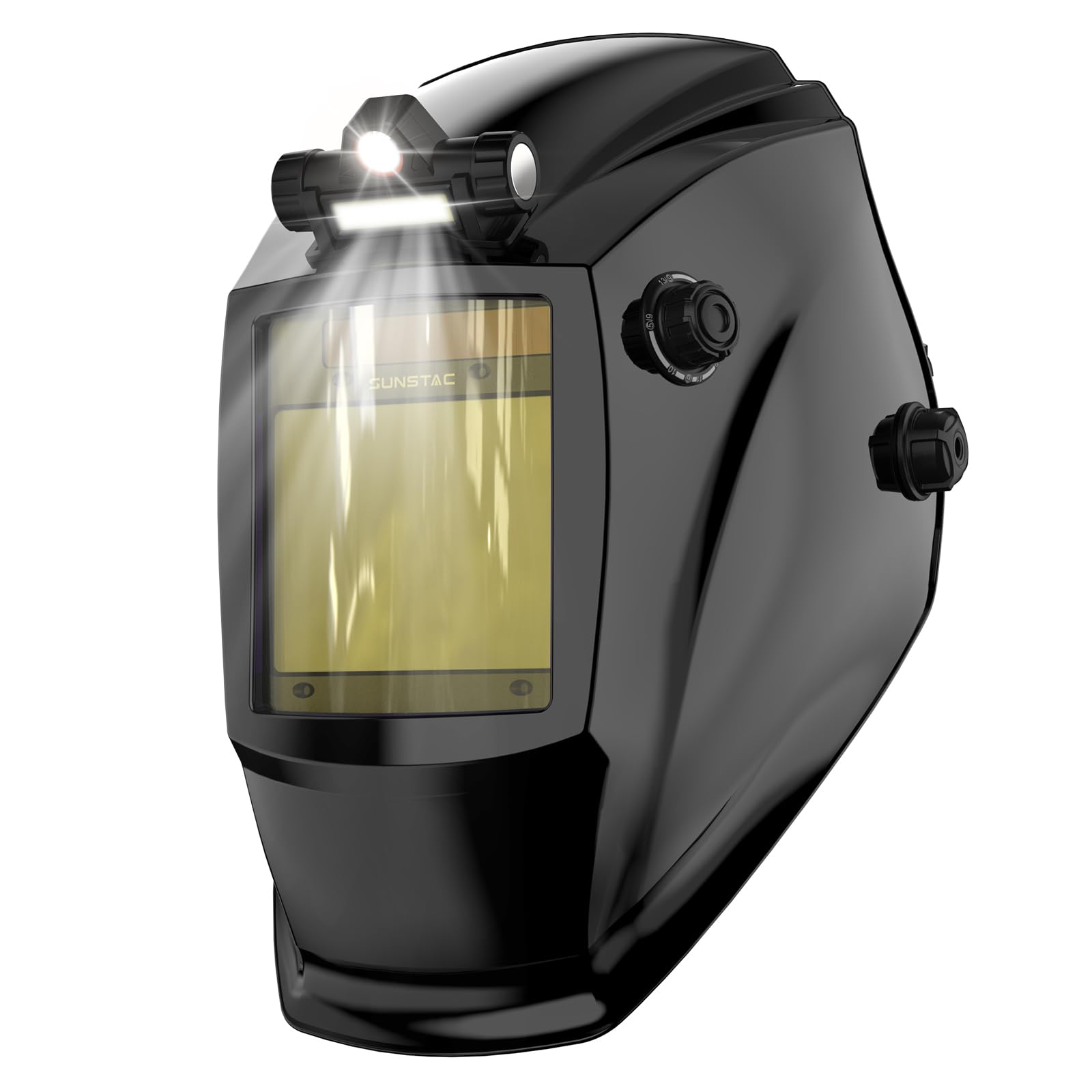
| Sunstac SS-A800DBest Value | Budget true color + work light | 3.94″ x 3.27″ | 4 | 1/30,000 sec | Amazon |
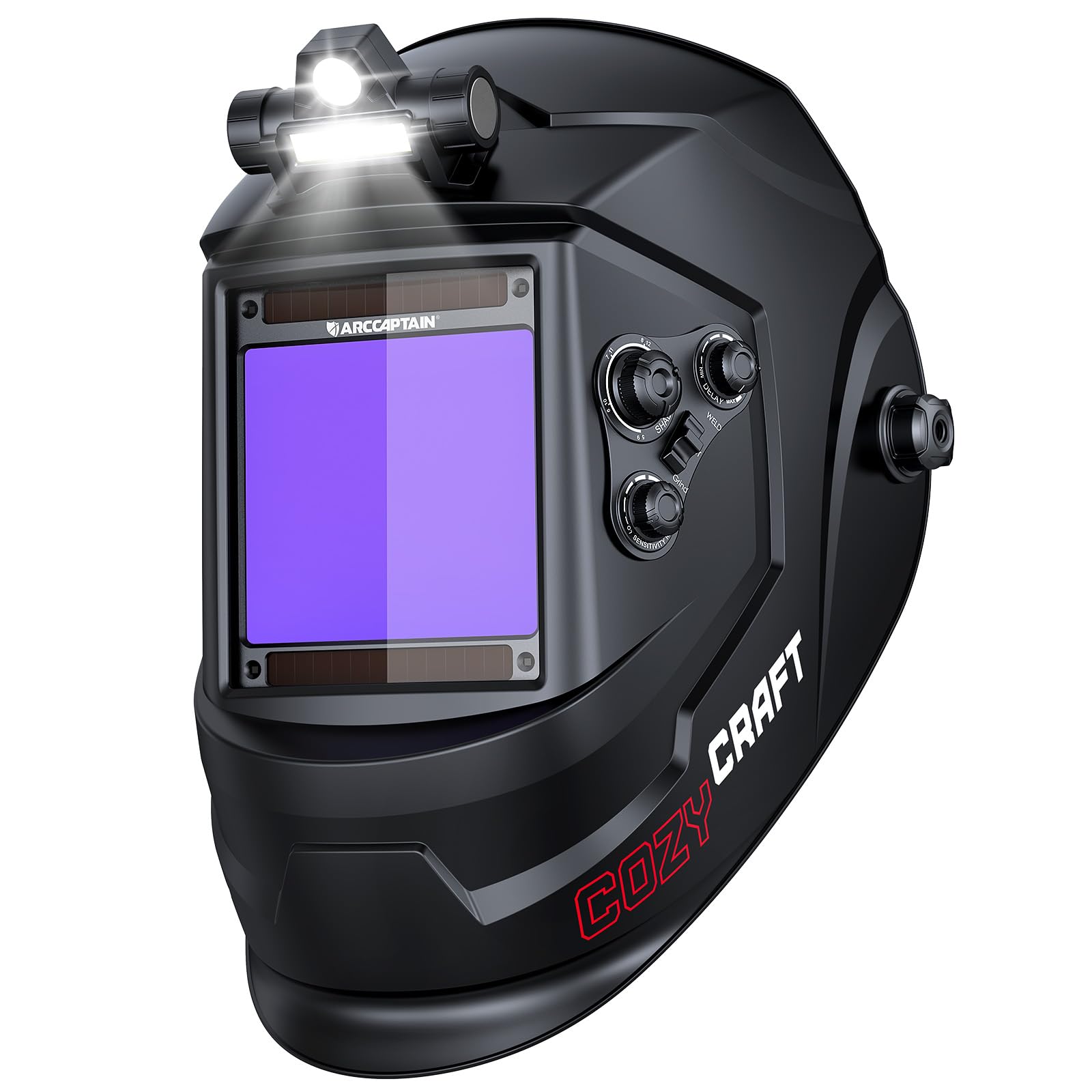
| ARCCAPTAIN XK-LY800HCompact Pick | Ultra-light with LED light | 3.94″ x 3.66″ | 4 | 1/25,000 sec | Amazon |
| MIGVAN H-21 | Starter all-rounder | Large viewing screen | 4 | 1/10,000 sec | Amazon |
| Miller Classic | Brand-name trust + clarity | 6 sq in | 2 | 1/23,000 sec | Amazon |
| ESAB Savage A40 | TIG-sensitive controls | — | 4 | — | Amazon |
| Lincoln VIKING 1740 | True color on a budget | 6.3 sq in | — | — | Amazon |
| Jackson Insight | Featherweight comfort | 3.94″ x 2.36″ | 4 | — | Amazon |
| ESAB Sentinel A60 | Professional low-profile | 4.65″ x 2.80″ | 4 | 0.08 ms | Amazon |
In‑Depth Reviews
1. Hobart 770890 Auto-Darkening Welding Helmet
Our pick — over 4.5★ from 850+ verified ratings; the strongest balance of quality and price.
A rugged 9.3-inch widescreen hood with four arc sensors that withstands daily drops and rain.
Hobart’s 770890 is the helmet that keeps showing up in “best I’ve owned” stories, and the numbers back it up. A 9.3-inch widescreen viewing area gives you a huge window on your weld, while four independent arc sensors trigger the auto-darkening lens the moment the arc strikes. The PureColor lens technology renders the weld pool and surrounding metal in accurate colors instead of the murky green of older lenses, so you can read your puddle and place your bead with real precision.
Durability is where this hood earns its keep. Buyers report using it most days of the work week for four months — then eleven months — through drops and rain, and it keeps going strong. It weighs just 1.25 pounds, which is a 78% gap lighter than the Sunstac’s 2.23 pounds, and that lightness translates directly into less neck strain on long jobs. The analog knobs for shade, sensitivity, and delay give you precise control, and the auto-on/off power control triggers the lens at the strike of an arc without you flicking a switch.
The one recurring gripe is the grind/weld switch: it sits inside the helmet, so flipping to grind mode means taking the hood off. Owners note the sensors can be over-eager — one mentioned activation from a 10W LED or grinding sparks — but for hobby and general use, the trade-off is easy to accept. It runs on two CR2 lithium batteries, and the included protective lens kit keeps the expensive filter safe. With a 4.7-star average from thousands of reviews, this is the recommended starting point for most welders.
Why Owners Stick With It
- 9.3″ widescreen view with accurate PureColor coloring
- 1.25 pounds keeps long sessions comfortable
- Four arc sensors for reliable darkening
- Dual CR2 batteries beat single-battery rivals
What to Expect
- Grind switch requires removing the helmet
- Sensors can trigger on bright ambient light
- Headgear is functional but not plush
Reach for this if: you want a do-everything hood with a huge view and proven toughness for the money.
Look elsewhere if: you grind and weld all day and can’t tolerate reaching inside to switch modes.
2. Sunstac Auto-Darkening Welding Helmet with Light
A huge true-color view with a rechargeable light for welding in the dark
The Sunstac is the budget pick that punches far above its weight, starting with its defining feature: a rechargeable auxiliary work light. The high-brightness lamp on top has two modes — concentrated or wider area — and an adjustable swivel angle so you can light up the weld joint precisely in low-light conditions. This rechargeable work light, typically found on hoods twice the price, illuminates dark corner welds for easier positioning.
The lens itself is no slouch. The 3.94″ x 3.27″ viewing screen uses 1-1-1-1 true color technology with auto-darkening in 1/30,000 of a second, and its wide shade range of 4/5-9/9-13 covers stick, TIG, MIG, cutting, and plasma. Four arc sensors handle detection, and dual power supply — lithium battery or solar — keeps it running. Owners repeatedly call it light, with the fit earning its own share of praise; the adjustable butterfly headgear even accommodates glasses. One owner’s summary: it does what it’s supposed to do whenever the light comes on.
The trade-offs are modest. The battery is not replaceable, which worries some long-term owners, and the grind mode switch sits inside the hood like the Hobart. Some found the fit narrow and had to stretch it. At 2.23 pounds it feels noticeably heavier than the Hobart’s 1.25 pounds, so all-day pros may prefer the lighter option. For DIY welders and weekend fabricators, the value here is hard to ignore.
Where It Wins: the rechargeable work light plus true-color 1/1/1/1 optics at a budget price point is a combination nobody else in this range matches.
The Trade-off: the sealed battery and inward grind switch are acceptable for hobby use but a reason for daily pros to look at the Hobart or Miller.
3. ARCCAPTAIN Auto Darkening Welding Helmet with Light
Featherlight at 8.1 ounces with a USB LED light for dark weld spots
If neck fatigue is your biggest complaint with other hoods, the ARCCAPTAIN weighs just 8.1 ounces, making it one of the lightest in this guide. That featherweight build comes from a PP material shell (a tough polypropylene plastic) with ergonomic headgear and breathable padding, so it locks in the up position without slipping or causing headaches, even during longer sessions. It is the clear pick for anyone who wants to forget they are wearing a helmet.
Complementing the light weight is a USB-powered LED light on top with two brightness levels. The light comes uninstalled but is easy to attach, and owners use it to weld under cars and in dark corners they could never see before. The 3.94″ x 3.66″ super large screen pairs with 1/1/1/1 optical clarity and true color technology, switching light to dark in 1/25,000 of a second with four arc sensors. Dark state levels span 4/5-8/9-13 for stick, MIG, TIG, grinding, and cutting.
Owners praise the three modes — grinding, cutting, and welding — and the instantly clear view when the lens is light. This is the helmet one buyer gave as a gift, reporting it more comfortable and higher quality than a previous Lincoln Electric. The recurring hesitations are the flimsier build versus the Hobart and a fit that some find tight on the temples. This is a hood for students, weekend welders, and anyone who prioritizes a light, bright, comfortable view over industrial ruggedness.
What Stands Out
- Only 8.1 ounces with ergonomic, breathable padding
- USB LED light with two brightness levels
- 1/25,000 sec switching with 4 arc sensors
- Includes 3 replacement lenses
Who Should Skip
- All-day pros may find the build less sturdy than Hobart
- Some report a tight fit on the temples
- Light arrives uninstalled, needs simple attachment
Grab it for: the lightest possible feel plus a built-in LED for dark work sites, at a price that beats most alternatives.
Not for: heavy industrial use where maximum ruggedness outweighs lightness.
4. Welding Helmet Auto Darkening True Color Large Viewing
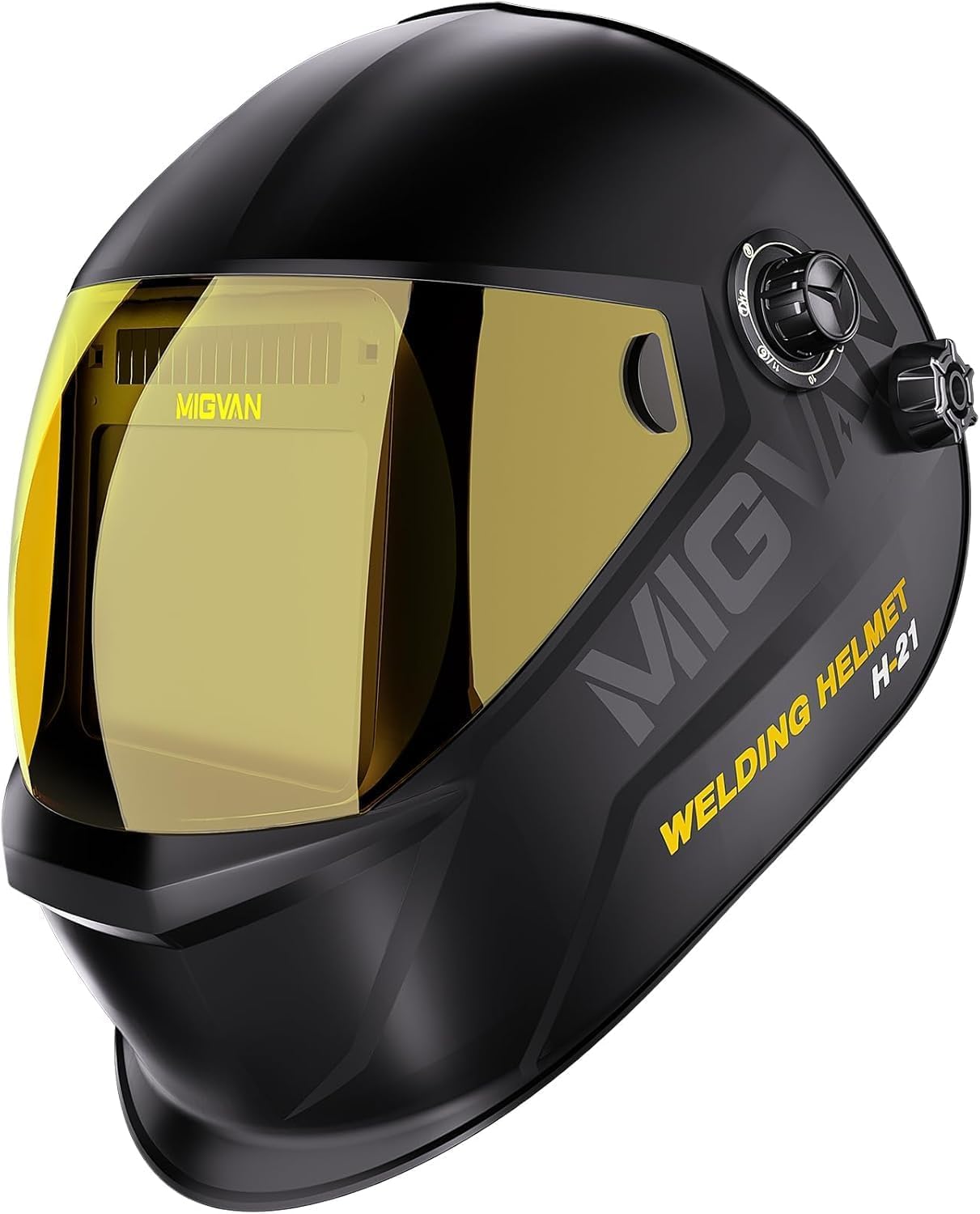
A beginner-friendly hood that one owner calls the best welding helmet he has ever owned
This MIGVAN helmet is built for the person buying their first auto-darkening hood. It meets ANSI and CE safety standards, ships with a heavy-duty storage bag, and includes two inner lenses and two outer lenses so you can replace the cheap parts yourself instead of buying a whole new helmet. The golden lens eliminates distortion and delivers a lifelike view of the weld pool, which makes learning to read a puddle dramatically easier.
The four premium arc sensors activate in 1/10,000 of a second, switching from DIN4 light state to DIN5-9/DIN9-13 dark state. Dual power — solar panel plus a replaceable CR2450 battery — keeps it running even in low-light conditions. Owners describe the reaction time as spotless and the wide view better than any helmet they have used in the past, with one noting it brightens the lens enough to see the whole work area while welding. That is a genuine step up from a basic hardware-store hood.
Two honest caveats come up in owner feedback. The head strap can loosen over time, and air circulation is limited because it is a closed full-face mask. One owner’s only complaint was that the helmet won’t stay up in the flip-up position. None of these are deal-breakers for small home projects, which is exactly the use case this hood targets. If you are starting out or need a second helmet to lend a friend, this is a smart, cheap entry point.
Perfect for: the first-time buyer who wants safety-certified protection, a clear view, and spare lenses without spending big.
Expect to adjust: the strap and flip-up mechanism need occasional attention; the full-face seal runs warm on long jobs.
5. Miller Classic Series Welding Helmet ClearLight
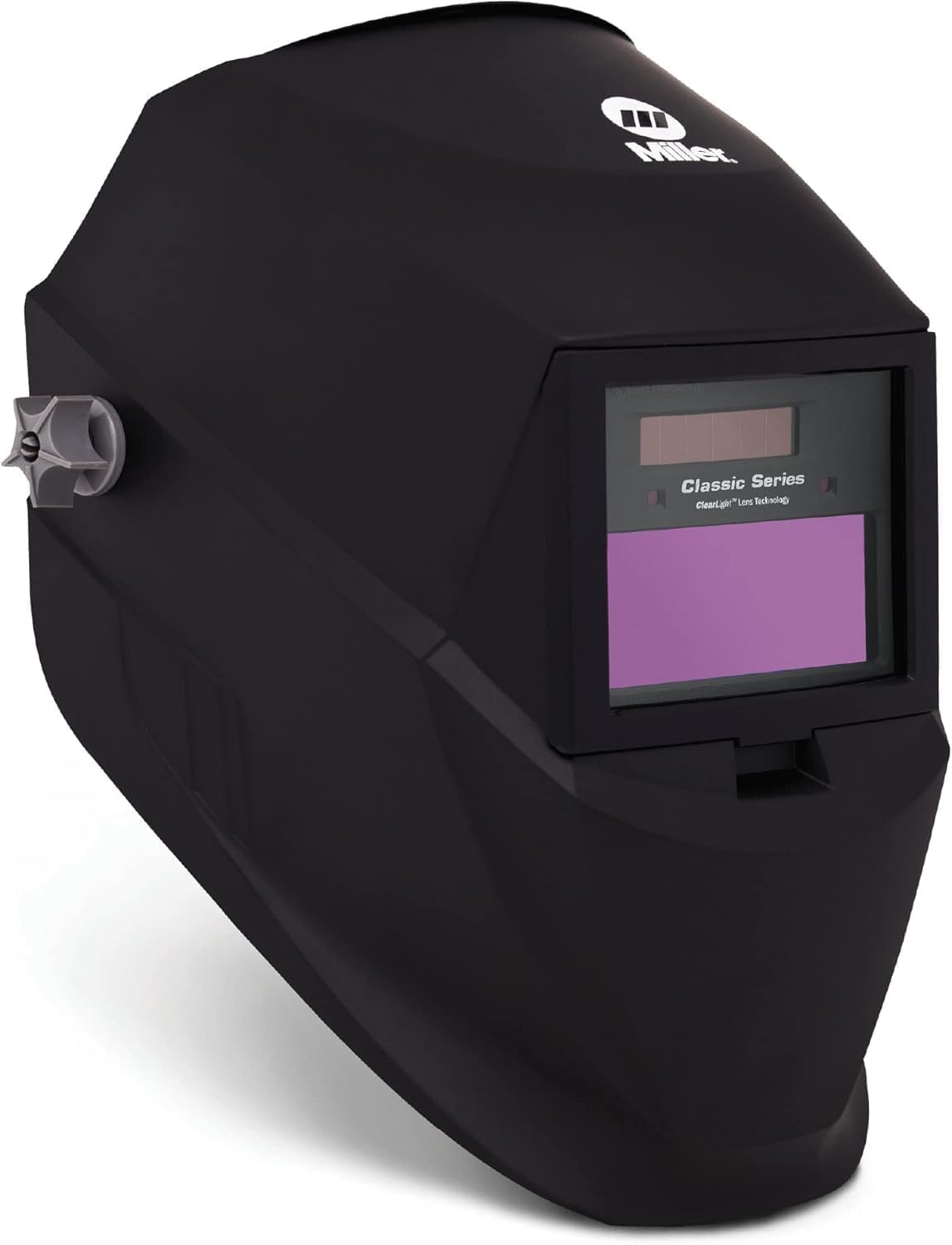
A legendary name delivering extreme clarity that one owner says improved his welding immediately
Miller is a name welders trust, and the Classic Series ClearLight backs that reputation with genuinely impressive optics. The ClearLight lens technology gives you a 6-square-inch viewing area with high-definition visuals — one owner reported the clarity was so extreme it improved his welding skills immediately. This is a hood designed for precision work at five amps or below, making it an excellent match for thin-gauge TIG and detail-oriented projects.
The auto-darkening filter provides weld shades 8-13, cut shades 5-8, and a grind shade 3, all adjustable through digital controls for shade, delay, and sensitivity. Two arc sensors switch in 1/23,000 of a second, and the auto-on power control activates at the strike of an arc. The 3.0 light state lets you keep the hood down between welds for better productivity, and the ratchet headgear distributes weight evenly for extended comfort. It meets ANSI Z87.1+, CSA, and CE standards and includes a three-year warranty.
The trade-off versus its rivals is the 6-square-inch window and two-sensor layout — smaller than the Hobart’s 9.3-inch widescreen. But buyers who picked this over basic hoods consistently cite superior clarity and comfort, with several buying a second one. It is a heavier feel at 989 grams, so all-day wearers notice it, but the headgear holds it in place comfortably. For welders who want brand reliability and crisp optics without jumping to premium price tiers, the Miller Classic is a safe, trusted bet.
Why It Earns Trust: Miller’s ClearLight optics plus a three-year warranty make this the low-risk “just works” choice for serious hobbyists.
The Small Print: the viewing window is smaller than widescreen rivals, and durability opinions are mixed enough that daily pros may want heavier-duty build.
6. ESAB Black Savage A40 Welding Helmet
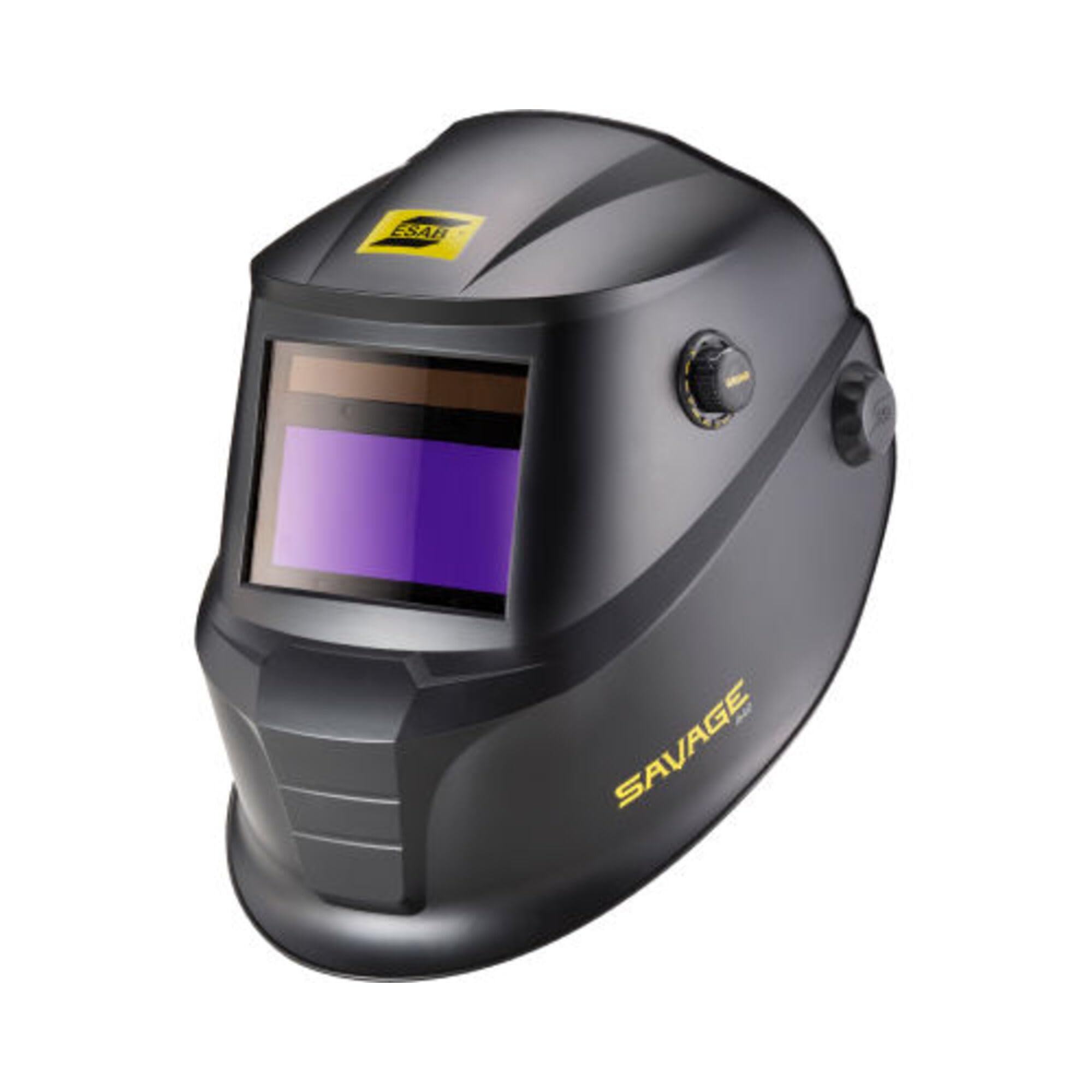
The hood TIG welders praise for clarity that makes you forget you’re wearing it
The ESAB Savage A40 is the helmet that replaced a dying Lincoln Viking 3350 for one owner, and after four years it still has not let him down — with only a single battery change. That kind of longevity story is common here. The A40 is built for welders who care about low-amp TIG, with an adjustable sensitivity control designed to react to the darker, subtler arc of TIG in the low rim range. Clarity through the lens is the feature owners rave about most, with one noting it is “like HD vision so clear” he no longer has to guess where his weld is going.
Four arc sensors deliver high auto-darkening response, and the delay control lets you set how long the lens stays dark after the arc stops — short for fast tack welding, longer for high amperage work. The grind mode switch is genuinely easy to use, with buyers specifically noting you can switch modes without removing the helmet, a convenience the Hobart lacks. It is a 2.2-pound build of plastic, nylon, and glass, powered by a single CR2 battery with a three-year plus track record.
The catch is a mixed verdict on clarity and dimming from some owners, and one reviewer noted double vision when using a cheater lens. It offers great value compared to premium brands — several note it is half the price of helmets that work this well — but it is not the lightest hood on this list. If you primarily TIG weld or want a dependable ESAB that skips the fancy extras, the Savage A40 is a strong, honest performer.
What Owners Love
- Adjustable sensitivity dialed for low-amp TIG
- Grind mode switch works without removing the hood
- Four arc sensors for reliable response
- Long battery life — one change in 4+ years
What to Weigh
- Mixed feedback on clarity and dimming consistency
- Cheater lens users report occasional double vision
- Heavier than the featherweight picks at 2.2 pounds
Best for: TIG-focused welders and anyone who hates the grind/weld switch dance — this one stays on your head.
Think twice if: you wear a cheater lens regularly or want the lightest possible shell.
7. Lincoln Electric VIKING 1740 Auto-Darkening Welding Helmet

Lincoln’s 4C lens tech delivering true color that keeps glasses-wearers comfortable for 20 hours
The Lincoln VIKING 1740 is the true-color specialist of this list. Its exclusive 4C lens technology renders vivid arc detail that reduces eye fatigue, and the 1/1/1/1 optical clarity rating means a view free from distortion and blur. One owner wore it for 20 hours with glasses and reported zero eye strain, which is a remarkable endorsement for anyone who welds long days.
Built for multi-process work, the VIKING 1740 handles MIG, TIG, stick, and plasma cutting with excellent clarity. The integrated solar panel plus AAA battery backup ensures consistent shading — this is the pick that uses standard, widely available AAA cells rather than odd sizes. A built-in grind mode switches quickly with a convenient LED indicator. The adjustable, cushioned ratchet headgear distributes helmet weight evenly, and at 1.1 pounds it stays light on your neck. The 6.3-square-inch view and shade range of 9-13 cover most everyday welding.
Owners found it superior to cheaper Lincoln models and even to older Jackson hoods, with one using it 40 hours weekly for six months without issue. The recurring notes are that the hood sits close to the face, so hot breath circulates, and the headgear could be nicer for the price. The sensors occasionally blink or miss on odd out-of-position welds — rare but worth knowing. This is an ideal upgrade for weekend and part-time welders who want professional-grade optics without the full professional price tag.
The Big Win: 4C true-color optics with 1/1/1/1 clarity at a mid-range price is why owners call it the best welding hood for the money.
Fair Warning: the snug fit traps breath, and occasional sensor misses on awkward angles mean it is not perfect for every position weld.
8. Jackson Safety Insight Auto Darkening Welding Helmet
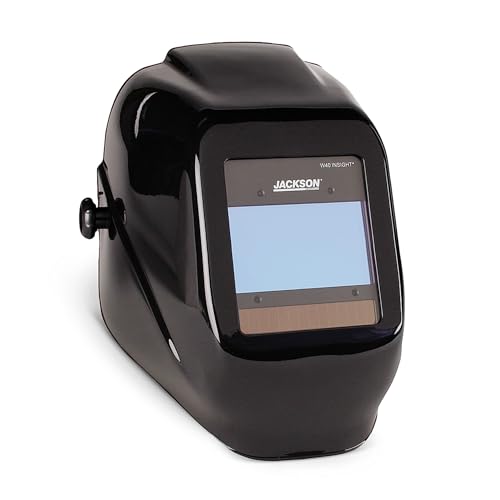
At just 6 ounces, the shell that disappears on your head during long pipe welds
The Jackson Insight is the neck-saver of the group. Its ultra-lightweight HLX shell design weighs only 6 ounces, reducing neck tension dramatically compared to heavier hoods. One owner wore it daily for three years and preferred its lightness over a more rugged Lincoln, and another used it 40-plus hours in a fab shop and found the clarity excellent. If your neck aches after every session, this is the helmet that fixes the problem.
Despite the featherweight build, the Insight does not skimp on vision. The 3.94″ x 2.36″ viewing area offers unobstructed views, and the latest True Color technology with a 1/1/1/1 optical clarity rating reduces eye strain. Variable shades 9 to 13 adjust through easy-to-use digital controls for sensitivity and delay, with dedicated Weld, Torch, and Grind modes. Four arc sensors minimize blockage for maximum eye protection, and the patented 370 Speed Dial ratcheting headgear with “Qwik-Fit” rear swivel headband and “Easy Grip-Easy Turn” adjuster knob gives a precise, comfortable fit. It meets ANSI Z87.1 and CSA Z94.3 standards.
The honest downsides: construction and durability get mixed feedback, with some finding it cheaply made and a few reporting breakage within the first week — an occasional unit issue rather than a pattern. The light state could be brighter for some. It also runs on the pricier side, with long-time owners noting the price has risen over the years. But for pipe welders, students, and anyone who works in tight spaces, the lightness and clarity are worth the premium. It has lasted over five years for one occasional-use owner on the original batteries.
The Featherweight Advantage
- 6-ounce HLX shell slashes neck fatigue
- 1/1/1/1 true color reduces eye strain
- 4 arc sensors for coverage from any angle
- Speed Dial headgear fits perfectly, beard-friendly
Honest Limitations
- Mixed durability reports, occasional first-week breakage
- Light state could be brighter
- Smaller 3.94″ x 2.36″ window than widescreen rivals
Choose this for: maximum comfort on long days, especially pipe welding and tight-space work where a light shell shines.
skip it if: you drop your hood constantly and need maximum ruggedness over featherweight comfort.
9. ESAB Sentinel A60 Welding Helmet

The professional’s hood where the weight centers over your head and the view stays flawless
The ESAB Sentinel A60 is the flagship of this list, and its spec sheet reads like a welder’s wish list. You get the largest viewing area here — 4.65″ x 2.80″ — paired with ESAB OpTCS True Color Lens Technology for crisp, accurate colors, so you see the puddle clearly. The shade range stretches from DIN 3/5 to 13, adjustable in 0.5 increments, and the ADF (auto-darkening filter) switches in a remarkable 0.08 milliseconds — the fastest response in this guide, so your eyes are protected instantly. On-board memory stores up to 9 different settings, so you can recall your exact shade for different jobs without re-dialing.
The low-profile black design is made from high-impact resistance nylon, and owners note how the weight centers directly over the head so it feels lighter than its 16 ounces. Four arc sensors handle detection, a replaceable CR2450 battery powers it, and dedicated LEDs show low battery, grind mode, and shade lock status. Owners call it “best hood on the market,” saying it outperforms a 3M Speedglas and works well for pipe welding. The yellow cover lenses are famously crisp, and the grind button function gets consistent praise.
This is the premium pick, and it owns its price. The flip-up mechanism can be finicky — one owner tightened lock nuts to keep it up — and the ratchet and cover lenses draw occasional criticism for cheapness and easy scratching. The auto-darkening sensitivity gets mixed feedback, with some finding it works “like a champ” and others adjusting settings. But for working professionals who weld daily and want the largest, clearest view in a low-profile shell, the Sentinel A60 is the hood serious welders graduate to.
Why Pros Pay Up
- Fastest switch time here at 0.08 milliseconds
- Largest 4.65″ x 2.80″ viewing area
- 9 memory slots for instant shade recall
- Weight centers over head for balanced comfort
The Premium Costs
- Flip-up mechanism can fail to stay up
- Ratchet feels cheap; lenses scratch easily
- Auto-darkening needs sensitivity tuning for some
Worth it for: daily professional welders who want the biggest, clearest view with the fastest darkening on the market.
Not for: casual hobbyists who would be paying for memory slots and speed they will rarely use.
Understanding the Specs
Shade Range (DIN Numbers)
The shade number tells you how dark the lens gets when you weld. Lower numbers like 4 or 5 are lighter and suit grinding or cutting. Higher numbers like 9 to 13 are darker and protect your eyes from intense arcs like stick welding. A helmet with a wide shade range, say 4/5 to 13, is more versatile because it handles multiple processes without needing adjustments or a second hood.
Arc Sensors and Switching Speed
Arc sensors are the small detectors around the lens that spot the bright flash of the arc and trigger the auto-darkening filter. More sensors — four is the standard for good coverage — mean the lens darkens reliably even when your head position blocks one of them. Switching speed, measured in fractions of a second like 1/25,000, is how fast the lens darkens after the arc strikes; faster means less eye flare and safer operation.
FAQ
What shade number should I use for TIG welding?
How many arc sensors do I really need?
What does optical clarity 1/1/1/1 mean?
Will an auto-darkening helmet fit over my glasses?
How long does the battery last in a welding helmet?
Is a solar-powered welding helmet better than battery-only?
Can I grind safely with an auto-darkening welding helmet?
How do I know if a welding helmet meets safety standards?
Final Thoughts: The Verdict
For most buyers, the automatic welding helmet winner is the Hobart 770890 because it combines a 9.3-inch widescreen, four reliable arc sensors, and proven toughness at a price that undercuts premium brands. If you want true-color optics with zero eye strain on a budget, grab the Lincoln VIKING 1740. And for the fastest darkening and the largest view in the group, the ESAB Sentinel A60 is the one to reach for.
How We Picked
We do not accept paid placement. Every pick is matched to a real buyer and a real use-case; we do not hands-on test units.
Sources & Methodology
Specifications: manufacturer listings and product documentation. Review insights: verified customer reviews, as of August 2026. Pricing: not shown on this page (it changes often); check the current price via the retailer link.
As an Amazon Associate, Gadgets Feed earns from qualifying purchases. This does not affect which products we feature.