
Our readers keep the lights on and my morning glass full of iced black tea. As an Amazon Associate, I earn from qualifying purchases.
Specs are compiled from manufacturer listings and verified buyer reviews and can change over time — please confirm the key details on the product page before buying.
Choosing binoculars with zoom means deciding how far you want to reach and how steady your hands are. Crank the magnification too high and the image shakes; keep it low and you lose the detail you wanted. The best zoom binoculars balance raw power with a field of view wide enough to actually find your target, and a body you can hold still.
I’m Min — the founder and writer behind Gadgets Feed. This guide is built by comparing the manufacturers’ published specifications and the patterns across verified customer reviews, so you get each pick’s real strengths and trade-offs instead of marketing spin.
From compact 8x models to giant 35x astro viewers, these are the binoculars with zoom that owners actually recommend for birding, concerts, hunting, and the night sky.
Our Picks at a Glance

How To Choose The Best Binoculars With Zoom
Zoom binoculars swap a fixed power for a range — often 8–16x, 10–30x, or even 15–35x. That flexibility is great, but every zoom range comes with physical trade-offs you feel the moment you lift them to your eyes. Here’s what actually separates a keeper from a shelf-sitter.
Match the zoom range to your hands
Past roughly 10x magnification, your heartbeat becomes visible in the view. At 30x or 36x handheld, the image shakes so much you’ll struggle to read a sign or hold a bird in frame. If you plan to shoot freehand, a range like 8–16x keeps things usable. If you’re chasing 30x or 35x, plan on a tripod — most serious owners mount these big zoomers anyway.
The lens size sets the brightness ceiling
The second number in the spec — the 50 in 10-30×50 — is the objective lens diameter in millimeters. Bigger lenses collect more light, which matters at dawn, dusk, and in shaded woods. A 50mm or 70mm objective gives a noticeably brighter, clearer image in low light than a compact 21mm, but it also adds serious weight you’ll carry around your neck all day.
Quick Comparison
| Model | Best For | Zoom Range | Objective Lens | Eye Relief | Amazon |
|---|---|---|---|---|---|
| Nikon ACULON A211★ Best Overall | All-around clarity | 10–22x | 50mm | 8.6mm | Amazon |
| Pentax UP 8-16×21Compact Pick | Pocket portability | 8–16x | 21mm | 15mm | Amazon |
| Tasco Essentials 10-30×50Astro Value | Tripod astronomy | 10–30x | 50mm | 14mm | Amazon |
| MLight 10-30X50 | Weatherproof field use | 10–30x | 50mm | 12mm | Amazon |
| deesoo 12-36×50 | Maximum zoom range | 12–36x | 50mm | 2.5mm | Amazon |
| Celestron SkyMaster 15-35×70 | Long-range astronomy | 15–35x | 70mm | 20.3mm | Amazon |
| Sogries 10-30×50 | Premium feel on a budget | 10–30x | 50mm | 22mm | Amazon |
| Nikon PROSTAFF 5 10×50 | Glasses-wearing birders | Fixed 10x | 50mm | 19.6mm | Amazon |
In‑Depth Reviews
1. Nikon ACULON A211 10-22×50 Binocular
Our pick — over 4.5★ from 3,000+ verified ratings; the strongest balance of quality and price.
The all-rounder whose clarity at every zoom step makes distant fields feel close enough to touch.
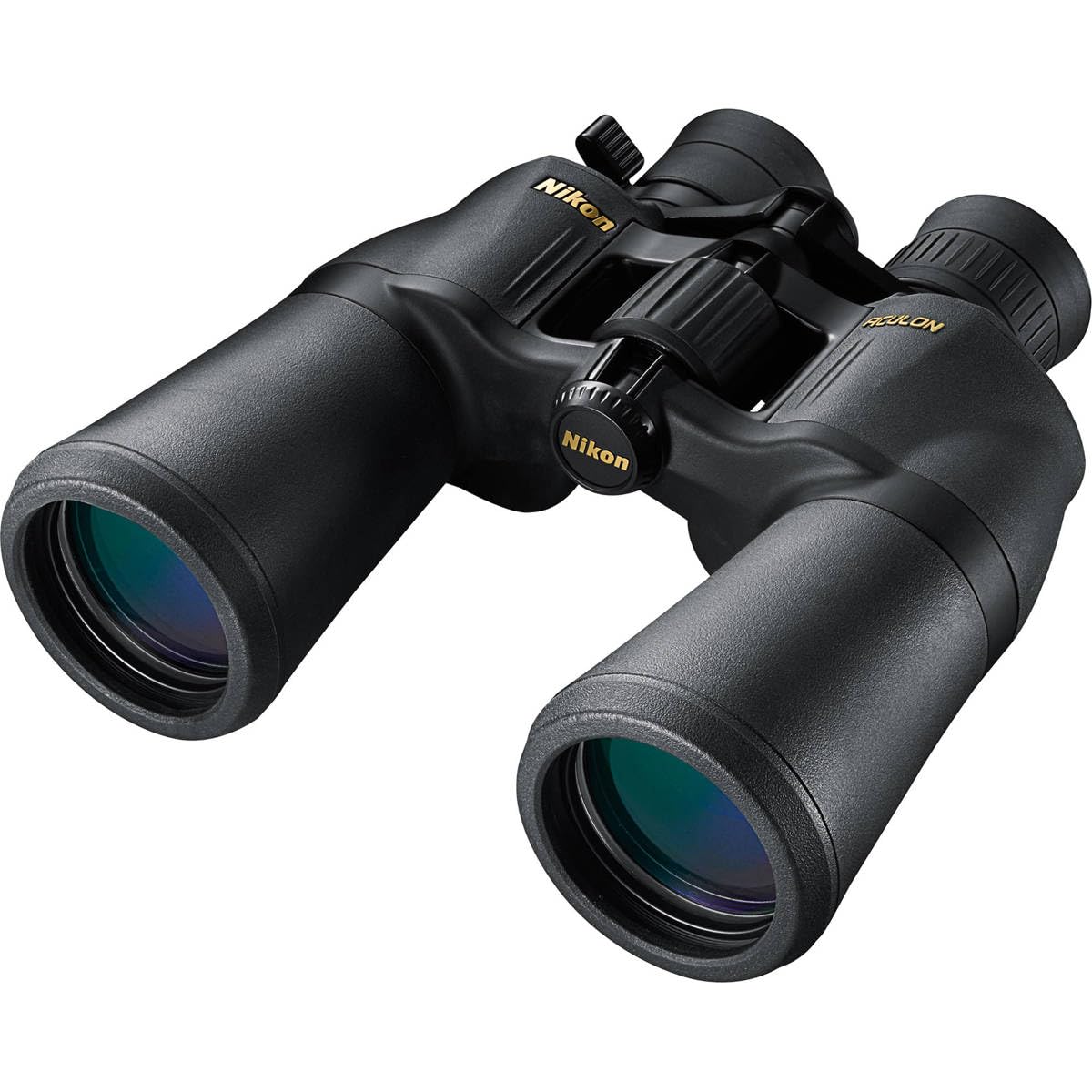
This Nikon is the pick that keeps winning people over, thanks to a 10–22x zoom range and a 50mm objective that stays bright in tricky light. The clarity is the headline — owners routinely report sharp views in bright sun and low light alike, and the optics hold up across the full zoom sweep rather than going soft at the top end.
You get a non-slip grip even when wet thanks to the rubber-armored body, and turn-and-slide rubber eyecups keep long sessions comfortable. A tripod adapter ships in the box, which matters because at 22x you’ll want the stability — owners note the zoom knob can feel a little sticky, and the included case is basic, but the glass quality carries the day.
Buyers report: “You can see at least 1/4 mile away down to or across the field with no problem.” For birding, wildlife, and general long-range scanning, this is the pair most owners would buy again.
What wins people over
- Clear across the whole 10–22x zoom range, even in low light
- Tripod adapter included right in the box
- Non-slip rubber armor holds firm in wet weather
What to expect
- At 22x handheld, you’ll want a tripod for steady viewing
- The zoom knob feels clunky to some owners
- The bundled case is basic with a bulky belt loop
Reach for this if: you want one versatile zoom pair for birding, wildlife, and general distance viewing with proven clarity.
Look elsewhere if: you need a compact pair that slips into a pocket — this one is a full-size, heavier instrument.
2. Pentax UP 8-16×21 Green Binoculars
A pocket-size zoomer that beats bigger, pricier rivals on focus smoothness and pure portability.
If you want zoom you can actually carry, this Pentax delivers an 8–16x range in a 21mm body that disappears into a backpack. The fully multi-coated optics give a bright, clear image, and the top-mounted zoom dial has an ergonomic short sweep that owners call smooth and precise. Aspherical lens elements keep the edges of the frame as sharp as the center.
Glasses wearers get a clear view thanks to the 15mm eye relief (the distance from the lens to your eye where the full image appears), and the magnesium body with a tripod socket adds durability rare at this size. Owners mention: “This is my 3rd purchase of this brand/style of binoculars because they are compact and powerful.” It’s the ideal concert, sporting-event, and backpacking companion — though the small 21mm objective (the front lens that gathers light) means it fades at dawn and dusk compared to the bigger 50mm picks here.
Where it shines: owners consistently praise the smooth focusing and compact size — the two things that make a small zoom pair actually enjoyable to use.
Best for: glasses wearers and travelers who want a light, carry-everywhere zoom for daytime events.
Think twice if: most of your viewing happens in low light, where the 21mm lens runs out of light fast.
3. Tasco ES10305Z Essentials Binoculars, 10-30x50mm
A 10–30x zoom with a 50mm lens that turns a modest budget into real astronomy views.
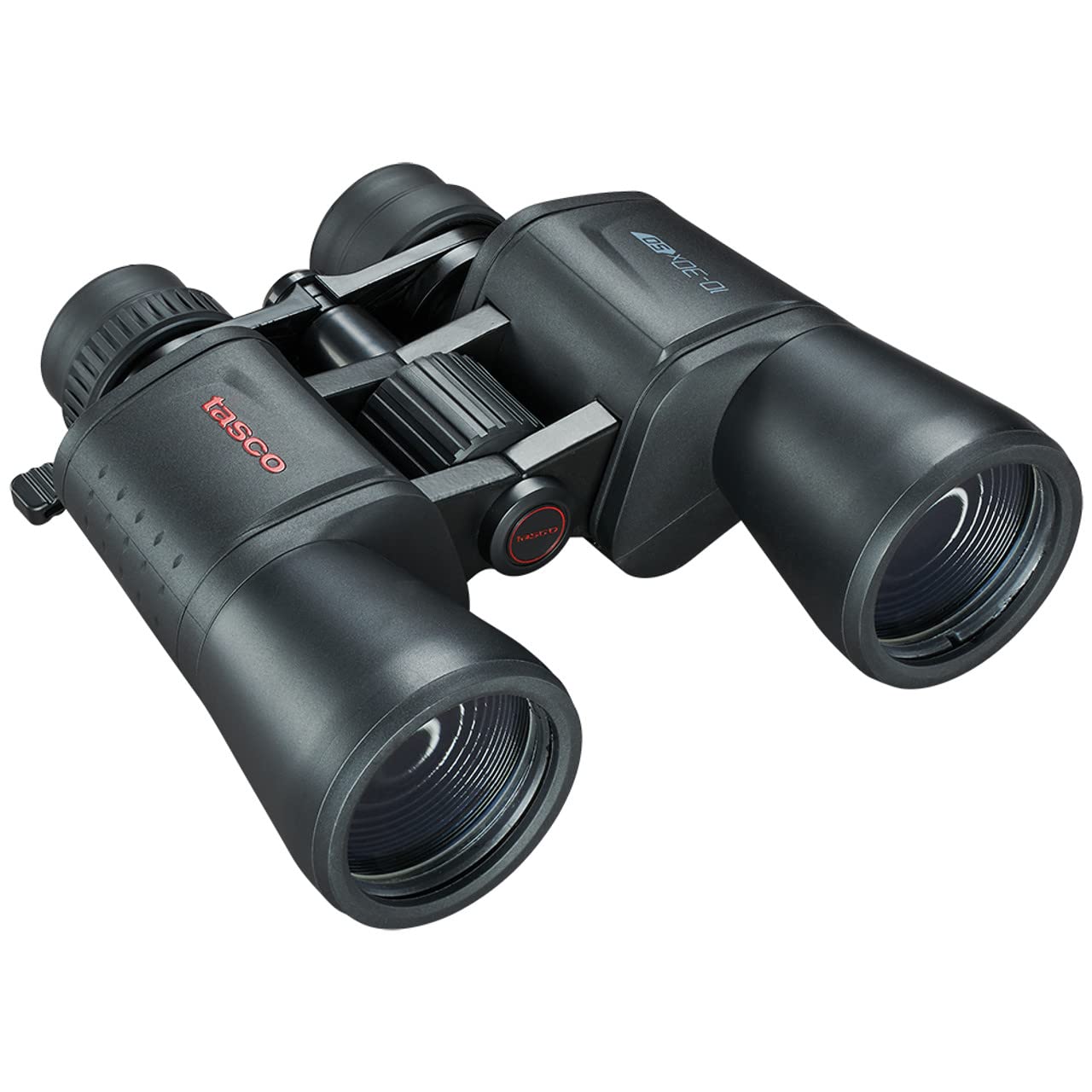
This Tasco is the budget ticket to the night sky. Mounted on a tripod, owners have caught Jupiter’s moons and Saturn’s rings, with a smooth zoom that keeps the target in view. The multi-coated optics boost light transmission for better color and contrast, and the 14mm eye relief works decently with glasses.
The zoom range stretches to 30x, where the image stays sharp if you refocus after zooming — a normal quirk of zoom binoculars. Handheld at the top end it gets shaky, so owners treat it as a tripod instrument for daytime and astronomy alike. The trade-offs are honest: it’s on the heavy side, the field narrows more than compact models, and it’s not waterproof, so keep it out of the rain.
Why it stands out
- Delivered moon and Saturn views that owners call excellent for the money
- Twist-up eyecups suit both glasses and bare eyes
- Porro prisms increase light transmission
Where it cuts corners
- Handheld at 30x, the image shakes — tripod recommended
- Zoom is stiff and needs refocusing as you change power
- Not waterproof, so avoid wet weather
Choose this for: first-time astronomy on a budget, where the 10–30x reach on a tripod outperforms its price class.
skip it if: you want a do-it-all handheld zoom for daytime sports — the weight and narrow field work against that.
4. MLight 10-30X50 Zoom Binoculars for Adults

The rugged 10–30x zoomer that shrugs off rain, dust, and rough handling in the field.
This MLight is built for the outdoors with an IP67 waterproof rating and O-ring sealed, anti-fog lenses that keep out moisture and debris. The skin-friendly rubber armor is non-slip and shockproof, so it takes bumps on hikes and hunts without complaint. Buyers call it sturdy, durable, and easy to use.
The 10–30x range with a 50mm objective pulls distant birds and animals into clear view, and the 22mm large-diameter eyepiece with soft silicone eyecups cuts eye fatigue during long sessions. Owners note it’s slightly heavy but well balanced, and the adjustable neck strap provides support. The honest catch: at max magnification, some have reported a double image, so keep the zoom below the top step for the crispest view.
The consensus: owners praise the quality and clarity most — the thing everyone raves about is how close the 10–30x zoom brings distant subjects.
Ideal for: hikers, campers, and birders who need a zoom that survives rain, dust, and drops.
Not for: anyone wanting a featherlight pair — the metal, plastic, and rubber build adds heft.
5. deesoo 12-36×50 Zoom Binoculars for Adults

A 12–36x zoom that reaches farther than anything else here — if your hands can stay steady.
This deesoo pushes magnification to 36x, the highest range in this lineup, with a 50mm objective lens pulling in light for clear low-light viewing. The BAK-4 prisms deliver up to 99% light transmittance, cutting edge distortion and keeping images bright, while FMC coating boosts contrast and color fidelity. For cruising, sightseeing, and long-range hunting, that reach is a genuine advantage.
Smooth zoom and easy two-step focusing make it quick to use, and the rubber armor with non-slip stripes keeps it secure in hand. Customers note excellent magnification and sharp images, though the honest trade-off is weight — at 950.5g it needs a tripod at the top end, and some find low-light performance limited to daytime unless conditions are bright. The plastic zoom knob is the weak link.
What you gain
- Biggest zoom reach here at 12–36x
- BAK-4 prisms keep edges sharp and images bright
- Smooth zoom lever with comfortable grip
What you trade
- Heavy at 950.5g — tripod needed past mid-range
- Low-light clarity drops; best treated as daytime glass
- Plastic zoom knob feels less solid than the body
Reach for this if: your priority is pure distance — reading signage, spotting game, or scanning open water from a boat.
Pass if: you mostly view handheld, where 36x becomes a shaky blur without a tripod.
6. Celestron SkyMaster 15-35×70 Binoculars with Zoom

A 70mm light-gulping giant built for night skies and long-distance sea viewing from a tripod.
With massive 70mm objective lenses and a 15–35x zoom, this Celestron is a serious light collector, and the BaK-4 prisms boost throughput for dim dawn, dusk, and astronomy views. Owners have enjoyed moon detail, Jupiter’s moons, and Saturn’s rings with it. The included ¼”-20 adapter mounts to most photo tripods in seconds, which is essential — at this size, you won’t hold it steady.
The rubber-armored housing is water-resistant and gives a secure grip, and the 20.3mm eye relief works comfortably with glasses. The honest picture: owners are split on image quality at the highest powers, and the weight is real — it measures over a foot long and causes neck fatigue at long concerts. The moon is great; for serious deep-space work, a telescope is the better tool.
What to know: buyers who praise it love the reach for sea and sky; those who don’t find the high-zoom image softer than hoped. It rewards a tripod and realistic expectations.
Best for: astronomy buffs and coastal viewers with a sturdy tripod who want 70mm light gathering on a budget.
Think twice if: you expect telescope-grade sharpness — a dedicated telescope beats it for deep space.
7. Sogries 10-30×50 Zoom Binoculars for Adults High Powered
A 10–30x zoom that feels pricier than it is, with the best eye relief in this lineup.
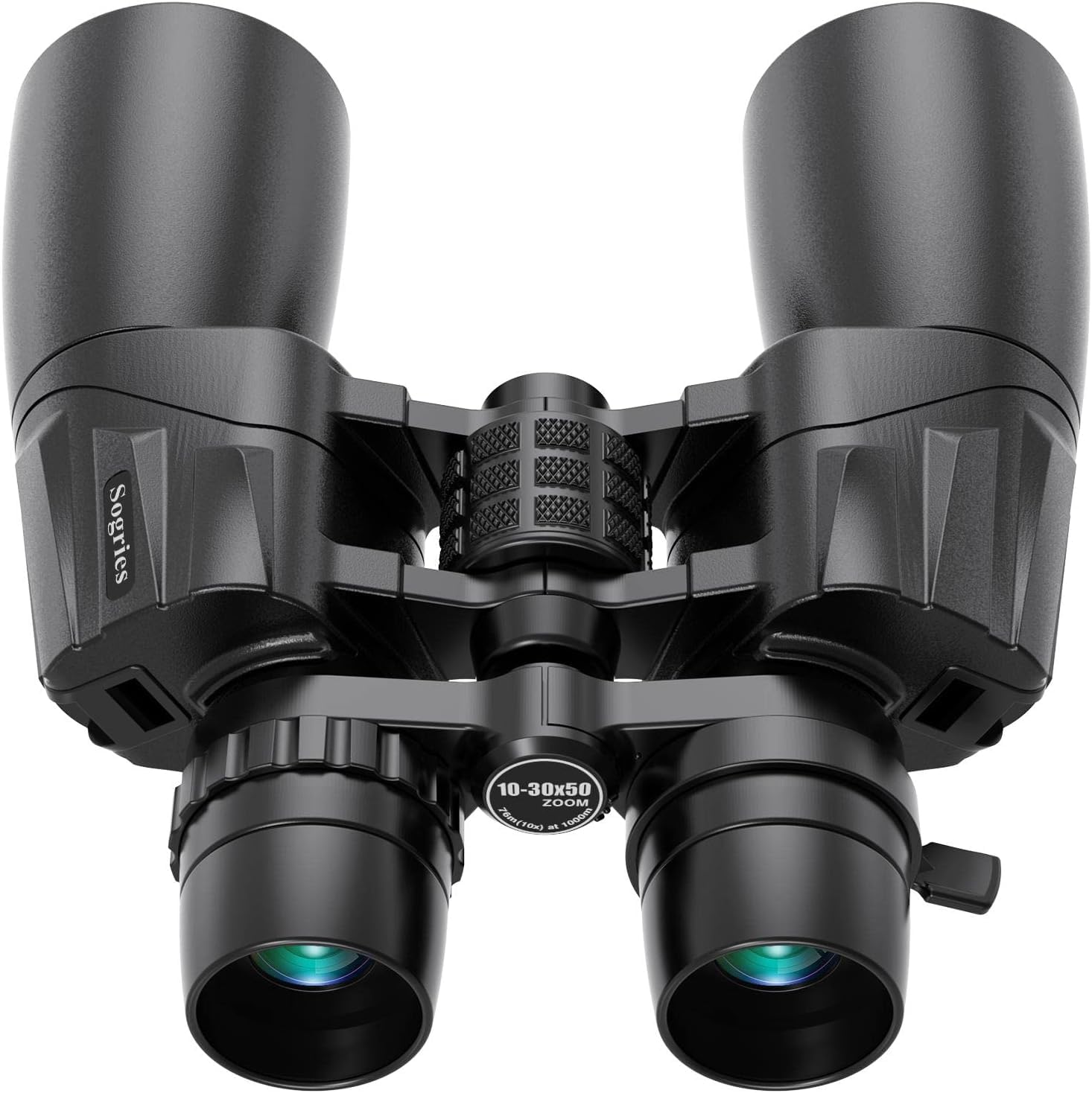
This Sogries delivers bright, sharp, high-contrast images from its BAK-4 prisms and FMC multi-coated broadband green film, with light transmittance up to 99.5%. The 10–30x zoom joystick moves smoothly from one power to the next, and the 22mm eye relief is the standout here — twist-extendable eyecups let glasses wearers see the full field without blackout.
Owners consistently call the clarity stunning and the zoom accurate, with a sturdy, comfortable grip and O-ring sealed, anti-fog waterproof build. The 50mm objective handles twilight viewing, though not pitch-dark nights. It comes with a 10-year warranty, which adds real confidence. The honest notes: it’s not a compact travel pair, and the metal barrel that ensures stability adds weight you’ll feel on long carries.
Why owners love it
- Premium feel and build that punches above its price
- Smooth, accurate zoom without double vision
- 22mm eye relief is superb for glasses wearers
What to weigh
- Not portable — the metal barrel makes it heavy
- Field of view narrows naturally at high zoom
- Front lens caps can shift during use
Reach for this if: you wear glasses and want a bright, comfortable 10–30x zoom for theater, concerts, and wildlife.
Look elsewhere if: you need something you can sling for a full-day hike — this one earns its stability from weight.
8. Nikon PROSTAFF 5 10×50 (7572) Black Binoculars Bundle

A fixed-power 10×50 from Nikon whose crystal clarity makes every detail pop instantly.
This PROSTAFF 5 is technically a fixed 10x power rather than a variable zoom, but it earns its place here for anyone who wants maximum clarity without the shake of high zoom. The 50mm objective with multilayer coatings delivers bright, wide views, and the fiberglass-reinforced polycarbonate body is light enough to carry yet tough enough for extreme adventures. Nitrogen-filled, O-ring sealed lenses make it fully waterproof and fogproof.
The turn-and-slide multi-click rubber eyecups give a custom fit with a full field of view, and the 19.6mm eye relief is excellent for glasses wearers. Buyers describe the image as crisp with accuracy that brings out details quickly. The bundle adds a lens pen and cleaning cloth for maintenance. The honest note: at a fixed 10x, you trade the flexibility of a zoom range for the purest, most reliable glass in this list — and some owners find the 10×50 heavier than a smaller 10×42 they prefer.
what separates it
- crisp optics that owners call phenomenal
- Fully waterproof and fogproof for all-weather use
- Long 19.6mm eye relief ideal for glasses wearers
What to consider
- Fixed 10x — no zoom range to reach farther
- Heavier than the 10×42 version some owners prefer
- Case lacks shoulder straps
Best for: hunters and birders who trust fixed power for the absolute sharpest, most dependable image.
pass on it if: a variable zoom range is your must-have — this is a different, clarity-first philosophy.
Understanding the Specs
Zoom range and stability
The two numbers like 10–30x tell you the lowest and highest magnification. At the low end, the view is wide and steady; at the top, it’s closer but shakier and dimmer. As a rule, anything above 15x or so demands a tripod or a very steady rest — your own pulse becomes visible in the image.
Objective lens and exit pupil
The second number (50mm, 70mm) is the front lens diameter — bigger means more light and a brighter image at dusk. The exit pupil is the beam of light leaving the eyepiece; divide the objective by the magnification to understand brightness, and remember a wider beam is easier to line up with your eye, especially in low light.
Eye relief for glasses wearers
Eye relief is the distance your eye can sit from the lens and still see the whole image. If you wear glasses, look for roughly 15mm or more — anything shorter forces you to press your glasses against the eyecup or lose the edges of the view. Twist-up eyecups let you dial in the perfect distance.
Prisms and coatings
Prisms (BK7 or BAK-4) route the light to your eyes; BAK-4 generally means less edge distortion and brighter images. Lens coatings reduce light loss from reflection — multi-coated and fully multi-coated optics pass more light, giving better color, contrast, and low-light performance than uncoated lenses.
FAQ
Why does the image shake at high zoom?
What does 10-30×50 mean on binoculars?
Is a zoom binocular better than a fixed power one?
Will these fit my tripod?
Can I use zoom binoculars while wearing glasses?
Are zoom binoculars good for stargazing?
What is the difference between BK7 and BAK-4 prisms?
Are higher zoom binoculars always heavier?
Final Thoughts: The Verdict
For most people, the binoculars with zoom winner is the Nikon ACULON A211 because it pairs reliable 10–22x zoom with the proven clarity owners praise most across thousands of reviews. If you want a compact pair for events and travel, grab the Pentax UP 8-16×21. And for astronomy on a budget, the Tasco Essentials 10-30×50 on a tripod is the one to reach for.
How We Picked
We do not accept paid placement. Every pick is matched to a real buyer and a real use-case; we do not hands-on test units.
Sources & Methodology
Specifications: manufacturer listings and product documentation. Review insights: verified customer reviews, as of August 2026. Pricing: not shown on this page (it changes often); check the current price via the retailer link.
As an Amazon Associate, Gadgets Feed earns from qualifying purchases. This does not affect which products we feature.