
Our readers keep the lights on and my morning glass full of iced black tea. As an Amazon Associate, I earn from qualifying purchases.
Specs are compiled from manufacturer listings and verified buyer reviews and can change over time — please confirm the key details on the product page before buying.
Your phone is full of music, but your old speakers have no way to play it wirelessly. A Bluetooth amplifier solves that: it receives the signal from your phone and powers your existing passive speakers (the kind without a built-in amp), letting you revive a dusty stereo or set up a new one on your patio or in your garage.
I’m Min — the founder and writer behind Gadgets Feed. This guide is built by comparing the manufacturers’ published specifications and the patterns across verified customer reviews, so you get each pick’s real strengths and trade-offs instead of marketing spin.
The thing to watch is real-world power versus the bold numbers on the box, because the crowd favorite here proves that clean watts and a rock-solid connection beat a scary wattage figure.bluetooth amplifier
Our Picks at a Glance


How To Choose The Best Bluetooth Amplifier
Most of these boxes look similar, but the differences that matter are power delivery, connection stability, and the inputs you actually need. Focus on those three and you will land on the right one quickly.
Watch the watts: peak versus real
A label that says 400W or 800W is usually peak power — a brief burst, not what the amp sustains. The continuous number, often called RMS (root mean square), is what you will actually hear. Several of the amps below deliver a fraction of the headline figure when driven normally, and that is fine for bookshelf speakers in a living room.
Inputs are the hidden differentiator
If you only stream from a phone, Bluetooth alone is enough. But a turntable needs RCA (the standard round red-and-white audio jacks), a TV usually wants optical (a fiber-optic cable connection), and a USB or SD slot lets you skip the phone entirely. The budget picks cram in FM and mic jacks for karaoke, while the premium units focus on cleaner, fewer inputs.
Quick Comparison
| Model | Best For | Speaker Output | Inputs | Weight | Amazon |
|---|---|---|---|---|---|
| Fosi Audio BT20A★ Best Overall | Clean, no-frills stereo | 100W x 2 max | Bluetooth, RCA | 567 g | Amazon |
| Pyle PDA77BUKaraoke King | Multi-zone karaoke | 800W peak | Bluetooth 5.0, USB, SD, FM, AUX, RCA, 3.5mm, 2x Mic | 4.95 kg | Amazon |
| Pyle PDA29BU | Karaoke and multi-source | 100W RMS x 2 | Bluetooth, RCA, USB, SD, Mic, FM | — | Amazon |
| Romicta AK50 | Compact karaoke setups | 50W x 2 rated | Bluetooth 5.0, FM, AUX, USB, SD, Mic | — | Amazon |
| Joengoep AK50 | HiFi-style metal build | 50W x 2 powerful | Bluetooth 5.0, USB, SD, FM, AUX, RCA, Mic | — | Amazon |
| Joengoep BT-398A | Turntables and 2.1 setups | 60W x 2 powerful | Bluetooth 5.0, AUX, RCA, Coax, Optical, USB, SD | — | Amazon |
| Fosi Audio HT4S | Outdoor and 4-speaker zones | 50W/ch @4 ohms | Bluetooth, AUX, Optical, pre-out | — | Amazon |
In‑Depth Reviews
1. Fosi Audio BT20A
Our pick — 4.5★ from 9,500+ verified ratings; the strongest balance of quality and price.
The featherweight that wakes up old speakers without breaking a sweat
The Fosi BT20A revives your passive speakers with a maximum output of 100W x 2 — enough to drive even large bookshelf and outdoor speakers — yet the whole unit weighs just 567 g, small enough to fit in your palm.
Buyers report the Bluetooth pairs fast and stays locked, with one owner streaming from an Echo Show placed 40 feet away using only a 30-foot cable. In the garage, it powered 8-ohm Proton speakers loud enough to be heard over power tools, and a Polk TSI100 bookshelf pair filled a room with no hiss at all.
There are just two inputs — Bluetooth and RCA — and no remote, so this is for purists who want clean sound, not a control center. The sound quality and performance dominate the review chatter, and this is the one people point to as the best starting point for a hi-fi journey.
Why Owners Love It
- Rock-solid Bluetooth with no dropouts, even at distance
- Surprising punch that easily beats older, bigger amps
- Simple one-touch controls and a durable all-black design
Keep In Mind
- Only two inputs, so no USB, SD, or optical
- No remote control for adjusting from across the room
Your best bet: A no-frills, high-value amplifier for anyone reviving old speakers or building a simple two-channel setup.
Not for you if: You need karaoke mics, FM radio, or a remote — this keeps things deliberately minimal.
2. Pyle PDA77BU
The four-channel beast that turns any garage into a stage
This Pyle PDA77BU is a different animal — a 4-channel receiver with 800W peak power and dual 1/4-inch microphone jacks, each with independent controls plus reverb (an echo effect) and delay. It is the pick for someone hosting karaoke nights or wiring up multiple zones, not just a single pair of speakers.
One owner plugged an old Echo into it and called their garage “a smart garage,” with Bluetooth covering a 3,300-square-foot home. Another ran eight speakers — 15-inch floors and 8-inch shelves — at max volume for 1.5 hours and the unit stayed cool.
The honest caveat is reliability: while sound quality and power get strong praise, the Bluetooth and overall build get mixed feedback, and one reviewer noted a humming sound at low volume. This is a feature-packed powerhouse, but you accept a little quality-control lottery with it.
Biggest strength: The sheer input variety — USB, SD, FM, AUX, RCA, 3.5mm, and two mics means it genuinely replaces a full AV receiver.
The trade-off: That 800W figure is peak, not continuous — owners note the real output sits around 500W RMS.
Reach for this if: You want a full karaoke control center with independent mic and echo controls for events at home.
Look elsewhere if: You need flawless Bluetooth reliability above all else — this one is more hit-or-miss than the Fosi units.
3. Fosi Audio HT4S

The five-channel wizard built for patios and sim-racing rigs
The HT4S handles a different job entirely. It supports up to 5 channels of output, switchable between 4.1 and 5.0 modes, with each channel delivering 50W at 4 ohms. That makes it the right tool for outdoor speaker zones in patios, cafes, and bars — or for pairing with bass shakers in a racing simulator setup.
Owners mention Bluetooth that connects from up to 100 feet away, and one owner says it beats a Denon for music clarity. The all-aluminum CNC unibody build is the most premium-feeling of anything here, and the built-in DAC (a digital-to-analog converter) keeps optical TV connections clean and distortion-free.
The catch is the remote — one owner found it changes the input setting when trying to adjust volume, forcing a trip to the unit. But for anyone wiring multiple outdoor speakers, the 4.1/5.0 flexibility is class-leading elsewhere in this list.
what separates it
- 5-channel output for multi-speaker outdoor zones
- Bluetooth range reported up to 100 feet
- Premium aluminum unibody with built-in DAC
The Catch
- Remote can misfire and change inputs instead of volume
- No USB or SD slot, and no FM tuner
Perfect for: Anyone with multiple outdoor or wall-mounted speakers who wants clean, distortion-free sound across all of them.
skip it if: You just need a simple stereo pair — the extra channels go unused and cost you.
4. Pyle PDA29BU

The budget box that gets loud past 40% and keeps going
This 200W amp (100W RMS per channel) is the budget champion for a reason. Customers note it powers 8-ohm speakers with ample headroom — one owner says it gets loud past 40% volume — and drives a pair of Bose 201 speakers perfectly, with fast, reliable Bluetooth pairing.
What makes it a value standout is the input count: RCA, USB, SD card, two 1/4-inch mic jacks, and an FM radio with antenna, plus a remote control. The digital LED display shows input mode and track names, and it remembers your last input after power-off, which is a thoughtful touch at this level.
Sound quality is the most-praised aspect, with one buyer describing outstanding stereo imaging when fed by a streamer through RCA. The honest limit: quality control can be spotty — one defective unit arrived with a loose transformer and feedback hum. For casual listening at home, though, the value is hard to argue with.
Why it’s a steal: All the inputs of a full receiver — USB, SD, FM, mics, remote — at an entry-level price.
The honest catch: It is not built for high-end vintage speakers, and an occasional unit slips through with a hum.
Ideal for: Someone wanting one box that handles Bluetooth, a USB stick, FM radio, and microphones on a tight budget.
Better options exist if: You prioritize flawless build quality — a few units arrive defective, so buy from a seller with easy returns.
5. Joengoep BT-398A
The 2.1 hub that connects vinyl, TV, and a powered sub in one box
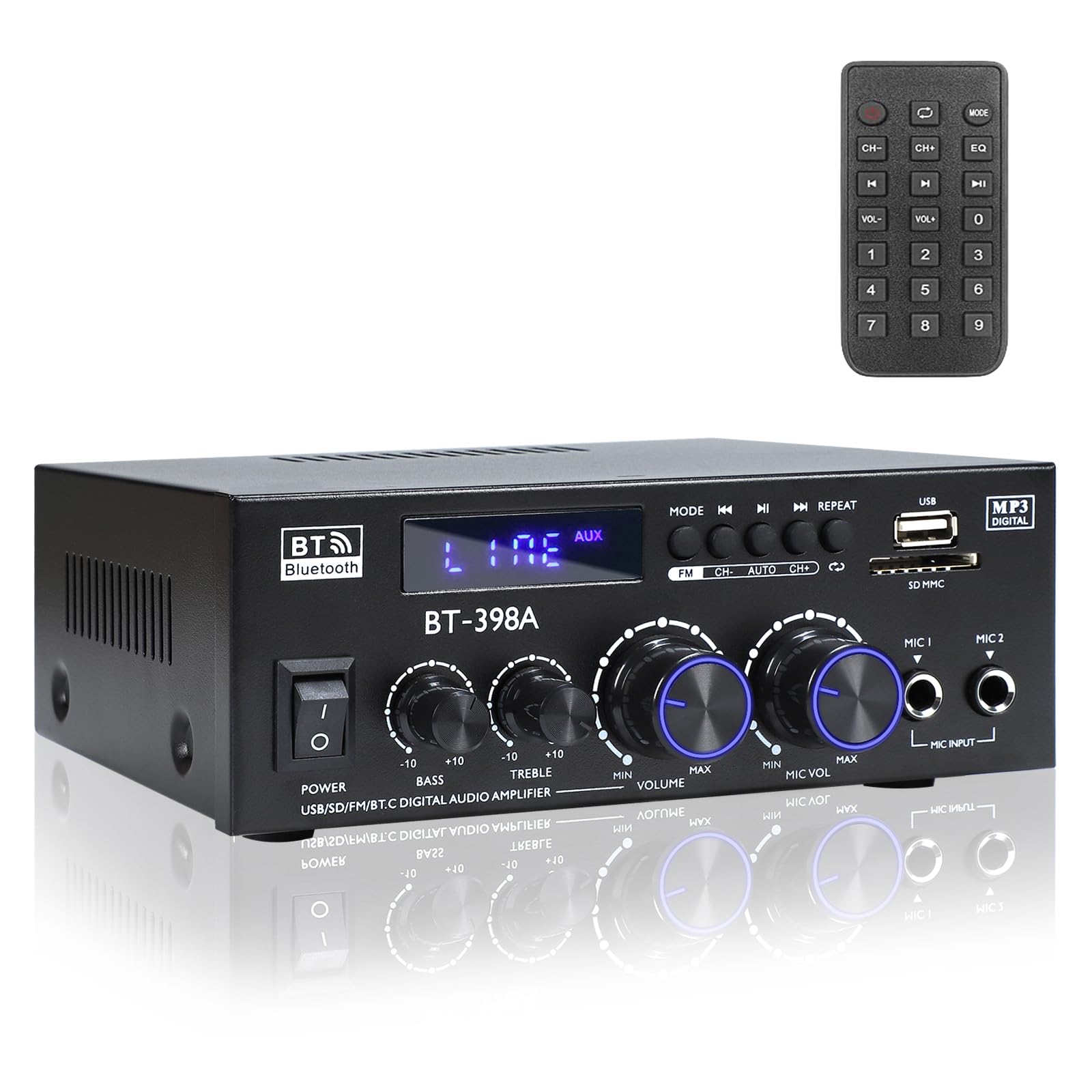
If your setup spans a turntable, a TV, and a powered subwoofer, this Joengoep BT-398A is the most flexible pick here. It packs RCA, coaxial, optical, USB, SD, and Bluetooth inputs into a 7-inch metal body, and it supports 60W x 2 powerful output — enough to drive Sony tower speakers to fill a room at 60% volume.
Owners revived 1990s passive speakers with this unit and praised crisp sound for TV and karaoke. The 2.1 mode line-out works directly with a powered subwoofer with no extra converter needed, which simplifies a common headache. The physical build feels heavy and solid, and reviewers point out easy control via the front panel or remote.
The trade-off: Bluetooth range gets mixed reviews, with intermittent drops reported on some devices, and the manual is poorly translated. But for the sheer number of connections in one compact box, it is tough to match.
Connection King
- Optical, coaxial, RCA, USB, and SD inputs cover almost everything
- 2.1 line-out drives a powered sub directly
- Heavy, sturdy metal build
Know The Limits
- Bluetooth stability is inconsistent across devices
- Defaults to max volume 30 after a power loss
Best for: The multi-source listener with a turntable, TV, and subwoofer who wants one compact hub instead of three boxes.
Think twice if: You depend entirely on Bluetooth — the range is the weakest link here.
6. Romicta AK50
A surprisingly mighty mini amp with echo control for mic work
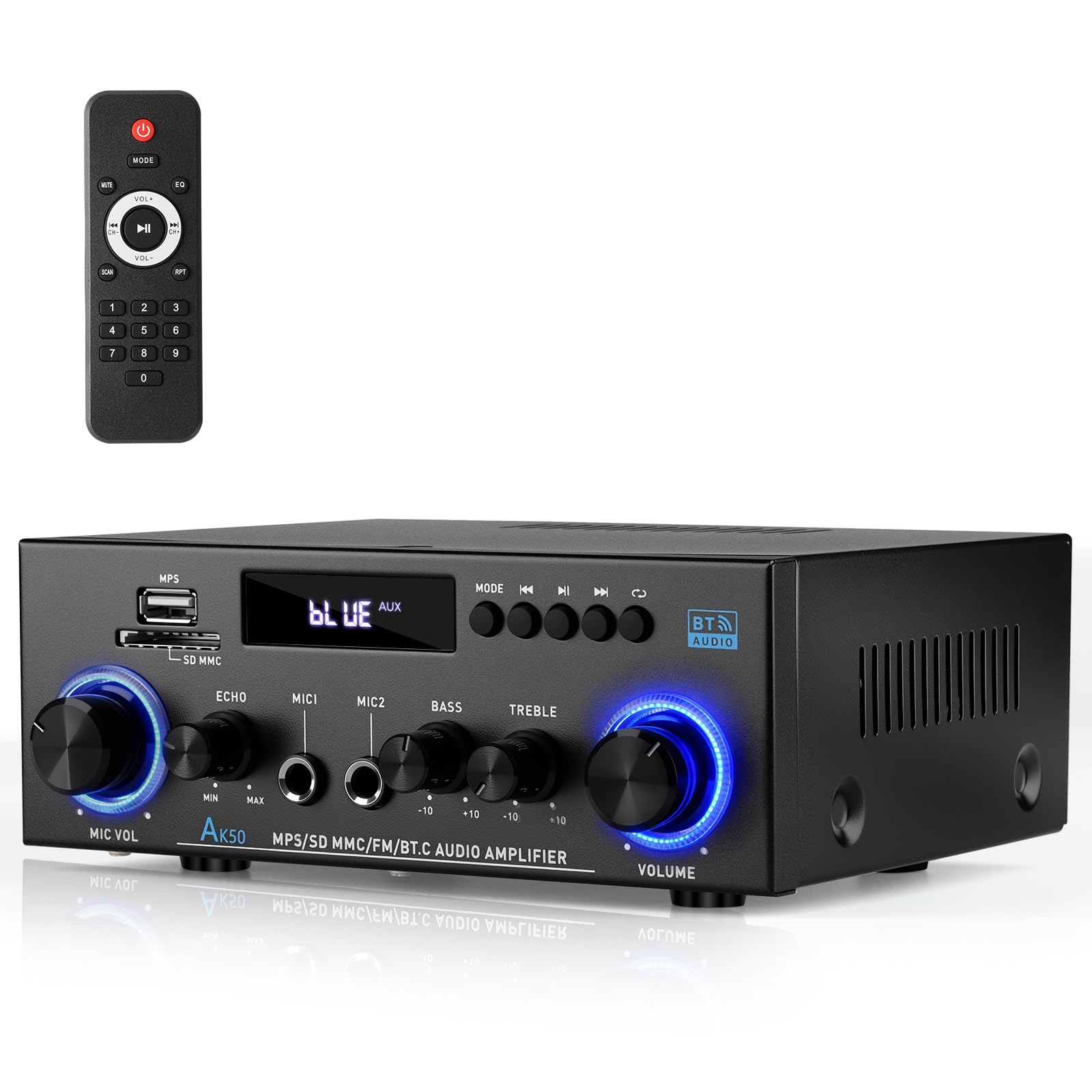
The Romicta AK50 is the compact surprise of this list. It lists 400W+400W peak power (50W+50W rated), supports 4-16 inch passive speakers and active subwoofers, and fits neatly on a TV stand. Its defining feature is the independent Echo adjustment knob, making it a true karaoke machine in a small package.
Buyers were “pleasantly surprised” plugging it into ceiling speakers in a shop, and others report clean handling of bookshelf speakers with no distortion on electronic music. The Bluetooth 5.0 pairs easily with a rated range of 50ft/15m in open areas, and the USB/SD slots play MP3 files with no phone needed.
One owner points out the 400W claim is misleading, with real output around 5-10W RMS per channel — fine for moderate home listening, not for shaking a large room. The Bluetooth gets genuinely mixed feedback, so treat the range as a hopeful extra, not a guarantee.
Surprise factor: All the karaoke features — echo, dual mics, FM — squeezed into a body that vanishes on a shelf.
The honest limit: The headline wattage oversells; think of this as a modest-power home amp.
Grab it for: A bedroom or office karaoke setup where space is tight and echo control matters.
Skip it for: Large rooms or demanding tower speakers — the real power is modest.
7. Joengoep AK50
The metal-bodied 400W stereo with subwoofer output for extra bass
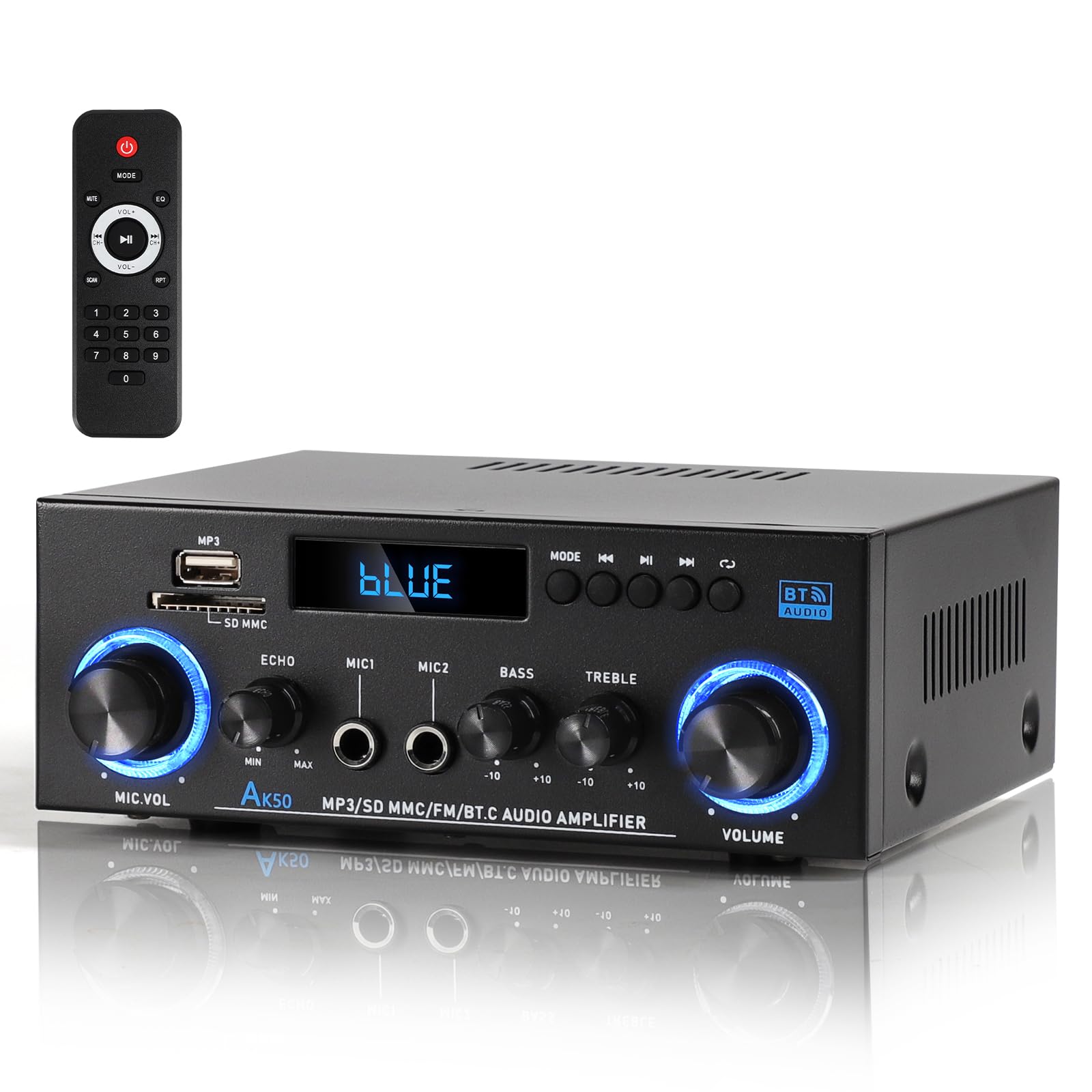
This Joengoep AK50 shares a name with the Romicta but takes a HiFi-leaning angle. It claims 400W+400W peak with 50W x 2 powerful output, a ≤0.4% distortion rate (meaning cleaner sound at normal volumes), an 80dB signal-to-noise ratio (how much background hiss you hear — higher is cleaner), and a metal body that feels sturdier than its plastic rivals. The subwoofer output is the stand-out, with buyers praising how the bass enhancement works with a powered sub.
Shoppers say fast Bluetooth, easy setup, and a compact size that fits a desk well. The inputs are broad — USB, SD, FM, AUX, RCA, plus dual mic jacks with echo — so it doubles as a small karaoke rig. One owner described it as a “multi-function audio control center” and a value-for-money product.
The weak spots: FM is auto-scan only with no manual tuning, the midrange EQ knob is ineffective, and distortion creeps in above 75% volume. There is also a manufacturer warning to never connect speakers at max volume, as overload can overheat the chip. Treat it as a solid, versatile budget stereo — not a reference-grade unit.
What Stands Out
- Subwoofer output that adds real bass punch
- Metal body with a professional look
- Broad inputs including USB, SD, FM, and dual mics
Watch For
- Distortion above 75% volume on demanding tracks
- FM tuner has no manual frequency adjustment
Choose this for: A desk setup with a powered subwoofer where bass depth matters more than ultimate loudness.
Not the one if: You plan to push near-maximum volume — the protection warning suggests keeping it moderate.
Understanding the Specs
Peak vs. RMS Power
The big number on the box — 400W, 800W — is almost always peak power, a short burst the amp can theoretically hit. What you actually hear is continuous power, often called RMS (root mean square). The Romicta lists 400W peak but delivers roughly 5-10W RMS per channel in practice, which is plenty for a bedroom but not a dance floor.
Speaker Impedance (Ohms)
Your speakers have a resistance rating measured in ohms, usually 4, 6, or 8. The amps here all support 4-16 ohm speakers, which covers nearly every bookshelf and tower speaker you will find. Match the amp to your speakers’ impedance and you avoid straining either component.
FAQ
Will any of these amps work with my old speakers?
What is the difference between peak power and RMS power?
Can I connect a turntable to a Bluetooth amplifier?
How far away can I stream before the Bluetooth drops?
Which amp is best for karaoke?
Do I need an amplifier for powered speakers?
Can I use one of these to power outdoor patio speakers?
What does the signal-to-noise ratio tell me?
Final Thoughts: The Verdict
Across the board, the bluetooth amplifier winner is the Fosi Audio BT20A because it pairs a rock-solid Bluetooth connection with clean, distortion-free 100W x 2 output and a compact 567 g body. If you want karaoke features and a full input deck, grab the Pyle PDA77BU. And for an outdoor multi-speaker patio setup, the Fosi Audio HT4S is the one to reach for.
How We Picked
We do not accept paid placement. Every pick is matched to a real buyer and a real use-case; we do not hands-on test units.
Sources & Methodology
Specifications: manufacturer listings and product documentation. Review insights: verified customer reviews, as of August 2026. Pricing: not shown on this page (it changes often); check the current price via the retailer link.
As an Amazon Associate, Gadgets Feed earns from qualifying purchases. This does not affect which products we feature.