
Our readers keep the lights on and my morning glass full of iced black tea. As an Amazon Associate, I earn from qualifying purchases.
Specs are compiled from manufacturer listings and verified buyer reviews and can change over time — please confirm the key details on the product page before buying.
You can replace two monitors with one 34-inch ultrawide panel that spans your desk, but the right pick depends on how you use it. If you play fast-paced games, you might want a 240Hz OLED; if you mostly work in spreadsheets and stream video, a 100Hz model will do. Here is how each choice matches your real routine.
I’m Min — the founder and writer behind Gadgets Feed. This guide is built by comparing the manufacturers’ published specifications and the patterns across verified customer reviews, so you get each pick’s real strengths and trade-offs instead of marketing spin.
The best 34-inch ultrawide monitor balances refresh rate, color accuracy, and curve radius against your desk space and budget.
Our Picks at a Glance


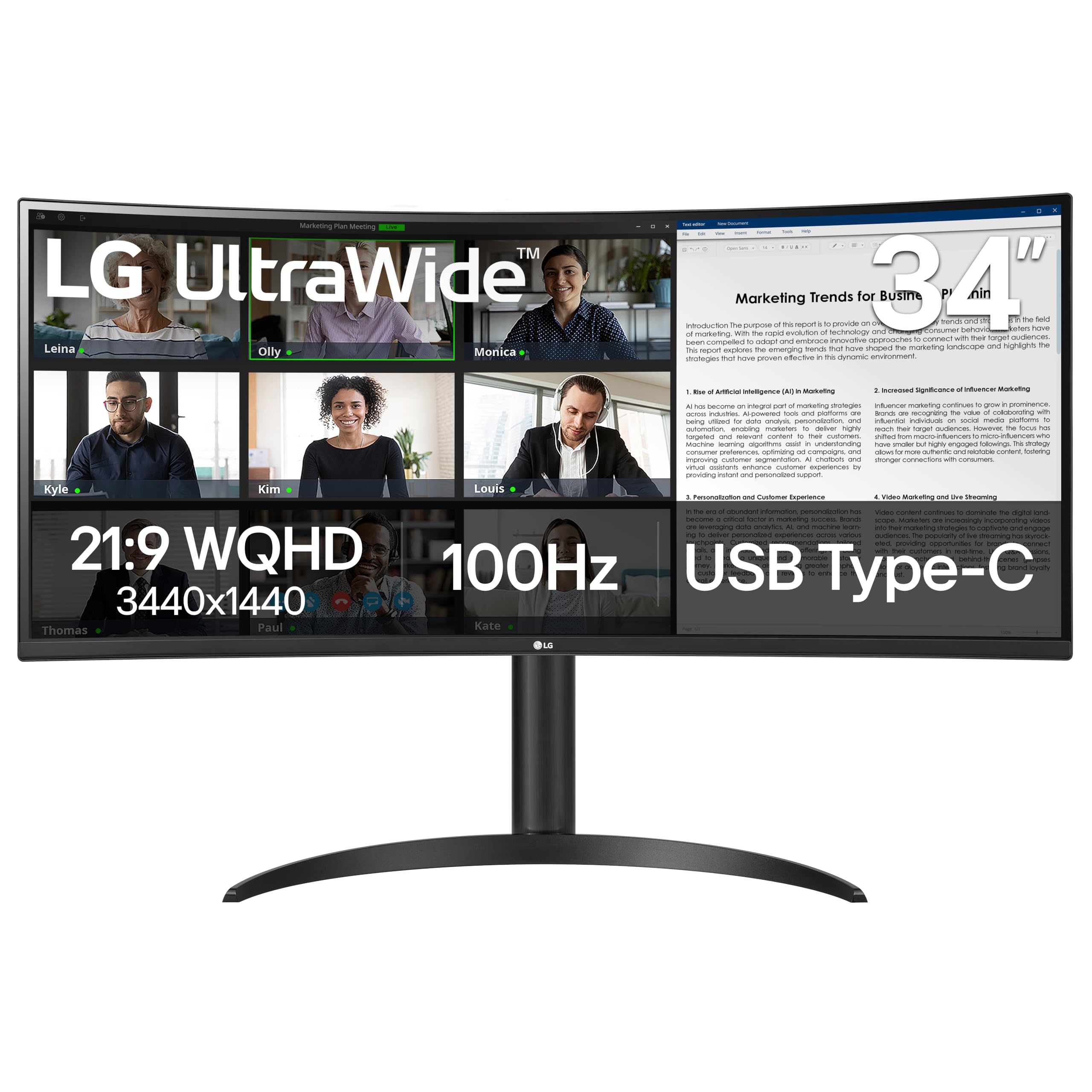
How To Choose The Best 34 Inch Ultrawide Monitor
Before you buy, think about the single most important factor: what sits on your desk and what sits in your GPU. A 3440 x 1440 panel demands real graphics power for gaming, while office tasks run on almost anything. Your monitor choice should follow your hardware, not the other way around.
Refresh Rate and Response Time
Refresh rate is how many times per second the screen redraws the image. A 60Hz panel looks fine for email, but a 180Hz or 240Hz panel makes fast motion look fluid instead of blurry. Response time — measured in milliseconds — is how quickly a pixel changes color, so a 1ms or 0.03ms rating means less ghosting behind moving objects. If you play shooters or racing games, prioritize both numbers; if you mostly type and read, a 100Hz panel with a 5ms response is plenty smooth.
Panel Type: VA vs OLED
The panel type decides your contrast and color. VA panels like those in the Alienware and LG picks offer strong contrast with deep blacks at a budget price. OLED panels — found on the pricier LG and Alienware models — deliver true black by turning pixels off completely, plus near-instant response times. The trade-off is cost and, on some OLEDs, slightly softer text edges due to the subpixel layout.
Curve Radius and Connectivity
Curve radius is measured in millimeters; a lower number means a deeper bend. A 1500R curve wraps gently around you, while an 800R curve is dramatically steep, pulling your peripheral vision into the action but demanding you sit closer. Look for a USB-C port with power delivery if you use a laptop — it lets one cable charge and connect simultaneously, which several of these picks offer at 65W.
Quick Comparison
| Model | Best For | Refresh Rate | Response Time | Contrast Ratio | Amazon |
|---|---|---|---|---|---|
| Alienware AW3425DWM★ Best Overall | Best Overall | 180Hz | 1ms | 3,000:1 | Amazon |
| ViewSonic VX3418-2KFlat Panel Value | Flat Panel Value | 165Hz | 1ms | 4000:1 | Amazon |
| LG 34WR55QK-BOffice & Laptop | Office & Laptop | 100Hz | 5ms | 3000:1 | Amazon |
| Philips 346E2CUAE | MacBook USB-C | 100Hz | 1ms (MPRT) | 16:9 (native) | Amazon |
| ASUS TUF VG34VQ3B | Console & PC Play | 180Hz | 1ms | 4,000:1 | Amazon |
| Samsung ViewFinity S50GC | Multitasking Hub | 100Hz | 5ms | 3000:1 | Amazon |
| LG 34SR60QC-W | Smart TV Combo | 100Hz | — | 3000:1 | Amazon |
| Dell S3425DW | Productivity & Audio | 120Hz | 0.03ms | 3000:1 | Amazon |
| LG 34GX90SA-W | OLED + Streaming | 240Hz | 0.03ms | 1.5M:1 | Amazon |
| LG 34GS95QE | Competitive OLED | 240Hz | 0.03ms | 1.5M:1 | Amazon |
| Alienware AW3423DWF | Color-Critical Work | 165Hz | 0.1ms | 1M:1 | Amazon |
In‑Depth Reviews
1. Alienware 34 Curved Gaming Monitor – AW3425DWM
Our pick — over 4.5★ from 650+ verified ratings; the strongest balance of quality and price.
The crowd-pleaser that turned 663 ratings into a 4.6-star reputation for gaming and work.
This Alienware is the rare ultrawide that satisfies both the gamer and the spreadsheet drudge in the same household. Its 180Hz refresh rate crushes the LG office panel below (which tops out at 100Hz) by a full 80% — so motion stays silky whether you are fragging or scrolling. The 1ms gray-to-gray response time is a 5.0x improvement over the LG 34WR55QK-B’s 5ms, which means you will not see ghosting trails behind fast-moving enemies.
You get vibrant colors and deep blacks from the VA panel, which has a 3,000:1 contrast ratio (the difference between the brightest white and darkest black), DCI-P3 95% color coverage (a wide color space used in film), and VESA DisplayHDR 400 certification (a standard for high dynamic range brightness). The 1500R curve (a gentle bend with a 1500mm radius) wraps around you, and the tool-less stand adjusts height and tilt without needing a screwdriver. Buyers report swapping out a 7-year-old Acer 100Hz panel and finding no dead pixels or connectivity issues, making it a smooth upgrade to higher refresh rates.
What wins people over is the build quality — it is the most-mentioned praise, with over 140 owners singling it out — followed closely by value for money. The AMD FreeSync Premium and VESA AdaptiveSync keep tearing away, and a hardware-based low blue light filter reduces eye strain without washing out colors. The flip side: there are no built-in speakers and the USB ports are Type-A only, so plan for external audio and a USB-C hub if your laptop needs one.
What Owners Love
- 180Hz refresh with 1ms response for fluid gaming
- Sturdy, tool-less stand with height and tilt adjust
- Bright 400-nit panel with strong VA contrast
- Budget-friendly for a name-brand high-refresh ultrawide
What to Plan For
- No built-in speakers
- USB ports are Type-A only, no USB-C
- Some find the 34-inch width very wide on a small desk
Reach for this if: you want a single 34-inch panel that handles fast gaming and daily work without breaking your budget — the 180Hz refresh alone justifies it over slower office panels.
Look elsewhere if: you need built-in speakers or a USB-C port for a modern laptop, since this monitor has neither.
2. ViewSonic VX3418-2K 34 Inch 1440p Ultrawide Gaming Monitor
The flat-screen purist’s pick that skips the curve to dodge distortion.
Not everyone wants a curved panel, and the ViewSonic VX3418-2K is the standout choice for those who prefer a flat 21:9 screen. This is a genuine niche: at 165Hz with a 1ms MPRT response time (over DisplayPort), it matches the Alienware’s speed while keeping a perfectly straight surface — ideal for design work where curved lines can visually bend. Its 4000:1 contrast ratio actually beats the Alienware’s 3,000:1, giving you deeper blacks and richer shadow detail in dark scenes.
Owners consistently praise the crisp image quality and easy controls, with build quality being the most-celebrated aspect of this model. One verified problem is the wide stand base — several owners mention it takes up too much desk real estate and had to switch to a swing arm or VESA mount. The package also only includes hardware for the base mount, so if you want to wall-mount it, budget for extra screws.
The warranty story here is honest and worth knowing. Customers note that one unit developed a dark, flickering corner — but the warranty replaced it without drama, and both units now work great. That is the kind of after-sales support that matters on a big purchase. FreeSync Premium and a Blue Light Filter round out a package that is a strong value if you are willing to trade the curve for a flat pane and a slightly wider footprint.
Who it beats: the Ask-anyone curve skeptics — at 165Hz and a 4000:1 contrast ratio, it out-specs several curved rivals for less, and the flat screen keeps straight lines honest for non-gaming work.
The trade-off: the stand’s wide legs will likely force you onto a monitor arm, and wall mounting means buying extra hardware from the start.
Best for: productivity users and gamers who find curved screens distracting — the flat 3440 x 1440 panel gives you crisp text and a fast 165Hz refresh without the bend.
Think twice if: your desk is small, because the stand base is famously wide and you may need to budget for a VESA arm.
3. LG 34WR55QK-B 34-inch UltraWide WQHD Curved Computer Monitor
The laptop charger that doubles as a monitor, thanks to 65W USB-C.
The LG 34WR55QK-B is built for the modern one-cable desk. Its USB-C port delivers up to 65W of power delivery, so a single cable can charge your laptop and drive the display at the same time — no separate power brick cluttering your workspace. That makes it the natural pick for MacBook and ultrabook owners who want to dock with one plug. Reviewers point out the screen quality is excellent, with vibrant colors and easy setup being among the most-praised traits.
For photo editing, this panel covers up to 99% of the sRGB gamut (a standard color space for web and print), which is about 4% more than the Alienware AW3423DWF’s 95% DCI-P3 in its native space — a real edge for accurate reds and greens. The 100Hz refresh rate (how many times the screen updates per second) with 5ms response time is calmer than gaming-focused rivals, but smooth enough for scrolling documents and light play. HDR10 support (a high dynamic range format) makes games and video pop, though the 300cd brightness (candela per square meter, a measure of luminance) is modest compared to the Alienware’s 400 nits.
Reader Mode reduces blue light for long reading sessions, and the ergonomic stand adjusts both height and tilt to your eye level. The OnScreen Control software lets you split the display or set up Picture-by-Picture, so you can view content from two separate input sources on one screen. One honest limitation: there are no built-in speakers, so factor in a soundbar or headphones when planning your setup.
Leading spec: the 65W USB-C power delivery — a feature the Alienware and ViewSonic lack entirely, making this the easy dock for laptop-first users.
Honest catch: at 100Hz it is not a competitive gamer’s panel, and the missing speakers are a real gap for a monitor at this price.
Choose this for: a clean one-cable laptop setup with strong sRGB color accuracy for editing and a fully adjustable stand.
skip it if: you want to push high refresh rates in fast shooters — the 100Hz ceiling will feel limiting next to 165Hz and 180Hz rivals.
4. Philips 34 Inch Curved Computer Monitor UWQHD, 346E2CUAE

The Apple-friendly panel that handles a MacBook with a single USB-C cable.
While most monitors make you fiddle with adapters, the Philips 346E2CUAE is a known plug-and-play partner for Macs — shoppers say connecting it to Mac Minis and MacBooks with zero configuration drama. Its 1500R curved VA panel delivers UltraWide Quad HD resolution (3440 x 1440) with an expanded workspace that dwarfs regular QHD monitors. The USB-C port handles both video and power delivery, so your notebook stays charged while you work.
Color reproduction is this monitor’s headline feature: Philips’ Ultra Wide-Color technology displays up to 121.3% sRGB and 99.5% NTSC gamut — figures that outdo several pricier rivals. Buyers praise the reliable 1440p display with vibrant colors and crisp text, calling it excellent value for both office and light gaming use. The 100Hz refresh rate with 1ms (MPRT) response and Adaptive-Sync keeps gameplay smooth, though serious competitive players will want more speed.
Owners praise the build quality, but many note the stand does not go high enough for some desks, so they bought a separate monitor stand to get the right eye level. The built-in speakers are only adequate, with some describing the audio as muddled and lacking high end. The 4-yard cable length gives you flexibility in arranging your desk, though the included VGA port (an older video connection) feels dated next to HDMI and USB-C.
The standout feature: a 121.3% sRGB gamut that gives this budget-friendly panel color range beyond its price bracket.
Honest limitation: the short stand frustrates taller setups, and you will likely want better speakers or headphones.
Best fit: Mac users who want a one-cable desktop with rich color and don’t need 165Hz+ gaming speed.
Not for: competitive gamers chasing high refresh rates — the 100Hz ceiling caps fast-paced play.
5. ASUS TUF Gaming VG34VQ3B 34” Ultra-Wide Curved Monitor

The wall-mountable speedster that Xbox owners rave about for its refresh rate.
The ASUS TUF VG34VQ3B is the pick when you want esports-level speed plus the flexibility to mount it anywhere. Its 180Hz refresh rate matches the Alienware’s pace, while the 1ms MPRT response and ASUS Extreme Low Motion Blur SYNC technology work together to strip out ghosting behind fast action. Console players specifically praise it — buyers report great picture quality with fantastic color and tones on the Xbox Series X, calling the refresh rate “spot on.”
In games, the 1500R curve and 3440 x 1440 QHD resolution (quad high definition, about 3.7 million pixels) create an rich view, and the 4,000:1 static contrast ratio delivers deep blacks that rival the ViewSonic’s shadow detail. Buyers love that it is light enough for wall mounting — one owner hung it with ease — and the VESA mount (a standard 100x100mm bracket) sits flush even with the curve. FreeSync Premium (AMD’s variable refresh rate technology) prevents screen tearing by default, and the 3-year warranty covers you long-term.
Connectivity is generous: HDMI, DisplayPort, and 4x USB 3.2 Gen 1 Type-A ports let you plug in peripherals directly, while the built-in speakers save you from buying a soundbar for casual use. The honest catch is that those speakers are weak — one buyer calls them “terrible, tinny, and quiet,” so serious listening needs external audio. The stand is also short and lacks height adjustment, pushing most owners toward a monitor arm or the VESA mount.
Built for Action
- 180Hz refresh with 1ms response for competitive play
- 4,000:1 contrast ratio for deep blacks
- 4x USB 3.2 ports for peripherals
- 3-year warranty included
Watch For
- Weak, tinny built-in speakers
- Short stand with no height adjustment
- Flat color gamut at 90% DCI-P3 is behind rivals
If you want: a fast, wall-mountable ultrawide for Xbox or PC gaming with plenty of USB ports, this fits the bill.
If you need: accurate wide color for creative work, the 90% DCI-P3 coverage falls short of the Philips and LG options.
6. Samsung ViewFinity S50GC 34″ Ultrawide QHD Monitor

The split-screen specialist with an ambient light sensor that watches your room for you.
The Samsung ViewFinity is built for multitasking, with Picture-in-Picture (PIP) and Picture-by-Picture (PBP) modes. PBP shows two input sources at their native resolution side by side — run a Chromecast on one half and your PC on the other — while PIP shrinks a second source into a corner so you can watch one task while working on another. Owners call it a huge upgrade from a 27-inch Dell, praising the crisp image and responsive feel.
Eye comfort is this display’s defining angle. An ambient light sensor detects the lighting in your workstation and automatically adjusts brightness, while Eye Saver Mode minimizes excessive blue light and Flicker Free tech relieves eye strain. That combination has owners comfortably running spreadsheets and programming for hours. The HDR10 support displays over 1 billion colors, making dark shades darker and bright highlights brighter than typical SDR panels.
The 100Hz refresh rate with 5ms response keeps scrolling and light gaming smooth, and AMD Radeon FreeSync (a variable refresh rate technology) reduces image tearing. Buyers consistently rate the quality and value highly, with many buying a second unit for consistency. The honest caveat is setup: some Mac owners mention being limited to 50Hz instead of the full 100Hz without custom configuration, and the built-in speakers are widely described as poor — one owner suggests using the aux output or a mount since the stand is wobbly.
Why it stands out: PIP/PBP dual-source viewing plus an auto-adjusting brightness sensor — features you rarely find bundled at this price.
One warning: peel the protective plastic film bottom-to-top only; improper removal can leave a permanent shadow column on the panel.
Grab it for: serious multitasking with two devices on one screen and all-day eye comfort for text-heavy work.
Pass if: you are a Mac user who wants plug-and-play 100Hz — it may need custom configuration, and the built-in speakers disappoint.
7. LG 34SR60QC-W 34-inch QHD Curved Smart Monitor

The all-in-one desk screen that replaces your TV, streamer, and work monitor.
The LG 34SR60QC-W collapses your entertainment stack into a single curve. Built-in webOS23 gives you instant access to Netflix, Prime Video, the Apple TV app, Disney+, HBO Max, and over 300 free LG Channels — no PC, console, or streaming box required. Apple users get AirPlay 2 and HomeKit compatibility, so you can cast and mirror content wirelessly from an iPhone or Mac without an Apple TV. Owners call it “a big work monitor PLUS Smart TV with high resolution” and a huge value for the price.
This 34” ultrawide offers a 34% wider view than a 16:9 display, and the sweeping 1800R curve immerses you like a cinema screen. With a 99% sRGB color gamut and HDR10 support, colors look vivid for both gaming and photo editing — owners specifically praise the color quality and recommend it for both use cases. The VA panel’s 3,000:1 contrast ratio delivers respectable blacks, while the built-in 100Hz refresh keeps motion smooth.
Owners love the sleek design and how easily it fits on a small desk, with the ability to run 3-5 apps open simultaneously for multitasking. The built-in speakers earn genuine praise here — one buyer says they “sound amazing” — a rare win for integrated audio. The main trade-off is connectivity: only two HDMI ports and no DisplayPort, and the G-Sync compatibility is a bonus rather than a headline feature. It comes in a clean white finish that stands out from the sea of black panels.
The best reason to buy: you get a full smart TV experience with streaming apps and 300+ channels, plus a 99% sRGB work display, in one elegant white panel.
The catch: limited to two HDMI inputs with no DisplayPort, so heavy multi-device setups will need a switch.
Perfect for: a dorm room, bedroom, or small office where one screen must serve as TV, streamer, and work monitor.
pass on it if: you already own a streaming device and want maximum input flexibility — the port selection is tighter here than on dedicated monitors.
8. Dell 34 Monitor S3425DW, WQHD VA, 120Hz

The editor’s choice that powers a MacBook and a music studio from one USB-C cable.
Dell’s S3425DW is the productivity-focused ultrawide that outperforms pricier rivals. The headline feature is USB-C with up to 65W power delivery — a single cable that connects and charges your laptop while clearing your desk of clutter. Owners use it as a complete MacBook desktop replacement, and music producers specifically praise it for Logic Pro X and Final Cut Pro editing, noting the wide screen shows a full timeline with room to spare.
ComfortView Plus is Dell’s eye-care technology that reduces harmful blue light emissions to ≤35% without sacrificing color accuracy — a real feature for all-day work sessions. The VA panel delivers 99% sRGB and 95% DCI-P3 coverage with a 3000:1 contrast ratio and HDR readiness, giving you vibrant, true-to-life colors whether you are editing photos in Lightroom or watching movies. The 120Hz refresh with AMD FreeSync Premium and an ultra-low 0.03ms response time keeps motion smooth for both work and play.
Display quality is the most-celebrated aspect among the hundreds of owners, who find it excellent for gaming, photography, and text work. The re-engineered speakers offer more output power and deeper frequency response than the previous generation — a genuine upgrade over typical monitor audio. Setup takes about 60 seconds tool-free, and the ash-white industrial design looks sharp on any desk. The honest note: port selection is limited (HDMI, USB-C, and USB-A only, no DisplayPort), and the VESA mount is recessed, so mounting requires a bracket.
Workday Strengths
- Single USB-C cable powers and connects a laptop at 65W
- ComfortView Plus cuts blue light to ≤35%
- 120Hz refresh with 0.03ms response
- Improved speakers over prior models
Consider First
- Few ports — no DisplayPort input
- Recessed VESA mount needs a bracket
- VA panel, not IPS, so not for color-critical graphics
Best for: the laptop worker who wants one-cable simplicity, strong eye comfort, and genuinely usable speakers.
Think twice if: you need multiple inputs or a flush VESA mount, since the limited ports and recessed bracket complicate things.
9. LG 34GX90SA-W 34-inch Ultragear WQHD OLED Curved Gaming Monitor
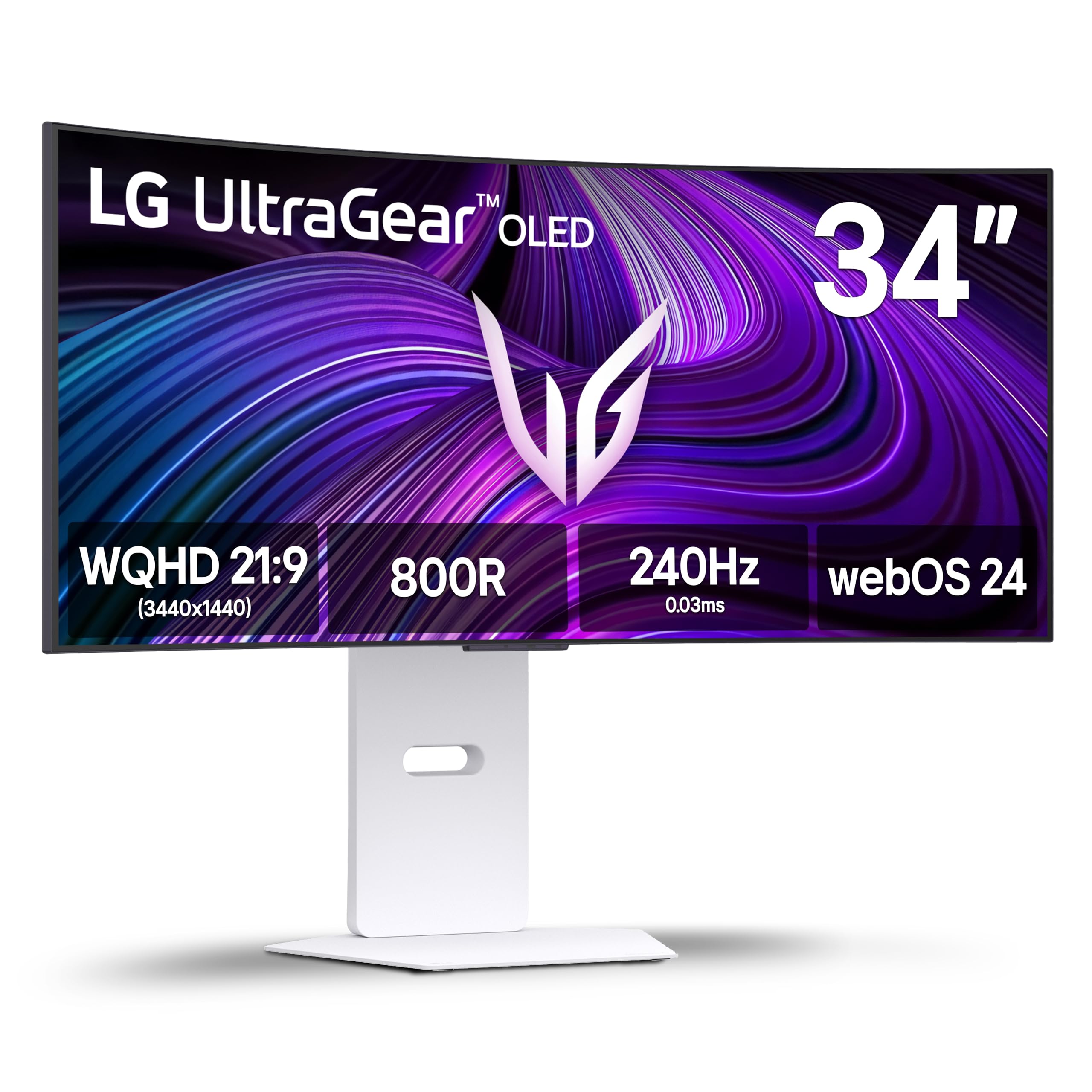
The steep-curve OLED that streams Netflix in the morning and melts frames at 240Hz by night.
The LG 34GX90SA-W is the most dramatic panel in this lineup, and not just because of its white chassis. Its steep 800R curve wraps around your peripheral vision like a cockpit, pulling you deep into games — customers note it can feel almost like VR-lite. Under that curve sits a WQHD OLED panel with a 240Hz refresh rate and 0.03ms response time, a combination that owners describe as “insanely fast” with zero ghosting or lag. Gaming on this feels fundamentally different from any LCD.
The OLED panel delivers a 1.5M:1 contrast ratio — literally a million to one — with VESA DisplayHDR True Black 400 certification. Blacks are truly black because pixels turn off completely, and the 98.5% DCI-P3 color coverage makes every scene pop with cinematic depth. Owners say night scenes in games look phenomenal and that the HDR implementation is stunning. Anti-glare surface treatment keeps reflections down so your attention stays on the action.
Beyond gaming, webOS24 turns this into a smart TV with Netflix, Prime Video, Disney+, HBO Max, and over 300 free LG Channels, plus cloud gaming via NVIDIA GeForce NOW and Amazon Luna without needing a PC. Connectivity is future-proof with HDMI 2.1, DisplayPort 1.4, and USB-C with 65W power delivery. The 2-year limited warranty includes OLED panel coverage with pixel-cleaning tools. One privacy-minded owner flagged that LG installs adware via Windows Update — a consideration for Windows users, though the Mac experience via USB-C works flawlessly.
The defining upgrade: OLED’s true blacks and 0.03ms response make every other panel in this list feel slower by comparison.
The honest trade-off: the steep 800R curve demands the right viewing distance, and Windows users should watch for LG’s bundled software.
Who this is for: gamers and streamers who want the best of both worlds — OLED motion clarity plus a built-in smart TV platform.
Who should wait: anyone sensitive to curve depth or uncomfortable with smart-TV software on a monitor; the gentler 1800R curve on the Alienware OLED below is safer.
10. LG 34GS95QE 34-inch Ultragear OLED Curved Gaming Monitor

The esports OLED where a 240Hz refresh meets a 0.03ms response for frame-perfect aim.
If you measure your gaming in milliseconds, the LG 34GS95QE is the monitor you have been waiting for. Its 240Hz OLED refresh rate and 0.03ms (GtG) response time (the time it takes a pixel to change color) deliver motion clarity that owners say is sharper than any 240Hz LCD — one buyer’s first impression: “The first time my desktop loaded, I thought the monitor was off,” thanks to OLED’s perfect blacks. The steep 800R curve (a tight bend with an 800mm radius) extends your periphery, and while it takes adjustment, owners find it improves FPS aiming by pulling targets into focus.
This is the rare panel that carries both NVIDIA G-Sync Compatibility (officially validated) and AMD FreeSync Premium Pro, so you get tear-free, stutter-free play whether you run a GeForce or Radeon card. The DisplayHDR True Black 400 certification with a 1.5M:1 contrast ratio makes dark scenes in games look impeccable — night raids and horror segments gain a depth that LCDs cannot touch. HDMI 2.1 and DisplayPort 1.4 both support the full 240Hz, and the anti-glare low-reflection screen keeps you focused.
Owners call it a masterpiece, praising the vivid colors and phenomenal refresh rate, and report no burn-in even after nine months of use — though they emphasize enabling the burn-in protection settings manually. The virtually borderless, ultra-thin design with height, tilt, and swivel adjustments keeps your battlestation clean. The honest caveats: the menu button is awkward and can cramp your hand, and reviewers point out that while the price is fair, this monitor is aggressively priced when full retail is higher. One owner returned it for a gentler 1800R curve, finding the 800R too steep — so test your tolerance for deep curves.
The standout stat: 240Hz refresh plus 0.03ms response with both G-Sync and FreeSync Premium Pro — no other class of panel gets faster.
The realistic catch: 800R is a very deep curve; some buyers prefer the subtler 1800R bend and returned it for that reason.
For the hardcore: if you play fast shooters and want OLED blacks with the fastest possible motion, this is the definitive choice.
For the cautious: if you have never used a deeply curved monitor, start with a gentler 1500R panel before committing to 800R.
11. Alienware AW3423DWF Curved QD-OLED Gaming Monitor

The QD-OLED that software developers and sim racers both swear by for color and motion.
The Alienware AW3423DWF is the color-accurate OLED that creative pros choose. Its Quantum Dot technology (a layer that converts blue light into red and green) delivers a 99.3% DCI-P3 color gamut — the widest color coverage in this entire list. Owners coming from 27-inch IPS panels call the colors and contrast superior to both VA and IPS, praising deep blacks and accurate tones. Software developers use it for daily work, and sim racers love the 1800R curve (a gentle bend with an 1800mm radius) that feels rich without the extreme bend of the 800R panels.
For content creators, the Creator Mode is the killer feature — it lets you switch between native DCI-P3 and sRGB color spaces and adjust gamma settings directly, so what you see on screen matches what prints or ships. The 0.1ms response time with a 165Hz refresh rate and AMD FreeSync Premium Pro (a variable refresh rate technology with low latency) delivers stutter-free, tear-free gaming. Owners say HDR games look amazing with class-leading clarity and almost zero pixelation, and that the 34-inch size is the perfect ultrawide balance with plenty of room for side-by-side windows.
Alienware backs this with a 3-year premium warranty that explicitly covers OLED burn-in — a genuine peace-of-mind feature that few rivals match. The design includes customizable RGB AlienFX lighting, a 5-axis joystick for OSD control, and a height-adjustable stand with tilt, swivel, and slant. The honest concerns: the anti-glare coating is fragile, with owners reporting spotting from gentle cleaning, and text edges are slightly less sharp than LCDs — an inherent OLED trait. Owners sum it up: “Every screen I own is now OLED and I’m not going back.”
Creator Credentials
- 99.3% DCI-P3 for color-critical work
- Creator Mode with DCI-P3 and sRGB switching
- 3-year warranty covers OLED burn-in
- 1800R curve balances immersion and comfort
Handle With Care
- Fragile anti-glare coating marks from cleaning
- Text edges slightly less sharp than LCD
- Legs take up significant desk space
Choose it for: professional color work plus gaming — the 99.3% DCI-P3 coverage and burn-in warranty make it the safest OLED for creative pros.
Be careful if: you clean aggressively or sit very close to the screen — the fragile coating and classic OLED text softness are real considerations.
Understanding the Specs
Refresh Rate (Hz)
This is how many times per second the screen redraws the image. A 60Hz panel looks fine for email, but 100Hz feels noticeably smoother for scrolling, and 165Hz to 240Hz is where competitive gaming lives. The Alienware and ASUS both hit 180Hz, while the OLED panels from LG push to 240Hz — at that speed, motion blur nearly disappears.
Response Time (ms)
This measures how quickly a pixel changes color, and lower is better. A 5ms response is fine for office work, but 1ms or 0.03ms matters for fast games where ghosting trails behind moving objects. The OLED panels at 0.03ms are virtually instantaneous, making them the clear choice for esports.
Contrast Ratio
This is the difference between the brightest white and darkest black a panel can show. VA panels like the ViewSonic (4000:1) and ASUS (4,000:1) offer strong depth, but OLED panels at 1.5M:1 — a million-and-a-half to one — produce true blacks by turning pixels fully off. That is why night scenes look dramatically better on OLED.
Curve Radius
Measured in millimeters, a lower number means a deeper bend. A 1500R curve wraps gently around you, comfortable for mixed work and gaming. The 800R curve on the LG OLED panels is much steeper, pulling your peripheral vision in but requiring you to sit closer. The 1800R on the Alienware QD-OLED is the gentlest of the premium options.
FAQ
Will a 34-inch ultrawide fit on my desk?
Can my laptop drive a 3440 x 1440 ultrawide?
What is the difference between VA and OLED panels?
Is 100Hz refresh rate enough for gaming?
Does a curved screen distort work or spreadsheets?
Will my Mac work with these ultrawide monitors?
What is FreeSync Premium and do I need it?
How long do OLED monitors last?
Can I use a 34-inch ultrawide for console gaming?
Final Thoughts: The Verdict
For most people, the 34 inch ultrawide monitor winner is the Alienware AW3425DWM because its 180Hz refresh rate, 1ms response, and strong VA contrast deliver a complete package at a fair price — it is the rare panel that satisfies both serious gaming and daily productivity. If you want a laptop-friendly one-cable setup with excellent color accuracy, grab the LG 34WR55QK-B with its 65W USB-C power delivery and 99% sRGB coverage. And for color-critical creative work plus gaming, the Alienware AW3423DWF with its 99.3% DCI-P3 coverage and burn-in warranty is the one to reach for.
How We Picked
We do not accept paid placement. Every pick is matched to a real buyer and a real use-case; we do not hands-on test units.
Sources & Methodology
Specifications: manufacturer listings and product documentation. Review insights: verified customer reviews, as of August 2026. Pricing: not shown on this page (it changes often); check the current price via the retailer link.
As an Amazon Associate, Gadgets Feed earns from qualifying purchases. This does not affect which products we feature.