
Rotary burrs chatter. Carbide bits grab. Precision air tools require a specific combination of run-out tolerance, free speed, and collet concentricity to deliver clean metal removal without fatigue-inducing vibration. The difference between a frustrating afternoon and a productive session comes down to the air motor’s bearing quality and the tool’s balance at high RPM.
I’m Min — the co-founder and writer behind Gadgets Feed. My deep market research on pneumatic micro-grinders focuses on comparing collet precision, bearing durability, and real-world free speed delivery across budget and premium tiers.
Whether you are deburring a machined aluminum part or carving detail into hardened steel, choosing the right unit means weighing RPM claims against actual torque under load. This guide breaks down the best air powered pencil grinder options for every shop floor scenario.
How To Choose The Best Air Powered Pencil Grinder
Selecting the right pneumatic pencil grinder involves more than comparing peak RPM numbers. The real factors are air consumption versus your compressor’s delivery, collet accuracy for holding small burs without wobble, and the tool’s weight-to-power ratio for extended use without fatigue.
RPM vs. Torque Under Load
A grinder rated at 65,000 RPM free speed may drop to 20,000 RPM the instant a carbide bur touches steel. Look for models with high-torque air motors or geared heads that maintain speed when the bit engages the workpiece — this determines actual material removal rate, not the unloaded number on the spec sheet.
Collet Precision and Run-Out
Radial run-out at the collet dictates whether your cut is smooth or chattery. Premium pencil grinders hold run-out below 0.001 inches. Budget units often exceed 0.003 inches, causing premature bur wear and poor surface finish. Verify that the collet grip is machined to match the shank exactly — fractional 1/8 inch collets are not interchangeable with metric 3 mm collets.
Air Supply Requirements
Every pencil grinder requires clean, lubricated air at a consistent 90 PSI. Small hobby compressors with 2 CFM or less will struggle to sustain operation beyond 30 seconds. Commercial users should verify the tool’s average CFM rating — typically 2 to 4 CFM — and match it to the compressor’s duty cycle.
Quick Comparison
On smaller screens, swipe sideways to see the full table.
| Model | Category | Best For | Key Spec | Amazon |
|---|---|---|---|---|
| NEIKO 10649A | Premium | General precision grinding | 54,000 RPM, variable speed | Amazon |
| Astro Pneumatic 218 | Mid-Range | Daily autobody and die work | 56,000 RPM, 1/8 collet | Amazon |
| Jrealmer JAG-095S | Premium | Tight-angle access grinding | 95° elbow, 53,000 RPM | Amazon |
| szdealhola Air Micro Grinder | Mid-Range | Complete kit for polishing | 54,000 RPM, 40-piece kit | Amazon |
| Baisiky Ultrasonic Micro Grinder | Mid-Range | Die filing and fine deburring | 28,000 RPM, file holder | Amazon |
| QWORK Air Micro Grinder | Budget | Entry-level small projects | 65,000 RPM, two-unit set | Amazon |
| WORKPAD Mini Air Angle Die Grinder | Budget | Narrow space right-angle work | 20,000 RPM, right-angle head | Amazon |
In‑Depth Reviews
1. NEIKO 10649A Micro Air Die Grinder

The NEIKO 10649A delivers 54,000 RPM in a streamlined pencil body that weighs only 0.25 pounds, making it the best balanced unit for extended deburring sessions on aluminum and mild steel. Its precision textured throttle enables fine speed modulation — critical when switching from carbide burrs to mounted stones without chattering the workpiece surface.
The included five-foot nylon hose with slip-on shield provides excellent flexibility, while the two collet wrenches and 1/4-inch NPT nipple allow immediate connection to standard shop air lines. Experienced users report minimal run-out and smooth rotation even at full throttle, outperforming many options in the premium tier.
Regular oiling is mandatory for any pencil grinder at this RPM range. The NEIKO motor runs noticeably truer than its direct competitors, and the variable speed lever allows the user to dial back RPM for precision engraving without sacrificing torque at lower settings.
Why it’s great
- Ultra-light 0.25 pound body reduces hand fatigue during long sessions
- Variable speed throttle gives precise control for different bit types
- Low run-out tolerance produces clean finishes on aluminum and steel
Good to know
- Requires daily oiling to maintain bearing life
- Speed adjustment is unmarked, requiring practice to find the ideal setting
2. Astro Pneumatic Tool 218 Pencil Die Grinder
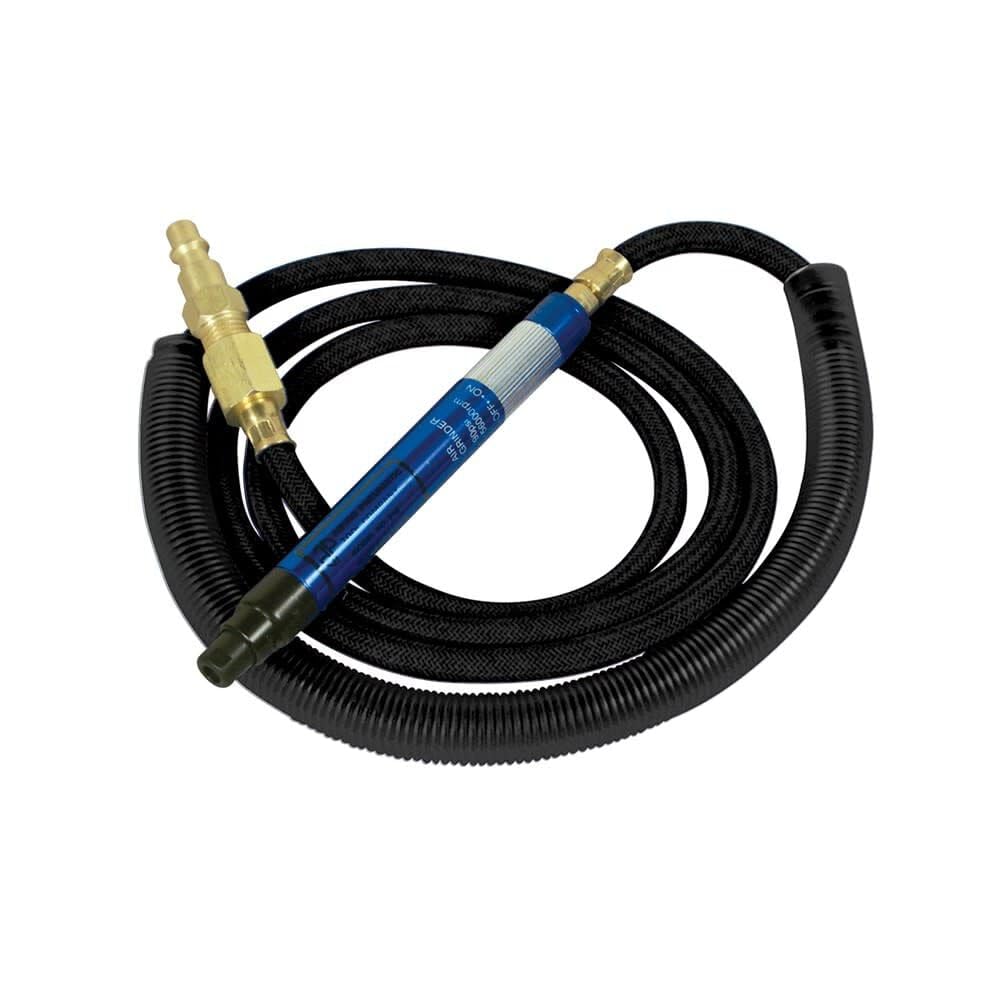
The Astro Pneumatic 218 runs at 56,000 RPM and has earned a reputation among autobody technicians and tool-and-die operators for delivering consistent performance under daily use. Its black pencil housing is compact enough to fit into recessed cavities, making it a go-to tool for cleaning brake caliper bores and deburring transmission housings.
Users report that the Astro 218 holds speed better under load than several comparably priced models, thanks to its well-matched air motor and bearing assembly. The regulator controls RPM effectively, allowing the operator to reduce speed for delicate bits without stalling the motor.
The crimped hose design is a single point of failure — unlike screw-on connections, a damaged hose requires replacement. However, with consistent oiling, multiple five-star reviews confirm this unit lasts a full year in industrial environments with three hours of weekly use on hardened steel.
Why it’s great
- Runs truer than many competitors at the same price point
- Compact pencil body fits into tight engine bay and die spaces
- Maintains strong torque under load for carbide burr work
Good to know
- Crimped hose cannot be repaired if damaged
- Requires a large compressor due to high air consumption
3. Jrealmer JAG-095S Right Angle Pencil Die Grinder

The Jrealmer JAG-095S features a 95-degree elbow head that delivers 53,000 RPM to the collet, making it the most maneuverable pencil grinder in this lineup for accessing confined areas like intake port interiors and submerged bolt cavities. The geared head design provides additional torque at the bit, which helps maintain material removal in hard-to-reach spots.
This unit ships with three collets — 1/8 inch, 3.0 mm, and 3/32 inch — plus four different air inlet fittings to accommodate both US and EU quick-connect standards. The alloy steel gear housing feels solid, and the variable power settings let the operator adjust speed for drilling versus grinding tasks.
Quality control on the collet threads is a reported weak point — some units arrived with collets that snapped under normal tightening torque. The precision gear set also generates more audible noise than a direct-drive pencil grinder, though this is typical for right-angle designs at this power level.
Why it’s great
- Smallest 90-degree air die grinder available for extreme access
- Three collet sizes accommodate a wide range of bur and drill bits
- Multiple included air fittings simplify connection to any compressor
Good to know
- Collet quality can be inconsistent across units
- Geared head runs louder than direct-drive pencil grinders
4. szdealhola 1/8″ Pneumatic Micro Air Pencil Die Grinder Kit

The szdealhola kit bundles the pencil grinder with an oiler, two wrenches, a female nipple, and 40 mounted stones in a plastic case, making it the most comprehensive starter package available. The tungsten steel alloy core provides wear resistance at 54,000 RPM, and the rotary air intake speed control gives the operator direct command over RPM for different materials.
The collet measures 3 mm rather than the advertised 1/8 inch, which means standard 1/8 inch shank tools will not fit without adapting or using collets designed for the metric dimension. This discrepancy has frustrated several buyers who expected a true fractional collet. For users working exclusively with metric bits, however, the fit is precise and repeatable.
Bearing quality in this unit is mid-range — the tool runs smoothly when properly lubricated, but some units have failed within a few months of regular use. The included mounted stone assortment is a genuine value add for light polishing and cleaning work on dies and small metal parts.
Why it’s great
- Comprehensive 40-piece kit includes stones, oiler, and case
- Rotary speed control on the air intake enables fine RPM adjustment
- Tungsten steel core offers good wear resistance at high RPM
Good to know
- Collet is 3mm metric, not true 1/8 inch fractional
- Bearing longevity is below premium-tier expectations
5. Baisiky 1/8″ Pneumatic Micro Pencil Grinder

The Baisiky Micro Grinder operates at a lower 28,000 RPM but compensates with a unique dual-grip system that accepts both standard needle files and rotary grinding tools. This makes it less of a conventional pencil grinder and more of a pneumatic reciprocating file — ideal for cleaning die cavities, deburring narrow slots, and finishing R-angles in injection molds.
The tool comes with ten file inserts and two collet holders, but the airline end is a hard plastic barb without a threaded female connector. Most users must cut the plastic barb off and install a 1/4 inch NPT adapter before connecting to a standard air hose. The build quality on the collet and bearing assembly is adequate for occasional use, though strong vibrations can cause hand numbness during extended operation.
Despite the documentation being sparse, the Baisiky grinder removes burrs efficiently on copper nickel alloys and fits into access points where standard pencil grinders cannot reach. The low noise output is a welcome feature in small workshop environments.
Why it’s great
- Accepts needle files for precise die-surface finishing
- Very quiet operation compared to high-RPM pencil grinders
- Excellent for burr removal in narrow die cavities
Good to know
- Airline requires modification to connect to standard fittings
- Strong vibration at the handle during extended use
6. QWORK Air Micro Grinder 2-Pack

The QWORK 2-pack offers two complete pencil grinders at a price point that makes it the most affordable entry into pneumatic micro-grinding. Each unit claims 65,000 RPM free speed and uses a standard 1/8 inch collet with a 1/4 inch NPT air inlet. The compact body and lightweight construction allow easy handling for small projects like jewelry polishing and light metal cleaning.
Real-world torque is limited — several users note that the 65,000 RPM rating is likely aspirational under load, with the motor bogging down noticeably when engaging steel or hardened materials. The collets are tight, and some users have snapped collet fingers while attempting to insert 1/8 inch shank tools. The 44.5-inch flexible hose is convenient for bench work, but the hose protector is basic.
For woodworking, light deburring on aluminum, or occasional use in a home workshop, the QWORK set delivers functional value. Having a backup unit in the same package is a practical advantage for mobile setups where tool loss or damage is a real risk.
Why it’s great
- Two grinders in one package for backup or shared use
- Lightweight body reduces fatigue on small projects
- Low entry cost for exploring pneumatic micro-grinding
Good to know
- Torque drops significantly under load on harder materials
- Collet tightness can make bit changes difficult
7. WORKPAD Mini Air Angle Die Grinder

The WORKPAD Mini Air Angle Die Grinder operates at 20,000 RPM with a right-angle head that provides access to narrow vertical and horizontal surfaces where a straight pencil grinder cannot fit. The radial run-out is specified at under 0.15 mm, delivering precise operation for light grinding and polishing tasks in confined engine bays, body panels, and restoration work.
The tool includes both 1/4 inch and 1/8 inch collets plus two wrenches, giving the operator flexibility to switch between standard die grinder bits and smaller pencil-type burs. The ergonomic aluminum body with low-vibration design has proven durable over years of use in restoration shops — one verified review notes it still runs strong after two years of consistent use with proper oiling.
A small percentage of units exhibit a collet arbor that spins inside the collet nut regardless of tightening force, which renders the 1/4 inch capacity unreliable for heavier carbide cutters. The 20,000 RPM maximum speed is lower than straight pencil grinders, but the trade-off in access capability is worthwhile for tight-space work.
Why it’s great
- Right-angle head reaches grinding areas inaccessible to straight tools
- Low radial run-out under 0.15 mm for clean finishing work
- Durable build with two-year track record in shop use
Good to know
- 1/4 inch collet can slip under heavy cutting load
- 20,000 RPM is slower than most pencil-type grinders
FAQ
Can I use a 1/8 inch bur in a 3 mm collet?
How much air does a pencil grinder really need?
Why does my pencil grinder vibrate heavily at high RPM?
Final Thoughts: The Verdict
For most users, the air powered pencil grinder winner is the NEIKO 10649A because it delivers the best balance of free speed, variable control, and low run-out in a lightweight package that reduces fatigue. If you need a rugged daily driver for autobody and tool-and-die work, grab the Astro Pneumatic 218. And for accessing tight-angle grinding spots where no straight pencil grinder fits, nothing beats the Jrealmer JAG-095S.