
Our readers keep the lights on and my morning glass full of iced black tea. As an Amazon Associate, I earn from qualifying purchases.
Specs are compiled from manufacturer listings and verified buyer reviews and can change over time — please confirm the key details on the product page before buying.
A dead battery is almost never a dead battery — it’s usually a battery that was never properly maintained. An intelligent charger changes that by handling the entire charge cycle automatically, so you just connect it and walk away. This guide sorts through the smart chargers that genuinely protect your batteries from the ones that just have a fancy label.
I’m Min — the founder and writer behind Gadgets Feed. This guide is built by comparing the manufacturers’ published specifications and the patterns across verified customer reviews, so you get each pick’s real strengths and trade-offs instead of marketing spin.
Whether you’re protecting a motorcycle through winter or reviving a deeply discharged car battery, the right battery intelligent charger pays for itself by extending battery life and preventing premature failure.
Our Picks at a Glance


How To Choose The Best Battery Intelligent Charger
An intelligent charger is defined by its ability to monitor the battery and adjust its output automatically, rather than just pushing a fixed current until you unplug it. The key is understanding what your battery chemistry needs and how long you plan to leave the charger connected.
Match the Amperage to Your Battery Size
The charger’s output amperage (measured in amps, or A) determines how fast it charges. A small 0.75A maintainer is perfect for a motorcycle or ATV battery left all winter. A 20A unit fills a large RV or solar bank much faster. The rule of thumb: higher amperage shortens charge time, but lower amperage is gentler for long-term maintenance. Choose based on your battery’s capacity in amp-hours (Ah).
Check Chemistry Compatibility
Lead-acid batteries (flooded, AGM, gel) charge differently than lithium (LiFePO4) batteries. Lithium cells need a higher voltage to reach full capacity, and lead-acid chargers can damage them. If you own a lithium battery, you need a charger that explicitly supports it — many smart chargers now offer selectable modes for both chemistries.
Look for Multi-Stage Charging and Safety Features
The core of an intelligent charger is its charge cycle. A proper 4-step program (initialization, bulk charge, absorption, float) prevents overcharging and extends battery life. Safety electronics like spark-proof circuitry, reverse polarity detection, and temperature sensors protect both you and your battery. These features are what separate a true intelligent charger from a plain trickle charger.
Quick Comparison
| Model | Best For | Output Amperage | Battery Chemistry | Charge Stages | Amazon |
|---|---|---|---|---|---|
| Battery Tender Junior★ Best Overall | Motorcycle & powersport storage | 0.75A | 12V Lead-Acid | 4-Step | Amazon |
| Nitecore UMS2Pro Performer | 18650 & rechargeable cells | 2A | Li-ion/Ni-MH | Intelligent Auto | Amazon |
| NOCO GENIUS1Rescue Pick | Dead battery recovery | 1A | 6V/12V Lead-Acid, LiFePO4 | Multi-Stage + Desulfation | Amazon |
| Tenergy T9688 | Household AA/AAA/C/D/9V | 1.3A | NiMH/NiCD | Auto Charge/Discharge | Amazon |
| ECO-WORTHY 5A | Dual lead-acid & lithium | 5A | 12V Lead-Acid, LiFePO4 | Fully-Automated | Amazon |
| Opus BT-C3100 | Battery testing & analysis | 2A (max) | Ni-MH, Ni-Cd, Li-ion | 5 Modes | Amazon |
| CRAFTSMAN 12A | Rapid car battery charging | 12A | 6V/12V Lead-Acid, LiFePO4 | Multi-Stage | Amazon |
| BatteryMINDer 1510 | Desulfation & long-term storage | 1.5A | 12V Lead-Acid | 5-Step + Desulfation | Amazon |
| LiTime 20A | Large lithium battery banks | 20A | 12V LiFePO4 | CC/CV/Float | Amazon |
In‑Depth Reviews
1. Battery Tender Junior
Our pick — over 4.5★ from 49,500+ verified ratings; the strongest balance of quality and price.
The set-and-forget champion that keeps your motorcycle battery alive all winter long.
This is the unit that defines the category for most people. The 0.75A output is small, but that’s the point — it’s built for long-term maintenance, not rapid rescue. Its complete 4-step charging program (Initialization, Bulk Charge, Absorption Mode, Float Mode) means it tops up your battery and then holds it safely at the right voltage indefinitely, without overcharging. The float mode is what makes it “smarter than a trickle charger,” as the manufacturer emphasizes.
What wins people over is the quality — it’s the most-praised aspect by a wide margin. The build is reliable, and Buyers report a single unit keeping a stored car battery going for 8 years.. The compact size earns frequent praise too: one owner mounted it inside a car hood. It’s sold with a 12-foot output cord and both fused-ring terminal harness and alligator clips, so it reaches awkward battery placements easily.
Safety is baked in with spark-proof circuitry that prevents no-spark connections, plus automatic reversed hook-up detection. The two-color charge status LED shows you the state of charge at a glance. It weighs just 1 lb (charger only), making it easy to tuck anywhere. The recurring gripe? The alligator clamps have small loops — an occasional owner swaps in separate ring terminals instead.
Why It Wins
- Compete 4-step program prevents overcharging
- Spark-proof and reverses hook-up protection
- Compact 1 lb design mounts almost anywhere
- 5-year warranty with lifetime support
Fit Notes
- 0.75A is slow for reviving a dead battery
- Alligator clip loops run small
The Verdict: Reach for this if you own a motorcycle, ATV, or lawn tractor that sits for weeks — it’s the most trusted way to keep it ready.
Consider otherwise: If you routinely need to resurrect a fully dead car battery, you’ll want a higher-amperage unit.
2. Nitecore UMS2
The vape-tech favorite that shows your battery health on a bright LCD while it charges fast.
This dual-slot charger targets a completely different crowd: people with 18650, 21700, 20700, and rechargeable AA/AAA cells. It’s built for the vape and flashlight community, and it nails that job. The LCD screen reports real-time info like battery health, charging status, and charging mode — you see exactly what’s happening, not just a glowing light. It auto-detects battery size, type, and voltage, so you just drop cells in and it figures out the rest.
Speed is a genuine standout. With a 9V QC2.0+ USB source, it hits a maximum 3000mA for one slot (or 4000mA total across two). The efficiency gain is real: owners coming from older chargers report the same cells finishing in 1.5-2 hours instead of 2-3. It runs on 5V USB-C input, which means no wall plug — you supply your own USB power source, a feature that makes it ideal for travel.
It includes an organizer to keep cells tidy on the go. The quality is the most-praised aspect, but durability draws some mixed feedback, so treat the spring bays gently. The main trade-off: it needs a quality USB wall adapter, since no power supply is included.
Standout Spec: The 3000mA single-slot output (vs 2A on the Opus) makes this the fastest dual-slot option here for 18650 users.
Best for: Vapers, flashlight enthusiasts, and anyone running multiple 18650/21700 cells who wants speed plus data.
Look elsewhere if: You’d rather not supply your own USB wall charger — this one ships without a plug.
3. NOCO GENIUS1
The palm-sized miracle worker that brings batteries back from 1 volt and even below.
NOCO’s GENIUS1 is the all-in-one answer for the person whose battery has been sitting dead for months. It’s a charger, maintainer, trickle charger, and desulfator all in one 15.2 oz package. The headline feature is its ability to start charging from a battery as low as 1 volt, and its Force Mode manually charges completely dead batteries down to zero volts. That’s a capability most smart chargers simply refuse to offer — they see a dead battery and shut off.
An integrated thermal sensor adjusts the charge based on ambient temperature. That means it prevents overcharging in hot weather and undercharging in cold, so the battery gets optimal treatment year-round. It handles 6V and 12V lead-acid (AGM, Gel, SLA, VRLA) plus lithium (LiFePO4) batteries. Reports of reviving decade-old SLA batteries in about a day are common. The 1A output is slow, but for maintenance and gentle recovery that’s exactly what you want.
One owner found it kept a generator battery charged for 7 months through daily storms. The 3-year warranty adds confidence. The catch: the 1A output means full charges take patience, and the included manual is thin — several owners recommend downloading the PDF version.
Rescue Note: Unlike the BatteryMINDer, which won’t touch a battery under 3V, this one will — that’s the differentiator for neglected batteries.
Reach for this if: You’ve got a dead battery that needs bringing back to life and you’re happy to wait.
skip it if: You need rapid charging — this 1A unit sips, it doesn’t gulp.
4. Tenergy T9688

The one charger that handles every household battery size you own, from AA to 9V.
If your house runs on rechargeable AA, AAA, C, D, and 9V batteries, this is the charger that replaces all your others. The Tenergy T9688 charges up to four batteries at once, all of different sizes, plus has two individual channels for 9V cells. It automatically selects the correct charging current for each battery size, so you never have to think about settings. The backlit LCD shows each battery’s status individually — capacity level, charging, discharging, or full.
What makes it genuinely “intelligent” is the automatic charge and discharge function. It can refresh older NiMH batteries by discharging them fully before recharging, which helps correct the “memory effect” and extends their life. Owners praise the sturdy spring contacts and easy loading. There’s even a built-in USB port (5V DC 500mA) on the back to power small digital devices — though it only works when the charger isn’t actively charging.
The quality is the most-praised aspect, and the blue LCD readout has a fine viewing angle. The honest trade-offs: charging speed gets mixed reviews (gentle is good for battery life but slow), and the display is on the small side. A few units have failed within a year, so it’s not the most durable pick here.
Standout Feature: The discharge/refresh cycle is rare at this level — it actively reconditions older NiMH cells instead of just topping them up.
Ideal for: Households with lots of rechargeable AA/AAA/9V devices that want one dock for everything.
Not for: Anyone who needs fast charge times or expects it to survive heavy daily use for years.
5. ECO-WORTHY 12V 5A

The budget smart charger that speaks both lead-acid and lithium without breaking a sweat.
Here’s the value angle: this 5A charger works with both 12V lead-acid and 12V lithium (LiFePO4) batteries, which puts it ahead of many pricier single-chemistry units. That dual support matters if you’ve migrated to a lithium battery in your BMW bike or RV but still maintain lead-acid elsewhere. It delivers 5A output with a 100-240V AC input, making it travel-friendly across different power standards.
It’s fully automated as a maintainer, not just a charger. It runs through bulk, absorption, and float stages automatically, which prevents overcharging. The smart detection prompts you if it finds low voltage, sulfation, or lost capacity. Owners appreciate the three included connection sets: battery clips, O-ring terminal cables, and an SAE connector with a 10A fuse. One owner used it to replace a failed trickle charger on a propane generator, saving a service fee.
Quality is the most-praised aspect, with compatibility close behind. The honest caveat: it runs warm during the bulk charge phase and needs ventilation. An occasional unit arrives dead on arrival, though replacements are quick. Also, the 240V input spec listed is actually the upper range — verify it matches your outlet before buying.
Value Read: Dual-chemistry support at this price beats the single-chemistry Battery Tender on versatility.
Great for: Budget buyers who own both lead-acid and lithium batteries and want one charger to cover them.
Think twice if: You need silent operation — it runs warm and needs airflow during charging.
6. Opus BT-C3100 V2.2

The battery laboratory that tests, refreshes, and revives cells instead of just charging them.
This is the serious enthusiast’s tool — the thing everyone raves about is its comprehensive testing and maintenance capabilities. The Opus BT-C3100 offers four independent slots that can each run a different battery type at the same time, plus five working modes: Charge, Discharge, Test, Quick Test, and Refresh. That means you can measure a cell’s actual capacity in milliamp-hours, not just assume it’s healthy. Owners specifically report it reviving “defective” NiMH batteries that other chargers gave up on.
Charging current is selectable from 200mA up to 1000mA per slot, and if you’re using only slot 1 or slot 4, you can push 1500mA or 2000mA. It handles Ni-MH, Ni-Cd, and 3.7V Li-ion in sizes from AA and AAA up to 18650, 26650, and 18490. The V2.2 upgrade added active thermal monitoring — a PCB temperature sensor controls the fan and shuts down if things get too hot.
The functionality is the most-praised aspect, with quality close behind. The honest downsides: the fan is loud and high-pitched, and the UI takes getting used to. An occasional unit resets to the 500mAh default. For DIY powerwall builders running multiple units, it’s proven — Several owners run 5 units at once..
Lab Note: Unlike the Nitecore UMS2’s basic health readout, this one runs a full discharge/recharge test to give you real mAh numbers.
Best for: Hobbyists, e-bike builders, and anyone who wants to verify a battery’s true capacity, not just charge it.
Skip if: You want silent operation — this fan really does whine.
7. CRAFTSMAN 12A

The 12A workhorse that brings a truly dead car battery back in a few hours.
This is the charger you grab when the car won’t start and you don’t want to wait overnight. The CRAFTSMAN 12A delivers a serious 12A rapid charge — compare that to the 0.75A of the Battery Tender Junior above, and you see the difference in philosophy. It’s a 4-in-1 device that charges, maintains, tests, and restores batteries for cars, motorcycles, ATVs, trucks, SUVs, and boats. The microprocessor control with digital display, auto voltage detection, and reverse hook-up protection make it safe for beginners.
Real-world evidence: A completely dead battery reached full charge in about 3.5 hours and the car turned over immediately.. That’s the speed buyers appreciate most. The progress meter on the digital display is a nice touch, showing you the charge state at a glance. It supports standard, AGM, deep-cycle, and 12V lithium (LiFePO4) batteries, with advanced desulfation mode and multi-stage charging algorithms. At 3.4 pounds, it’s a lightweight replacement for those heavy old metal chargers.
Reliability is the most-praised aspect, with an occasional report of dead-on-arrival units. The main wish from owners: a dedicated repair mode. Also note the 6-foot AC cord and 6-foot battery cables give 12 feet of total reach.
What Excites
- 12A output charges a dead car battery in ~3.5 hours
- Digital display shows charge progress
- Lightweight 3.4 lb design
- Handles lithium, AGM, and deep-cycle
The Trade-Off
- No dedicated repair mode
- An occasional unit arrives dead
Reach for this if: You need a fast, multi-vehicle charger that can revive a dead car battery in an afternoon.
Look elsewhere if: You want a repair/desulfation mode — this one focuses on speed, not restoration.
8. BatteryMINDer 1510
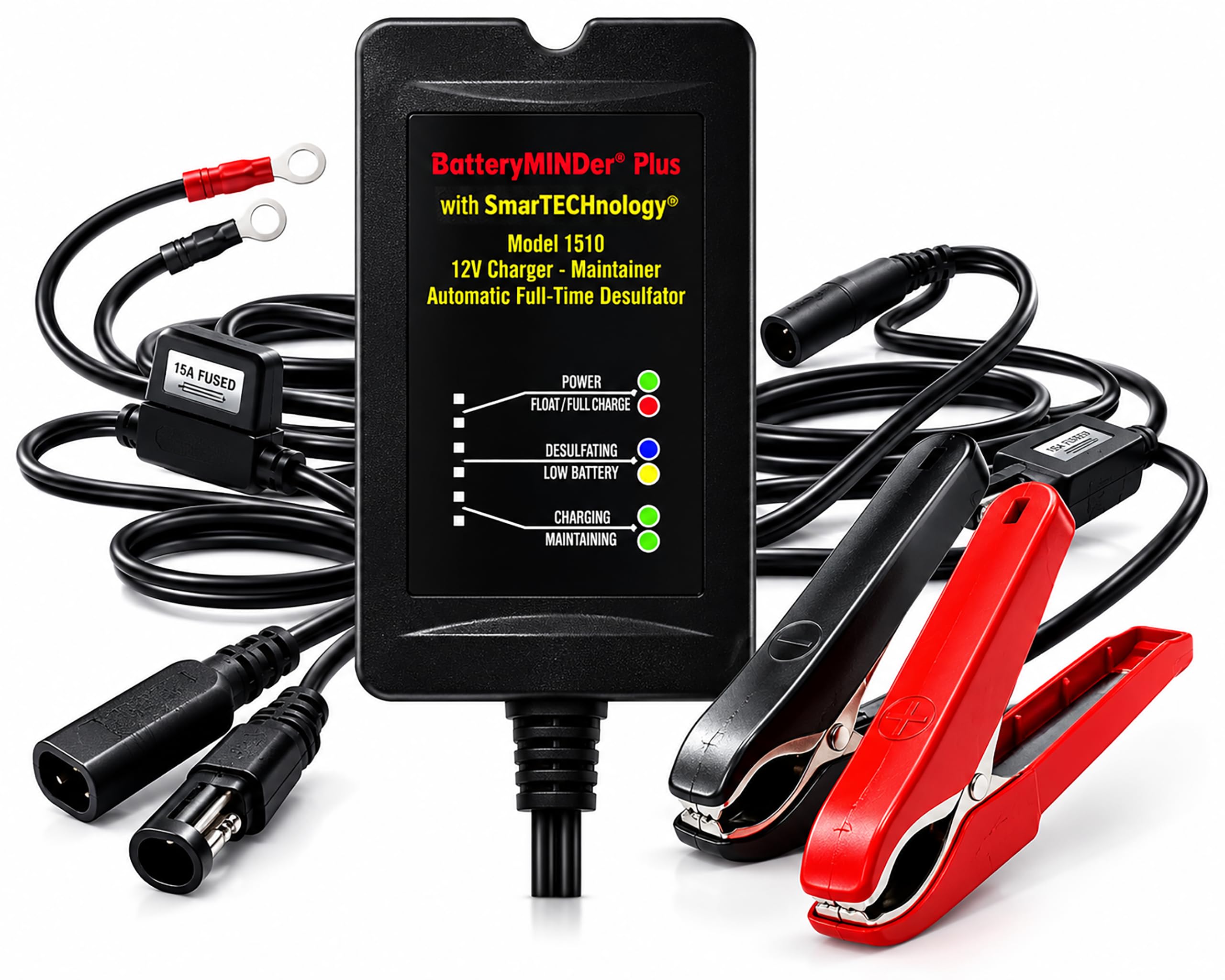
The desulfation specialist that rescues batteries others declare dead.
Here’s the differentiator: this charger actively removes sulfation, the lead sulfate crystal buildup that’s the primary cause of early battery failure. It uses a patented range of high frequencies to safely dissolve those crystals and recondition weak batteries. That’s not marketing fluff — the desulfation function is why owners mention reviving batteries that sat idle for a year, and even tractor batteries that appeared beyond recovery. The manufacturer claims it can extend battery life up to four times.
The installed temperature compensation adjusts voltage based on ambient temperature, so it charges correctly whether it’s freezing or hot. It includes reverse polarity, short-circuit, and over-temperature protection. A standout feature: it maintains up to four batteries at a time when connected in parallel, though you’ll need Y-Connectors (sold separately). The 90-240V AC 47-63 Hz input means it works worldwide.
Functionality is the most-praised aspect, with battery life extension close behind. Long-term owners are loyal — One owner has used the brand since 1998.. The honest catch: it won’t charge a battery under 3V, so a completely dead battery needs a jump start first to get it above that threshold. Owners who’ve had it maintain race car batteries through winter call it easy as plugging in a lamp.
Restoration Edge: Unlike the NOCO GENIUS1 that charges from 1V, this one requires a 3V minimum but actively dissolves sulfation to restore capacity.
Best for: Long-term storage, winterizing multiple vehicles, and reviving sulfated batteries that others gave up on.
Not for: Truly dead batteries below 3V — you’ll need to jump-start them first.
9. LiTime 12V 20A

The high-amp workhorse that refills a 100Ah lithium bank in hours, not days.
This is the heavy-duty answer for lithium battery owners. The LiTime delivers a massive 20A output with a 14.6V output, designed specifically for 12V (12.8V) LiFePO4 batteries. If you’re running an RV, off-grid solar system, or home deep-cycle setup, this is the charger that keeps pace with your power consumption. Customers note charging from 30% to 100% in under two hours, and a full discharge on a 100Ah battery takes about 5 hours.
The 0V activation feature is the standout — it can wake up a BMS-protected lithium battery that’s been deeply discharged and shut itself off. That’s a common failure point for lithium systems, and this charger handles it. It’s built with an aluminum alloy housing and efficient cooling fan for heat dissipation, plus LED indicators for clear monitoring. The full automatic transition through CC (constant current), CV (constant voltage), and Float/Cut off stages protects the battery. Multilevel protections prevent over-temp, over-voltage, short-circuit, over-current, low-voltage, and reverse polarity.
Buyers praise this charger most for how well it works, with charging speed a close second. The Anderson 50A and M8 terminal connectors (heavy-duty plugs and bolt-on terminals) give you a sturdy, secure connection — one owner wired a set to the battery and enjoyed a satisfying, hearty “click” on connect/disconnect. You also get a 2-year warranty for confidence. The honest cautions: the fan is a bit loud, and it’s not waterproof — so skip it for marine environments, as the manufacturer warns.
Power Read: At 20A, this charges 10x faster than the 2A Opus — a different class entirely for serious lithium users.
Reach for this if: You run a lithium battery bank for solar, RV, or off-grid use and want fast, reliable refills.
Look elsewhere if: You need a waterproof charger or want silent operation — the fan makes its presence known.
Understanding the Specs
Output Amperage
This is the charging speed in amps (A). A 0.75A charger is a gentle maintainer for small batteries left in storage. A 20A unit is a rapid charger for large batteries that need a quick refill. Match the amperage to your battery’s capacity — too high can stress a small battery, too low means long waits. For reference, the Battery Tender Junior pushes 0.75A while the LiTime delivers 20A — a massive difference in charging speed.
Charging Stages
Smart chargers use a multi-stage program rather than a single continuous current. A typical 4-step cycle includes Initialization (checking the battery), Bulk Charge (main charging), Absorption (topping off), and Float (maintaining). Float mode is what lets you leave the charger connected indefinitely without overcharging. Some chargers add desulfation, which sends high-frequency pulses to dissolve lead sulfate crystals and restore capacity.
FAQ
Can an intelligent charger revive a completely dead battery?
Can I leave an intelligent charger connected indefinitely?
What’s the difference between a trickle charger and an intelligent charger?
Will a lead-acid charger damage a lithium battery?
How many batteries can one charger handle?
What battery sizes can the Opus BT-C3100 charge?
What does desulfation do for a battery?
What is reverse polarity protection?
Can a 12V charger work for 6V batteries?
Why does my charger run warm or have a fan?
Final Thoughts: The Verdict
For the majority of shoppers, the battery intelligent charger winner is the Battery Tender Junior because it nails the most common job — keeping a vehicle battery healthy through long idle periods — with proven reliability and a 4-step smart program. If you want dead-battery rescue capability, grab the NOCO GENIUS1 with its 1-volt starting threshold and Force Mode. And for lithium battery owners needing serious amperage, the LiTime 20A is the one to reach for.
How We Picked
We do not accept paid placement. Every pick is matched to a real buyer and a real use-case; we do not hands-on test units.
Sources & Methodology
Specifications: manufacturer listings and product documentation. Review insights: verified customer reviews, as of August 2026. Pricing: not shown on this page (it changes often); check the current price via the retailer link.
As an Amazon Associate, Gadgets Feed earns from qualifying purchases. This does not affect which products we feature.