
Our readers keep the lights on and my morning glass full of iced black tea. As an Amazon Associate, I earn from qualifying purchases.
Specs are compiled from manufacturer listings and verified buyer reviews and can change over time — please confirm the key details on the product page before buying.
You want a balanced headphone amplifier to get a louder, cleaner signal through a 4.4mm or XLR cable, not just a standard single-ended jack. True balanced output doubles the amp circuitry per channel, which cuts crosstalk (signal bleed between left and right) and can push far more power into demanding planars (headphones with flat diaphragms) and high-impedance dynamics (traditional drivers needing more voltage). Your choice depends on your headphones’ sensitivity, your source (PC, phone, or console), and how much EQ or sound-shaping you want built in.
I’m Min — the founder and writer behind Gadgets Feed. This guide is built by comparing the manufacturers’ published specifications and the patterns across verified customer reviews, so you get each pick’s real strengths and trade-offs instead of marketing spin.
From compact desktop DAC/amps to analog-only powerhouses, these are the top-rated balanced headphone amplifier options for every rig and budget.
Our Picks at a Glance


How To Choose The Best Balanced Headphone Amplifier
Balanced amps are a genuine upgrade over standard headphone jacks, but only if your headphones support a 4.4mm or XLR cable. If your cans only take a 3.5mm plug, a balanced amp still helps via an adapter, but you lose some of the true dual-channel benefit. Start by checking what connector your headphones actually use.
Know Your Power Needs
Output power, measured in milliwatts per channel (mW), tells you how loud and how controlled the amp can drive your headphones. High-impedance dynamics over 250 ohms and power-hungry planar magnetics need serious wattage to sound full and punchy, while sensitive in-ear monitors need far less — and benefit from a low gain setting to avoid hiss.
DAC vs Pure Amp
Some of these are DAC/amp combos with a built-in digital-to-analog converter (the chip that turns music files into an analog signal), letting you plug straight into a PC or phone via USB. Others are pure analog amps that require a separate DAC as a source. If you want a one-box desktop setup, a combo saves desk space; if you already own a high-end DAC, a dedicated amp is the cleaner path.
Quick Comparison
| Model | Best For | Balanced Output | Max Power (per ch.) | DAC Chip | Amazon |
|---|---|---|---|---|---|
| Fosi Audio K7★ Best Overall | Gaming + desktop value | 4.4mm | 2100mW | AK4493S | Amazon |
| FiiO K7Premium Pick | Desktop all-rounder | 4.4mm | 2000mW | AK4493SEQ x2 | Amazon |
| FiiO K11 R2RBest Value | R2R sound on a budget | 4.4mm | 1300mW | 24-bit R2R array | Amazon |
| Khadas Tone2 Pro | Pocketable high-end sound | 4.4mm | — | ESS ES9038Q2M | Amazon |
| Questyle M15i | iPhone/Android portable | 4.4mm | — | ESS ES9281AC | Amazon |
| iFi Zen CAN 3 | Pure analog + EQ fun | 4.4mm | 2000mW | — (analog) | Amazon |
| Schiit Midgard | XLR preamp + power | 4-pin XLR | ~5W | — (analog) | Amazon |
| TOPPING DX5 II | Feature-packed desktop | 4.4mm | 7600mW | ES9039Q2M x2 | Amazon |
| HIFIMAN EF400 | R2R warmth + planars | 4.4mm / XLR | 4.4W | HIMALAYA R2R | Amazon |
In‑Depth Reviews
1. Fosi Audio K7 DAC Headphone Amp
Our pick — over 4.5★ from 250+ verified ratings; the strongest balance of quality and price.
A desktop DAC/amp that delivers 2100mW of balanced power for gaming, streaming, and planar headphones.
The Fosi Audio K7 earns its spot as the best first balanced setup because it delivers 2100mW (milliwatts) through its 4.4mm balanced output — enough power to make demanding planar headphones sound full and controlled, not thin. It pairs an AK4493S DAC chip (digital-to-analog converter) with a TPA6120 headphone amp. It’s the crowd favorite here, with 4.7 stars across hundreds of owners: gamers call out tight, controlled bass and superb positional clarity, while music lovers praise its neutral, detailed voicing.
What makes it so versatile is the input selection. You get USB-C for your PC or PS5, plus optical, coaxial, and Bluetooth aptX HD/LL for wireless streaming, and a 3.5mm microphone input for headset mics. The all-aluminum chassis feels premium and adds electromagnetic interference shielding, which keeps the signal clean. Owners sum it up: “simple, without a lot of bells and whistles that aren’t needed,” and call it plug-and-play on PS5 and PC alike — no drivers to wrestle with.
The main trade-offs are minor: the digital volume knob is an endless rotary that some find easy to overshoot in the dark, and the display is hard to read at off angles. Buyers also note the companion software is basic. But at its price tier, it delivers balanced output, Bluetooth, and a mic input in one compact metal box — a combination that’s tough to top.
What Owners Love
- 2100mW balanced output drives planars with ease
- Metal build feels rugged and premium
- Bluetooth aptX HD/LL plus optical and coaxial inputs
- PS5 and PC plug-and-play with no drivers
The Honest Trade-offs
- Endless volume knob can be easy to overshoot
- Display hard to read at an angle
- Software control is bare-bones
Reach for this if: you want one desktop box that handles gaming, streaming, and demanding headphones through a 4.4mm balanced output, with Bluetooth as a bonus.
Look elsewhere if: you need an XLR output or deep EQ controls — this unit keeps things simple on purpose.
2. FiiO K7 Full Balanced HiFi DAC Headphone Amplifier
A dual-chip desktop amp with 2000mW balanced output that rivals pricier units.
If you want a no-compromise desktop unit, the FiiO K7 takes the balanced formula further with dual AK4493SEQ DAC chips and dual THX AAA 788+ amplifiers — the same amp tech found in far pricier units. It delivers 2000mW of stable power through the 4.4mm balanced output, which easily drives full-size headphones. Owners consistently report a wider soundstage and better instrument separation on balanced vs single-ended, calling it a “must have for audiophiles” that runs cool even under load.
The K7 is built around flexibility: USB, optical, coaxial, and AUX inputs cover just about any source, while 4.4mm balanced, 6.35mm, and 3.5mm outputs mean you can swap between headphones and powered speakers. It offers 2 gain levels and 3 output levels, plus RGB indicator lights that shift color to show sampling rates. One owner noted it delivers roughly 85-90% of the performance of a flagship amp at a fraction of the investment — a strong value argument for stepping up.
The catch is the digital volume knob, which steps in distinct increments rather than sweeping smoothly; some find it annoying for fine adjustments. There are also occasional reports of the unit needing a power cycle after wake-from-sleep driver hiccups. But the clean, neutral THX sound signature and the sheer power on tap make this a top-tier entry into balanced listening.
Balanced Power: 2000mW through a 4.4mm jack drives demanding cans with headroom to spare, and dual THX amps keep the noise floor dead quiet.
Who it beats: owners say it rivals pricier amps and even approaches a fraction of a flagship’s performance — a serious step up from a soundcard or dongle.
Who it doesn’t: if you hate stepped digital volume or want a pure analog amp with no DAC, keep looking.
3. FiiO K11 Compact Desktop R2R Architecture DAC and Headphone Amplifier
A budget R2R DAC/amp that delivers warm, musical sound through a 4.4mm balanced output.
Most budget amps use Delta-Sigma DAC chips; the K11 R2R instead packs a fully differential 24-bit R2R resistor array — 192 precision resistors across four channels — for that organic, musical character R2R is known for. It outputs up to 1300mW per channel through a 4.4mm balanced jack, and owners say it pairs beautifully with planars like the Hifiman Ananda Stealth, taming treble and adding vocal richness. The dual NOS/OS modes let you switch between a more musical presentation (NOS, keeping original sampling rate) and a more detailed, precise one (OS, oversampling to 384kHz).
For the price, the sound staging and clarity genuinely impress — one owner called it a night-and-day upgrade over phone dongles, with warm clarity and no hiss. It handles a wide range of gear, from sensitive IEMs at low gain to power-hungry over-ears, and the included 12V low-noise power supply keeps things clean. The design is sleek, with a single pressable knob that controls everything.
The honest downsides: that single-knob interface draws mixed reactions — some find it annoying, others get used to it — and a few buyers report units failing within months, with FiiO support slow to help. It also struggles with the absolute hardest-to-drive planars. But if you want R2R warmth on a budget, this is the standout.
R2R Character: the 24-bit resistor array delivers that smooth, slightly warm sound that Delta-Sigma chips often lack, all for an entry-level price.
Best for: planar-headphone owners and anyone wanting that ‘analog’ R2R tone from a compact desktop box.
Think twice if: you want a sturdy multi-button interface or need to drive the hardest-to-run planars — this unit has limits there.
4. Khadas Tone2 Pro Desktop DAC and Headphone Amplifier

A pocketable DAC/amp with an ESS ES9038Q2M chip that drives full-size headphones up to 150 ohms.
The Tone2 Pro proves you don’t need a big chassis for big sound. This slim aluminum unit weighs just 120 g — light enough for a pocket — yet pairs an ESS ES9038Q2M DAC with four OPA1612 op-amps plus three buffers in a 3-stage amplification path. That setup drives demanding headphones up to 150 ohms, and owners say it handles Sennheiser HD650s with “deep, flowing, no loss” sound that rivals much pricier DACs. It supports MQA decoding via the XMOS XU216 processor, plus up to 32-bit/768kHz PCM and DSD512.
The connectivity is a differentiator: a 4.4mm balanced headphone jack alongside 3.5mm single-ended, plus an industry-first balanced RCA line-out with three signal pins. You can also feed a clean 5V linear power supply into a second USB-C port while data flows on the first — smart power-noise isolation for purists. Owners repeatedly describe the sound as clear, non-fatiguing, with excellent separation and spaciousness.
Here’s the honest catch: the volume control is a push-and-turn wheel that owners find frustrating and non-intuitive until you watch the maker’s YouTube tutorials — “the knob interface is the weak point,” as owners mention. The manual is unhelpful, and reliability gets mixed feedback. But once set, the sound is genuinely high-end for the money.
Sound First: MQA decoding plus a multi-stage amp path deliver spacious, airy sound that owners compare to far more expensive gear.
Control Quirk: that little knob has a learning curve — set it once and it’s fine, but fumbling it initially is common.
Grab it for: a travel-friendly balanced DAC that still drives full-size cans and decodes MQA.
skip it if: a simple, obvious volume knob is a must — this one demands patience.
5. Questyle M15i Portable USB DAC and Headphone Amplifier

A dongle-sized amp with Current Mode Amplification that drives full-size headphones from your phone.
If portability matters most, the M15i is a desktop-level performer in a compact stick. It uses Questyle’s patented Current Mode Amplification — a different approach from traditional voltage amps — for ultra-low distortion and fast transient response, delivering a warm, natural sound. The flagship ESS ES9281AC DAC decodes PCM up to 768kHz/32-bit and DSD512, so Tidal, Qobuz, and Apple Music all sound their best. A manual gain switch lets you run sensitive IEMs without background hiss, then flip to high gain for demanding over-ears.
Owners who compared it to flagship portables like the Mojo 2 and iFi xDSD Gryphon say it beats them in both sound quality and power with HiFiMAN Sundara planars, while staying smaller and running cool. The MFi certification means it’s plug-and-play with the latest iPhones, iPads, Macs, and Android devices, with no battery drain or “device not supported” errors. Both 3.5mm and 4.4mm balanced outputs cover just about any headphone cable.
The trade-offs are real: it’s USB-only — no Bluetooth, no sound profiling apps — and connectivity gets mixed reviews, with some reporting disconnections from phones. Durability is also a gamble; some units ran flawlessly for months, while a few died early. But the consensus is that when it works, it’s “very musical,” with deep bass and smooth, non-harsh treble.
Pocket Power: Current Mode Amplification plus a manual gain switch means one dongle serves both sensitive IEMs and big headphones.
Ideal for: phone-first listeners who want MFi-certified, balanced output on the go without carrying a desktop box.
Pass if: you need Bluetooth or worry about the occasional connectivity quirk reported by a few owners.
6. iFi Zen CAN 3 High-Resolution Analogue Headphone Amplifier
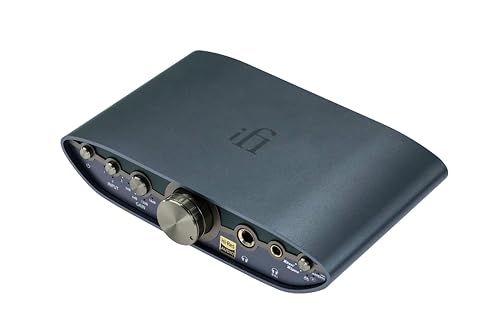
A pure analog amp with 2000mW balanced output and five hardware EQ modes.
This is the amp for people who already own a DAC and just want clean, powerful analog amplification with a bit of personality. The Zen CAN 3 is pure analog circuitry — no digital signal processing (DSP) in the path — so the sound stays smooth and full. It pushes up to 2000mW via its 4.4mm balanced output, smoothly driving everything from Beyerdynamic Pro X to Sennheiser 600 series cans. Owners describe it as a “truly remarkable” value with excellent build quality and easy handling of both headphones and IEMs.
The fun part is the five built-in EQ modes: XBass+ restores lost low-end punch, XSpace widens the sound field, a combined mode layers both, and a Game mode boosts subtle sound effects so you hear approaching enemies clearly. A gain switch (0 dB default, +6 dB for quiet vinyl) adds flexibility. It accepts both 4.4mm balanced and RCA inputs, and outputs through 4.4mm and 6.35mm jacks, pairing naturally with the Zen DAC 3.
The recurring mixed feedback centers on the XSpace feature — some owners find it does almost nothing, while one reviewer bought it specifically for that mode and was let down. The 4.4mm cable is sold separately, adding to the cost. But the core amp performance is praised across the board: “perfect sound” with the gain boost and XBass engaged, in a compact, stylish chassis that’s portable enough to move around.
Analogue First: no DSP in the path means a cleaner, fuller sound, with EQ that’s hardware-based — not an app gimmick.
Mode Reality: XBass+ wins fans; XSpace gets shrugs — test it before relying on it.
Best for: folks pairing it with a separate DAC who want powerful analog output plus switchable bass and spatial effects.
Not for: anyone who needs a built-in DAC or who measures value purely on XSpace — its effect is subtle at best.
7. Schiit Midgard Headphone Amp and Preamp

A US-built amp that delivers nearly 5W into 32 ohms via XLR and includes a preamp.
For XLR users, the Schiit Midgard is a serious step up. It pushes nearly 5W (watts) into 32 ohms (a common headphone impedance) through either the 1/4″ TRS or 4-pin XLR front connectors — enough to grab power-hungry planars by the horns, with owners noting “plenty of punch on the low end” and an incredibly large soundstage. It’s built like a tank and designed in Texas, with a 3-year warranty and US-based support that owners rave about. The Halo topology mixed-mode feedback delivers near state-of-the-art measurements.
what separates it is its dual role. It’s not just a headphone amp — it has balanced and single-ended preamp outputs, so it can drive powered speakers too, plus both balanced and single-ended inputs and two gain levels. Owners upgrading from a Magni/Modi stack report a huge improvement: larger, more enveloping sound with greater instrument separation. One owner called it a “great bargain” that sounds better than many amps they’ve owned, with warm analog character and a 3D-like soundstage.
The honest notes: it’s 115VAC only — a US/Canada/Mexico plug that won’t work in 220-240V countries, so international buyers need a converter. One owner returned it after finding the headphone output isn’t truly balanced as advertised, preferring the pricier Jotunheim 3. And it’s a pure amp with no built-in DAC, so you’ll need a separate source. But for raw US-built XLR power at this level, it’s a standout.
Raw XLR Might: nearly 5W into 32 ohms plus preamp outs make it a hub for both headphones and speakers.
Source Required: there’s no DAC inside — pair it with your own converter or streamer.
Grab it for: XLR planars and a one-box preamp that feeds powered speakers, all backed by a 3-year US warranty.
Look elsewhere if: you’re outside North America or want a strict textbook-balanced headphone circuit.
8. TOPPING DX5 II Hi-Res DAC and Headphone Amp Combo
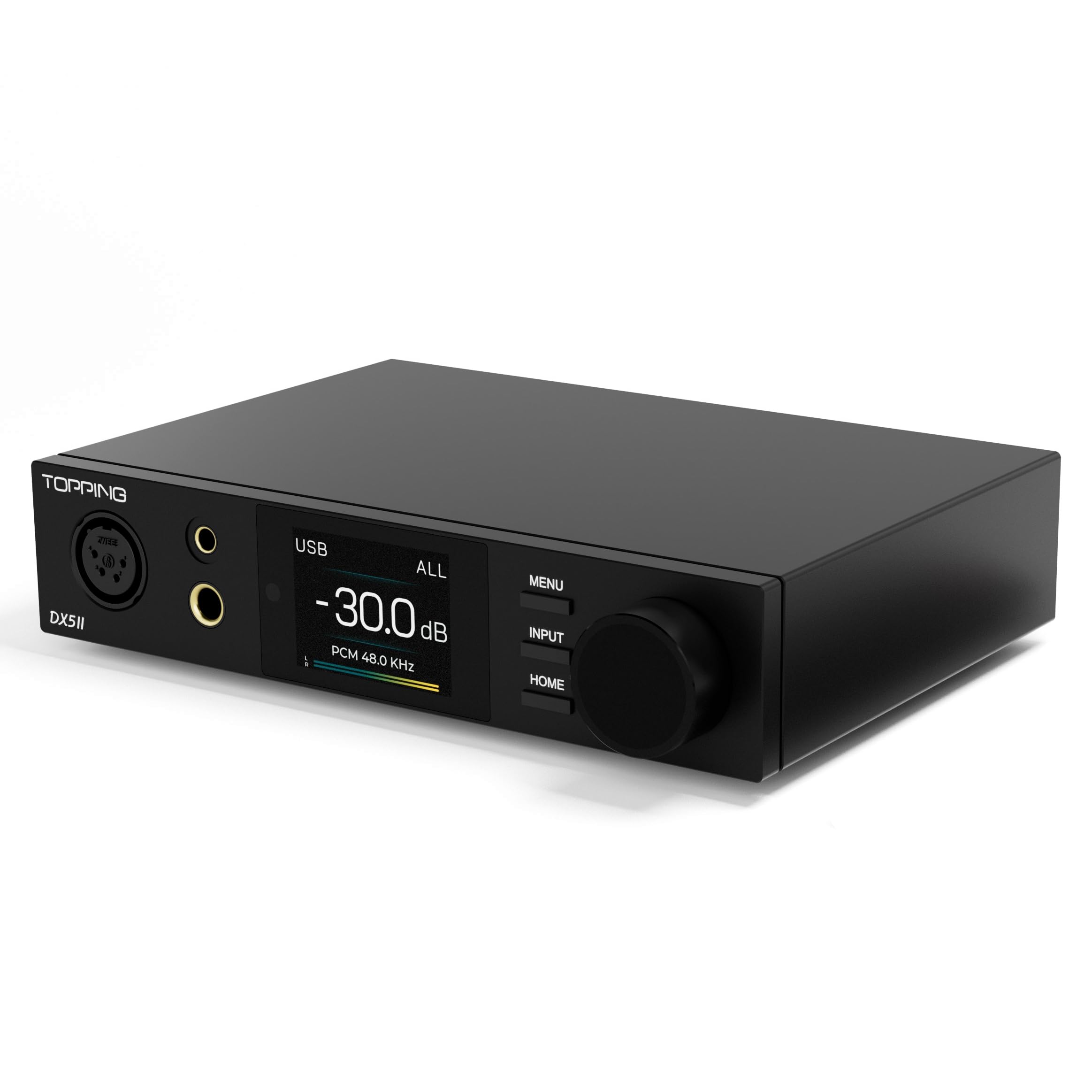
A feature-loaded desktop combo with 7600mW balanced output and a 10-band PEQ.
If you want one box that does everything, the TOPPING DX5 II is the most feature-packed unit here. At its heart sit dual ES9039Q2M DAC chips feeding an X-Hybrid headphone amp that pushes a massive 7600mW x2 into the 4.4mm balanced output — the highest power figure in this lineup, enough to drive basically any headphone with authority. Owners say it offers A30 Pro-level power with perfect channel matching and a transparent, neutral sound that’s “clean but not sterile.”
The features list reads like a wishlist: a 10-band PEQ (parametric equalizer, for precise sound tuning), LDAC Bluetooth 5.1 via a QCC5125 chip, USB/Coaxial/Optical SPDIF inputs, a 2.0″ full-color Aurora UI display with 9 themes, preamp mode, and a 12V trigger for smart integration with HiFi systems. It’s plug-and-play across Windows, Mac, Linux, iOS, and Android via XMOS XU316. One owner noted it took 90 minutes of customization through the Topping Tune app to get superior EQ, but called it “outstanding value for the money.”
The mixed reviews center on reliability and the headphone jacks — a known Topping hot-swap issue where plugging in while powered can damage the jack; one unit broke within two weeks. Another owner flagged the cheap-feeling volume knob. And it’s not ideal for ultra-sensitive IEMs, where the low noise floor still isn’t silent enough. But for power and flexibility at this price, it’s hard to match.
The Feature Wall
- 7600mW x2 balanced output — the most power here
- 10-band PEQ for real sound customization
- LDAC Bluetooth 5.1 plus full wired input suite
- 12V trigger and preamp mode for speaker systems
What to Watch
- Headphone jacks can fail on hot-swap — power down first
- Volume knob feels cheaper than the rest of the unit
- Too much noise floor for ultra-sensitive IEMs
Choose this for: a do-everything desktop stack with huge power, deep EQ, and Bluetooth — best for flexible system builders.
pass on it if: you mostly use ultra-sensitive IEMs or want a bombproof volume knob.
9. HIFIMAN EF400 Desktop Balanced Headphone DAC and Amplifier

The R2R-toned amp built to make planar headphones sing.
For planar-headphone fans, the EF400 is a purpose-built match. It runs the HIMALAYA R2R DAC — a discrete resistor-based digital-to-analog converter that won a VGP Gold Technology Award in 2022 — and outputs a thumping 4.4W per channel through balanced output. Owners who A/B tested it against the FiiO K5 Pro found clear gains in planar bass weight and fullness, calling it a “great PC DAC/AMP for gaming and multimedia” that’s plug-and-play with no drivers needed. The four-channel fully differential circuit pushes up to 10.7 Vrms into a 36Ω load.
The 4-level function switch is the standout feature: High Gain NOS, High Gain OS, Low Gain OS, and Low Gain NOS let you blend two gain options with two digital filtering modes. NOS (non-oversampling) offers a warmer, more natural sound — one owner says it adds “warmth and engagement” that’s excellent for jazz and pop — while OS (oversampling) delivers crisper detail. Front-panel outputs include 6.35mm, 3.5mm, 4.4mm balanced, and 4-pin XLR balanced, so any headphone cable works.
The honest mixed feedback is significant: NOS mode can produce crackling noises on CD-quality tracks with certain sources, and there’s no firmware fix — a workaround is using Roon with sample conversion. A few customers note the unit failing to power on reliably, and one flagged poor volume knob machining. The general advice: it’s best with a PC or Mac source. But for the R2R warmth and planar-driving power, it’s a compelling flagship.
Planar Power: 4.4W per channel plus 4-pin XLR makes it a serious partner for HIFIMAN and other planars.
NOS Caveat: the crackle on some CD-quality sources is real — plan to feed it from a PC or Mac.
Best for: planar-headphone owners who want R2R warmth and huge balanced power in one desktop box.
Look elsewhere if: you primarily stream from an iPad or need flawless NOS performance across all sources.
Understanding the Specs
Balanced Output (4.4mm vs XLR)
A balanced connection keeps the left and right audio channels on completely separate circuits, which cuts crosstalk and doubles the power available per channel. You’ll see 4.4mm jacks on most modern desktop and portable amps, while 4-pin XLR is the pro-standard found on bigger units like the Schiit Midgard. Your headphones need a matching balanced cable to get the full benefit; otherwise a 3.5mm adapter still works but loses some of the advantage.
Output Power (mW)
Milliwatts per channel tell you how much headroom the amp has. The Fosi K7 offers 2100mW and the FiiO K7 delivers 2000mW, both enough for most full-size headphones. If you own power-hungry planars, hunt for higher numbers like the TOPPING DX5 II’s 7600mW or the HIFIMAN EF400’s 4.4W. Sensitive IEMs need far less — pair them with a low gain setting to keep the background silent.
DAC Chip and R2R vs Delta-Sigma
The DAC chip converts your digital music file into an analog signal your headphones can play. Delta-Sigma chips like the AK4493S or ESS ES9038Q2M are the modern standard — clean, detailed, and precise. R2R (resistor ladder) DACs, found in the FiiO K11 R2R and HIFIMAN EF400, use discrete resistors for a warmer, more musical tone that some listeners prefer for vocals and jazz. Neither is “better” — it’s a tonal preference.
DAC/Amp Combo vs Pure Analog Amp
A combo unit (like the Fosi K7 or TOPPING DX5 II) includes a built-in DAC, so you plug it straight into a PC, phone, or console via USB and get sound immediately. A pure analog amp (like the iFi Zen CAN 3 or Schiit Midgard) requires a separate DAC or source with a line output. Combos are simpler for desktops; pure amps are the choice when you already own a high-quality DAC or want to pair components individually.
FAQ
Do I need a balanced headphone amplifier?
What is the difference between 4.4mm and XLR balanced?
How much output power do I need for planars?
Can I use a balanced headphone amp with my iPhone?
What is a DAC chip and why does it matter?
Is there a difference between NOS and OS modes on an R2R amp?
Can I connect a balanced amp to powered speakers?
Will a balanced headphone amp work with my PS5?
Final Thoughts: The Verdict
For the majority of shoppers, the balanced headphone amplifier winner is the Fosi Audio K7 because it combines 2100mW of balanced power, Bluetooth, and a mic input in a rugged metal desktop box that works with PS5 and PC from the start. If you want a feature-loaded powerhouse with massive 7600mW output and deep EQ, grab the TOPPING DX5 II. And for XLR users needing near-5W plus a preamp for speakers, the Schiit Midgard is the one to reach for. Whichever you choose, make sure your headphones have a 4.4mm or XLR balanced cable to get the full benefit.
How We Picked
We do not accept paid placement. Every pick is matched to a real buyer and a real use-case; we do not hands-on test units.
Sources & Methodology
Specifications: manufacturer listings and product documentation. Review insights: verified customer reviews, as of August 2026. Pricing: not shown on this page (it changes often); check the current price via the retailer link.
As an Amazon Associate, Gadgets Feed earns from qualifying purchases. This does not affect which products we feature.