
Our readers keep the lights on and my morning glass full of iced black tea. As an Amazon Associate, I earn from qualifying purchases.
Specs are compiled from manufacturer listings and verified buyer reviews and can change over time — please confirm the key details on the product page before buying.
An acoustic guitar capo is a small clamp that presses all six strings down at a chosen fret, letting you change key without changing your chord shapes. The real challenge is finding one that holds firm without pulling strings sharp or causing buzz, and that survives years of quick changes. This guide compares trigger, clamp, and adjustable designs to match your playing style.
I’m Min — the founder and writer behind Gadgets Feed. This guide is built by comparing the manufacturers’ published specifications and the patterns across verified customer reviews, so you get each pick’s real strengths and trade-offs instead of marketing spin.
Whether you are a beginner or a gigging player, the right acoustic guitar capo keeps your strings ringing true with one quick motion, so you can focus on the music.
Our Picks at a Glance


How To Choose The Best Acoustic Guitar Capo
A capo must move fast, press evenly, and fit your guitar’s neck so you never think about it mid-song.
Trigger vs. Adjustable vs. Clamp
Trigger capos use a spring-loaded lever you squeeze and snap across the neck in one motion. They are the fastest option for switching keys mid-song. Adjustable capos let you dial in the exact pressure with a screw, which helps if you own multiple guitars with different neck thicknesses. Simple clamp designs are often cheaper but can require two hands and more fiddling to seat correctly.
Fit, Tension, and Materials
A capo needs a silicone or rubber pad to grip the strings without scratching the fretboard. The body is usually aluminum or zinc alloy — aluminum keeps your guitar neck feeling light, while zinc alloy adds heft and durability. Most capos are made for standard 6-string acoustics, but classical guitars with wider necks need a longer bar, so check the fit before buying.
Quick Comparison
| Model | Best For | Mechanism | Body Material | Weight | Amazon |
|---|---|---|---|---|---|
| Kyser Quick-Change★ Best Overall | One-handed live key changes | Spring Trigger | Aluminum | 0.07 kg | Amazon |
| Sondery MultifunctionalBest Value | Capo plus onboard tools | Spring Trigger | Zinc Alloy | 0.11 kg | Amazon |
| Salvori GradientStyle Pick | Style with strong string hold | Spring Trigger | Zinc Alloy | 0.11 kg | Amazon |
| KLIQ Guitar Capo | Clean intonation on steel strings | Spring Trigger | Zinc Alloy | 0.14 kg | Amazon |
| DOMMI Guitar Kit | Complete starter bundle | Spring Trigger | Aluminum Alloy | — | Amazon |
| Jim Dunlop Trigger Classical | Classical and nylon-string guitars | Spring Trigger | Aluminum | 1.6 oz | Amazon |
| Martin Guitar Capo | Martin players wanting brand match | Spring Trigger | Silicone | 5.67 g | Amazon |
| Alice Alligator Capo | Conversation-piece style | Spring Trigger | Aluminum Alloy | 0.12 kg | Amazon |
| Shubb C1N Standard | Adjustable precision for frequent use | Adjustable Lever | Nickel, Brass | 2.4 oz | Amazon |
In‑Depth Reviews
1. Kyser Quick-Change Capo
Our pick — over 4.5★ from 950+ verified ratings; the strongest balance of quality and price.
The original one-handed trigger that parks on the headstock between songs.
You get the fastest key change in the business with the Kyser, the capo that made one-handed operation the live-playing standard. Squeeze the lever, clamp it over the fret, and you are in a new key before the chorus ends — no fiddling, no second hand needed. At just 0.07 kg, it is featherlight on the neck, and the sunburst finish looks sharp against a rosewood fretboard.
The build is straightforward: strong, lightweight aluminum with a steel spring. Because the tension is fixed, you press once and trust it — buyers report it holds tuning cleanly, and the quality is the thing the review pages rave about most. This is the crowd favorite for good reason: it works even after being chewed up by a large dog.
When not in use, it clamps right onto the headstock, so you never lose it between songs. The fixed tension means it is not ideal for a guitar with an unusually thick or thin neck, but for a standard 6-string acoustic, it is the set-and-forget answer.
Why Players Pick It
- One-handed quick release for instant key changes
- Parks on the headstock when idle
- Lifetime guarantee and USA-made quality
Worth Knowing
- Fixed tension won’t adjust to thicker necks
- Pricier than basic clamps
Your go-to if: you play live or switch keys often and want one reliable motion every time.
Think twice if: you own a classical or wide-neck guitar that needs a longer bar.
2. Sondery Multifunctional Capo
A zinc-alloy workhorse that hides a string cutter and pick storage.
This one earns its place in your case by doing more than clamping strings. The Sondery is a full 3-in-1 tool — beyond the capo function, it doubles as a string cutter and a bridge pin puller, with a built-in spot for a spare pick. That makes it a smart pick for a gig bag where every gram counts.
The premium zinc alloy body gives it lasting strength, and the scratch-proof rubber pads protect your fretboard while delivering a pure tone through precision spring pressure. It weighs 0.11 kg — noticeably heavier than the Kyser above, but that heft translates to a secure feel on the strings. The kit includes 5 assorted-color guitar picks and a practical pouch, so you are ready to play the moment it arrives.
One honest note from the review pages: the string cutter works, but it takes a little patience — owners mention it is a bit tricky and best kept for emergencies. As a capo, though, it shines, with clear, unmuted ringing across the strings.
Swiss-Army Appeal: the built-in tools and included picks make this the most practical single purchase for a beginner building a starter kit.
The Trade-Off: the cutter is a pinch-hitter, not a dedicated tool, so treat it as a backup.
Reach for this if: you want one accessory that covers capo duties plus the occasional string change.
Look elsewhere if: you want a pure, dedicated cutter with no compromise.
3. Salvori Gradient Blue-Plated Capo
A gradient blue clamp that holds strings firm past the 4th fret.
The Salvori is built for players who want their gear to look as good as it sounds. The blue-plated zinc alloy shifts through gradient colors as it catches the light, and the polished finish turns a utilitarian clamp into a statement piece. Owners love that it matches a blue guitar and makes practice sessions sound more polished.
Under the looks, there is real substance. The industrial-strength spring delivers exact, strong tension with no fret buzz, and the silicone cushion shields your strings from scratches as you slide it up and down. At 0.11 kg, it is substantial without being a burden — the test: your guitar stays in tune with it on, at least to the 4th fret.
The 3-in-1 design adds a pick holder and string puller, plus four bonus picks in the box. It is a flexible package for acoustic, electric, and even 12-string instruments, though the heavier zinc body is something you notice compared to featherweight aluminum models.
What Stands Out
- Gradient blue finish is genuinely unique
- Industrial-strength spring stops fret buzz
- Works on 12-string guitars
Keep in Mind
- Zinc body adds noticeable weight
- Classical guitar necks may need adjustment
Best for: the player who wants gear that doubles as a conversation piece, especially on a blue or 12-string guitar.
Not for: classical guitarists with wide necks who need a longer bar.
4. KLIQ Guitar Capo

A precision-tension trigger designed for clean intonation on steel strings.
The KLIQ K-PO is engineered for one thing: consistent, even pressure across the fretboard. The smart-alloy spring is calibrated to apply just the right amount of squeeze, which means no fret buzz, less retuning, and great intonation — the key benefit for players who obsess over staying in tune. It is specifically shaped for the radiused fingerboards of steel-string acoustics.
The black chrome finish is sleek, and the soft rubber pad protects the neck while eliminating the tone deadening you get with some trigger capos. At 0.14 kg, it is the heaviest of the triggers here — that weight gives it a solid, premium feel, and the protective metal case it comes in keeps it safe in your gig bag.
One recurring note from long-term owners: the black chrome can scratch if you are careless, and a few players had to tweak the tension to get the exact pressure they wanted. But for those who dial it in, it delivers precise tone on a Taylor or any quality acoustic.
Intonation King: the calibrated spring gets you clean, in-tune notes with no buzzing — the reason players stick with it for years.
The Fine Print: expect to adjust tension occasionally for your specific strings, and be gentle with the black chrome finish.
Your pick if: clean tone and note clarity matter more than raw speed, and you play a steel-string acoustic.
skip it if: you hate fiddling with tension adjustments and want pure one-touch simplicity.
5. DOMMI Guitar Capo Kit

A full accessory kit with a capo, tuner, and picks for beginners.
The DOMMI set is the everything-bagel of guitar accessories: a rosewood aluminum-alloy capo, a chromatic clip-on tuner, six different-color celluloid picks, and a pick holder all in one box. For a new player, this kills the problem of buying pieces separately — the kit has a little bit of everything you need to start practicing.
The capo itself uses a steel spring with internal memory to control tension, aiming for buzz-free, in-tune performance at any fret. The soft silicone pad keeps your guitar safe from scratches. The tuner is the standout extra — it offers five modes (chromatic, guitar, bass, violin, ukulele) with a large LCD color display and auto powers off after 3 minutes of no use.
The trade-off: the tuner gets mixed feedback from owners, with some saying it could be more accurate, and the picks are more of a bonus than a premium upgrade. If you already own a good tuner, you might not need this bundle — but as a complete starter package, the value is tough to top.
The Convenience
- Capo, tuner, and 6 picks in one purchase
- Tuner works on guitar, bass, violin, and ukulele
- Compact and travel-friendly kit
The Catch
- Tuner quality draws mixed reviews
- Included picks are basic, not premium
Reach for this if: you are just starting out and want every essential in a single affordable package.
Look elsewhere if: you already own a tuner and just need a high-quality capo alone.
6. Jim Dunlop Trigger Capo Classical

The original 1995 trigger design made for wide classical necks.
Dunlop’s Trigger Capo has been the live-performance standard since 1995, and this Classical Flat version is the one nylon-string players reach for. It uses the original patented squeeze-on design — a strong clamping mechanism you operate with one hand, made from lightweight-yet-durable aluminum for fast key changes.
What sets this apart is the fit. It is long enough to cover all six strings on a classical guitar’s wider neck, which is a rare feature. Owners confirm it secures strings with no buzzing up to the 5th fret, and the big fat spring holds firm without pulling notes sharp. At just 1.6 ounces, it is among the lightest options here, so your nylon-string guitar keeps its natural resonance.
The build is classic Dunlop: a nice black finish that seems very durable after months of use. It is also versatile enough to work on electric guitars in a pinch, though it is primarily designed for the wide classical profile.
Classical Specialist: the flat design and wide bar make it the go-to for nylon-string players who struggle to find a capo that fits.
The Note: on a standard acoustic it works fine too, but you are paying for the classical-specific fit.
Best for: classical and nylon-string guitarists who need a capo that actually covers their wide neck.
Not for: players who want an adjustable tension setting for different guitars.
7. Martin Guitar Capo

A matte black capo built with the same precision as Martin guitars.
Martin players take note: this capo is designed to match the quality of your instrument. The silicone body applies even pressure across all strings for accurate fretting and ringing clarity, and the matte black finish gives it a professional, understated look that blends right in with your guitar’s aesthetic.
One-handed operation is the headline feature — you can clamp or release it mid-song without breaking your strumming hand. It is engineered to adapt to a variety of neck shapes, though the fit is where opinions split. Some owners call it perfect, while others find it very tight on thicker necks and note the rear arm runs a bit short.
The strong point for gigging players: it stays exactly where you put it, with no bits sticking up to get in the way of fretting. For a working musician using a Martin X-series, it holds up to 3-4 gigs a week where a Kyser spring eventually weakens after about six months.
The Strengths
- One-handed clamp and release
- Sleek matte black, no protruding parts
- Holds firm for frequent gigging
The Fit Questions
- Very tight on thick necks for some owners
- Rear arm length is short for wider profiles
Your pick if: you play a Martin and want a capo that matches the brand’s precision and looks.
Think twice if: your guitar has a thick neck that might be too much for the clamp.
8. Alice Alligator Capo
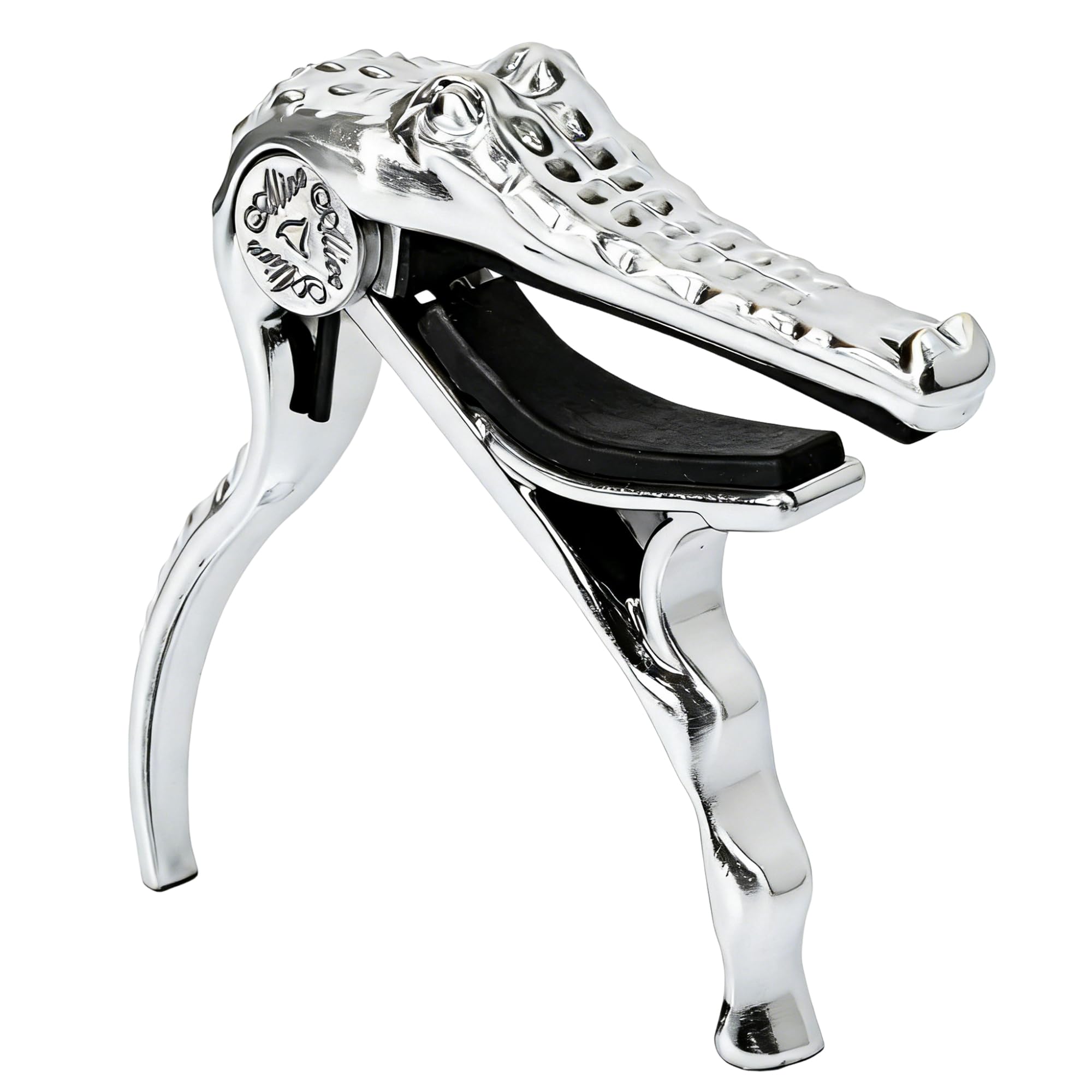
A crocodile-shaped clamp that turns a functional tool into a statement.
If you want your capo to be noticed, this is it. The Alice Alligator Capo is shaped like a crocodile and finished in a warm bronze pearl chrome that looks classy on any acoustic. Owners describe it as a conversation piece that gets attention at gigs while doing the job of a quality capo.
Under the unique design, it is built to last with an aluminum alloy body and a high-quality steel spring that provides consistent pressure across the fretboard. The crocodile jaw clamps securely, and the warm bronze finish renders a distinct, classy look that stands out from every black and silver capo in your case.
The fit gets mixed reviews — most owners find it works on almost any guitar, and one classical player specifically praised how long the bar is, which let them use it very high on the neck. It is a little spendier than basic options, but the sturdy metal build and the fun factor make it worth it for the right player.
Style + Function: the alligator design is genuinely unique, and the steel spring holds pressure reliably across your fretboard.
The Fine Print: fit varies by guitar, so check the bar length against your neck if you play a classical.
Best for: the player who wants gear that sparks conversation and stands out visually.
Not for: minimalists who just want a plain, no-frills black clamp.
9. Shubb C1N Standard Capo

The adjustable lever design trusted by musicians for over 35 years.
Shubb changed the capo game with an adjustable design that lets you “low-maintenance” — you dial in the pressure once, and you never have to reset it with each use. The C1N is built from nickel and brass with a custom-made rubber pad that works like a fingertip to keep your guitar in tune.
Locking and removing is as simple as flipping the lever, which makes it incredibly easy to use mid-song. The adjustable pressure is the standout feature: you can fine-tune it to match your specific strings and neck, eliminating buzz issues that plague fixed-tension capos. Customers note it is superior to cheaper options for high-neck clearance and gives precise placement with great sound.
The catch depends on the clip. The mechanism clamps securely, but it will not easily clip onto the headstock for parking, which is a habit many players miss. For daily use and frequent capo changes, though, the Shubb is durable and precise — a 12-string version has lasted years for some owners.
Why It Endures
- Adjustable tension for a custom fit
- No buzzing and stays in tune
- Durable brass and nickel build
The Limitation
- Doesn’t park on the headstock easily
- Pricier than most options
Your pick if: you want precise, adjustable tension and play often enough to appreciate the low-maintenance design.
pass on it if: you like to keep your capo parked on the headstock between songs.
Understanding the Specs
Spring Tension and Fret Buzz
The spring is the heart of any capo. A calibrated spring applies even pressure across all six strings, which prevents fret buzz and keeps notes in tune. Fixed-tension capos like the Kyser are simplest, while adjustable models like the Shubb let you dial in the exact pressure for your guitar’s neck and string gauge.
Body Material and Weight
Aluminum keeps a capo light on your neck, as the 0.07 kg Kyser proves, while zinc alloy adds durability at a slightly heavier weight, like the 0.11 kg Sondery. Heavier metal feels solid, but lighter designs preserve your guitar’s natural resonance.
FAQ
Will a capo damage my guitar’s finish?
Why does my guitar go out of tune when I use a capo?
Can I use a regular capo on a classical guitar?
What is the difference between a trigger capo and an adjustable capo?
How long does a capo last?
Can I park a capo on the headstock?
Is a heavier capo better?
Do capos work on electric guitars too?
Final Thoughts: The Verdict
For most players, the best acoustic guitar capo is the Kyser Quick-Change because it delivers the fastest one-handed key changes with a featherlight 0.07 kg build that holds tuning reliably. If you want extra tools built in, the Sondery adds a string cutter and pick storage at a great value. And for precise adjustable tension that you set once and trust forever, the Shubb C1N is the one to reach for.
How We Picked
We do not accept paid placement. Every pick is matched to a real buyer and a real use-case; we do not hands-on test units.
Sources & Methodology
Specifications: manufacturer listings and product documentation. Review insights: verified customer reviews, as of August 2026. Pricing: not shown on this page (it changes often); check the current price via the retailer link.
As an Amazon Associate, Gadgets Feed earns from qualifying purchases. This does not affect which products we feature.