
Our readers keep the lights on and my morning glass full of iced black tea. As an Amazon Associate, I earn from qualifying purchases.
Specs are compiled from manufacturer listings and verified buyer reviews and can change over time — please confirm the key details on the product page before buying.
An RV battery box has one job: keep a heavy, acid-filled block of lead (or lithium) from bouncing around, shorting out, or filling your rig with gas. The real question is which one actually locks down your specific battery size and survives a rough camp road. This guide breaks down the seven worth your money, starting with the one most RV owners should buy.
I’m Min — the founder and writer behind Gadgets Feed. This guide is built by comparing the manufacturers’ published specifications and the patterns across verified customer reviews, so you get each pick’s real strengths and trade-offs instead of marketing spin.
The safest way to shop is to match the box to your battery’s group size and venting needs first, then weigh the extra features. That’s exactly how to find the right battery box for rv without overpaying for ports you’ll never use or under-buying on protection.
Our Picks at a Glance

How To Choose The Best Battery Box For RV
Start by measuring your battery, not the other way around. A box that’s too small won’t close, and one that’s too big lets the battery slide into the sidewalls on every turn. Most RV boxes are built around standard group sizes (24, 27, 31), so know which group you own before you shop.
Match the group size first
A Group 27 box is built for batteries up to roughly 13 inches long and 7 inches wide, while a Group 24 box is shorter. Check the interior dimensions printed on the listing against your battery’s actual footprint, and always leave extra room for the terminals and cable bends.
Decide: vented or sealed
Lead-acid and AGM batteries release hydrogen gas while charging, so an enclosed RV compartment needs a vented box with a hose to push that gas outside. If you run a lithium (LiFePO4) battery, the cells are sealed and don’t vent the same way, so a plain sealed box is fine.
Count the security features
The strap matters as much as the plastic. A flimsy strap that pops loose on a washboard road is worse than no strap, so look for a rated hold-down or plan to bolt the box to the floor. A lockable lid is a bonus if you park in public campgrounds.
Quick Comparison
| Model | Best For | Battery Fit | Material | Weight | Amazon |
|---|---|---|---|---|---|
| Attwood 9067-1★ Best Overall | Group 27 lead-acid, bolt-down security | Group 27 | Polypropylene | 2.8 lb | Amazon |
| Sidasu BXGDCHPremium Pick | Group 24/27, maximum rust-proof durability | Group 24/27 | Stainless Steel | 4.24 kg | Amazon |
| Moeller 42214 | Group 27/30/31, camper tongue mounting | Group 27/30/31 | Plastic | 2 lb | Amazon |
| Camco 55371 | Group 24, enclosed compartments with venting | Group 24 | Plastic | 1 lb | Amazon |
| POWO Carlife PB007A | 10-30Ah lithium, portable power on the go | 10-30Ah | Plastic (sealed) | — | Amazon |
| ALL-TOP Smart Box | 12V-24V DIY power station on the trailer | Group 24/27/31 | Plastic | — | Amazon |
| SUNAPEX Pro | 12V/24V lithium, trolling motor power | Group 24/27/31 | Plastic | — | Amazon |
In‑Depth Reviews
1. Attwood 9067-1 Vented Battery Box
Our pick — over 4.5★ from 4,000+ verified ratings; the strongest balance of quality and price.
The lock-down king with a strap rated for abuse, not just show
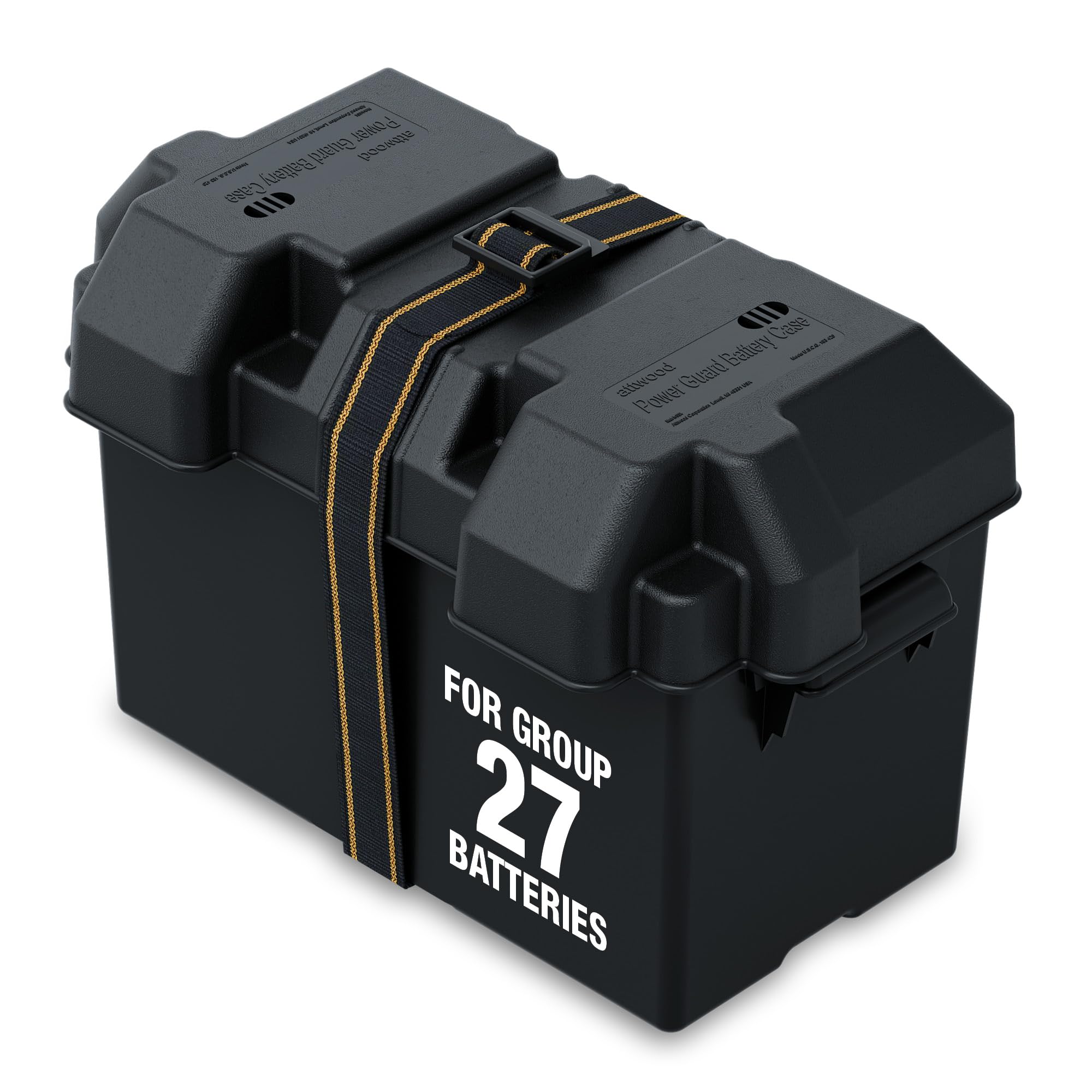
This is the box the crowd trusts most for a reason: it pairs a tight Group 27 fit with a 40-inch hold-down strap rated for 350 lbs of force — nearly 4x the U.S. Coast Guard requirement. That means your battery stays put on the trailer tongue through a washboard gravel road, not just on a smooth highway.
The polypropylene shell is impact-tested from -20°F to +120°F, so it won’t get brittle in a northern winter or soften in a desert summer. Integrated vents let hydrogen gas escape safely while the cover still blocks most water intrusion, which is exactly the balance you want for a lead-acid battery living outside.
Buyers report it fits “3x Group 27 Weize 100Ah LiFePO4 batteries” perfectly, and the molded handles make it easy to lift a 60-lb battery in and out. The recurring gripe is the strap hardware — several owners say the clips are mediocre and simply screw the box down instead.
Why owners trust it
- Studied feedback shows value and performance are the two most-praised traits, with over 100 owners each calling both out
- Vented lid handles gas while minimizing water splash
- Strap rated at 350 lbs — nearly 4x the USCG standard
The honest trade-offs
- The included strap clips are the weak link; bolting it down is the fix owners use
- Ventilation drew some negative feedback, so keep the hose path clear
Reach for this if: you run a Group 27 lead-acid or lithium battery and want a proven, vented box with a serious hold-down strap.
Look elsewhere if: you want a self-locking lid or a strap you never think about — plan to add screws.
2. Sidasu Stainless Steel Battery Box
The armor-plated upgrade that makes plastic boxes feel disposable
If you’ve replaced a cracked plastic box once, you’ll understand this one. Sidasu builds the housing from stainless steel with a black anti-rust paint coating, making it waterproof, sunproof, and fireproof — protection no polypropylene box can match. It’s the box you buy when you want to forget about the battery tray entirely.
At 4.24 kg (over 9 lbs) of steel, it’s the heaviest pick here by far, and that weight is the point: it sits planted. The interior fits most Group 24 and Group 27 batteries up to 13.0″ L × 7.5″ W × 10.0″ H, and the lift-off lid is lockable with a padlock for campground security.
Owners fitted it to a 1971 Pontiac Street Rod trunk, a boat winch system, and a trailer — and the trailer owner’s summary is universal: “Our original battery box was plastic. Our battery is now safe and secure.” The concave bottom keeps it improve off wet ground, and detachable non-slip feet add grip.
Solid as a rock: sturdiness is what wins owners over here, and the lockable lid plus rubber anti-conductivity ring show real design thought.
The one caveat: an occasional rubber grommet arrives torn and there’s no spare, so check it before install.
Get it if: your box lives in the weather or you’re done with cracking plastic — steel outlasts them all.
skip it if: every pound matters on a small trailer, or you need a vented hose for an enclosed compartment.
3. ALL-TOP Smart Battery Box

A mini power station that turns a bare battery into a multi-port hub
If you are a DIY owner who wants more than storage, the ALL-TOP turns a bare 12V-24V battery into a power center. You get external +/− terminals, two 50A quick connectors (Anderson SB50 compatible), a digital voltmeter, two USB ports, and a 12V cigarette socket — so you can run a fridge, charge phones, and feed a solar panel from one box.
Each 50A connector is fused at 60A for high-current gear, while a 16A resettable circuit breaker protects the USB and cigarette ports. Owners have powered a 36V outboard with three 12V 100Ah LiFePO4 batteries wired in series, and another runs a sump pump backup full-time off one unit.
The smart-box category is where feedback splits: some owners find the dual 50A Anderson connectors overkill and wish for varied sizes, and the internal battery strap has been called out for falling apart. It’s also note there’s no fixing frame inside, so smaller batteries may shift.
Buy it for the output: functionality and quality are the two most-praised traits here, with dozens of owners crediting both.
Know the limits: the strap and connector mix get mixed reviews, and a couple of owners’ sockets broke under use — cheap fixes, but real.
Choose it when: you want one box that charges from solar, runs a fridge, and tops up your phone on a single battery.
Think twice if: your battery is small or you won’t use the Anderson plugs — a plain vented box costs less.
4. SUNAPEX Smart Battery Box Pro
The trolling-motor sidekick that turns lithium into a charging block
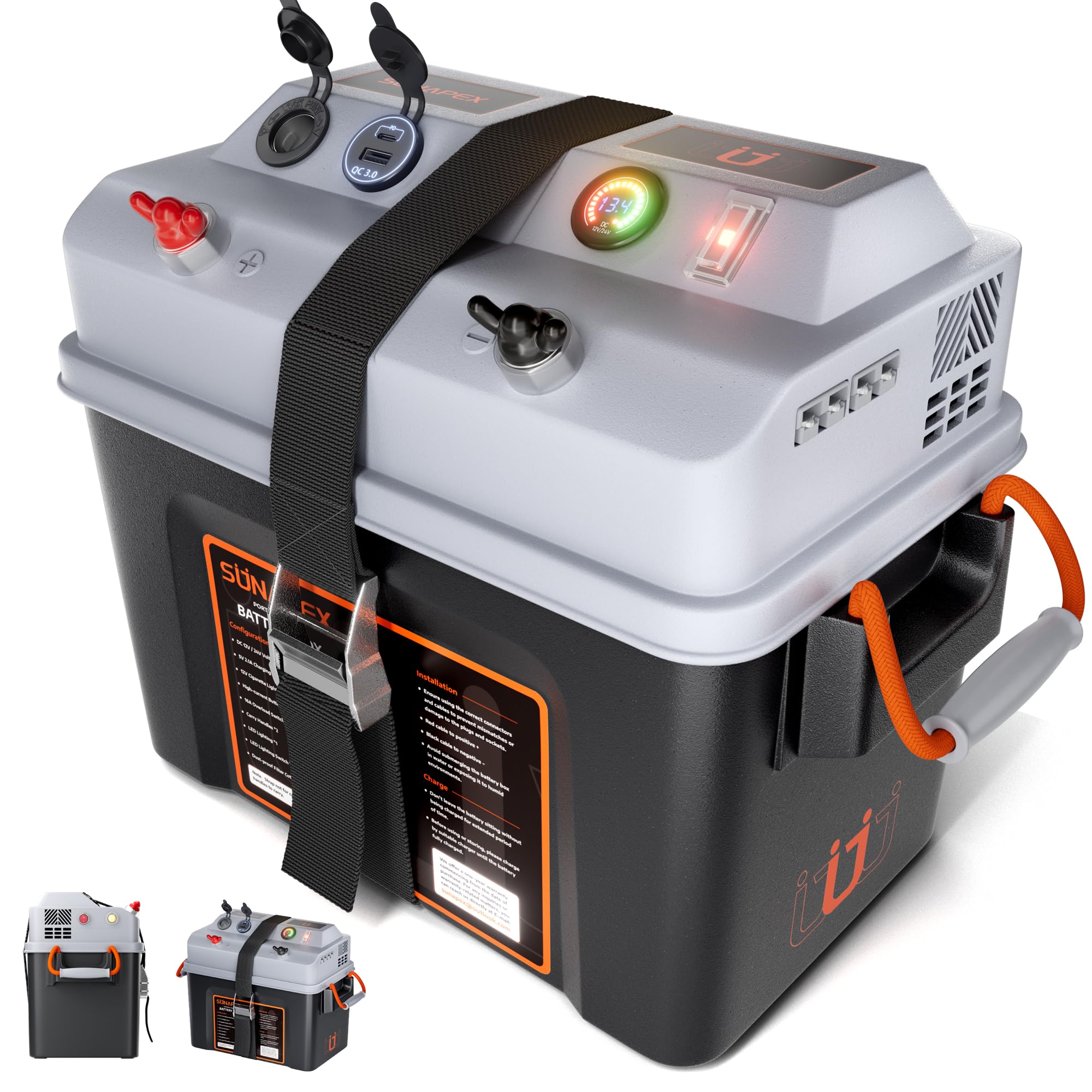
The SUNAPEX Pro earns its name with a 16A overload switch, a 12V cigarette socket, a QC3.0 port, a PD Type-C port, two 30A Anderson plugs, high-current terminals, a digital voltmeter, and internal lighting. It’s the most complete port selection on this list, built for anglers and off-grid campers who want to plug in without adapters.
It handles Group 24, 27, and 31 AGM or lithium batteries, with an interior of 13.1 x 8.2 x 7.8 inches that fits most 100Ah LiFePO4 packs. The 30A Anderson plugs each carry a 30A fuse at a combined max of 50A, so a fridge or trolling motor draws cleanly while the 16A breaker watches the low-voltage ports.
Owners mention strong quality and versatility: one owner called it “a must have for any on the go activities,” and another noted it “transforms a lithium trolling motor battery into a power block.” The honest gripes: some find the plastic a bit flimsy, the rope handles are a weak point, and the top studs are short for stacking thick wires.
What stands out
- Quality is the top-praised trait, with over 40 owners flagging it
- Combined 50A output from two fused Anderson plugs runs real appliances
- Internal lighting and a voltmeter make night use easy
What to watch
- The rope handles and thin-feeling plastic draw the most criticism
- Strap length got negative feedback, so add a retainer strap inside
Pick it for the ports: if you run a trolling motor, fridge, and phone chargers off one lithium battery, this is the cleanest hub.
Pass if: you just need to store a battery — you’d be paying for features you won’t use.
5. Moeller Marine Injection-Molded Battery Box

The no-frills workhorse that mounts two-up on a camper tongue
The Moeller is a straightforward, injection-molded plastic box that fits Group 27, 30, or 31 batteries — a wider range than most, which makes it a smart value pick. It ships complete with a hold-down strap and mounting hardware, sized at 25 x 15.5 x 27.5 inches for the package, with a 2-lb box weight.
Owners praise the “knock-outs on both the ends and side” that make running wires clean and easy, and one camper owner reports mounting two of them on the front of his rig for a dual-battery setup. The non-corrosive high-strength plastic keeps marine salt and road spray from eating it.
The honest notes: the lid is not self-locking, so it won’t snap shut on its own, and a few owners describe the plastic as “a bit thin and flimsy” while still agreeing it does the job. The strap also drew mixed feedback, with some reporting missing tie-downs.
Fit is the headline: battery fit is the most-praised aspect, and the wide 27/30/31 range means it covers most deep-cycle packs.
Set expectations: the lid won’t lock itself and the strap can be hit-or-miss — bring screws if you want true security.
Grab it if: you run a Group 30 or 31 battery and want a cheap, wire-friendly box that mounts easily.
pass on it if: you need a self-locking lid or a heavier-duty shell for rough roads.
6. Camco 55371 Vented RV/Marine Battery Box

The safety-first box that pipes dangerous gas out of your rig
If your battery lives inside an enclosed compartment — not out on an open tongue — the Camco is the one to beat. It’s a complete venting kit: box, hose, hose mount plate, louvered vent grille, and foam tape, all ready to route hydrogen gas safely to the outside. That’s the difference between a battery box and a properly ventilated one.
It holds a single Group 24 battery and measures 14 7/8 x 9 5/8 x 11 ¾ inches including the vent ports. The construction meets U.S. Coast Guard CFR 183.420 and ABYC E-10.7 specifications, which is the compliance you want when the box is near living space.
Owners confirm the battery “did not fall out on the 800 mile journey back home,” and several note the kit is complete and easy to install in an enclosed trailer. The main complaint is price — it’s a simple box that costs more than bare plastic — but the vent hardware justifies it.
Buy it for the hose: the included vent tube and grille make this the safest choice for enclosed compartments, and owners say it’s better quality than stock RV boxes.
The cost of safety: it’s pricier than a bare box, and at 1 lb it’s light — the trade-off is the venting system, not heft.
Choose it if: your Group 24 battery sits inside a compartment and you want gas routed outside, not pooling.
Look away if: your battery is on an open tongue or larger than Group 24.
7. POWO Carlife Smart Battery Box
The pocket-sized power hub for 10-30Ah lithium packs
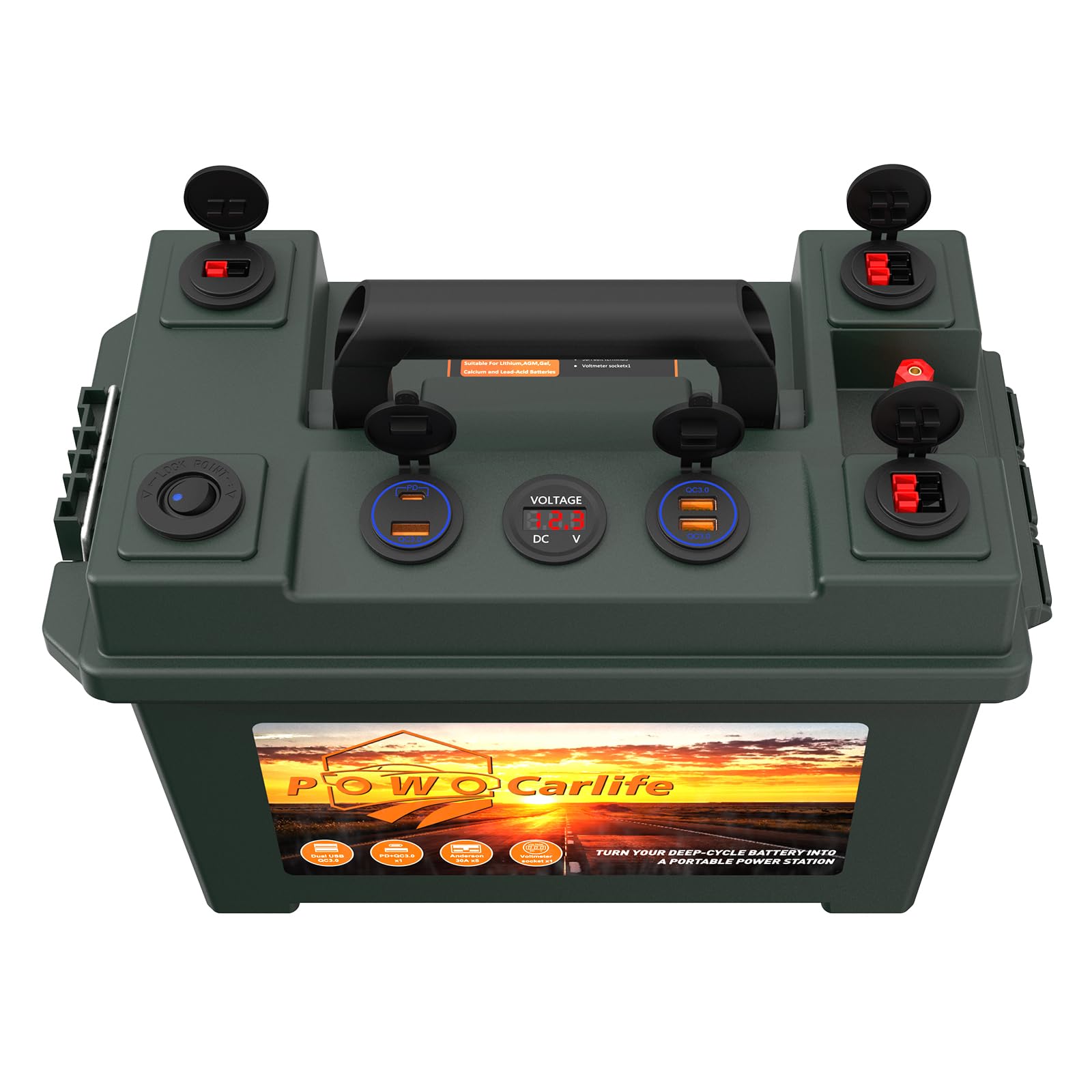
This is the odd one out in the best way: it’s built for small lithium batteries (10Ah, 16Ah, 18Ah, 20Ah, 30Ah) that won’t fit a full-size Group 27 box. At just 5.74 x 9.05 x 7.28 inches — roughly a quarter of the Moeller’s footprint — it’s made for hunting, ham radio, fishing, and lightweight camping where every inch counts.
Don’t let the size fool you. It packs a 30A Anderson plug for solar charging, a dual QC3.0 USB charger, a QC3.0+PD port, and a 30A overload protection circuit. Owners power trolling motors and fridges with the Anderson connector, use the USB to charge phones and GPS, and report the 30A connectors “don’t overheat.”
The seal is the selling point: it’s waterproof and dustproof, so it shrugs off rain and trail dust. Owners have run it for ham radio field days and camping trips where it kept four phones charged plus a radio running — all off a 25Ah battery.
Why it wins small setups
- Quality is the most-praised trait with over 30 owners flagging it
- Waterproof seal plus 30A Anderson plug means real outdoor durability
- Dual QC3.0 fast-charges two devices at once
Who should pass
- Only fits small Ah batteries — a full-size RV pack won’t drop in
- No 12V cigarette socket; you’ll work around it via the powerpoles
Reach for it if: you run a 10-30Ah lithium battery for hunting, radios, or short camping trips.
Move on if: you’re powering a full RV — you need a Group 24-31 box instead.
Understanding the Specs
Group size and interior fit
The single most important number is your battery’s group size (24, 27, 30, 31). A Group 27 box is built for batteries up to roughly 13 inches long, while a Group 24 box is shorter. Always compare the box’s interior dimensions against your battery’s footprint, and leave room for the terminals, cable connections, and wire bending — an oversized battery may not close.
Venting and gas routing
Lead-acid and AGM batteries release hydrogen gas while charging. A vented box with a hose routes that gas outside, which matters when the box sits in an enclosed compartment. Sealed lithium (LiFePO4) cells don’t vent the same way, so a plain sealed box is fine for those. If the listing mentions USCG CFR 183.420 or ABYC E-10.7 compliance, the venting has been verified to a marine safety standard.
FAQ
Will a Group 27 battery box fit my Group 24 battery?
Do I need a vented battery box for a lithium battery in my RV?
How strong does the hold-down strap need to be?
Can I mount two battery boxes side by side on my camper tongue?
What is the difference between a smart battery box and a plain one?
Will a stainless steel battery box corrode in salt air or rain?
How do I know if my battery size fits a smart box’s interior?
Is a lockable battery box worth it for campground security?
Can a smart battery box charge from a solar panel?
What amp rating do I need for a fridge or trolling motor?
Final Thoughts: The Verdict
For most RV owners, the battery box for rv winner is the Attwood 9067-1 because it pairs a proven Group 27 fit with a 350-lb rated strap and a vented lid at a price that’s tough to top. If you want maximum durability against weather and corrosion, grab the Sidasu stainless steel box. And for turning a bare battery into a solar-ready power station for your trailer, the ALL-TOP Smart Box is the one to reach for.
How We Picked
We do not accept paid placement. Every pick is matched to a real buyer and a real use-case; we do not hands-on test units.
Sources & Methodology
Specifications: manufacturer listings and product documentation. Review insights: verified customer reviews, as of August 2026. Pricing: not shown on this page (it changes often); check the current price via the retailer link.
As an Amazon Associate, Gadgets Feed earns from qualifying purchases. This does not affect which products we feature.