
Our readers keep the lights on and my morning glass full of iced black tea. As an Amazon Associate, I earn from qualifying purchases.
Specs are compiled from manufacturer listings and verified buyer reviews and can change over time — please confirm the key details on the product page before buying.
Handing a 12-year-old a camera is a gamble between capturing genuine creativity and watching a gadget take a tumble. You can find models that are both durable and capable. The best options for this age split into two camps: instant-print cameras that deliver a physical photo in seconds, and compact digitals that teach framing and editing before a single shot hits social media.
I’m Min — the founder and writer behind Gadgets Feed. This guide is built by comparing the manufacturers’ published specifications and the patterns across verified customer reviews, so you get each pick’s real strengths and trade-offs instead of marketing spin.
The key is matching the camera to how your child actually wants to use it, and the detailed breakdown below of the camera for 12 year old choices will help you make that call with confidence.
Our Picks at a Glance


How To Choose The Best Camera For 12 Year Old
At twelve, kids are past the toy stage but not ready for a complex DSLR. The right camera balances real photographic features with a durable, kid-friendly design. Decide whether they prefer instant prints or digital editing.
Instant Print vs. Digital First
Instant cameras hand over a physical photo in about five seconds, which is pure magic for a party or a sleepover. The trade-off is the ongoing cost of film, which makes every shot a deliberate choice. Digital cameras, by contrast, let a kid snap hundreds of photos for free, experiment with settings, and learn what works before printing or posting anything.
Durability and the Drop Factor
Durability matters more than slim design for a kid’s camera. Look for a compact body that’s easy to grip and light enough to carry on a lanyard around the neck. Some kits include a lanyard or strap specifically to keep the camera out of the danger zone.
Features That Teach, Not Frustrate
Look for autofocus and a flip screen for easy selfies and vlogs. A 16x digital zoom is standard here, letting them pull distant subjects closer, and built-in filters add style without any editing software. When they want to share, WiFi transfer sends photos straight to a phone, so the jump from camera to social media takes seconds.
Quick Comparison
| Model | Best For | Print Type | Photo Resolution | Video Quality | Amazon |
|---|---|---|---|---|---|
| Fujifilm Instax Mini 12★ Best Overall | Instant photo fun | Instax Mini film | — | — | Amazon |
| Photomaker KitBest Value | Crafting & journaling | Thermal rolls | — | 1080p HD | Amazon |
| AUREAPIX 4K | Beginners & vlogging | None | 64MP | 4K | Amazon |
| SIXTARY 8K | Sharp images on a budget | None | 96MP | 8K | Amazon |
| SMARTKLIK 4K | Lens versatility | None | 75MP | 4K | Amazon |
| KODAK PIXPRO FZ45 | Real optical zoom | None | 16MP | 1080p Full HD | Amazon |
| Kodak PixPro FZ55 | Premium everyday quality | None | 16MP | 1080p Full HD | Amazon |
In-Depth Reviews
1. Fujifilm Instax Mini 12 Instant Camera – Lilac Purple
Our pick — over 4.5★ from 1,500+ verified ratings; the strongest balance of quality and price.
The instant-print icon that turns every button press into a tangible keepsake.
This camera turns a 12-year-old into the party’s photographer. Twist the lens to power it on, use the built-in selfie mirror to frame a group, and watch a 2″ x 3″ photo slide out in about five seconds — full development takes around 90 seconds, which is half the fun. Automatic exposure and flash control work behind the scenes, so shots come out bright instead of “washed-out,” a problem young photographers won’t have to fix.
The lilac purple color is a genuine crowd-pleaser, and the compact 10.72-ounce body fits small hands comfortably. What wins people over is the pure delight of watching a memory materialize on the spot, a reaction you don’t get from a screen. The catch is the film: INSTAX MINI packs are sold separately, and the per-shot cost makes every photo a considered choice rather than a casual snap. It’s the stuff of scrapbooks and party favors, and the print size runs small compared to vintage Polaroids.
The crowd favorite here holds a strong 4.6-star average across 1,500+ ratings, and owners consistently call it a “huge hit” at birthdays and family gatherings. It’s less about pixel-perfect clarity and more about the ritual of creating something physical together. If your child wants to hold memories in their hand, this delivers that magic with zero learning curve.
Why kids and parents adore it
- Instant physical print in about 5 seconds
- Built-in selfie mirror for easy framing
- Automatic exposure prevents washed-out photos
- Compact 10.72 oz body, easy to tote
The honest trade-offs
- Film is sold separately and gets pricey
- Prints are small at 2″ x 3″
- Image clarity varies in some lighting
Reach for this if: your child loves the idea of a physical photo album and thrives on instant, shareable results.
Budget for: the ongoing cost of INSTAX MINI film packs, which add up fast with enthusiastic snapping.
2. Photomaker Kit – Instant Print Camera for Kids Plus DIY Journal Kit
A complete craft-and-capture bundle that turns photos into a personalized scrapbook project.
This kit answers the question of what a kid actually does with all those photos. Alongside the instant-print camera, you get over 150 journaling pieces and 70 sheet pages, so a 12-year-old can build a diary or scrapbook that’s uniquely theirs. The camera itself shoots black & white prints or records full color 1080p HD video, and a 32GB memory card is included to store the digital stuff.
The 16X digital zoom and silly filters keep the camera fun, but the real star is the creative workflow: snap a photo, print it, and immediately glue it into a decorated journal page. Parents report it’s a joy for daughters, nieces, and granddaughters in the 8-14 range, and it arrives with charging cable, lanyard, and photo paper rolls to get started right away. It works best as a complete activity gift rather than a serious photography tool.
The kit carries a 4.6-star average across 200+ ratings, with the build quality and gift appeal earning the loudest praise. One honest note: the camera is not built for rough handling, and a single fall onto a hard floor can stop the printing mechanism, leaving blank paper. It’s a crafting companion first, so treat it with a little care.
Perfect for crafters: the included 150+ journal pieces and 70 pages make this a full afternoon project, not just a camera.
Choose this when: the gift needs to be an experience — a camera plus a creative outlet — rather than a standalone device.
Be aware: the printing mechanism is delicate, so it’s better suited to gentle hands than drop-prone backpacks.
3. AUREAPIX 4K Digital Camera with WiFi
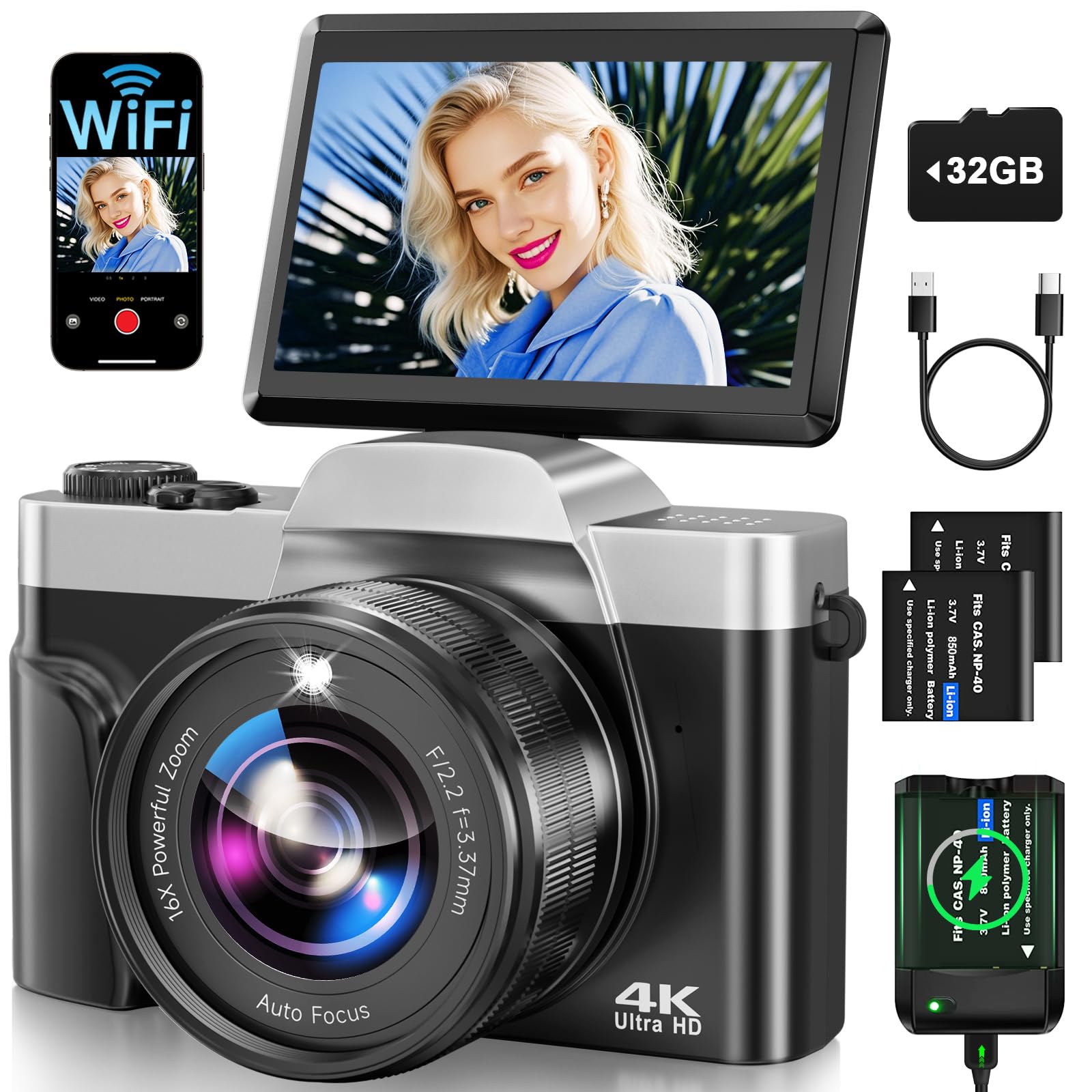
The beginner-friendly vlogging companion that makes a 12-year-old look like a pro on camera.
If your kid is more interested in YouTube than photo albums, this is the camera that grows with them. The 64MP photos and 4K video resolution deliver sharp results in good light, and the 180° flip screen makes self-framing easy — the exact feature young vloggers need to record themselves without guessing. WiFi transfer via the “Viipulse” app moves clips straight to a phone for posting on TikTok, Instagram, or YouTube in seconds.
The rotary dial on top switches between photo, video, slow motion, and filter modes, so a beginner never has to dig through menus. A 16x digital zoom lets them pull in distant subjects, and the pause function during recording saves editing time and storage. It doubles as a webcam for live streaming, which makes it a tool that stays useful beyond just outings.
It earns a 4.3-star average across 398 ratings for its image quality-to-value ratio. It shoots sharp 64MP stills and clear 4K video that exceed expectations for the price, and it comes with an SD card so it’s ready from the start. A minor quibble from some owners is that the flip screen doesn’t rotate fully, and 4K video files may need conversion for Windows playback — small hurdles for a first real camera.
Best for budding creators: the flip screen, WiFi transfer, and webcam mode cover vlogging, streaming, and casual photography in one compact body.
Pick this if: your child dreams of making videos, not just taking photos — the vlogging toolkit here is hard to match at this level.
Know the limits: it relies on digital zoom and excels in good lighting, so don’t expect DSLR-level low-light performance.
4. SIXTARY 8K Digital Camera with Dual Screen
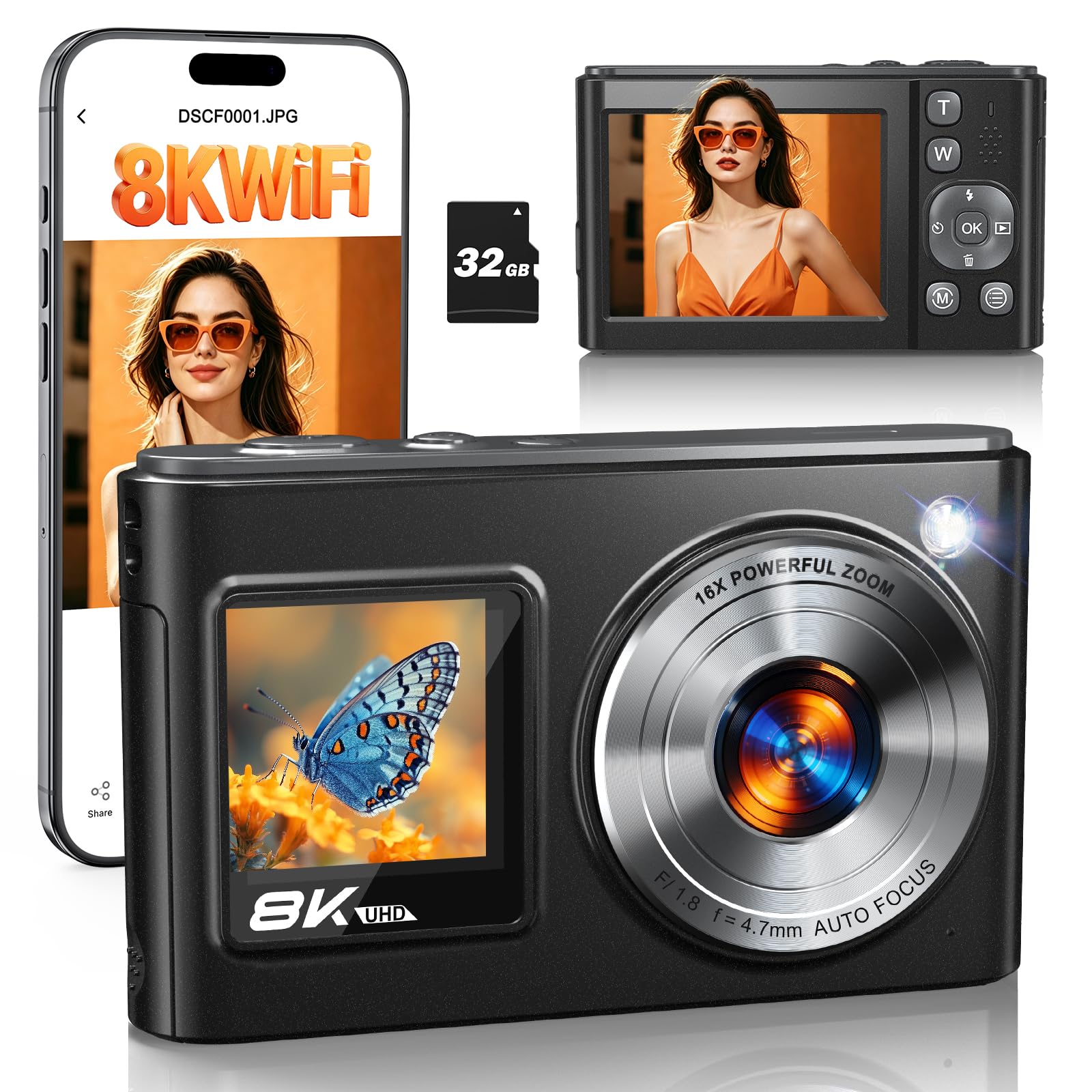
A dual-screen shooter that captures sharp 8K video in a pocket-sized, kid-proof package.
The stand-out spec here is the 96MP still images and 8K ultra HD video, a step above most cameras in this class. The dual-screen design pairs a 2.8-inch rear screen with a 1.54-inch front selfie screen, so a young photographer can frame a self-portrait or vlog without flipping anything around. Face detection autofocus locks onto subjects instantly, which cuts down on the blurry shots that frustrate beginners.
At a featherweight, pocket-friendly size, it’s the kind of camera a 12-year-old will actually carry to a friend’s house or on a school trip. The 16X digital zoom, anti-shake, and a built-in flash handle most casual scenes, while WiFi via the Viipulse app makes dropping photos onto a phone quick and painless. It ships with a 32GB Micro SD card, two rechargeable batteries, a charging dock, and even a lanyard and camera bag.
It holds a 4.5-star average across 60 ratings for crisp images and simple menus. The interface is simple enough for kids and seniors alike, and the included battery setup means no hunting for AA cells. It’s not a pro-grade tool — the 8K label is marketing-friendly — but for a first serious camera, the value and portability are tough to beat.
What wins people over: the dual screens make framing easy while the lightweight body and included 32GB card make it a grab-and-go companion.
Grab this for: travel, camping, and on-the-go shooting where a compact size and long battery life matter more than bulk.
Keep expectations real: the 8K spec reads impressively, but this is still a consumer point-and-shoot, not a cinema camera.
5. SMARTKLIK 4K Digital Camera with Interchangeable Lenses

A pink vlogging camera that swaps lenses to chase wide horizons or tiny details.
This is the kit for a curious kid who wants to experiment with different kinds of shots. It ships with interchangeable 52mm wide-angle and macro lenses — the wide-angle expands the view to 120 degrees for landscapes and group photos, while the macro lens reveals close-up detail on flowers, insects, or jewelry. That’s a creative range most beginner cameras simply don’t offer.
You get 4K video (ultra-high-definition footage) and 75MP photos (megapixels, a measure of image detail) on a 3-inch 180° flip screen, plus tools like time-lapse, slow motion, self-timer, and 22+ filters to keep skills growing. Two rechargeable Li-ion batteries and a built-in 64GB SD card mean room for a vacation’s worth of memories. A 3.5mm microphone socket and hot shoe mount let you attach an external mic for clearer vlog audio.
Buyers report clear 2K shots but find the highest setting less impressive, and audio is weak without an external mic. The pink color and easy setup earn consistent praise, and it holds a 4.1-star average across 333 ratings. If your kid wants to learn about lenses, this is a playground — but skip it if they’ll record sound without an add-on mic.
The creative edge: wide-angle and macro lenses in the box mean your child experiments with perspective, not just filters.
Choose this for: a kid who’s curious about photography techniques and wants to try different lens styles without buying extras.
Know the catch: audio quality is weak for vlogging, and the plastic body feels less premium than the price suggests.
6. KODAK PIXPRO FZ45 16MP Compact Digital Camera
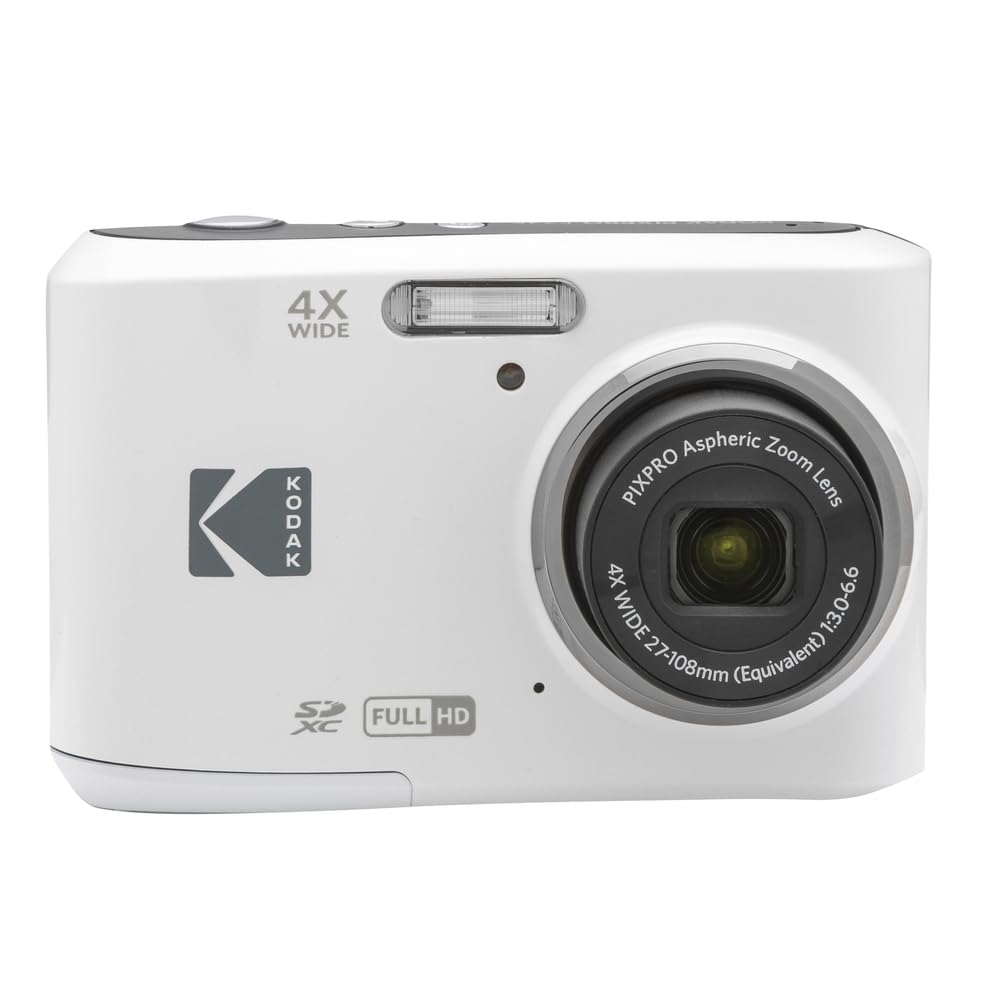
A real optical zoom from a trusted brand, at a price that won’t break the birthday budget.
Unlike the digital zoom found on most budget cameras, this KODAK has a genuine 4X optical zoom on a 27mm wide-angle lens. That means your child can zoom into a soccer game or a stage performance without the image turning to mush — the lens does the work, not software. The 16MP CMOS sensor captures detailed everyday photos, and the 1080p Full HD video recording handles travel clips and simple vlogging.
The 2.7-inch LCD screen gives a clear view for framing, and it runs on two AA alkaline batteries, which is convenient when you’re far from an outlet. It supports Class 10 SD, SDHC, or SDXC cards up to 512GB, so storage is rarely a concern. Owners call it a budget-friendly alternative to pricier cameras, with crisp, vibrant, accurate colors that exceed what the price suggests.
The honest downsides are reliability and battery life — a segment of owners mention units that randomly stop working, and the included AA batteries die quickly, so a rechargeable set is a smart add-on. It carries a 4.0-star average across 6,540 ratings, and the sheer volume of happy owners speaks to the value. This is a solid “real camera” starter that teaches the fundamentals without a big investment.
The fundamentals done right
- True 4X optical zoom, not just digital crop
- 1080p Full HD video recording
- Compact size and simple controls
- Supports SD cards up to 512GB
Where it stumbles
- AA batteries run out fast; grab rechargeables
- Some units have reliability issues
- No WiFi for quick phone transfer
Ideal for: a first real digital camera where optical zoom and brand trust matter more than bells and whistles.
Plan around: the lack of WiFi and the need for a separate SD card and card reader to move photos to a phone.
7. Kodak PixPro Friendly Zoom FZ55 16MP 1080p Full HD Camera
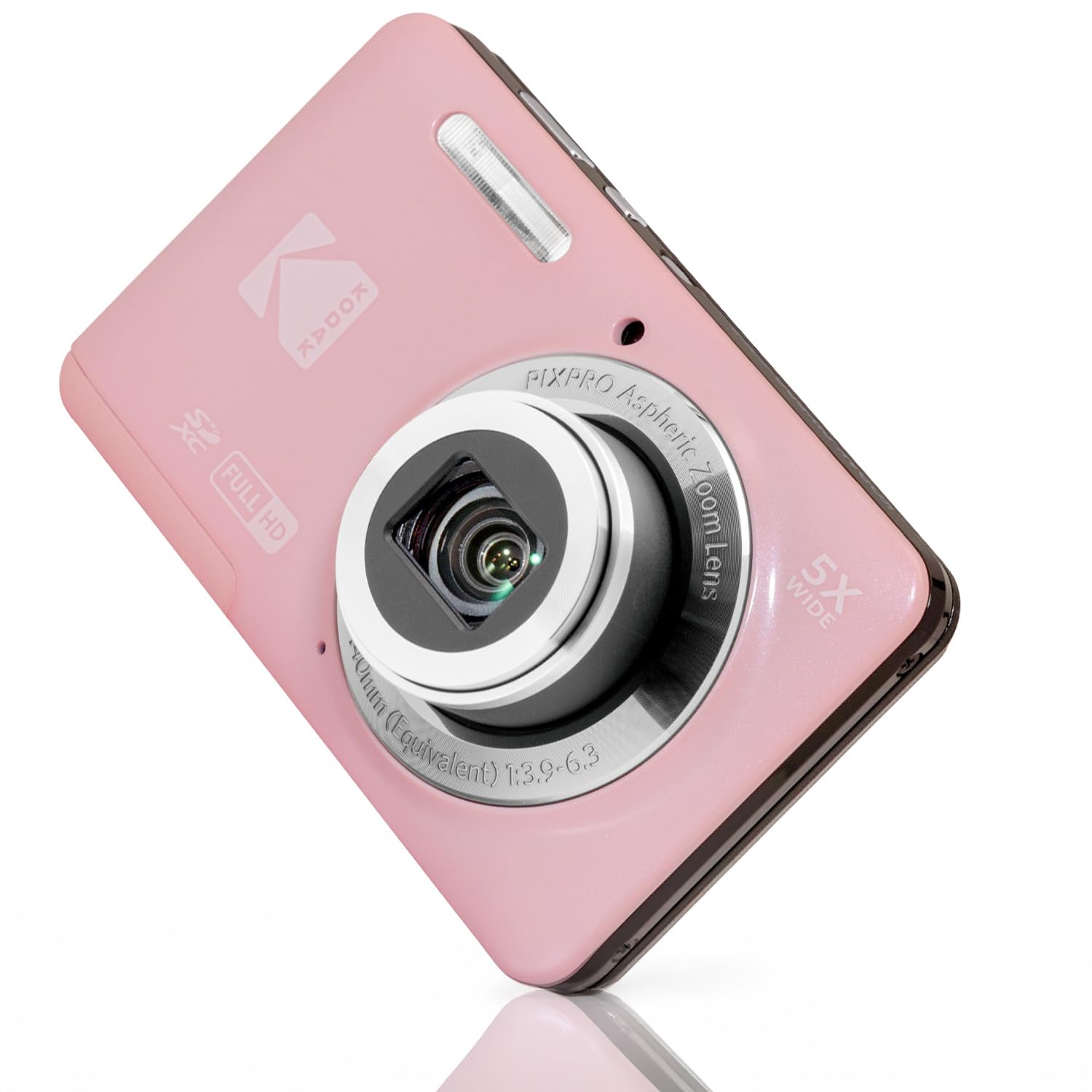
The pastel-pink premium that makes a 12-year-old feel like a real photographer instantly.
This is the camera you buy when you want the experience to feel special from the unboxing. The pastel pink body is “even prettier in person,” as owners put it, and the build quality carries a premium weight that a 12-year-old will treat with respect. Under the pretty shell is a 16MP CMOS sensor with a 5X optical zoom and a 28mm wide-angle lens, so group shots and landscapes fit in the frame without stepping backward.
The smart auto settings — face, smile, and blink detection — mean a kid can point and shoot and still capture the perfect expression without fiddling with manual focus. The 1080p Full HD video recording preserves birthday moments and dance routines in crisp detail. It runs on a rechargeable lithium-ion battery, so no hunting for AA cells, and the slim, lightweight design slips easily into a small bag.
It’s the most expensive pick here, and the 4.6-star average across 157 ratings shows buyers feel it’s justified. The image quality “completely exceeds expectations” for such a compact camera, and the flash works surprisingly well for indoor shots. The main gotchas are the need to buy a separate SD/memory card and an adapter for fast transfer to a phone — minor costs on top of a premium gift.
The prestige factor: a Kodak brand name and a gorgeous pastel finish make this feel like a serious step up from a toy, which is exactly what a 12-year-old wants.
Splurge on this when: you want a camera that will be treasured, carried everywhere, and produce genuinely lovely photos for years.
Add to the cart: a memory card and a card reader, since neither is included and both are required to save and share shots.
Understanding the Specs
Optical vs. Digital Zoom
Optical zoom uses the lens to magnify, keeping the photo sharp. Digital zoom just crops and enlarges the image, which makes it look blurry or pixelated. A 4X or 5X optical zoom (found on the Kodak models) is genuinely useful for far-away subjects, while a 16X digital zoom is mostly marketing — it’s better to move closer than to lean on it.
Megapixels and Video Resolution
For a 12-year-old, anything above 16MP is plenty for sharing on social media or printing small photos. Bigger numbers like 64MP or 96MP sound impressive but won’t look dramatically different on a phone screen. Video resolution matters more if they want to vlog: 1080p Full HD is solid and easy to edit, while 4K gives extra detail but takes up more storage and may need conversion to play on some computers.
FAQ
Is an instant-print camera or a digital camera better for a 12-year-old?
How much does instant film cost to keep feeding the camera?
Will a 12-year-old need a memory card for these cameras?
What’s the difference between optical zoom and digital zoom?
Can a 12-year-old use these cameras to make YouTube videos?
Are these cameras durable enough to survive drops and bumps?
Which camera has the best photo quality for the price?
Does a 12-year-old need WiFi on their first camera?
Are rechargeable batteries or AA batteries better for a kid’s camera?
What accessories should I buy alongside a first camera?
Final Thoughts: The Verdict
The camera for 12 year old winner is the Fujifilm Instax Mini 12 because it delivers the pure joy of a physical photo with zero learning curve, making it the crowd favorite among kids and parents alike. If your child dreams of vlogging and sharing online, the AUREAPIX 4K offers the best creator toolkit with its flip screen and WiFi transfer. And for the most premium, treasured everyday camera, the Kodak PixPro FZ55 pairs real optical zoom with a gorgeous pastel finish that a 12-year-old will adore.
How We Picked
We do not accept paid placement. Every pick is matched to a real buyer and a real use-case; we do not hands-on test units.
Sources & Methodology
Specifications: manufacturer listings and product documentation. Review insights: verified customer reviews, as of August 2026. Pricing: not shown on this page (it changes often); check the current price via the retailer link.
As an Amazon Associate, Gadgets Feed earns from qualifying purchases. This does not affect which products we feature.