
Our readers keep the lights on and my morning glass full of iced black tea. As an Amazon Associate, I earn from qualifying purchases.
Specs are compiled from manufacturer listings and verified buyer reviews and can change over time — please confirm the key details on the product page before buying.
You want a receiver with Bluetooth, but the real question is what you’ll use it for: pure two-channel music, a full movie surround system, or a one-box unit that does karaoke and streaming. The choices here range from compact desktop amps to 7.2-channel home theater hubs, so the right one depends on how many speakers you plan to connect and what you listen to most.
I’m Min — the founder and writer behind Gadgets Feed. This guide is built by comparing the manufacturers’ published specifications and the patterns across verified customer reviews, so you get each pick’s real strengths and trade-offs instead of marketing spin.
The nine models below cover the real reasons owners buy an amp receiver with bluetooth, from audiophile-grade stereo amps with analog-only modes to budget receivers that power garage speakers and ceiling zones.
Our Picks at a Glance


How To Choose The Best Amp Receiver With Bluetooth
Before you pick, decide what job the receiver has to do. A two-channel amp (an amplifier that drives just a left and right speaker) is ideal for music-listening in a single room. A surround receiver (an AVR) powers 5.1 or 7.1 speaker setups for movies. Budget-friendly models often trade raw power and reliability for flexibility, so it helps to know where your priorities sit.
Match power to your speakers
Your speaker’s sensitivity (measured in dB) tells you how loud it plays with one watt. That number matters more than raw wattage. A 45W-per-channel amp paired with 87dB speakers can play remarkably loud, while a high-wattage amp driving inefficient speakers may still sound weak. If you own large floorstanding speakers, look for an amp that can handle 4-ohm loads (a lower-impedance speaker that draws more current) without overheating.
Count the inputs you actually need
Bluetooth gets the phone in, but what about the TV, turntable, or CD player? If you spin vinyl, a phono input (a jack that amplifies the cartridge’s signal) is essential. If the receiver feeds your TV, check for optical or HDMI ARC (a single HDMI that carries audio back from the TV). A receiver with only RCA aux ports may force you to buy adapters for modern TVs.
Look for the features that matter for your space
For a whole-home or garage setup, multi-channel outputs and independent volume controls are a boon. For a living room, a subwoofer output (a dedicated jack for an external bass speaker) is key for deep bass. And if you host parties, dual microphone jacks with echo and reverb controls turn the receiver into a karaoke station.
Quick Comparison
| Model | Best For | Power | Channels | Inputs | Amazon |
|---|---|---|---|---|---|
| Denon PMA-600NE★ Best Overall | Audiophile stereo music | 70W at 4 ohms | 2 | 2 Optical, 1 Coaxial, Phono | Amazon |
| Pyle PDA77BUBest Value | Karaoke & whole-home zones | 800W peak | 4 | USB, SD, FM, RCA, 3.5mm | Amazon |
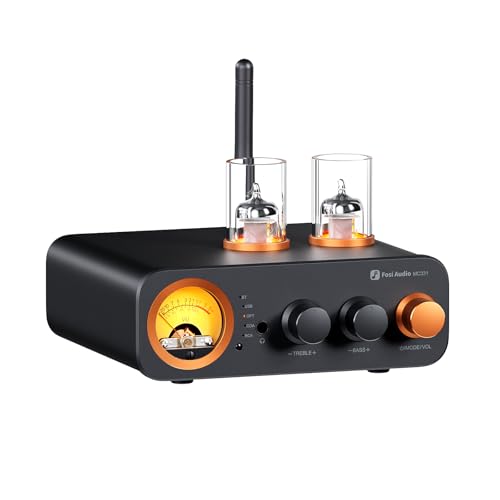
| Fosi Audio MC331Compact Pick | Compact desktop tube sound | 105W x2 at 4Ω | 2 | Bluetooth, USB, Opt, Coax, RCA | Amazon |
| Donner 1000W | Party & karaoke flexibility | 1000W peak (25W x4 RMS) | 4 | Bluetooth 5.3, USB, FM, 2 Mic | Amazon |
| Dayton Audio HTA200 | Vintage-style music listening | 100W RMS per channel | 2 | RCA, Optical, Bluetooth, USB DAC, Phono | Amazon |
| Onkyo TX-8470 | Hi-res streaming & vinyl | 100W+ per channel | 2 | Wi-Fi, Bluetooth, Phono, HDMI | Amazon |
| WiiM Amp Ultra | Smart streaming & TV | 100W | 2 (up to 4 speakers) | HDMI ARC, RCA, LAN, Optical | Amazon |
| Yamaha RX-V6A | Movie surround & gaming | — | 7.2 | 7 HDMI in, eARC, Wi-Fi, Bluetooth | Amazon |
| Denon AVR-X1700H | 8K home theater | 80W per channel | 7.2 | 6 HDMI in, 8K, Phono, Wi-Fi | Amazon |
In‑Depth Reviews
1. Denon PMA-600NE Bluetooth Stereo Amplifier
Our pick — over 4.5★ from 550+ verified ratings; the strongest balance of quality and price.
The audiophile pick that can turn off its own Bluetooth for pure analog sound.
The PMA-600NE earns its spot as the crowd favorite — 4.7 stars across more than 500 owners — because of sound quality above all. It uses divided circuitry, so you can disengage the digital circuits entirely. Flick that switch and the Bluetooth shuts off, giving you an undivided analog path that owners describe as warm, tube-like, and reminiscent of a 70s receiver. That analog focus is a feature you won’t find on the budget multi-channel units in this guide.
Power is genuinely useful, not just a sticker number. It outputs 70W at 4 ohms, and buyers report that 45W is plenty for speakers rated at 87dB sensitivity. The internal DAC (a digital-to-analog converter that turns digital files into sound) is clean, and the phono stage for turntables is silent. Owners note the subwoofer output tightens bass, and the headphone jack drives high-impedance 300-ohm headphones without strain.
The honest trade-off is the volume control, which draws the most mixed feedback. Buyers describe the remote as laggy and coarse, with no tone or Pure Direct control from the remote itself. It runs cool, looks sleek, and the relay switching is clunky but functional — a small price for the musical detail this Denon delivers.
What wins owners over
- Sound quality is the #1 praise — 94 owners mention it as the standout
- Analog Mode disengages Bluetooth for a purer listening path
- Plenty of power for high-sensitivity speakers at 70W at 4 ohms
- Silent phono preamp and clean internal DAC
The fair caveats
- Volume control draws mixed feedback from owners
- Input LED dim and relay switching is clunky
- No tone or EQ customization on the remote
The audiophile’s choice: if you want a receiver that sounds like a vintage classic but still streams from your phone, this is the one to build a stereo system around.
Think twice if: you need a remote that feels modern — the volume control here is the recurring gripe.
2. Pyle Home Stereo Receiver PDA77BU
The workhorse that puts Bluetooth sound into every corner of a big house.
This Pyle is the multi-zone utility pick, with a 4-channel amp that buyers use to drive ceiling speakers, garage pairs, and whole-home setups. One owner powers four garage speakers and an Echo dot for a smart garage setup. Bluetooth 5.0 claims a 30+ foot range, and owners mention the connection holds across a 3,300 square foot home. At this price tier, that level of coverage is the headline.
The front panel is a control center: dual 1/4-inch microphone jacks with independent controls for karaoke, plus USB, SD card, and FM radio inputs. Buyers love the ability to adjust volume in different areas directly at the unit. It runs cool even after 1.5 hours at max volume with eight speakers connected, which is an impressive thermal result.
The catch is the honest one: the “800W” is peak power, and customers note the real output is closer to 500W. That gap matters if you are chasing maximum volume. The other recurring complaint is reliability — some units arrive with issues like a humming sound through the speakers or a Bluetooth range that tops out at 5-10 feet instead of the advertised 30+. For basic whole-home music and karaoke, it delivers; for critical audiophile listening, look up the list.
Real-world reach: this is the pick for covering a large house with music on a budget. The 4-channel design powers multiple speaker pairs, and the dual mic inputs make it a karaoke machine from the start.
The honest limit: peak wattage overstates real power, and reliability is the most-discussed mixed point — some buyers get a flawless unit, others hit a humming noise.
3. Fosi Audio MC331 Tube Integrated Amplifier
A tiny desktop amp with a retro tube glow and a serious 105W punch.
The MC331 earns the compact crown for a simple reason: it packs a DAC, amplifier, preamplifier, and headphone amp into a small chassis while delivering 105W x2 at 4 ohms. That is enough to drive bookshelf speakers with authority, and reviewers point out clean, undistorted bass at high volumes. The vintage VU meter and exposed vacuum tubes give it a retro look that owners consistently call out as a highlight, adding a warm visual glow to match the warmer sound.
Shoppers say the tube warmth is audible after a warm-up period, and the Bluetooth pairs reliably with up to 10 devices (one at a time). The all-metal build feels sturdy, and the included remote lets you adjust bass and treble from your chair. The replaceable tube design means you can change the sound signature yourself over time.
The quirks are real but manageable. The remote has noticeable latency and needs direct line-of-sight, which owners find frustrating. The tubes ship separately for DIY assembly, and the rear connections are tight enough that banana plugs (spade-style connectors) are recommended. A few buyers reported tubes failing within three days, though most find the reliability satisfactory — treat the tubes as a consumable part.
The desktop appeal
- Build quality is the #1 praise (97 owners) with sound quality close behind (96)
- 105W x2 at 4Ω drives bookshelf speakers with no distortion
- Replaceable tubes let you customize the sound signature
- All inputs covered: Bluetooth, USB, coaxial, optical, RCA
What to know first
- Remote latency and line-of-sight requirement is the top frustration
- Tubes ship separately and need DIY assembly
- Some buyers report tubes failing within days
Reach for this if: you want an affordable tube amp that sits on a desk, looks like a vintage piece, and still drives real speakers.
Look elsewhere if: a laggy remote would drive you up the wall — use the front panel instead.
4. Donner 1000W 4-Channel Amplifier

A karaoke-ready receiver with independent volume for up to 4 speaker groups.
Donner targets the party crowd with a 4-channel receiver that offers 1000W peak power (delivering 25W x4 RMS, a 25W continuous output per channel). Those 4 channels can be independently controlled, supporting up to 4 groups of 8 speakers at 4 to 8 ohms. If you are wiring a shop, a patio, or a multi-room setup with separate volume needs, this is the flexibility that the stereo-only amps lack. One buyer uses it across a 3000 sq ft shop.
Inputs are the star feature: Bluetooth 5.3, USB (up to 64G of storage), 2 pairs of RCA, 2 mic inputs, AUX IN, FM radio, plus digital optical and coaxial for smart TVs. The Talk Over function lowers the background music automatically during announcements or hosting, which makes it a genuinely useful event tool. The dual 1/4-inch mic jacks with echo are perfect for karaoke nights.
The honest reality is that sound quality draws the most mixed feedback here. Some owners mention clear, powerful sound with stable Bluetooth 5.3, while others say it struggles with big tower speakers and produces weak bass with no punch. Reliability is also a mixed bag, with some units stopping working within 5 months and others running fine. This is a party-adjacent tool, not a reference-quality amp — for critical music listening, the Denon PMA-600NE is the clear step up.
Flexibility first: the independent channel control and Talk Over function make this the most versatile karaoke-and-events receiver in this list.
The trade-off to weigh: sound quality is the most-discussed mixed point — it is fantastic for casual listening, but big floorstanding speakers may expose its limits.
5. Dayton Audio HTA200 Hybrid Tube Amplifier

Hybrid tube warmth with class A/B punch and a motorized volume knob.
The HTA200 stands out for its looks as much as its sound. The black brushed aluminum chassis, classic front-panel VU meters, and the glow of exposed tubes make it a centerpiece next to a vintage turntable. It is a hybrid design: a tube preamplifier (the first stage that shapes the tone) paired with a solid-state class A/B amplifier. Owners describe the result as warm and rich, with a wide soundstage (the apparent spread of sound between the speakers).
Under the hood, it delivers 100 watts RMS per channel of clean power. That is enough to drive Bowers and Wilkins speakers nicely, according to buyers, and the motorized volume knob (a knob that turns itself when you use the remote) makes it easy to control from across a large room. Inputs cover the bases: RCA, Optical, Bluetooth, USB DAC, and a phono preamp for moving-magnet turntables.
Customers note the Bluetooth is effective and convenient, though it can drop occasionally. The biggest recurring complaint is the remote control — described as flimsy, unreliable, and hard to open for battery changes. Some buyers also note the volume control jumps from soft to loud in steps. The amp’s sound, though, keeps the rating high at 4.6 stars, with sound quality earning the top praise count of 104 mentions.
Why it wins listeners
- Sound quality is the #1 praised aspect — 104 owners call it out
- Hybrid tube preamp adds warmth that solid-state amps lack
- 100W RMS per channel drives demanding speakers with authority
- Motorized volume knob and phono input for turntables
What owners put up with
- Remote control is the most-discussed negative — flimsy and unreliable
- Volume control can jump from soft to loud
- Bluetooth occasionally drops mid-session
The statement piece: buy this for the blend of tube warmth and class A/B power, and for the way it looks glowing next to a record player.
Be ready for: a remote that feels like an afterthought — you will likely control it from the unit itself.
6. Onkyo TX-8470 2-Channel Network Receiver

A two-channel network receiver built for hi-res streaming and the vinyl comeback.
The Onkyo TX-8470 is for the listener who wants high-resolution streaming without wading into a full surround receiver. It is a 2-channel network stereo receiver, meaning the amplifier design is tune for just left and right — and that focus pays off in clarity. Owners consistently report over 100 watts per channel, enough to drive Klipsch floorstanding speakers with ease. The gold-plated terminal and audio-grade capacitors are part of the clean-sound recipe.
Vinyl is a big part of the pitch here. The TX-8470 includes an isolated MM/MC phono board, which means it can handle both moving magnet (the common cartridge type) and moving coil (a higher-end cartridge type) turntables. That flexibility is rare at this price. It also streams via Wi-Fi, works with Roon, Tidal, and Deezer, and integrates with Apple and Google voice assistants for hands-free control.
The catch is software. Some reviewers point out connectivity issues and a setup process that ranges from easy to frustrating. The USB drive playback stops at the end of each folder rather than continuing through a long playlist, which frustrated one long-listening owner. Buyers who hardwired ethernet and disabled Wi-Fi/Bluetooth report a more stable experience. This is a stellar-sounding receiver with a somewhat demanding setup.
Hi-fi focus: the dedicated 2-channel design and MC/MM phono input make this the pick for serious vinyl listeners who also want modern streaming.
The setup tax: the recurring gripe is connectivity stability — hardwiring ethernet solves it, but you should expect some tinkering.
7. WiiM Amp Ultra Streaming Amplifier

A touchscreen streaming hub with automatic room correction built in.
The WiiM Amp Ultra is the most modern pick here — a 100W hi-fi amplifier with a 3.5-inch glass-covered touchscreen display. It’s built around streaming: Wi-Fi 6, Bluetooth 5.3 with LE Audio, and HDMI ARC (a single HDMI cable that carries TV audio back to the amp) for smooth TV integration. Owners say it drives demanding speakers like the B&W 706 S2 easily, and the app-based control earns universal praise for its EQ and subwoofer management.
What sets this apart is RoomFit, a room correction system that auto-calibrates the sound based on your room and speakers. That means the amp measures the space and adjusts the output for a balanced listening experience. It supports Spotify, TIDAL, Qobuz, Amazon Music, Roon Ready, and Chromecast in up to 24-bit/192kHz quality. Owners describe it as filling large rooms with punchy, clean, dynamic sound while driving Emotiva T2 towers rated for 200W.
The build quality and sound earn the top praise, with 123 owners calling out quality and 116 praising sound. The notable omission: no AirPlay compatibility, so Apple users cannot stream directly via AirPlay. Also, Bluetooth is limited to SBC/AAC codecs (basic wireless audio standards), so owners recommend using Wi-Fi for the best quality. It pairs best with other WiiM, Alexa, or Google speakers for multi-room sync.
The modern advantages
- Build quality is the #1 praise — 123 owners single it out
- RoomFit auto-calibrates to your room and speakers
- HDMI ARC integrates a TV with one cable
- Touchscreen display shows album art and settings
What to know
- No AirPlay support — Apple users must use the app or Wi-Fi streaming
- Bluetooth is limited to SBC/AAC for quality
- Connectivity draws mixed feedback for pairing complexity
The all-in-one streamer: if you want a TV-connected, app-controlled, room-corrected amp with a screen, this is the most forward-looking pick in the lineup.
skip it if: you live in the Apple ecosystem and rely on AirPlay — it is not supported here.
8. Yamaha RX-V6A 7.2-Channel AV Receiver

A 7.2-channel home theater hub with 8K-ready HDMI and Dolby Atmos height virtualization.
If you are building a movie room, the RX-V6A is the dedicated surround pick. It is a 7.2-channel AV receiver (an audio-video receiver that processes both sound and picture) with full Dolby Atmos support, including Height Virtualization that simulates overhead speakers even without ceiling channels. The HDMI section is modern: 7 inputs and 1 output with 8K60, 4K120, HDCP 2.3 and eARC (an enhanced HDMI audio return channel that handles high-quality TV audio).
Buyers consistently praise the sound quality, noting it outperforms rival receivers in power and clarity. The YPAO room correction (Yamaha’s automatic speaker calibration) works well, and the receiver handles 4-ohm speakers at 5.1 channels without strain. It includes Wi-Fi, Bluetooth, AirPlay 2, Spotify Connect, and MusicCast multi-room support, plus voice control via Alexa, Google Assistant, and Siri.
The most-discussed negatives are reliability and connectivity, split fairly evenly. Bluetooth is a particular pain point, with multiple buyers reporting constant disconnections. The setup is also demanding: there is no physical manual, only digital versions, and the full settings require on-screen display. One reviewer noted the HDMI caps at 21gbps, so uncompressed 4K/120 or 8K/60 passthrough is not fully supported. Sound quality keeps this at 4.2 stars, but it is a receiver that demands patience.
Surround authority: the 7.2-channel layout, Dolby Atmos, and 8K-ready HDMI make this the clear pick for a serious home theater setup.
The patience test: setup is the most-discussed mixed point — no physical manual and a steep learning curve. Bluetooth reliability is the recurring connectivity gripe.
9. Denon AVR-X1700H 7.2 Channel AV Receiver

A 7.2-channel Denon that makes 8K home theater setup genuinely beginner-friendly.
The AVR-X1700H earns its place with a rare combination: serious 7.2-channel power (80W per channel) and a setup process that buyers repeatedly describe as the easiest they have ever experienced. The color-coded back panel and award-winning on-screen setup guide walk you through connections step by step. One owner called it the easiest setup of any receiver they have owned, with color-coded plugs and clear labels. That clarity is a lifesaver when you are wiring a 7-speaker system.
Video support is future-proof: 3 dedicated 8K inputs and 1 output with 8K/60Hz and 4K/120Hz pass-through, plus 8K upscaling on all 6 HDMI inputs. It handles HDR10+, Dolby Vision, and HLG for improved contrast and color. For audio, it supports Dolby Atmos, DTS:X, and Dolby Atmos Height Virtualization, which creates height effects without the physical ceiling speakers. The built-in HEOS platform streams Spotify, Pandora, and Amazon Music HD via Wi-Fi, AirPlay 2, or Bluetooth.
The connectivity earns positive feedback, with buyers praising the fast Bluetooth pairing and iPhone/iPad compatibility. The phono input handles both MC and MM cartridges, which is flexible for vinyl. The recurring grumbles are the HEOS app itself — described as clunky and text-based — and the auto-calibration, which some buyers found poor and corrected manually. For the price, the blend of 8K readiness, 7.2 channels, and simple setup is strong.
Why it stands out
- Build quality is the #1 praise — 102 owners call it out
- Easiest setup of any receiver here, with color-coded connections
- 8K upscaling on all 6 HDMI inputs
- Fast, reliable Bluetooth with iPhone/iPad compatibility
The minor trade-offs
- HEOS app is clunky and text-based
- Auto-calibration can be poor — manual adjustment often better
- Reliability draws mixed feedback from some owners
The beginner’s theater: this is the receiver to buy if you want 8K readiness and 7.2 channels without fighting the manual.
Be prepared for: the HEOS app feeling dated, and possibly tuning the auto-calibration yourself for perfect sound.
Understanding the Specs
Watts and Ohm loads
Amplifier power is measured in watts, but two numbers matter: continuous RMS (a steady, real output) and peak power (a momentary maximum). Budget receivers often quote peak watts that look impressive — like 800W or 1000W — but the real continuous output can be far lower. A receiver’s ability to drive 4-ohm speakers (lower-impedance speakers that demand more current) tells you whether it can power large floorstanding speakers without overheating.
Phono inputs and DACs
A phono input is a dedicated turntable jack that comes with a built-in preamp to boost the cartridge’s tiny signal. Without one, you need an external phono preamp for vinyl. A DAC (digital-to-analog converter) is the chip that turns digital audio files into sound your speakers can play — a better DAC means cleaner, more detailed playback from Bluetooth, optical, or USB sources.
FAQ
Can I connect a turntable to a Bluetooth receiver without a phono input?
What is the difference between a stereo amplifier and an AV receiver?
How many watts do I need to drive my speakers?
Will a Bluetooth receiver work with my TV?
What does “4-ohm stable” mean and why should I care?
What is the difference between peak watts and RMS watts?
Can I use a Bluetooth receiver for karaoke?
Can I power multiple pairs of speakers in different rooms?
Why does my receiver hum or make noise through the speakers?
What is the best way to stream music to a receiver?
Final Thoughts: The Verdict
For most buyers, the amp receiver with bluetooth winner is the Denon PMA-600NE because it delivers true audiophile sound quality in a two-channel format that owners consistently rate 4.7 stars. If you want a smart streaming hub with room correction and a touchscreen, grab the WiiM Amp Ultra. And for building a movie theater at home with 7.2 channels, the Denon AVR-X1700H is the one to reach for.
How We Picked
We do not accept paid placement. Every pick is matched to a real buyer and a real use-case; we do not hands-on test units.
Sources & Methodology
Specifications: manufacturer listings and product documentation. Review insights: verified customer reviews, as of August 2026. Pricing: not shown on this page (it changes often); check the current price via the retailer link.
As an Amazon Associate, Gadgets Feed earns from qualifying purchases. This does not affect which products we feature.