
Our readers keep the lights on and my morning glass full of iced black tea. As an Amazon Associate, I earn from qualifying purchases.
Specs are compiled from manufacturer listings and verified buyer reviews and can change over time — please confirm the key details on the product page before buying.
Most bonsai trees don’t die from neglect — they die from drowning in the wrong soil. Regular potting mix holds water against the roots until they rot, and that’s the single biggest mistake new growers make. The fix is a granular, fast-draining mix designed to let air reach the roots while still holding enough moisture to keep the tree alive.
I’m Min — the founder and writer behind Gadgets Feed. This guide is built by comparing the manufacturers’ published specifications and the patterns across verified customer reviews, so you get each pick’s real strengths and trade-offs instead of marketing spin.
Whether you’re repotting a juniper or planting your first ficus, the right bonsai soil determines whether your tree thrives or slowly suffocates in waterlogged roots.
Our Picks at a Glance


How To Choose The Best Bonsai Soil
Bonsai soil isn’t dirt — it’s a carefully engineered aggregate that balances water retention, drainage, and aeration for roots that live in a shallow pot. The right mix keeps your tree hydrated without ever letting the roots sit in standing water.
Match the Mix to Your Tree Type
Tropical species like ficus and jade like a mix that holds a bit more moisture, while conifers such as junipers and pines thrive in a grittier blend with faster drainage. A universal mix works for most beginners, but a conifer-specific blend gives pines and junipers the coarser texture they prefer.
Particle Size and Sifting Matter
Granules that are too fine turn to mud and suffocate roots, while oversized chunks leave it hard to water evenly. Quality soil is sifted through mesh to remove dust and tiny particles, so the bag is mostly uniform, sturdy granules that keep their shape after repeated watering.
Know Your Aggregates
Akadama is a fired Japanese clay that darkens when wet — a built-in watering indicator. Pumice is a lightweight volcanic rock that holds both air and moisture. Calcined clay behaves similarly to akadama at a lower cost. Most premium mixes combine several of these to balance drainage and water retention.
Quick Comparison
| Model | Best For | Volume | Base Material | Style | Amazon |
|---|---|---|---|---|---|
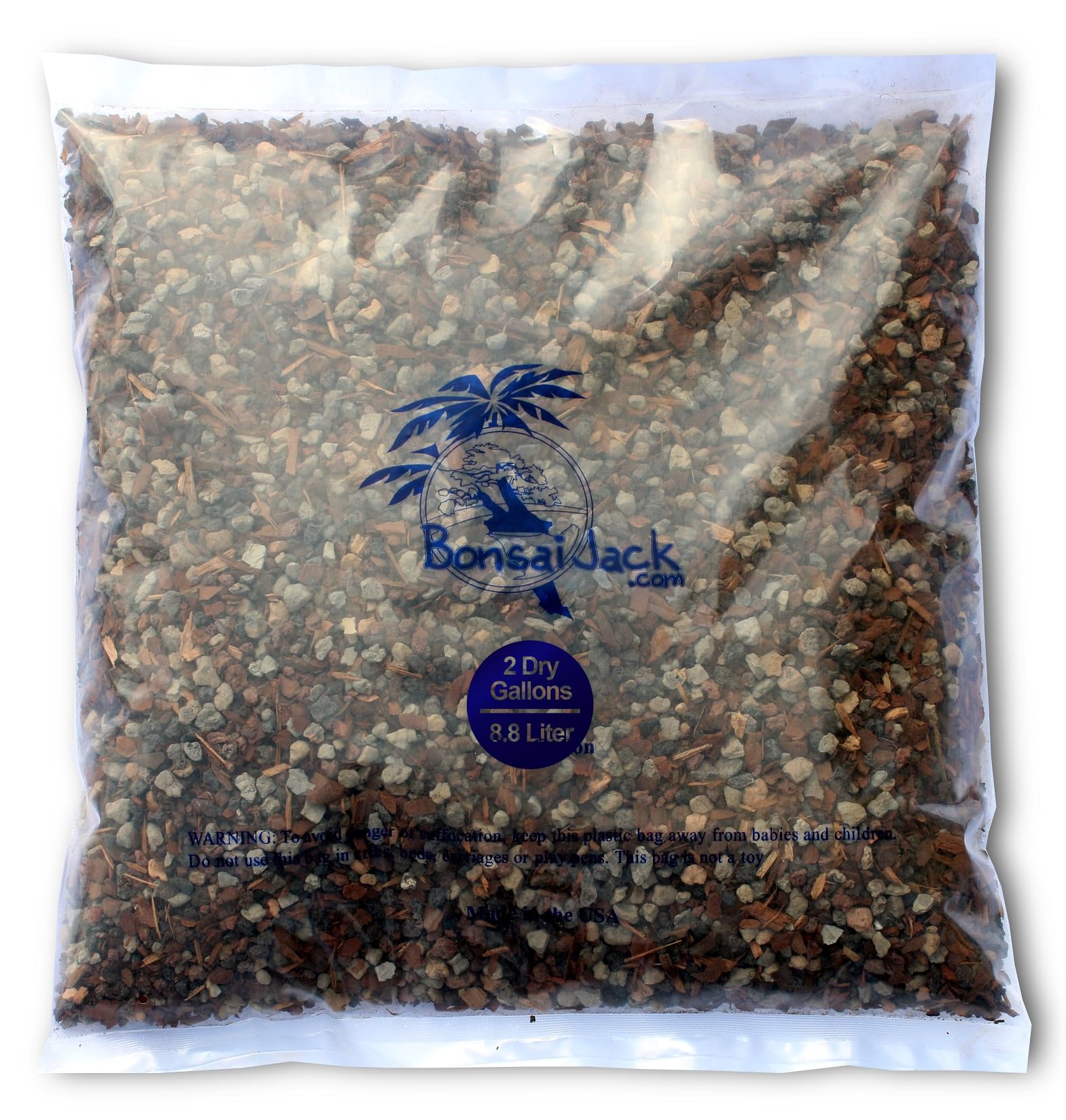
| Bonsai Jack Universal Mix #221★ Best Overall | All-purpose tropicals & succulents | 2 gallons | Pine bark & calcined clay | Pre-screened | Amazon |
| Calcined Clay (Bonsai Supply)Budget Champion | Succulents & top dressing | 2 quarts | High-fired clay | 1/8″ particle | Amazon |
| Tinyroots AkadamaTraditional Choice | Traditional Japanese mixes | 2.25 quarts | Volcanic akadama | 5mm sifted | Amazon |
| Tinyroots Conifer Blend | Junipers, pines, cedars | 2.25 quarts | Bark, sand, clay, pumice | Pre-mixed | Amazon |
| Harris All Purpose | General single-tree use | 2 quarts | Humus, pumice, clay | All-purpose | Amazon |
| Hoffman Bonsai Mix | Beginners & evergreens | 2 quarts | Stone & soil blend | Pre-mixed | Amazon |
| NOHOBE Hard Akadama | Cacti & succulents | 5 liters | Fired volcanic clay | 1/8–1/4″ grain | Amazon |
| Tinyroots Horticultural Pumice | Succulent soil blend | 2.25 quarts | Pumice | 1/4″ uniform | Amazon |
In-Depth Reviews
1. Bonsai Jack Universal Organic Bonsai Soil Mix #221
Our pick — over 4.5★ from 750+ verified ratings; the strongest balance of quality and price.
The crowd-pleasing 2-gallon bag that keeps tropicals thriving with zero guesswork.
This is the mix that wins owners over on plant health above everything else — the blend of pine bark and absorptive rock holds a little moisture while draining fast enough to protect roots. It arrives screened and pre-washed, so you can pour it straight from the bag without the dust cloud that cheaper mixes produce.
Your trees stay healthier because this soil holds a pH of 6.4 (a measure of acidity/alkalinity), and the calcined clay (a heat-treated clay that resists breaking down) adds a slight acidity many trees prefer. One experienced grower shares a simple watering schedule: “Water tropicals every 4 days, succulents 6-7.” That predictability is why 27 buyers report their ficus, jade, and fukien tea thriving.
You get 2 gallons of soil, which is 4.6 times more than the 2-quart calcined clay bags featured elsewhere in this guide. Each order includes a metal chopstick (useful for checking soil moisture), and the supplier offers phone support if you have questions.
What Trees Love Here
- Pre-screened and pre-washed, so it’s ready to use immediately
- Optimal pH of 6.4 for balanced nutrient uptake
- Fast drainage plus pine bark for gentle moisture retention
- Comes with a metal chopstick and phone support
Who Should Pass
- Water retention gets mixed feedback — some find it drier than expected
- Not ideal for mature refinement trees that demand akadama’s root development
Your all-around pick: if you keep tropicals or succulents and want one bag that works across species, this is it.
The honest trade-off: advanced growers pushing for show-quality refinement on old trees may still prefer pure akadama beneath the surface.
2. Calcined Clay for Bonsai, Succulent, Cactus (The Bonsai Supply)
A wallet-friendly 2-quart bag of high-fired clay that suits Lithops and top dressings alike.
Owners mention this one is basically broken-down clay that holds water and then releases it slowly — exactly the behavior succulents crave. The most-repeated praise is effectiveness, with 16 owners vouching for how well it performs as a bonsai additive, a cactus mix, and even in carnivorous plant potting blends.
At 2 quarts (64 fluid ounces), it’s the budget companion to the bigger mixes here. One grower sums up the versatility plainly: “I use this mostly for Lithops plants; sometimes I use it for other succulents.” The rough edges of the 1/8″ particles create air pockets that encourage healthy root spread.
The trade-off is straightforward: it’s a single-ingredient aggregate, not a complete ready-to-plant soil. You’ll blend it with bark or pumice for a full mix, but it also shines as a top dressing for a clean finish.
The affordability edge: a low-cost way to add proven drainage and moisture release to homemade mixes.
The catch: particle size and value draw mixed notes, and the clay skews slightly red-pink rather than the gray-white many expect.
Reach for this if: you’re blending your own succulent or bonsai mix on a budget.
Look elsewhere if: you want a complete all-in-one soil that’s ready for the pot without any mixing.
3. Tinyroots Akadama Bonsai Soil (Sifted 1/8″ to 1/16″)
The authentic Japanese volcanic soil that master gardeners reach for, sifted clean for you.
This is akadama in its truest form — mined from Japanese volcanic soil, dried, and sifted through a 1/8-inch mesh and then again through a 1/16-inch mesh to strip out sediment. The proof of that careful prep is in the granules themselves: customers note they’re “very sturdy and produce minimal dust,” a direct contrast to the crumbly, dusty akadama that dominates the cheap end of Amazon.
Quality is the runaway theme here, with 87 owners calling it out as the standout trait — the #1 praise in the entire product block. The granules hold their shape, which means the soil structure stays open and airy for healthy roots season after season. A built-in visual cue helps beginners: the volcanic soil darkens when wet, so you can see at a glance when it’s time to water.
It works for conifers, deciduous trees, succulents, and cactus alike.
Why It Wins Traditionalists
- Double-sifted to remove dust and tiny particles
- Darkens when wet, serving as a watering indicator
- Sturdy granules resist breaking down
- Authentic Japanese volcanic soil
What’s Mixed
- Some owners find the grain size on the larger side
- A few report granules breaking down faster than they’d like
Choose this for: growers who want the classic Japanese substrate with consistent, dust-free granules.
Think twice if: you’re after a complete ready-to-use mix — this is a single component, not a full blend.
4. Tinyroots Conifer Bonsai Soil Blend (2.25 Quarts)

A hand-mixed blend engineered for junipers, black pines, and cedars that drain without compacting.
Buyers consistently praise the quality—68 owners note it—and the practical result is a soil that “doesn’t compact at all” and lets water “drain right through it.” That coarse, open structure is exactly what conifers need: it keeps roots aerated (supplying oxygen) while still holding enough moisture to prevent stress.
This pre-mixed blend combines double-sifted pine bark fines, coarse river sand, calcined clay, and pumice. The heavy particles are pre-sifted to protect delicate roots, and everything is hand-mixed, dried, and bagged in a resealable pouch. No sifting needed — it’s ready straight from the bag at repotting time.
Reviewers point out redwoods “grow fast” in it, and bristlecone pines, coast redwoods, and giant sequoias all respond well. One experienced hand recommends a 50/50 blend with peat moss for seedlings, and a higher 80/20 to 90/10 ratio for mature trees in rocky habitats.
Built For Conifers
- Pre-mixed with bark, sand, calcined clay, and pumice
- Excellent drainage with no compaction or dust
- Resealable bag for long-term storage
- Hand-mixed and dried for consistency
Keep In Mind
- A few owners find it pricey for the volume
- Not recommended as the sole soil for seedlings — mix with peat moss
Grab it if: your collection leans toward junipers, pines, cedars, or other conifers.
skip it if: you grow mostly tropicals — they prefer a blend that holds more moisture than this gritty mix.
5. Harris Bonsai Soil, All Purpose Premium Blend (2qt)

A 2-quart American blend that suits junipers, pines, and ficus straight from the bag.
Harris leads with quality across 40 owner mentions, and the practical payoff is a blend that’s genuinely all-purpose. It combines forest humus, pumice, calcined clay, organic amendments, basalt rock dust, and lime — the lime being a rare and important addition that buffs pH stability, as experienced growers point out.
The moisture control earns its own praise: shoppers say they only need to water about once a week, and the mix drains excess moisture while holding just enough for the plant. One seed-starter reports three out of four bonsai seeds sprouted and settled in happily after moving to this soil.
The 2 dry-quart bag is sized for a single bonsai tree or several small containers. It’s manufactured in the USA and arrives in secure packaging that owners describe as generous for the price.
What You Get
- Complete blend — no amendments needed
- Contains lime for pH stability
- Well-draining with good moisture control
- Secure packaging for delivery
The Mixed Note
- A small number of buyers report trees declining after transfer — worth potting a test cutting first
Best for: first-time bonsai owners who want one simple, ready-to-use bag that covers most species.
Consider elsewhere if: you need a massive volume for a large collection — this bag is sized for a single tree.
6. Hoffman 10708 Bonsai Soil Mix (2 Quarts)

The reassuring pre-mixed favorite that builds beginner confidence with visible drainage.
Hoffman is the pick beginners consistently recommend to each other. Functionality leads at 39 owner mentions, and the experience they describe is simple: water drains fast, the soil dries visibly when it’s time to water again, and the tree perks up within weeks. One new grower saw their bonsai looking healthy just six weeks after repotting.
Root growth is the second most-praised trait at 34 mentions, with a well-mixed stone-and-soil composition that supports support, moisture, and drainage. The 2-quart bag comes in a resealable pouch that holds humidity well, and owners say it’s enough for several medium pots or 3-4 plants.
The honest caveats are practical, not fatal: this is a pebble-and-bark blend rather than pure soil, so some owners add a little topsoil to pack it. Also, the bag tears easily if shipped with hard items — best ordered alone.
The confidence builder: clear drainage behavior and simple instructions make it forgiving for first-time growers.
The packaging watch: order it solo, since the pouch can tear in transit alongside hard goods.
Start here if: you’re new to bonsai and want a no-fuss mix with visible, forgiving drainage.
Move past it if: you demand a richer organic component for mature trees that need more nutrition.
7. NOHOBE 5lb Hard Akadama Bonsai Soil (1/8–1/4 inch)

A 5-liter bag of fired volcanic clay that guards against overwatering and fungus gnats.
Quality anchors this one too — 59 owners call it out — and the value story is strong at 21 mentions for a bag that holds 5 liters. The fired volcanic clay keeps its form when dry and absorbs water when wet, which is the core mechanism behind its fast drainage and its reported ability to help cut down fungus gnats.
The 1/8-to-1/4-inch grain size slots neatly into succulent and cactus mixes, and owners note it blends perfectly with pumice and lava rock. It arrives in a reusable sealing bag with a warm reddish-brown hue, and buyers describe it as low-dust after a quick rinse.
Akadama is rarely used on its own — the maker’s own guidance is to combine it with particles that have different structural and water-retention properties. That makes this a component for the hands-on grower rather than a grab-and-go soil.
The Strengths
- 5 liters of material for a substantial volume
- Fired from 100% natural volcanic soil
- Darkens when wet as a watering cue
The Dust Question
- Many owners find it dustier than expected — plan for a rinse
Pick this up if: you like building custom mixes and want a large, clean akadama component.
Reconsider if: you prefer a zero-prep soil — this needs blending and a rinse before use.
8. Bonsai Outlet Horticultural Pumice – Tinyroots (2.25 Quarts)

Quality, dust-free pumice that keeps roots aerated and prevents rot in small pots.
This is real pumice — not an imitation — and owners emphasize that it genuinely absorbs and releases moisture, which is the trait that matters for succulents and bonsai alike. Quality leads the feedback at 35 mentions, with versatility close behind at 16, as people use it for cactus, succulents, conifers, and deciduous trees.
The 1/4-inch pumice is sifted to a uniform size and is dust-free, hand-mixed, dried, and bagged. Owners note it’s small enough to fit 3 or 4-inch pots, and its rough texture keeps air pockets open around roots — the mechanism that prevents root rot. The resealable bag makes storage simple between repottings.
The honest read: pumice is a single-ingredient aggregate, so it shines when blended into a complete mix or used as a top dressing to brighten a display. Value draws mixed opinions, with some owners noting these small bags carry a premium.
The aeration payoff: keeps roots breathing and prevents rot in succulents and small bonsai pots.
The value note: excellent quality, but the small bag price means bulk buyers may want a larger source.
Use it for: blending into succulent mixes or as a clean, bright top dressing over existing soil.
Pass on it if: you need a complete all-in-one soil — this is an aggregate component, not a full mix.
Understanding the Specs
Drainage and Aeration
The #1 job of bonsai soil is to let water flow through while air reaches the roots. Granular aggregates like pumice, calcined clay, and akadama create air pockets that keep roots from suffocating in waterlogged soil. A mix that drains well prevents root rot, the most common cause of bonsai death.
Particle Size and Sifting
Uniform granules are what separate quality soil from cheap imitations. Good soil is sifted through mesh screens (often 1/8-inch and 1/16-inch) to remove dust and tiny particles that turn to mud when wet. Sturdy, consistent particles hold their shape through months of watering, keeping the structure open and healthy.
FAQ
Can I use regular potting soil for my bonsai tree?
What is the difference between akadama and calcined clay?
How often should I water my bonsai in this type of soil?
Is akadama used on its own or blended with other components?
Why is my bonsai soil bag so dusty when I open it?
What is pumice used for in a bonsai soil mix?
How long does bonsai soil last before it needs replacing?
Do I need fertilizer if my bonsai soil has organic components?
Final Thoughts: The Verdict
The clear winner for most growers is the bonsai soil from Bonsai Jack — it’s the crowd favorite at 4.8 stars with 700+ owners behind it, and the plant-health results speak for themselves across tropicals and succulents. If you grow conifers and want a pre-mixed specialist, the Tinyroots Conifer Blend delivers the fast-draining structure junipers and pines demand. And for hands-on growers who like blending their own mixes, the Tinyroots Akadama offers authentic, sturdy granules that earn their reputation as the traditional Japanese choice.
How We Picked
We do not accept paid placement. Every pick is matched to a real buyer and a real use-case; we do not hands-on test units.
Sources & Methodology
Specifications: manufacturer listings and product documentation. Review insights: verified customer reviews, as of August 2026. Pricing: not shown on this page (it changes often); check the current price via the retailer link.
As an Amazon Associate, Gadgets Feed earns from qualifying purchases. This does not affect which products we feature.