
Our readers keep the lights on and my morning glass full of iced black tea. As an Amazon Associate, I earn from qualifying purchases.
Specs are compiled from manufacturer listings and verified buyer reviews and can change over time — please confirm the key details on the product page before buying.
If your paint looks dull, swirled, or scratched, you need a buffing compound that matches the damage—more cut for deep marks, finer polish for a glossy finish. This guide separates the aggressive cutters from the gentle finishers, so you can pick the right one for your paint’s condition without risking your clear coat.
I’m Min — the founder and writer behind Gadgets Feed. This guide is built by comparing the manufacturers’ published specifications and the patterns across verified customer reviews, so you get each pick’s real strengths and trade-offs instead of marketing spin.
The right abrasive level is everything here, so we break down the crowd favorites and the pro-grade formulas to find the best buffing compound for your specific paint correction job.
Our Picks at a Glance


How To Choose The Best Buffing Compound
Picking a buffing compound is really about answering one question first: how deep is the damage? A compound that removes a 1500-grit sanding mark will be too aggressive for a car that just needs its shine back, while a light finishing polish won’t touch a scratch you can catch with a fingernail.
Match the grit to the damage
The grit number tells you how coarse the abrasive is. Lower numbers like 40 or 800 cut harder and remove deeper defects, while higher numbers like 1500 or 2000 are for final refinement. Start with the least aggressive compound that will do the job, so you preserve as much clear coat as possible.
Consider working time and dust
A compound that dries out quickly forces you to work in tiny sections and can leave a chalky dust that’s a pain to remove. Products with extended work time let you keep buffing until the defect is gone, which is what the pros look for when they need to move fast.
Quick Comparison
| Model | Best For | Grit Rating | Size | Cut Level | Amazon |
|---|---|---|---|---|---|
| Griot’s Garage BOSS Correcting Cream★ Best Overall | Moderate defects & swirls | 120 | 16 oz | Medium | Amazon |
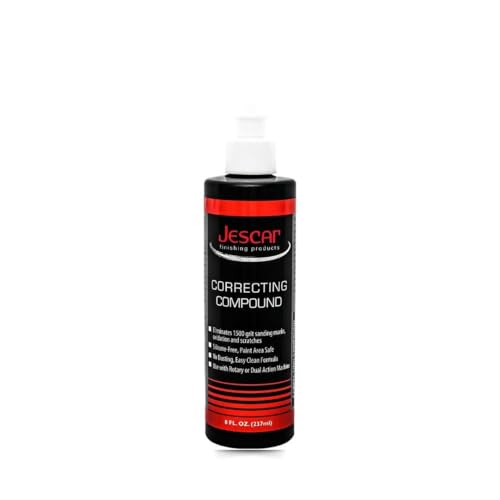
| Jescar Correcting CompoundTop Performer | Sanding marks on fresh paint | P1500 | 8 oz | Fine | Amazon |
| Chemical Guys V34Precision Cut | Ceramic clear coats | 1500 | 16 oz | Medium | Amazon |
| Meguiar’s M04 Heavy Cut | Heavy oxidation & etching | 40 | 16 oz | Coarse | Amazon |
| menzerna Super Finish Plus 3800 | Final gloss on dark paint | — | 8 oz | Medium | Amazon |
| Malco Super Duty Heavy Cut | Heavy sand scratches on boats/cars | 800 | 32 oz | Fine | Amazon |
| menzerna Heavy Cut 1000 | Abrasive scratch removal | 1000 | 8 oz | Medium | Amazon |
| Chemical Guys C4 & P4 Kit | Complete 2-step correction | 2000 | 2 x 16 oz | Fine | Amazon |
| ABRO Rubbing Compound | Light oxidation on a budget | — | 10 oz | Fine | Amazon |
In-Depth Reviews
1. Griot’s Garage BOSS Correcting Cream
Our pick — over 4.5★ from 850+ verified ratings; the strongest balance of quality and price.
A medium-grit (120) compound that removes light scratches and swirls on daily drivers, restoring a mirror finish in 4-5 passes.
The Griot’s BOSS Correcting Cream is the one that wins people over across the board, and the reason is its forgiving, dust-free formula. It carries a medium 120 grit that removes light scratches and swirl marks while adding depth, and the extended buff cycle means it won’t dry out or powder up as you work. Owners describe taking dull, swirled paint to a mirror finish in just 4-5 passes, which is exactly the kind of real-world speed you want on a daily driver.
What makes this pick so flexible is the BOSS system behind it — you can dial in aggressiveness simply by swapping pads. A firmer pad handles deeper defects, while a softer pad turns it into a light polish, so one bottle stretches across most of your paint correction needs. The 16-ounce size is also double the 8-ounce bottles from menzerna, giving you more product for the same kind of job.
The strongest praise centers on effectiveness and quality, with over 90 owners calling out its cutting power specifically. It even gets credit for restoring a cloudy acrylic turntable cover to clear and shiny, which shows how versatile the formula is beyond just cars. On the extreme end, one owner resurrected paint they thought was beyond repair on a 25-year-old vehicle.
What gives it the edge
- Extended working time won’t dry out mid-pass
- Wipes off clean with minimal dust residue
- BOSS system lets you adjust cut with different pads
Who should look elsewhere
- Not aggressive enough for deep sanding marks that need a heavy cut
- Boat gel coat scratches are a hit but extreme oxidation may need rougher grit
The smart money says: start here for moderate swirls and light scratches on any paint color, especially black.
One honest limit: if you’re removing 1500-grit sanding marks, step up to a dedicated heavy cut compound first.
2. Jescar Correcting Compound
A P1500-grit compound engineered to eliminate sanding marks on fresh paint, leaving a glass-like finish.
Jescar’s Correcting Compound is the one that earns the “miracle in a bottle” label from people who don’t even consider themselves detailers. Its advanced formula is built to eliminate P1500 grit sanding marks on fresh paint, which is a task that stumps most consumer-grade compounds. Buyers report it removes haze and fine scratches with ease, and the cutting performance is described as extremely good — the kind of praise that comes from someone who watched their paint “look like glass.”
The finish quality is where this compound shines, but it’s note the market perspective: it sits at a higher price per ounce than some bigger bottles, and not everyone agrees it’s worth the premium. Yet the results speak loudly for themselves. The formula doesn’t powder up during use, and the working time is long enough that you don’t feel rushed, which is a rare combination in a correcting compound.
What wins people over is the effectiveness at removing swirls, water spots, and scuffs that other products leave behind. One owner called it the best scratch remover they’d ever used, noting it wipes off very easily and doesn’t dust. If you’ve just wet-sanded a repair panel, this is the compound that finishes the job without leaving haze behind.
A detailer’s confidence: built for the sanding-to-shine step, where it eliminates P1500 marks that lighter polishes can’t touch.
Reach for this if: you’ve wet-sanded or have fresh paint that needs a serious scratch-free finish.
Look elsewhere if: your paint only has light swirls — a finishing polish will do the job for less money.
3. Chemical Guys V34 Optical Grade Compound
A filler-free compound for ceramic clear coats that removes 1500-2000 grit sanding scratches without masking defects.
Chemical Guys designed the V34 specifically for scratch-resistant and ceramic clear coats, which is a different animal from traditional soft paint. It removes 1500-2000 grit sanding scratches, and because it’s formulated with no silicone or fillers, you’re not just masking defects — you’re actually correcting them. That’s a crucial distinction for anyone who wants a true repair rather than a temporary cover-up.
Owners rave about its cutting power, saying it slices through medium to fine scratches and swirls “like butter.” One buyer revived a car that had sat neglected for 18 months, and the results showed across every panel. In a recent three-product panel test, it outperformed the other two brands, earning the top spot for cutting performance.
The honest trade-off is dust. It’s not a dealbreaker, but factor in cleanup time after your buffing session. The extended work time and VOC-compliant, body shop safe formula make it a legit choice for both pros and serious DIYers.
Built for modern clears: ceramic-coat safe and filler-free, so the shine you see is the paint you keep.
Your best bet if: your car has a newer ceramic or scratch-resistant clear coat that lighter compounds can’t bite into.
Know before you buy: the dust aftermath is real, so budget a few extra minutes for wiping down your work area.
4. Meguiar’s M04 Heavy Cut Cleaner
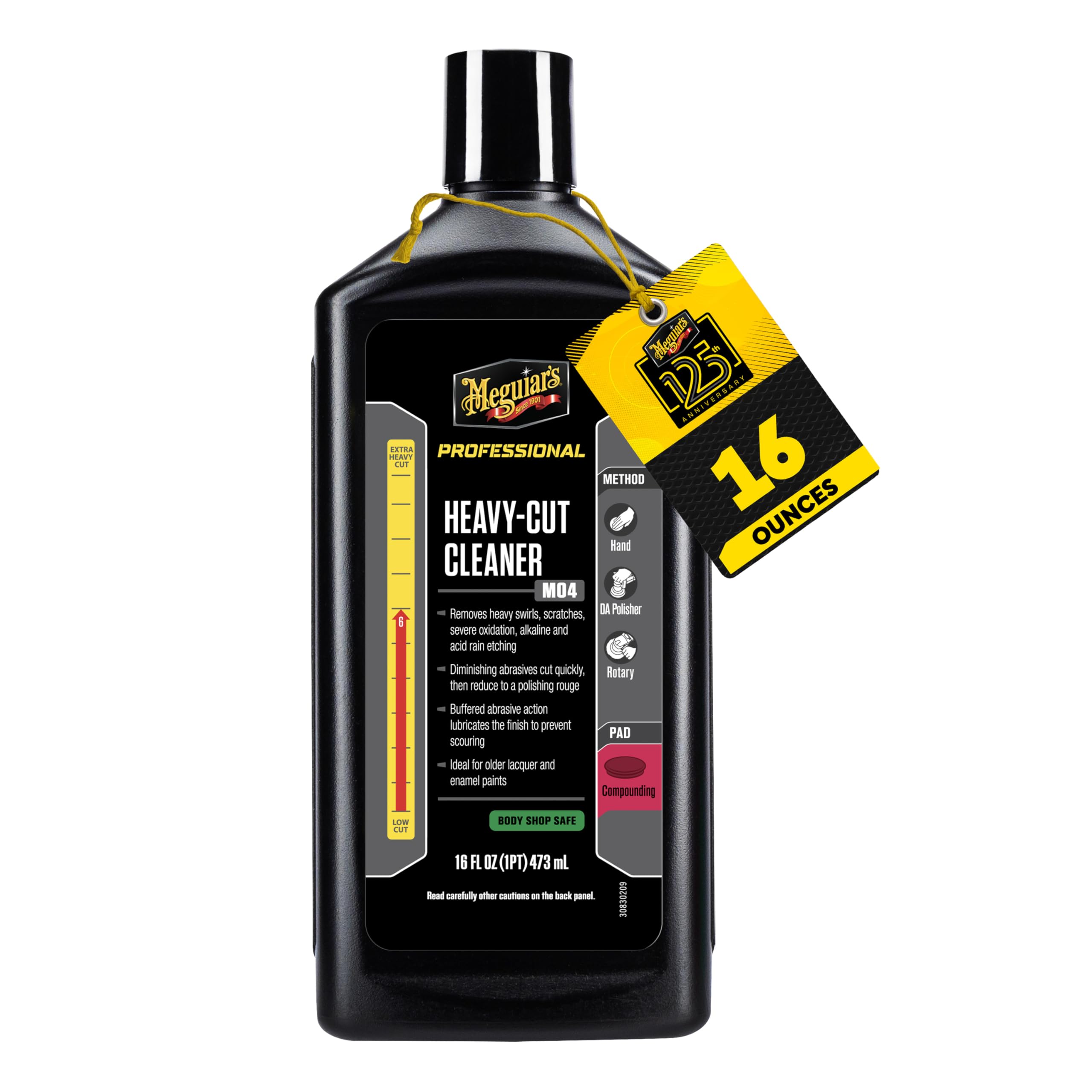
A coarse 40-grit rotary-buffer compound that removes heavy oxidation, acid rain etching, and deep swirls.
When your paint has severe oxidation, alkaline or acid rain etching, or heavy swirls that a scratch remover couldn’t touch, the Meguiar’s M04 is the heavy artillery. Its coarse 40 grit abrasive cuts quickly, then breaks down to a buffing rouge that minimizes swirling — a smart design that reduces the risk of marring the clear coat even as it works hard. One owner confirmed it “removed scratches that my scratch remover couldn’t remove” without damaging the clear coat.
This is a rotary buffer formula, designed for serious correction rather than quick hand polishing. Owners have used it to clear up oxidation on old classic cars, revealing the original paint underneath, and to strip mineral deposits left by sprinkler exposure. The 16-ounce size is generous, and the value proposition keeps people coming back for more.
What stands out is how well it handles the toughest jobs: the buffered abrasive action lubricates the finish to prevent scouring or scratching. It’s safe on all glossy paint finishes including clear coats, and especially ideal for older lacquer and enamel paints. This is the tool you reach for when your daily driver has been baking in the sun for years.
Where it flexes
- Coarse 40 grit removes heavy oxidation and acid rain etching
- Abrasive breaks down to a rouge to reduce swirl risk
- Ideal for older lacquer and enamel paints
Keep in mind
- Designed for rotary buffers, not casual hand application
- Too aggressive for light swirls that a medium compound handles
Deploy this when: your paint is heavily oxidized or etched and you’re working with a rotary buffer.
Don’t reach for it if: your paint is in decent shape and just needs a quick shine — this will remove more clear coat than you want.
5. menzerna Super Finish Plus 3800
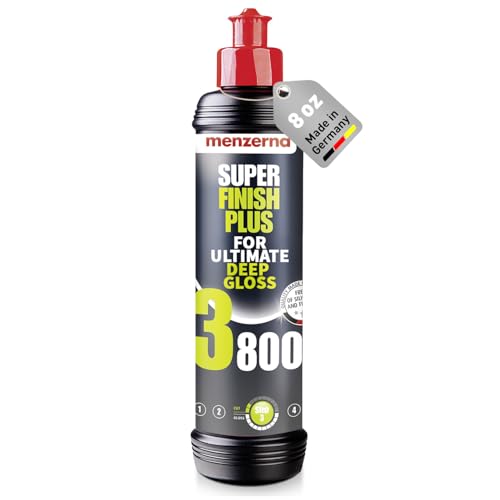
A finishing polish that removes holograms and micro-abrasions, delivering deep gloss on dark paint.
The menzerna Super Finish Plus 3800 is what detailers reach for after the heavy lifting is done. This finishing polish sits between a polishing compound and a pure polish — a hybrid that removes holograms and micro-abrasions while layering on deep gloss, particularly on dark cars. One owner removed holograms from black paint using a rotary at low speed with a red jeweling pad, achieving crisp results with a long working time.
It’s a premium formulator’s product, so it expects a clean surface and pairs best with a machine. The included 8-ounce bottle is lighter on quantity than competitors — it’s 8 ounces versus Griot’s 16 ounces — but the quality concentration is what owners praise. The brand has over 130 years of polishing expertise behind it, and it shows in how easily the residue wipes off and how bright the finish turns out.
Owners note it works beautifully as a final gloss after compounding, and one even used it to remove scratches from a resin bathtub by hand, showing its versatility. The caveat is that it offers no paint protection, so you’ll want to follow it with a wax or sealant to lock in that showroom shine. This is the product that answers the question “how do I get the deepest gloss possible.”
The finishing touch: not a heavy cutter, but the master of the final gloss layer that makes dark paint look wet.
Choose this for: the final polishing step after correction, especially on black or dark metallic paint.
Set expectations: it won’t fix deep scratches, and you’ll need a separate sealant to protect the finish afterward.
6. Malco Super Duty Heavy Cut Compound
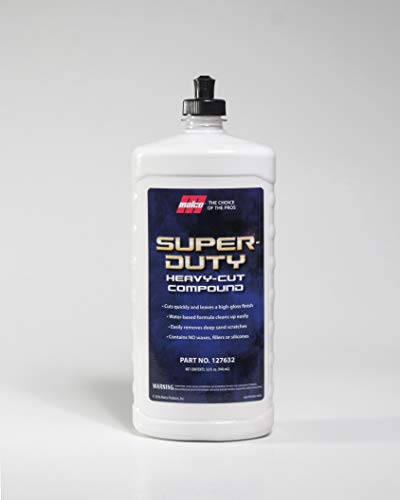
A 32-ounce heavy-cut compound that removes P1500 sand scratches on cars, boats, and RVs.
The Malco Super Duty is the value pick that doesn’t skimp on cutting power. At 32 fluid ounces, it gives you double the product of most 16-ounce competitors, which makes it the smart choice for larger jobs like RV paint restoration or boat gel coats. The formula is designed to remove P1500 grit and finer sand scratches from clear coat painted surfaces and gel coats, making it a versatile addition to any shop.
Owners working on heavily oxidized paint describe a night-and-day difference when switching to Malco, especially when paired with a wool cutting pad and rotary tool. It cuts fast and leaves a high-gloss finish, and it’s clear coat safe across automotive, marine, and industrial coatings. One owner restored a severely oxidized 2008 Honda Accord with an orbital buffer and wool pad and said it exceeded expectations.
The honest note is about workability: it can leave residue if overworked, so damp-cloth removal helps, and it’s not ideal for soft clear coats. But for the price per ounce, it’s a serious performer that dusts less than other heavy cutters. This is the one to grab when you have a big project ahead.
Why it’s a workhorse
- 32 oz bottle covers entire vehicles or boats
- Removes P1500 grit sand scratches fast
- High-gloss finish on auto, marine, and industrial coatings
The fine print
- Residue can be hard to remove if you overwork it
- Not the best match for soft clear coats
Grab this for: full-vehicle corrections, boats, RVs, or any large sanding-mark project.
skip it if: your car has a soft clear coat or you only need a small spot repair — the size is overkill.
7. menzerna Heavy Cut Compound 1000
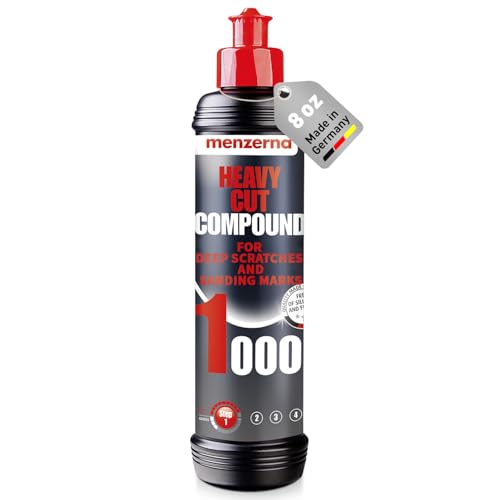
A 1000-grit compound that cuts fast on deep scratches, working with a drill pad or by hand.
The menzerna Heavy Cut 1000 is the abrasive compound you turn to when scratches and signs of use need to disappear. It carries a 1000 grit and is designed to remove scratches from a variety of surfaces without the hassle, leaving the paint looking fresh. Owners have had success using it with a cheap 3-inch foam buffing pad attached to a drill after some 1500 grit wet sanding — an easy DIY fix that resulted in glossy, flat paint.
The cutting speed is the standout trait. It’s described as cutting fast and well, taking out a lot of scratches even after touch-up paint was applied. One owner removed door ding paint and scratches with impressive results, and another did the same using just a cloth rather than a buffer. This accessibility is the product’s calling card — you don’t need a full rotary setup to see results.
The recurring trade-off is dusting. Several owners note it “dusts like crazy no matter what I try,” though they still acknowledge it works well on pretty bad scratches. It’s a menzerna product, so you get that 130-year pedigree in the formulation, but expect to wipe up after yourself. If you want a heavy cutter that works by hand or machine without extreme dust, look to the Griot’s pick instead.
A fast friend in a pinch: this compound cuts quickly and works by hand or machine, but it leaves a chalky dust trail.
Right for you if: you’ve got deep scratches and want a budget-friendly heavy cut that works with a simple drill pad.
Not ideal if: dust bothers you — the cleanup is real and noticeable.
8. Chemical Guys C4 & P4 Correction Kit
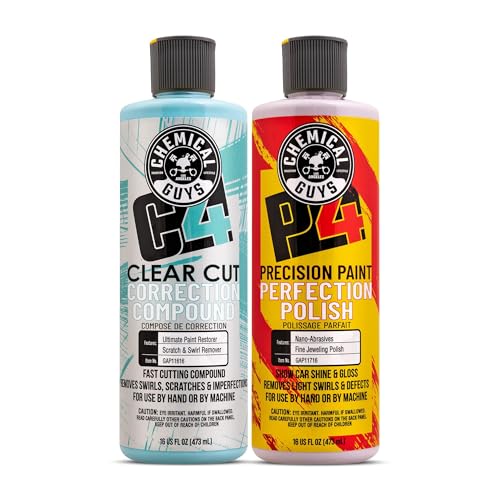
A two-step kit pairing a cutting compound with a finishing polish for a complete correction workflow.
This is the two-step system that takes the guesswork out of paint correction. The kit pairs the C4 Clear Cut Compound, which removes scratches, swirls, oxidation, and etching, with the P4 Precision Polish that refines the paint to a flawless high-gloss finish. It’s a complete workflow in one purchase, and owners consistently describe it as delivering “professional results without the professional price.”
The effectiveness is the most-discussed aspect by a wide margin. Owners have removed 95% of off-road scratches on a truck, leaving one barely visible, and improved scratches that were 8 years old. The C4 cuts above average, clearing imperfections and oxidation, while the P4 restores gloss and reflection. Both products spread easily and aren’t messy, which makes the whole process feel approachable for a first-time DIYer.
The kit is safe for clear coat, single-stage, and ceramic-coated vehicles, and works with dual action, rotary, or hand application. Value for money gets mixed opinions — some think it’s worth every dollar, others aren’t convinced — but the two bottles give you a complete correction arsenal. It’s the best way to step up from a single compound to a full system.
The system advantage
- Two-step correction workflow in one kit
- Removes deep defects then refines to high gloss
- Safe on clear coat, single-stage, and ceramic paint
Consider this
- Work in small areas — the shine is great but needs sectioned passes
- Some owners find the value debatable compared to single products
Ideal if: you want a complete compound-plus-polish process without buying separate products.
Reconsider if: you only need one step — buying the full kit when you just need a compound is overkill.
9. ABRO Rubbing Compound

The budget fast-cutter for oxidized paint that does the job without the premium price.
The ABRO Rubbing Compound is the entry-level option that punches above its weight for light correction work. It’s made for dull, faded, weathered, or oxidized paint that needs stronger correction than a basic polish, and it targets scuffs, swirls, and light scratches. It’s a solid first step before polish or wax, designed to cut through surface oxidation and restore a cleaner finish.
It works by hand for spot correction or with a buffer for larger panels, spreading smoothly and buffing off cleanly. One owner confirmed it’s a “legit rubbing compound,” using it after a clay bar kit to hand buff out a long tree branch scrape from offroading — the classic use case for a fast-cut compound. Another found it works well on rims, though headlights were “so so,” which is a fair expectation for a budget product.
The honest feedback is that scratch-removal is mixed — it handles small scratches but isn’t great with deeper imperfections or heavy oxidation. It also tends to dry out a bit quickly during hand buffing, though using a minimal dab helps. As a first-step compound on a budget, it’s a great value; just know it can leave white marks if you’re not careful. It’s the right pick for a single panel job, not a full-car correction.
Budget-friendly starter: a silicone-free fast-cutter that handles light scratches and oxidation, with honest limits on deep defects.
Pick this up if: you need a cheap compound for a specific scuff or oxidized spot on a daily driver.
Pass on it if: you’re chasing a mirror finish on dark paint — you’ll want a finishing polish on top.
Understanding the Specs
Grit Rating Explained
The grit number represents the coarseness of the abrasive particles in the compound. A lower number like 40 means a coarser, more aggressive cut that removes deeper scratches, while a higher number like 2000 is finer and used for final polishing. Matching the grit to the defect depth is the key to avoiding unnecessary clear coat removal.
Working Time & Dusting
Working time is how long the compound stays wet and effective before drying out. A longer working time lets you keep buffing until the defect is gone, while a short one forces you to work in smaller sections. Dusting refers to the chalky residue that some compounds leave when they dry — more dust means more cleanup time after your session.
FAQ
What is the difference between a rubbing compound and a polishing compound?
How do I know which grit level I need for my car’s scratches?
Can I use a buffing compound by hand or do I need a machine?
Will a buffing compound damage my clear coat?
What does dusting mean when using a compound?
Is a buffing compound safe on ceramic coated paint?
How much compound do I need for a full car?
Do I need to wax after using a buffing compound?
Are rubbing compounds from different brands interchangeable in quality?
Can I use a buffing compound on headlights?
Final Thoughts: The Verdict
For most people, the best buffing compound is the Griot’s Garage BOSS Correcting Cream because it balances real cutting power with a forgiving, dust-free formula that works on the most common paint defects. If you need to eliminate P1500 sanding marks on fresh paint, grab the Jescar Correcting Compound. And for a complete correction workflow, the Chemical Guys C4 & P4 Kit takes you from defect to showroom shine in two steps.
How We Picked
We do not accept paid placement. Every pick is matched to a real buyer and a real use-case; we do not hands-on test units.
Sources & Methodology
Specifications: manufacturer listings and product documentation. Review insights: verified customer reviews, as of August 2026. Pricing: not shown on this page (it changes often); check the current price via the retailer link.
As an Amazon Associate, Gadgets Feed earns from qualifying purchases. This does not affect which products we feature.