
Our readers keep the lights on and my morning glass full of iced black tea. As an Amazon Associate, I earn from qualifying purchases.
Specs are compiled from manufacturer listings and verified buyer reviews and can change over time — please confirm the key details on the product page before buying.
Clay soil turns your lawn into a hard, oxygen-starved crust that water pools on and roots can’t push through. The only real fix is pulling actual cores of soil out of the ground — not just poking holes that collapse shut. The right tool for that job lives and dies by two things: how deep its hollow tines can bite and whether those tines clog up mid-row. Across the manual, rolling, and tow-behind styles below, those two factors separate the tools that make your back ache for an hour from the ones that make it ache for an afternoon.
I’m Min — the founder and writer behind Gadgets Feed. This guide is built by comparing the manufacturers’ published specifications and the patterns across verified customer reviews, so you get each pick’s real strengths and trade-offs instead of marketing spin.
If your yard is heavy, sticky clay that defies spades and sprinklers, choosing the right aerator for clay soil means looking past fancy handles and focusing on tine length, weight, and whether the plugs eject on their own.
Our Picks at a Glance


How To Choose The Best Aerator For Clay Soil
Clay is the most punishing soil type for aeration, so the rules that apply to sandy or loamy lawns don’t hold here. You need a tool that can generate enough downward force to penetrate hardpan and then eject a solid, sticky core without gumming up. Every decision below comes back to those two realities.
Core Tines vs. Spike Tines
A spike aerator pushes solid metal rods into the ground, which actually compresses clay further around the hole. A core aerator uses hollow tines to physically pull a plug of soil out, leaving a real channel that air, water, and roots can use. On clay, core aeration is the only option worth considering — the extra step of removing the plug is what relieves the compaction.
Tine Depth and Penetration
Depth is the number that matters most, and it’s controlled by two things: the length of the tines themselves and the weight you can put behind them. A manual step tool with 3.94-inch tines will out-penetrate a lighter tool with shorter tines, but only if your body weight is enough to sink them. Rolling and tow-behind models succeed on hard clay because the weight of the machine — or the weight you can add to a tray — does the work your foot would otherwise have to do.
The Anti-Clog Factor
Wet clay is sticky clay, and sticky clay loves to pack inside a hollow tine and refuse to come out. The best designs use side openings, ramped interiors, or angled tips so the soil plug slides out on its own before you have to stop and poke it loose. If a tool lacks this feature, plan on tapping or shaking it after every few steps, which turns a 30-minute job into an afternoon.
Style: Manual, Rolling, or Tow-Behind
Match the tool to the size of your lawn, not the size of your ego. A manual step aerator is fine for patches and small beds but will exhaust you on a quarter-acre. A rolling aerator spreads your weight across wheels so you push rather than stomp, which is gentler on your knees. If you have a riding mower and a big yard, a tow-behind unit turns a brutal workout into a relaxing lap around the property.
Quick Comparison
| Model | Best For | Tines | Style | Weight | Amazon |
|---|---|---|---|---|---|
| Xuperace Core Aerator★ Best Overall | Best Overall (Manual) | 3 (Hollow) | Step | 5.79 lbs | Amazon |
| Suchtale Tow BehindLarge Lawn Pick | Large Lawns | 24 | Tow-Behind | 55 lbs | Amazon |
| Brinly PA-403BHHeavy-Duty Towing | Heavy-Duty Towing | 24 | Tow-Behind | 63.9 lbs | Amazon |
| Landzie Rolling | Mid-Size Yards | 7 (Hollow) | Rolling | 50.8 lbs | Amazon |
| LawnVigor Rolling | Easy Rolling | 6 (Hollow) | Rolling | 31.5 lbs | Amazon |
| AVVA VISION Rolling | Sand-Weighted Rolling | Rotary | Rolling | 43.4 lbs | Amazon |
| RAEOHE Manual | 4-Tine Coverage | 4 (Hollow) | Step | — | Amazon |
| hugeneroy Manual | Budget Manual | 3 (Hollow) | Step | 3.52 lbs | Amazon |
| LawnVigor Manual | Entry-Level Manual | 3 (Hollow) | Step | 3.52 lbs | Amazon |
In‑Depth Reviews
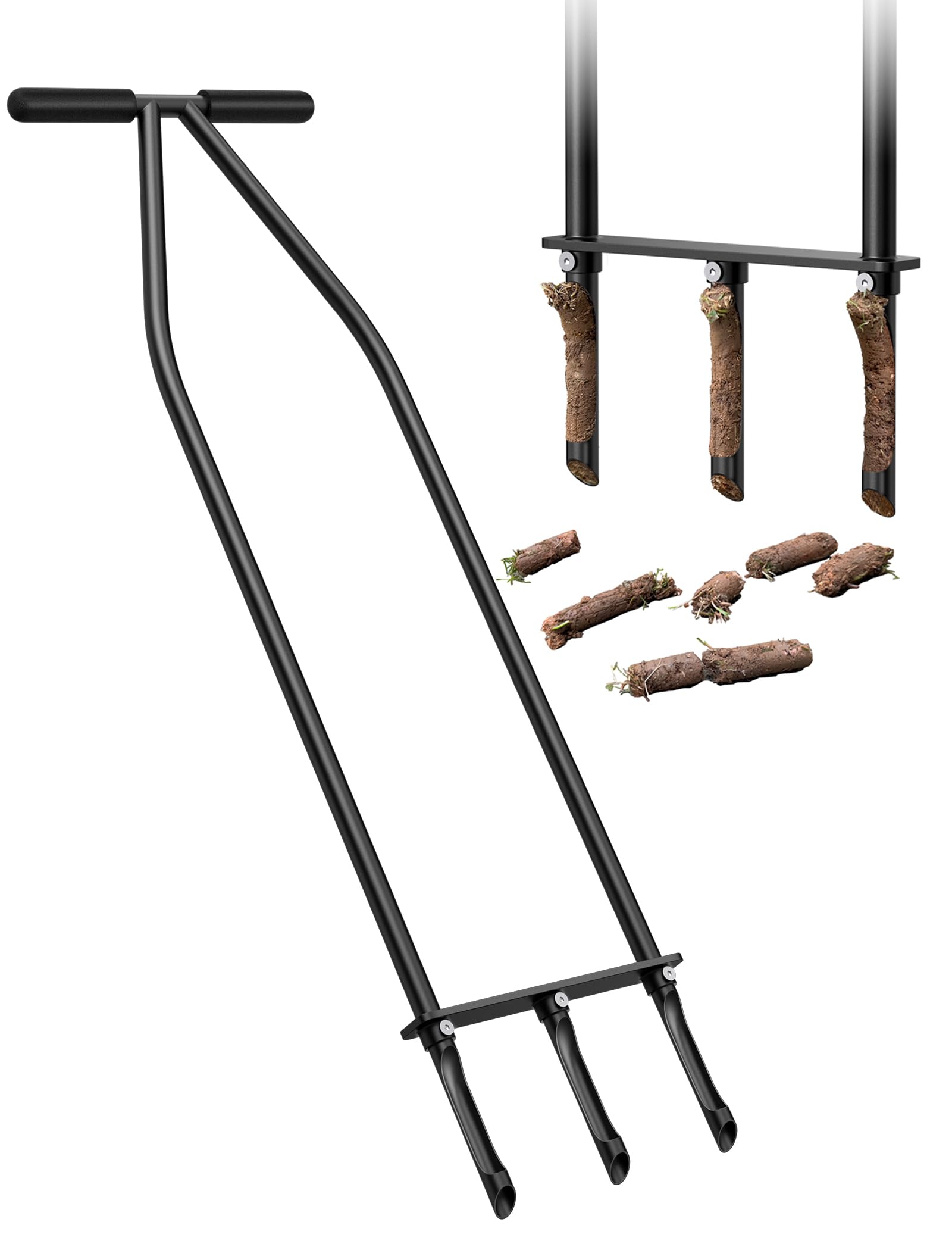
1. Xuperace Core Aerator Lawn Tool
Our pick — over 4.5★ from 100+ verified ratings; the strongest balance of quality and price.
The manual step aerator that treats clay like it is not even there.
Clay’s classic insult to manual aerators is clogging — wet, sticky plugs pack the hollow tines and you waste the whole afternoon jabbing them out with a screwdriver. This tool’s patented side-eject design answers that directly: instead of pushing the plug back out the open bottom where it can hang up, the soil travels up and slides out the side along a ramp. Buyers report pulling 3.5-4 inch plugs in dry compacted clay and 5-5.5 inches in damp areas, with zero clogging.
The whole unit weighs 5.79 pounds and is built from high-strength alloy with an integrally formed frame, so it holds up to serious stomping. A knee-friendly footplate lets you drive the 3 hollow tines in with your leg’s strongest muscle rather than bending over. Something as simple as being able to remove the middle tine for harder ground is a thoughtful touch that reveals the design’s lawn-care pedigree — you adjust the tool to the soil, not the other way around.
The recurring gripe here is the screws: they tend to loosen the more you use it. Owners who apply a dab of thread-locker early on report the tines stay put. Owners mention the build quality is the standout feature, with the tool’s non-clogging design close behind. The plugs eject on their own as you walk, which is the difference between a chore and a workout that respects your time.
What Clay Owners Love
- Side-ramp ejection means plugs slide out on their own — no stopping to clear tines
- Alloy steel frame and replaceable tines built to survive demanding jobs
- Knee-friendly footplate lets you press with less force
The Fit Note
- Screws can loosen with use — a little thread-locker early on solves it
- Premium price over basic manual tools, justified by the non-clog design
Reach for this if: you want the highest-performing manual step aerator for clay that won’t clog every few steps.
Look elsewhere if: you are covering a full acre on foot — your back will thank you for a rolling or tow-behind model instead.
2. Suchtale 40-Inch Tow Behind Plug Aerator
Sit back and let 24 heat-treated plugs chew through the hardpan for you.
When your lawn is measured in acres, a manual step tool is not an option — it is a punishment. This tow-behind unit hooks to any lawn tractor or ATV with a universal hitch pin and rolls 24 coring plugs down your yard from the comfort of the driver’s seat. Each plug sinks up to 2 inches into compacted soil, and the 55-pound all-steel frame gives it the mass to bite into clay that lighter units bounce off.
The secret to its clay performance is the weight tray: an all-steel design that accepts up to 125 pounds of extra weight. Customers note loading it with cinder blocks and running it through clay after rain, drawing deep cores without effort. The 6 spools of integral aerator knives resist bending and rust, and the 2-piece steel draw bar stays straight under a heavy load. It is a genuine workhorse for seeding and renovating large lawns.
Assembly is the trade-off. The instructions have mixed reviews — some owners had a smooth 1-2 hour solo build, while others hit missing bolts and a wheel spacer that needed modifying. Owners who added washers to the axle brackets found it reduced lever play and improved stability. Reviewers point out it supports up to 5 cinder blocks, a durability sign that inspires confidence on tough ground. If you want a mechanic’s project with a professional-grade payoff, this is your tool.
The Bottom-Line Read: The best value-per-acre tow-behind on this list, provided you are comfortable with a moderately involved build on delivery day.
Who this fits: owners of large lawns who already own a riding mower or ATV and want aeration without the workout.
Where it falls short: assembly quality control is inconsistent — set aside an afternoon and keep a wrench handy.
3. Brinly Tow Behind Plug Aerator
The 63.9-pound tow-behind that pulls 3-inch clay plugs like a hot knife.
Brinly has a reputation for building serious steel, and this 40-inch tow-behind earns it. The 24 heat-treated, 16-gauge steel plugging spoons are designed narrower with sharpened ends, which lets them sink into hard clay with less added weight than a blunter design. Shoppers say pulling consistent 3-inch plugs after rain and 2.5-inch cores in damp conditions, with the 150-pound weight tray handling the toughest ground.
On uneven turf, the three independently rotating, welded tine sections keep the tines in contact with the ground on slopes, so you don’t leave skipped patches. They also minimize turf damage when you turn. A single transport lever lifts the tines to cross driveways and walks without gouging them, and the 10-inch semi-pneumatic rubber tread tires (air-filled with a solid core) roll smoothly over rough ground.
The honest catch is assembly: this unit takes real time and effort to put together, with a reported 1.5 to 2.5 hours on the build and a single-lever mechanism that some owners found tedious. Buyers report the construction is the thing everyone raves about, and that the narrow spoons penetrate with less weight than alternatives. Owners who loaded 140-pound sandbags found the tines dug deep, though one noted a tine weld broke early — Brinly shipped replacements the next day. It is a premium investment that replaces an annual professional service.
Final Call: The most capable tow-behind here for large, uneven lawns — if you can stomach the assembly, it is a decade-long tool.
Choose it if: you need maximum plug depth on a big property and value steel durability over a quick setup.
Think twice if: a multi-hour build sounds like a dealbreaker — consider the simpler Suchtale above.
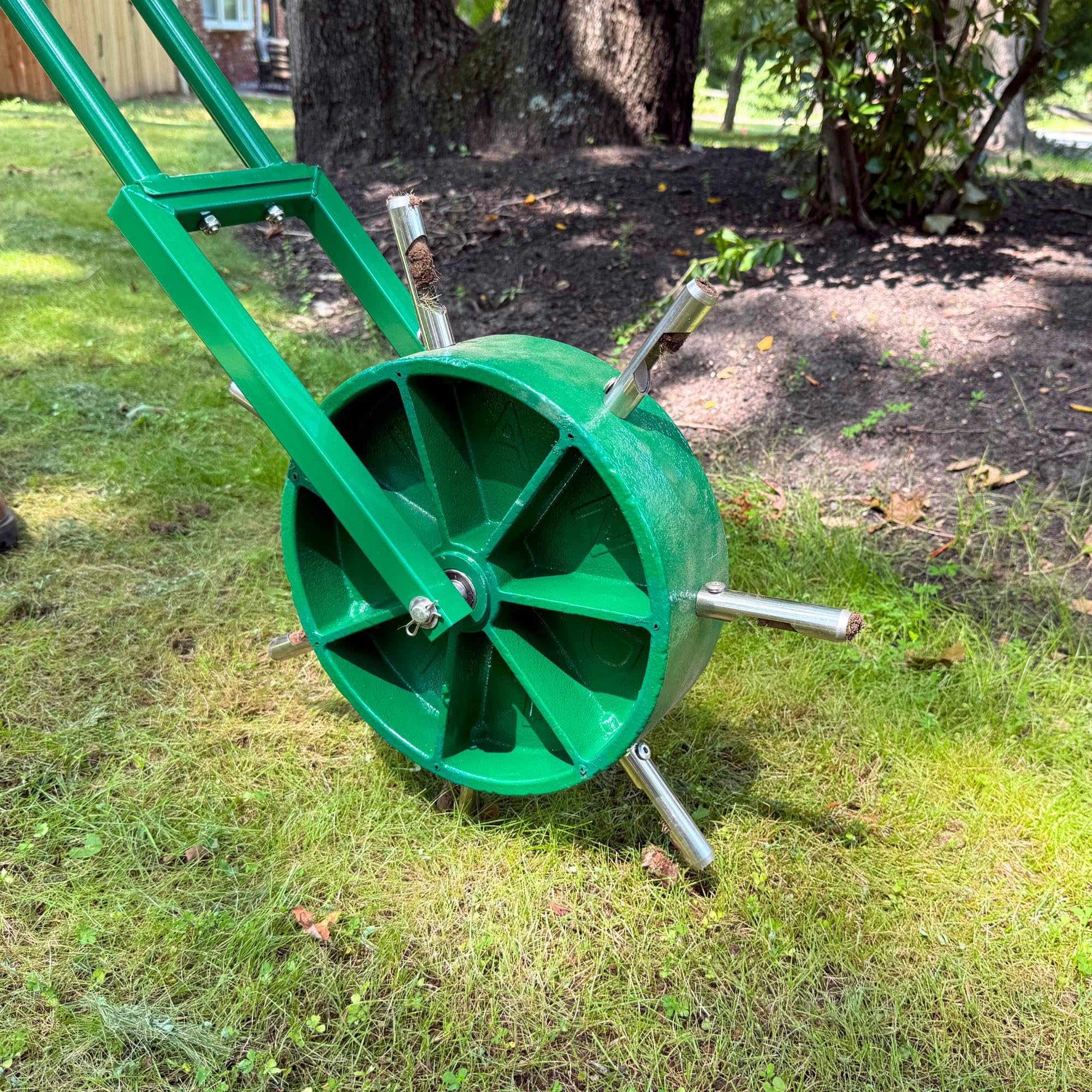
4. Landzie Rolling Lawn Aerator
Push, don’t stomp — a rolling core aerator that spares your knees.
Manual step aerators demand you drive tines in with your foot, which on hard clay can feel like kicking a brick wall. The Landzie replaces that stomp with a rolling motion — you push it forward and backward, and the 7 stainless steel hollow tines rotate into the ground and pull cores as they go. The 50.8-pound powder-coated steel frame provides the heft to sink into compacted soil without needing you to add sand or weight, a real advantage on clay.
Owners mention aerating a 4,500-square-foot lawn in about 2 hours with 6-inch spacing, and a 12,000-square-foot yard in several sessions. The wide-diameter, chamfered tines eject cores as they roll, so you are not stopping to clear clogs. It is easier to maneuver than a heavy pull-behind and light enough to haul around, though at 50.8 pounds a smaller person will feel the carry between areas. The review pages sum it up: “way better than spiked shoes because it aerates with actual core plugs.”
The trade-off is effort — this is a rolling aerator, not a self-propelled one. Effectiveness gets mixed reviews from owners who expected it to glide, when it is really a solid workout. The value proposition is strong if your lawn is too big for a manual step tool but too small to justify a tow-behind. It is a middle ground that trades a little speed for a whole lot less back strain.
Yard-Size Verdict: Ideal for medium lawns where a step aerator would exhaust you and a tow-behind is overkill.
Best for: homeowners with a third-to-half-acre lawn who want core aeration without kneeling or stomping.
Not for: anyone expecting a light push — it is a genuine workout, and carrying it between areas takes strength.
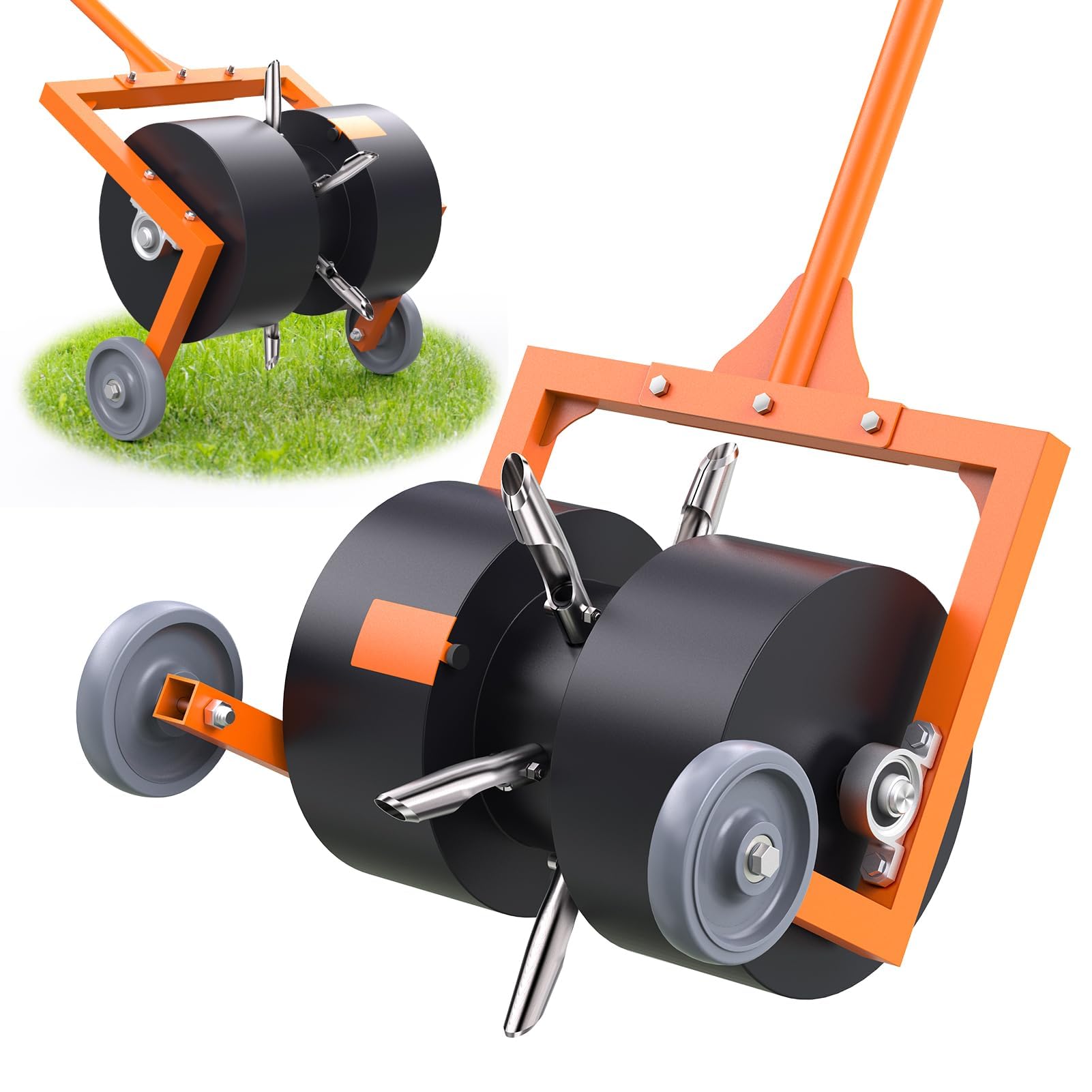
5. LawnVigor Rolling Lawn Aerator
A rolling core aerator with a sand-filled drum for adjustable clay-crushing weight.
Where the Landzie relies on a fixed heavy frame, the LawnVigor takes a smarter approach: start with a 31.5-pound power-coated steel unit and let you add your own weight. The drum fills with dry sand through a provided funnel, and customers note loading a full 50 pounds to drive the 6 non-clogging hollow tines deep into heavy clay. The wheels keep the drum rolling smoothly, so the extra weight translates to penetration, not a harder push.
This design makes it genuinely adaptable — you can aerate a dry patch with the drum empty and then load it up for the hard-packed sections, adjusting as you go. Reviewers point out it “preps heavy clay without strain,” with hollow tines pulling clean plugs and improving water absorption. The integrated side wheels protect your lawn from the drum scraping as you turn, which is a thoughtful detail on uneven ground.
The caveat is one of physics: once you load 50 pounds of sand into the drum, it becomes a significant chore to push, and moving it around property takes real strength. Assembly is quick with high-end included tools, though the sharp edges warrant a pair of gloves on build day. Shoppers say it is far more effective than spike shoes, which just poke holes, and the ability to dial in your weight makes it a smart mid-range value.
Why It Wins People Over: The sand-fillable drum is the standout feature — it is the cheapest way to get more plug depth without buying a heavier machine.
Reach for it if: you want a rolling aerator you can tune to your soil hardness on the fly.
skip it if: you cannot manage 50+ pounds of extra push weight — the empty-drum setting is noticeably lighter but will struggle in dry clay.
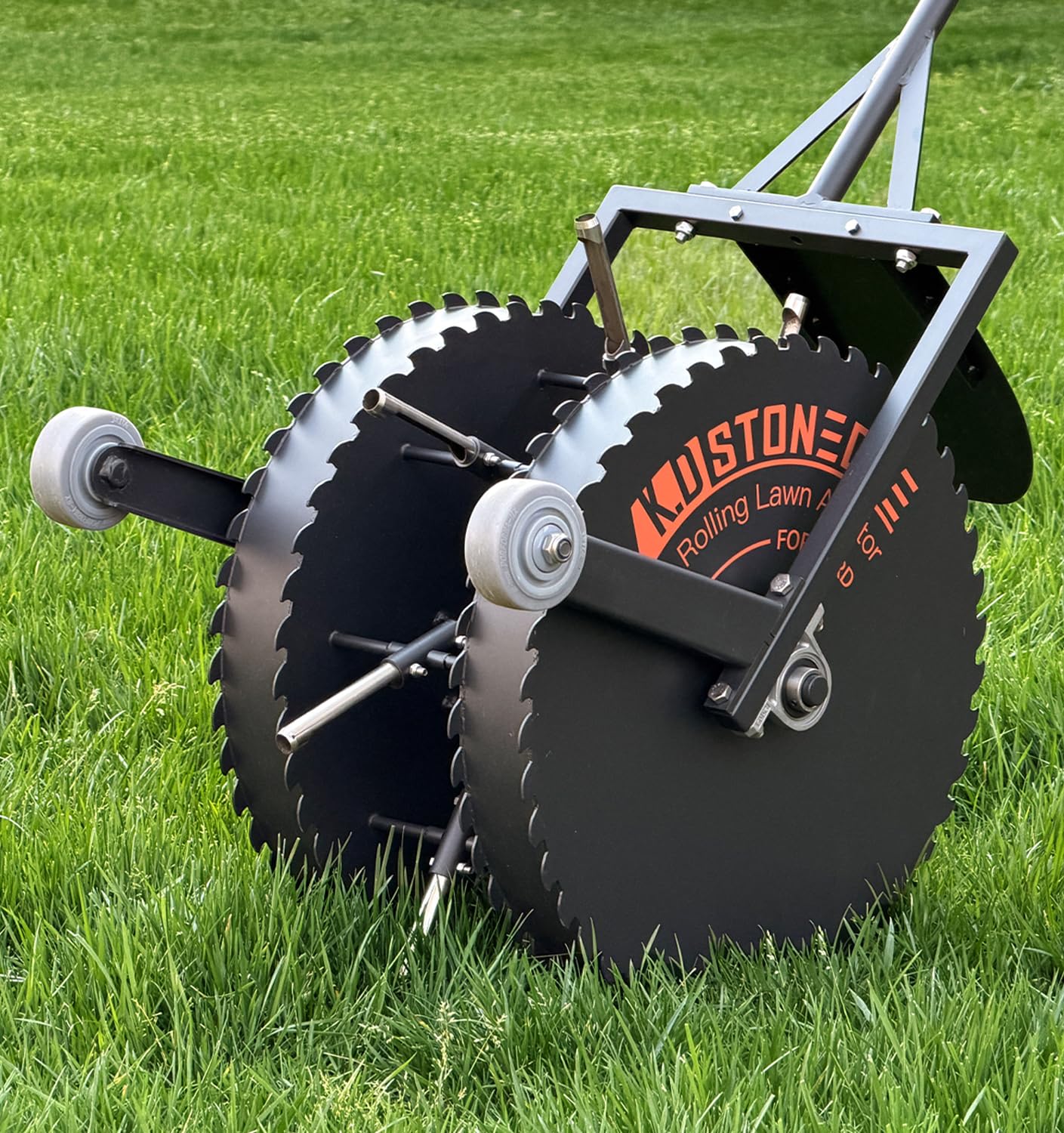
6. AVVA VISION Patented Rolling Lawn Aerator
A patented rotary coring design that treats clay like a full-body workout with a payoff.
This rolling aerator earns its keep on heavy clay by using a patented rotary coring mechanism that punches holes and extracts plugs in one motion. Buyers report the 43.4-pound frame pulls 2-3 inch plugs without clogging across 3,000 square feet in one session. The scientifically balanced weight distribution means the tines stay engaged as you roll, rather than skimming the surface on hard ground.
The real headline is value: owners describe it as an “affordable, effective alternative to renting a machine” that replaces an professional service or a rental. The sand-weighted drum (filled at a tricky 45-degree angle, so bring a funnel) lets you customize penetration to your clay’s mood. One owner noted they could recover the cost by aerating neighbors’ yards — a sign of how confidently it handles the tough stuff.
The honest limitations are motion and maintenance. Mobility is the most-cited negative — it takes real effort to push back and forth, especially once weighted. Axle screws tend to loosen and the wheels have a little flex, so a periodic tightening is part of ownership. Owners mention excellent coring performance in wet conditions and build quality that holds up to repeated use. It is the best cheap entry point into rolling aeration, with the caveat that you will earn the results.
Money-Saving Angle: The strongest cost-to-capability ratio on this list if you have a medium lawn and the ambition to push through the effort.
Pick it for: budget-conscious owners with a third-acre who are happy to trade sweat for savings.
Steer clear if: mobility is a concern — this is the heaviest-feeling rolling unit here, and the loosening axle screws need attention.
7. RAEOHE Manual Core Aerator
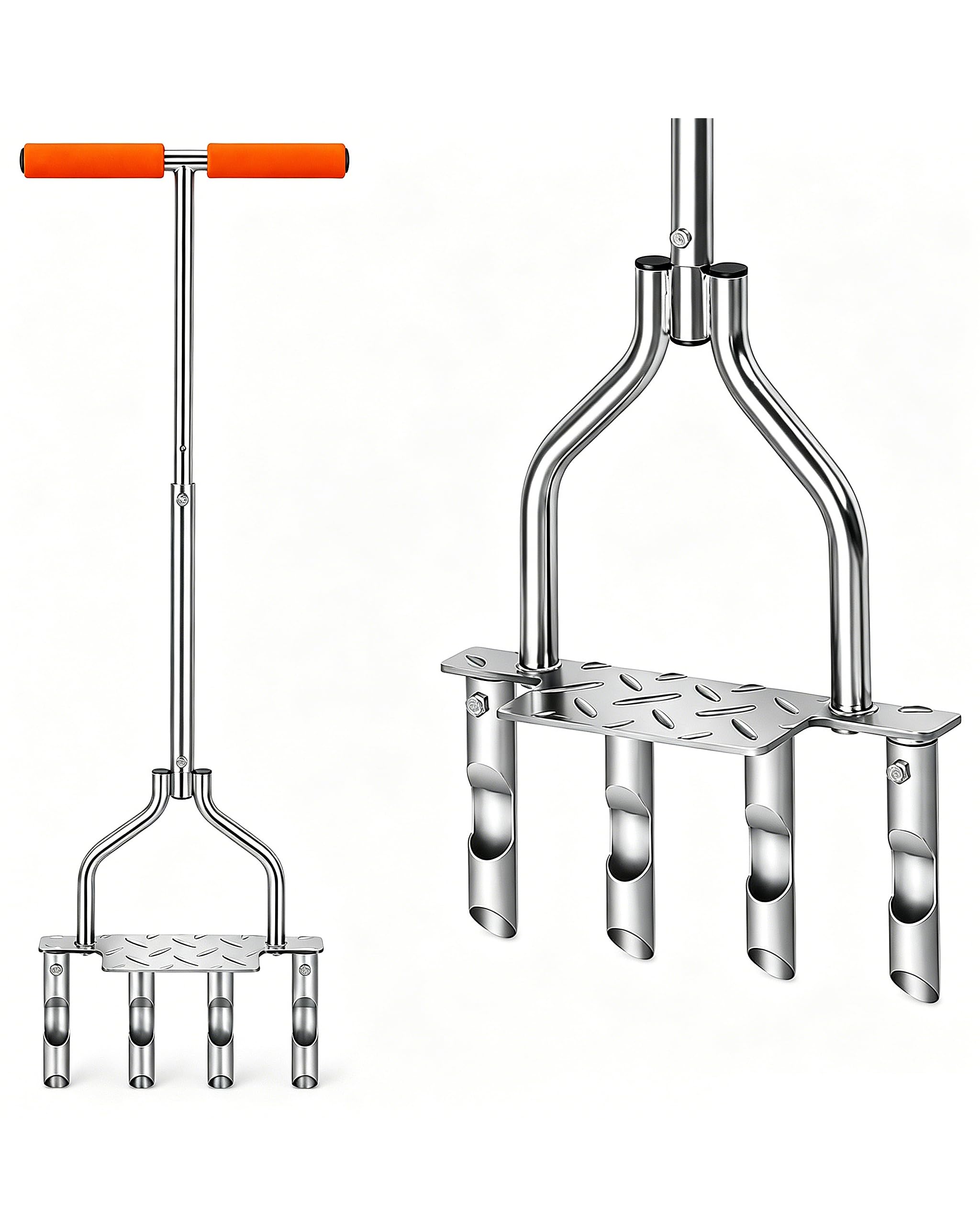
Four hollow tines pull more plugs per step than any other manual on this list.
Most manual step aerators make you stomp three tines into the ground and repeat endlessly. This one uses 4 hollow tines that remove more soil per step, cutting the number of passes you need across a patch of clay. The tines penetrate up to 3.94 inches into compacted soil, and the side-opening, sealed-back design with angled tips helps the plugs release smoothly as you lift.
Customers note visible lawn improvement within 2 weeks and find it easy to assemble and effective on hard topsoil. The wide textured pedal gives your foot a solid, non-slip surface, and the foam T-handle is comfortable to grip when you press down and pull up. It also breaks down into a small box for storage, which is a genuine plus for a tool that lives in the shed between seasons.
The honest catch: one owner found the tines only penetrated halfway and clogged with dirt, proving difficult to empty despite tapping and shaking. This suggests the anti-clog design works better in moist soil than dry, hard clay — wet the ground first and the 4-tine advantage shines. Owners who did found it a “quality manual aerator” and a strong value, with height adjustment an appreciated extra. It is the best choice if you want maximum plugs per stomp without paying for a rolling machine.
Efficiency Read: The 4-tine layout is the standout — you cover more ground per step, but it demands damp soil to perform at its best.
Grab it if: your lawn is small beds or patches and you want the fastest manual coverage possible.
pass on it if: your clay is frequently bone-dry — the tines can struggle and clog without moisture.
8. hugeneroy Heavy Duty Steel Core Aerator
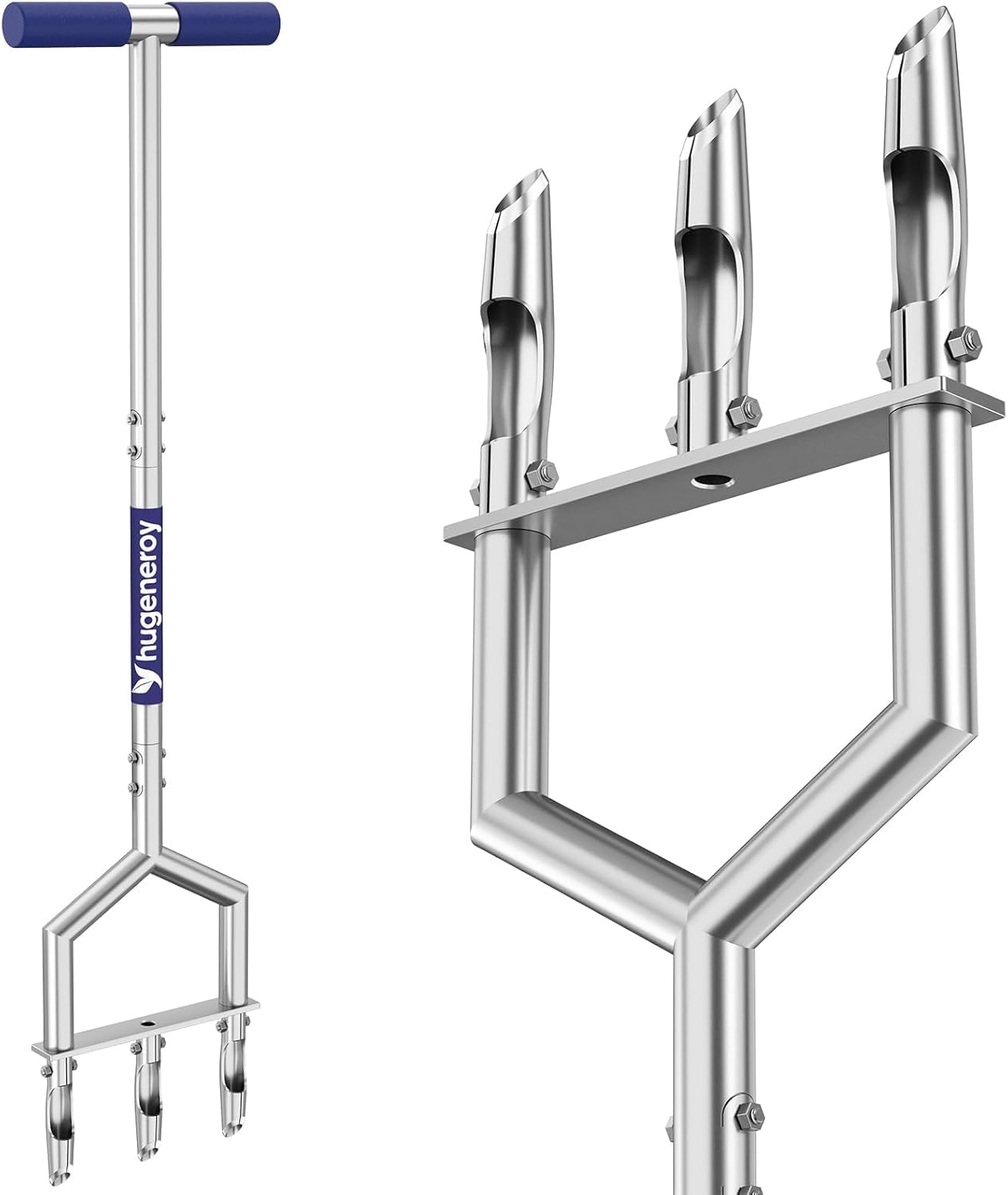
A budget step aerator with tempered tines that pierce moist clay cleanly.
At just over 3.5 pounds, this is one of the lightest core aerators here, which is a double-edged sword on clay. The upside is an easy, fatigue-free swing; the downside is that you will need moist soil — the manufacturer and owners both advise watering 24 hours before use — to let the 3 tempered hollow tines sink in. In damp clay, the plugs eject fairly easily, and reviewers point out penetrating “very sturdy” ground with solid quality.
The build is genuinely industrial-grade: reinforced tine geometry designed to resist bending and warping through repeated soil extraction, with replaceable hollow tines for longevity. Owners were pleasantly surprised at how easy it worked in areas a pull-behind couldn’t reach. The comfort-grip handle reduces hand fatigue and the long handle helps prevent back strain, so you can run a full small-lawn session without the aches.
The limitations are real but fair for the price tier: one owner broke a tine after covering 90% of a rocky clay yard, and another found the bolt/nut on the side bar hits their knee on the downstroke. These are fit and terrain notes, not dealbreakers — wet the soil first, watch the knee, and this is a solid entry-level tool. Shoppers say the included assembly tools are better quality than typical, a small sign of care.
Honest Trade-Off: The light weight is a blessing for your arms and a curse for dry clay — this is a fair-weather, moist-soil manual tool.
Best if: you aerate after rain or watering and want an affordable manual for a small yard.
Look elsewhere if: your clay stays rock-hard and you refuse to water it first — you will need a heavier tool.
9. LawnVigor Manual Core Aerator
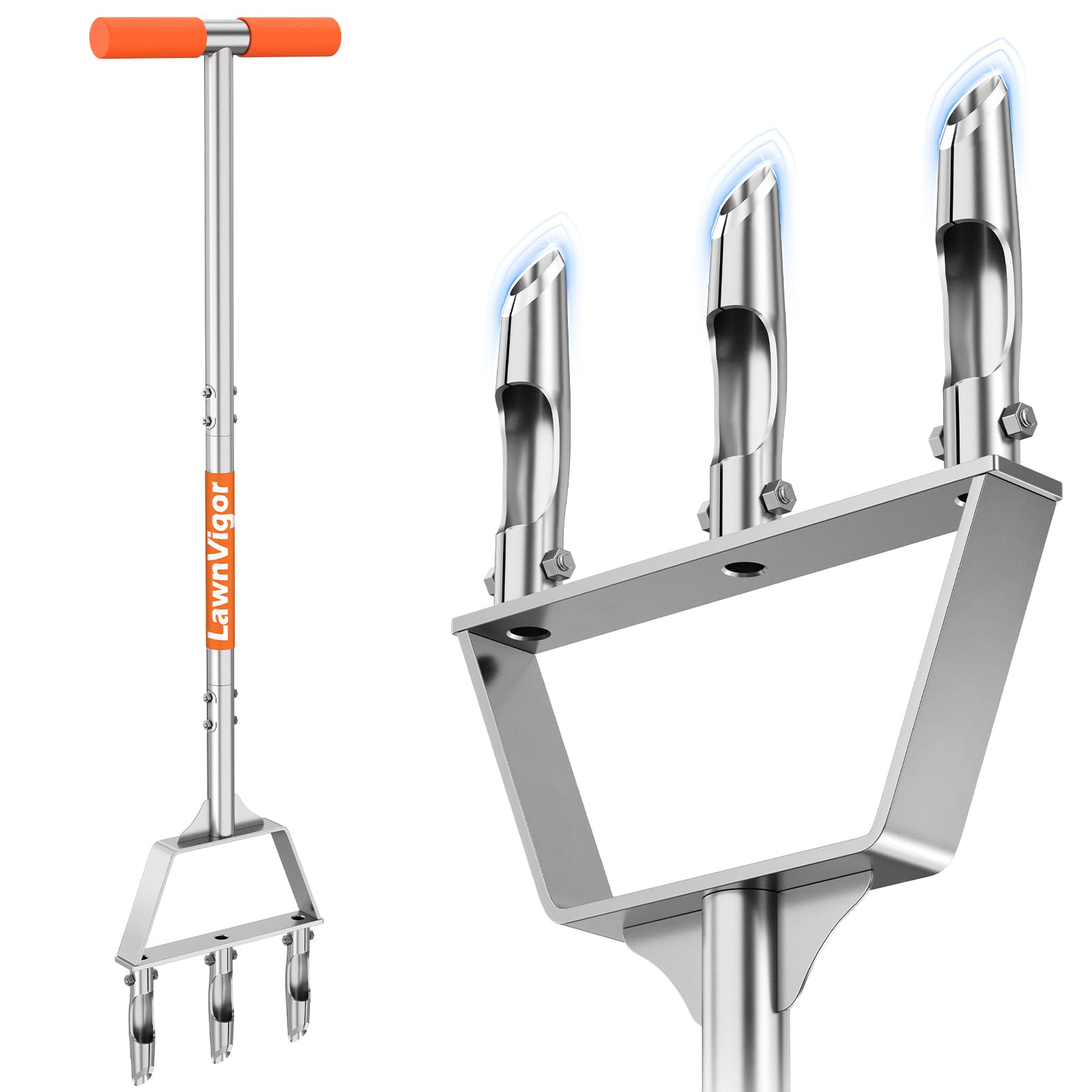
A no-frills 3-tine step aerator that wins on ease of use and durability.
This is the tool for the gardener who wants a dependable manual aerator without paying for clever ejection systems. The 3 heat-treated hollow tines pull clean, uniform 3-inch cores on moist soil, and the white plastic inserts inside the tines help release plugs reliably — buyers report the plugs come out every time you push down. The heavy-duty powder-coated steel and double-bolt construction earn consistent praise for durability.
At 3.52 pounds, it is light enough to swing all day, and the wide T-handle with foam grips means comfort on a long session. Assembly genuinely takes about 5 minutes with the included tools, which are higher quality than the category norm. Owners using it on a small urban backyard with no motor access found it “rips” through the job, and removing the center tine helps penetrate especially compacted spots. The height is designed to minimize back strain, a thoughtful ergonomic touch.
The known limitation is labor: on compacted clay, it will not fully penetrate unless the soil is moist, and the effort required even from a fit 6-foot owner involved kicking and jumping. It is also best for spot aeration on small areas — a full acre would be exhausting. Owners mention it struggles in compacted red clay and is best used straight on, not at angles. This is an honest, well-built entry-level tool for targeted lawn care, not a marathon machine.
What Wins People Over: Reliability — the plugs eject every time and the steel build feels like it will last years.
Choose it for: spot-aerating high-traffic patches or small beds where you want simple, dependable performance.
Pass on it if: you need to cover a large lawn — the manual labor will wear you out before the lawn is done.
Understanding the Specs
Tine Count and Depth
The number of hollow tines determines how many plugs you pull per step — 3 is standard, 4 covers more ground faster. Depth is the more important number on clay: tines rated around 3.94 inches can reach deeper roots, but only if your weight (or the machine’s) is enough to drive them in. Deeper holes mean air and water reach further down, which is the entire point of aeration.
Weight and Soil Penetration
Weight is the physics that makes or breaks a clay aerator. A heavier tool sinks in with less effort from you, which is why rolling units weigh 30-50 pounds and tow-behinds exceed 55. The smartest designs let you add weight — a tray on tow-behinds that holds up to 150 pounds, or a sand-fillable drum on rollers. If the tool is too light for your soil, it will bounce off the surface instead of pulling cores.
FAQ
Why do I need a core aerator instead of a spike aerator for clay?
How wet should the clay soil be before I aerate?
How deep should the tines penetrate for clay soil?
What makes an aerator non-clogging on sticky clay?
Is a manual step aerator or a rolling aerator better for my lawn?
Can I use a tow-behind aerator with my riding mower?
How much weight can I add to a tow-behind aerator for hard clay?
Why do my aerator tines keep clogging with dirt?
Final Thoughts: The Verdict
For most people, the aerator for clay soil winner is the Xuperace Core Aerator because its side-eject tines solve the clog problem that plagues every other manual tool on sticky clay. If you are covering a full acre on a riding mower, the Suchtale Tow Behind is the smart money, delivering 24 plugs of penetration without breaking your back. And for medium yards where a step tool would exhaust you, the Landzie Rolling hits the balance between effort and coverage.
How We Picked
We do not accept paid placement. Every pick is matched to a real buyer and a real use-case; we do not hands-on test units.
Sources & Methodology
Specifications: manufacturer listings and product documentation. Review insights: verified customer reviews, as of August 2026. Pricing: not shown on this page (it changes often); check the current price via the retailer link.
As an Amazon Associate, Gadgets Feed earns from qualifying purchases. This does not affect which products we feature.