
Our readers keep the lights on and my morning glass full of iced black tea. As an Amazon Associate, I earn from qualifying purchases.
Specs are compiled from manufacturer listings and verified buyer reviews and can change over time — please confirm the key details on the product page before buying.
A soft brake pedal that sinks toward the floor is dangerous, and the cure is simple: get the air out of the lines. The hard part is choosing the right brake bleeding tool, because the difference between a vacuum puller, a pressure bleeder, and a shop-grade hydraulic system changes how you work. That choice depends on your air compressor, your patience for learning adapters, and if you want a helper or a solo tool. In plain terms, the best brake bleeding tool for most DIYers is the one that turns a two-person, 30-minute job into a one-person, 10-minute routine.
I’m Min — the founder and writer behind Gadgets Feed. This guide is built by comparing the manufacturers’ published specifications and the patterns across verified customer reviews, so you get each pick’s real strengths and trade-offs instead of marketing spin.
You want a tool that won’t leak, builds vacuum or pressure reliably, and fits your car without fuss. brake bleeding tool choices span hydraulic pressure systems, pneumatic vacuum pumps, and manual hand pumps, each serving a different garage setup and vehicle collection.
Our Picks at a Glance


How To Choose The Best Brake Bleeding Tool
Start with the method. A vacuum bleeder sucks old fluid through the bleeder screw using air pressure from a compressor. A pressure bleeder pushes fresh fluid down from the master cylinder reservoir, which often clears stubborn air pockets faster. A manual hand pump needs no compressor but demands more effort from you.
Compressor or no compressor
Pneumatic kits (air-operated) are fast but useless without a shop compressor nearby. If you only work on your car in the driveway with no air tank, a manual pressure bleeder or a hand vacuum pump makes more sense. Check the inlet air pressure range before buying — some pneumatic kits need a solid 40-170 psi to run properly.
Adapters are the real compatibility test
Every master cylinder has a different cap shape. The more adapters included, the more likely one fits your car without a trip to the auto parts store. Count the adapters, but also read whether they are universal thread-on caps or vehicle-specific threaded caps — universal caps sometimes need a firm push to seal properly.
Quick Comparison
| Model | Best For | Method | Reservoir | Adapters | Amazon |
|---|---|---|---|---|---|
| Mityvac MV6840★ Best Overall | Pro shops & full systems | Hydraulic Pressure | 1.2 gal | 7 | Amazon |
| 3L YEYETUO KitBest Value | Budget air-tool owners | Pneumatic Vacuum | 2L + 1L | 16 | Amazon |
| YSTOOL Hand PumpMulti-Purpose | Multi-fluid testing | Manual Vacuum/Pressure | 2x 4.5 oz | 12 | Amazon |
| FOUR UNCLES 2L | Motorcycle & car DIY | Pneumatic Vacuum | 2L + 1L | 16 | Amazon |
| OMT 2.5L | European car owners | Manual Pressure | 2L | 1 (42mm) | Amazon |
| EWK 22-Piece | Solo DIY with compressor | Pneumatic Vacuum | 2L | 17 | Amazon |
| SMOTIVEPRO 2L | Manual pressure fans | Manual Pressure | 2L + 1L | 4 | Amazon |
| Mityvac MV6830 | Fast shop flushes | Pneumatic Vacuum | 1.9 qt | Hoses & tips | Amazon |
In‑Depth Reviews
1. Mityvac MV6840 Hydraulic Brake and Clutch Pressure Bleeding System
Our pick — over 4.5★ from 600+ verified ratings; the strongest balance of quality and price.
The hydraulic pressure system that turns brake bleeding into a true one-person job, even on BMWs and Mercedes.
This is the pick for anyone bleeding brakes professionally or maintaining several vehicles, because it uses hydraulic pressure to push fluid through the system instead of relying on a compressor. The 1.2-gallon (4.5L) reservoir holds enough fresh fluid to service an entire brake and clutch system in one fill, so you rarely stop to top up mid-job. Seven master cylinder adapters are included, covering cars, SUVs, motorcycles, ATVs, and commercial trucks, which is the kind of coverage a mobile mechanic needs.
Owners who bleed whole systems report a full four-wheel bleed takes about 10-15 minutes, and One long-term user notes it “works well at 15 psi for 4 years.” That reliability is the reason the functionality is what wins people over, with the value-for-money praise running close behind. There are honest caveats though — the steel adapters can corrode if you neglect them, and after years of service, fluid can leak into the gauge and quick-disconnect, which the manual says isn’t serviceable. Cleaning the hoses after each use keeps the vinyl lines from stiffening.
At 11.4 pounds, this is a hefty unit you carry around in its heavy-duty storage case, not a tool that lives loose in a drawer. It’s noticeably heavier than the YSTOOL hand pump’s 3.72 pounds, which tells you the difference between a mobile workshop tool and a compact tester. Buyers report it handles spongy pedals and worn brakes reliably across vehicle types, and the built-in readable pressure gauge means you watch the number, not guess. If you want a system that flushes a full brake circuit in under 20 minutes and lasts years, this is the one.
Why It’s The Top Pick
- Large 1.2-gallon reservoir does a full system in one fill
- Seven adapters cover cars, trucks, motorcycles, and ATVs
- Pressure gauge built in for accurate monitoring
- Heavy-duty storage case for transport and organization
Honest Limitations
- Steel adapters corrode if you don’t clean them
- Fluid can leak into the gauge and quick-disconnect after years
- Heavy at 11.4 pounds compared to compact pumps
Reach for this if: you bleed brakes regularly and want a durable pressure system with a full set of adapters and a real reservoir.
Look elsewhere if: you only bleed brakes once a year and don’t want to clean hoses and adapters to prevent corrosion.
2. 3L Brake Bleeder Kit, One Person Vacuum Brake Fluid Bleeder Kit
An air-powered vacuum bleeder that delivers professional results at a budget-friendly price, complete with 16 adapters.
If you already own an air compressor, this kit gives you speed without the premium price tag. The pneumatic vacuum pump runs on inlet air pressure of 2.8-12 bar (40-170 psi), and its built-in silencer keeps the workshop quieter than typical air tools. For one-person operation, it’s tough to top — you connect the hose, open the bleeder screw, and let the vacuum pull old fluid continuously while you monitor the reservoir.
The kit ships with a 59-inch silicone bleed hose with a universal rubber adapter, plus a 45-inch master cylinder evacuation hose, and 16 bleed screw adapters to fit most models. What wins owners over is the functionality — it performs just as effectively as pricier alternatives and makes a formerly two-person job feel easy. Owners mention it handled a completely dry brake system and survived four hours of continuous use and a few drops, which speaks to its build quality.
The honest trade-off is the value-for-money feedback, which is mixed: some owners feel it’s a great deal, while a few wish they’d spent more. The container threads are also stiff, so it takes a firm twist to seal the bottle. If you’re replacing old calipers like the owner of a Toyota FJ cruiser who no longer dreads brake work, this kit makes the job simple. It’s the budget-friendly entry point into pneumatic bleeding that doesn’t feel like a compromise.
Solid pick: An air-powered bleeder with 16 adapters and a 2L fluid reservoir that handles a full flush in one session, at a price that undercuts most competitors.
3. YSTOOL Hand Held Vacuum & Pressure Pump Brake Clutch Fluid Bleeder Tool Kit
The featherweight hand pump that doubles as a vacuum tester for carbs, fuel systems, and power steering.
This compact pump is the one to grab when you want a tool that does more than bleed brakes, because it also clears oil, power steering fluid, tests vacuum systems, carburetors, and fuel petcocks. The aluminum alloy body is anodized for corrosion resistance, and at 3.72 pounds it’s a fraction of the weight of the 11.4-pound Mityvac MV6840. The 0-30 in Hg vacuum gauge reads your data accurately, and the kit packs a hand pump, five clear hoses, two 4.5oz reservoirs, and 12 adapters into a portable plastic case.
What owners genuinely appreciate here is the value for money and the variety of accessories — the kit comes with the most-needed attachments for pressure testing two-stroke engines and carburetors. The pump works great as a vacuum and pressure tester, and the aluminum cylinder feels well-made even though the handle levers are plastic. Customers note it’s a necessary tool for keeping 2-stroke engines running, checking carburetor passages and jets with ease.
Here’s the fit note, though: functionality gets mixed feedback in the review data, and the highest-count aspect is mixed, not glowing. Some owners found it works well for bleeding brakes, but a few report it didn’t get the job done for that specific purpose, and the instruction manual is widely described as terrible. If brake bleeding is your only goal, a dedicated bleeder is a safer bet; if you want a multi-fluid tester that also handles brake fluid, this is a versatile, lightweight option.
Versatile but specific: Best treated as a general vacuum/pressure testing pump with brake-bleeding capability, not a dedicated brake specialist — the mixed feedback on bleeding confirms that.
4. FOUR UNCLES 2L Vacuum Brake Bleeder Pump Kit with 16 PCS Adapter
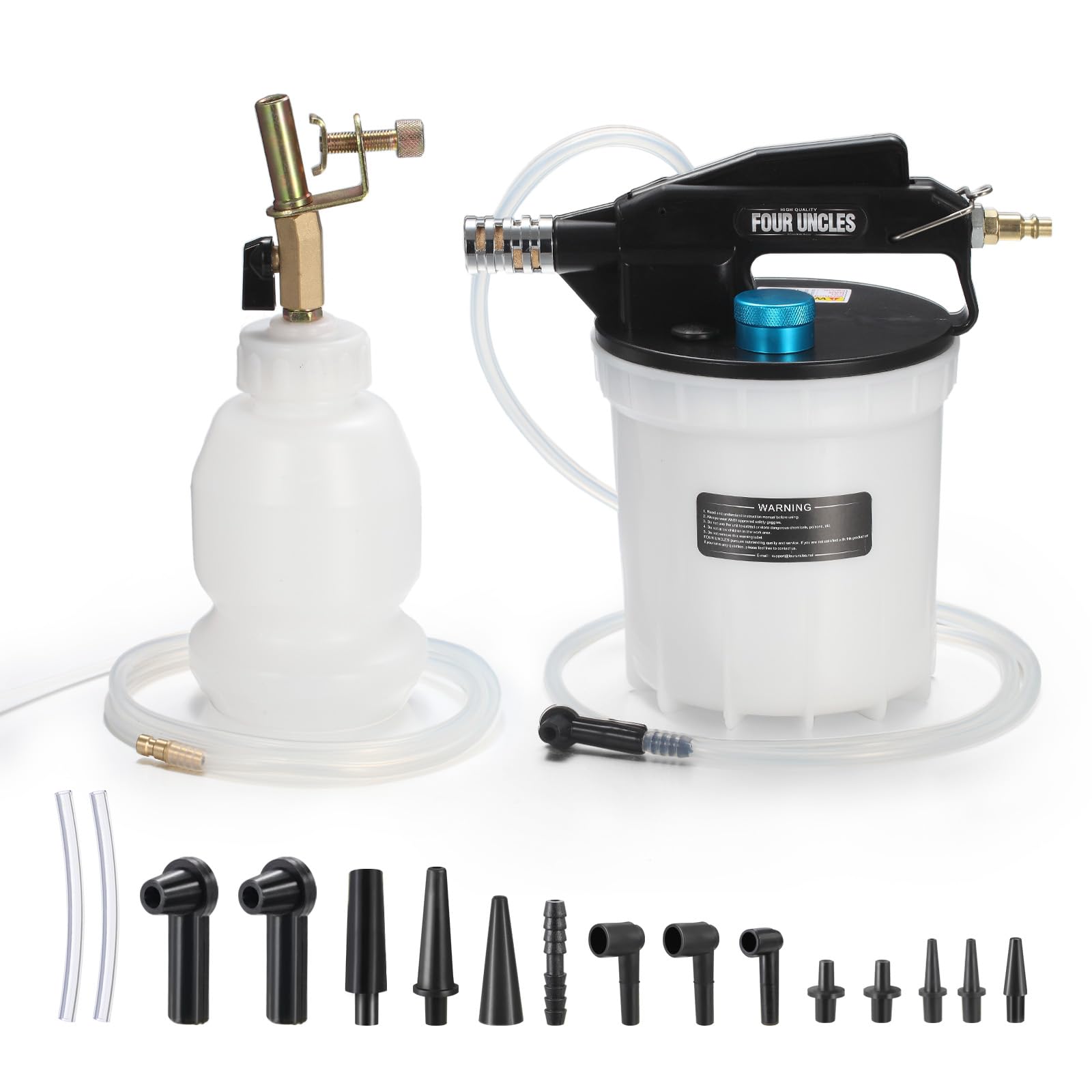
The pneumatic bleeder motorcycle owners rave about, with 16 adapters and a 2L tank that handle a full flush.
This kit earns its place for anyone bleeding brakes on motorcycles, cars, trucks, UTVs, or ATVs, because its 16 adapters cover more fitting sizes than most competitors. The 2L brake fluid tank plus a 1L refill bottle means you can extract and replace fluid without constant interruptions, and the two 60-inch silicone hoses reach awkward bleeding points that would otherwise require a second person. The integrated silencer keeps the noise down while the pneumatic vacuum system does the heavy lifting.
What wins people over is the functionality — a strong vacuum pull that flushes four corners in under 30 minutes per vehicle, with consistent suction and no sputtering. Owners describe it as a must-have tool that delivers immediate firm pedal feel, and the quality is praised for holding up under daily use in a professional shop environment. The adjustable thumb throttle gives you precise control so you don’t overshoot and suck air back in.
The connectivity aspect is the honest weakness — a quick-connect coupling on one unit failed to lock after months of storage, though the seller’s customer service quickly offered a refund or replacement. Beyond that, the fluid flow and air pressure get mixed marks from a handful of owners, so check your compressor’s output before relying on it. For a true one-person brake flush with professional results at a DIY price, this kit is tough to top.
What Wins People Over
- 16 adapters fit cars, trucks, motorcycles, UTVs, and ATVs
- 2L tank + 1L refill bottle for uninterrupted flushing
- Strong, consistent vacuum with no sputtering
- 60-inch hoses reach difficult bleeding points solo
Watch Out For
- Quick-connect coupling can fail after long storage
- Fluid flow and air pressure get mixed reviews
- Needs a solid air compressor to perform at its best
Choose this for: motorcycle and multi-vehicle DIYers who want a fast pneumatic flush with excellent adapter coverage.
skip it if: you have no air compressor and need a manual tool that works anywhere.
5. OMT 2.5L One-Person Pressure Brake Bleeder Kit Extractor with 42mm Adapter
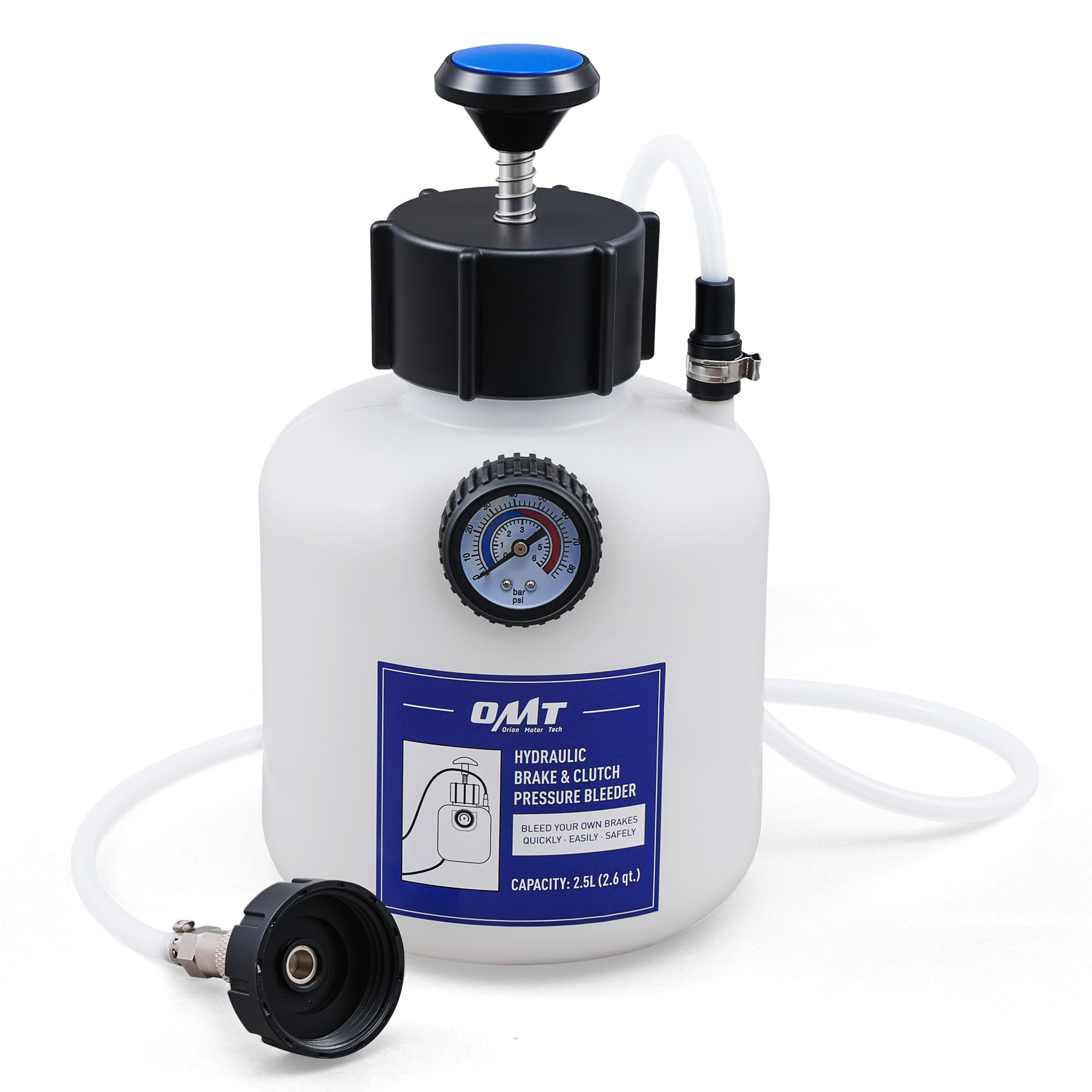
A pressure bleeder built for European cars, solving clutch bleeds that gravity and vacuum methods can’t crack.
If you drive a BMW, Audi, Mercedes, Porsche, Volkswagen, or Volvo, this is the kit designed around your master cylinder. The included 42mm adapter fits most European models, and the kit’s reach extends to Alfa Romeo, Ferrari, and Ford Europe. The tank holds over 2 quarts of fluid, so one fill covers an entire brake system, and the built-in gauge lets you monitor pressure as you pump the ergonomic handle. It’s a manual pressure bleeder, meaning no compressor required.
What wins owners over is the recommendation and ease of use — One owner solved an impossible clutch bleed on a Subaru Crosstrek in five minutes after gravity, pedal, and vacuum methods all failed. The cap fits Subaru and Nissan reservoirs, and a 1975 Chevy K5 Blazer owner found it held pressure perfectly on a disc/drum setup. A full four-wheel bleed on a 1991 Ford Explorer took about 20 minutes once the nuances were understood.
The recurring gripes are sealing and pressure retention, which get mixed feedback — some reviewers point out the cap leaks unless you push it down after cranking, and one found the master cylinder cap blew off after it wouldn’t build pressure. The universal adapter is tricky and can leak until clamped down hard. Pressure retention is the most-discussed aspect here, so treat the seal as the thing to get right. For European car owners who want a compressor-free pressure bleed, this is a strong, lightweight choice at 1.98 pounds.
Euro-focused pick: A lightweight pressure bleeder that shines on BMW, Audi, Mercedes, and Subaru reservoirs, but demands careful sealing to avoid pressure loss.
6. EWK 22-Piece Pneumatic Brake Fluid Bleeder Kit, 2L Vacuum Pump with 17 Adapters

The 22-piece pneumatic kit that bleeds a stubborn Honda Civic ABS where the two-person method failed.
This kit is the answer when you’ve tried the two-person pedal-pumping method and still have air trapped in the lines. Its pneumatic vacuum system pulls up to 0.5L per minute, and the check valve prevents fluid backflow and dripping, keeping your workspace clean. The 17 adapters make it compatible with nearly every brake system out there — cars, motorcycles, trucks, and ATVs — and the 2L reservoir handles a full flush. You’ll need an air compressor to run it, but the maker’s own design goal is freeing your hands and your schedule.
What wins owners over is the build quality and bleed performance — A professional mechanic of 36 years finally found a tool that got pressure back into a system he’d struggled with for hours. Another owner bled a Honda Civic ABS after replacing a caliper, using 50 psi and opening the bleeder screws 3/4 of a turn, which is the only method that worked after 30 failed attempts with the two-person approach. The suction is genuinely strong, and the kit comes with extras like a one-way valve for manual bleeding.
The ease of use gets mixed feedback — some find it intuitive, while others note it requires practice and research to use properly, and the compressed-air fitting arrives way over-tightened on some units. The air intake and fit are the most common complaints, so double-check your bleeder screw sizes against the adapters. If you have a compressor and want a kit that handles ABS systems and stubborn air pockets that manual methods can’t clear, this is a smart investment.
Why Owners Love It
- 17 adapters fit nearly every brake system
- Pulls up to 0.5L per minute for fast flushes
- Check valve prevents fluid backflow and dripping
- Clears ABS air pockets other methods can’t
Consider Before Buying
- Requires an air compressor to operate
- Air intake and fit are the most common complaints
- Needs practice to use properly, per owner feedback
Best for: solo DIYers with a compressor who need a reliable vacuum bleeder for ABS-equipped cars.
Think twice if: you’re avoiding air tools and want a manual, compressor-free solution.
7. SMOTIVEPRO 2L Manual Brake Bleeder Kit with 4 Master Cylinder Adapters
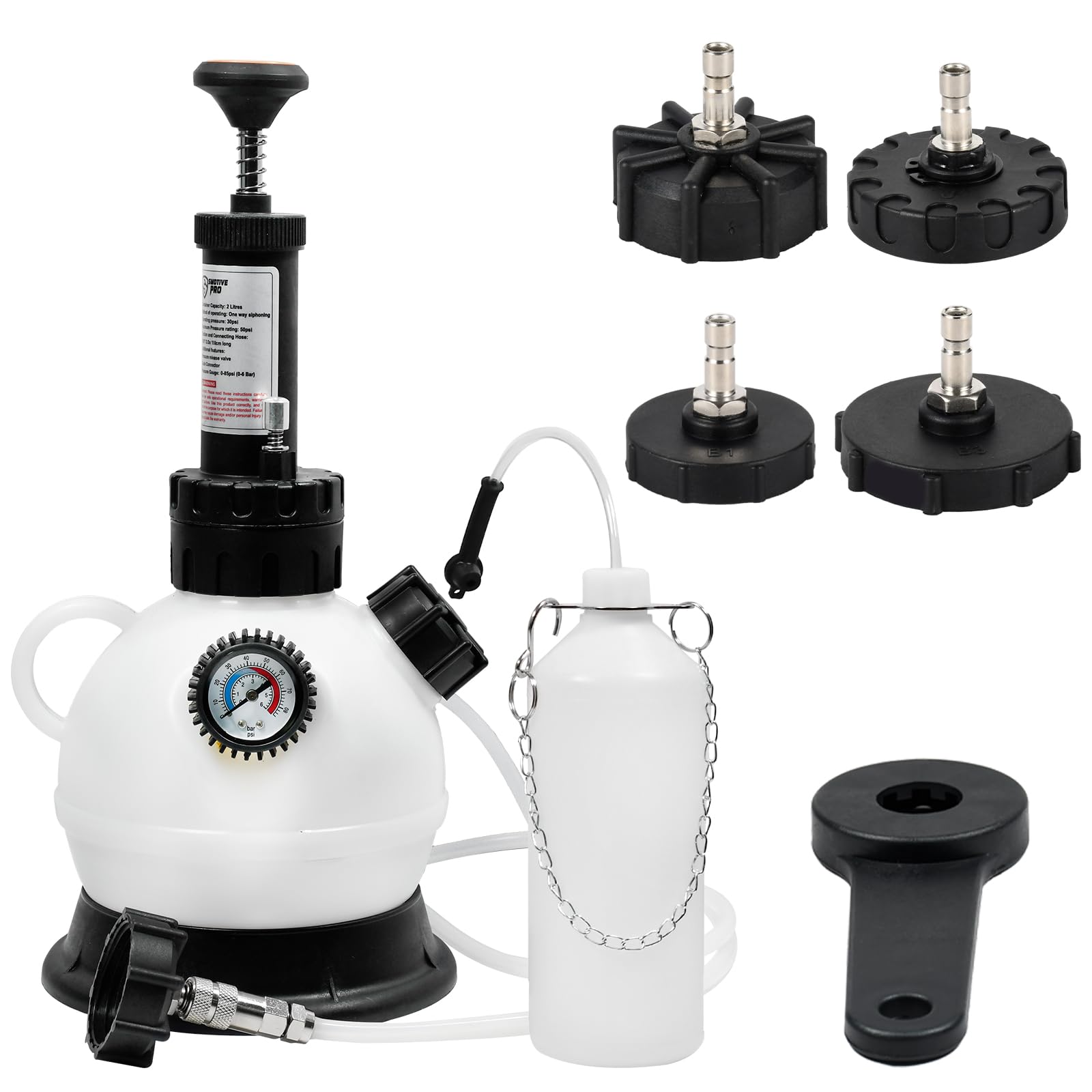
A manual pressure bleeder with four vehicle-specific caps that bled a Porsche Boxster and BMW Z4 flawlessly.
For owners who want pressure-bleeding results without needing a compressor, this kit delivers with a hand pump and four master cylinder adapters. The E20 (45mm) cap fits BMW, Mercedes, Audi, and VW; the J (50.7mm) covers Ford, Dodge, Nissan, Honda, Subaru, and Hyundai; the B1 (43.5mm) works on Chrysler, Dodge, and Jeep; and the B3 (49.5mm) handles GM, Chevy, and GMC. A 2L pressure refill tank plus a 1L waste collection bottle keeps the work organized, and the built-in pressure gauge with a safety relief valve prevents over-pressurization.
What wins owners over is the functionality and quality — It worked flawlessly on a Porsche Boxster and BMW Z4, held pressure well, and made clutch bleeding on an MGB a sub-10-minute job. Owners note it’s a better deal than the ARES 70921, coming with a recovery bottle at a lower price. The simplicity of filling the reservoir, attaching the adapter, and pressurizing with the hand pump makes it beginner-friendly, and it cleans air pockets and fluid color change effectively on a 2001 Chevy Suburban.
The fit is the honest catch — the quick-connect adapters aren’t universal, and while the four vehicle-specific caps cover a lot of ground, some owners needed a custom cap adapter for their reservoir. Some universal caps failed to seal completely, and the kit includes only one cap per size, so it’s not a universal solution. Fit and compatibility get mixed feedback, with some owners reporting their fluid reservoir fits perfectly and others finding it doesn’t work with their vehicles. For a manual pressure bleeder that covers the most common car brands, this is a strong, well-built pick.
Strong Points
- Four vehicle-specific adapters cover BMW, Ford, Chrysler, and GM families
- 2L refill tank minimizes interruptions mid-job
- Safety relief valve prevents over-pressurization
- No compressor needed — pure hand pump operation
Fit Notes
- Quick-connect adapters aren’t universal across all kits
- Some universal caps failed to seal completely
- Only one cap per size included
Grab this if: you want compressor-free pressure bleeding and your vehicle falls into the four major adapter families listed.
Pass it up if: you drive something outside those adapter sizes and don’t want to hunt for a custom cap.
8. Mityvac MV6830 Pneumatic Brake and Clutch Bleeding Kit

The pneumatic speedster that bleeds two quarts a minute and pulled a dry fire truck system to a hard pedal.
If speed matters more than anything, this Mityvac air-operated kit handles 2 quarts per minute with a 1.9-quart (1.8L) reservoir, making it ideal for shops that flush multiple vehicles. The 360-degree swivel air inlet gives you flexibility in tight spaces, and the automatic shutoff valve prevents overfilling so you can run continuously while extracting fluid. The variable control thumb throttle gives precise pressure adjustments, and at 2.1 pounds it’s light enough to maneuver around calipers without fatigue.
What wins owners over is the quality and functionality — the crowd of regulars here runs deep, with reviewers describing it as a professional-grade product that makes the job quicker and easier, taking about 15 minutes for a full system. One owner bled a Mini Cooper clutch solo in five minutes with no bubbles, and another pulled a completely dry fire truck system to a hard pedal without needing master cylinder adaptors. The kit’s ability to also drain gas tanks safely — because it has no electric pump to spark — is a bonus for track-day enthusiasts.
The airflow and fluid flow get mixed marks from a handful of owners, and a minor air leak at a connection is the most common quibble. It requires a compressor, though it works with a small one at 0.75 cfm and lower pressure, per owner experience. This is the pick for autocross and track-day drivers who flush fluid frequently and want a fast, clean, one-person tool that encourages more frequent changes. If you bleed brakes often and value speed, this is the one.
Why It’s Fast
- Bleeds 2 quarts per minute for rapid flushes
- Automatic shutoff prevents overfilling
- 360-degree swivel air inlet for tight spaces
- Light at 2.1 pounds, easy to maneuver
Minor Quirks
- Requires an air compressor
- Occasional minor air leak at connection
- Airflow and fluid flow get mixed feedback
The standout spec: 2 quarts per minute of pure suction speed — the fastest way to flush a brake system solo.
The single caveat: it’s useless without a compressor, so driveway-only mechanics should look at manual options.
Understanding the Specs
Pneumatic vs. Manual vs. Hydraulic
Pneumatic bleeders run on compressed air and pull vacuum fast, but they’re tied to your air compressor. Manual pressure bleeders use a hand pump to push fluid down from the reservoir, needing no compressor but more pumping effort. Hydraulic systems like the Mityvac MV6840 use fluid pressure to push brake fluid through, offering the highest capacity but the most weight and cost.
Reservoir Size and Adapter Count
Reservoir capacity tells you how much fresh fluid you can push before refilling — a 1.2-gallon (4.5L) tank covers a full system in one go, while smaller 1.9-quart or 2L tanks may need a top-up on larger vehicles. Adapter count matters less than whether one fits your specific master cylinder cap shape, so check the listed vehicle brands before buying. A 16-adapter kit only helps if your car’s cap is among the sizes covered.
FAQ
Will a vacuum bleeder work without an air compressor?
What is the difference between a vacuum bleeder and a pressure bleeder?
How many adapters do I actually need to bleed my car’s brakes?
Can I bleed a clutch with these brake bleeding tools?
Will a universal adapter seal properly on my European car?
How long does it take to bleed all four brakes with one of these tools?
Is a heavier brake bleeding tool always more durable?
Can these tools bleed ABS-equipped brake systems?
Final Thoughts: The Verdict
The crowd favorite — 4.6 stars across 600+ owners — is the brake bleeding tool winner, the Mityvac MV6840, because its 1.2-gallon reservoir and seven adapters turn a full-system bleed into a 15-minute solo job. If you want a pneumatic speed demon that bleeds 2 quarts a minute, grab the Mityvac MV6830 for your air-compressor setup. And for European car owners who want compressor-free pressure bleeding, the OMT 2.5L with its 42mm adapter is the one to reach for.
How We Picked
We do not accept paid placement. Every pick is matched to a real buyer and a real use-case; we do not hands-on test units.
Sources & Methodology
Specifications: manufacturer listings and product documentation. Review insights: verified customer reviews, as of August 2026. Pricing: not shown on this page (it changes often); check the current price via the retailer link.
As an Amazon Associate, Gadgets Feed earns from qualifying purchases. This does not affect which products we feature.