
Our readers keep the lights on and my morning glass full of iced black tea. As an Amazon Associate, I earn from qualifying purchases.
Specs are compiled from manufacturer listings and verified buyer reviews and can change over time — please confirm the key details on the product page before buying.
Mounting your phone to the handlebars drains its battery, struggles in direct sunlight, and stops working when a call comes in. A dedicated bike computer solves all three at once, and the ANT+ wireless standard is the secret that lets it talk to your heart rate monitor, power meter, and speed sensors without the phone in the loop. This guide cuts through the marketing to find the right unit for your riding style, whether you chase Strava segments, follow GPS routes into the backcountry, or just want clean data on the daily commute.
I’m Min — the founder and writer behind Gadgets Feed. This guide is built by comparing the manufacturers’ published specifications and the patterns across verified customer reviews, so you get each pick’s real strengths and trade-offs instead of marketing spin.
You want an ant+ bike computer that lasts through long rides, stays readable in sunlight, and syncs easily with the sensors and apps you already use. Battery life, screen clarity, and pairing ease decide which one is worth your money.
Our Picks at a Glance


How To Choose The Best ANT+ Bike Computer
The best bike computer for you hinges on where you ride and what data you can’t live without. A roadie doing 100-mile centuries has different needs than a mountain biker navigating tight singletrack, and both differ from a commuter who just wants speed and distance.
Battery Life vs. Screen Size
These two specs are locked in a constant trade-off. A bigger, brighter color screen with GPS navigation draws more power, which is why the premium units with 2.2-inch color displays top out around 17 hours. The value-focused units with simpler monochrome LCD screens can stretch a single charge across a full week of daily riding. Think about your longest ride, not your average one, when you compare these numbers.
Buttons vs. Touchscreen
Riding in the rain or with thick winter gloves makes a touchscreen frustrating. Physical buttons give you a reliable, tactile click you can operate without looking. Many modern units offer a hybrid — a touchscreen for setup and map panning, plus hardware buttons for the most common actions like start, stop, and lap. If you ride in variable weather, lean toward buttons.
ANT+ and Bluetooth: Why You Need Both
ANT+ is the wireless protocol that lets your computer talk to power meters, heart rate straps, speed sensors, and even electronic shifting systems. Bluetooth is what connects the computer to your phone for uploading rides to Strava or receiving call notifications. A unit that supports both gives you the widest compatibility with gear you already own and the apps you already use.
Quick Comparison
| Model | Best For | Battery Life | Display Size | Weight | Amazon |
|---|---|---|---|---|---|
| Wahoo ELEMNT ROAM★ Best Overall | Serious navigation & mapping | 17 hours | 2.2 inches | 3.2 ounces | Amazon |
| CYCPLUS M1Best Value | Max battery life on a budget | 60 hours | 2.9 inches | 2.73 ounces | Amazon |
| Magene C506SETraining Partner | Indoor trainer integration | 24 hours | 2.4 inches | 2.61 ounces | Amazon |
| Magene C506 | Touchscreen with smart nav | 24 hours | 2.4 inches | 2.68 ounces | Amazon |
| iGPSPORT BSC300T | Offline maps & eBike support | 20 hours | 2.4 inches | 67 g | Amazon |
| SIGMA ROX 11.1 EVO | Lightweight & waterproof | — | — | 55 g | Amazon |
| Garmin Edge Explore 2 | Easy-to-use navigation | 16 hours | 3 inches | — | Amazon |
| Garmin Edge 540 | Performance training & coaching | 26 hours | — | 2.8 ounces | Amazon |
| SRAM Hammerhead Karoo | Smartphone-like color screen | 15 hours | 3.2 inches | 0.41 kg | Amazon |
In‑Depth Reviews
1. Wahoo ELEMNT ROAM GPS Cycling/Bike Computer
Our pick — 4.5★ from 400+ verified ratings; the strongest balance of quality and price.
The Wahoo ELEMNT ROAM delivers a full-color map with pinpoint accuracy for serious navigators.
The Wahoo ELEMNT ROAM is built for riders who tackle serious routes and need reliable navigation. The Dual-Band GPS locks onto more satellite systems — GPS, GLONASS, BEIDOU, Galileo, QZSS, SBAS, and NavIC — which keeps your position accurate even under thick forest cover or in dense urban canyons where signals bounce around. That translates to fewer wrong turns and a track log that matches the road you actually rode.
The 2.2-inch screen packs 64 colors, and the ambient light sensor auto-adjusts brightness, so the map stays readable in blazing sun without blinding you on a dark morning ride. A 17-hour battery life covers a full day of exploring, though it falls short of the CYCPLUS M1’s 60-hour endurance. At 3.2 ounces, it’s noticeably heavier than the M1’s 2.73 ounces, but the trade-off buys you a glass lens, a built-in altimeter, accelerometer, gyroscope, and compass.
Navigation is the star here. It auto-generates turn-by-turn prompts for GPX and TCX files, and routes imported from Strava, Ride With GPS, and Komoot just work. Summit Segments preview the difficulty of climbs ahead on the color display, and Strava Live Segments alert you in real time as you race for a PR. Buyers report the maps downloaded from Ride with GPS “perform really well” on the larger screen, and the customizable Quicklook LED indicators give you glanceable notifications without reading text.
Where It Shines
- Multi-band GPS keeps you accurate in tough signal environments
- Color display with ambient light sensor stays readable in direct sun
- Automatic route downloads from Strava, Komoot, and Ride with GPS
Trade-Offs to Know
- 17-hour battery trails the 60-hour budget champs
- One buyer found some USB-C chargers don’t work; stick with the included cable
Reach for this if: you ride new routes often and want a reliable color map with turn-by-turn prompts that just works.
Look elsewhere if: you only ride familiar loops and want a device you charge once a month instead of every few rides.
2. CYCPLUS GPS Wireless Bike Computer M1
The CYCPLUS M1’s 60-hour battery and 2.9-inch screen make it the endurance champion.
If you hate charging gadgets, this is your computer. The 1200mAh battery delivers a claimed 60 hours of run time — a 3.5x gap over the Wahoo ROAM’s 17 hours. Owners mention the battery “lasts 8+ weeks (1 hr/day)” of riding, which means you can basically forget the charging cable lives. It also out-screens the Wahoo, with a 2.9-inch glare-free backlit display using FSTN technology that stays visible in direct sunlight and auto-lights based on sunrise and sunset times.
The ANT+ support here is genuine and broad. The kit bundles a speed and cadence sensor, and you can toggle between the two modes. It records speed, cadence, heart rate, power, route, and altitude simultaneously, and you can sync to Strava through the CYCPLUSFit app. The included handlebar mount installs in about 60 seconds with a screwdriver in the box, and the compact mount itself weighs only 29g, so your bars don’t feel cluttered.
The catch is honesty about what this isn’t. There’s no route mapping, and the trip odometer resets when you power off, which some owners found annoying. The bottom buttons require a firm press to start and stop recording. At 2.73 ounces, it’s a touch lighter than the Wahoo’s 3.2 ounces, and riders who upgraded from far pricier units say it holds a charge “way better than my wahoo which was 10 times more.”
Durability that ages well: One owner reports it still works after 2 years of use, which is remarkable at this price point.
The honest catch: No turn-by-turn mapping, so it’s a data logger, not a navigator.
The best pick if: you want a huge readable screen and a battery that outlasts every other unit on this list.
Who should skip it: riders who need full GPS route navigation will find the lack of maps limiting.
3. Magene C506SE Wireless GPS Bike Computer
The Magene C506SE is a featherweight color-screen computer that also serves as an indoor training companion.
The C506SE earns its place with a 2.4-inch color screen that weighs just 74g, making it one of the lightest units here for one-handed use. It connects via ANT+ and Bluetooth to 9 different device types — speed sensors, cadence sensors, heart rate monitors, power meters, smart trainers, radar tail lights, smart tail lights, and electronic shifting systems. That broad compatibility makes it a natural hub for a bike already loaded with sensors.
What sets this apart is the indoor cycling angle. It connects to a smart trainer so you can customize power target, resistance level, and gradient — turning your living room into a structured training session without needing a separate head unit. Outside, the high-precision Airoha chipset claims positioning in about 5 seconds thanks to AGNSS support, and the Offline AGNSS stays valid for roughly 14 days.
Navigation is present but app-dependent. Colorful turn tips, off-course alerts, and route re-planning all flow through the OnelapFit app, and you can upload GPX files or create custom routes there. The WiFi sync is a highlight, claiming 28 times faster data transfer than Bluetooth, which gets your ride files off the device and onto Strava quickly. One buyer who upgraded from an older Magene unit found it accurate, easy to use, and praised the excellent battery life, though they noted the small screen limits how much data you can see per view.
Feature-dense for the price: Color screen, smart trainer support, and 9-device compatibility in a 74g package.
A fair warning: The GPS can get confused on laps or when you double back on the same road, so give it a moment to recalibrate.
For riders who: split their time between outdoor miles and indoor smart trainer workouts.
Keep shopping if: you want a larger screen that shows more data fields per page.
4. Magene C506 GPS Bike Computer
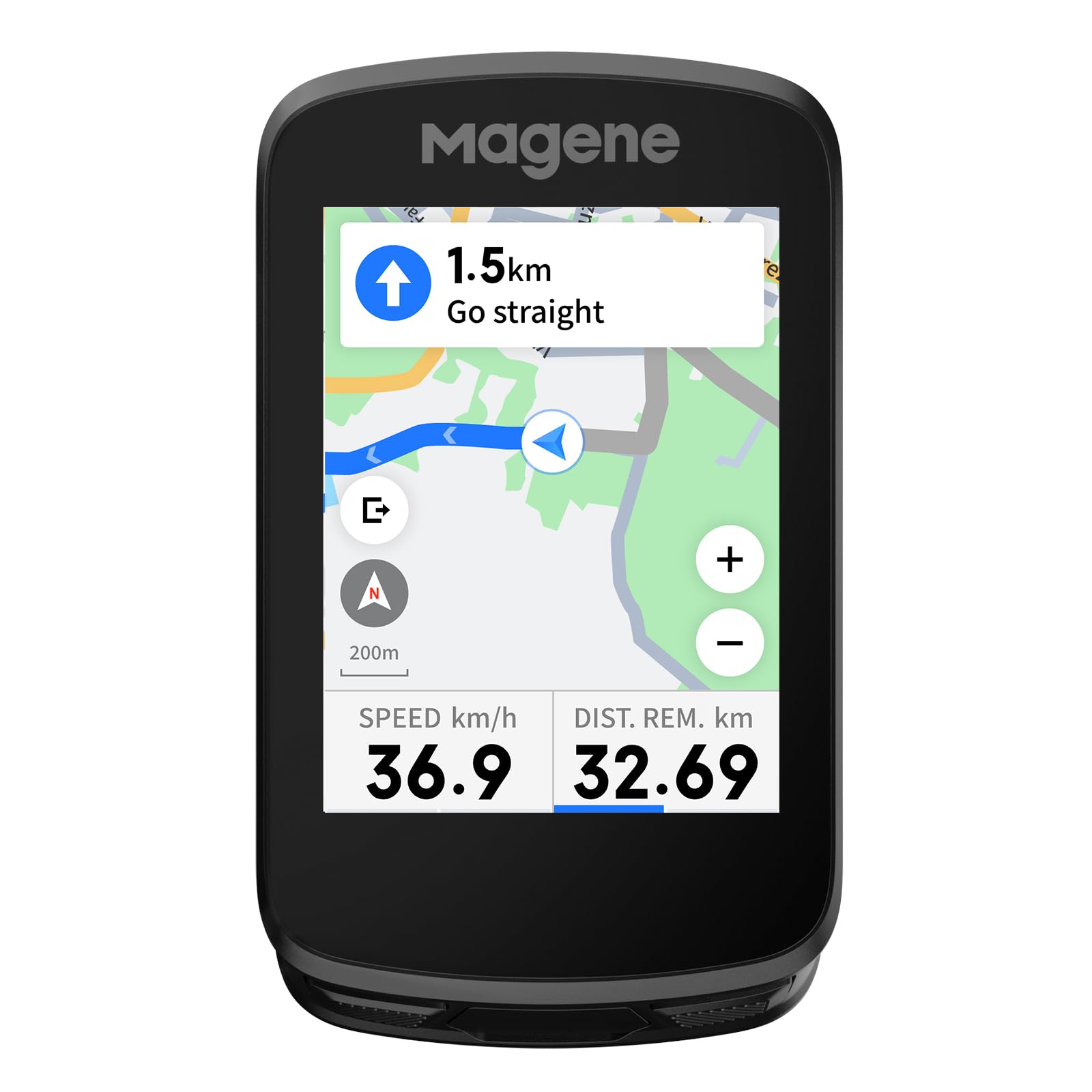
The Magene C506 adds a touchscreen, smart light control, and a slicker interface to the lineup.
This is the upgraded cousin of the C506SE, adding a 2.4-inch touchscreen alongside 3 buttons for a hybrid control scheme. The Airoha chipset still delivers that fast 5-second positioning claim, and WiFi uploads run 28 times faster than Bluetooth.
The standout feature is the Smart Riding Assistant. Without touching your phone, you can control Magene L508 and L308 tail lights, with smart interactions like auto front light activation at 10km/h. That’s a genuinely useful safety feature that most competitors don’t offer. It also supports 9 device types over ANT+ and Bluetooth, including SRAM eTap and Shimano Di2 electronic shifting.
The screen brightness is handled by an ambient light sensor, and the battery lasts up to 24 hours in endurance mode. Riders praise it as a “fantastic device for price,” noting it auto-syncs to Strava and Google Health over WiFi. The recurring nitpick is that map downloads require a convoluted process through WiFi settings, and the touchscreen sometimes needs multiple presses. One owner summed it up: “simple setup and use, great navigation with turn-by-turn and street names, bold fonts readable in sunlight.”
Smart ecosystem: Tail light control and trainer integration make this a true cycling hub.
The friction point: The map download process is clunky, so set it up at home before your first ride.
Pick this up if: you want touchscreen control and smart tail light integration without paying premium prices.
skip it if: you prefer physical buttons for gloved hands and want a simpler setup process.
5. iGPSPORT BSC300T Wireless Bike Computer

The iGPSPORT BSC300T offers offline maps and eBike battery display, making it a versatile all-rounder.
The BSC300T covers more bike types than most. It supports road bikes and mountain bikes, but also handles eBikes, displaying power level and other e-specific data. The 2.4-inch touchscreen works alongside 6 physical buttons, giving you redundant ways to control it — useful when gloves make the touch layer unresponsive. Global offline map downloads mean you can ride anywhere in the world without burning phone data.
Positioning uses 5 satellite systems — GPS, Beidou, GLONASS, GALILEO, and QZSS — which makes lock-on faster and tracks more accurate. The Off Course Warning buzzes you the moment you veer off your planned route, and it keeps notifying until you’re back on track. With over 130 riding data fields, from speed and grade to temperature and calories, there’s plenty to customize.
A 20-hour battery covers multi-day adventures, and real-time tracking lets your group see each other’s location to avoid wrong turns on group rides. Riders coming from a Garmin Edge 820 call it a “great value, checks all the boxes,” noting 8 hours of riding leaves about 20% battery — a 10x improvement over their old Garmin. The honest criticism is that the button and touchscreen combo takes getting used to, and the LCD needs backlight in low light, which shortens that battery.
Why Riders Pick It
- Offline global maps mean no phone dependency
- eBike support with power level display
- Real-time group tracking for club rides
Where It Tests You
- Touchscreen can be sluggish and tricky with gloves
- GPS can briefly drop out under dense tree cover
Best suited for: eBike riders and group riders who want offline mapping without a premium price tag.
Think twice if: you ride mostly under heavy forest canopy and need multi-band GPS accuracy.
6. SIGMA Sport ROX 11.1 EVO GPS Bike Computer

A featherweight 55g unit built to shrug off rain with IP67 waterproofing.
The ROX 11.1 EVO is for riders who prioritize minimal weight and maximum weather protection. At just 55g, it’s the lightest unit on this list — barely noticeable on your bars. The IP67 water resistance rating means it’s fully sealed against dust and can handle being submerged in up to a meter of water briefly, so a downpour or an accidental drop in a puddle won’t kill it.
The transmissive display is designed for outdoor readability, and the touchscreen keeps the interface modern. It handles navigation with Komoot and Ride with GPS route files, and the smartphone connectivity syncs rides to your phone app. Garmin mounting compatibility means you can likely reuse a mount you already own, which is a small but welcome convenience.
Buyers upgrading from the older ROX 10 call it a “huge upgrade,” praising the fast startup, easy phone app settings, and cloud sync. The battery performance gets specific praise, with one owner noting 2 hours of riding at 100% charge barely dented it. The trade-off is the small screen, and phone alerts require a button press to dismiss. A few owners hit accuracy issues on mountain bike trails, finding it off by 80-90 feet on known roads.
Built for wet weather: The IP67 rating is the best water protection on this list.
The compromise: Standard GPS accuracy can struggle on tight singletrack, so road riders will get the most out of it.
Choose this for: all-weather commuters and road riders who want a barely-there device that survives storms.
Pass on it if: you need high-accuracy trail navigation in dense woods.
7. Garmin Edge Explore 2 GPS Cycling Navigator

A big 3-inch glove-friendly touchscreen built for riders who want navigation without the learning curve.
The Edge Explore 2 is Garmin’s answer to riders who found the Edge 540 too training-focused. It packs a 3-inch high-resolution touchscreen that works with gloves and in the rain, and stays visible even in direct sunlight. Setup is genuinely simple, with preloaded road, off-road, and indoor activity profiles ready to use right from the start.
The maps are ride-type specific, highlighting popular roads and trails, and showing high-traffic roads directly on the map so you can make informed routing choices. For eBike riders, it receives navigation guidance and alerts based on your bike’s battery status, assist level, and range when connected to a compatible eBike. That’s a feature the standard Edge 540 doesn’t emphasize.
This unit lasts 16 hours on a charge, which is shorter than others here, but it earns its spot with daily ease. Riders call it a “fantastic device” and say it delivers “1050 performance for a fraction of the cost.” One owner connected radar, cadence, and speed sensors within seconds and found it easy to use while riding. Reliability feedback is mixed—some units died after several uses—but most customers note it works well.
What Works
- Large glove- and rain-friendly touchscreen
- Preloaded profiles for road, off-road, and indoor riding
- eBike-specific routing and battery alerts
What to Watch
- 16-hour battery is on the shorter side for multi-day tours
- City navigation can lag or misdirect until it learns your area
Reach for this if: you want Garmin’s ecosystem and a big readable screen without training-centric complexity.
Look elsewhere if: you need the multi-day battery life of the Edge 540 or the CYCPLUS M1.
8. Garmin Edge 540 Compact GPS Cycling Computer

The Garmin Edge 540 turns your handlebars into a personal coaching dashboard for training-focused riders.
This is the pick for cyclists who take training seriously. The Edge 540 delivers up to 26 hours of battery life in demanding use — and up to 42 hours in battery saver mode — which means you can ride 100+ miles without hunting for a charger. The button controls are a deliberate choice, and riders confirm they’re better than a touchscreen when your hands are wet or gloved.
The training features are what separate this from the Explore 2. Daily suggested workouts and training prompts appear on screen, adapting to your current training load when paired with a power meter and heart rate monitor. The ClimbPro ascent planner shows remaining ascent and grade on every climb, no course required. The power guide suggests power targets throughout a course, and stamina insights tell you how much longer you can really push it.
Multi-band GNSS (a satellite system that uses several frequencies at once) keeps your position accurate in tricky spots, and riders report fast satellite lock even under tree cover. At 2.8 ounces, it is light and tough, with riders calling it “a standout” for hill climbing. The consistent gripe is the button interface—it has a learning curve, and the included instructions are unclear. One owner said it is “a challenge to figure out how to use it” at first, though they admitted it becomes very useful.
Training depth: Coaching prompts, power targets, and stamina insights beat every other unit here.
Patience required: The button interface and unclear manual mean a steeper learning curve than the Explore 2.
The right pick if: you train with power and heart rate and want adaptive coaching on every ride.
Not for you if: you want simple navigation and touchscreen ease; the Explore 2 fits better.
9. SRAM Hammerhead Karoo GPS Bike Computer

The SRAM Hammerhead Karoo’s smartphone-like screen sets a new standard for bike computer displays.
The Karoo is the closest thing to strapping a phone to your bars, minus the battery drain. It features a 3.2-inch display — the largest on this list — with a responsive touchscreen and hardware buttons for gloved hands. The 64GB of memory and 4GB of RAM mean faster map rendering, more stored maps, and longer uptime without lag. Multi-band GNSS technology delivers pinpoint accuracy in crowded cities, tight singletrack, and tree-covered trails.
The interface is genuinely intuitive. You choose your routing type — road, MTB, or gravel — and the free global maps adjust accordingly. Automatic climb detection works with or without a route, and instant route syncing from connected accounts gets you riding faster. Riders coming from 15 years in the Garmin ecosystem say they’re “finally exiting permanently thanks to the Hammerhead Karoo,” praising the intuitive mapping and fully customizable screens.
A 15-hour battery life is the shortest here, which is the price you pay for that bright, dense color screen. It connects to sensors, SRAM AXS components, and your phone, with reliable ANT+ sensor connectivity. The 0.41 kg weight (about 14.5 ounces) makes it the heaviest unit on this list — a real consideration for weight-conscious riders. A small subset of owners hit reliability issues, with one reporting the unit stopped working after a few months, though the broader consensus is it’s a navigation king.
The Big Wins
- Largest, sharpest screen with smartphone-like responsiveness
- 64GB memory stores maps for the whole world
- Surface-specific routing for road, MTB, and gravel
The Heavy Costs
- 15-hour battery is the shortest here
- 0.41 kg weight is the heaviest, noticeable on long climbs
Splurge on this if: you want the best screen and mapping experience and ride with SRAM components.
Pass it up if: battery life and weight matter more than screen real estate.
Understanding the Specs
ANT+ vs. Bluetooth
ANT+ is a low-power wireless protocol designed specifically for fitness sensors. It lets your bike computer talk to power meters, heart rate straps, speed sensors, and electronic shifting without draining the battery. Bluetooth handles the connection to your phone for uploading rides and notifications. The best computers support both, so you can mix gear from different brands.
Battery Life in Real Hours
Manufacturer battery claims assume ideal conditions — dim screen, minimal navigation, no backlight. The CYCPLUS M1’s 60 hours and the Garmin Edge 540’s 26 hours are measured in demanding use, but real-world rides with constant backlight and GPS navigation will eat into that. Multiply your average ride time by your weekly rides, and leave a 30% buffer.
FAQ
What does ANT+ actually do on a bike computer?
Will an ANT+ bike computer work with my existing sensors?
How long does a bike computer battery actually last?
What is multi-band GPS and do I need it?
Is a touchscreen better than buttons for cycling?
Can I use a bike computer for indoor trainer workouts?
What is the difference between the Garmin Edge Explore 2 and Edge 540?
Do I need a separate speed sensor if I have GPS?
Final Thoughts: The Verdict
For most riders, the ant+ bike computer winner is the Wahoo ELEMNT ROAM because it nails the two things that matter most on every ride: accurate multi-band GPS and a color map that stays readable in direct sun. If you want the absolute longest battery life and a huge screen on a budget, grab the CYCPLUS M1. And for riders who train with power and heart rate, the Garmin Edge 540 is the one to reach for, turning every climb into a coaching session.
The crowd favorite here is the Garmin Edge 540, holding a high score across hundreds of owners who ride 100+ miles without charging. Whichever you choose, make sure it supports both ANT+ and Bluetooth so your existing sensors and apps all work together.
How We Picked
We do not accept paid placement. Every pick is matched to a real buyer and a real use-case; we do not hands-on test units.
Sources & Methodology
Specifications: manufacturer listings and product documentation. Review insights: verified customer reviews, as of August 2026. Pricing: not shown on this page (it changes often); check the current price via the retailer link.
As an Amazon Associate, Gadgets Feed earns from qualifying purchases. This does not affect which products we feature.