
Our readers keep the lights on and my morning glass full of iced black tea. As an Amazon Associate, I earn from qualifying purchases.
Specs are compiled from manufacturer listings and verified buyer reviews and can change over time — please confirm the key details on the product page before buying.
Before you buy a 72V battery, ask yourself one thing: what are you actually powering? A golf cart, an e-bike, an APC backup unit, and a DIY scooter build each need a different chemistry, capacity, and physical size — pick the wrong one and you waste money or end up with a pack that won’t fit. Here are the four strongest options on the shelf, with the exact specs that matter for each use case.
I’m Min — the founder and writer behind Gadgets Feed. This guide is built by comparing the manufacturers’ published specifications and the patterns across verified customer reviews, so you get each pick’s real strengths and trade-offs instead of marketing spin.
Whether you’re upgrading a cart or reviving a UPS, the right 72 volt battery depends on matching capacity, amp draw, and physical size to your equipment’s exact needs.
Our Picks at a Glance
How To Choose The Best 72 Volt Battery
Start with the device you need to power, then work backward. A UPS backup unit has completely different space and discharge demands than a 3000W e-bike motor, so the “best” battery is the one that fits your specific equipment’s voltage, physical bay, and current draw.
Match the chemistry to the job
Sealed lead-acid (SLA) AGM batteries are the budget workhorse for backup power — they’re heavy but reliable for occasional discharge. Lithium iron phosphate (LiFePO4) is the premium choice for vehicles you ride daily, offering thousands of charge cycles versus a few hundred for lead-acid, plus a much lighter weight that makes handling and installation far easier.
Understand the BMS rating
The BMS (battery management system) is the internal brain that protects the pack from overcharging, over-draining, and short circuits. Its amp rating tells you the maximum continuous current the battery can safely deliver. A 60A BMS handles a 3000W motor that peaks hard; a 50A BMS suits more modest draws. Undersize this and your battery will cut out under load.
Measure your space before you order
72V batteries come in wildly different shapes. A 5.5Ah UPS cartridge is a slim 15.7 x 8.3 x 3 inches, while a 20Ah e-bike pack is a compact 5.95 x 5.2 x 9.73 inches, and a 105Ah golf cart cell is a massive 22.24 x 12.09 x 11.1 inches. Always measure the compartment on your vehicle or device — a beautiful spec sheet means nothing if the pack won’t physically fit.
Quick Comparison
| Model | Best For | Chemistry | Capacity | BMS | Amazon |
|---|---|---|---|---|---|
| Raion Power RBC141 Cartridge★ Best Overall | APC UPS backup units | SLA AGM | 5.5 Ah | — | Amazon |
| VATRER POWER 72V 105Ah | Golf carts | LiFePO4 | 105 Ah | 200A | Amazon |
| Wroyeti 72V 20Ah Metal Case | E-bikes (200W-3000W) | Lithium-ion | 20 Ah | 60A | Amazon |
| PYXMGSHMY 72V 20Ah Power Pack | DIY scooter builds | LiFePO4 | 25 Ah | 50A | Amazon |
In‑Depth Reviews
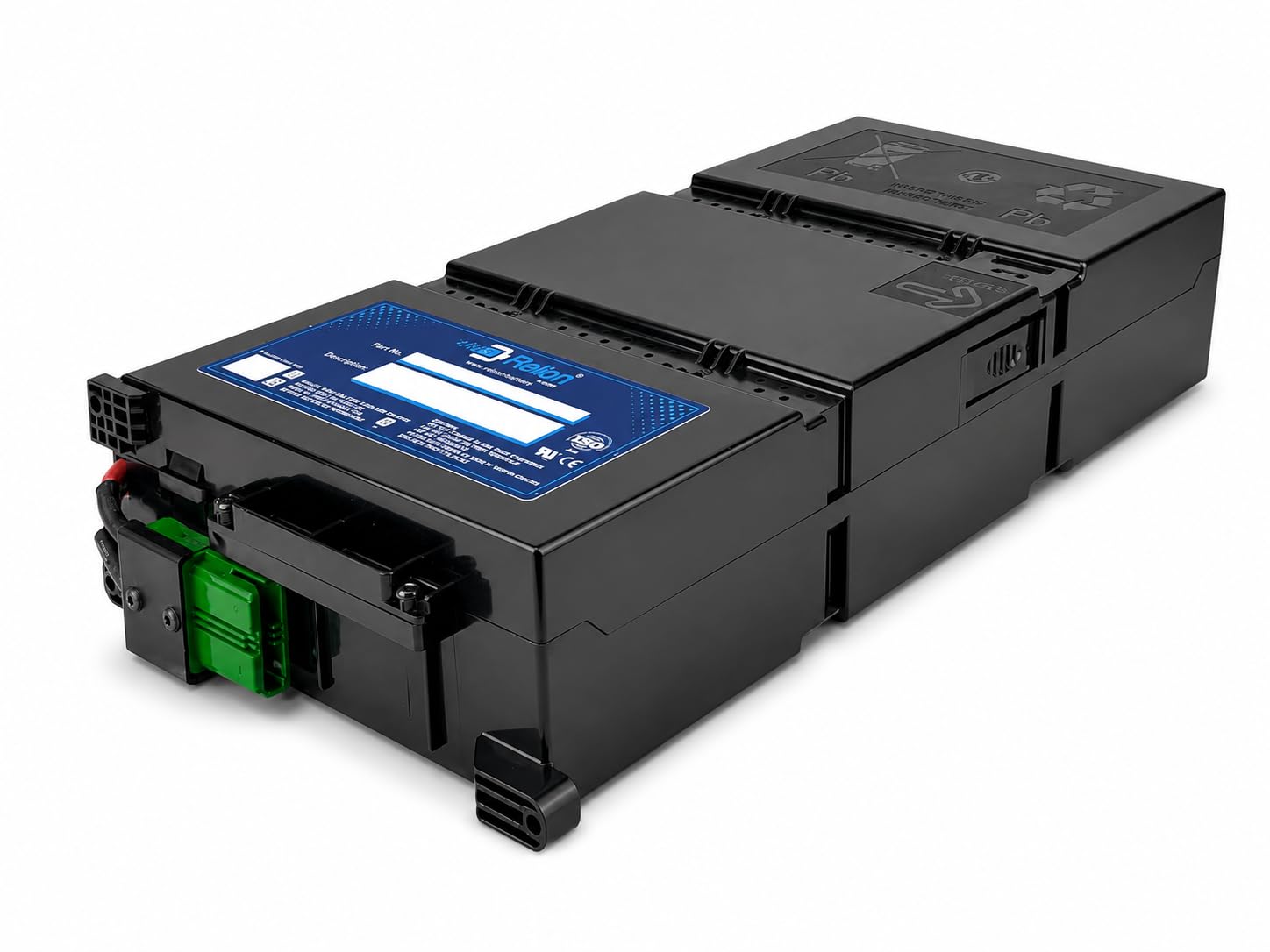
1. Raion Power APCRBC141/RBC141 Compatible Battery Cartridge, 72V 5.5Ah
Our pick — over 4.5★ from 450+ verified ratings; the strongest balance of quality and price.
The five-minute UPS fix that revives your APC backup at half the OEM cost.
If you’ve got an APC Smart-UPS SRT series unit with a dead cartridge, this is the budget-friendly revival. This sealed lead-acid AGM cartridge delivers 5.5Ah at 72V, built from six Raion Power RG126-22HR 12V 5.5Ah high-rate batteries, and it’s engineered to work with the SRT2200RMXLA, SRT2200XLA, and the other RBC141-compatible models listed.
The headline promise is up to 10% longer runtime versus standard 12V 5Ah cartridges under similar load, and owners confirm it. Customers note the swap is genuinely tool-free: “Perfect fit. The replacement process took a total of 5 minutes and didn’t require any tools.” The plug-and-play design comes with pre-installed wiring harnesses, fuse, and connectors, so the UPS recognizes it instantly. Quality is the most-praised trait, with 143 owners singling it out, and the 24-pound weight is the main thing you’ll notice while installing.
The recurring caveat is compatibility — a few reviewers point out connector or fitment issues, so always verify your exact UPS model and original cartridge number before ordering. The batteries are UL recognized and CE rated, built in ISO 9001 certified facilities, explaining the reliability that keeps owners returning.
The verdict: an exact-fit, cost-saving replacement that’s the easiest 72V install you’ll do all year.
Who it’s not for: anyone with a non-APC UPS — confirm the connector setup matches before you buy.
The easy win: UPS owners who want a 5-minute, no-tools swap at roughly half the price of a genuine APC cartridge.
skip it if: your backup unit isn’t on the compatible model list — check the spec sheet before committing.
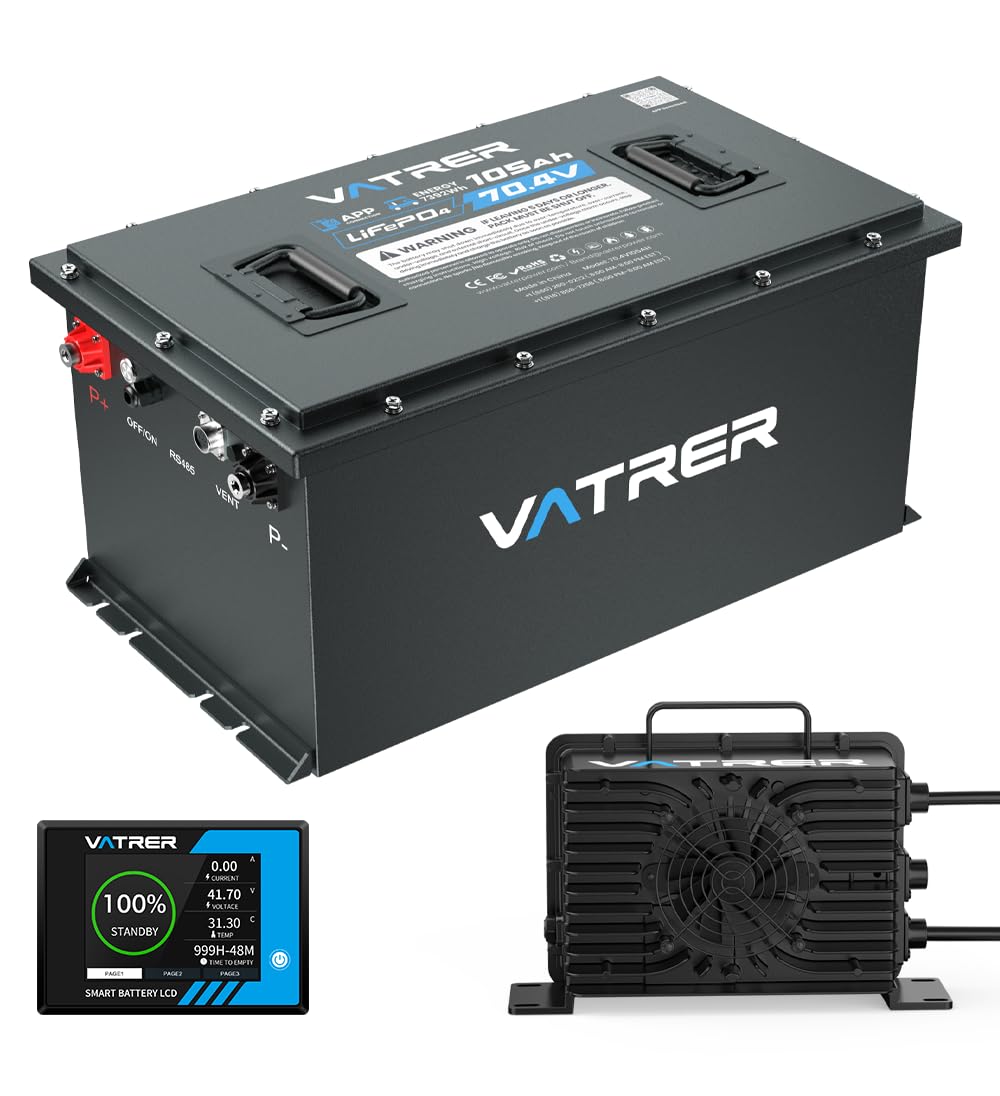
2. VATRER POWER 72V (70.4V) 105Ah Lithium Golf Cart Battery
The golf cart king that replaces six lead-acid bricks with one maintenance-free cell.
This is the battery for anyone who wants to ditch lead-acid for good. The 105Ah LiFePO4 pack carries 7.392kWh and weighs 132.3 pounds—50% lighter than a lead-acid bank of the same capacity—making the swap into an old six-battery compartment doable.
Buyers report 35 to 40 miles per charge, with one 6-seater Club Car on a 600A Navitas AC kit hitting 45 MPH and 40-mile trips. The built-in 200A BMS delivers continuous discharge up to 200A with 400A peaks for 35 seconds, so hard acceleration won’t trip it. Owners mention the installation is straightforward with “fantastic instructions,” and the included 79.2V 18A charger takes the pack from 0% to 100% in just 5.8 hours.
The 2.8-inch touchscreen and mobile app show real-time state of charge, and the fireproof, shockproof cold-rolled steel case is IP67 waterproof. The recurring gripe is minor: the LCD can be finicky to power on, though support promptly swaps a faulty unit. One reviewer noted the battery runs about 0.5 inches too long for a stock EZ Go Freedom TXT, needing a small modification.
Why it leads: 4000+ charge cycles versus the 300 to 500 you’d get from lead-acid, plus the lowest long-term cost per mile.
The honest trade-off: the premium price and the need to confirm your cart’s controller is compatible before you commit.
Best suited for: serious golf cart owners who want max range and zero daily maintenance.
Consider twice if: you’re on a tight budget or your cart has a compact bay that can’t take a 22.24 x 12.09 x 11.1-inch pack.
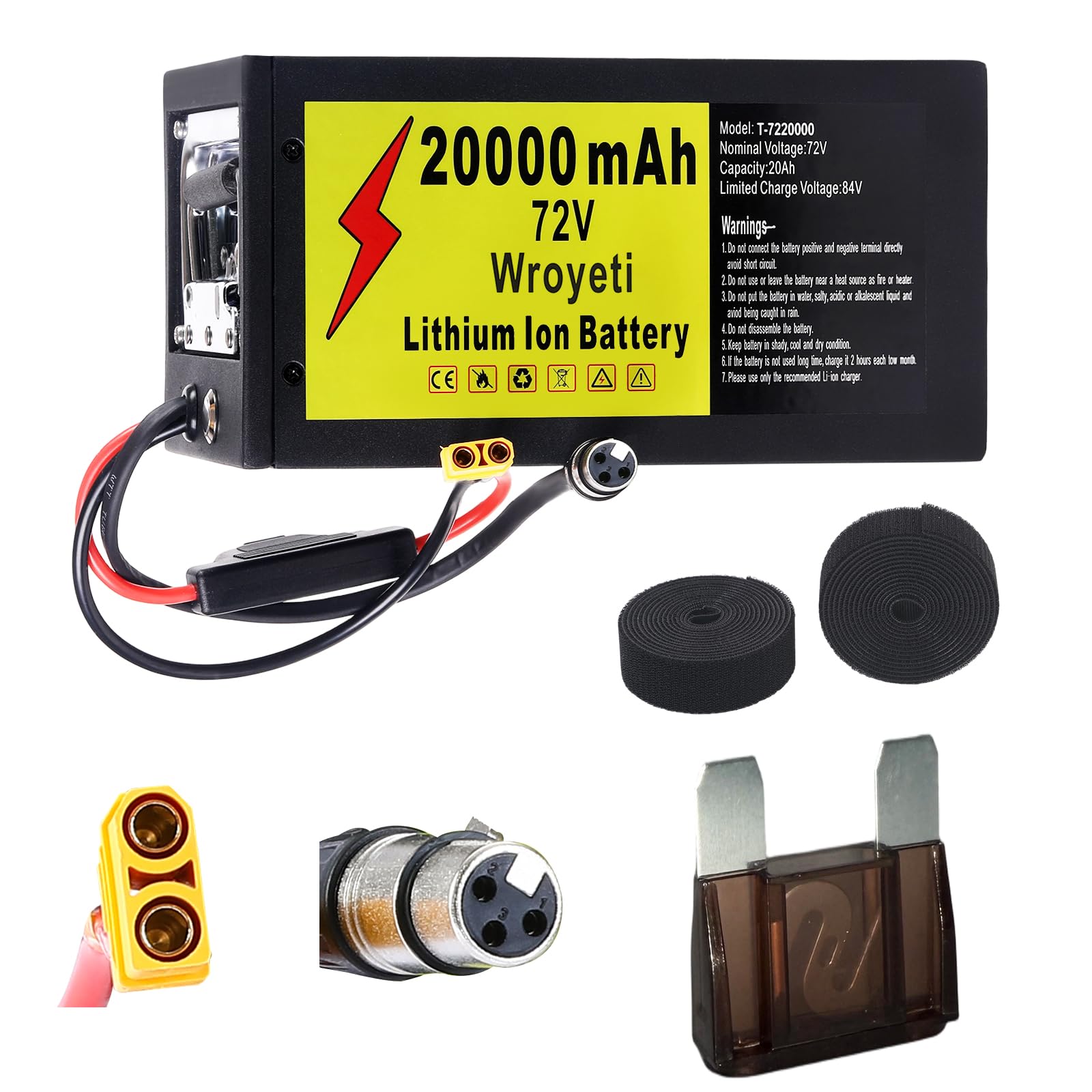
3. Wroyeti 72V 20Ah Metal Case E-Bike Lithium Battery, 60A BMS Fits 200W-3000W
A rugged metal-clad e-bike pack with a beefier 60A brain than most rivals.
This is the go-to for e-bike and scooter builders who want a plug-and-play swap without extra accessories. The 20Ah pack measures a compact 5.95 x 5.2 x 9.73 inches and comes with all matching wires and plugs pre-mounted, so installation is genuinely straightforward — buyers describe it as “very easy to install” and note the scooter feels “more spunky” afterward.
The standout here is the 60A BMS. The review pages sum it up: “Most batteries only have at 40-50 amp BMS, but this has a 60 amp BMS, which is great!” That headroom means the 200W-3000W motor range is realistic, and the outside safety fuse plus the dual protection against overcharge, over-draining, overcurrent, and short circuits keep things safe under hard pulls.
The 1.3mm thick metal case resists bumps and scratches, and the interior is sealed with waterproof glue to protect cells from rain. Grade A lithium cells in fixed internal brackets stay steady on bumpy trails, and the spring rebound handle eases lifting for charging.
What riders love
- 60A BMS handles high-draw motors without cutting out
- Metal case with full waterproof glue sealing for wet rides
- External power cutoff switch stops idle power loss in storage
What to weigh
- One buyer called it flat-out “HEAVY”
- Golf-cart-style full waterproofing isn’t rated for immersion
Reach for this if: you run a 200W-3000W e-bike or scooter and want a direct, tool-free swap with strong current headroom.
Look elsewhere if: you need the absolute maximum range — a 20Ah pack gives less distance than the 25Ah option above.
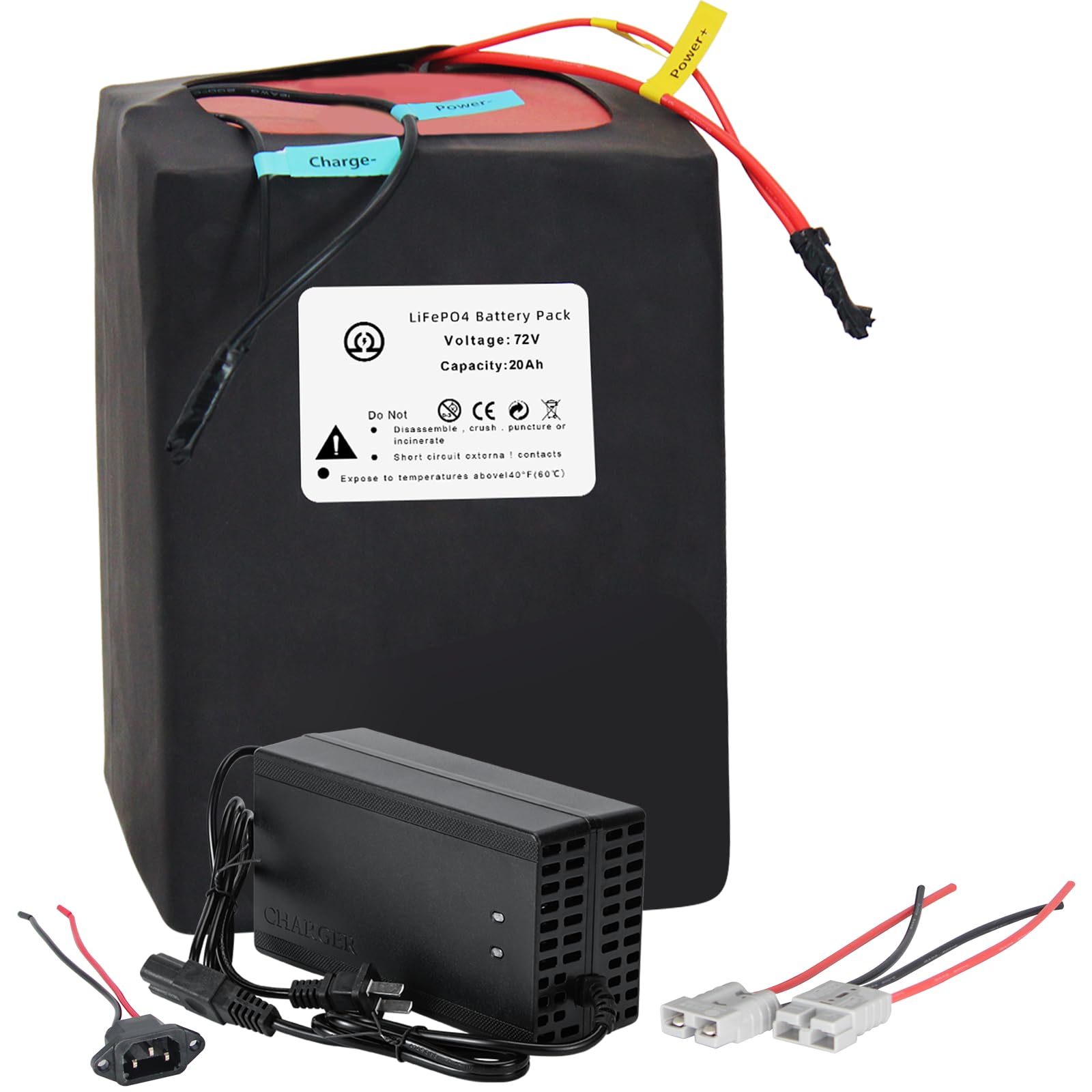
4. PYXMGSHMY 72V 20Ah Universal Power Pack Rechargeable Battery, 50A BMS
A LiFePO4 workhorse that punches above its price for DIY scooter builders.
This pack is the smart buy for project builders who want lithium iron phosphate safety without the four-figure premium. The battery produces a real-world 25Ah in a 28-pound package sized at 7.09 x 6.69 x 10.24 inches, and the 50A BMS active equalization chip guards against short circuit, overcharge, overdischarge, and temperature spikes.
Buyers on modified Razor MX650 builds report genuinely impressive results: one hit 35mph top speed with a 20-mile range at around 24mph, and another praised the strong torque that lets the front wheel lift at 15+ mph. The support team earns repeated praise — when a charger arrived dead, the seller refunded it within 24 hours and pointed to a recommended 5A charger. One owner who ordered a 20Ah even got bumped up to the 25Ah for free when stock ran short.
The honest caution is quality control. One buyer received a defective unit that showed 64.3V at full charge instead of the expected 72V and cut out after roughly 100 feet — a classic bad-cell symptom. The seller replaced it with excellent service, but it’s worth the 48-hour support window if yours arrives off-spec. Check the voltage at full charge: 80.4V to 87.6V is the healthy range for this chemistry.
The smart money pick: for DIY scooter and e-bike builders who want LiFePO4 safety plus real torque at a mid-range price.
Be ready for: the need to verify the pack fits your battery case — always measure the 7.09 x 6.69 x 10.24-inch body first.
Understanding the Specs
Amp-hours (Ah) — the range number
Amp-hours tells you how much energy the battery holds, and it’s the single biggest factor in how far you’ll go. A 5.5Ah UPS cartridge and a 105Ah golf cart pack both run at 72V, but the golf cart holds nearly 20 times the energy. For vehicles, more Ah means more miles per charge — the jump from 20Ah to 25Ah is roughly a 4.5x gap in capacity versus the 5.5Ah UPS unit, so match Ah to how far you actually ride or how long you need backup.
BMS amp rating — the current ceiling
The BMS (battery management system) protects the cells, and its amp rating sets the maximum current the pack can safely push. A 50A BMS suits moderate builds, but a 60A BMS handles a 3000W e-bike motor that surges on acceleration, and a 200A BMS is what a golf cart needs to pull hard up hills. Undersize the BMS and the battery cuts out exactly when you need power most.
FAQ
Will any 72V battery fit my golf cart or e-bike?
What’s the difference between SLA, lithium-ion, and LiFePO4?
What voltage should my 72V LiFePO4 show at full charge?
How long does a 72V lithium golf cart battery take to charge?
How many miles can I get from a 72V battery?
Can I run two 72V e-bike batteries in parallel for more range?
What does the BMS amp rating actually protect against?
Is a 72V battery waterproof for riding in the rain?
How do I know if my 72V battery has a bad cell?
Are 72V batteries safe for a DIY scooter build?
Final Thoughts: The Verdict
For the majority of shoppers, the 72 volt battery winner is the VATRER POWER 105Ah because it delivers the most range per charge with the longest lifespan — 4000+ cycles versus a few hundred for lead-acid — plus 50% less weight and a 200A BMS that never flinches under load. If you want a lighter e-bike pack with extra current headroom, grab the Wroyeti 20Ah Metal Case with its 60A BMS. And for a budget-friendly UPS revival, the Raion Power RBC141 cartridge is the five-minute fix worth starting with.
How We Picked
We do not accept paid placement. Every pick is matched to a real buyer and a real use-case; we do not hands-on test units.
Sources & Methodology
Specifications: manufacturer listings and product documentation. Review insights: verified customer reviews, as of August 2026. Pricing: not shown on this page (it changes often); check the current price via the retailer link.
As an Amazon Associate, Gadgets Feed earns from qualifying purchases. This does not affect which products we feature.