
Our readers keep the lights on and my morning glass full of iced black tea. As an Amazon Associate, I earn from qualifying purchases.
Specs are compiled from manufacturer listings and verified buyer reviews and can change over time — please confirm the key details on the product page before buying.
The real challenge with an at-home bike trainer is managing noise, stability, and the risk of your bike slipping during hard efforts.. This guide compares trainer types by road feel, noise, and storage so you can match one to your space and riding style..
I’m Min — the founder and writer behind Gadgets Feed. This guide is built by comparing the manufacturers’ published specifications and the patterns across verified customer reviews, so you get each pick’s real strengths and trade-offs instead of marketing spin.
Whether you’re a racer chasing structured intervals or a commuter dodging bad weather, the right at home bike trainer turns your existing bike into a year-round training tool that fits your space and your budget.
Our Picks at a Glance


How To Choose The Best At Home Bike Trainer
Your riding style determines which trainer type fits best.. Ask yourself if you want the most realistic feel for hard interval sessions, or if you just need a simple way to pedal while watching TV. That choice splits the market into three camps: classic wheel-on, smart wheel-on, and premium direct-drive trainers..
Wheel-On vs Direct-Drive: The Core Decision
A wheel-on trainer clamps onto your rear axle and presses a roller against your tire. It’s simpler, often cheaper, and your bike stays intact. A direct-drive trainer removes your rear wheel entirely and locks the frame onto a cassette. Direct-drive gives you rock-solid stability and the most accurate power readings, but it costs more and needs a matching cassette installed.
Resistance Type: Magnetic, Fluid, or Electromagnetic
Magnetic trainers use magnets to create drag and typically offer adjustable levels you can change mid-ride. Fluid trainers use a sealed impeller in liquid — the faster you pedal, the harder the resistance gets, which feels remarkably close to a real road. Electromagnetic trainers, found in smart models, let an app control resistance automatically to simulate hills and intervals without you touching anything.
Smart Connectivity and App Compatibility
If you plan to ride in virtual worlds like Zwift or Rouvy, you need a trainer that talks to your device. Look for dual-band ANT+ and Bluetooth support so it pairs with your phone, tablet, or laptop. Smart trainers automatically adjust resistance to match the virtual terrain, turning indoor riding into an engaging game rather than staring at a wall.
Quick Comparison
| Model | Best For | Resistance | Max Slope | Weight | Amazon |
|---|---|---|---|---|---|
| Garmin Tacx Neo 2T★ Best Overall | Serious cyclists wanting real-road feel | Magnetic (32 magnets) | — | 47.4 lbs | Amazon |
| Goplus Folding StandBudget Champion | Budget buyers on a tight budget | Magnetic | — | — | Amazon |
| CXWXC Magnetic StandBest Value | Value seekers wanting 6 levels | Magnetic | — | — | Amazon |
| Sportneer Magnetic Trainer | Quick setup and solid stability | Magnetic | — | 18.7 lbs | Amazon |
| Saris Fluid2 | Classic road-feel without smart tech | Fluid | — | 7.3 lbs | Amazon |
| Alpcour Fluid Trainer | Quiet rides with progressive resistance | Fluid | — | — | Amazon |
| Saris M2 Smart | Smart training on a budget | Electromagnetic | — | 20 lbs | Amazon |
| ThinkRider X2Max | Direct-drive realism with high power | Electromagnetic | 18% | 35.2 lbs | Amazon |
| ThinkRider XXPRO | Extreme gradients and self-powering | Electromagnetic | 25% | — | Amazon |
In‑Depth Reviews
1. Garmin Tacx Neo 2T Smart Trainer
Our pick — over 4.5★ from 450+ verified ratings; the strongest balance of quality and price.
The gold standard that turns indoor rides into road-like escapes with whisper-quiet magnetic resistance.
This is the closest you’ll get to outdoor riding indoors.. It uses 32 neodymium magnets for resistance, and the result is a ride that owners describe as smooth, comfortable, and remarkably realistic — the inertia feels correct whether you’re sprinting or spinning easy. Because it’s a direct-drive unit, you remove your rear wheel and lock your frame onto it, which eliminates tire wear and gives you rock-solid stability during hard efforts.
The crowd favorite here — 4.7 stars across 400+ owners — consistently highlights how quiet it runs and how easy setup is for a premium unit. It connects wirelessly via ANT+ and Bluetooth, and it works across iOS, Android, macOS, and Windows, so pairing with Zwift or other apps is quick. Built-in cadence and Bluetooth heart-rate support mean you don’t need extra sensors bolted to your bike.
The honest catch is setup: several buyers report you need two cassette spacers, and if you miss them the unit runs noisy until you fix it. A derailleur adjustment is often required too. Once dialed in, Owners mention measurable fitness gains within three weeks of consistent use.. At 47.4 pounds and 2200 watts of load capacity, it’s a heavy, serious piece of kit built for serious training, not casual spinning.
What wins people over
- Realistic road feel with dynamic inertia that mimics actual outdoor momentum
- Whisper-quiet operation — you can hear music or TV without cranking volume
- Instant connection to Zwift with built-in cadence and heart-rate support
The learning curve
- Setup needs two cassette spacers and possible derailleur adjustment — instructions aren’t crisp
- Heavy at 47.4 pounds, so it’s not a grab-and-go trainer for most homes
- Connectivity gets mixed feedback from some owners using various devices
Reach for this if: you train year-round and want the most realistic, quiet, and stable platform available — worth the premium for dedicated cyclists.
Look elsewhere if: you want a simple, foldable stand for casual pedaling, or you’re on a budget and don’t need 2200 watts of capacity.
2. Goplus Folding Stationary Bike Stand
A no-frills folding stand that proves you don’t need to spend big to ride indoors.
This is the most affordable way to start indoor training, delivering what casual riders need.. It’s a wheel-on trainer that clamps to your rear axle and uses a magnetic flywheel for resistance, with 8 settings to dial in your effort. The whole stand folds flat without tools, so you can tuck it into a corner of a room or the trunk of your car when the ride is done.
Assembly is genuinely simple — owners say it takes minutes to put together and the double locking system holds the bike firmly in place. The pyramid-style frame is built from alloy steel and handles up to 220 pounds, and it fits bikes with 26 to 28 inch wheels. For an 84-year-old cyclist who set it up on a covered patio to escape the heat, it was a hit — easy to mount and dismount.
The trade-offs are real at this price. Noise gets mixed feedback, with some finding it pleasantly quiet while others call it loud, and the instructions aren’t the clearest. A folding-bike owner was disappointed the company wouldn’t help when it didn’t fit. But if you have a standard road or mountain bike and just want to pedal while watching TV, customers note it’s “everything I was expecting — very little noise, sturdy, and easy to assemble.”
Best for: first-time indoor riders who want the cheapest possible way to use their existing bike, with folding storage as a bonus.
Not ideal for: anyone with a folding bike, an electric bike with wiring at the axle, or riders who need a whisper-quiet session in a shared apartment.
3. CXWXC Magnetic Bicycle Trainer
A sturdy magnetic stand with handlebar-mounted resistance control that keeps you in the zone.
What sets this trainer apart at its price is the drive-by-wire resistance control. A small switch mounts on your handlebars, so you can change between 6 resistance levels in seconds without reaching down to the unit. That means you can simulate a climb or an interval mid-ride while keeping your hands in position — a genuinely useful feature for a trainer in this range.
The frame is built to handle up to 330 pounds, and the pyramid structure keeps it stable even when you push hard. It fits 26 to 29 inch wheels including 700c road bikes, which covers most standard bikes on the road today. Setup is the thing owners praise most — over 50 buyers single it out — with most saying it takes just minutes to clamp the rear axle and adjust the roller contact.
The recurring honest note is noise: it’s fairly quiet with smooth tires, but MTB riders with knobby tread find it loud — the brand itself warns that rough tires are noisy on any trainer. Magnetic attachment issues and inconsistent resistance at higher settings show up in a few reviews too. One owner, recovering from knee surgery, found it ideal because the quick mount and dismount made it easy to hop on and off safely.
Solid and simple: If you want a stable, affordable trainer with handlebar-level control and don’t mind switching to slick tires, this is a reliable choice.
4. Sportneer Magnetic Indoor Trainer
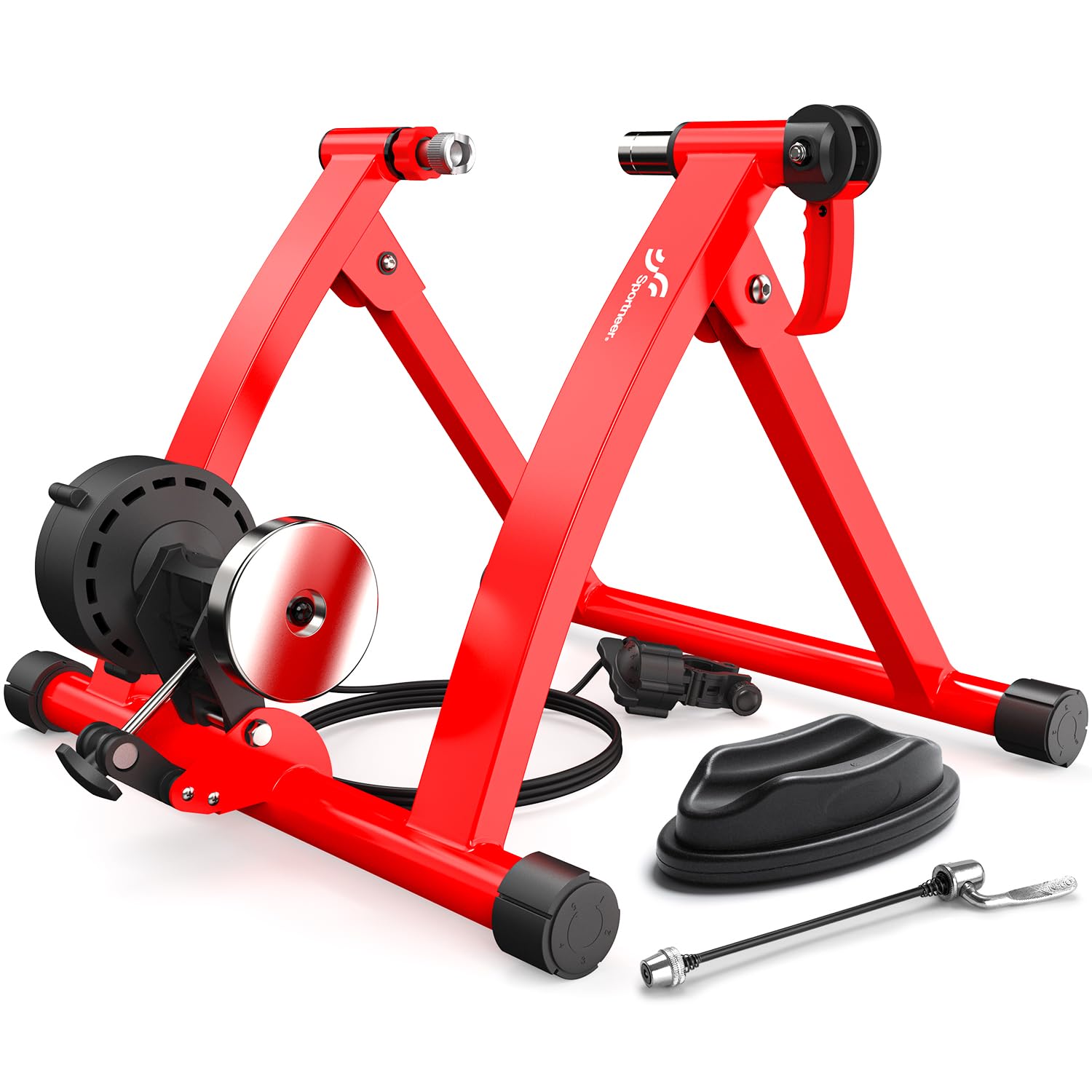
A rock-solid wheel-on stand that sets up in minutes and feels steadier than trainers twice its price.
You can be riding in under five minutes with no tools at all — that’s the headline here. Owners consistently report that the press-down lever clamp mounts your bike fast, and the included front wheel riser block and quick-release skewer (the part that holds your rear wheel) are already in the box. At 18.7 pounds, it’s light enough to move around, yet its 300-pound load capacity means it stays planted even during hard sprints.
The 6-level magnetic resistance is controlled by a bar-mounted remote, so you can shift intensity mid-ride without breaking your rhythm. The wide base, low center of gravity, and 5 adjustable anti-slip rubber feet add up to a ride that feels secure even on uneven floors. A hybrid bike owner called it great for winter workouts, and one buyer measured it as quieter than their old fluid trainer.
Here’s where honesty matters: noise is the most-discussed topic, and it’s a mixed bag. Some owners call it noiseless and a huge relief; others find it noticeably loud depending on tire tread. The resistance adjustment also gets mixed feedback, with a few riders noting minimal difference between levels and a resistance cord that can get in the way on certain handlebars. It fits 26 to 28 inch and 700C wheels with rear axles between 4.92 and 6.57 inches — and if you have a thru-axle bike, you’ll need the non-standard version with the adapter.
Why it’s a fast favorite
- No-tool setup in under five minutes for most riders
- Wide base with 5 adjustable feet stays stable on uneven floors
- Bar-mounted remote switches 6 resistance levels while you ride
What to check first
- Noise level depends heavily on your tire tread — slick tires are recommended
- Resistance controller may be too small for some drop bars
- Thru-axle bikes need the separate adapter version
Grab this if: you want a fast, stable, budget-friendly wheel-on trainer for a standard road, mountain, or hybrid bike.
Think twice if: you run knobby MTB tires and can’t swap to slicks, or you need true smart-trainer app integration.
5. Saris Fluid2 Indoor Trainer
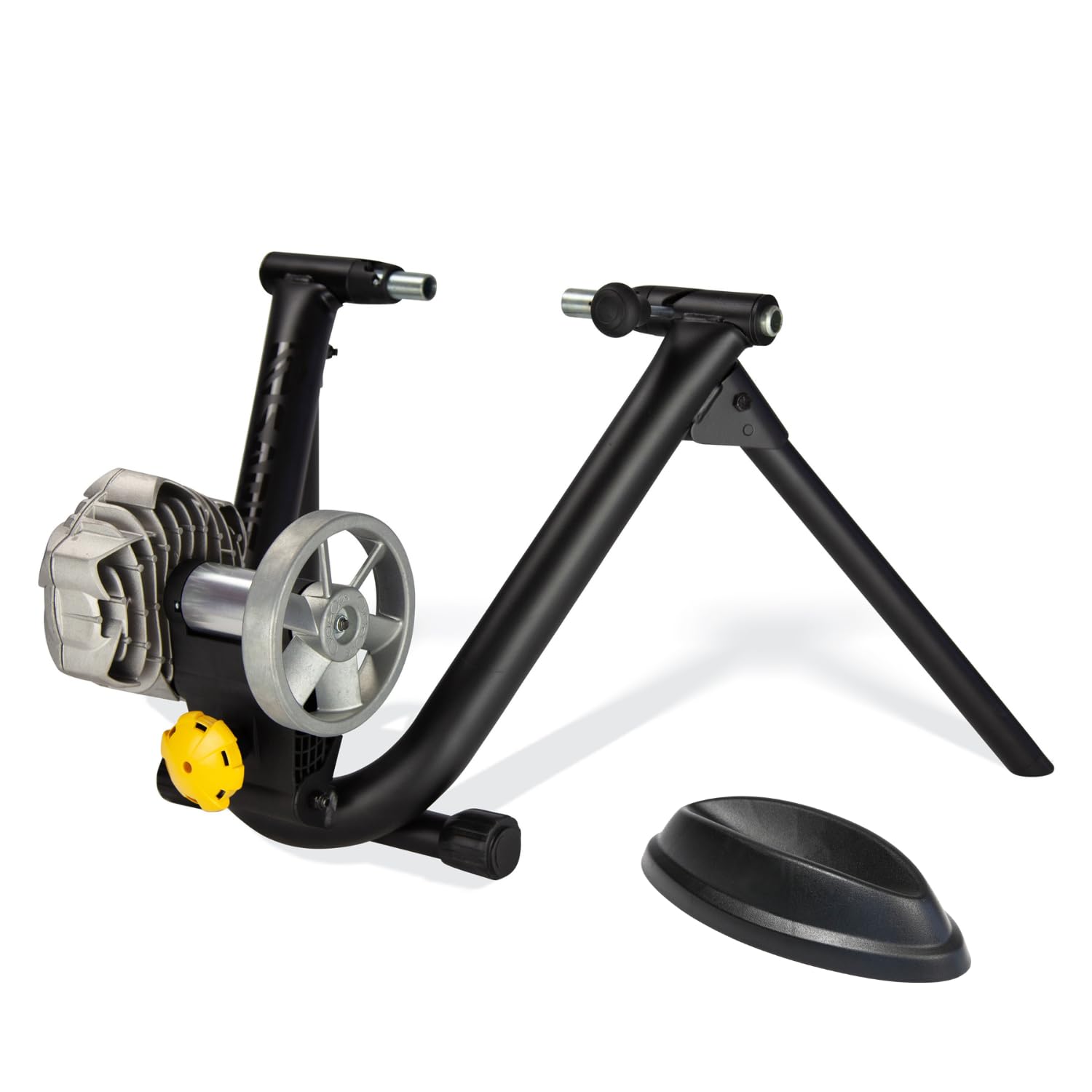
A featherweight fluid trainer that rewards harder pedaling with road-like progressive resistance.
At just 7.3 pounds, this is the lightest trainer in this lineup, and it earns its place with a patented fluid resistance design. Unlike magnetic units with set levels, the fluid impeller creates resistance that builds the faster you pedal — exactly like a real road. Owners call it smooth and quiet, with one noting you control intensity simply by shifting your bike’s gears.
This is a classic non-smart trainer. It works with apps like Zwift and Rouvy only when you add a separate speed or cadence sensor, which you’d pair yourself. Buyers who want a no-frills, reliable platform love that simplicity — one replaced a 15-to-20-year-old leaking trainer with this and found it met every need. The frame is aluminum and foldable, so storage is genuinely easy.
The mixed feedback centers on assembly and noise. Instructions are unclear, with owners noting the beveled pin goes in end-first and the power unit sits on the left. Folding the legs requires real force, so it’s not built for daily fold-and-store. Noise runs relatively quiet for most but loud for others, and durability takes occasional hits. It fits hybrid, mountain, and road bikes, though an older 1990s frame needed the widest setting.
Classic and capable: If you want that real-road progressive feel without smart tech or a high price, and you’re comfortable with a little setup patience, this lightweight fluid trainer delivers.
6. Alpcour Fluid Bike Trainer

A stainless-steel fluid trainer that ramps resistance as you push, with near-silent operation.
This is the trainer for riders who want progressive, self-adjusting resistance without any knobs or remotes. The fluid impeller heats up as you pedal faster, increasing drag naturally — so the harder you go, the harder it gets, with no adjustment needed. Owners praise the quality above all, with well over 100 buyers calling out the solid build and smooth ride.
The stainless-steel frame folds flat and ships with a carry bag, making it genuinely portable. It includes a front wheel riser block and anti-slip rubber pads to keep everything planted, plus a dual tension knob and lock ring for security. It accepts most 26 to 29 inch and 700c wheels. A larger rider around 295 pounds found it stable and confidence-inspiring even on carpet, which speaks to the sturdy construction.
Noise is the split decision here. Some measured it around 70 dB — noticeable but not painful — while others found it surprisingly quiet. A few owners received units with missing bolts or slow parts delivery from customer service, though the brand’s responsive frame replacement helped. Resistance is low at the start and ramps over 10 to 15 seconds, and one competitive rider noted it’s built for fitness rather than racing-grade precision.
What stands out
- Progressive fluid resistance that increases naturally with your effort
- Stainless-steel build that feels heavy-duty and stable under bigger riders
- Folds flat and comes with a carry bag for easy storage
Worth knowing
- Noise runs around 70 dB — fine for a house, not ideal for a thin-walled apartment
- Some units arrive missing a bolt or nut; customer service can be slow
- Instructions are a weak point, though assembly is quick once you start
Pick this if: you want a quiet, self-adjusting fluid ride with genuine build quality and an easy fold-and-carry design.
skip it if: you’re training for competition and need precise power numbers, or you need apartment-friendly whisper silence.
7. Saris M2 Smart Trainer

A wheel-on smart trainer that brings app-controlled resistance without the direct-drive price tag.
This is the most affordable entry into app-controlled smart training.. It’s a wheel-on design, so you keep your rear tire on, and it uses electromagnetic resistance that an app controls automatically. Accuracy sits at ±5%, which is respectable for a unit at this level. It’s Zwift certified and includes a one-month Rouvy subscription, and the dual ANT+ FE-C and Bluetooth connectivity means it pairs with your phone, tablet, or computer easily.
The M2 folds for storage and weighs 20 pounds with a 300-pound capacity. Built-in power, cadence, and speed tracking means you don’t need separate sensors. Owners find it stable and smooth, with resistance that handles sprints and climbs well. One reviewer noted it’s an excellent budget option compared to a Wahoo Kickr, working great with FulGaz and holding firm without slippage.
The honest picture is mixed. Quality gets the most mentions, but opinions split hard — some call it a phenomenal deal, others report failures within two months, including a damaged frame that ejected a rider during a sprint. Assembly gets divided reviews too, and connectivity hiccups show up for some. Thru-axle bikes (142×12) may need a separate adapter kit, and the noise is louder in high gears at over 70 dB. Tire wear is a real concern on wheel-on smart trainers.
Smart on a budget: The M2 delivers app-controlled training for less than direct-drive units, but the mixed quality reports mean it’s a fit for patient buyers who accept some risk.
8. ThinkRider X2Max Smart Trainer

A direct-drive powerhouse that hits 2000 watts and simulates an 18% climb at a fraction of the big-name price.
This is serious training hardware for riders who want direct-drive realism without paying Garmin money. It’s a direct-drive unit, meaning your rear wheel comes off and your frame locks onto the trainer’s own cassette. It uses a dynamic electromagnetic torque power meter with ±2% accuracy, and it can pump out up to 2000 watts — enough for even the strongest sprinters. It simulates climbs up to an 18% grade, which the app adjusts automatically to match the virtual terrain.
The X2Max supports both BLE and ANT+ dual-mode protocols, so it’s compatible with Zwift and other mainstream cycling software. The I-beam triangular structure keeps it stable even when you’re out of the saddle. Owners are impressed with how quiet it runs — around 58dB at 30 km/h, which is genuinely neighbor-friendly. Setup takes under five minutes for most, with one rider enjoying a two-hour Zwift ride immediately after assembly.
The catches are practical. You need a matching cassette (often around extra) plus a special tool and spacer setup, and some owners needed shims to fit their thru-axle bikes. The red LED can’t be turned off — unplugging is the workaround — and there’s no virtual shifting support. A few find the initial resistance settings and connectivity inconsistent. At 35.2 pounds, it’s hefty but that’s the trade-off for stability.
The direct-drive payoff
- 2000W power capacity with ±2% accuracy for serious training data
- Quiet at about 58dB — you can ride without disturbing others
- Stable I-beam frame that handles sprints without wobble
Budget for extras
- Needs a separate cassette and tools to install it
- No virtual shifting support in apps yet
- Red status LED can’t be switched off while plugged in
Choose this if: you want direct-drive accuracy and high-power capacity for serious training without paying flagship prices.
Pass on it if: you don’t want to buy a cassette and tools, or you rely on virtual shifting features.
9. ThinkRider XXPRO Smart Trainer
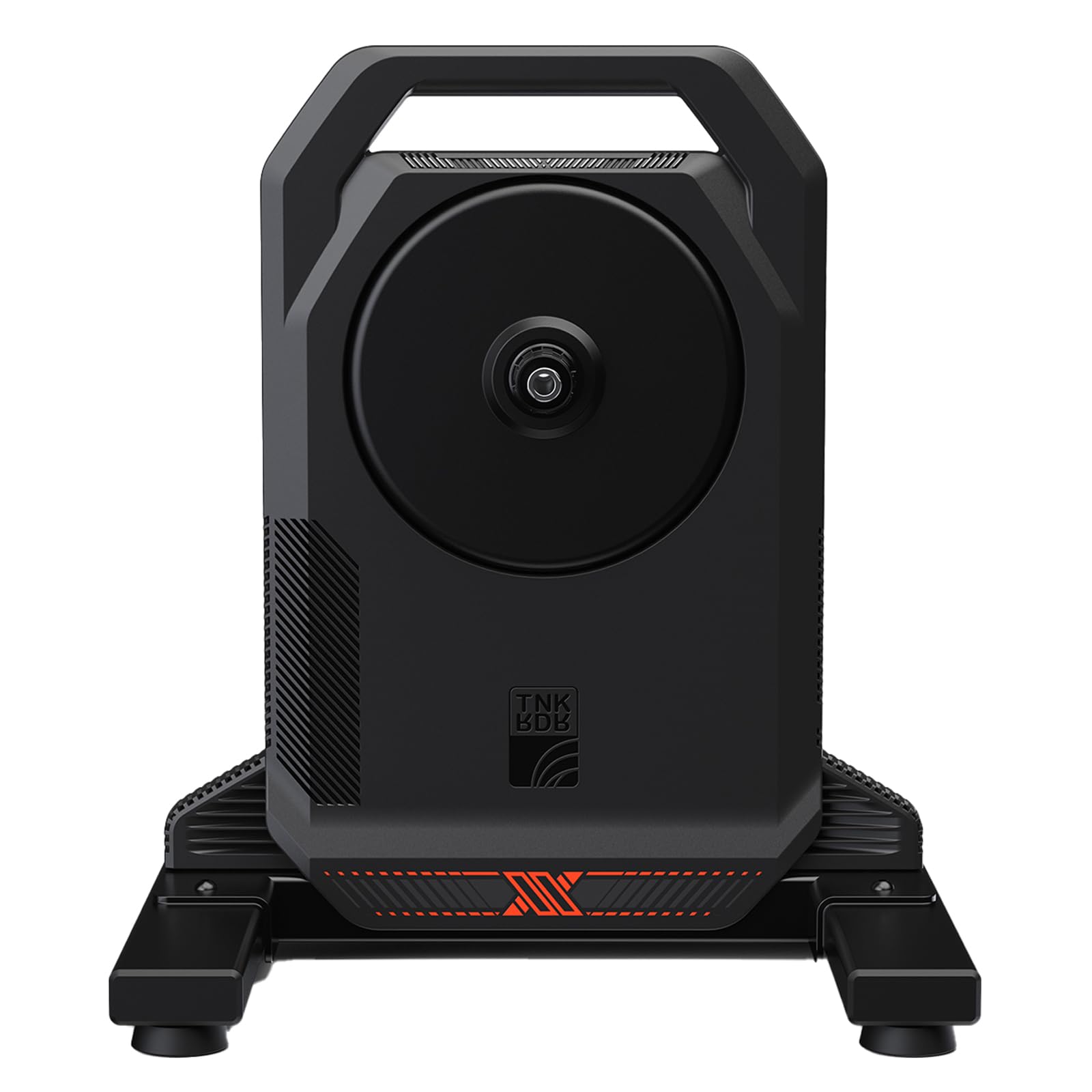
The rare direct-drive trainer that powers itself and simulates a brutal 25% gradient.
This is the most extreme trainer in the lineup on paper. It generates its own electricity while you pedal, so you can train without plugging into a power adapter — a genuinely unique convenience. It also simulates downhill riding, automatically adjusting resistance to match the map slope for a more complete virtual experience. With a maximum 2500W power output and a 25% max simulated slope, it can handle the most demanding climbs and sprints you can throw at it.
Accuracy is the standout spec: ±1% data accuracy with no calibration required. The direct motor drive keeps things quiet, and owners describe it as silent and smooth. It connects via Bluetooth and ANT+, and it works with Zwift, MyWhoosh, and GPS bike computers. One rider logged over 100 hours with no faults, while another put in 350+ miles and found the resistance close to real hills. It’s built from iron, and the 242-pound capacity covers most riders.
The setup friction is real. You’ll need your own cassette and the tools to install it, plus a missing 7-speed spacer means ordering a compatible one. Screws run short for some, and there’s no virtual shifting on Zwift. An odd “slip” at low speed and high load shows up occasionally, and stability gets mixed notes — one owner built a DIY front fork stand for extra security. The self-powering feature means it works even without the adapter, which is a nice safety net.
Big power, big potential: The XXPRO offers flagship-level power, self-generation, and downhill simulation at a mid-range price — if you’re handy with cassette tools, it’s a standout.
Understanding the Specs
Resistance Type and Feel
Magnetic trainers use magnets to create drag, often with adjustable levels you can change mid-ride. Fluid trainers use a sealed impeller that increases resistance the faster you pedal, closely mimicking a real road. Electromagnetic trainers, found in smart models, let an app control resistance automatically to simulate hills and intervals.
Max Slope and Power Output
Max slope tells you how steep a virtual climb the trainer can simulate — measured in percentages like 18% or 25%. Power output, measured in watts, tells you the ceiling for how hard you can sprint. Higher numbers mean the trainer won’t cap your effort during intense intervals.
Smart Connectivity: ANT+ and Bluetooth
ANT+ and Bluetooth are wireless standards that let the trainer talk to apps like Zwift or Rouvy. Dual-band support means you can pair with more devices — older bike computers often use ANT+ while phones and tablets prefer Bluetooth. Smart trainers automatically adjust resistance to match virtual terrain.
Wheel-On vs Direct-Drive
Wheel-on trainers clamp onto your rear axle and press a roller against your tire — simpler and cheaper, but they wear your tire and can be noisier. Direct-drive trainers remove your rear wheel and lock your frame onto a cassette, giving better stability and accuracy, but they cost more and need a matching cassette installed.
FAQ
Will a bike trainer work with my thru-axle bike?
What is the difference between magnetic and fluid resistance?
How loud is an indoor bike trainer?
Do I need a smart trainer to use Zwift?
Can I leave my bike on the trainer all the time?
What does max slope percentage mean for training?
Will a bike trainer fit my 700c road bike?
Is a direct-drive trainer worth the extra cost?
How much weight can an indoor bike trainer hold?
Do I need extra accessories to start using a trainer?
Final Thoughts: The Verdict
For most riders, the at home bike trainer winner is the Garmin Tacx Neo 2T because it delivers the most realistic, quiet, and stable ride, backed by a 4.7-star crowd favorite with 400+ owners. If you want smart training without the direct-drive price, the Saris M2 brings app-controlled resistance to a wheel-on format. And for the biggest value in direct-drive power, the ThinkRider X2Max gives you 2000 watts and 18% climbs at a mid-range price.
How We Picked
We do not accept paid placement. Every pick is matched to a real buyer and a real use-case; we do not hands-on test units.
Sources & Methodology
Specifications: manufacturer listings and product documentation. Review insights: verified customer reviews, as of August 2026. Pricing: not shown on this page (it changes often); check the current price via the retailer link.
As an Amazon Associate, Gadgets Feed earns from qualifying purchases. This does not affect which products we feature.