
Our readers keep the lights on and my morning glass full of iced black tea. As an Amazon Associate, I earn from qualifying purchases.
Specs are compiled from manufacturer listings and verified buyer reviews and can change over time — please confirm the key details on the product page before buying.
Buying a bead roller is a game of inches and pounds, not brand names. The two numbers that decide whether you fight the tool or enjoy it are throat depth (how far you can reach into a panel) and frame rigidity (how much it flexes when you crank). The right pick for a home garage is out there, and it does not require a shop machine.
I’m Min — the founder and writer behind Gadgets Feed. This guide is built by comparing the manufacturers’ published specifications and the patterns across verified customer reviews, so you get each pick’s real strengths and trade-offs instead of marketing spin.
We focus on manual sheet-metal tools for strengthening ribs, flanging edges, and making decorative panels, so you can confidently choose the right bead roller for your next fabrication job.
Our Picks at a Glance


How To Choose The Best Bead Roller
Choosing a bead roller starts with the metal you will actually feed through it. Thin 20-gauge sheet and thick 14-gauge plate demand completely different machines, so match the tool to your material before you look at anything else.
Match the gauge to the machine
Every roller lists a maximum material thickness, usually in gauge numbers. A bigger number means thinner metal — 22 gauge is thin and easy, 14 gauge is thick and brutal. Pick a roller rated for the thickest steel you plan to form, because pushing a machine past its limit just produces wavy, ugly beads.
Throat depth sets your panel size limit
Throat depth is the distance from the rollers back to the frame. A 12-inch throat reaches halfway across a 24-inch panel, while a 19-inch throat lets you form the center of a 38-inch panel without rotating the metal. If you are building floor pans or hoods, a deeper throat saves hours of re-clamping.
Weight and frame rigidity do the real work
Heavier frames flex less, which means cleaner lines. The 52-pound machines in this list are the sturdy ones, while lighter options often need a stand or reinforcement to stop the frame from bowing under load. A machine that flexes will turn a crisp bead into a wandering line.
Quick Comparison
| Model | Best For | Capacity | Throat Depth | Weight | Amazon |
|---|---|---|---|---|---|
| Woodward Fab WFBR6★ Best Overall | Panel work in a vise | 20–22 Gauge Steel | 18″ | 52 lbs | Amazon |
| Eastwood Elite 8InCompact Pick | One-person operation | 18 Gauge Steel | 8″ | 28.7 lbs | Amazon |
| Eastwood 19″ ThroatDeep Throat | Large panels & DIY | 18 Gauge Steel | 19″ | 50 lbs | Amazon |
| KAKA RM-12 | Starter fabrication | 18 Gauge Steel | 12″ | 46 lbs | Amazon |
| 19″ Metal Bead Roller | Motorizing & modifying | 18 Gauge Steel (est.) | 19″ | 51.9 lbs | Amazon |
| KAKA RM-18 | Deeper reach on panels | 18 Gauge Steel | 18″ | 53 lbs | Amazon |
| Vibrant Performance 2990 | Tubing & exhaust work | Steel / Aluminum Tube | — | 5.51 lbs | Amazon |
| Ticon Furick K2 | Stainless tubing | 16 Gauge Stainless | — | 6.09 lbs | Amazon |
In‑Depth Reviews
1. 18″ Bead Roller KIT (Woodward Fab WFBR6)
Our pick — over 4.5★ from 200+ verified ratings; the strongest balance of quality and price.
The heavy 52-pound frame that eats 20-gauge for breakfast and asks for more.
Weight is the first thing you notice — this machine tips the scales at 52 pounds, and that heft translates directly into clean, rigid beads. The steel frame is built from heavy plate, so when you crank through a pass, the rollers stay true instead of flexing away from the metal.
Buyers report it handles 20/22 gauge perfectly, with 18 gauge as its honest limit where beads start to degrade slightly. You get six sets of dies in the kit, which is generous at this level, and the shafts run true with smooth dies that leave no marks on the material. The confidence behind it shows in the buyer consensus: the functionality is the thing everyone raves about, and the value for money runs a clear second.
It is not a bolt-on-and-go tool, though. The vise mounting is the weak spot — owners recommend building or buying a stand because the included mounting is not sturdy enough for heavy work. The adjusting hardware and zerk fittings are budget-grade and several owners swap them out. Treat those as upgrade points, not deal-breakers.
What wins people over
- 52-pound frame resists flexing for crisp lines
- Six die sets included in the box
- Smooth, true shafts that leave no scratches
Where it cuts corners
- Vise mounting is flimsy — plan a stand
- Cheap adjusting hardware and zerk fittings
The right first machine: if you are starting out on 20-gauge panels and want a sturdy foundation that grows with you, this is the pick.
Plan for a stand: the bolt-on vise mount is the one thing you will want to replace early.
2. Eastwood Elite 8In Heavy Duty Bead Roller
The 28.7-pound compact that one person can actually operate solo.
Most manual bead rollers fight you with a long, two-handed crank. Eastwood solved that with a 4-spoke crank handle and a smaller footprint, so the whole machine is usable by a single operator — a genuine rarity in this category. At 28.7 pounds, it is a featherweight next to the 52-pound Woodward Fab.
It is rated for 20-gauge stainless steel, 18-gauge mild steel, and 16-gauge aluminum, which covers the vast majority of home fabrication. Here is where the reviews get interesting: owners mention it “works well on 16 gauge steel (above rating)” and “likely handles 14 gauge,” meaning the real-world capacity punches above the spec sheet. The included 3/8-inch bead die set and offset die set handle typical panel-rib and edge work.
The honest caveat is delivery consistency. A couple of units arrived with the wrong die set — one got a 1/4-inch bead die instead of the promised 3/8-inch, and another found no tipping dies included at all. Check your box before you start rolling; Eastwood’s after-sale support gets high marks for fixing these issues quickly.
Why it wins: the 4-spoke crank design genuinely lets one person form floor pans without a helper — something the heavier machines simply cannot do. Full marks for the single-operator experience, with a side of “check your die set on arrival.”
Solo-shop favorite: if you work alone and roll floor pans or decorative panels, reach for this one first.
Inspect on arrival: die-set mix-ups happen, so open your box right away.
3. Eastwood Metal Fabrication Bead Roller with Dies (19″ Throat)
A 19-inch throat that reaches the center of a 38-inch panel without a fight.
Deep-throat capacity is this machine’s whole personality. The 19-inch throat lets you form the center of a 38-inch panel, which is exactly what you need for floor pans, firewalls, trunk floors, and inner fenders. It is gear-driven, so you get maximum forming power with minimal crank effort.
At 50 pounds it is no featherweight, and customers note it “holds in a 4″ vise” nicely — though they also note it is heavy and not very portable. Assembly is genuinely easy, and beginners call it a “good item for learning.” The included offset dies create channels, flanges, and multiple profiles right from the start.
The catch is dialing it in. Several owners say it “takes a little while to dial it in” — you have to adjust parts to prevent side-to-side movement before the bead quality is right. Solo operation is possible, but it flows better with two people. Buyers recommend a pedal or motor kit and a stand for serious use.
Panel-spanning reach: the 19-inch throat is the standout here, beating the Woodward Fab’s 18-inch reach for anyone forming wide panels. Just budget time for the initial setup adjustment.
Wide-panel specialist: if your projects are floor pans and firewalls that span 38 inches, this throat depth is your friend.
Expect setup time: dialing out side-to-side play is part of the first session.
4. Sheet Metal Bead Roller, 18 Gauge KAKA INDUSTRIAL RM-12
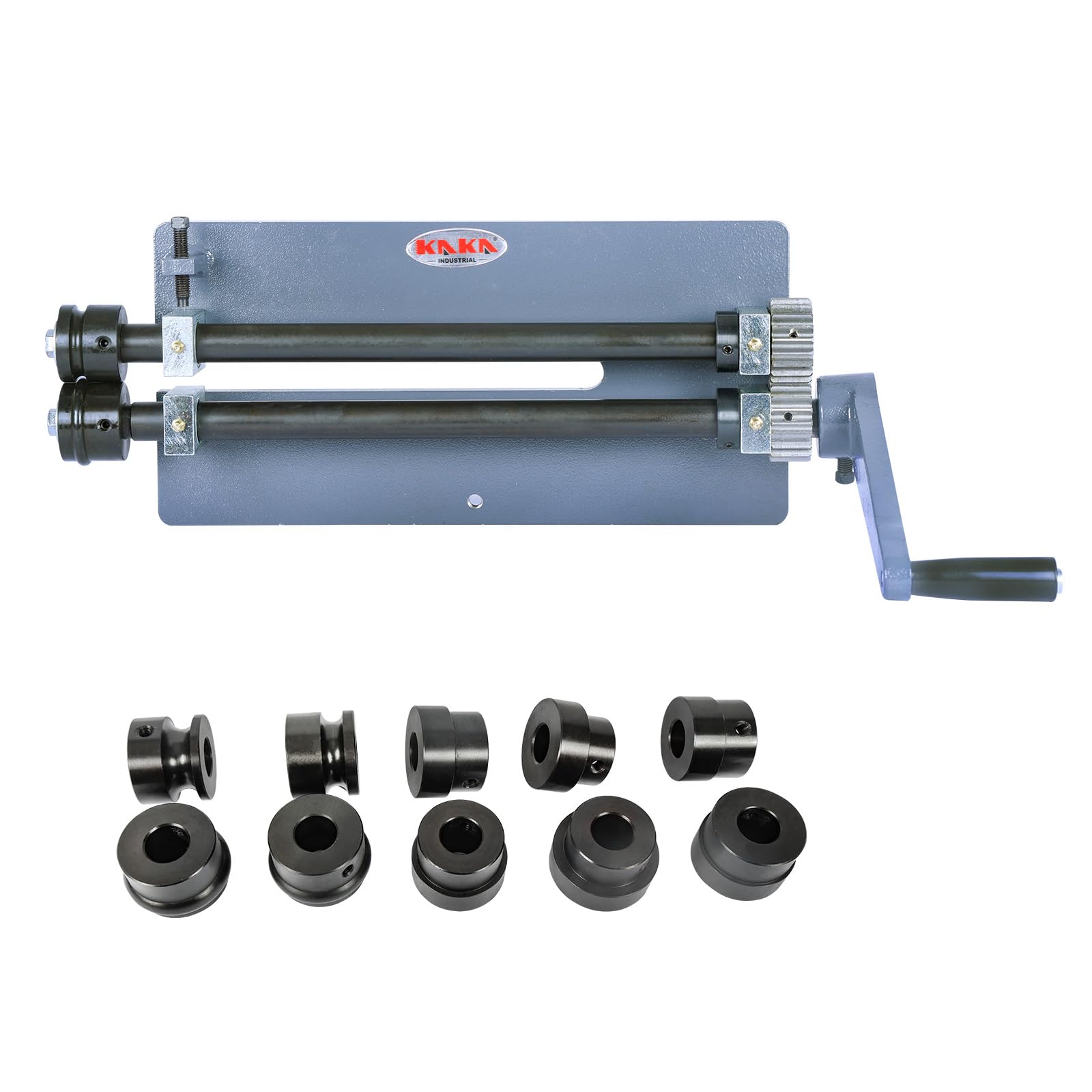
The 46-pound starter kit that reviewers point out “will last a lifetime.”
KAKA packs a lot of tool into the RM-12. The 12-inch throat is shorter than the big machines above, but it still reaches into roofs, decks, hoods, and repair panels. You get six forming roll sets — R4, R6, R7.5 bead dies plus 1/16-inch, 1/8-inch, and 1/4-inch flanging dies — which is the same die count as machines costing more.
The buyer experience is uniformly positive. Owners say the adjustment was easy and rolled beads perfectly, with one starting a fabrication business thrilled with its performance. The construction is heavy-duty steel with oil ports and grease points for maintenance, and the manual crank gives you full speed control during setup.
As a starter kit, the value is the story. One owner put it plainly: for the price and what it comes with for home tinkering, it doesn’t get any better than this. The trade-off is the shorter 12-inch throat — if your panels are wide, the deeper-throat machines above will serve you better.
The value story
- Six die sets at a starter price
- Heavy steel body with oil ports
- Easy, smooth adjustment
The reach limit
- 12-inch throat caps your panel width
- Bench mounting required
Budget-wise buy: for home tinkering and repair panels up to 24 inches wide, this is the smart money pick.
Wider panels? step up to the 18-inch-throat machines if you build floor pans.
5. 19″ Metal Bead Roller with Dies

A 9/16-inch steel frame that is stiffer than the typical 1/2-inch plate.
Rigidity is the headline here. The frame is built from 9/16-inch (14mm) solid steel plate, which is a noticeable step up from the 1/2-inch frames found on most rollers in this range. That extra thickness means less flex, cleaner beads, and a tool that holds its adjustment under load.
The 19-inch throat reaches the center of a 38-inch panel, matching the Eastwood deep-throat machine, and the industry-standard 22mm shafts accept all professional dies. Four die sets come in the box with bead mandrel sizes of 1/4-inch, 3/8-inch, and 1/2-inch, plus copper bushings and a grease cup for maintenance.
Buyers call it a high-quality item for the price, with one owner enthusiastically reinforcing the stiffer-than-typical 1/2-inch frame. The recurring negative is quality assurance: one unit arrived with a gouged shaft flat, and another’s bakelite crank handle shattered in transit. Owners say these are fixable sloppy-workmanship issues, not design flaws.
Stiffest frame per dollar: the 9/16-inch plate is the reason modders love this one — it is the go-to platform for adding a motor later.
Motorize-me candidate: if you plan to bolt on a motor and want a rigid frame to handle it, this is your platform.
Inspect the shafts: QC slips mean you should check the shaft flats before first use.
6. Sheet Metal Bead Roller, 18 Gauge KAKA INDUSTRIAL RM-18
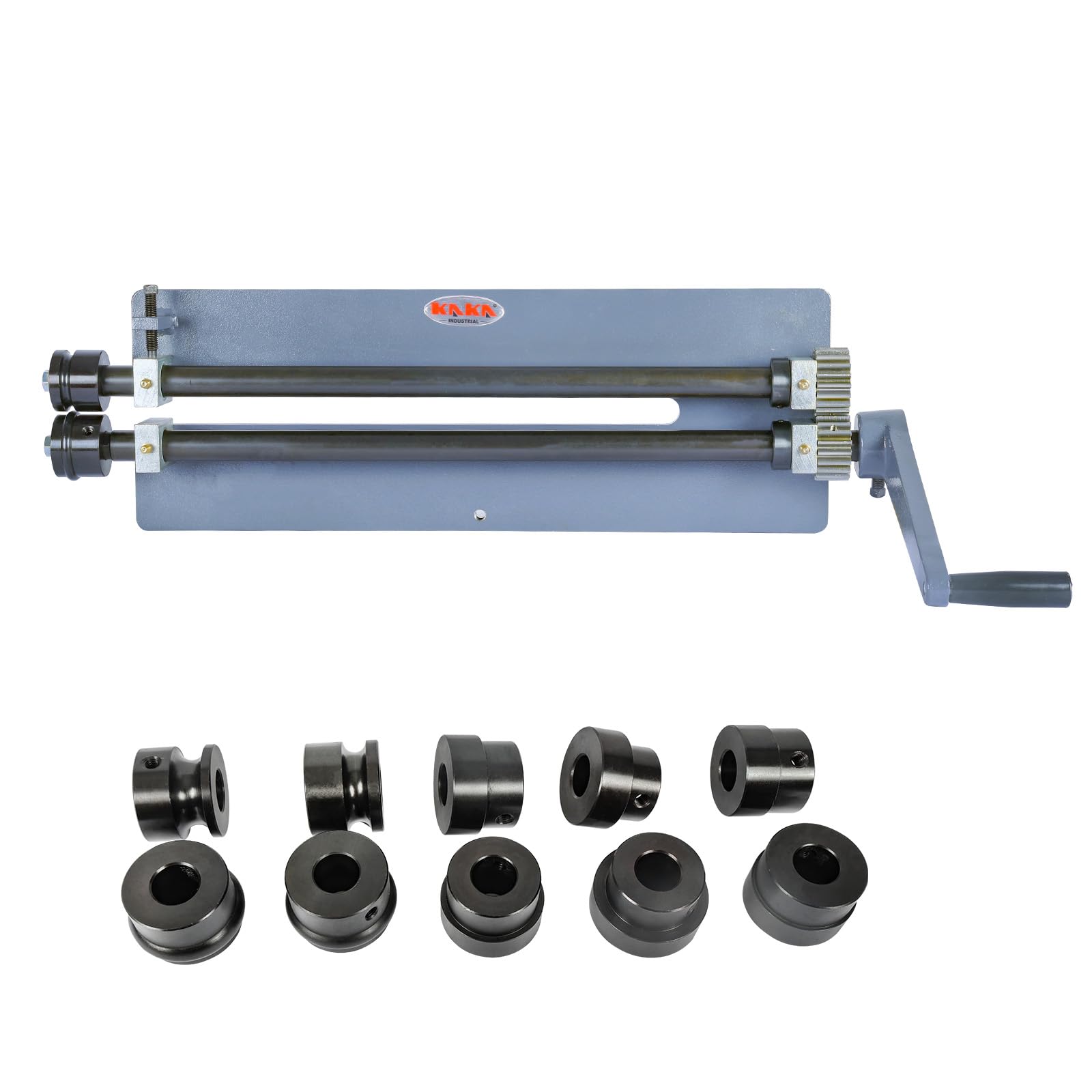
The 53-pound deep-throat sibling with the same six-die kit.
If the RM-12’s 12-inch throat feels limiting, KAKA makes the exact same machine with an 18-inch throat. The RM-18 keeps the same six-die set — R4, R6, R7.5 bead dies plus the 1/16-inch, 1/8-inch, and 1/4-inch flanging dies — and the same manual crank control, just with a deeper reach into larger panels.
At 53 pounds net weight, it is the heaviest machine in this lineup, edging out the 52-pound Woodward Fab. That weight is why shoppers say it makes bending sheet metal easier in different ways — it just does not move around on you. The bench-mounted steel construction with oil ports keeps maintenance straightforward.
The honest assessment comes with caveats. One owner wished for “an adjustable stop to run my edges on,” which is the main missing feature for production-style edge work. Another flagged deflection, solving it by reinforcing with 1.5×1.5 tubing to make it “solid as a rock.” The lack of set screws for the dies also draws a complaint — you get 5 or 6 die sets but only 2 set screws in the box.
Same family, deeper reach: buy the RM-18 over the RM-12 only if your panels are genuinely large — the 18-inch throat is the single upgrade, and it is a meaningful one.
Large-panel value: grab this if you need the deeper throat but want to stay in the KAKA six-die ecosystem.
Buy extra set screws: the box only ships two for six die sets.
7. Vibrant Performance 2990 Manual Bead Roller

The 5.51-pound hand tool that makes perfect beads on exhaust tubing.
This is a completely different animal from the panel rollers above. The Vibrant 2990 is a hand-held tubing bead roller, not a bench machine — it works on round tube with a minimum diameter of 3/4-inch OD, which is why it weighs just 5.51 pounds and fits in a toolbox. It is the tool for exhaust work, intercooler piping, and custom cold-air intakes.
Buyers are enthusiastic about the results. One owner successfully used it on steel exhaust tubing and 4-inch-diameter aluminum tubing to make a cold-air intake, reporting a “perfect bead.” The technique is incremental passes — you tighten a little, roll, tighten again — and patience is the whole game. It is durable if not abused.
The catch is material limits. The Amazon listing says steel or aluminum, but the item’s own label warns the warranty is voided if used on steel, per one buyer. The other honest note is arm fatigue — manual tubing rollers like this one “make your arms burn by the time you’re done.” If you plan to roll steel tube regularly, a powered tubing roller is the better path.
Tube-only specialist: this is the right tool only if your work is round tubing, not flat panels. The incremental-pass technique is the secret, and patience is mandatory.
Exhaust builders: for flaring the ends of steel or aluminum pipe for silicone couplers, this hand-held roller is the one.
Steel warranty warning: check the label — steel use may void the warranty on this unit.
8. Ticon Furick K2 Manual Tubing Bead Roller

The 6.09-pound American-built roller rated for 16-gauge stainless with hardened 4140 parts.
Made in USA is stamped on this one, and the material choices back it up. The dies and gears are hardened 4140 USA steel, and the whole unit is electroless nickel plated for corrosion resistance. It is rated up to 0.065-inch or 16-gauge (1.6mm) thick stainless steel, which beats most hand-held tubing rollers — and two buyers report successfully rolling heavier wall by taking it slow.
At just 6.09 pounds, it is the lightest “heavy duty” tool in this list, and the bear roll diameter goes down to 0.875 inches (22mm), so it handles tight-radius tube well. One buyer used it for a customer’s Cummins turbo diesel build on stainless tubing and reported great results. Another logged 30 bead rolls and reported it still looks good.
The learning curve is real. Owners stress keeping the tube seated properly and straight, and they warn against trying to make the bead in one pass — slow, patient passes are the way. The quality is outstanding, and several owners mention they would order a second unit. The trade-off is the premium price, which reflects the USA manufacturing and hardened internals.
Top-tier tube tool: the hardened 4140 dies and 16-gauge stainless rating put this a clear step above the Vibrant 2990 for serious tube work. You pay for the USA build, and it shows in the results.
Professional stainless work: if your living depends on clean beads in stainless tube, this is the hand roller to own.
Patience required: one-pass beads are not an option — slow and steady wins here.
Understanding the Specs
Throat Depth
Throat depth is the distance from the roller dies back to the machine frame. A 12-inch throat reaches the middle of a 24-inch panel, while a 19-inch throat forms the center of a 38-inch panel without rotating the metal. Deeper is better for floor pans and hoods, but it adds weight and cost. Match the throat to your widest panel, not your dream project.
Material Gauge Capacity
Gauge is a measure of metal thickness where bigger numbers mean thinner metal. A roller rated for 18-gauge mild steel can also handle thinner 20-gauge easily, but pushing it to 16-gauge thick plate will flex the frame and ruin the bead. Stainless steel is harder than mild steel at the same gauge, so a roller rated for 18-gauge mild may only handle 20-gauge stainless.
FAQ
What is the difference between a panel bead roller and a tubing bead roller?
What gauge steel can an 18-gauge bead roller actually handle?
How deep of a throat do I need for floor pans?
Can I use a bead roller in a bench vise instead of bolting it down?
Do I need a motorized bead roller or is manual enough?
What dies come with a starter bead roller kit?
How much does a heavy-duty bead roller weigh?
Can a hand-held tubing roller work on stainless steel?
What is the minimum tube diameter for a hand bead roller?
Why is my bead roller flexing and making wavy lines?
Final Thoughts: The Verdict
For most buyers, the bead roller winner is the Woodward Fab 18″ Kit because the 52-pound frame and six die sets give you the best combination of rigidity and value for starting out on 20-gauge panels. If you work alone and want a single-operator machine, grab the Eastwood Elite 8In with its 4-spoke crank. And for professional stainless tube work, the Ticon Furick K2 is the one to reach for — its hardened 4140 steel and USA build justify the premium.
How We Picked
We do not accept paid placement. Every pick is matched to a real buyer and a real use-case; we do not hands-on test units.
Sources & Methodology
Specifications: manufacturer listings and product documentation. Review insights: verified customer reviews, as of August 2026. Pricing: not shown on this page (it changes often); check the current price via the retailer link.
As an Amazon Associate, Gadgets Feed earns from qualifying purchases. This does not affect which products we feature.