
Our readers keep the lights on and my morning glass full of iced black tea. As an Amazon Associate, I earn from qualifying purchases.
Specs are compiled from manufacturer listings and verified buyer reviews and can change over time — please confirm the key details on the product page before buying.
Before you buy an 8 channel preamp (a device that boosts weak microphone or instrument signals to a usable level), ask yourself one question: are you setting up for a live stage, a home studio, or a podcast desk? A live-stage PA rig demands a powered mixer with high output, while a home guitarist needs a compact USB mixer for quiet recording. We rank each preamp by its intended use case—live, studio, streaming, or installed sound—so you match the gear to your actual signal chain.
I’m Min — the founder and writer behind Gadgets Feed. This guide is built by comparing the manufacturers’ published specifications and the patterns across verified customer reviews, so you get each pick’s real strengths and trade-offs instead of marketing spin.
The crowd favorite is the Mackie 802VLZ4, a 4.6-star compact mixer with three clean Onyx preamps. get clarity on which 8 channel preamp fits your exact signal chain and budget.
Our Picks at a Glance


How To Choose The Best 8 Channel Preamp
An 8 channel preamp is the entry point that boosts weak mic signals to line level. Each mic needs a preamp to raise its millivolt-level signal to a usable line level for mixers, recorders, or amps. Decide first between a mixer, a powered mixer with built-in amp, or a standalone preamp for expansion—each serves a different job.
Match the Output to Your Destination
Think about where the signal goes after the preamp. If you are feeding a powered speaker or a separate amplifier, a powered mixer with a built-in amp saves you a rack space. If you are recording into a computer, you need a preamp with a USB output. If you already own an audio interface with spare ADAT ports (an optical connection standard for expanding channel counts), a standalone preamp like the Focusrite OctoPre adds eight channels of high-quality gain without replacing your existing gear.
Count Your Mic Preamps, Not Just Channels
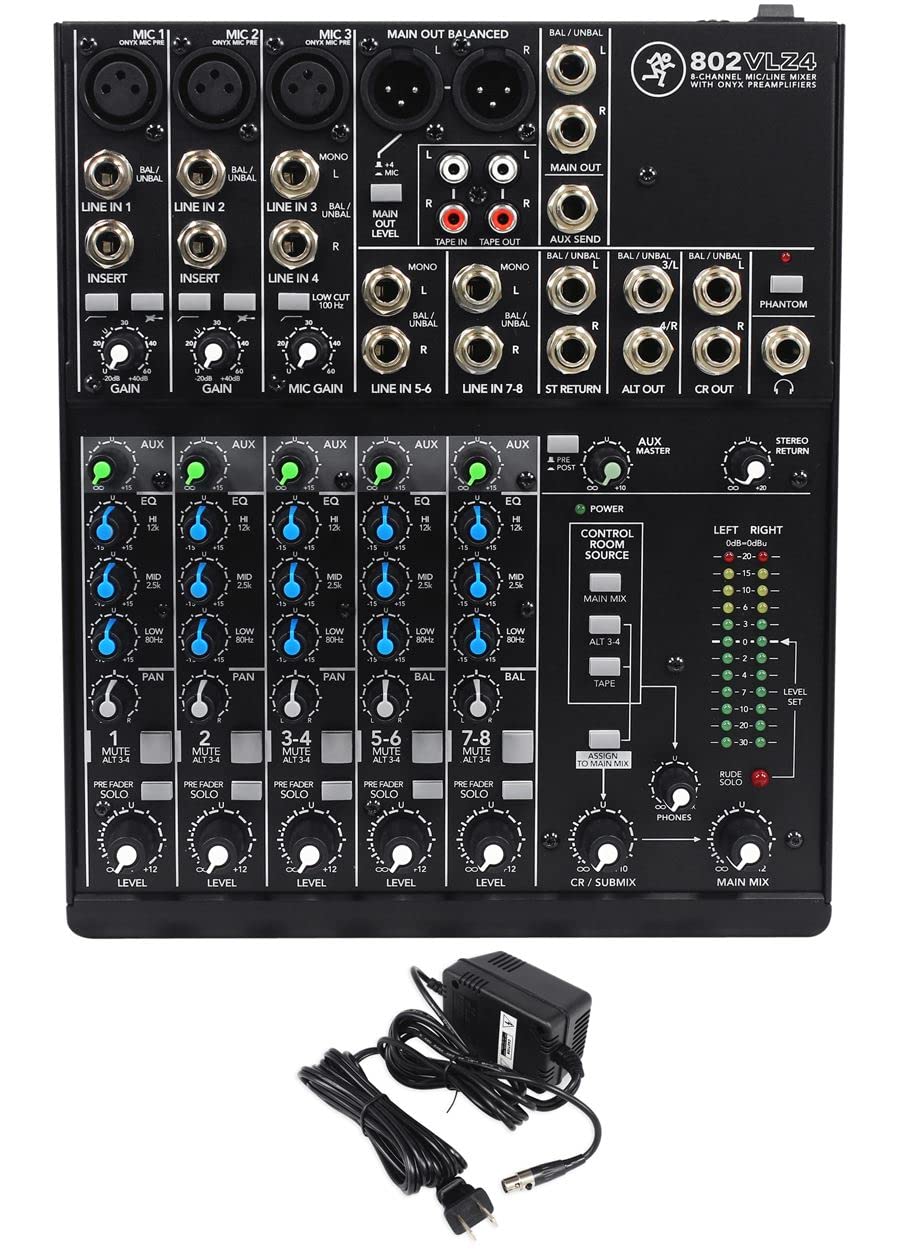
Not every channel on a mixer includes a microphone preamp. A mixer might list 8 channels but only have 3 or 6 mic preamps, with the rest being line-level inputs for keyboards or CD players. For example, the Mackie 802VLZ4 offers 8 channels of input but only 3 are dedicated Onyx mic preamps. If you plan to plug in more than three microphones, that is a hard limit you need to respect. Check the spec sheet for the number of XLR mic inputs before you commit.
Phantom Power Is Not Optional for Some Mics
Condenser mics need +48V phantom power sent up the XLR cable to run their internal electronics. A preamp without per-channel or global phantom power means your condenser mics will be nearly silent. If you use dynamic mics like a Shure SM58, you do not need phantom power at all, but having the option on board future-proofs your setup for when you add better mics later.
Quick Comparison
| Model | Best For | Mic Preamps | Power Output | Weight | Amazon |
|---|---|---|---|---|---|
| Mackie 802VLZ4★ Best Overall | Compact live mixing | 3 Onyx | — | 4.5 lbs | Amazon |
| Soundcraft Notepad-8FXBest Value | Home USB recording | 8 | — | 1 kg | Amazon |
| Pyle PT8050CHBest Multi-Zone | Multi-zone home speaker systems | 8 | 4000W | — | Amazon |
| Rockville RPM870 | Powered PA rigs | 8 XDR2 | 750W x 2 RMS | — | Amazon |
| Rolls RM82 | Simple rack-mount utility | 8 | — | 5.4 lbs | Amazon |
| Yamaha AG08 | Live streaming and podcasting | 8 | — | 4.9 lbs | Amazon |
| Zoom LiveTrak L-8 | Portable recording on the go | 6 | — | — | Amazon |
| Focusrite OctoPre Dynamic | Studio channel expansion | 8 | — | 7.5 lbs | Amazon |
| Bose T8S toneMatch | Touring musicians with Bose systems | 8 | — | 4 lbs | Amazon |
In‑Depth Reviews
1. Mackie 802VLZ4
Our pick — over 4.5★ from 800+ verified ratings; the strongest balance of quality and price.
The compact workhorse that packs three studio-grade Onyx preamps into a tiny all-metal frame.
What wins people over here is rock-solid reliability — the single most-praised trait in the owner community. This is the mixer owners describe driving motocross PA systems and home guitar rigs alike, with a clean, low-noise signal path that needs no added noise suppression. The all-metal chassis and 4.5-pound weight make it easy to toss in a bag for a gig, yet dense enough to feel genuinely pro.
The headline spec is the pair of boutique-quality Onyx mic preamps on channels 1 and 2, backed by a third on channel 3, all feeding 8 total input channels. Phantom power is on board for condenser mics, and the improved RF rejection (resistance to radio interference) makes it a go-to for broadcast work. Owners note the preamps are clean and powerful, and the XLR balanced outputs keep the signal stable over long cable runs. At just 15.8 inches deep, it slips into compact spaces where deeper boards won’t fit.
One honest quirk: buyers report that “my only issue was that I received a slightly different revision than what was pictured.” The unit shipped with a 12V wall-wart power supply instead of the expected 18V, which caught some owners off guard. Also, the knobs lack center detents (the clicky stops that help you find a setting by feel) and feel a touch slippery, and the sparse Quick Start Guide pales next to the full manual PDF with its useful block diagram. The headphone output works at any volume for recording, which is a genuine plus for quiet practice.
Why the crowd trusts it
- Clean, powerful Onyx preamps with no added hiss
- Compact all-metal build for easy transport
- Phantom power and RF rejection for broadcast use
Fit notes to know
- Only 3 mic preamps despite 8 channels
- Wall-wart supply may differ from the pictured revision
- Knobs lack detents and can feel slippery
Reach for it when: you want a trusted, low-noise mixer for small live gigs, home recording, or installed PA setups where reliability is the top priority.
Think twice if: you need more than three microphone preamps on board — this board’s remaining channels are line-level only.
2. Soundcraft Notepad-8FX
A tiny 1 kg mixer that packs studio-grade Lexicon reverb and a USB interface into one box.
Sound quality is the trait owners mention most here, and the reason is the built-in Lexicon reverb, echo, and delay effects — the same legendary effect algorithms found in much pricier studio racks. This is the mixer for a keyboard player or home podcaster who wants one compact box for both mixing and recording. The integrated USB audio interface connects to a Mac or PC for plug-and-play recording, which reviewers describe as a step above a basic 2×2 audio interface.
The 8 channels include 8 mic preamps across the board, plus phantom power for condenser mics, and the aux output doubles as a second headphone jack for monitoring. Owners who run it daily call it a reliable workhorse: “three years and no problems” is the kind of verdict that shows up repeatedly, with the unit connecting to computers, TVs, and amps all at once. The durable metal enclosure is built for the wear of regular use, and the compact footprint fits neatly on a crowded desk.
There are a few omissions worth knowing about before you buy. There is no power button — the unit is always on when plugged in — and no mute buttons per channel, so you lower the mic volume when it’s idle. Compatibility gets mixed feedback, with some owners reporting it won’t work when plugged in while others praise the simple routing. The reverb parameter knob selects programs without clicks, so you cannot feel where you are in the list, just hear it.
The sound-forward pick
- Genuine Lexicon reverb, echo, and delay on board
- Integrated USB interface for direct computer recording
- 8 mic preamps in a compact 1 kg metal frame
Loose ends
- No power button and no mute buttons
- USB compatibility is mixed in owner reports
- Effects knob has no detents for visual confirmation
Get this if: you want one small box that mixes, applies studio-quality effects, and records to a computer without extra gear.
Look elsewhere if: you need per-channel mute buttons or a physical power switch in your workflow.
3. Pyle PT8050CH
The 8-zone powerhouse that streams Bluetooth to built-in house speakers in minutes.
This is the pick for whole-home audio distribution, and the defining scenario is in the reviews: a buyer found 8 ceiling-mounted speakers in a new house, plugged in the wires, connected Bluetooth from a phone, and had the whole system running in about 15 minutes. That is the exact use case this amp nails. Rated at 4000W of power with support for 4-8 ohm speakers, it drives multi-zone setups that would choke smaller receivers. Owners value it enough that the most-praised trait is value for money, with easy setup close behind.
Connectivity is the story here — 9 inputs total including 3 pairs of RCA inputs, 2 quarter-inch microphone inputs, AUX 3.5mm, USB, and an SD card slot. The voice priority button ducks the background music when you talk into Mic 1, which is perfect for paging and announcements. Bluetooth pairing is described as quick and low-maintenance, and owners mention one can control all 8 channels individually from the front control center. Each channel gets its own volume knob, so you can balance zones independently.
The caveat is reliability — it is the most-discussed aspect in the reviews and the verdict is mixed, not positive. One owner reported an overheating incident after about a year on a power cycle, while others report years of solid service. The bass is less pronounced than some dedicated amps, and the unit resets to the USB input on power-up with no input memory. Also, it stands slightly over 2U tall, so rack mounting needs a shelf rather than direct rail mounting.
Zone control: the independent per-channel volume and voice priority button make it a natural fit for paging, restaurants, and whole-house setups, not just music playback.
Best for: homeowners and small venues with multiple speaker zones who want Bluetooth streaming and mic paging from one rack unit.
Not for: audiophiles chasing deep bass or anyone needing a predictable input that remembers its last selection.
4. Rockville RPM870

The 750W-per-side powered mixer that outperforms big-name amps for a fraction of the cost.
Quality is what the owner community praises most here, and for a powered mixer, the numbers back it up: 750W x 2 RMS at 4 ohms and 500W x 2 RMS at 8 ohms, with program ratings up to 3000W x 2. Customers note it easily drives Peavey and Bose speakers plus stage monitors. This is a complete PA-in-a-box solution — 8 XDR2 low-noise mic preamps with +48V phantom power for vocals and instruments, plus USB playback and recording, Bluetooth streaming, and a headphone jack with PFL monitoring for cueing channels before you bring them into the mix.
The onboard effects are a real asset: a 24-bit processor with 16 presets, FX level controls, a mute button, and an FX footswitch input for hands-free control mid-song. The dual 7-band EQ gives you serious tone-shaping power over the main output, while each channel gets its own 4-band EQ. Owners specifically note how clean the mic preamps are and that the unit runs very cool even under load, which is more than many budget amps can claim.
The honest trade-off is that the 3000W peak rating is not a true continuous figure — owners note it sounds comparable to a 450W x 2 PA in practice. The fan never stops running, which can be a concern in quiet venues, and the control labels are small and hard to read from a distance. There is no serial number for warranty registration, and the 4-ohm limit means you should not run more than four 8-ohm speakers per side. Owner sentiment on the hardware is strong, though support gets mixed marks.
The powered-PA value king
- 750W x 2 RMS onboard amplification
- 16-preset 24-bit effects processor with footswitch input
- Clean XDR2 preamps that run cool under load
Know before you gig
- Fan runs constantly — audible in quiet rooms
- Peak wattage rating overstates real continuous output
- Small control labels and no serial number
Choose it for: a self-contained powered mixer for live bands and mobile DJs who want built-in effects and Bluetooth without a separate amplifier rack.
skip it if: silent operation matters or you plan to push more than four 8-ohm speakers per channel.
5. Rolls RM82

A rare 1U rack mixer with eight real mic preamps and per-channel 48V phantom in a no-frills frame.
This is the utility player for installed sound — the kind of box a school auditorium or gym worship team mounts in a rack and forgets about. It is a rare 1U form factor (one rack unit tall) with eight 1/4-inch unbalanced inputs, each of which can be internally jumpered to become an insert or a direct output. Every channel gets its own trim control plus treble and bass cut tone controls, and critically, each channel has individually switchable +48V phantom power for condenser mics. Owners running two of them in a gym praise the low-noise performance and simple setup.
The flexibility extends to the back panel: an RCA prefader output for recording or monitoring, and an RCA aux buss input that lets you cascade units or feed a ninth unbalanced input. The AUX input can serve as a ninth channel, which is a clever workaround if you need just one more input. At 5.4 pounds, it is easy to handle during installation, and the all-analog signal path requires no software or drivers — set levels, and it works.
The honest limits: output is weaker than a Shure transformer-balanced mixer, so you may need more gain downstream. A long-time audio veteran flags occasional humming or line noise in some units, and the field longevity is the recurring concern — one owner notes the units “don’t seem to last more than two years in the field” and suggests studio use may be a better fit for longevity. At normal sound levels, though, it sounds clean and does exactly what a rack mixer should.
Transparent gain: per-channel phantom power and true mic preamps on every input make it a genuine 8-mic solution, not a mixer that counts line jacks as channels.
Reach for it when: you need eight real mic preamps in a single rack space for a permanent installation like a classroom or house of worship.
Think twice if: your rig lives a rough touring life — reviewers point out the analog internals prefer a stable studio environment.
6. Yamaha AG08

A powerful little black box built for streamers who need clean 48 kHz audio and tactile control.
This is the modern creator’s mixer — an 8-channel USB-C audio interface and live streaming mixer with XLR and TRS outputs, designed for podcasters and streamers who want hardware control over their broadcasts. Owners describe it as a “powerful little black box with blinky lights” that does exactly what it is meant to do in a clean, powerful way. The 11.5-inch-deep chassis at 4.9 pounds is compact enough for a crowded desk, and the XLR and TRS output options cover both professional and consumer gear.
It is listed as a demo unit, which is worth knowing — this is the 8-channel mixer/USB interface that Yamaha built for the streaming boom, with loopback and sound pad features designed for broadcast use. The preamps deliver great mic sound, and the many buttons give you hands-on control over your stream mix. The basic USB input and output work without any driver, so you can plug in and record immediately on a Mac or PC.
The catch is the software. The Yamaha Steinberg driver requires disabling macOS System Integrity Protection, which is a genuine security risk, and owners flag it as the major flaw. The multi-channel and controller features need that driver, so you get basic USB I/O from the start but not the full routing capabilities. Some owners also report the routing table is missing key controls — you cannot easily exclude your mic or soundboard from the Stream mix, and the soundboard lacks its own dedicated channel. Channel 2 failing after six months is also on record, with the owner noting Yamaha support made the fix process a hassle.
The creator-focused board
- 48 kHz USB-C interface with loopback for streaming
- Powerful, clean mic preamps in a compact frame
- XLR and TRS outputs for flexible routing
Setup stress points
- Steinberg driver needs macOS SIP disabled — a security risk
- Routing table lacks full stream-mix exclusion controls
- At least one unit developed a dead channel at six months
Get it for: streamers and podcasters who want Yamaha-quality hardware and are comfortable with the driver requirements for full features.
Look elsewhere if: you are on macOS and will not disable SIP, or you need granular control over routing each sound source to your stream.
7. Zoom LiveTrak L-8

The battery-powered mixer-recorder that captures 12 tracks at once for bands and podcasters on the move.
This is the most versatile pick in the lineup because it is three devices in one: a mixer, a multitrack recorder, and a USB audio interface, all powered by batteries so you can record anywhere. It captures 12 tracks simultaneously at 24-bit/96kHz quality directly to an SD card, which is studio-grade resolution for a portable unit. Owners describe it as “maybe the best portable mini-studio recorder,” praising the standalone mixing capability that needs no computer at all. For a podcasting duo or a small band rehearsing off-grid, this removes the laptop from the equation entirely.
The 6 preamps deliver a -121dBu noise floor (an extremely low hiss level) with up to +54dB of gain and a 3-band EQ plus onboard effects on every channel. Four headphone outputs with three independent monitor mixes mean each performer gets their own personalized mix — a feature normally found on far pricier studio desks. The 6 assignable Sound Pads with 13 built-in sounds give you instant playback triggers for intros and stingers. It also records to SD and computer at once via USB, so you get a backup while you stream.
The learning curve is real — owners consistently say to read the manual to avoid frustration, especially for the menu-driven presets and saved settings, which some find annoying. Channels 7 and 8 are line-level only with no preamps, so they work for keyboards but not microphones. For small PA work it outperforms many dedicated podcast interfaces, and an external USB power bank keeps it running as an interface. It is built solidly despite some durability concerns.
Record anywhere: battery power plus simultaneous SD and USB recording makes this the only pick here you can run in a park, a van, or a stage without hunting for an outlet.
Choose it for: podcasters, streamers, and small bands who want to record multitrack on location without a computer and give each performer their own mix.
pass on it if: you prefer knob-per-function simplicity — the menu-driven presets here demand a read of the manual.
8. Focusrite OctoPre Dynamic

The studio-expansion workhorse that adds eight natural-sounding preamps with analog compression to any ADAT interface.
This is the serious studio pick — a dedicated 8-in/8-out mic preamp designed to expand an existing audio interface via ADAT, the optical connection standard for adding channels. The defining spec is the flexible analog compression on every channel, which means you can tame loud sources like drums before they hit your converter. Owners describe it as “the best tool I’ve added to my studio” and note it pairs perfectly with a Focusrite 18i8 to reach 12 balanced inputs plus 4 line inputs. If you already own an interface with spare ADAT ports, this is the cleanest way to grow from 8 to 16 channels.
The preamps are the natural-sounding Scarlett type that built the brand’s reputation, and the precision AD/DA conversion runs up to 192 kHz sample rates for high-resolution recording. The eight balanced line inputs and two front-panel instrument inputs cover everything from vocals to guitars, and the accurate 5-segment LED metering on each channel keeps your levels honest. State-of-the-art digital clocking with Word Clock I/O lets you sync to external devices without drift or jitter, which matters when you are stacking multiple converters.
One crucial note: this is not plug-and-play. Owners flag that you must use the Focusrite Control software to dial in the routing, which adds a setup step before you can record. At 7.5 pounds, it is a rack-mountable desktop unit with a solid feel. The +48V phantom power is available on every channel for condenser mics, and the 20 KHz frequency response covers the full audible range cleanly. For drum tracking, the tune headroom handles the transient spikes without clipping.
The channel-count expander
- 8 natural-sounding preamps with analog compression per channel
- ADAT connectivity for any brand of interface
- 192 kHz conversion with Word Clock I/O sync
Setup requirements
- Requires Focusrite Control software — not pure plug-and-play
- Heavier than most portable mixers at 7.5 pounds
- Requires an existing ADAT-equipped interface
Get it if: you have an audio interface with spare ADAT ports and want to add eight channels of quality preamps with analog compression for drum or band tracking.
Reconsider if: you are looking for a standalone recorder or mixer — this is purely an expansion unit, not a complete interface.
9. Bose T8S toneMatch
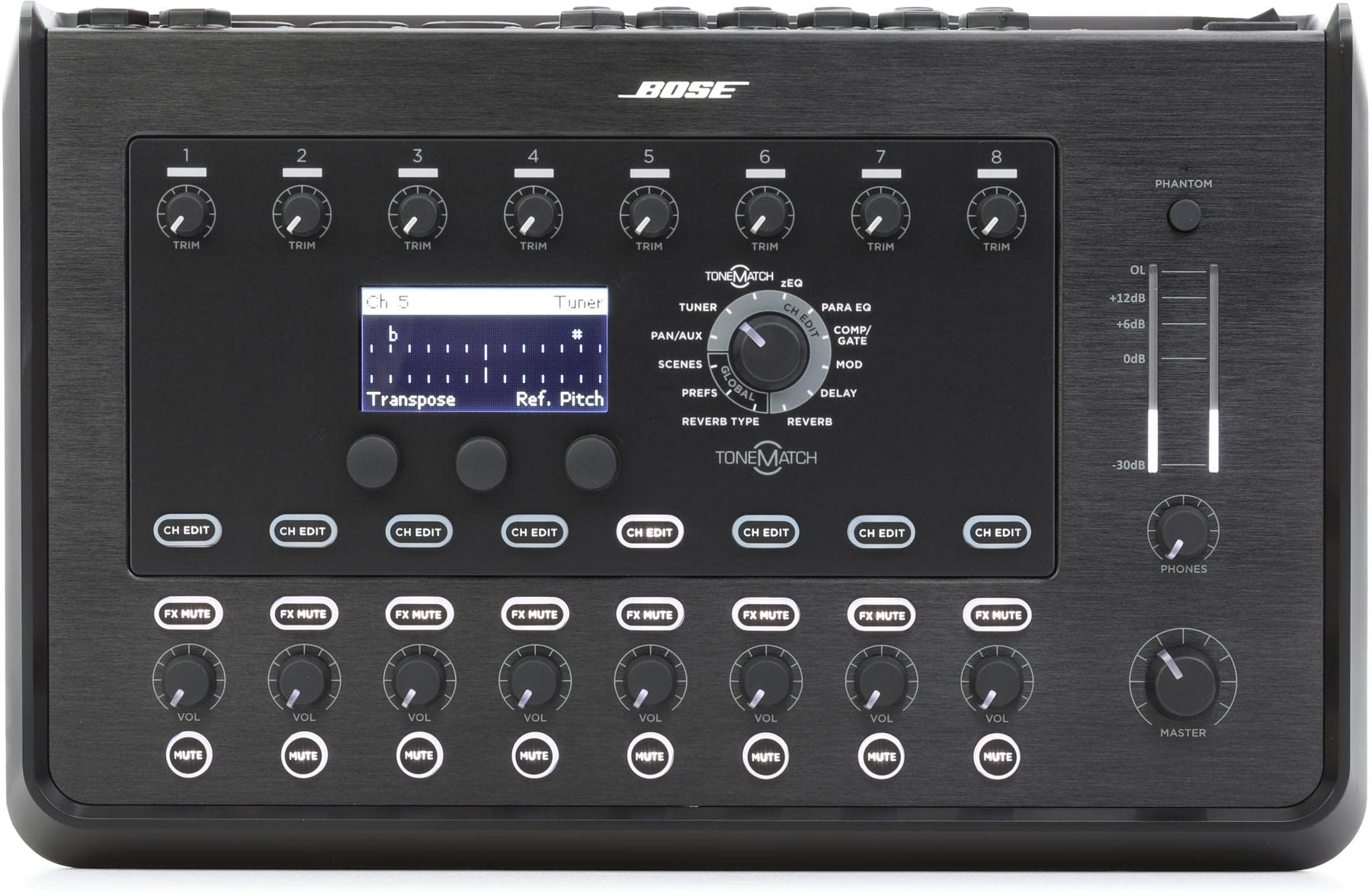
The 4-pound touring mixer with pre-programmed ToneMatch EQ that dials in pro sound in seconds.
Sound quality is what owners here praise most, and the secret is the exclusive ToneMatch technology — pre-programmed EQ curves for specific mics, instruments, and drums that save hours of setup time. For a gigging musician with a Bose L1 system, this is the perfect pairing, described by owners as a workhorse with “studio-grade live sound quality,” especially for voice processing. The 8 high-quality audio preamps sit behind combo jacks that accept either microphones or instruments, with switchable phantom power, 2 aux inputs, and 4 aux sends for flexible routing.
The defining advantage is portability plus power: at 4 pounds, it is the lightest full-featured 8-channel mixer here, and the tactile, illuminated controls with LED display are easy to read even on a dimly lit stage. Owners note it handles feedback control better than expected with condenser mics, and a full band — upright bass, guitar, mandolin, banjo, fiddle, and vocals — runs cleanly through a single unit. The USB-A and USB-B ports handle drive playback and PC/Mac interfacing, and the stereo headphone output gives you a quick monitor check.
The honest trade-off is value — owners are split on whether the price is justified, with several calling it pricy for what it is. There is a loud boom on power on and off that you will want to account for in your routine, and the compact layout takes some learning to navigate confidently. The ToneMatch EQ presets save real time on stage, and the camera tripod mount and mic stand mount add mounting flexibility. Included in the box are the cover, the mixer, and the power supply.
Stage-ready simplicity
- ToneMatch pre-programmed EQ saves setup time
- 8 combo jacks for mic or instrument inputs
- Only 4 pounds with illuminated, dim-light-readable controls
Honest trade-offs
- Value for money is mixed in owner feedback
- Loud pop on power on and off
- Compact layout has a learning curve
Reach for it when: you play live with a Bose L1 system and want studio-quality EQ presets in a lightweight, stage-lit-friendly mixer.
Think twice if: budget is your primary constraint or you want a deep effects library rather than pre-programmed EQ curves.
Understanding the Specs
Mic Preamp vs Line Input
A mic preamp boosts the very weak signal from a microphone (measured in millivolts) up to line level, which is what mixers and recorders expect. Line inputs, by contrast, accept the much stronger signal from keyboards, CD players, or audio interfaces. When a mixer advertises 8 channels, check how many are XLR mic inputs with preamps versus line jacks — a count of 8 channels does not mean 8 microphones can plug in.
Phantom Power +48V
Condenser microphones need a 48-volt DC supply sent up the XLR cable to power their internal electronics. A preamp with phantom power on every channel lets you use any condenser mic on any input. Per-channel phantom switches give you more control — you can power only the mics that need it, while leaving dynamic mics unpowered to avoid any risk of damage.
FAQ
How many microphones can actually plug into an 8 channel preamp?
Will an 8 channel preamp work with my condenser microphone?
Do I need a powered mixer or a standalone preamp?
Can I record to my computer with an 8 channel preamp?
What is ADAT and why does it matter for an 8 channel preamp?
How long will a budget 8 channel mixer last?
Is a higher wattage rating always better for a powered mixer?
What is the difference between an 8 channel mixer and an 8 channel audio interface?
Can I use a guitar or other instrument in an 8 channel preamp?
Do I need separate effects like reverb and delay?
Final Thoughts: The Verdict
For most buyers, the 8 channel preamp winner is the Mackie 802VLZ4 because its reliability record and clean Onyx preamps make it the safest long-term investment in the group. If you want built-in Lexicon effects and USB recording in one compact box, grab the Soundcraft Notepad-8FX. And for expanding a home studio’s inputs without buying a new interface, the Focusrite OctoPre Dynamic is the one to reach for.
How We Picked
We do not accept paid placement. Every pick is matched to a real buyer and a real use-case; we do not hands-on test units.
Sources & Methodology
Specifications: manufacturer listings and product documentation. Review insights: verified customer reviews, as of August 2026. Pricing: not shown on this page (it changes often); check the current price via the retailer link.
As an Amazon Associate, Gadgets Feed earns from qualifying purchases. This does not affect which products we feature.