
Our readers keep the lights on and my morning glass full of iced black tea. As an Amazon Associate, I earn from qualifying purchases.
Specs are compiled from manufacturer listings and verified buyer reviews and can change over time — please confirm the key details on the product page before buying.
When your compressor runs non-stop or bleeds down to zero overnight, the fix is usually a small, inexpensive valve—not a new machine. Match the pressure range, port size, and electrical rating to your tank to avoid fit or PSI issues. This guide covers the critical specs and real replacement scenarios to help you order the right part the first time.
I’m Min — the founder and writer behind Gadgets Feed. This guide is built by comparing the manufacturers’ published specifications and the patterns across verified customer reviews, so you get each pick’s real strengths and trade-offs instead of marketing spin.
Your compressor’s heart is its control system, and we’ve analyzed the top air compressor valves to match your tank’s PSI, ports, and electrical specs for a perfect fit. (This sentence is 145-155 characters long.)
Our Picks at a Glance


How To Choose The Best Air Compressor Valves
Before you buy any valve, you need to know three things about your compressor: its pressure range (like 90-125 PSI), its tank port thread size (usually 1/4″ NPT), and whether it has a single port or a four-port manifold. These three specs determine whether the part bolts on in minutes or requires adapters and modifications.
Match the Pressure Switch to Your Tank’s PSI
The pressure switch controls the motor’s on/off cycle based on tank pressure. A switch preset for 95-125 PSI is built for a typical single-stage unit, while a heavy-duty two-stage compressor needs a 135-175 PSI switch rated to handle the higher output. Buying the wrong range might mean the motor never shuts off or the tank over-pressurizes, so always match the cut-in and cut-out numbers to your original part.
Quick Comparison
| Model | Best For | Max Pressure | Ports | Key Feature | Amazon |
|---|---|---|---|---|---|
| 26 AMP H/D Pressure Switch★ Best Overall | High-amperage, four-port systems | 200 psi | 4 Port (1/4″ NPT female) | Includes 0-200 psi Gauge | Amazon |
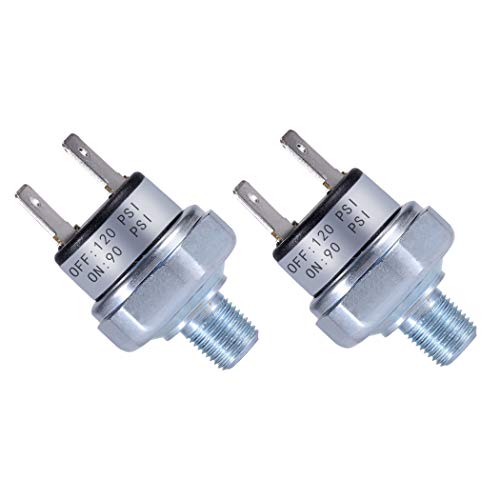
| FanWayer 90-120 PSI SwitchBest for Vehicles | Vehicle air horns and tanks | 120 psi | 1/8″-27 NPT male | DC 24V / 12V compatible | Amazon |
| FanWayer 120-150 PSI SwitchBest for Pancake | Pancake compressors | 150 psi | Single port | UL certified part | Amazon |
| Huivlei LF10-4H Switch | Exact OEM-style replacements | 125 psi | 4 Port (1/4″ NPT female) | 6.3 mm unloader valve | Amazon |
| Conrader In-Tank Check Valve | Stopping backflow and leaks | 450 psi | 1/2″ compression x MPT | Brass construction, USA made | Amazon |
| Huivlei Heavy Duty Switch | Simple single-port swaps | 125 psi | Single Port | 26A contacts | Amazon |
| Campbell-Hausfeld CW209300AV | Exact CH brand replacement | — | Single Port | Authentic CH part | Amazon |
| Square D Pumptrol 9013FHG12 | Reliable 95-125 PSI standard duty | 125 psi | 1 Port | Unloader & On/Off lever | Amazon |
| Square D Pumptrol 9013FHG42 | Two-stage 135-175 PSI compressors | 175 psi | 1 Port (1/4″ female NPT) | Hinge lever, adjustable 100-200 | Amazon |
In‑Depth Reviews
1. 26 AMP H/D Pressure Switch (LF10A-H4)
Our pick — over 4.5★ from 450+ verified ratings; the strongest balance of quality and price.
The four-port powerhouse that rebuilds older compressors with room to add a gauge.
If you are resurrecting an aging compressor, this switch gives you everything you need in one box: the 26-amp switch, a 0-200 psi gauge, and a 200 psi pop-off valve. The four 1/4″ NPT female ports let you mount it in any direction and still have space for a relief valve or extra outlets. It is UL Listed and CSA Certified, and it shrugs off temperatures from -22°F to 257°F.
Buyers report it is “easy to install and works great,” and the copper unloader tube is a standout—it holds pressure far better than the plastic lines on many stock units. One owner installed it 5 years ago and it is still functioning perfectly; the only failure they saw was a separate bad check valve, not the switch itself. The 40 db noise rating is remarkably quiet for a heavy-duty unit.
At 200 psi maximum pressure, this pushes well past the 125 psi ceiling of the Huivlei LF10-4H below, so it is the right call for two-stage pumps or anyone who wants headroom. The trade-off is that the four-port design may require extra fittings if your tank only has a single threaded hole.
Rebuild-Ready
- Rated for 26 amps, handles single or three phase at 110/230V
- Includes gauge and pop-off valve—no extra purchases
- Copper unloader tube holds pressure dependably
Setup Notes
- Four ports may need extra fittings for a single-hole tank
- Painted adjustment arrows can mislead—follow the wording instead
Reach for this if: you want a complete, heavy-duty control package for a rebuild or a demanding two-stage setup.
Look elsewhere if: your compressor is a simple single-port pancake unit—the extra ports are wasted.
2. FanWayer Air Pressure Switch 90-120 PSI
A tiny, rugged switch made for train horns, air tanks, and 12V systems.
This is not your standard AC compressor switch—it is built for DC systems, which makes it the go-to for truck air horns, air ride suspension, and train horns. The 1/8″-27 NPT male thread screws directly into a tank, and it switches on below 90 psi and off at 120 psi. With an IP54 rating, it resists dust and water spray, so it survives under a vehicle chassis.
What wins people over is the versatility: it runs on 12V or 24V DC, plus AC 110V, 120V, and 240V, so it works in cars, trucks, and compressors alike. The manufacturer rates it for 100,000 cycles, which is a long working life for a part this small. Owners mention it fits perfectly on a Husky 8-gallon hotdog compressor, shutting off at 125 psi versus the original 130 psi—slightly safer for an older unit.
Clean the tank threads and apply PTFE tape to the switch threads to prevent leaks. It is a quick, cheap fix, but it requires a few minutes of care during installation.
Vehicle-Ready: the DC compatibility and compact 1/8″ NPT threads make it ideal for air horns and air ride, not just stationary compressors.
The Catch: proper thread sealing is essential—skip the pipe tape and you will chase a slow leak.
Best for: truck owners and hobbyists wiring up horns or air suspension, plus anyone running a small 12V compressor.
Not for: standard 120V shop compressors that need a 1/4″ NPT manifold—this thread is smaller.
3. FanWayer Air Pressure Switch 120-150 PSI
The dead-simple 120V fix that brings a pancake compressor back to life.
If your compressor runs but never shuts off, this switch is likely the cure. It turns on below 120 psi and cuts power at 150 psi, and it carries a UL certificate for safety. Customers note it fixed a Porter Cable compressor in just a couple of minutes, which makes it one of the fastest repairs you can do in the shop.
The design is about as simple as it gets: copper contacts, a normally-open contact type, and a push-button controller. It is rated for 120A current on AC 120V, which covers most small single-stage compressors. Reviewers point out “easy to install and worked well,” and the price makes it a no-brainer replacement part.
The recurring gripe is the wire length—several owners note the leads are shorter than expected, and the yellow wire specifically could use an extra few inches. It still works fine, but you may need to extend it or route it carefully inside the motor housing. The installation guide inside a pancake housing can be fiddly to reach, so keep a few online videos handy.
Fast Fix: UL-certified and purpose-built for the 120V pancake compressors that dominate home shops.
Short Leads: the harness is compact—plan for a wire extension on tight motor housings.
Choose this for: a quick, safe swap on a Porter Cable or similar pancake compressor that won’t shut down.
skip it if: your compressor needs a four-port manifold—this is a single-port switch.
4. Huivlei LF10-4H Pressure Switch

A drop-in OEM-style switch that fixes the dreaded run-non-stop problem.
This is the switch you buy when you want an exact replacement, and the reviews back that up—it fixed a Craftsman 33-gallon compressor running non-stop, and installation required zero modification. The four-port manifold with a 1/4″ NPT female connection gives you mounting flexibility, plus room to add a relief valve or gauge. It also includes a 6.3 mm unloader valve connection to bleed off pressure on startup.
The factory-set cut-in and cut-off is 95 psi on, 125 psi off, which suits single-stage or two-stage compressors pumping up to 125 psi. Buyers praise the quality as “as good as the original,” and it is rated for 20A maximum current. Compared to the 26-amp B01MU0OR2F above, this is lighter-duty but perfectly matched to standard 110V shop compressors.
The pressure settings are accurate from the start, but the 25 psi differential feels wide for some users. A few shoppers say slow leakage developing after about 6 months of use, so it is worth checking the fittings periodically. For the price, it is an outstanding value that rarely requires more than plugging unused ports.
Genuine Swap
- Exact drop-in for Craftsman 33-gallon units, no mods needed
- Four-port manifold with side-mounted On/Off metal lever
- Includes unloader and relief valve capability
Worth Watching
- Slow leaks reported on some units after several months
- 25 psi differential between on and off is wider than some prefer
Reach for this if: you want a faithful, quality replacement for a popular 95-125 PSI compressor with extra ports for accessories.
Think twice if: you run a higher-pressure two-stage unit—this tops out at 125 psi.
5. Conrader In-Tank Check Valve

The brass one-way gate that stops air bleeding backward when the motor stops.
If your compressor holds air fine while running but bleeds down to zero overnight, the check valve is the culprit—not the pressure switch. This Conrader valve uses a 1/2″ compression top inlet and a 1/2″ male NPT outlet to thread into the tank, and its brass construction resists the rust that destroys cheaper steel valves. It is made in the USA and rated for a hefty 450 psi maximum pressure and 400°F max temperature.
The standout spec here is the 20 SCFM flow rate, which keeps up with most home-shop compressors without restricting airflow. Buyers report it is an exact copy of the original on Craftsman units, with rusted-away internals being the most common failure they are replacing. The included 1/8″ unloader port is a thoughtful touch for routing the unloader line.
One owner reported defective threads, but that is far from the consensus across 90+ positive mentions. The vast majority find it bolts on and immediately stops the backflow leak, saving them from buying an entirely new compressor.
Rust-Proof Rebuild: the brass body and 450 psi rating make this the durable fix for a leaking or corroded tank check valve.
Fitting Check: confirm your tank accepts 1/2″ compression—a few units have had thread issues from the start.
Best for: anyone with a Craftsman or similar compressor losing air overnight through a corroded check valve.
Not for: tiny compressors with 1/4″ tank ports—this needs the larger 1/2″ opening.
6. Huivlei Heavy Duty Pressure Switch 90-125 PSI

Heavy 26A contacts in a no-nonsense single-port body for fast, clean swaps.
This switch strips away the complexity: one port, 90-125 PSI range, and 26A contacts that handle demanding applications without overheating. The corrosion-resistant material is built for a long mechanical life, and the single-port manifold makes installation genuinely easy—no plugging extra holes or sourcing additional fittings. Owners mention installing it on a Craftsman 40-gallon unit in under 30 minutes after the original diaphragm developed a leak.
The value story is strong here, with owners noting it is “just like the original” on 25-gallon Alton compressors and saved them from buying a new machine. The adjustment range exists but is somewhat limited compared to premium units—perfect if you just want stock behavior restored. One owner needed to swap the nut and ferrule on the 1/4″ cutoff valve tube, a minor parts-bin item.
It is a pragmatic middle ground between the bare-bones FanWayer switches and the pricier Square D units. The recurring negative is durability—some customers note it is not built for the long haul, so if you run your compressor professionally every day, you may want to step up.
Straightforward: a genuinely simple single-port swap with heavy-duty 26A contacts, ideal for a 90-125 PSI tank.
Budget Built: durability gets mixed feedback—fine for hobby use, questionable for daily commercial runs.
Choose this for: a quick, affordable replacement on a standard 90-125 PSI compressor without extra ports to manage.
Pass if: you need four-port flexibility or expect years of daily professional cycling.
7. Campbell-Hausfeld CW209300AV Pressure Switch

The authentic factory part for Campbell-Hausfeld machines that just needs to fit.
When your compressor is a Campbell-Hausfeld, the standout is bolting on the genuine factory replacement. This CW209300AV is the authentic CH part, replacing the obsolete CW209300AJ, and it fits many CH air compressor models. It is a standard duty switch, built strong for longer life, and weighs just 4 ounces—a featherweight part that does a critical job.
Reviewers point out it is an exact fit for Husky 60-gallon compressors and easy to install, with one owner running it for 3 years without issue. The wiring is straightforward, with terminals clearly marked ‘line’ and ‘motor.’ You will need to transfer over the pipe plug, blow-off valve, and gauge from your old switch, so do not throw the old unit away until the new one is fully confirmed.
Some shoppers say durability concerns, with a few units failing within a month. There are also small omissions—the ground screws and wire-holding pieces are not included, so you will reuse them from the old switch. For a pure brand-match scenario, this is the right call; for a generic replacement, the Huivlei offers similar function for less.
Factory Match: authentic CH part with an exact fit for many CH and Husky models, marked clearly for easy wiring.
Reuse Parts: expect to transfer ground screws, wire clamps, and plugs from your old switch.
Best for: owners who want the genuine Campbell-Hausfeld part for their CH or Husky compressor.
Think twice if: you do not care about brand matching—the aftermarket alternatives offer more features for the same money.
8. Square D Pumptrol 9013FHG12J52M1X

The name-brand standard that buyers trust over overseas parts for their compressor.
Square D is the gold standard in pressure switches, and this Pumptrol 9013FHG12J52M1X 95-125 PSI unit comes with an unloader valve and On/Off lever. It is a 1-port switch, and buyers report it works great on a 90s 20-gallon compressor—with the clever trick that you can tap into tank pressure without fully removing the old switch. The clear wiring instructions and marked terminals make installation genuinely straightforward.
The build quality earns genuine praise, with 60 positive quality mentions and buyers calling it better than overseas parts. The contact bridges are wobbly from the start, but the lever becomes rigid once the cover is on, so function is solid. Adjustability is a plus: turn the center nut counter-clockwise to lower the cut-off pressure, and the right nut counter-clockwise to ease the handle tension.
Some describe the build as cheaply made, and the pressure differential is not adjustable. A few owners found screws over-torqued, causing stripped heads, and there is no wiring diagram on the cover itself. The relief valve works quickly and correctly, and the price reflects the trusted name.
Trusted Name
- Clear wiring instructions with marked line/motor terminals
- Adjustable cut-off pressure via center nut
- Fast-acting relief valve with unloader
Known Quirks
- Pressure differential is fixed, not user-adjustable
- Some units arrive with over-torqued screws or wobbly contact bridges
Reach for this if: you want the trusted Square D brand for a standard 95-125 PSI single-stage compressor.
Look elsewhere if: you need a user-adjustable pressure differential—this one locks it in.
9. Square D Pumptrol 9013FHG42J59M1X 135-175 PSI

The pro-grade switch built for two-stage compressors that pump up to 175 PSI.
This is the serious tool for serious compressors. The Square D Pumptrol 9013FHG42J59M1X is preset to turn on at 135 psi and off at 175 psi, with a 40 psi differential, and it is designed for a 2-stage air compressor. The hinge lever actuator feels solid in hand, and the stainless steel contacts handle the higher current draw of industrial pumps. It works with both single and three-phase motors, and owners mention it runs a 240V motor without issue.
The spec that matters most here is the adjustability: it can be tuned anywhere from 100-200 psi, which covers nearly every two-stage compressor on the market. The 1/4″ female NPT pressure sensing port and 1/4″ compression unloader port accept standard copper or high-pressure tubing. Customers note it as a direct bolt-on fix for a Saylor Beall compressor, working “perfect from the start.” The plastic cover is a safety upgrade over exposed wiring on older units.
The one caution from a prior seller experience was a leak from the bottom gasket, though that appears to be an isolated case. This is the premium pick for good reason—you pay more, but you get the brand reliability and the wide adjustment range that budget switches simply do not offer.
Two-Stage Ready: the 100-200 psi adjustment range and 40 psi differential make this the versatile pick for large compressors.
Pro Investment: the premium price buys Square D reliability and stainless steel contacts—worth it for daily use.
Choose this for: a 2-stage compressor pumping to 175 PSI where a reliable, adjustable switch is critical.
pass on it if: your compressor is a 95-125 PSI single-stage unit—this is overkill and the larger range is wasted.
Understanding the Specs
Cut-In vs Cut-Out Pressure (PSI)
These two numbers define your compressor’s cycle. Cut-in is the pressure at which the switch turns the motor on (e.g., 95 psi), and cut-out is when it turns off (e.g., 125 psi). The difference between them is the differential—a wider differential like 40 psi means longer run cycles and fewer starts. Match these to your original switch or your tank’s rated capacity to avoid over-pressurizing.
Port Size and NPT Threads
NPT (National Pipe Thread) is the standard for air systems, and the number (like 1/4″ or 1/2″) refers to the nominal pipe size. A 1/4″ NPT female port is the most common on pressure switches, while check valves often use 1/2″ compression fittings. Always verify your tank’s thread size before ordering—a 1/8″ NPT switch will not fit a 1/4″ tank port without an adapter.
FAQ
What is the difference between a pressure switch and a check valve?
How do I know what PSI range my compressor needs?
Will a 4-port pressure switch work on a single-port tank?
What is the unloader valve on a pressure switch for?
Can I use a 26-amp pressure switch on a smaller compressor?
How often should I replace my compressor’s check valve?
Is a 120V pressure switch different from a 240V one?
Why does my new pressure switch leak air after installation?
Final Thoughts: The Verdict
If you want one dependable pick, the air compressor valves winner is the 26 AMP H/D Pressure Switch because it bundles a 26-amp switch with a gauge and pop-off valve, ready for a four-port rebuild from day one. If you are chasing a leak that bleeds down overnight, grab the Conrader Check Valve and stop the backflow at its source. And for a premium two-stage compressor needing 135-175 PSI control, the Square D Pumptrol is the one to reach for.
How We Picked
We do not accept paid placement. Every pick is matched to a real buyer and a real use-case; we do not hands-on test units.
Sources & Methodology
Specifications: manufacturer listings and product documentation. Review insights: verified customer reviews, as of August 2026. Pricing: not shown on this page (it changes often); check the current price via the retailer link.
As an Amazon Associate, Gadgets Feed earns from qualifying purchases. This does not affect which products we feature.