
Our readers keep the lights on and my morning glass full of iced black tea. As an Amazon Associate, I earn from qualifying purchases.
Specs are compiled from manufacturer listings and verified buyer reviews and can change over time — please confirm the key details on the product page before buying.
Choosing a 13-inch subwoofer is about matching raw power to your actual room. These are the heavyweights of home audio, designed to pressurize large spaces and deliver chest-thumping bass for both movies and music, and the real challenge is picking the right amplifier and enclosure type for your setup. You are not just buying loudness; you are buying control, speed, and low-frequency extension down to frequencies you feel more than hear.
I’m Min — the founder and writer behind Gadgets Feed. This guide is built by comparing the manufacturers’ published specifications and the patterns across verified customer reviews, so you get each pick’s real strengths and trade-offs instead of marketing spin.
The finest 13 inch subwoofer options here all bring studio-grade DSP and powerful Class D amplifiers, but they differ wildly in how they pressurize a room.
Our Picks at a Glance
How To Choose The Best 13 Inch Subwoofer
Before you lock in a 13-inch subwoofer, know that the driver size is only half the story. The amplifier’s continuous wattage, the enclosure type, and the digital processing determine whether your room gets tight musical bass or bone-rattling movie effects. Match these three elements to your space and your listening habits.
Sealed versus ported enclosures
Sealed subs deliver punchy, articulate bass that stops and starts quickly — ideal for music and smaller rooms. Ported designs, which use vented ports or tubes, push more air and play deeper and louder, making them the go-to for massive home theater spaces. Some premium models let you switch between the two modes using foam plugs, so you can tune the character to your room.
Amplifier power and DSP controls
Look at RMS (continuous) wattage first — that is the honest measure of sustained output, not the peak figure. A quality digital signal processor (DSP) gives you app or rear-panel control over crossover frequencies and equalization (EQ), which matters more than raw watts when integrating bass with your main speakers. A sub you can tune to your room will always sound better than a louder one you cannot adjust.
Quick Comparison
| Model | Best For | RMS Power | Peak Power | Enclosure Type | Amazon |
|---|---|---|---|---|---|
| SVS SB-3000★ Best Overall | Music-first listeners wanting app control | 800 watts | 2,500 watts | Sealed | Amazon |
| SVS SB-3000 R|Evolution | High-end stereo pair integration | — | — | Sealed | Amazon |
| Monolith THX Ultra | Large home theater rooms up to 3,000 cu ft | 2000 watts | 3800 watts | Ported (switchable) | Amazon |
In‑Depth Reviews
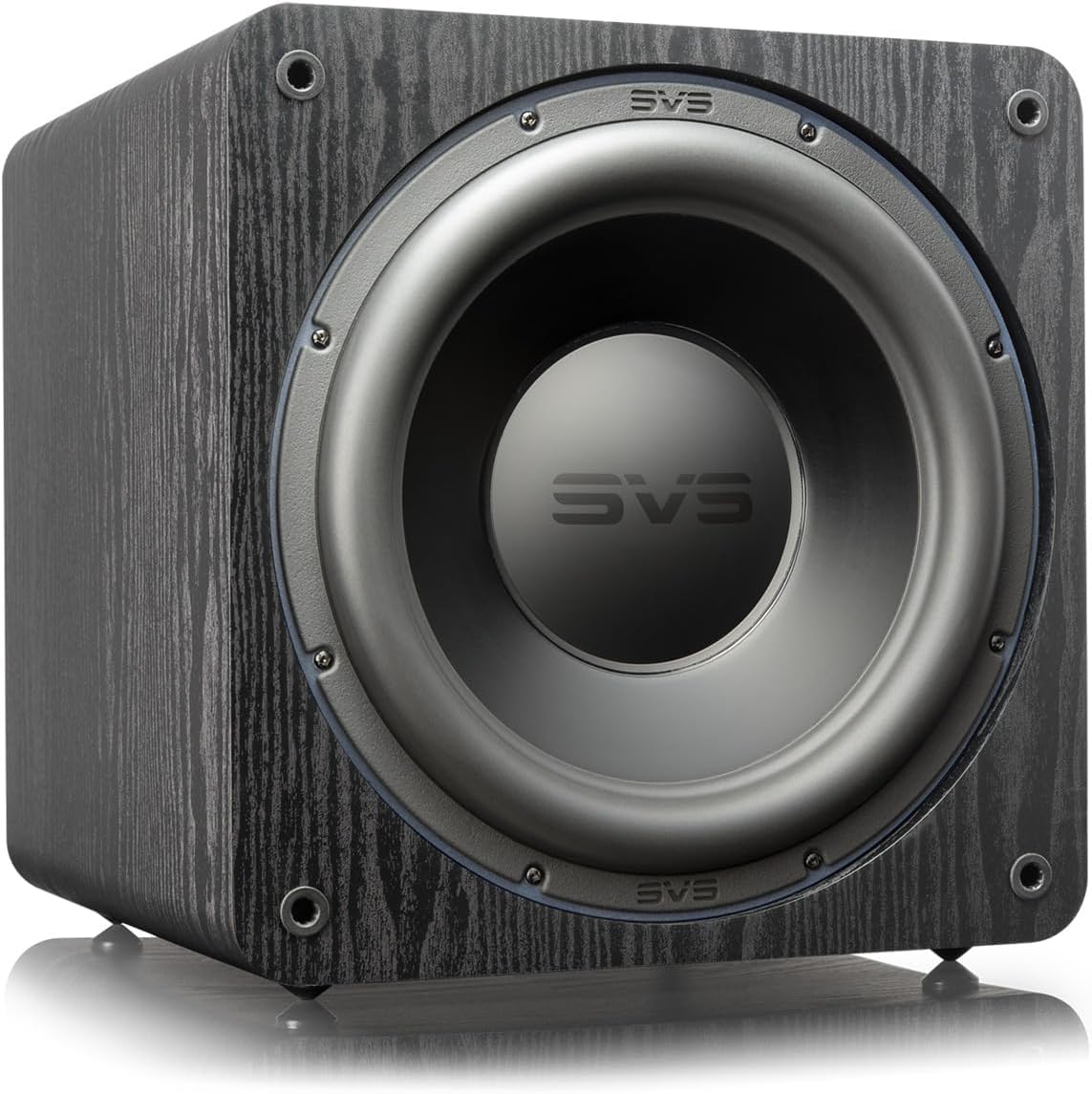
1. SVS SB-3000 Subwoofer – 13-inch Driver
Our pick — over 4.5★ from 250+ verified ratings; the strongest balance of quality and price.
This sealed-cabinet subwoofer gives you studio-grade tuning in a box that fits easily into most rooms, so you get accurate bass without sacrificing floor space.
This SVS redefines what a compact sub can do by pairing an 800 watts RMS (continuous power) amplifier with a brand-new 13-inch high-excursion driver. The result is deep, room-filling bass that starts and stops on a dime, so music keeps its tight, punchy rhythm instead of turning to mush. Buyers report smooth playback down to 28Hz and audible output at 20Hz, shaking a home theater without losing accuracy.
The real ace here is the 50MHz Analog Devices DSP (the digital brain that shapes the sound) and the companion smartphone app. From your seat, you can adjust crossover frequencies, a three-band parametric EQ, polarity, and room gain, then save custom presets for music, movies, or gaming. Bluetooth control works even when the sub is out of sight, and the app shows your changes in real time on both the phone and the rear panel.
At 2,500+ watts peak power, it carries an iron fist inside a velvet glove. Upgraders from a Klipsch R-112 praised the app tuning and found corner placement boosted SPL while fixing a 50Hz response dip. It is heavier and sturdier than its size suggests, and while it leans music-focused, a quick app tweak brings movies to life. It holds a 4.8-star rating from a few hundred owners.
What wins people over
- 800W RMS Sledge amp punches well above its compact frame
- App-based DSP tuning with presets for movies, music, gaming
- Tight, distortion-free bass even at high volumes
The honest limits
- Sealed design lacks the deepest rumble of ported subs
- Built-in Bluetooth needs a paid add-on on some units
Reach for this if: you want accurate musical bass with app-driven control and a footprint that hides in a corner.
Look elsewhere if: your home theater demands the very deepest sub-20Hz rumble that only a ported monster delivers.
2. SVS SB-3000 R|Evolution Sealed Subwoofer
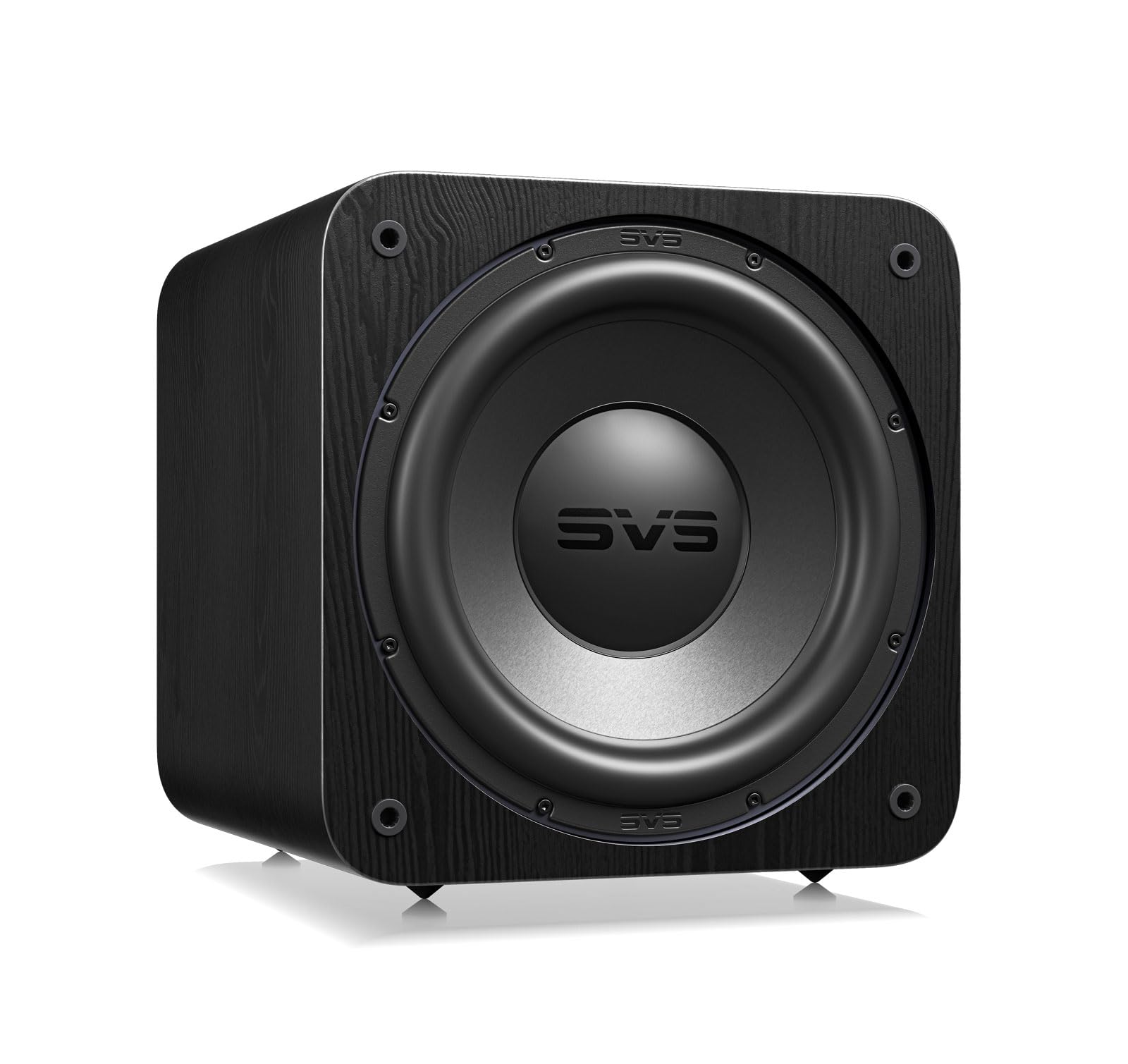
The evolution model built for high-end stereo rigs that need clean, articulate bass integration.
This is the next-generation take on the SB-3000, and it is built specifically for owners of premium speakers who demand bass that keeps up with the detail of the mains. The long-throw 13-inch driver uses a flat edge split wind voice coil to boost magnetic force at extreme excursion while keeping moving mass low, which translates to fast, accurate transients. It is a floor-standing sealed design weighing 54.8 pounds, and owners mention its 13-inch driver comfortably fills a 400 square foot room.
The defining upgrade here is Auto Room EQ, which automatically applies precision filters to tune in-room response — meaning the sub tunes itself to your space rather than leaving you to guess. With KEF R3 Metas, owners heard clear separation between bass drum and tympani, and trombone versus tuba. Paired with Wharfedale Lintons, it delivered deep, rich bass for 90% music and occasional movies.
Replacing a pair of Klipsch R12SW subs, this single unit hits harder and tighter, with app-based low-pass, slope, and dB adjustments. The recommended setup for serious listeners is adding a miniDSP to manage high/low-pass, time alignment, and room correction. It has its own personality — owners note it took some time to dial in perfectly, but the result is reference-grade bass that relieves your main speakers of the heavy lifting.
Made for detail: if you can hear the difference between a bassoon and a viola, this sub is tuned for your ears, not just for shaking walls.
The trade-off: it rewards owners of high-end speakers and patient setup; casual listeners may not open up its full potential.
3. Monolith THX Ultra Certified 2000 Watt Powered Subwoofer

A certified theater monster that pressurizes 3,000 cubic feet with a 2000-watt RMS amplifier.
For a true cinematic experience, this Monolith carries THX Ultra certification, which means THX engineers tested it to play at Reference Level volumes in large rooms up to 3,000 cubic feet without audible distortion. Its 2000 watt RMS amplifier (3800+ watts peak) uses a Texas Instruments 48-bit DSP engine (a digital processor that fine-tunes bass response), and it clearly outpowers the two SVS options: 2000W RMS versus 800W RMS is a 2.5x gap in continuous power, and 3800W peak versus 2500W peak is a 52% margin in headroom.
The 13-inch driver uses a hybrid cone of long fiber pulp and fiberglass, which blends stiffness with lightweight rigidity for durability and deep excursion (the cone’s travel distance). It sits in an HDF (high-density fiberboard) cabinet with heavy internal bracing and three ports that accept foam plugs, so you can run it sealed, semi-sealed, or fully ported to match your room. Upgraders from an SVS PB1000 called it far superior, shaking the couch at inaudible frequencies; one owner running two with Dirac Live called it an absolute monster.
The honest catch is its physical presence — it is a massive, 200+ pound subwoofer that arrives in a huge box and is genuinely hard to move, so in-room delivery is the smart move. It is overkill for small spaces but thrilling in a dedicated theater. There are no gimmicks here: no Bluetooth or app, just simple controls and brute-force foundation-rattling bass that handles THX reference levels with ease, and the review pages sum it up: it hits lower and deeper than the SVS.
Why it is the end-game pick
- THX Ultra certified for large rooms up to 3,000 cubic feet
- Triple ports with foam plugs for sealed, semi-sealed, or ported operation
- 2000W RMS with 48-bit DSP engine for low-distortion output
Who it is not for
- Weighs over 200 pounds — moving it solo is rough
- No app or Bluetooth; controls are simple wired manual
Get it for: a dedicated home theater where a 3,000 cubic foot room needs true reference-level pressure.
Think twice if: your space is small or you want smartphone tuning — this delivers brute force, not convenience.
Understanding the Specs
RMS vs peak power
RMS (root mean square) wattage is the continuous power a subwoofer amplifier can sustain, and it is the honest number to compare. Peak watts are brief bursts of maximum output that tell you the headroom for sudden impacts. A 2000W RMS sub will play louder and cleaner at sustained reference levels than an 800W RMS unit, even if both claim similar peak figures.
Sealed vs ported enclosures
A sealed cabinet gives tight, accurate bass that starts and stops quickly — great for music and smaller rooms. A ported enclosure, which uses vented ports to move more air, plays deeper and louder, which suits big home theaters. Switchable designs let you plug the ports with foam to change between modes, giving you both characters in one cabinet.
DSP and room tuning
DSP (digital signal processing) is the audio brain that shapes the bass to your room. App-controlled DSP lets you adjust crossover frequencies, EQ curves, polarity, and room gain from your seat, saving presets for movies or music. Auto room EQ takes this further by measuring the space and applying correction filters automatically.
THX certification and room size
THX certification means a third party tested the sub to reach Reference Level volume in a specific room size. The Monolith is certified for rooms up to 3,000 cubic feet, roughly a 10 to 12 foot viewing distance from the screen. If your room is smaller, that power is thrilling but easy to overdo.
FAQ
Should I choose a sealed or ported 13-inch subwoofer for music?
How much amplifier power do I need for a 13-inch subwoofer?
Will a 13-inch subwoofer fit in my room?
What is the difference between the SVS SB-3000 and the SB-3000 R|Evolution?
Do I need a DSP or app-controlled subwoofer?
Can one 13-inch subwoofer fill a large open room?
Is a 13-inch subwoofer good for both movies and music?
Should I upgrade from a 12-inch subwoofer to a 13-inch model?
Final Thoughts: The Verdict
For the majority of shoppers, the 13 inch subwoofer winner is the SVS SB-3000 because its 800W RMS amplifier and app-driven DSP (a digital processor you control from your phone) give you the best balance of compact size, musical accuracy, and tuning control. If you want automated room correction and own high-end stereo speakers, grab the SVS SB-3000 R|Evolution for its smooth integration. And for a dedicated large home theater, the Monolith THX Ultra — with its 2000W RMS and THX certification — is the one to reach for when you want true reference-level pressure.
How We Picked
We do not accept paid placement. Every pick is matched to a real buyer and a real use-case; we do not hands-on test units.
Sources & Methodology
Specifications: manufacturer listings and product documentation. Review insights: verified customer reviews, as of August 2026. Pricing: not shown on this page (it changes often); check the current price via the retailer link.
As an Amazon Associate, Gadgets Feed earns from qualifying purchases. This does not affect which products we feature.