
Our readers keep the lights on and my morning glass full of iced black tea. As an Amazon Associate, I earn from qualifying purchases.
Specs are compiled from manufacturer listings and verified buyer reviews and can change over time — please confirm the key details on the product page before buying.
You want a two-way radio that actually reaches across open water, through forest, or around mountain ridges — not just one that claims to. Real-world range depends on terrain, power output, and if you need a license to transmit. This guide separates the handhelds that hold a signal in tough conditions from those that are only fine for the neighborhood.
I’m Min — the founder and writer behind Gadgets Feed. This guide is built by comparing the manufacturers’ published specifications and the patterns across verified customer reviews, so you get each pick’s real strengths and trade-offs instead of marketing spin.
For backcountry trips or job-site coordination, a reliable 2 way radio long range depends on battery capacity, weather sealing, and honest power output — not the numbers on the box.
Our Picks at a Glance

How To Choose The Best 2 Way Radio Long Range
The single biggest mistake buyers make is trusting the “40-mile range” printed on the box. That figure assumes flat, open ground with zero obstacles — in reality, trees, buildings, and hills cut that distance dramatically. Match the radio to your terrain, not the marketing claim.
Power Output and Licensing
Radios fall into two main classes. FRS radios are license-free and cap at 2 watts of power, making them the simplest for families. GMRS radios can push up to 5 watts and reach further, but they require a license from the FCC before you transmit. If you want maximum legal handheld power without a license, 2 watts is your ceiling.
Weather Protection and Build
If you’re heading into rain, snow, or dusty trails, check the IP rating — an IP67 rating means the radio is dust-tight and survives submersion in water up to about a meter. For heavy work use, look for MIL-STD-810H certification, which means the unit passed tests for drops, vibration, and temperature extremes. A radio with a flimsy clip or exposed charging port can fail in the field.
Quick Comparison
| Model | Best For | Power | Battery Life | Water Rating | Amazon |
|---|---|---|---|---|---|
| Retevis RB48 FRS★ Best Overall | Harsh conditions & open water | FRS | 18 hours | IP67 | Amazon |
| BAOFENG GM-15 Pro 8WBest Value | Repeater-capable value | 8W GMRS | 24 hours | — | Amazon |
| BAOFENG UV-5R 3800mAhHam Radio Pick | Ham radio hobbyists | 8W dual band | 3800mAh | — | Amazon |
| Retevis RB48PLUS GMRS | Farm & forest work | GMRS | 18 hours | IP67 | Amazon |
| Motorola T475 | Simple family use | FRS | 12 hours | IPx4 | Amazon |
| Midland T290VP4 | Open-terrain range | GMRS | — | — | Amazon |
| BTECH GMRS-PRO | Tech-savvy off-roaders | 5W GMRS | 14 hours | IP67 | Amazon |
| Rocky Talkie Mountain | Climbers & hikers | 2W FRS | 4 days | IP56 | Amazon |
| Rocky Talkie Expedition | Serious backcountry | 5W GMRS | 5 days | IP67 | Amazon |
In-Depth Reviews
1. Retevis RB48 FRS Walkie Talkies
Our pick — 4.5★ from 800+ verified ratings; the strongest balance of quality and price.
The yellow workhorse that shrugs off drops, dust, and downpours while keeping a clear signal.
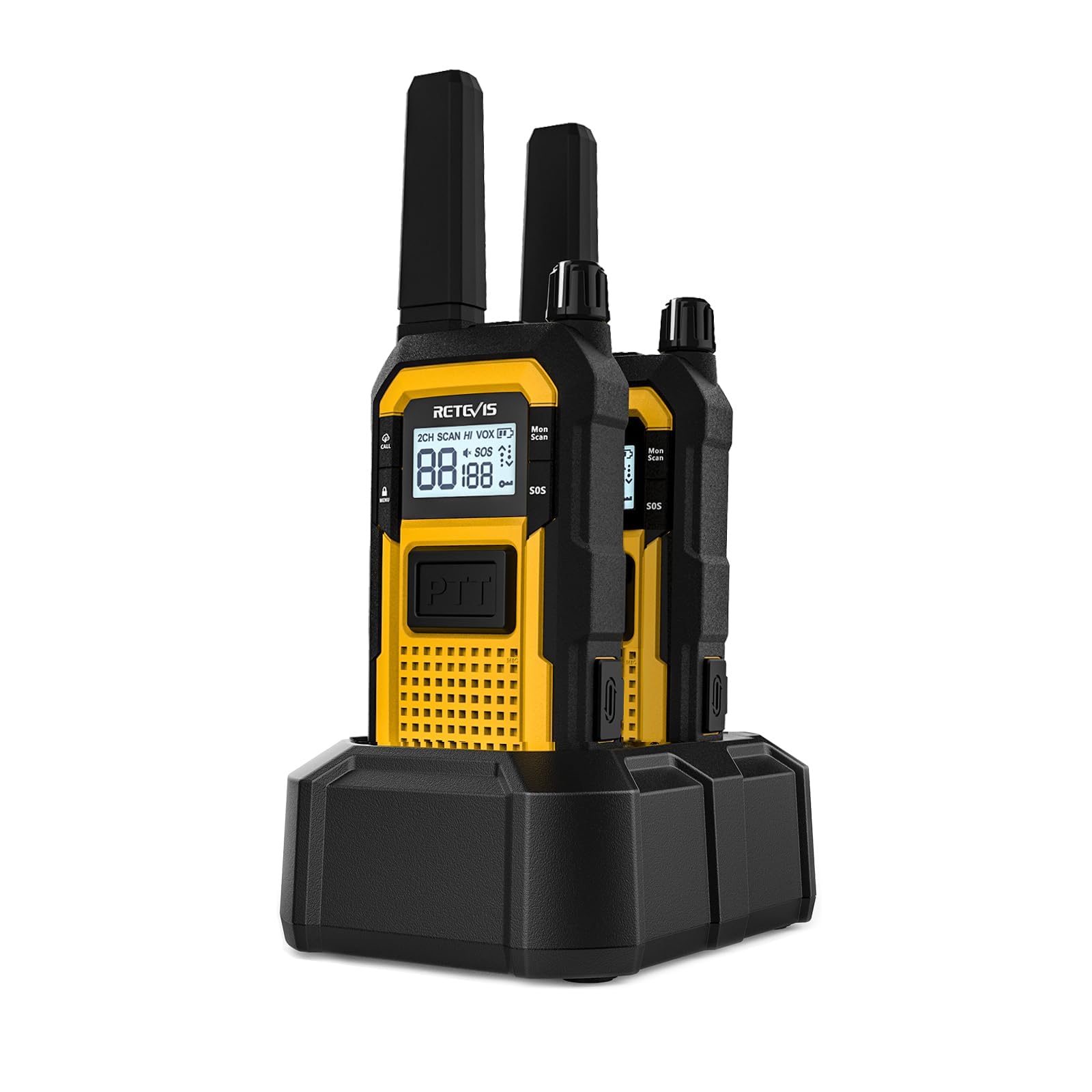
The RB48 passed 1000 drops from 2 meters and carries an IP67 rating, so it’s dust-tight and survives submersion. That ruggedness is the reason owners trust it for brush hogging, snow plowing, and cross-country road trips where a fragile radio would fail within a week.
For a license-free FRS unit, it reaches up to 300,000 sq.ft. or 25 floors, with buyers reporting strong signals over open water and several miles of open terrain. The 2000mAh battery delivers up to 20 hours per charge, and USB-C plus a charging dock let you top up at home or in the car.
The thing everyone raves about is the reception — it’s the most-discussed strength, ahead of sound quality and value. Owners note the giant PTT (push-to-talk) button is easy to operate even with gloves, and it floats if dropped in water, which is a bonus you don’t expect. It is license-free FRS, so no testing is required to transmit.
Field-ready reliability: the RB48 stands apart on durability and reception, the two things that actually decide whether a radio survives a season of hard use.
Reach for this if: you need a tough, license-free radio for outdoor work, family trips, or any environment where drops and weather are guaranteed.
Look elsewhere if: you want repeater capability or the maximum 5-watt GMRS power — this unit stays at FRS output.
2. BAOFENG GM-15 Pro 8W
A feature-packed 8-watt GMRS radio that reaches miles further than its price suggests.
The GM-15 Pro is the value pick that refuses to compromise on power. It’s rated at 8W — nearly triple the 2W typical of FRS radios (2.5x the output of the 3800mAh UV-5R’s standard competition) — and buyers report a “4-mile urban range on high power” from the start. In open flat ground and suburbs, that stretches to 4-5 miles, which is outstanding for the price.
It’s a GMRS radio, so you’ll need an FCC license to transmit, but that’s a small hurdle for the capability. The unit packs 250 memory channels, 154 privacy codes (50 CTCSS plus 104 DCS) to filter out interference, and 11 NOAA weather channels that scan for emergency alerts. The 1500mAh battery runs 24 hours — a full third longer than the RB48’s 18 hours — and charges via USB-C from a power bank, car, or wall.
What wins people over is the overall quality, which earns far more praise than any single feature. The radios include both a short rubber-duck antenna and a long whip antenna, plus earpieces and chargers — almost everything you need to get started. Programming repeaters is easy from the front panel or via PC, and the display shows battery voltage alongside frequency, which hobbyists love.
Why it’s the value king
- 8W power with 4-5 mile open-ground range
- 250 channels and repeater-capable
- USB-C charging from any source
- Complete accessory kit included
What to know first
- Requires a GMRS license to transmit
- Speaker audio quality is only average
- Manual channel switching is slow
Best for: buyers who want maximum power and features for the lowest cost, especially if you’re already comfortable with repeater programming.
Think twice if: you want a truly plug-and-play radio — the menu system is dense and the interface feels budget.
3. BAOFENG UV-5R 3800mAh
The field-proven classic that became the standard for emergency and hobby communication.
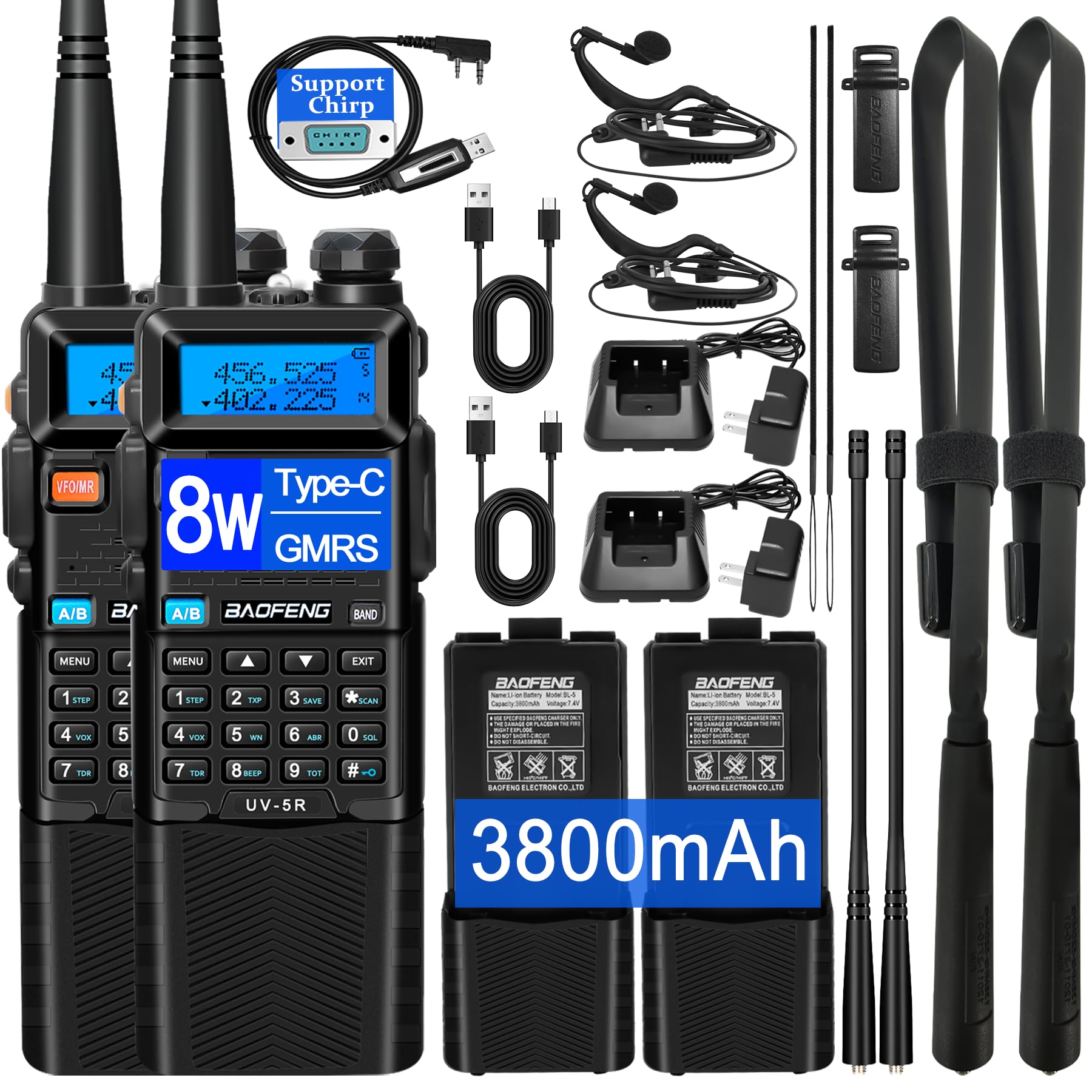
The UV-5R is the radio that volunteers carried during Hurricane Helene relief — owners describe it as cheap, easy to program, and reliable when it mattered most. It’s a dual-band unit covering VHF (144-148 MHz) and UHF (420-450 MHz) with a maximum 8W output, making it genuinely versatile for ham radio operators.
What sets this version apart is the 3800mAh battery, which delivers 200% more standby time than standard models — a 2.5x capacity gap over the GM-15 Pro’s 1500mAh. It charges via USB-C, so you can keep it topped up from a solar battery in the field, which is exactly what disaster volunteers relied on. The box includes two radios, two earpieces, a programming cable, and both original and tactical antennas.
The reputation here is the story: this is the radio that “the standard these days” buyers recommend to friends. It works well on large job sites and communicates clearly at longer distances, with 128 storage channels and dual display/dual standby functionality. Durability gets mixed feedback, so treat the housing with reasonable care — the electronics are solid, the shell is not indestructible.
Proven in the field: the UV-5R’s real-world track record in emergencies and its massive battery make it the pick for preparedness-minded buyers.
Choose this for: ham radio use, emergency kits, or job sites where USB-C charging and long standby time matter more than weatherproofing.
skip it if: you want a license-free FRS radio — this one needs a ham license to transmit legally.
4. Retevis RB48PLUS GMRS
The IP67-sealed GMRS that keeps farm and forest crews connected through heavy rain and sandstorms.
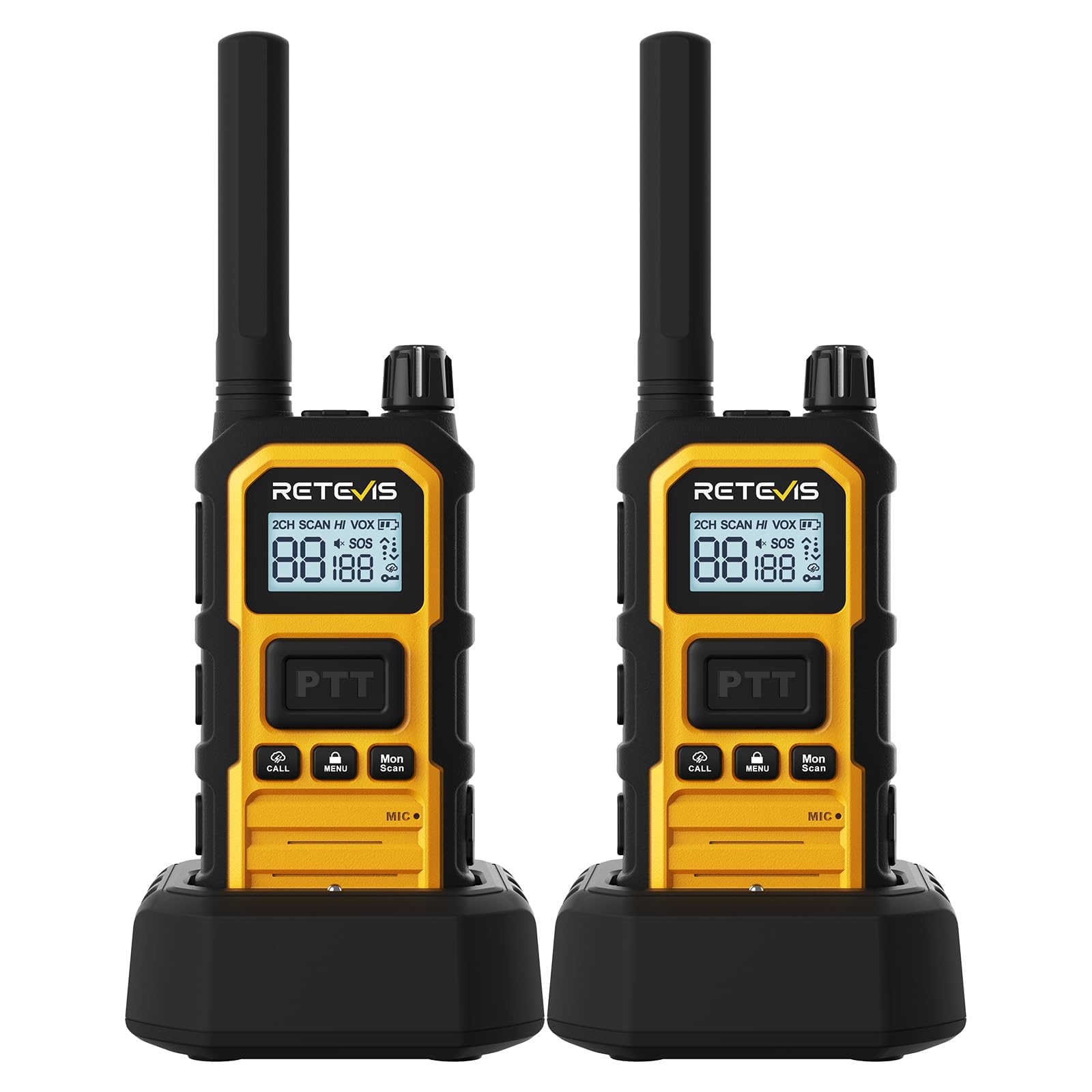
The RB48PLUS takes the rugged recipe of the RB48 and adds GMRS power and range. It’s rated IP67 waterproof and dustproof against 0.1μm particles, with a 2-meter fall-proof build using PC and TPE material — owners confirm it holds up in rain far better than comparable brands. The dual large PTT buttons make it easy for all ages to operate, even with gloves on.
Range reaches up to 3 miles in real-world use, with owners reporting clear, professional-sounding voice with minimal static — one flagged radio for over 60 hours of work across 14-hour shifts. The 2000mAh battery delivers 18 hours of use and a 100-hour standby, so it easily lasts a full day of farm or forest work. It also features 11 NOAA channels for live weather updates.
The safety features are a real draw: a remote emergency alarm lets you send a distress signal to teammates on the same channel, and vibration plus call-ring alerts ensure you never miss a message. The build quality earns the most praise from owners, ahead of functionality and range. For a GMRS radio, it needs a license, but the additional reach over FRS is worth it for property owners.
Built for work: the RB48PLUS pairs genuine weatherproofing with the emergency and NOAA features that make it a dependable work-site companion.
Ideal for: farmers, foresters, and anyone who works outdoors in rain or dust and needs GMRS range with emergency features.
Not for: buyers who want free, no-license operation — this is a GMRS unit that requires FCC registration.
5. Motorola Solutions T475
The family-friendly FRS radio with easy pairing and a flashlight built right in.
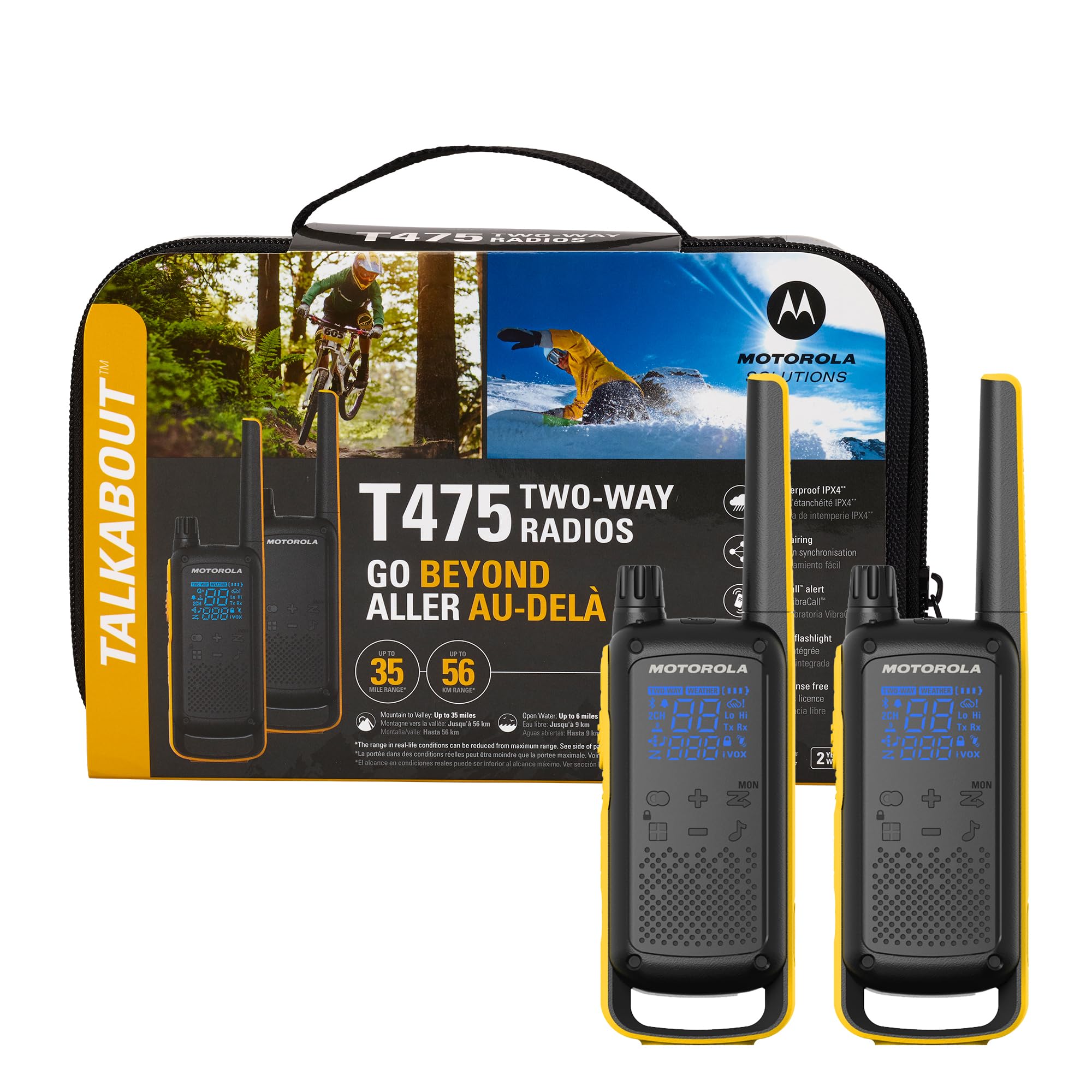
The T475 is the radio you hand to kids and grandparents without a second thought. It’s license-free FRS, so anyone can transmit immediately, and it floats if dropped in water — an actual feature owners discovered by accident. The 22 channels plus 121 privacy codes create 2,662 combinations, so finding a clear channel free of interference is easy.
Battery life varies by use. The included NiMH 800mAh pack (a rechargeable nickel-metal hydride battery) delivers up to 12 hours; some owners mention several days of light use, while others say the stock pack drains fast and they swapped in lithium-ion AAs for longer life. You can also pop in 2 AA batteries as backup — a useful safety net on a long trip. Range tops out around 3.9 miles on low power in open conditions, and wind cancellation is superb on windy ridgelines.
The quality is the standout — owners consistently praise how well these are built and how easy they are to use. The VibraCall alert vibrates for incoming calls so you feel it in a pocket, and the built-in flashlight is handy for camping. The IPx4 rating means it shrugs off splashes and rain, though the charging port is a known weakness if submerged, so treat it as weather-resistant, not waterproof.
Keep-it-simple quality: the T475 wins on ease of use and build polish, the two things families care about most, with a fair caveat on battery endurance.
Reach for this if: you want a dependable, license-free radio for family camping, boating, or neighborhood use where simplicity beats raw power.
Look elsewhere if: you need GMRS-level range on rugged terrain — the T475 is FRS-only and range is terrain-dependent.
6. Midland T290VP4
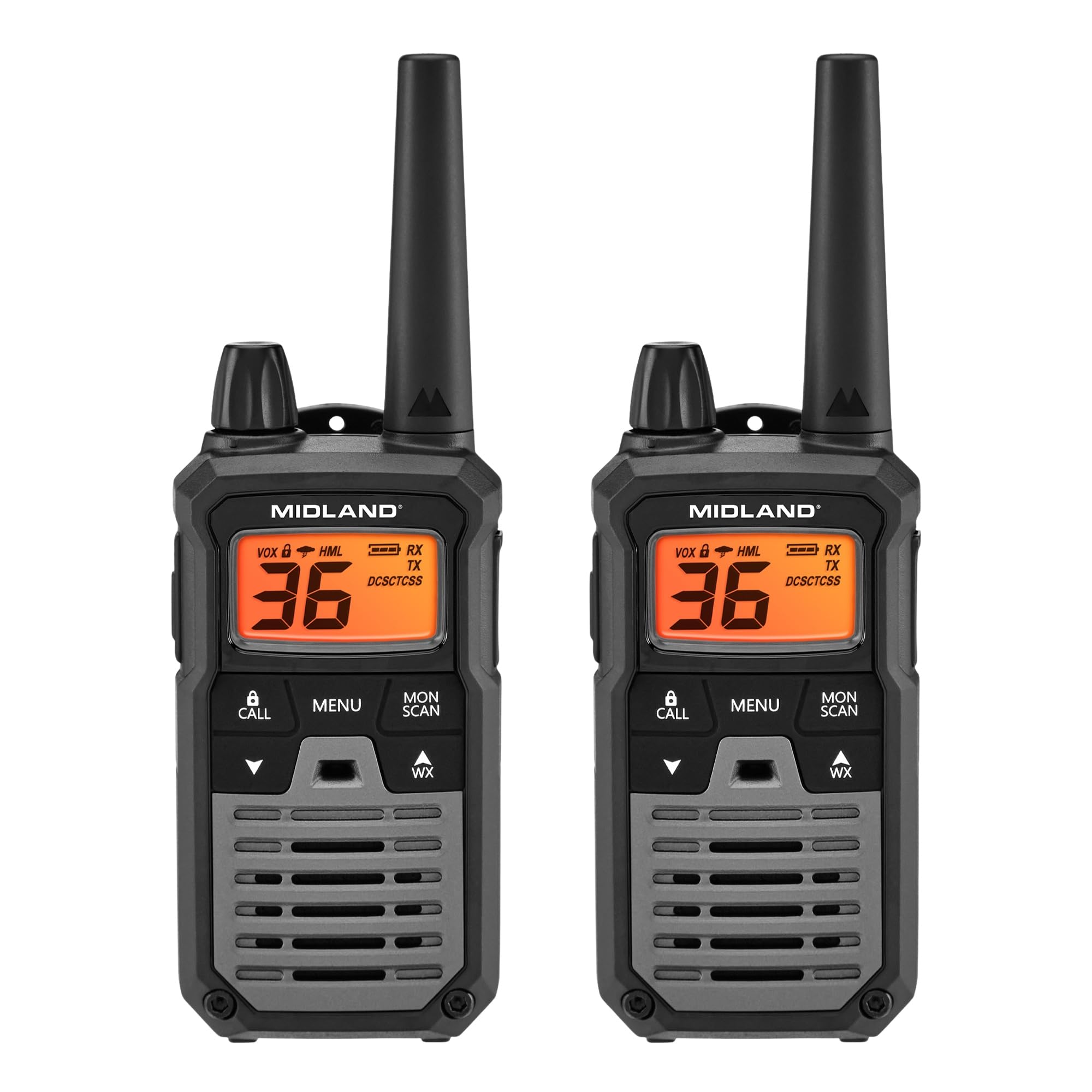
A high-powered GMRS that proved itself flawless across two mountain ridges in Moab.
The T290VP4 is Midland’s answer to buyers who need genuine range in open country. The box advertises a 40-mile range in unobstructed terrain, and while real-world numbers are lower, owners tested these in the Moab mountains with crisp, clear audio across two ridges — exactly the scenario where cheaper radios go silent. It runs on 22 GMRS channels plus 14 privacy code channels.
The key advantage is power: at roughly 2W, it outclasses the typical 0.5W FRS radios, and owners measured about 2 miles with obstructions and 1.5 miles in urban areas, both perfectly usable. The 121 CTCSS privacy codes (2,662 total channel options) block out other conversations, and the eVOX hands-free mode lets you transmit by voice without pressing a button.
NOAA Weather Scan automatically finds the strongest of 10 weather channels and locks on, with an alert that sounds when severe weather is near. The one real catch is battery compatibility: these radios only accept the included battery pack, not regular AA batteries, and the battery life draws mixed feedback — plan to carry spares for long outings. The build quality and clear sound earn solid praise from owners.
Open-country power: the T290VP4’s higher output and proven mountain performance make it a strong GMRS choice when terrain is your biggest obstacle.
Best for: off-roaders, hikers, and 4×4 groups who need reliable GMRS range across ridges and open valleys.
Think twice if: you want the convenience of standard AA batteries — this radio is locked to its included battery pack.
7. BTECH GMRS-PRO

The app-connected GMRS with GPS text messaging that turns your radio into a smart communicator.
The GMRS-PRO is the most feature-dense radio on this list. It pairs with the BTECH app for quick setup, channel management, and contact syncing — no digging through dense front-panel menus. But the headline features are GPS-based: you can share your location, send text messages, and view a digital compass with your coordinates, heading, speed, and altitude right on the screen.
Customers note hitting a repeater 20 miles away without line-of-sight, and clear chats beyond 30 miles with an upgraded antenna. The 2600mAh battery runs 14 hours, and the IP67 rating survives full immersion — owners soaked it repeatedly with no water ingress. It’s Bluetooth-capable, so a headset or motorcycle helmet audio system pairs wirelessly for hands-free use.
The sound quality is what everyone raves about — it’s the most-praised aspect by a wide margin, ahead of the features list. That said, ease of use is genuinely mixed: some find the app intuitive, others call it not intuitive, and the operating system shows occasional lag. The GPS and text features only work between two GMRS-PRO radios, so you’ll want two for the full experience.
What makes it unique
- Bluetooth audio and app programming
- GPS location sharing and texting
- IP67 waterproof with USB-C charging
- Repeater capable for extended range
Where it stumbles
- App and OS feel sluggish at times
- Proprietary accessories need adapter cords
- Belt clip installation is difficult
Choose this for: tech-savvy off-roaders or motorcyclists who want GPS tracking, texting, and Bluetooth audio in one rugged IP67 body.
pass on it if: you want a simple, instant-on radio — the learning curve and occasional lag will frustrate.
8. Rocky Talkie Mountain Radio
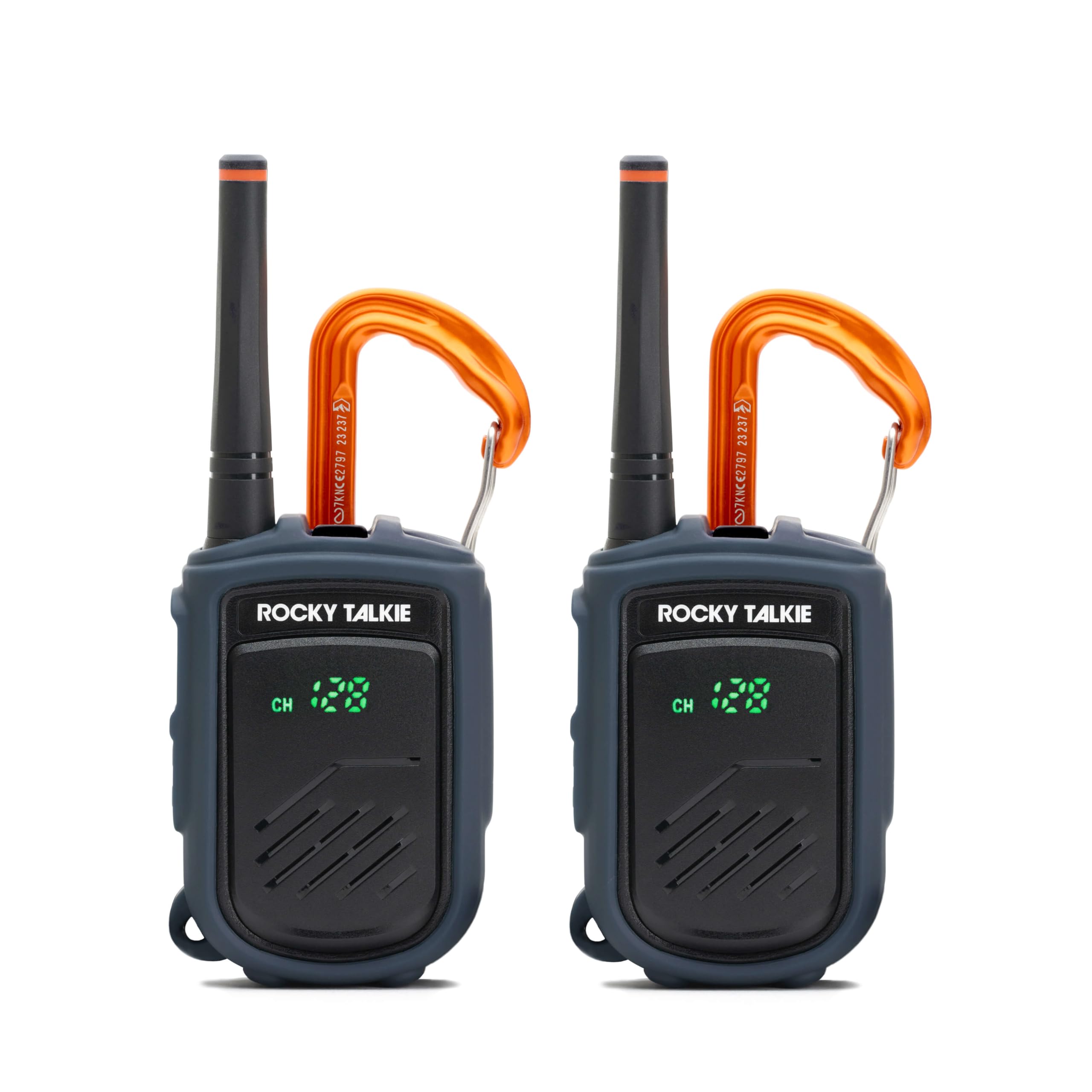
The ultralight FRS that runs four days on a charge and clips to your harness with a climbing-rated carabiner.
Climbers and backcountry travelers get a radio built for their terrain: the Rocky Talkie Mountain Radio transmits at the maximum 2 watts legally allowed without a license. The brand claims max range over 35 miles, but reviewers point out 3 miles is realistic in the Rockies — still excellent for a license-free FRS unit. It works from the start with zero configuration.
The battery is the headline: a specialized rechargeable lithium-ion pack delivers over 4 days of life even in very cold conditions, and owners confirm it lasted a full 4-day road trip and charged back up fast via USB-C. The durability design is clever — instead of fragile plastic clips, it secures to backpacks with an ultra-light climbing-rated carabiner and a metal-reinforced back-up leash, plus a shatterproof LED screen.
Everything about this radio is stripped back to essentials: 5 easy-to-understand buttons, no dense menus, and a form factor so light and simple that even a 4-year-old can use it. The IP56 rating handles splashes and snow, making it a fair-weather-to-light-storm companion. The only common gripe is the lack of a belt clip — the carabiner is great for packs, but some owners want a traditional clip option.
Purpose-built simplicity: the Rocky Talkie Mountain Radio nails the two things climbers demand — multi-day battery life and secure, bombproof attachment.
Best for: climbers, hikers, and skiers who want a license-free, dead-simple radio that lasts a full long weekend without a charge.
Not for: buyers who need GMRS repeater range or a traditional belt clip — this is FRS-only with a carabiner mount.
9. Rocky Talkie Expedition 5 Watt
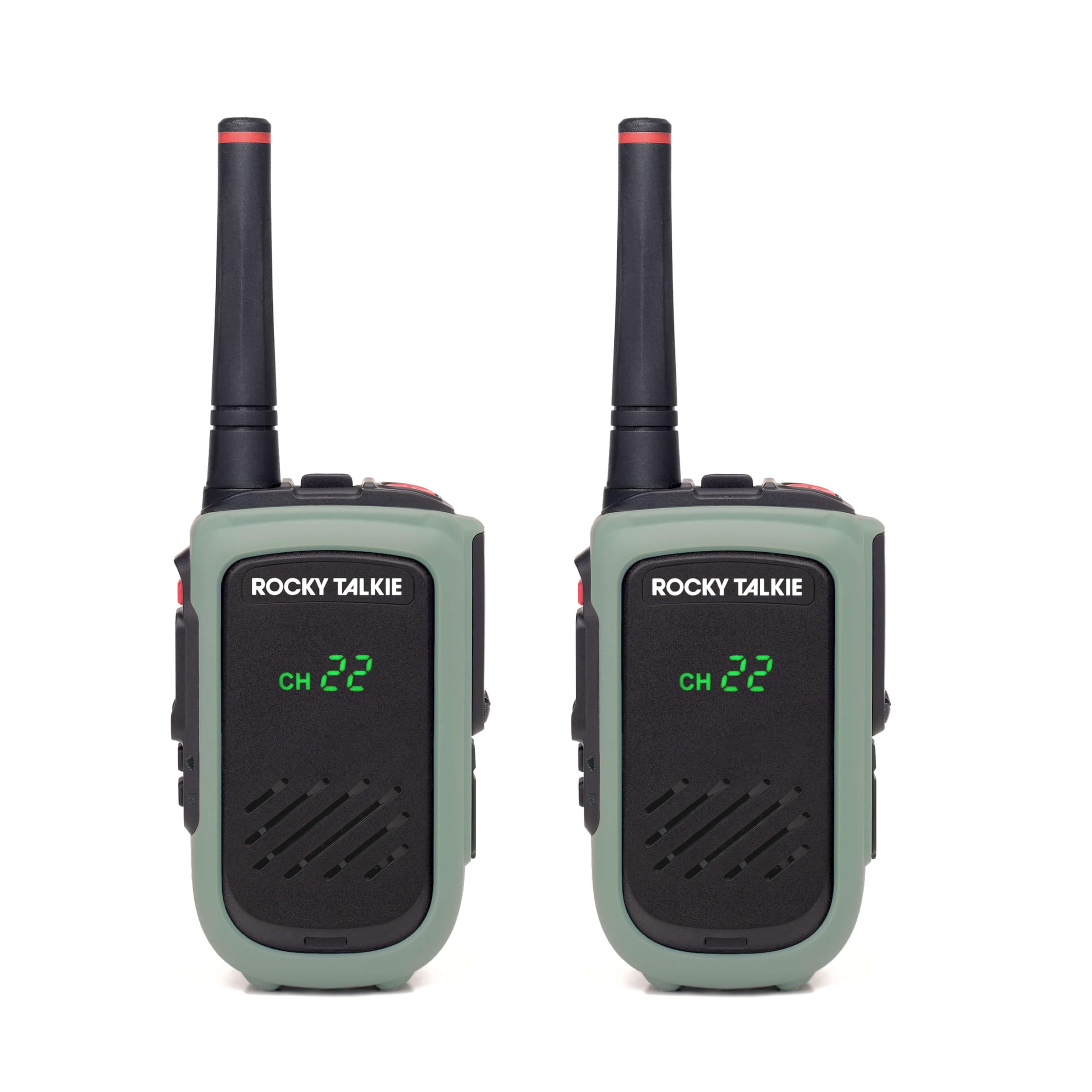
This 5-watt GMRS flagship (a General Mobile Radio Service unit that needs a license) gives you a 5-day battery and backcountry range that owners call class-leading.
The Expedition is Rocky Talkie’s top-shelf GMRS radio, delivering the maximum 5 watts of handheld power allowed in the GMRS band. That extra power translates to a typical 2 to 8 miles in backcountry terrain, with owners reporting successful communication up to 21 miles away in open conditions. It also open up 8 repeater channels to extend your reach even further.
The 1800mAh battery averages 5 days on a single charge, even in frigid conditions. The radio displays battery percentage, so you always know where you stand, and both the battery and a 7.5cm or 17cm antenna are replaceable. It’s IP67 waterproof up to 1 meter of submersion, and includes 11 NOAA weather channels plus dual-channel monitoring for weather alerts.
The quality and reliability are the most-praised aspects, and owners specifically note it outperforms cheaper, feature-heavy brands in the mountains. One used it with heavy tracked loaders and reported flawless communication. It comes with a Steel Gator Clip and metal-reinforced back-up leash. The honesty in the manual is a plus — it clearly explains that terrain limits range, so you go in with realistic expectations.
The serious backcountry tool: the Expedition combines the legal maximum GMRS power with a genuinely class-leading 5-day battery and IP67 sealing.
Reach for this if: you demand the best handheld range, durability, and battery life for off-road groups, expeditions, or critical communication.
Look elsewhere if: you’re on a tight budget or don’t want to deal with a GMRS license — this is a premium, licensed-band radio.
Understanding the Specs
FRS vs GMRS Licensing
FRS radios are license-free and top out at 2 watts, making them the easiest choice for families. GMRS radios reach up to 5 watts for better range but require an FCC license before you can transmit. Check which band fits your needs before buying — a GMRS radio used without a license is a violation.
Battery Life and Charging
Battery life is measured in hours of continuous use or days of standby — a 2000mAh battery typically delivers 18-20 hours, while premium packs stretch to 5 days. USB-C charging is a huge convenience, letting you top up from a car, power bank, or solar panel in the field instead of hunting for a proprietary dock.
FAQ
Do I need a license to use a long-range two-way radio?
Why don’t I get the advertised “40-mile” range?
What does IP67 waterproof actually mean?
How long should a two-way radio battery last?
Can GMRS radios talk to FRS radios?
What is a repeater channel and how does it extend range?
Are the 8-watt radios actually more powerful than 5-watt ones?
What is NOAA weather alert and why does it matter?
Final Thoughts: The Verdict
For the majority of shoppers, the 2 way radio long range winner is the Retevis RB48 because it pairs genuine IP67 durability with excellent reception and an 18-hour battery at a license-free price. If you want maximum power and repeater capability on a budget, grab the BAOFENG GM-15 Pro. And for serious backcountry expeditions where battery life is critical, the Rocky Talkie Expedition is the one to reach for.
How We Picked
We do not accept paid placement. Every pick is matched to a real buyer and a real use-case; we do not hands-on test units.
Sources & Methodology
Specifications: manufacturer listings and product documentation. Review insights: verified customer reviews, as of August 2026. Pricing: not shown on this page (it changes often); check the current price via the retailer link.
As an Amazon Associate, Gadgets Feed earns from qualifying purchases. This does not affect which products we feature.