
Our readers keep the lights on and my morning glass full of iced black tea. As an Amazon Associate, I earn from qualifying purchases.
Specs are compiled from manufacturer listings and verified buyer reviews and can change over time — please confirm the key details on the product page before buying.
If you have a big compressor feeding a sandblaster, a jackhammer, or a long shop line, a narrow hose is quietly strangling your tools. A proper 3/4″ inner-diameter hose is the fix that lets high-volume air actually flow, and the real question is which material and length fit your workspace without turning into a wrestling match.
I’m Min — the founder and writer behind Gadgets Feed. This guide is built by comparing the manufacturers’ published specifications and the patterns across verified customer reviews, so you get each pick’s real strengths and trade-offs instead of marketing spin.
Here is the short version: for heavy constant use, 100% rubber beats hybrid for durability, but it is heavy — and the 3/4 air hose that wins depends entirely on whether you prioritize flow, weight, or cold-weather flexibility.
Our Picks at a Glance

How To Choose The Best 3/4 Air Hose
If you need to power large pneumatic tools, a 3/4″ hose moves far more air than the 3/8″ or 1/2″ lines most compressors ship with. The wider bore delivers that extra flow, but the trade-off is weight and stiffness. Your choice depends on three things: the material, the pressure rating, and the fittings.
Material: Rubber vs EPDM vs Vinyl
100% rubber hoses are the toughest and most flexible in cold weather, but they are heavy; a 15-foot length can weigh over 5 pounds. EPDM synthetic rubber offers similar durability with better resistance to chemicals and ozone, often at a lighter weight. Vinyl braided tubing is the lightest and cheapest, but it tops out at a lower working pressure and has a strong smell that needs time to air out.
Working Pressure and Burst Rating
Check the working pressure, which is the pressure the hose can safely handle continuously. Many 3/4″ hoses are rated at 300 PSI, which covers most large compressors. The burst pressure is the point where the hose would fail — a higher burst rating gives you a bigger safety margin if your compressor spikes. Never run a hose above its rated working pressure.
Fittings and Connections
The end fittings matter as much as the hose itself. Brass fittings resist rust better than steel and are stronger than aluminum. A swivel end makes connecting to a wall-mounted regulator far easier, while a fixed non-swivel end requires you to twist the whole hose to thread it on. Check the thread type — 3/4″ NPT is common on these large hoses — to make sure it matches your compressor and tools.
Quick Comparison
| Model | Best For | Length | Working Pressure | Weight | Amazon |
|---|---|---|---|---|---|
| PneumaticPlus RED EPDM★ Best Overall | Short, sturdy connections | 3 feet | 300 PSI | 1.7 pounds | Amazon |
| BLUBIRD BB3415Top Performer | Heavy-duty shop use | 15 feet | 300 PSI | 5.2 pounds | Amazon |
| DAVCO Clear Vinyl | Water and multipurpose lines | 50 feet | 200 PSI | — | Amazon |
| Milton Industries 1638 | Industrial jackhammer duty | 50 feet | 300 PSI | 3 pounds | Amazon |
| Eagle Hosee Red Jackhammer | Construction job sites | 50 feet | 300 PSI | — | Amazon |
In-Depth Reviews
1. PneumaticPlus RED EPDM Synthetic Rubber Air & Water Hose
Our pick — over 4.5★ from 150+ verified ratings; the strongest balance of quality and price.
The short, stout bridge piece that links your compressor to the rest of the system.
If all you need is a flexible connection from a rigid supply line to a hose reel, this 3-foot section is made for exactly that job — it isolates vibrations so your metal pipework isn’t stressed. It uses EPDM synthetic rubber, which shrugs off chemicals and ozone far better than plain rubber, and it handles a working pressure of 300 PSI, so it’s not the weak link in your setup.
Weighing just 1.7 pounds with a 1.15-inch outside diameter, this is a featherweight compared to the BLUBIRD’s 5.2 pounds across a much shorter run — you won’t even notice it’s there. Buyers report it “Works perfect for linking 2 air compressors together,” and the build quality earns consistent praise as a sturdy, well-made piece of gear.
The one catch: the ends are non-swivel, meaning you have to rotate the whole short hose to thread the connections on. It’s a minor annoyance on a 3-foot section, but worth knowing before you mount it to a wall regulator.
What Wins People Over
- Featherlight at 1.7 pounds — the least noticeable part of your air system
- 300 PSI working pressure handles high-volume demand
- EPDM synthetic rubber resists chemicals, ozone, and aging
- Sold with 3/4″ NPT male fittings ready to thread on
What To Know
- Non-swivel ends mean you twist the whole hose to connect it
- At 3 feet, it’s a connection piece, not a working hose
The straightforward pick: buy this if you need a rock-solid, vibration-isolating bridge between your compressor or water separator and your hard-piped shop line.
The honest limit: skip it if you need to reach tools across a workspace — this one is strictly a link, not a runner.
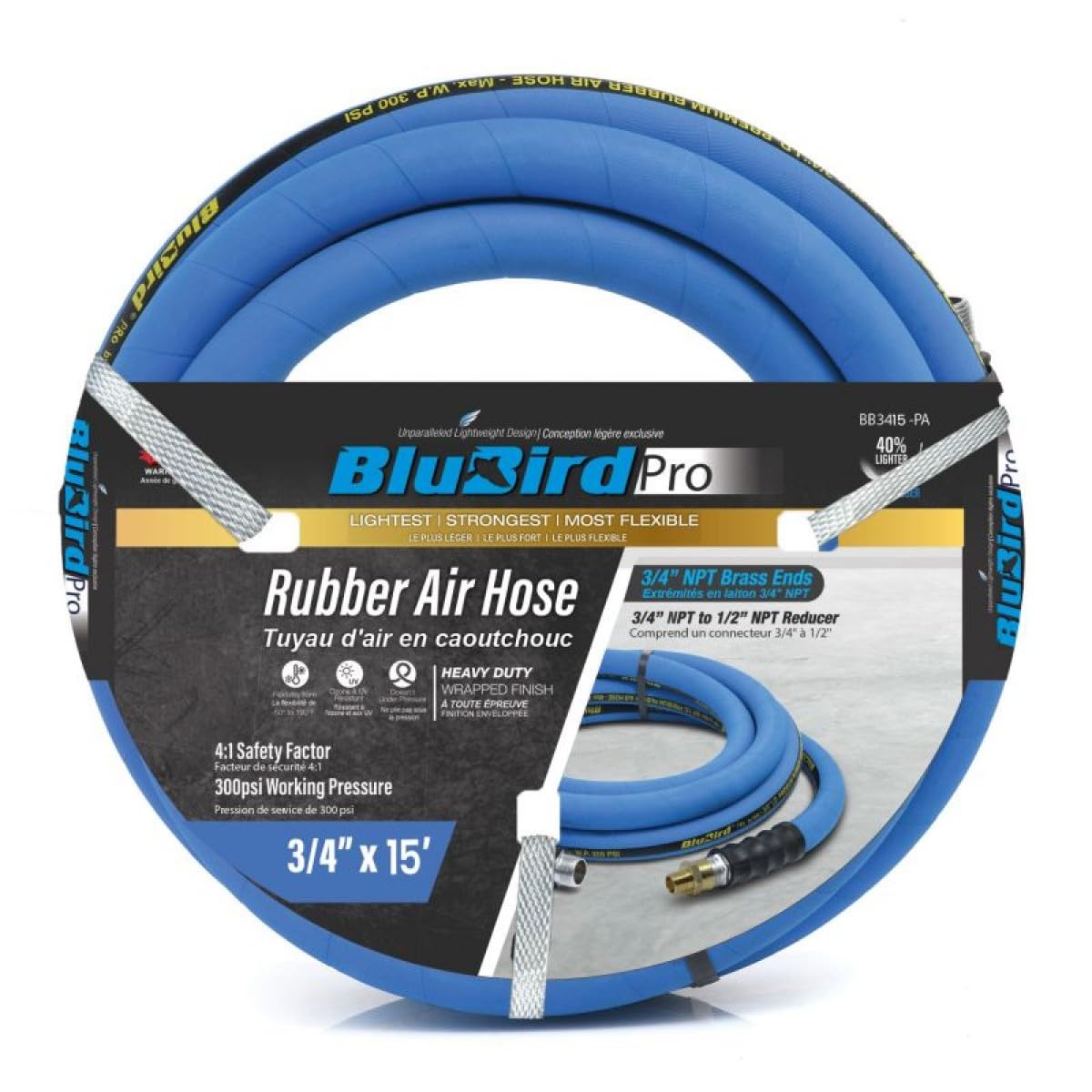
2. BLUBIRD BB3415 3/4″ x 15′ Rubber Air Hose
A 5.2-pound workhorse that refuses to kink, even when the shop gets cold.
For a 15-foot 100% rubber hose, this BLUBIRD is built to feed the hungriest tools. It carries a 300 PSI working pressure with a 1200 PSI burst rating — a bigger safety margin than the typical 900 PSI burst you see on many “300 PSI” hybrids. The polyester braid reinforcement is what lets it flex in cold weather without turning into a stiff noodle, staying usable down to -50°F.
Buyers praise the brass end fittings on this hose because they resist rust better than steel and survive constant plugging and unplugging. They report it “delivers maximum flow to large pneumatic tools” and pairs well with a big compressor feeding shop lines, but they warn it “is very heavy to lug around the shop.” At 5.2 pounds, that weight is the honest trade-off for real rubber durability.
This hose shines in a fixed shop setup where it stays on a reel. The maker backs it with a 5-year manufacturer warranty, which says a lot about confidence in the construction.
Built For The Long Run
- 100% rubber stays flexible down to -50°F
- 1200 PSI burst pressure, well above the 300 PSI working rating
- Brass fittings resist rust and stand up to heavy use
- 5-year manufacturer warranty
Where It Holds You Back
- 5.2 pounds is genuinely heavy to drag around by hand
- At 15 feet, you may need a second hose or a reel for larger shops
Reach for this if: you want a single, uncompromising rubber hose that keeps delivering max flow to large pneumatic tools from a stationary compressor.
Think twice if: you plan to carry it tool-to-tool; the weight argues for a hose reel as a companion piece.
3. DAVCO 3/4″ ID x 50 ft Clear Braided Vinyl Tubing

50 feet of clear, budget-friendly tubing that bends easily and costs a fraction of rubber.
This DAVCO roll is a different animal — it’s clear braided vinyl, not rubber, and that makes it ideal for jobs where you need to see what’s flowing. At 50 feet long with a 1-inch outside diameter around a 3/4-inch bore, it covers serious distance, and owners mention it holds its shape without deforming when you bend it, while staying flexible enough to work with.
The trade-off is pressure: it’s rated at 200 PSI working pressure, a full 100 PSI below the 300 PSI rubber hoses in this guide. That makes it a better fit for water, drain lines, and lighter air duty than for high-volume pneumatic tools. Buyers recommend it for aquarium supply, landscape lines, and even drain hookups for iron filters and softeners, and they note it needs a bit of warming and soap to slide over barbed fittings.
One honest caveat is the smell — a strong new-hose odor that needs about a week of airing out before it’s pleasant. It’s non-toxic and BPA-free, but it’s not for food or potable water use.
The clear winner for water: 50 feet at a budget-friendly price, flexible and kink-resistant, with a transparent wall so you always know what’s inside.
The limitation to respect: at 200 PSI, keep it on water and light-air duty rather than feeding a sandblaster or jackhammer.
Buy it for: long drain lines, aquarium supply, and multipurpose water transfer where visibility and low cost beat raw pressure.
Look elsewhere if: you need a 300 PSI air line for heavy tools — this vinyl caps out well below that.
4. Milton Industries 1638 Industrial Jackhammer Rubber Air Hose

A 50-foot industrial-grade line with 4-spiral layered reinforcement, built for the hardest work.
When the job calls for a jackhammer, a garden-variety hose won’t survive. This Milton Industries hose is a synthetic rubber tube wrapped in four spiral layers of texture for strength, and it handles 300 PSI working pressure across a full 50 feet. It ships with a crimped Universal (Chicago) coupling already attached, so it’s ready to hook up from the start.
The durability story is built in: it resists heat, aging, chemicals, and ozone, and it stays flexible even in cold weather — buyers running it on diesel air compressors outdoors report it holds up great. At 50 feet it gives you real reach, and the steel-included construction feels appropriately serious for industrial settings.
It’s note the maker rates it as an industrial unit and backs it with a 1-year warranty. There’s a slight stiffness compared to lay-flat designs, which is expected for a hose built this tough, but it remains reasonably flexible in practice.
Industrial toughness: 4 spiral reinforcement layers plus chemical, ozone, and heat resistance make this the pick for punishing environments.
The honest note: it’s not as supple as a lay-flat hose, so expect a bit more fight when coiling it up.
Made for: construction and industrial air tool work where the hose takes abuse and must keep feeding 300 PSI to the tool.
Not the one for: light home use or anyone who wants a lay-flat, ultra-supple coil; this is a serious-duty line.
5. Eagle Hosee Red Jackhammer Rubber Air Hose

A 50-foot job-site hose with a natural rubber core and factory-installed steel couplings.
Built specifically for air tool work on construction sites, this Eagle Hosee line combines a natural rubber/SBR blend core with a red EPDM synthetic rubber cover. The result is a hose that stays flexible and resists abrasion while the cover fights off ozone, chemicals, and aging — and the spiral polyester yarn reinforcement gives it the strength to handle 300 PSI.
It ships with two factory-installed steel universal couplings, so there’s no fiddly fitting work on day one. Buyers describe it as a “super heavy duty” hose with a thick wall that feels appropriately tough, and it covers a useful -22°F to +176°F temperature range for year-round use.
The durability story here is genuinely mixed in the feedback — some owners find it extremely durable, while a few report issues over time. Value for money is the strongest consistent praise, especially for anyone buying it in 50-foot sections to cut into custom leader hoses.
The job-site value pick: strong 300 PSI performance with factory steel couplings and a temperature range that covers most working conditions.
The mixed note: durability feedback is split, so this is best for buyers who want solid performance at a fair price rather than a lifetime heirloom.
Right for: construction crews and anyone who needs a ready-to-run 50-foot 3/4″ line with steel fittings already attached.
Reconsider if: you expect decades of abuse; treat this as a strong-value workhorse, not an heirloom investment.
Understanding the Specs
Working Pressure vs Burst Pressure
Working pressure is the pressure the hose can safely carry all day — most of these sit at 300 PSI, which suits large compressors fine. Burst pressure is the failure point, the number you never want to approach. A bigger gap between working and burst pressure means a safer hose if your compressor spikes.
Inner Diameter (ID) vs Outside Diameter (OD)
The inner diameter is the bore that carries the air — 3/4″ is the high-flow standard here. The outside diameter, often 1 to 1.15 inches, tells you how thick the walls are. Thicker walls generally mean more reinforcement and higher pressure capability, but also more weight and stiffness.
Rubber, EPDM, and Vinyl
100% rubber is the classic tough choice: durable, flexible in cold, but heavy. EPDM synthetic rubber adds resistance to ozone and chemicals with similar strength, often a bit lighter. Vinyl braided tubing is the lightest and cheapest but tops out at lower pressures and carries a strong initial smell.
Fittings and Connections
Fittings are how the hose actually connects to your compressor and tools. Brass resists rust better than steel and is stronger than aluminum. A swivel end lets you tighten the connection without twisting the hose, while a non-swivel end means rotating the whole hose. The 3/4″ NPT thread is the common standard on these large lines.
FAQ
What is the difference between 3/8″, 1/2″, and 3/4″ air hoses?
Will a 3/4″ hose fit my compressor?
How long does a 3/4″ rubber air hose last?
Is a 300 PSI hose better than a 200 PSI hose?
Why is a 3/4″ rubber hose so heavy?
Can I use a 3/4″ vinyl braided hose for air tools?
What does a swivel fitting do and why does it matter?
Does cold weather affect a 3/4″ air hose?
Are brass fittings better than steel on an air hose?
Final Thoughts: The Verdict
If you need a reliable link between your compressor and the rest of your system, the 3/4 air hose to start with is the PneumaticPlus RED EPDM — it’s featherlight at 1.7 pounds, handles 300 PSI, and earns top marks for build quality. For a heavy-duty shop line that delivers max flow to large tools without kinking, grab the BLUBIRD BB3415 and pair it with a hose reel to manage its 5.2 pounds. And when you need long reach on a budget, the DAVCO Clear vinyl gives you 50 feet of flexible tubing for water and lighter applications.
How We Picked
We do not accept paid placement. Every pick is matched to a real buyer and a real use-case; we do not hands-on test units.
Sources & Methodology
Specifications: manufacturer listings and product documentation. Review insights: verified customer reviews, as of August 2026. Pricing: not shown on this page (it changes often); check the current price via the retailer link.
As an Amazon Associate, Gadgets Feed earns from qualifying purchases. This does not affect which products we feature.