
Our readers keep the lights on and my morning glass full of iced black tea. As an Amazon Associate, I earn from qualifying purchases.
Specs are compiled from manufacturer listings and verified buyer reviews and can change over time — please confirm the key details on the product page before buying.
If you are shopping for a window air conditioner that plugs into a standard 115V outlet, stop reading — this guide is for the other kind. These units run on 230V or 208V power, which means they move far more air and cool far larger spaces than anything you can run off a regular bedroom outlet. The trade-off is that they need a dedicated high-voltage circuit, so the real buying question is not just BTUs, but whether your home is wired for them.
I’m Min — the founder and writer behind Gadgets Feed. This guide is built by comparing the manufacturers’ published specifications and the patterns across verified customer reviews, so you get each pick’s real strengths and trade-offs instead of marketing spin.
From 12,000 BTU units for single rooms up to 24,500 BTU beasts for whole floors, you are about to see the 240v window ac options worth your money and the exact outlet each one demands.
Our Picks at a Glance


How To Choose The Best 240V Window AC
Before you fall in love with a spec sheet, you have to answer one practical question: does your wall have the right outlet? Every unit here needs a dedicated high-voltage circuit — 230V, 208V, or 250V — and several need a specific amperage breaker. If you do not have that outlet, you are looking at hiring an electrician on top of the unit’s cost, so check your panel first.
Match BTUs to your square footage
BTU (British Thermal Unit) is the raw cooling muscle of the machine — the higher the number, the more heat it can pull out of a room. A rough rule for this category: 12,000 BTU handles roughly a 550 square foot space, 18,000 BTU covers about 1,000 square feet, and 23,000 to 24,500 BTU strides through 1,500 square feet or more. Oversizing means wasted energy; undersizing means a unit that never stops running.
Decode the voltage and amperage demands
The terms 208V, 230V, and 240V all describe the same family of high-voltage circuits, but they are not interchangeable at the outlet. The plug shape matters as much as the voltage — some units need a standard 30 Amp 250V receptacle, others use a specific NEMA plug type like an LCDI 6-30P. Read the fine print on the plug before you wire anything, because a mismatch means a wasted delivery and a frustrating afternoon.
Decide if you want heat, too
Many high-voltage window units pull double duty as heaters, which makes them year-round appliances rather than summer-only machines. The catch is that most supplemental heat modes are designed for shoulder seasons — outdoor temps roughly between 23 and 76 degrees — not as a primary heat source for freezing winters. If you want one unit for both jobs, check what the heat function is actually rated for.
Quick Comparison
| Model | Best For | Cooling Power | Floor Area | Annual Energy | Amazon |
|---|---|---|---|---|---|
| Midea 24,000 BTU Smart Inverter★ Best Overall | Whole-floor cooling on a budget | 24,000 BTU | 1,500 sq ft | 3,200 watts | Amazon |
| ROVSUN 12,000 BTU with HeatHeat & Cool Value | Year-round comfort in one room | 12,000 BTU | 550 sq ft | 820 kWh/year | Amazon |
| LG 18,000 BTU | Mid-sized rooms with a trusted brand | 18,000 BTU | 1,000 sq ft | 1,510 watts | Amazon |
| Durastar 18,800 BTU | Heating and cooling with a standard 30A outlet | 18,800 BTU | 700–1,000 sq ft | 2,254 watts | Amazon |
| Keystone 23,200 BTU | Large spaces with smart remote precision | 23,200 BTU | 1,500 sq ft | 4,800 watts | Amazon |
| LG 24,500 BTU | Maximum cooling for the biggest rooms | 24,500 BTU | 1,560 sq ft | 2,370 watts | Amazon |
| Durastar 23,200 BTU | Tiny-house year-round climate control | 23,200 BTU | 1,500 sq ft cool | 5,060 watts | Amazon |
In‑Depth Reviews
1. Midea 24,000 BTU Smart Inverter 230V Window Air Conditioner
Our pick — over 4★ from 90+ verified ratings; the strongest balance of quality and price.
The floor-cooling beast that whispers while it works
The headline here is sheer muscle: 24,000 BTU of cooling power aimed at rooms up to 1,500 square feet — that is the same coverage as the Keystone below, but this Midea hits that mark with roughly a third less annual energy draw at 3,200 watts versus 4,800. Buyers report: “Quiet, strong cold air; cools entire second floor in 20 mins.” That is the story of this unit — enormous output delivered almost eerily quietly, with a noise floor as low as 48.5 dBA even on high.
What wins people over is the smart control suite. You get 4 modes (Auto, Cool, Dry, Fan), 3 speed settings (Auto/H/M/L), a 24-hr timer, and an ECO energy saver — all reachable from the LED panel, the remote, the SmartHome App, or your voice via Alexa and Google Assistant. The inverter compressor is the reason for the efficiency: the maker claims more than 40% energy savings compared to the Energy Conservation Standard, and the washable filter slides out from the front panel for easy cleaning.
There is one critical caveat baked into the name: this is a 230V unit, not a standard 115V unit. The listing is emphatic about it — it requires a 230V outlet, and the crowd favorite is the 4.2-star rating across 90+ owners for a reason. Installation is the sticking point, though. Some owners call it a breeze; others describe the hardware as a genuine headache, with the provided screws not matching the frame holes and requiring re-drilling. The unit also weighs 44.6 kg, so plan for two people and a sturdy windowsill.
Why owners rave
- Cools a whole second floor in about 20 minutes, per owner reports
- Inverter tech delivers over 40% energy savings versus the Energy Conservation Standard
- Runs as low as 48.5 dBA — quiet enough for a Zoom call on high
- Full smart control via app, remote, or Alexa/Google Assistant
Where it gets tricky
- Needs a 230V outlet — never plug into a standard 115V receptacle
- Installation hardware draws mixed reviews, including screws that don’t match
- At 44.6 kg, it needs two people to lift and seat
Reach for this if: you want the best balance of raw cooling power, smart features, and energy efficiency for a large open floor plan or a whole upstairs.
Look elsewhere if: you cannot easily source a 230V outlet or if a multi-hour, hardware-fiddling installation would ruin your day.
2. ROVSUN 12,000 BTU Window Air Conditioner with Heat
One window, four seasons of climate control
This ROVSUN is the all-in-one answer for a single room — it packs air conditioning, heating, a dehumidifier, and a fan into one 12,000 BTU unit rated for spaces up to 550 square feet. That puts it at exactly half the cooling power of the Midea above (12,000 BTU versus 24,000 BTU), and it covers just over a third of the floor area — a 550 square foot footprint versus 1,500. But it is the only unit here that pairs that cooling with genuine 5-mode flexibility: Heat, Auto, Cool, Dry, and Fan.
The smart controls are genuinely useful. Beyond the panel and remote, it works with the phone app and voice control via Alexa and Google Assistant, so you can set routines and adjust the temperature before you walk through the door. The swing button directs airflow, and the washable filter pulls out from the front for maintenance. It is also built for standard windows — the listing says it fits windows 26″ to 36″ wide with a 16″ height, and installation parts are included.
The honest caveat is that this is a polarizing unit. The quality itself earns praise, but the experience splits hard: owners mention “Works great once installed. It is a little tricky to install, you have to take the guts out, install the casing and then put the guts back in.” That same owner ordered eight units, had one defective, and got a fast replacement — so be prepared for a two-stage install and a possible lemon. Some owners also report the heating function underperforms and that the noise level is loud for certain buyers. This is the right pick if you want one 208/230V unit that crosses seasons.
All-season flexibility: heats, cools, dehumidifies, and fans from one window opening, with app and voice control throughout.
Install reality: the two-stage setup — casing first, guts second — is the most mentioned challenge; budget extra time and patience.
Best for: a home office, apartment, or single bedroom where you want one high-voltage unit to handle both summer and shoulder-season winter.
Acknowledge the trade-off: heating performance and noise get mixed owner feedback, so set expectations before you buy.
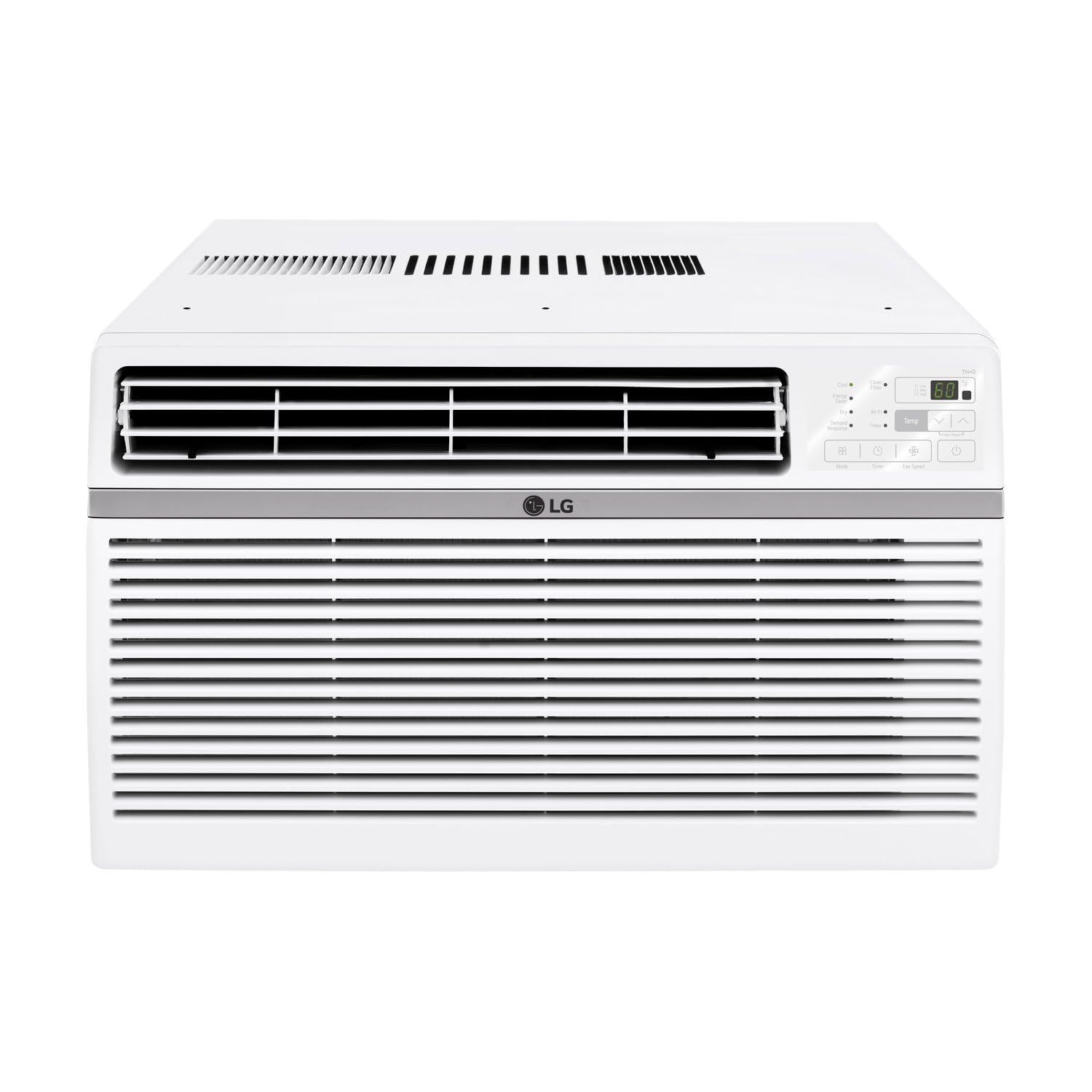
3. LG 18,000 BTU Window Air Conditioner, 230/208V
A familiar name with a heavy-duty pedigree
LG brings its reputation to the high-voltage window category with an 18,000 BTU unit rated for rooms up to 1,000 square feet — described on the listing as a 25′ x 40′ space. The brand’s engineering shows in the details: Auto Restart turns the unit back on by itself after a power failure, and the 24-hour digital on/off timer lets you set a cooling schedule for the whole week. You get 3 cooling and fan speeds with Auto Cool to fine-tune airflow.
The efficiency story is genuinely strong. At 1,510 watts of annual energy consumption, this LG sips power compared to the Midea above at 3,200 watts — and that is despite the Midea having more cooling power. If your electric bill is the deciding factor, this is the most efficient option in the entire lineup. The washable filter keeps maintenance simple, and the electronic controls with remote are easy to use.
The catch here is real and it is the noise. The 2.6-star average tells the story honestly: one owner described it as sounding “like there is a helicopter outside my window,” and the noise level is the most-discussed aspect, split between owners who accept it and those who cannot. There are also freight-damage stories — units arriving with dents and oil on the cabinet — and reports of units not powering on at all. When it works, it cools superbly, even out-performing an older 18,000 BTU unit it replaced on 90°F+ days, but you are rolling the dice on delivery and decibels.
Efficiency leader: at 1,510 watts, it draws far less power than other high-capacity units on this list, making it the cheapest to run.
The noise gamble: “helicopter outside my window” is the most repeated phrase, and freight damage is a recurring theme.
Choose this for: a mid-sized room where energy consumption matters more than absolute silence, and you trust the LG brand enough to ride out a potential dud.
Think twice if: you are noise-sensitive or if a damaged-box delivery would send you over the edge.
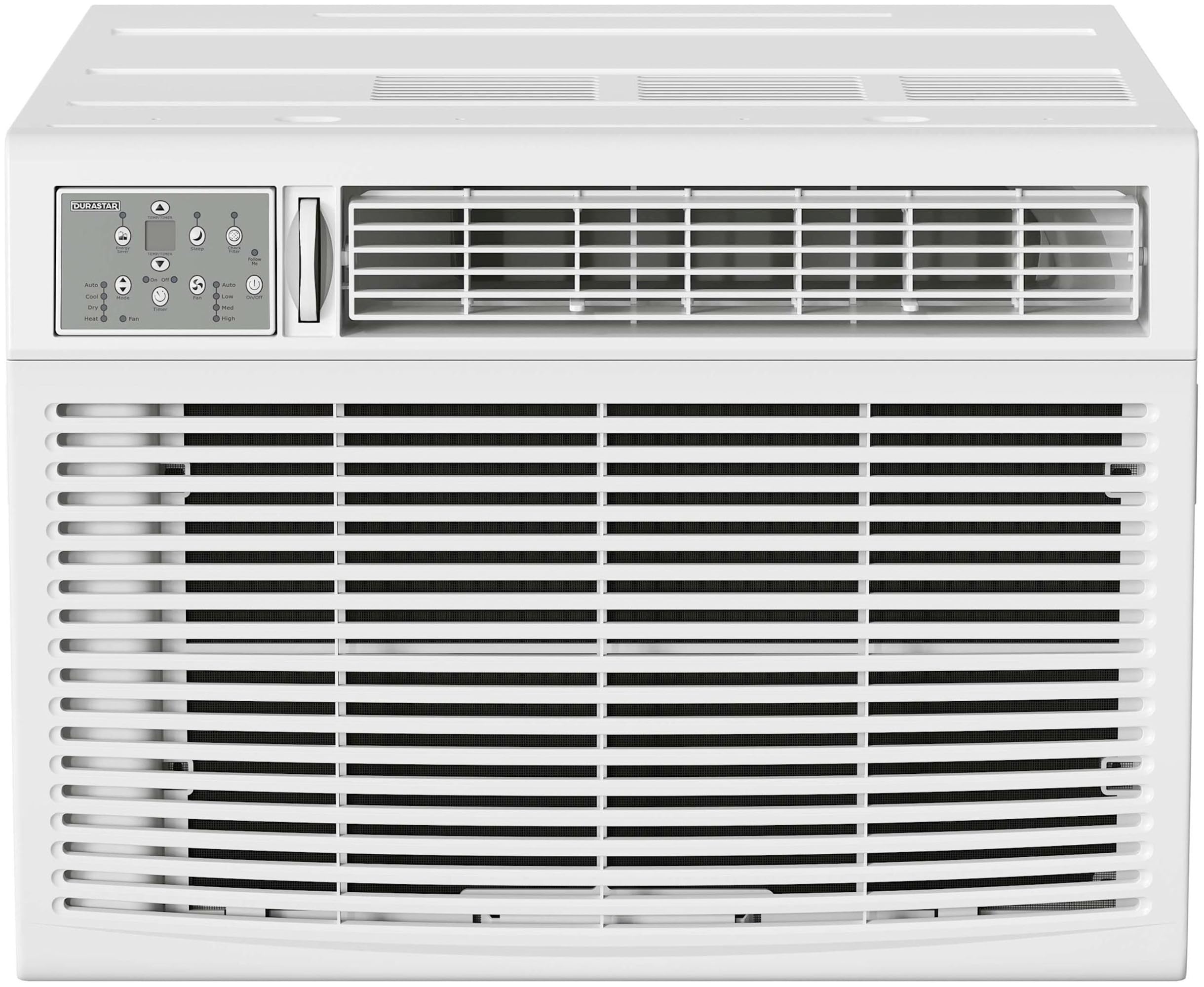
4. Durastar 18,800 BTU Window 208/230V Air Conditioner
A compact dual-season unit that asks for exact wiring
This Durastar splits the difference nicely: 18,800 BTU of cooling and 16,000 BTU of heating, covering 700 to 1,000 square feet. That makes it a direct alternative to the LG 18,000 BTU above — nearly identical cooling output — but with the added year-round flexibility of built-in heat. The 4-way air directional louvers give you control over where the air goes, and installation hardware and weather seals are included in the box.
The wiring requirement is the headline detail here. The listing is blunt: this model requires a 30 Amp 230 Volt breaker to function properly, and it draws 9.8 amps at 208/230V. That is a very specific electrical setup, so check your breaker panel before you commit. At 117.3 pounds, this is also a two-person lift, though the reciprocating compressor keeps the internal design straightforward.
Owner sentiment is genuinely split. Some are delighted — “the a/c duraster is working fine” and “Works great” — while others hit the two recurring walls: broken units that turn off after 3 seconds despite verified 240V at the outlet, and installation hardware that misses the mark, with screws too small for the frame holes and a fan control that only runs on one speed in heat mode. One owner did note it heats and cools well once installed, so the core function is solid; the risk is in the unboxing and the first install.
What works
- Dual-season operation: 18,800 BTU cooling plus 16,000 BTU heating
- 4-way directional louvers direct air exactly where you need it
- Weather seals and hardware included for a cleaner install
What to watch
- Strictly needs a 30 Amp 230 Volt breaker
- Screws reported too small for the frame holes by some owners
- Occasional DOA units that shut down seconds after power-on
Best if: you already have a 30 Amp 230V breaker ready, and you want one unit to both cool and heat a 700-1,000 square foot space.
Pass if: your electrical panel cannot accommodate another 30 Amp circuit without an electrician’s visit.
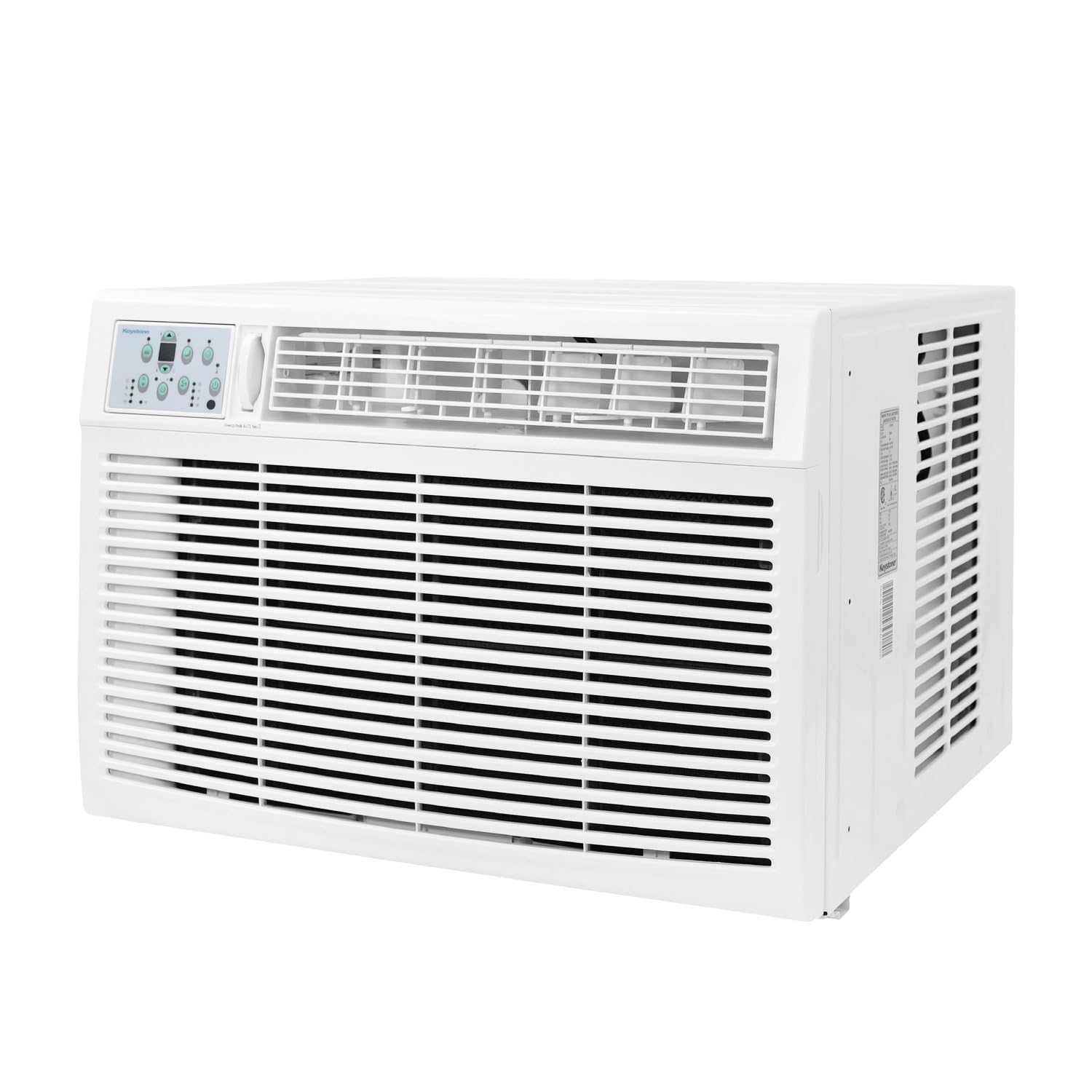
5. Keystone 23,200 BTU Window Air Conditioner with Heat
The remote that reads your room every three minutes
The Keystone brings a genuinely clever piece of hardware: the smart remote takes the temperature of the room you are sitting in, displays it on the LCD screen, and sends a signal to the AC wall unit every 3 minutes to keep conditions accurate. That is a meaningful upgrade over standard remotes that just fire commands — this one actively monitors. Under the hood, you get 23,200 BTU of cooling and 16,000 BTU of supplemental heating for large spaces up to 1,500 square feet.
The year-round versatility is real, but read the fine print. The supplemental heating mode is meant for outdoor temperatures between 23 and 76 degrees, and the listing is explicit that it is NOT meant as a primary heat source — it is a shoulder-season helper, not a furnace replacement. You also get dehumidification and fan circulation, plus a washable filter and a filter light reminder so you never forget maintenance. The ‘Energy Saver’ and ‘Sleep’ modes are designed to ease the electric bill.
The functionality is the most-praised aspect by far — owners consistently report great cooling and heating from a unit that installs easily. The recurring gripe, though, is electrical confusion: the listing photo shows a 25 Amp outlet, but the actual plug on the unit is a standard 250V 30 Amp plug. If you are wiring a dedicated 230V outlet, you need the 30 Amp receptacle, not what the picture suggests. Durability and value-for-money also draw negative feedback from some owners who question the build quality at this price point.
Room-aware cooling: the 3-minute remote temperature feedback loop is a standout feature you will not find on most rivals.
Read the plug: the listing photo misleads — the unit ships with a 250V 30 Amp plug, so wire your outlet accordingly.
Reach for this if: you want precise, room-true temperature control for a large space and understand the heat mode is supplemental, not primary.
Be ready for: matching the physical plug on arrival, since the online photo shows the wrong receptacle type.
6. LG 24,500 BTU Window Air Conditioner, 230V
The strongest single-window cooling on this list
This is the top of the BTU food chain here — 24,500 BTU of cooling aimed at rooms up to 1,560 square feet, described on the listing as a 39′ x 40′ space. That edges out even the Midea above, which covers 1,500 square feet with 24,000 BTU, and it does so at a quieter efficiency story: 2,370 watts annual energy consumption versus the Midea’s 3,200 and the Keystone’s 4,800. For sheer cooling output per watt, this LG is the winner.
It shares the LG feature set with the 18,000 BTU sibling: Auto Restart after power failure, a 24-hour digital timer, 3 cooling and fan speeds with Auto Cool, and easy electronic controls with a remote. The washable filter keeps it simple to maintain, and the reciprocating compressor is a proven, straightforward design. At 7.7 pints of dehumidification capacity, it pulls meaningful moisture out of the air too.
The reality check is reliability. The 3.4-star average reflects a split owner base: some call it a solid unit that cools well and stays quiet, with one owner noting the fan never rises above low because the unit gets too cold. Others report failures within a year — one unit died completely after 10 months, another failed after a single month just past the return window. At 146 pounds, it is also prone to transit damage, with one owner’s first unit arriving with a jammed fan. The quality itself earns praise (it’s the most-mentioned positive aspect), but the durability record is the worry.
The strengths
- Biggest cooling output here: 24,500 BTU for 1,560 square feet
- Efficient 2,370-watt draw beats other high-capacity units
- Auto Restart and a 24-hour timer add real convenience
The risks
- Reliability is the most-discussed topic, with some units dying within a year
- 146-pound weight makes it prone to shipping damage
- Occasional water sloshing sound on startup reported
Choose it for: an open-plan great room or large living area where you need maximum cooling and will keep the packaging to test before installing.
Hesitate if: you cannot afford the risk of a unit that might need a warranty claim within its first year.
7. Durastar DRWHC232XNA1 23,200 BTU Window Air Conditioner
The tiny-house workhorse that owners swear by for years
This Durastar is the one owners come back to praise with real longevity — one owner has run it in a 500 square foot tiny house “for the last two years” and both heats in winter and cools in summer. It pairs 23,200 BTU of cooling with 16,000 BTU of supplemental heating, covering 1,500 square feet for cooling and 700 for heat. The moisture removal is the standout number: 137 pints per day, which makes this a serious dehumidifier as much as an air conditioner.
The spec sheet is thorough. Three fan speeds, four operation modes, a 24-hour timer, and 4-way air directional louvers give you full control, all from the included remote. The listing flags the electrical requirement clearly: a 30 Amp 230 Volt breaker with an LCDI 6-30P plug type — a specific NEMA configuration you need to match at the wall. At 121 pounds, it is heavy but manageable with a second person, and the rotary scroll compressor is a reliable design.
The enthusiastic owner reviews are tempered by shipping stories. Multiple customers note units arriving with bent cabinets and dented fins — one arrived damaged twice — but note that the dents did not affect operation. Treat the delivery box with suspicion, but trust the machine inside it.
Proven longevity: multi-year owner reports of reliable heating and cooling in a real tiny house.
Shipping caution: dents and bent fins have arrived on multiple units; inspect thoroughly before install.
Your pick if: you live in a small home or cabin and want one high-voltage unit that has proven it can handle both seasons for years.
Know before you buy: you must have a 30 Amp 230V breaker and the LCDI 6-30P plug to match.
Understanding the Specs
BTU and Square Footage
BTU (British Thermal Unit) measures how much heat the unit can remove per hour. More BTUs mean more cooling muscle, but they also mean more energy draw and usually a heavier machine. Match the BTU rating to your room size — a 12,000 BTU unit handles roughly 550 square feet, while the 24,000+ BTU units stride through 1,500 square feet or more. Buying too much BTU for a small room wastes power on short cycling.
Voltage and Amperage
The 208V, 230V, and 240V labels all signal a high-voltage circuit — this is not a standard 115V bedroom outlet. Each unit specifies its breaker needs, from a 30 Amp 230 Volt breaker to specific plug types like the LCDI 6-30P. The plug shape matters as much as the voltage, so never assume your existing outlet matches. If you do not have the circuit, factor in an electrician’s visit before you commit.
Inverter vs. Standard Compressors
An inverter compressor runs at variable speeds rather than cycling fully on and off, which cuts energy use dramatically — the Midea claims over 40% savings versus the Energy Conservation Standard. Standard reciprocating or rotary compressors are simpler and proven but draw more power. For a unit that runs for months at a time, inverter tech can meaningfully shrink your electric bill.
Heat and Dehumidifier Functions
Many high-voltage window units double as heaters and dehumidifiers. Supplemental heat modes cover shoulder seasons (roughly 23 to 76 degrees outside) but are not primary heat sources for deep winter. Dehumidification capacity ranges widely — from about 5 pints up to 137 pints per day — so if humidity is your enemy, prioritize that number over raw BTUs.
FAQ
What is the difference between a 230V and a 115V window air conditioner?
Will a 240V window AC unit work in a standard outlet?
How many square feet can a 24,000 BTU window AC cool?
Does a 240V window AC unit use more electricity than a 115V one?
Can a window AC with supplemental heat replace my furnace in winter?
What does the BTU number on a window AC actually mean?
What is an inverter compressor and why does it save energy?
Are 240V window air conditioners noisy?
Final Thoughts: The Verdict
For most people, the 240v window ac winner is the Midea 24,000 BTU Smart Inverter because it combines floor-level cooling power, genuine smart control, and inverter efficiency at a price the crowd clearly respects. If you want year-round flexibility in a single room, the ROVSUN 12,000 BTU with Heat is the smart all-in-one. And for the absolute maximum cooling output with the best efficiency, the LG 24,500 BTU is the one to reach for — just budget for the reliability gamble.
How We Picked
We do not accept paid placement. Every pick is matched to a real buyer and a real use-case; we do not hands-on test units.
Sources & Methodology
Specifications: manufacturer listings and product documentation. Review insights: verified customer reviews, as of August 2026. Pricing: not shown on this page (it changes often); check the current price via the retailer link.
As an Amazon Associate, Gadgets Feed earns from qualifying purchases. This does not affect which products we feature.